Feeds:
Posts
Comments

Archive for the ‘Bruce Byfield’ Category

Not too many years ago, you only had to walk down Government Street in Victoria to find more shops selling Northwest Coast art than you could properly absorb in a day. Looking back, I’m not sure of the quality of some of the shops, but they were there. But times are harder, with many store fronts along Government empty, and now you have to search for galleries.

Descending on Victoria yesterday, these are the galleries we managed to find:

  • Art of Man: Located in the mall in the basis of the Empress Hotel, the Art of Man specializes in Inuit and First Nations masks and sculpture. The pieces for sale included four or five from Ron Telek, including a meter high blue shaman (this from an artist who rarely uses color), and a shaman marionette fending off a spirit attacking his foot with other spirits resting in his hand. Daryl Baker, the nephew of the LaFortune brothers Doug, Perry, and Aubrey, is also represented by highly-detailed designs that border on the surreal, and that are all marked by a close attention to finishing details. The Art of Man also seems to get first pick of Tim Paul’s work – so much so that I realize that only his lesser pieces reach Vancouver. Other artists whose work is available at this gallery are John and Luke Marston, whose work shows an awareness of history that I had never realized before that it possessed. In general, the quality of the work at the Art of Man is extremely high, making it by far the premier gallery of Northwest Coast art in downtown Victoria.
  • Hill’s Native Art: Like the Vancouver store, the Victoria Hills is mainly a tourist shop. However, the Victoria store seems to have a slightly better ratio of art to high-end tourist pieces, as though it gets first choice of all the locations. But perhaps this impression is due partly to the fact that it is less crowded and better lit.
  • Alcheringa Gallery: From the web site, I had the impression that this gallery was huge. The reality, though, is that this is a gallery with only a few of its pieces on display – and about half of those are given to works from Papua New Guinea, which is worth seeing, but doesn’t engage my interest the way that the Northwest Coast tradition does. Still, you can see some works by Tim Paul and John Marston there. I was also interested in seeing two works I had seen on the Internet, one by Ron Telek and another by Dean Heron.
  • Pacific Editions: Unfortunately, this story is closed on Mondays, which meant that we walked six blocks out of our way for nothing. But what we could see through the window confirmed the impression I had from the web site: Pacific Prints has a huge collection of limited editions prints. I look forward to spending a happy few hours there the next time I’m in Victoria.
  • Eagle Feather Gallery: A mixture of art and tourist pieces, this gallery is only a block from the Empress Hotel – but on a side street that you may have trouble finding. It specializes in the work of Doug, Perry, and Aubrey LaFortune, especially Doug (in fact, he was due to drop by the day that we visited, although we missed him). Daryl Baker and Pat Amos also have a couple of pieces, while Francis Dick has at least a dozen 2-D works from throughout his career at the gallery. Whether the gallery is worth a visit probably depends on your opinions of these artists, although its stock gives you a good opportunity of evaluating Doug LaFortune thoroughly.
  • Out of the Mist Gallery: This gallery specializes in antiques. Its modern selection is devoted largely to the Hunt family, and includes a few curios like a mask carved by Richard Hunt when he was a teenager, a formal, somewhat stiff print from the start of Beau Dick’s career, and a two meter-long eagle by Roy Henry Vickers. The quality of the antiques is completely indiscriminate, and includes some pieces from across North America. If your taste runs to antiques in Northwest Coast art, you could probably find something to your taste, but the somewhat dim lightning and the bored staff makes the effort hardly seem worthwhile.

As with previous lists I’ve made of galleries, this one makes no effort to be comprehensive. We did not, for instance, have to visit the Provincial Museum’s gift shop, which I seem to remember as having a few art pieces. So if you know of any other galleries in the Victoria area that might be worth a visit, please add a comment and let me know.
Read Full Post »

For as long as I can remember, I have always disliked those who correct other people’s grammar unasked. My dislike has little to do with being corrected myself, although I can be careless with proofreading my own work because I am in a hurry or simply because I dislike the task. However, having taught composition at university and sold hundreds of articles, I have reasonable confidence in my own literacy, and the most I can muster when my mistakes are pointed out is generally a mild embarrassment. Nor am I upset when people correct grammar when asked – that’s called editing. But those who decide that their mission is to correct other people’s writing or speech are rude, misguided, wrong (as often as not), and less interested in clear communication than in establishing their own superiority over someone else.

Working on the Internet as I do, I am used to all levels of literacy. Text messaging, lack of education, and efforts to write in a second language all mean that the English I read is often less than fluent. But unless someone asks my help, I refrain from pointing out errors and simply do the best I can to decipher. Under modern circumstances, zeroing in on someone’s errors is simply rude. It’s like telling someone with a large birthmark on their cheek that they have a blemish. If you have any claim to manners, you don’t mention the fact, and do your best not to stare or make the other person uncomfortable with your awareness.

At any rate, many of the grammar police seem to have little understanding about what language is about. Yes, consistency in language helps communication. But English can support a high number of transmission errors without being unintelligible. So why linger over the errors when you should be focusing on understanding?

More importantly, grammar-correcters seem under the impression that only one standard for communication exists. Perhaps this impression is the result of how reading and writing is taught in schools, but nothing could be more misguided. Any language has variations based on region, ethnicity, class, gender, politics, and just about every other factor that you can name. It changes over time and even over circumstance – for instance, my own sentence structure and vocabulary changes drastically depending on whether I am writing an academic paper or a blog entry, or talking to octogenarians or young adults. And when I follow the lead of Shakespeare and I use “they” as the impersonal pronoun (as in “Everybody is entitled to think what they want”), I am not committing an error but refusing to use “he” because of support for feminist language critiques I absorbed in university.

The grammar police, however, like to pretend that language has a single standard and never changes. A particularly popular ploy of their is lament the perfectly normal change in meaning of words; often, they can go on for thousands of words on the subject. But their diatribes are pointless – I have never heard of a single case in which a word reverted to a former meaning because the grammar police complained. In fact, I suspect that on some level they would be disappointed if their complaints had results, because then they would have less point to nag everyone with.

At other times, they show a singular lack of understanding of context. The much-dreaded double negative (“There ain’t no way”) is a common method of emphasis in Germanic languages for over a thousand years. So is repetition, although I recently saw “I personally” on the grammar police’s hit list.

The truth is, the grammar police often show a limited understanding of the language they claim to be defending. For example, you often hear them denouncing starting a sentence with “and” or “because,” although the practice is widespread among writers of all levels of expertise. Their argument is that “and” and “because” are conjunctions that join two clauses. And so they do – but the idea that the clauses can be in separate sentences never seems to occur to the grammar police.

But few of the grammar police are interested in accepting, much less appreciating the endless variations of English. What they are really interested in doing is establishing themselves as experts and their victims as less than themselves. Since this effort is often irrelevant to whatever is being discussed – that is, to the content – it amounts to what Roman orators described as an ad hominem attack – an effort to discredit an argument by attacking the person making it rather than disproving the argument itself. In other words, by making a writer or speaker appear illiterate, they hope to sway listeners against what is being said. Or, possibly, their goal is simply to demonstrate their superiority over the person they are attacking.

You can see these goals very clearly in the attacks on the syntax of George W. Bush – as though it were his syntax rather than his ideas that made him so alarming. Of course, you might argue that an incoherent politician is likely to have muddy thoughts, but the usual impression is that those who dwell on Bush’s syntax are more interested in establishing themselves as smarter than he is than on any more valid critique. They may very well be, but crowing about the fact is ugly and ignores the substance of what he is saying, which needs to be addressed far more than his illiteracy.

Being rude, ignorant, and elitist, the grammar police do little worth doing. They show only their own massive insecurities, and do nothing to advance communication or discussion. In the end, it is not just their lack of social graces or understanding that makes them irritating, but the way that they insist on thrusting their own need to prove themselves superior into every conversation. They are like a man who insists on adding irrelevant jokes into every conversation, only worse.

Read Full Post »

For the last couple of years of my bachelor’s degree and a few years after that, I was an avid Dungeons and Dragons player. Or, rather, I was an avid Dungeon Master – I was never an actual player more than once or twice. Somehow, with me ever thinking about why, I seemed naturally to fall into the role. Maybe anyone with ambitions to be a story-teller falls into that role, because the game is basically group story-telling, and the DM is the lead story-teller. But, at any rate, the experience taught me a thing or two I didn’t know about human nature – and that I still partly wish that I had never learned.

The regular group of players numbered six to a dozen, equally divided between men and women. All of them were people I knew from the Society for Creative Anachronism. Several were in the same SCA household, and three were sharing a townhouse in real life.

The result, to say the least, was scary. More than any of the adventures I sent them on (and I had them scampering across the wilderness between two cities, with a side trip to the nether world), what I recall best was how the usual Friday night sessions began to resemble a group therapy session, with me caught in the middle, trying to ignore the unpleasant undertones, smooth things over, and keep the game moving for everyone else.

At times, though, I might have saved myself the effort. When two of the room mates who were arguing in real life started trying to attack each other in the game, I knew that their housing arrangements couldn’t last. And, sure enough, one of the two moved out a couple of weeks later.

I was proud of my efforts to invent entertaining scenarios, and spent time that I should have used for study developing elaborate scenarios and maps. When many of the players decided that their characters were related, I came up with a plausible family tree. If someone wanted to bring a guest, I would develop a plausible scenario to explain how the guest joined the group and eventually left it. If someone missed a session, I would hold special sessions for them to catch up, so they wouldn’t be far behind in points. I was proud of my efforts, and prouder still of my efforts to weave an entertaining story.

Then I discovered that the group was holding another D & D session on another night – one to which neither Trish nor I were invited. Apparently, some of the players wanted a game where they could simply kill things. When confronted, they said that I was too intense to be invited along, and that they wanted a game without me.

Not so intense, apparently, that they weren’t willing to let me work to entertain them, I thought. Or eat our food and drink our juice and wine. Angrily, I told them that they could find another Dungeon Master for their Friday night game. They seemed honestly hurt and bewildered, which made me damn them as hypocrites and freeloaders, and cut off contact with them, even drifting away from the SCA.

The few times I’ve seen them since, they seemed genuinely unsure of what had happened – a reaction that only makes me think that I was sensible to stop hanging out with them.

A year or two later, we started another role-playing session with some friends who had moved down from the Sunshine Coast. This time, it was a post-holocaust setting, and I was Dungeon Master again. But that game died when our friends’ marriage started breaking up, and I haven’t played since.

Every now and again, I do wonder what it would be like to be just a player. But I don’t suppose I’ll ever find out now.

Read Full Post »

As I visit Northwest Coast Galleries in Vancouver, I’m starting to notice relations between certain galleries and certain artists. Out of friendship, enthusiasm, long-term business relations, or a combination of all three, some galleries simply carry a better selection of some artists than others.
Here are the specializations I’ve been able to detect so far:

  • Coastal People’s Gallery: This gallery has a good general selection of artists, although it seems to be buying less recently, possibly because it’s overstocked. However, it is the main exhibitor in town of Henry Green, especially for his carved and increasingly colorful panels. Coastal People’s also favors Chester Patrick, a less well-known artist who has done a number of acrylic paintings notable for the complex grouping of characters, as well as panel carving. Since the summer, the gallery’s Gastown store has had space set aside for Patrick to work. I’ve heard at least one patron refer to Patrick as the store’s artist-in-residence, although I don’t know whether the arrangement is formalized.
  • Douglas Reynolds Gallery: Douglas Reynolds seems to have first right of refusal on works by Beau Dick, the Kwaguilth mask-maker and Haida artist Don Yeomans, possibly because the artists have a long friendship with the owner. At any rate, the selection of works by both Dick and Yeomans tends to be larger and more varied than at any other gallery – so much so that, in Yeoman’s case, I tended to think that he was past his creative prime based on his work in other galleries. However, based on what I’ve seen at Douglas Reynolds, that’s far from true; I just wasn’t seeing his best work. This same gallery has also started carrying a good selection of jeweler Gwaii Edenshaw.
  • Edzerza Gallery: As you might expect, this new gallery is mainly a showcase for the work of owner Alano Edzerza. However, it has also had the work of newer artists like Ian Reid and John P. Wilson.
  • Inuit Gallery: The Inuit Gallery seems to have good connection with the North, including Alaska artists like Clarissa Hudson and Norman Jackson, whom many galleries neglect – even though importing First Nations art from the United States is supposed to be duty-free. Recently, it has also had a couple of new masks from Tlingit/ Northern Tutchone artist Eugene Alfred, and a number of playful masks from Kwaguilth carver Simon Dick. Other with whom the gallery seems to have a good relation include Salish artist Jordan Seward and Nuu Chan Nulth artist Les Paul.
  • Sun Spirit Gallery: Located in West Vancouver’s Dundarave strip, this small gallery currently has a strong selection of Klatle-Bhi’s work, particularly masks. Much of this work is in Klatle-Bhi’s apparently favorite white and light-blue palette.
  • Spirit Wrestler Gallery: Robert Davidson seems to offer new works to Spirit Wrestler first, and to have an arrangement with the gallery for prints as well. The gallery also gets the pick of new works by Norman Tait, and currently has more work by Dempsey Bob than any other gallery in town. In addition, the gallery seems to cultivate some of the best of up and coming artists, such as Dean Heron and Sean Hunt, making it more adventuresome that I originally thought from my first visit.

As I was making this list, I realized that it represents my own interests as much as each gallery’s specialization. Very likely, I have left out some specializations either because I am not interested in them or haven’t got around to them yet. Still, it’s useful to know which gallery to go to if you’re interested in a particular artist, so I’ll let the list stand, even while acknowledging that it is probably incomplete.

Read Full Post »

Earlier this week, The Globe and Mail ran an article about freelancers who were considering finding full-time work in response to the recession-cum-depression of the last couple of months. Being a long-time freelancer myself – and someone who has never been happier than when working for himself – I found some wry amusement in the assumption that freelancing is riskier than full-time employment. Not only do I believe that freelancing is generally safer than full-time employment, but I suggest that freelancers are better equipped to weather the uncertain economy.

Admittedly, a recession is a bad moment to begin a freelance career, if only because so many other people may be attempting the same change. Obviously, too, a freelancer’s ability to survive depends on what services they offer; for instance, if you offer web design services, in hard times people might be tempted to put off improvements and changes to their web pages as non-essential.

However, in general, freelancers have distinct advantages in troubled times:

  • Freelancers are already established: As full-timers are laid off and try to support themselves on freelancing, established freelancers already have the contracts and – most importantly – the reputations to keep themselves employed. Many of them have an established customer base, and they can focus on assignments rather than on marketing themselves – a process that usually takes a few months.
  • Freelancers are more versatile: Full-time employees are generally slotted into narrow specialties. By contrast, freelancers can offer new, related services as the opportunity or need arises. For example, if you are a technical writer who finds that clients are putting off updating their documentation, perhaps you can branch out into public relations or graphic design.
  • Freelancers are used to working on multiple contracts at the same time: While full-timers often have the luxury of concentrating on one project at a time, most freelancers juggle multiple projects at the same time. Part of the reason may be freelancers are so afraid of being without income that they often overbook themselves. However, an even larger part of the reason is that they don’t always find a single project that brings in enough income by itself. A recession simply makes this situation even more likely. So, in this sense, the habits of the average freelancer become a useful survival mechanism during a recession.
  • Freelancers have established social networks: In any sort of job-hunting, connections are important. But, while full-timers often neglect networking because of their false sense of security, freelancing is like constantly looking for work. The result is that freelancers may be prepared to replace work lost to the recession with other assignments.
  • Freelancers are better prepared psychologically for losing work: Many full-timers invest a lot of their self-image in their employment. When they lose their position, they are devastated. But freelancers do not nurse the full-timers’ dream of a job for life. They expect to work on many contracts during their careers. So, when one contract is canceled, it means very little to freelancers – unlike full-timers, they are not devastated. While they may regret the loss, freelancers know that some work will never materialize or be canceled, even in good times.
    In other words, a recession is only a freelancer’s regular situation intensified. They know how to deal with the situation, and don’t need to change their attitudes to survive – unlike full-timers.

I’m not surprised that The Globe and Mail could find freelancers who were considering full-time employment, but I suspect that they are in a minority. Although all the freelancers I know are alert to the economic situation, they seem reasonably confident of their ability to survive it. Unlike full-timers, they find little new in troubled times.

Read Full Post »

For the past three Wednesday evenings, I’ve attended George Macdonald’s lectures on Haida villages at the Bill Reid Gallery. It was time well-spent, and I only regret that the lectures stopped with three. Nobody is boring when talking about an area of expertise, and Macdonald, Director of the Bill Reid Centre for Northwest Coast Art Studies at Simon Fraser University and the author of Haida Monumental Art, was certainly in his element. Just as importantly, he combined knowledge with an informal and lively manner, which made for an absorbing scholarly trio of evenings.

Macdonald divided his subject matter into the southern villages centering on Skidegate, the central villages around Masset, and the northern or Kaigani villages of southern Alaska. Unsurprisingly, the second lecture was the most popular, with many Haida living in Vancouver coming out for it, including artists like Gwaai Edenshaw and Dorothy Grant, but the third was also popular, perhaps because the arbitrary border has resulted in few Canadians knowing much about the Kaigani villages. And the entire series was attended by a core of regulars, including me.

The first surprise in the lecture is how much photographic evidence exists from the 19th and early 20th centuries. Because much of this evidence is not available to the general public, many people, I suspect, are like me and believe that it is very limited. However, Macdonald speaks in terms of thousands of photos (and I’m not sure that he didn’t talk of tens of thousands), to say nothing of sketches by anthropologists and navy officers, and works of art like Emily Carr’s. In fact, so much of this evidence exists that pieces can be cross-correlated, and the distinctive style of individual – if often anonymous – artists can be detected. Macdonald showed perhaps a few hundred slides of this evidence, but his lectures were enough to suggest the surprising wealth of material.

Another source of evidence is family tradition. In many Haida villages, memory or written records have preserved the names of many of the houses, as well as some of their history. For instance, at the third lecture, Dorothy Grant told her grandfather’s story of how his village was abandoned for a centralized, missionary-run new village of running water and electricity. During the burning of possessions that the missionaries insisted upon, her grandfather saved only the contents of the bentwood box in his hands.

Nearly four hours of lecture and audience participation is almost impossible to summarize. However, other topics in Macdonald’s lectures included the patterns of resettlement in the south as European diseases forced the survivors to regroup and, in many cases, regroup again; the use of palisades and hilltops during wars between lineages; the names and appearances of some of the great chiefs and carvers of a hundred and forty years ago; the question of whether Albert Edward Edenshaw was trying to bypass matrilineal inheritance by bestowing property on his son, and the characteristic designs of the graves of shamans. In many cases, too, the villages were illustrated by sketch maps or aerial photos.

Equally fascinating were Macdonald’s own stories of his experiences as an archaeologist in the field. They ranged from the careless destruction of one pole that survived into modern times in Prince Rupert, and the danger of bears while exploring villages. Macdonald also revealed in passing some of the professional issues and puzzles in the study of villages.

This was the first lecture series from the Bill Reid Gallery. The gallery is an ideal place for a small crowd, even if the monumental Mythic Messengers and the smell of cedar from Jim Hart’s work on his tribute pole to Bill Reid sometimes became distractions. But, on the whole, if it is an example of what these organizations plan to offer in the future, then future events deserve to be crowded. Like any good lectures, Macdonald’s have pushed back the boundaries of my ignorance a little while tantalizing me to find out more.

Read Full Post »

Around the turn of the millennium, the Haida clothes designer Dorothy Grant had a shop in the Sinclair Center in downtown Vancouver. When she moved, we lost track of her. But I noticed her at a lecture a few days ago at the Bill Reid Gallery, where she was flashing a pair of earring by Gwaai Edenshaw, and yesterday we made a point of dropping by her new store and studio just off Broadway and Main.

Grant’s downtown store felt like a small clothing boutique, differing from countless of others only in her designs and impeccable tailoring. Her new location feels more like a work space; you go down a hall into a retail space, but the activity seems to be taking place either in the studio and meeting place up the stairs or the work area on the other side of it. The entire area is dedicated with art from Grant’s personal collection: A mask by Beau Dick, a print by Robert Davidson, a glass box by Alano Edzerza, and some recent glass plaques by Grant herself (which leaves no doubt that she could have become a gallery artist rather than an applied artist, had she chosen).

The location is open to the public, but you have to ring for entry, perhaps a reflection of the fact that the space is in the middle of an industrial area that, while not seedy, has probably seen better days.

Or perhaps the locked door reflects that this is more a work space than a retail outlet. It certainly seemed so during our visit, with Grant planning with a couple of other people (for a photo shoot, I think), and only stopping briefly to greet us in the friendly and energetic way that, from the little that I’ve seen, appears to be her most common public persona.

Whether you are female or male, you could easily drop a few thousand dollars going through Grants’ racks. But that few thousand would be exceptionally well-spent, especially compared to what you would get elsewhere for the same price in terms of cut and sturdiness of material, let alone the designs. And if you can’t afford that sort of money, you can still find blouses, shirts and jackets for a few hundred dollars, some of which will be heavily discounted if you arrive at the right time of year.

Even as an old-married, I can’t really speak to Grant’s line for women, although nine years ago I bought several blouses and vests as presents. But, from a male perspective, Grant’s line is a relief from mediocrity. Most men’s clothing is drab and unimaginative, and the most you can hope from more upscale offerings is better tailoring. But Northwest Coast designs are one of the few options for men who want a bit of flamboyance without being inappropriately dressed or having to fend off taunts about their sexuality (the sort that are supposed to be jokes but aren’t, if you know what I mean). And Grant’s simple, but bold designs are works of art in themselves that lend an elegance that nobody would dare to question.

Personally, I have arranged my life so that I only need a suit – much less a tuxedo – only for marriages and funeral. However, if I ever did, Grant’s versions of either, with designs on the lapels on one side would reconcile me to the uncomfortable garments. I might still feel uncomfortable wearing them, but at least I would know that I was artistically and well-dressed, and perhaps signaling to the world that I was indvidualistic, if not outright eccentric.

My life being as it is, I will settle for buying two or three buttoned shirts or polo shirts from the store – and I don’t especially like polo shirts.

I did succumb to a light black jacket with an eagle design on the back and a raven wing design on the left arm. Julie, the store manager insisted that I could carry off the look, and a survey of my image in the mirror suggested she was right. A look at the price tag reinforced her view, so I left with a different jacket than the one that was on me when I came in.

“That will bring all the ladies to you,” she said as we were leaving. I started to mutter about how little good that would be for me as a married man when an old customer arrived wearing a similar jacket.

She turned to him for reinforcement of her claim. He agreed, and called after me, “Better stay away from my part of town, man!”

I’ve looked in a mirror. Given the human material that the jacket has to work with, I remain dubious of Julie’s claims. All the same, I’m sure that I’ll return to Dorothy Grants’ the next time that I want well-made clothes with a bit of flare. When we have so much Northwest Coast art on our walls, why shouldn’t I be wearing some as well?

Read Full Post »

When the gallery owner in Terrace told me he could have a friend deliver my purchase to the South Terminal of the Vancouver airport, it sounded like an adventure. I imagined a scene out of Casablanca, with me standing on a fog-ridden runway as a single-prop plane descended out of the gloom. Or maybe I would sidle up to the bar in the terminal, wearing my trench coat and saying, “Got the bird, sweetheart?” out of the side of my mouth as a mysterious woman handed me the parcel under the table. So, naturally, I agreed. I’d never been to the South Terminal, and it sounded like a mild adventure, or at least a change of pace.

My first hint that my expedition would be more surreal than adventurous came when I board the airport bus at the 22nd Street Skytrain station. The shuttle from the main terminal didn’t run except in peak hours, I was told, but I could easily walk from the last bus stop.

Feeling concerned but already committed, I walked to the back of the bus and endured the long and winding fifty minutes of the ride – to say nothing of the fat woman who boarded on Granville Street and sat beside me devouring a Big Mac and fries, letting me hear every oversize mouthful she chewed and making me almost gag with the rancid smell.

The things we do to avoid passing through three transit zones and spending a little more money.

Eventually, just as reading one more page would have sent me nodding off to sleep, I reached the end of the line. Just to be sure, I consulted the driver again. “You can easily walk the distance,” he assured me. “It’s about a kilometer.”

For some reason, I forgot that no middle-aged North American except me had any clear idea of how far a kilometer was. Instead of taking a taxi, I started walking. I wasn’t wearing the shoes for serious walking, but I figured I didn’t need them for such a short stroll.

The better part of a kilometer down the road, I came across the BCIT Aerospace center. Aha, I told myself – the terminal must be on the other side of the embankment on the far side. It must be great for the students to be so close to the runway. I decided to cut through the school and maybe ask some likely looking official if I were on track. But I didn’t see anyone to ask, and by the time I blundered out into the back lot behind the school’s hangar, I realized that the South Terminal was nowhere in site.

I continued plodding down the road another half kilometer. I saw a sign and a traffic light that would allow me to cross to a turnoff. I did, glad to get away from the highway whose shoulder I had been traversing and arrive at my destination.

Only, it wasn’t my destination. The signs – so far as I could make out (and, frankly, I had to guess the direction) – seemed to indicate that the South Terminal was 1.5 kilometers to my right.

At this point, my spirits and my calf muscles were starting to sag, but I noticed that the signs seemed to point to a curve that went along two sides of a large grass field. I thought I’d save time and cut across the grass.

Unfortunately, I forgot that the shoes I was wearing had low, half-open panels on each side. Before I had gone thirty paces, my socks were soaked from the puddles concealed in the grass.

This must be how the knights on the Grail Quest must have felt after wandering around for months in the wilderness, I told myself. I grimly plodded on, feeling ridiculous and half-convinced that someone must be watching me from one of the distant hangars and doubling over in laughter. But I had gone too far to turn back now, I told myself.

The road turned into a smaller one, lined with two-story buildings that looked like they were put up in the early 1960s. That road wound around to a smaller one, and suddenly, beyond all hope, I had reached the terminal, nearly three kilometers from the bus stop from which I had started.

My shoes squelching, my shirt sweaty and me feeling more than a little dishevelled, I staggered into the terminal.

I regret to confess that there was no sultry dame to greet me – only a bored clerk at the airline’s desk, who interrupted her conversation about the weekend with another employee long enough to pass me the parcel and look on disinterestedly as I checked to see if it was intact. Much to my surprise after my long walk, it was.

Only then did I take the time to look around. The terminal was drab, almost empty, and as romantic as a turnip. I quickly downed a scone and a bottle of juice, and started back. I could have taken a cab, but I was determined to play my folly through to the end. After all, I might not otherwise have time to exercise today,

This time, though, I took the long way around the grass.

Knowing what to expect, I found the return trip less traumatic. It was, however, deadly dull. The side of a highway isn’t the place to walk while reading a book, and the only way I could amuse myself was by singing, secure in the knowledge that no one had the faintest chance of hearing me over the cars.

I arrived at the bus stop limping and cursing my choice of shoes. When the bus finally came, all I wanted to do was get home, so I splurged and travelled through three zones to get there. Suddenly, my usual day at the keyboard didn’t seem so bad after all.

Read Full Post »

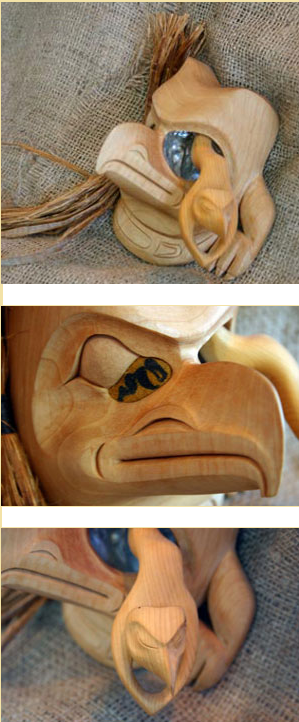
As I go through Northwest Coast galleries and web sites, one of the things I am always looking for are miniatures masks – ones under about eight inches in height. We have several wall areas – mostly above doors – that are too small for anything else. Even more importantly, a miniature is a sign of a carvers’ skill. Yet I don’t see many worth buying, perhaps because miniatures tend to be either student pieces or ones designed for the tourist trade, and experienced carvers cannot charge enough for their time to produce many. As a result, I was especially pleased when I noticed that Ron Telek’s “Transformation Mask: Human to Eagle” had come back on to the market. It’s an unusually fine miniature that shows his customary skill and imagination.

How the mask came from Terrace to Vancouver and I picked it up at the South Terminal of the Vancouver airport (which was not, to my disappointment a foggy runway used by single prop planes like something out of Casablanca) doesn’t matter. Enough to say that it did, and I did, and the mask now resides at the busiest crossroads in the hallway of our townhouse.

What makes the mask so haunting is its ambiguity. Although a human is turning into an eagle, the dominant face is more of an eagle’s. From the left eye, whose socket is lined with abalone, a human shape with a bird’s head seems to diving. Or so it appears; if you look at how the spirit’s head and arms are arranged, you’ll notice that they suggest another beak. You have to wonder, too, if the shape is the departing human soul or, given the deepness of the eye socket, if the transformation is being achieved by the plucking out of an eye.

Then, if you look at the right eye, you’ll notice that it is bare wood. However, in the eye’s lower third, like a cataract, is a piece of leather with a small shape that resembles the one leaving the left eye. Does that mean that the transformation is all in the eye of the imagination and not literal? That the transformation, or the need for it is based on faulty vision and understanding? Or is it a supreme act of will?

Also, despite the title of the mask, what dominates is a largely bird-like face with a full beak and one taloned foot where its left ear should be. So who is transforming into what? Perhaps the transformation is of the human into the form of his helper spirit or true self. Certainly, the bird face seems serene, perhaps even amused to judge by the line of its mouth on the beak. It is the human spirit that seems in pain or exaltation. By contrast, the eagle seems more stoic and less affected by the transformation. Perhaps for the eagle’s nature, transformation is natural, and it is the human spirit that finds passing from one form to the other uncomfortable.

These ambiguities make for an asymmetrical design – something that is relatively common in Northwest Coast art, but which is part of the foundation of modern mainstream design. By showing elements of both, the mask increases its ambiguity even further. To a certain extent, the asymmetry is reduced by the long cedar braid on the right, but the mask remains, like the figure it represents, halfway between two different states.

In the end, you can say so little about the mask that the uncertainty adds to its fascination. The only thing that you can say for sure about the mask is that it is finished with Telek’s usual attention to detail.

I don’t know why the previous owner decided to sell the mask, but I’m glad he did. Unlike the previous owner, we don’t plan to let it out of our hands. We wonder, though, where we will find other miniatures to match its complexity.

telek-human-eagle

Read Full Post »

One of the pleasures of buying art is the thought that you might recognize a young artist before anyone else. The pleasure is not in the fact that the piece increases in value, but in the knowledge that you recognized excellence before anyone else. Currently, buying a print in Northwest Coast art by Robert Davidson or Susan Point requires no special insight – the excellence of both has been well-established for years. By contrast, when Trish and I purchased an acrylic copy of Alano Edzerza’s “The Thief” today, we were taking a gamble.

However, it’s a gamble that we are sure will prove our foresight as Edzerza’s career continues to flourish.

Under thirty, Edzerza is an artist who is beginning to make himself known, especially in glass, graphics, and large scale installations in businesses and offices. Unlike most artists, he also knows the business side of art, and few other artists are in so many galleries, or can boast so many shows so early in their careers.

Last summer, he also became owner of the Edzerza Gallery, which showcases both his work and pieces by other up and coming actions, making him one of the only First Nations artists to run a commercial gallery. I know of several young artists who hope that he will provide a fairer deal than other galleries, and at least one who believes that he does.

I have heard one person denigrate Edzerza for producing giclee prints, as though running off prints from the computer was an abomination rather than a convenience.

More tellingly, I have seen lines in several other people’s artwork pointed out to me that Edzerza might have copied. However, if that is so, the practice is common enough among young artists. Even such an icon as Bill Reid borrowed and imitated at the start of his career, and nothing is wrong with the practice so long as an artist eventually outgrows it.

A more valid criticism is that Edzerza’s imagination is still more two-dimensional than three-dimensional, to judge by his jewelry; not that anything is wrong with his jewelry except that it is not at the same level as his graphics or glass work. Just as importantly, he is also still mastering color, tending to use only one per work.

But, at the same time, Edzerza already shows an exceptional sense of design and a strength of line in his works. Not only are his works effective compositions, but, at least twice, he has found new pieces in closeups of existing works. He simply has an eye for design, and, with this trait, I have few doubts that his limitations will cease to exist in the next few years.

It helps that he seems to have a curiosity and memory for design. The one time I met him, he seemed very current about what other artists were doing, and the way he studied the Henry Green bracelet I was wearing when I passed it to him suggests a capacity to learn.

Just as importantly, Edzerza has an eye for drama, tending to show figures in motions rather than static ones. For instance, in depicting the over-used story of how Raven stole the light, in “Smoke Hole,” he focuses on Raven erupting from the smoke hole, charred and on fire. The result is one of the most arresting retellings of that myth that I have ever seen, because he has chosen a dramatic moment to represent.

Although I find graphics like “Smoke Hole” and “Think Like a Raven” powerful, we chose to buy the acrylic of “The Thief” because we believe that it has the potential to be a breakthrough piece for Edzerza. Even if it is not, it is still one of the most effective piece that he has done in a career that already does not lack for highlights.

“The Thief” is another depiction of the Raven engaged in stealing the light. However, unusually in Edzerza’s work, it is a still and formal piece. Almost a mask, it shows the child that the Raven has transformed himself into in order to accomplish the theft, surrounded by the body of the bird that he really is. But a hint of Edzerza’s characteristic drama rests in the enigmatic smile of the child, which – unlike the sleepy eyes — is not only decidedly not innocent, but mirrored by the raven’s beak above it. The disturbing smile suggests the theft that is about to happen or is in the process of happening.

Like much of Edzerza’s latest work, “The Thief” is in grayscale. However, there are more shades within “The Thief” than in any other of Edzerza’s works that I have seen. I strongly suspect that “The Thief” is a study in chromatic complexity, and (whether he knows it or not), one of the first steps that may eventually lead to a richer use of color in his future works.

Even if it doesn’t, grayscale is a fascinating world of its own, as anyone who has ever worked in black and white photography can tell you. In “The Thief”’s case, the color palette suggests the moon, which, depending on the version of the myth, is either what Raven steals, or else soon results from his theft. Especially in the acrylic version, the composition has something of the rich sheen of argillite – and, although argillite is generally worked by the Haida, rather than by a Tahltan like Edzerza, the resemblance suggests a carving as much as a graphic. This impression is heightened by the position of the raven’s head over the child’s forehead, an arrangement often seen with transformation figures on masks. Could Edzerza also be using grayscale and the illusion of depth it creates as an exercise to improve his three-dimensional imagination?

Whatever exactly Edzerza was intending, “The Thief” remains the best northwest coast composition I’ve seen this year. It’s a contemporary piece, while remaining firmly rooted in tradition. I am proud to be one of its custodians, and look forward to ferreting out its secrets in the coming years. And if Edzerza becomes as well known as I suspect he might, I will be just as proud to loan it for the inevitable retrospective on his career, when it is recognized as a pivotal moment in his career.
cropped1

Read Full Post »

« Newer Posts - Older Posts »