Feeds:
Posts
Comments

Archive for the ‘First Nations art’ Category

Last night, I was at the reception for Tahltan artist Alano Edzerza’s new exhibit, “Gift of the Raven.” The show features Edzerza’s work of the last six months. Also on display were a number of pieces by Morgan Green, a recent recipient of the YVR Art Foundation Scholarship and (as she may be tired of hearing) the daughter of Tsimshian master carver Henry Green.

The evening started with a performance of “Raven Steals the Light” by Victor Reece’s Big Sky Multi-Media Storytelling Society. The performance was held in the courtyard of the Waterfall Building, the complex in which the Edzerza Gallery is located. It featured a dancer with suitably nervous bird-like movements and a light mask with mirrors for eyes, and ended with him climbing to an overhead walkway to conclude the performance – all in all, a successful blending of the traditional and the contemporary.

Then, the crowd squeezed inside the gallery for the viewing.

The show did not include any new traditional style work by Edzerza. Otherwise, it was a good representation of the different strains in his work. My main problem was dodging the crowd and finding gaps in it that lasted long enough to snap a picture. Combined with the fact that some paintings were hung high, the result is pictures that are less than professional quality (to say the least), but should give some idea of what was on display.

In one corner of the front of the gallery was a collection of Edzerza’s glass boxes:
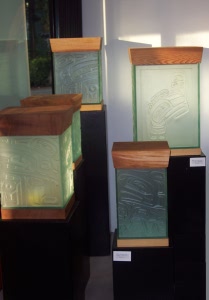
alano-glass-boxes1

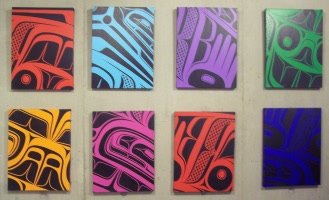
Elsewhere, you could see some of his experiments with color, such as this collection of closeups of traditional formline designs done in the electric colors of pop-art on a back wall:
alano-colors

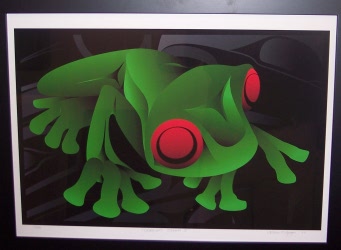
The same pop-art sensibility appeared in a couple of contemporary paintings of frogs, which were inspired, I am told, by a tattoo on a woman’s back:
alano-frog3

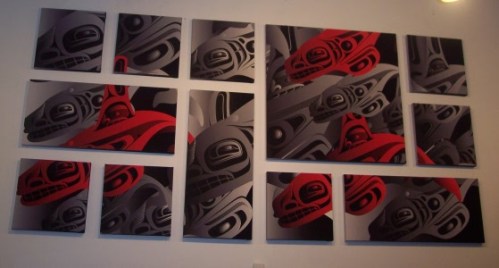
But the major works in the exhibit were the multi-panel ones, like this one that was hung near the ceiling, facing the door:
alano-orca-multi

Another orca design, a triptych, was hung just inside the door, and a triptych featuring ravens on the back wall. The raven triptych was especially dramatic, as one of its panel shows:

alano-eagle-triptych2

All these multi-panel works shared features that are characteristic of Edzerza’s work: A three-dimensional contemporary take on traditional Northwest Coast designs, an experiment with color in mainly grayscale designs, and a dramatic sense of movement that is enhanced by the separate canvases and draws your eyes from one to the next.

Morgan Green is not as an experienced an artist as Edzerza, but, in the last year, her work has matured quickly. Previously, the work by Green that I knew best were her leather cuffs and a somewhat over-ornate wolf helmet in the gallery, but the works I saw last night shows some other sides to her work, and an interest in different media that, if anything, is even greater than Edzerza’s.

Green’s works included a wall hanging and a variety of earth-colored ceramics inspired by a recent trip to Arizona and the First Nations work she saw there. A plate depicting Mouse Woman was particularly striking:

morgan-green-mouse-woman-plate

So far as I know, no historical depictions of Mouse Woman survive. But Green’s rendering seems a reasonable one, with features like the ears, the round eyes and the incisors providing the defining features that you would expect in a traditional design. At the same time, placing the design on grainy ceramic creates a pictograph-like effect, all the more so because the formline is hinted at more than fully realized.

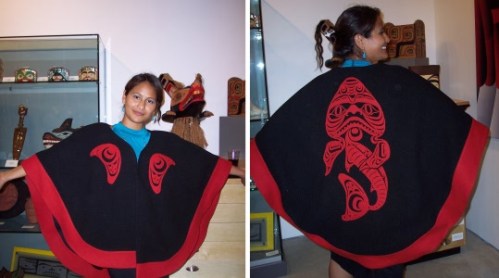
Perhaps the most accomplished work by Green on display was a Dogfish Woman robe she had created for an elder. The design was fairly standard (that is to say, more or less a descendant of Charles Edenshaw’s sketch via Bill Reid), but the cutting of the design and the assembly of the robe made for a first rate piece of work. As Green was discussing it with some of the guests, one of them agreed to model it:
morgan-green-dogfish-woman-robe

The evening was a fund-raiser, with a quarter of all sales going to the Vancouver Foundation. How successful the evening was a fund-raiser, I didn’t ask. But from the perspective of spotlighting two promising young artists, no one could have asked for more. I came away from the evening with increased respect for both, and an even greater determination to watch and enjoy their future growth.

Read Full Post »

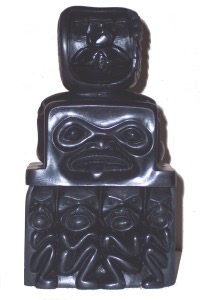
Earlier this week, we received “Master Shaman on His Throne of Power,” the latest sculpture by Ron Telek. We had been waiting for it since last December, so I consider it an act of supreme will power that we did not scream with frustration as we unwrapped the layers of paper, towels, cardboard and duct tape protecting it.

But the result was worth the wait, and then some. We had some photos of the work in progress courtesy of John Wilson, and were impressed enough then, but the finished piece goes beyond anything we could have expected.

The unfinished sculpture

The unfinished sculpture

“Master Shaman” is a carving in African wonderstone, with a black finish that makes it resemble argillite. In fact, Telek told me that he consulted an argillite carver about how to apply the finish. Back in December, I had no idea how he would finish it, but, recently we have started to look more closely at argillite, so his decision was a bit of serendipity so far as I was concerned.

The finished sculpture

The finished sculpture

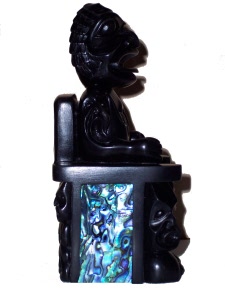
The subject of the sculpture is self-explanatory: it depicts a shaman on a throne imbued with the spirits he controls transforming into a raven. You can see the spirits in the seat on the supports for the chair’s arms, while on the back, one of the shaman’s enslaved spirits presides over four confined spirits.

The sculpture depicts the shaman in mid-transformation. The spirit of the raven is erupting from his chest and the back of his head has started to sprout feathers while his feet and hands are half-turned into claws. His nose is hooked, suggesting that it is becoming a beak.

As always with the transformations that Telek depicts, you cannot say whether changing shape is an ecstatic or agonizing effort (I tend to think both). However, it is unquestionably intense. The shaman and most of the spirits seem to be screaming, and the shaman’s fist is clenched and his eyes bulging. His erect posture seems more an act of will, as though he would be doubled over in pain if he let himself relax.

Even more ominously, the shaman seems on the verge of losing control. Although the spirit on top of his head seems serene, screaming spirits seem to be erupting from his arms, in contrast to the close-mouthed on his rigidly-positioned knees. Meanwhile, his left hand has been replaced by another spirit that, considering the half-transformed shape of his feet and other hand, might well be an intruder. The overall impression is that the shaman is at best only partially in control of the process he has begun, and that, if he relaxes or allows himself to be distracted, he will lose control entirely.

telek-back

Turn the sculpture around, and you get another dimension – not only literally, but figuratively as well. The face on the shaman’s forehead has a more or less neutral expression, suggesting at most the shaman’s disciplined state of mind. However, the back of his head is hollowed out and contains a figure ripping its abdomen open in direct reflection of the raven spirit erupting from his chest. This figure grimaces in pain, revealing the true state of emotion beneath the shaman’s efforts to remain calm. It also raises the question of whether the transformation is real, or only happening in the shaman’s mind, a question that some of Telek’s other works, such as “Transformation Make: Human to Eagle” also raise.

All these aspects are enhanced by Telek’s usual attention to details. For example, although you cannot see from the pictures, the shaman’s back is separate from the back of the chair far more deeply than strictly necessary, while the feathers sprouting on his head are each individually carved. Similarly, the abalone on the sides of the seat are carefully matched, and both include dark lines in their pattern that complement the black finish of the rest of the sculpture.

telek-right-side

In some ways, “Master Shaman” is a typical Telek piece, balanced uniquely between traditional design and modern sensibilities. A seated figure is reasonably common in traditional argillite carvings, and so are transformation themes, but who other than Telek would add such a modern sense of ambiguity or such a psychological edge? It also has the three-dimensionality and amount of detail that I have come to expect from his work.

However, I know of no other piece by Telek that carries these tendencies to such an extreme as “Master Shaman.” The piece has a Gothic quality that combines traditional roots with the sensibility of the best dark fantasy novels; in fact, I would love to see a graphic novel or piece of animation done in the same style (although I wonder if it would be possible to depict more of the world than the sculpture does).

Phoning to tell me that the piece was ready, Telek commented that he thought the piece was his best yet. Maybe that was just an artist high on having finished a major work, but I’m not about to argue.

“Master Shaman” is an intense, unique work, and I haven’t tired of looking at it after three days of living with it. It sits a meter away from me as I type, and my eyes keep straying to it, even when I’m not writing about it.

Read Full Post »

With no Northwest Coast art on layaway and no must-haves in the galleries or on the web, we didn’t expect to buy any new pieces this month. But luck struck unexpectedly, and early this month we were told that Trish’s ticket had won the pendant being raffled as part of Lyle Wilson’s North Star exhibit at the West Vancouver Museum.

Five centimeters in diameter and made of engraved silver, the pendant is a miniature version of the aluminum piece that was the logo for the show. Wilson’s aluminum sculptures are much more finely cut than most large scale Northwest Coast installations in the same metal, and, mounted some distance from the wall, cast shadows that quite literally give them another dimension. However, Wilson is known primarily for his jewelry, so the pendant is perhaps more representative of him.

lyle-wilson-aluminium

Like much of Wilson’s work, the pendant is a mixture of European and Haisla tradition. The pendant is a compass rose, with the four cardinal points marked by arrows, and the figure of what I believe is a bear in the middle. The pendant differs from the aluminum logo in that the cardinal points do not extend beyond the circumference of the design, and the image of the bear is slightly smaller in diameter.

What the pendant has that the logo lacks is a variety of different hatching techniques. At the outer rim, the hatching is a series of finely etched vertical lines, each extremely fine but distinct. A band of unadorned metal separates the uttermost hatching from a smaller band that continues the vertical lines. The fourth ring of hatching is an equally fine stippled effect that extends into the compass points. The inner figure is separated by yet another fine ring of vertical lines, and is itself a small show piece of diagonal lines, with the face, the lower left and the upper right slanted to the right, and the upper left and lower right to the right. Most design teachers would advise students not to mix so many hatching styles in such a small space, but it speaks volumes about Wilson’s virtuosity that he is able to ignore such standard advice and produce such an intricate design.

The bear design, of course, is appropriate because the north star is in the constellation of Ursa Minor, the little bear. Perhaps, the pendant is the north star itself, with the outer vertical lines the rays of light radiating from it. Or, if you consider the design for a while, you might conclude that Wilson is playing with the idea of the bear being both a constellation and an earth-bound creature. To my eye, at any rate, the outer rim of vertical lines could suggest either the rays of the sun, or perhaps the northern lights, while the heavy stippling suggests the earth. These two realms are bridged by the points of the compass, which are identifiable by taking a bearing (if you pardon the pun), on the north star.

At the same time, you could take the contrast between sky and earth as a reflection of the two cultures that Wilson is caught between. With the emphasis on the compass in the pendant’s design, the sky could be interpreted as modern scientific culture, and the earth as Wilson’s first nation roots. Alternatively, you could reverse the interpretation, and see the bear in the sky as the mythologizing that informs the first nation cultures, the earth the mundane reality of the city in which Wilson lives. The interpretation works either way, because what matters is the contrast.

However, such readings are not my first reaction to the pendant. My first reaction is respect for Wilson’s attention to detail. Looking at the pendant, I am never in any doubt that I am looking at a piece by a master carver, and it is appreciation of his skill that makes me grateful that we have the right to house it.

lyle-wilson-pendant

Read Full Post »

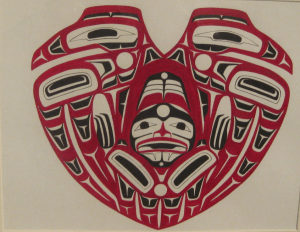
Someday, I am going to jot down the stories of my art acquisitions. There’s the story of how I had to trek to the South Terminal of the Vancouver Airport not knowing the distance, and the story of how a simple bank transfer assumed nightmare proportions as I returned again and again to the bank. And now, after yesterday, I have the story of stopping by the Chateau Granville to pick up Shawn Aster’s “Raven Heart” to the befuddlement and bemusement of the desk clerk and manager, who had obviously never heard of such a thing.

The situation was no one’s fault – just one of those times when the perversity of the universe seems set to stun. I had reserved the painting when I was in Terrace five weeks ago, but I didn’t have the time to get to a bank machine and return before the show closed for the day. As a result, I didn’t pay until after I returned home. We had floated various schemes for delivery, ranging from leaving the piece at the Grayhound station to picking it up at the Spirit Gallery reception yesterday. But an emergency had forced Aster to return home early, and the hotel desk was his improvised way of getting the piece to me.

Now that Aster has won a couple of scholarships at the Freda Diesing School, his work is starting to sell, and people are expecting a successful career ahead of him. As he takes his first steps, I can’t resist a bit of self-congratulation for having discovered the young Tsimshian artist’s work several months ago at the school’s mid-term show (and some mild complementary scorn for those who needed the scholarships to realize the quality of his work).

Many young artists seem to enjoy designs in which Northwest Coast designs are incorporated into the shapes of modern culture. For instance, Latham Mack, another scholarship winner at the Freda Diesing, did a group figure of traditional designs that formed the outline of a Playboy bunny on a T-shirt. In the same way, “Raven Heart” takes two traditional ravens and constrains them in a heart design.

This practice, I suppose, is the extension of the tradition of adjusting a design to fit the contours of the shape it is on – a pole, or a bowl, spoon, hat, or box. The main difference, of course, is that the possibilities for innovation and commentary open up when a modern shape informs the design. In the case of “Raven Heart,” the two ravens resemble a traditional split design, but, when put into a heart, suggest a rather unhappy relationship, the raven of mythology being associated more with promiscuity than faithfulness, and more with clever and expedient lies than the truthfulness that is generally thought to be a necessity for a successful relationship. A confirmation that the relationship is less than smooth is the constrained feathers on the wings that seem almost like bars confining the trapped figure inside the heart — which has a decidedly unhappy look on its face.

It is probably no accident, either, that the piece was first exhibited at a show shortly before Valentine’s Day this year. The piece seems to play one culture against the other, using each to comment sarcastically upon the other.

But what interests me most about “Raven Heart,” like all of Aster’s work that I have seen, is its technical skill. Its form lines do not have the most graceful curves that I have seen, but for the most part they are suitably varied in thickness, and the use of interior U-shapes to minimize the thickness of the intersections is well done. In addition, of course, the use of red as the primary color – a relatively rare practice, traditionally-speaking – is suited to the heart shape.

The design itself is made up of only a few shapes – notably the U-shapes and T-shapes – which vary in length and whose colors are sometimes inverted. The composition has an obvious horizontal symmetry, but it also includes a less noticeable vertical symmetry, made up of groups of threes and fours: three feathers on the stylized wings, three fingers on the trapped figure’s hands (or are they the claws of the ravens?), four interior shapes on the outer wings, and four tail feathers on the bottom. Each side, too, has three large ovoids filled with black. Similarly, the circles at the joints of the wings are balanced by one that might be the tail-bone, while three circles, irregularly shaped, are also at the center of the trapped figure’s design. There is an economy in the relatively few shapes used in the design, and an almost mathematical precision in the vertical symmetry that is rare in any Northwest Coast art, but especially rare in an artist over thirty.

I have talked off and on with Aster about a commission, and I still hope to see it one day. Meanwhile, “Raven Heart” is a masterful small performance that makes me believe that Aster has a future every bit as promising as everyone is saying.

aster

Read Full Post »

Most Saturdays, noon sees me barely staggering out to the gym. But today, noon or shortly after saw us arriving in Gastown for the reception to mark the opening of the Northern Exposure 2009 show at The Spirit Wrestler Gallery. The show is an exhibit of the graduating class of the Fred Diesing School of Northwest Coast Art, plus this years’ scholarship winners. It has already become a tradition in the three years that the school has existed.

With 19 carvings and no graphics, the show was a subset of the graduation show I saw in Terrace, which had some 75 pieces. One or two second year students were missing, as well as most of the first year, including some artists like Mitch Adams or John Wilson who I’d rate above some of those who were represented. Still, space was limited, so some way of reducing the numbers was probably unavoidable.

At any rate, the reduced number also had the benefit of allowing you to pay close attention to each piece – something that is impossible with four times the number. It was especially interesting to see the graduates’ work beside that of their teachers, Stan Bevan and Ken McNeil. That way, you could see the teachers’ influence, and which students were on their way to establishing their own style.

To my eye, the exhibit was somewhat weaker than last years’, which included the work of Dean Heron, who is rapidly becoming one of the major up and coming young artists in the Northwest Coast Tradition. However, the show included the paddles I had admired in Terrace by Latham Mack and Shawn Aster. Another standout was Mack’s “Northern Beauty” mask with its striking painting and individualistic detailing of the nostrils and mouth.

northern-beauty

I also appreciated two samples of Reynold Collins’ detailed, often intricate work. While I think Collins’ work would be improved by more finishing and greater attention to the grain, his work never suffers from the clumsy blank spaces found in many of the other students’ work and shows a vividness of imagination that makes me suspect it is only a matter of time until I find the right piece of his work to buy.

reynold-collins

Only a half dozen students were at the reception, and their time was in demand. However, because the event was smaller than the graduate show, it was easier to have a few words with them and find what motivated them. I talked briefly with Sophia Patricia Beaton, Darryl W. Moore, and Reynold Collins, each time finding something in the conversation to bring me back for another look at the pieces they were exhibiting.

Last years’ show, as well as the work of other recent graduates was priced somewhat high – a mistake that means that the pieces do not sell, and that the artist is tempted to try to charge prices elsewhere that their reputation cannot sustain. By contrast, this year, the students seem to have priced their own work, and, thanks to the guidance of their teachers, this year, realism prevailed. Most of the pieces were under $1400, and only one over $2000. This realism seems to have helped; as I write seven hours after the start of the reception, some six of the pieces in the show have sold, including two each by YVR award-winners Todd Stephens and Shawn Aster. Not bad for a day’s display.

Especially at realistic prices, the show cannot be much of a money-maker for Spirit Wrestler, which often sells works by Robert Davidson or glass artist Preston Singletary for tens of thousands of dollars. In fact, when the cost of publicity, reception and staff wages are taken into account, the show might even cost the gallery money. That makes the show a public-spirited effort, or at the very least, a long-term investment in the next generation of artists.

Certainly, it means a considerable amount to the artists, many of whom have limited funds and some of whom had to go to some effort to get to Vancouver. But, after several days that included the YVR ceremony, and a tour of several local galleries and a CBC interview for the award-winners, the reception was clearly the highlight of their trip. Many said as much, and their sincerity was unquestionable. The reception gives them a taste of the lives they would like to live – and, thanks to Spirit Wrestler, for some of them, those lives may now be that much closer.

Read Full Post »

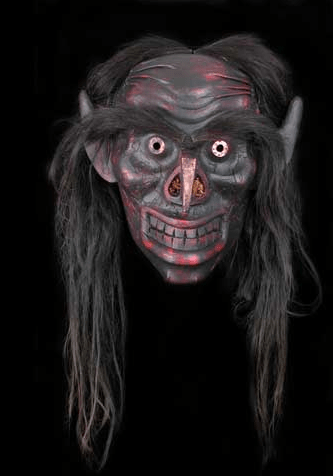
After six months of layaway payments, today we finally brought home our Beau Dick Bukwus mask from the Douglas Reynolds Gallery. Bukwus, the wild man of the woods, is second only to Tsonokwa among Dick’s favorite subjects, but this goblin-like rendering is by far my favorite among his treatments of the subject.

The mask is several years old, but was kept for a while by Douglas Reynolds, who put it back in the gallery only because he had limited room and other masks by Dick that were personal gifts. This bit of history alone would be an endorsement of the work, if my own taste wasn’t enough. In terms of craft, it is close to a unique piece, using a technique that Dick has used in less than half a dozen masks.

This technique is to overlay the wood with leather, using a layer of cloth to create wrinkles on the face, then moistening the leather so it dries cracked and with a broken surface. The result is a close approximation of a man who has been living rough, and whose face is pocked by cuts and sores and the lines of hard usage. In other words, it is perfect for the Bukwus.

(Whether another face is carved on the mask, hidden by the leather, I don’t know. But, suddenly, it occurs to me to wonder, although I can never know without destroying the mask).

Another unusual piece of technique is that the eye holes are drilled deep, through nearly three inches of wood, and rimmed with copper that makes them come alive when the light captures them.

Even more interestingly, the nose is a piece of copper, as though the Bukwus has ripped off his own nose, and found a crude replacement. The sinuses, which are exposed by the lack of a true nose, are stuffed with cedar shavings, just (I am told) as a corpse’s would once have been among the Kwakwaka’wakw. Is the Bukwus dead? Or has he been left for dead? Or is he simply dead to his family and past? Could he be some collector of the dead?

You can take your pick among the possibilities, but all of them are potentially ominous. Add a manic grin with an under-bite, pointed ears, eyebrows that are as long as the hair on top of the head, and a red-black color that suggests a layer of filth and open sores, and the result is an intensely eerie bit of the supernatural, even if you know nothing about the Bukwus.

In fact, it is so intense that I wouldn’t be surprised to learn that Dick had his own manic delight in his creation and laughed as he finished it. It is close to being over the top, yet stops short of being so, creating an ambiguous figure that, the longer you stare, the less certain you are whether you should be uneasy or laughing yourself.

This ambiguity makes the mask one that should not be hung in the bed room – and definitely not where you can see it when you wake up. Instead, we hung it at the top of the stairs leading up from our front door. If we are ever woken by a scream on the stairs, we will know that somebody broke in and got their first look at Dick’s creation. It’s a magnificent piece, but not something you want to take you by surprise in the dark.
beau-dick-bukwus

Read Full Post »

Patrick Amos is one of the leading Nuu Chah Nulth artists. From the first time I saw his work, I knew it was only a matter of time before I bought something by him. However, until I was browsing the Quintana Galleries web site about six weeks ago, I hadn’t found the right piece. There, I saw his acrylic on paper “Supernatural Wolf Transforming into Killer Whale,” which appealed in so many different ways that I immediately contacted the gallery before anyone else could snap it up.

I assume (but haven’t been able to verify yet) that the piece refers to a myth apparently shared by both the Nuu Chah Nulth and Haida nations of a great wolf that was such a savage and wasteful hunter that shamans transformed it into a killer whale so that it would not de-populate the animals of the land. This is a story that I have never seen depicted in art before, which gives the piece an immediate interest for me – I mean, Raven stealing the light is a powerful story, but it’s as common in Northwest Coast art as Madonnas and crucifixions are in European Renaissance art. I simply like to see my imagination stirred by a story less often told.

However, “Supernatural Wolf” is also an office in the important Wolf Society, although why one should be transforming into an orca isn’t clear to me.

At any rate, transformation is a subject that often brings out the best in many Northwest Coast Artists, and this piece is no exception. Amos’ acrylic shows the wolf twisted in the throes of transformation – throes that seem all the more agonizing as it struggles in the confines of the circle.

At the moment depicted, the most obvious sign of the transformation is the dorsal fin on the wolf’s back that it is evidently twisting to see (and maybe bite). However, at a second look, the wolf’s head is also sprouting the fin that is one of the killer whale’s distinguishing features in Northwest Coast Art. Moreover, if you look closely, one front leg may be changing into a flipper, while the other, with toes that seem elongated compared to the hind foot beside it, seems to have just started to change. The tail, too, is presented in a three-quarters view that makes it look flat, and more an orca’s flukes than a wolf’s brush.

An additional indication of change may be the irregular and asymmetrical shapes that make up the wolf’s legs. They give a strong contrast to the wolf’s body, which exists only in outline, except for the two stars that perhaps suggest the wolf’s spirit, remaining unchanged despite the physical transformations that arre happening.

For me, the piece is all the more effective because it is in stark white and black. Not everybody appreciates black and white or grayscale these days, which may be why the piece languished in the gallery for a while. Personally, though, I have always felt that, with the right subject, a lack of primary colors makes for boldness and drama, which is certainly the case here.

One additional note: The small mark in the lower right is a finger print, presumably Pat Amos’. The gallery was apologetic about this flaw, but I was more philosophical. Your eye is hardly drawn to it, after all. Besides, if I ever wanted to establish provenance, I shouldn’t have any trouble (to which the employee I was dealing with replied that you could have no doubt that Amos had a hand in the work).

pat-amos

Read Full Post »

When I was up at the Fred Diesing School Student Art Exhibition a couple of weeks ago, one of the main attractions was the paintings of Sean Aster. I bought one myself, and joked that I had traveled north just to see how he was coming on the commission we’d arranged a couple of months ago. However, the way that the reactions to his work changed over the afternoon taught me something about the way that people view and buy art.

Before the graduation ceremony, when people were gathering in the studio, very few of us gave Aster’s work any particular attention. However, during the ceremony, Aster won two scholarships, including one that master carver and senior advisor to the school Dempsey Bob gave out himself. Twenty minutes later, staff could barely put up the little red stickers indicating a sale fast enough. Suddenly, everybody wanted one of his works.

This change had nothing to do with the quality of the works. Aster is a promising artist, especially for someone still in his twenties, and his work deserved the awards and the attention he got. But his work was no finer after the ceremony than before. Nor were people necessarily buying the biggest or most original pieces.

All that had changed was that the school instructors had got up and said very publicly, in several different ways, that he was a young artist with a future. Apparently, most of the guests had missed the fact before, until recognized authorities had emphasized it to them. Those of us who had recognized his skill by ourselves were morbidly amused (to say nothing of pleased with ourselves that we had arrived at our conclusion unaided).

A week later, I repeated the story to a Vancouver director of a Northwest Coast Art gallery. He didn’t get what I was saying. How else, he asked me, would people have known what to buy?

Listening to his question, I realized, more strongly than ever before, that there were two reasons for buying art.

The first, and perhaps the most common, is based on reputation, and, much of the time, on the hopes of a profitable investment. Beyond a very limited extent, it has nothing to do with an artist’s ability. For example, it is no reflection on the ability of either artist than an original canvas by Robert Davidson can sell for seventeen times the price of one by his current apprentice David Robert Boxley; Davidson sells for so much more because of his reputation, not because he is seventeen times the artist that Boxley is (although, quite obviously, he is his elder in their craft). This was the sort of collector I saw buying Aster in Terrace – for the afternoon, at least, Aster was the one with the reputation.

The second reason to buy art is because it moves you, or because it is well-composed. This reason owes nothing to reputation; those who buy for this reason will buy a $100 sketch from an unknown as happily as a $10,000 one from a master artist if it has the right qualities, and let the potential investment take care of itself.

These two types of buyers can talk amiably, and may even wish to buy the same piece. However, the motives for buying are really quite different, and quite irreconcilable. Secretly, an enthusiast like me can’t help thinking that those whose buying decisions are based on reputation are unimaginative, even a little crass, and buying for entirely the wrong reasons. In turn, though, I don’t doubt that the reputation-buyers dismiss us enthusiasts as arrogant in our naivety.

Read Full Post »

“How does this compare to a show down south?” John Wilson asked me last week, shortly after I arrived at the Freda Diesing School Student Art Exhibition in Terrace. He seemed surprised when I told him that a 23 person show with some 75 pieces almost never happened, but it’s true. The annual show is one of the largest annual exhibits of modern Northwest Coast Art anywhere.

The show lasted only two days, with a private viewing for friends and family on Friday and a public viewing on Saturday. The location is the Freda Diesing Studio on the Terrace campus of Northwest Community College, a well-lit building with a large lower floor ordinarily occupied by work benches and a loft for a more conventional class room setting:

fd-studio1

Just inside the door, above the table with the show catalog and price list were a few prints by Freda Diesing herself, including a self-portrait mask:

fd-self-portrait

These works were not for sale, but stood as tutelary spirits of the show – or, more precisely, as the standards to which the students should aspire.

Several months ago, I reviewed the school’s mid-term show via a collection of pictures sent to me by John Wilson. That show was mostly painting and sketches, the first year class in particular having not begun its study of carving at the time. By contrast, the year-end show had a few two-dimensional pieces, but consisted largely of paddles, spoons, and masks.

Painted paddles are closer to two dimensional than three dimensional works, so I was not surprised when two of the best-designed paddles were from Shawn Aster and Latham Mack, two artists who were among the standouts at the earlier shows and scholarship winners at the graduation ceremonies that accompanied the private viewing:

shawn-aster-paddle

latham-mack-paddle

However, making the transition from the two-dimensional craft of painting to the three-dimensional one of carving does not always comes easily, and many students are still making it. Latham Mack, for instance (who as a Nuxalk, is learning his second style of carving), is well on the way, using the same blue that I am starting to recognize as characteristic of his two-dimensional designs:
latham-mack

By contrast, a mask by Shawn Aster shows a sense of surfaces, but seems more tentative, with a shallowness in the carving and a thinness of line that makes you only appreciate the mask up close, as seen in this (unfortunately cropped) picture:

shawn-aster-mask

A similar lack of ease in three dimensions is true of Todd Stephens, another scholarship winner from whom I’ve bought several paintings:

todd-stephens

Other students showed similar learning curves – and, as might be expected in a student show – a certain tendency to conformity – although Norman McLean, Sr., in a triumph of social sensibility over aesthetics did do a bright pink mask, as well as a spoon with a more discrete pink ribbon around the handle as fund-raisers for breast cancer. Still, there were some interesting pieces here and there.

Sophia Patricia Beaton, another scholarship winner, had only one piece in the show, but the wavy hair and the obviously feminine face and the labret were original enough to make me wonder what the rest of her work might be like:

sophia-beaton

I also noticed James Weget-McNeil’s frog mask, which, although in a very different style, reminded me of some of the faux-artifacts that Beau Dick has been carving recently:

james-weget-mcneil1

However, much of the interesting carving came from mature students with more experience.

Charles Richard Wesley, whose work I noticed in the mid-term show, came up with two interestingly intricate masks:

charles-richard-wesley

I also appreciated John Wilson’s work, which he says represents an advance in finishing details over his earlier work – pointing, for example, an indentation of the eye sockets at the top of the nose:

john-wilson

These are just some of the pieces in the show, but, aside from the bowls (something needing to be left out), they give an idea of the variety to be seen at the show. I appreciate the chance to see students learning and mastering their craft, and while some flaws and weaknesses are apparent, there are just as many examples of solid and skilled works.

In fact, I could have come away from the show considerably poorer. Fortunately or unfortunately, depending on my shifting perspective, most of the pieces I considered buying were marked NFS, many earmarked for a show at the Spirit Wrestler Gallery in Vancouver later this month.

But buying is only one reason to attend such a show. A far better reason is spend a few hours surrounded by efforts of art – and that, so far as I am concerned, is more than enough reason for me to want to attend next year’s show.

My thanks to Stan Bevan for seeing that I got an invitation. That small kindness gave me an enriching day.

Read Full Post »

“Nasty disturbing uncomfortable things!” Bilbo Baggins says about adventures in The Hobbit. “Make you late for dinner!” Working out of our townhouse, I sympathize with that view. But, as with Bilbo, there must be something Tookish in me lying in wait. When I was invited to go to Terrace for the end of the year show at the Fred Diesing School of Northwest Coast Art, I was determined to go. To fly 1350 kilometers only to return the next day seemed more than a little quixotic, especially when I didn’t feel I could really afford the trip and had never met anyone there, but the whole idea seemed irresistible. For someone who had never been farther north than 100 Mile House, it seemed a small adventure, all the more interesting because I was moving way out of my comfort zone.

I flew out of the South Terminal of the Vancouver Airport, a relic of quieter days that services the coast and the remoter areas of British Columbia. After looping around the city, with me peering out eagerly to spot the Metrotown Towers, Swangard Stadium, Cleveland Dam and other visible landmarks, we headed north. The mountains grew progressively taller and more snowcapped, and I tried not to be disappointed that all I could see of the coast was the occasional inlet masquerading as a river at first glance.

I won a T-shirt in an on-board raffle, and hoped it was an indicator of how my luck was running.

As we circled Terrace and descended to the airport, I could see signs of logging that showed that I was flying into a resource extraction community. From the air, I could see that the evergreens flanking the highway were often only one hundred meters thick, and that the town, whatever its other virtues, was a stranger to zoning in most areas.

At every other airport I’ve ever visited, taxis are always awaiting incoming flights. But not at the Terrace-Kitimat Airport. Rather sheepishly, I retraced my steps and hunted for the direct phone for the taxi.

After twenty minutes, an Indian driver – that is, someone from India, not a First Nation – picked me up and took me directly to the college. We crossed the Skeena, brown with the spring runoff, and through the mixture of stores and industrial sites that forms the downtown, and up a hill to a suburb where small houses mixed with hobby farms of a few acres and pasturage for a cow or horse or two.

Semi-rural British Columbia, I thought, reminded of places in Surrey and Langley and the Sunshine Coast. I decided I could deal with it.

All the same, the college seemed incongruous when it suddenly appeared. Paying off the driver, I found my way to the cafeteria to fortify myself and ask directions if I needed to.

A bagel and orange juice revived me, and I headed across the parking lot in the middle of the college. A few inquiries confirmed that the building with the high roof and large windows was the Freda Diesing School, just as I had thought. Trundling my carry-on, I stepped inside.

Almost instantly, I was greeted by Jennifer Davidson, Henry Green, and Peter Jackson, at least one of whom must have a stronger ability to recognize people from their photos than I’ve ever managed. Then I started meeting people – Bill McMillian, carver and teacher Stan Bevan, and students with whom I’d been in contact with online but never met, including John Wilson, Latham Mack, Sean Aster, and Todd Stephens, to say nothing of ex-students like Dean Heron. The sheer number of people to meet was overwhelming, and their friendliness left me exhilarated. Really, a stranger couldn’t have asked for a better welcome to a group with such close internal connections.

I just barely had time to go around the show (which deserves a blog of its own) snapping pictures like mad before it was time to trek across campus for the graduation ceremony. While we were milling about, Jennifer Davidson took the opportunity to photograph the copper bracelet that Henry Green did for me eighteen months ago, and Henry threated to straighten it out, evoking a squeal of dismay from me.

After rampaging through the buffet, the crowd sat through the usual round of thanks at graduation ceremonies. Mercifully we were spared long speeches, although I did notice most of the students gradually sitting lower and lower in their chairs. But an end came at last, with the most deserving students receiving awards and all of them praised for their dedication.

Two drummers, one of whom was a student, were supposed to lead a procession back to the studio, but the riff-raff like me at the back lingered so long that we missed most of it. I had a chance to look at the exhibits more carefully, and saw the sketches for one piece that I hope to eventually buy, and all too soon the show was over.

John Wilson drove me downtown, where I found a hotel and we headed out for Chinese food. A sign that we were in the north was that one of the offerings at the restaurant was salmon in black bean sauce.

I had hoped to meet sculptor Ron Telek, but he was busy with family matters, and we had to make do with a quick phone call late at night. I found myself wishing that I had booked another day, both to see Ron and to see more of the town, but, as things were, I fell asleep exhausted and buoyed by the friendly welcome I had received.

The next morning, I was at the airport before most of the staff (Memo: in small towns, the rule of arriving two hours before a flight doesn’t apply). Tired but satisfied, I flew south, putting adventures behind me for a while. But now that I’ve ventured north once, I’m sure I’ll be coming back again. Terrace may be more distant from my townhouse than Calgary, but in many ways it feels more like home.

Read Full Post »

« Newer Posts - Older Posts »