“Nasty disturbing uncomfortable things!” Bilbo Baggins says about adventures in The Hobbit. “Make you late for dinner!” Working out of our townhouse, I sympathize with that view. But, as with Bilbo, there must be something Tookish in me lying in wait. When I was invited to go to Terrace for the end of the year show at the Fred Diesing School of Northwest Coast Art, I was determined to go. To fly 1350 kilometers only to return the next day seemed more than a little quixotic, especially when I didn’t feel I could really afford the trip and had never met anyone there, but the whole idea seemed irresistible. For someone who had never been farther north than 100 Mile House, it seemed a small adventure, all the more interesting because I was moving way out of my comfort zone.
I flew out of the South Terminal of the Vancouver Airport, a relic of quieter days that services the coast and the remoter areas of British Columbia. After looping around the city, with me peering out eagerly to spot the Metrotown Towers, Swangard Stadium, Cleveland Dam and other visible landmarks, we headed north. The mountains grew progressively taller and more snowcapped, and I tried not to be disappointed that all I could see of the coast was the occasional inlet masquerading as a river at first glance.
I won a T-shirt in an on-board raffle, and hoped it was an indicator of how my luck was running.
As we circled Terrace and descended to the airport, I could see signs of logging that showed that I was flying into a resource extraction community. From the air, I could see that the evergreens flanking the highway were often only one hundred meters thick, and that the town, whatever its other virtues, was a stranger to zoning in most areas.
At every other airport I’ve ever visited, taxis are always awaiting incoming flights. But not at the Terrace-Kitimat Airport. Rather sheepishly, I retraced my steps and hunted for the direct phone for the taxi.
After twenty minutes, an Indian driver – that is, someone from India, not a First Nation – picked me up and took me directly to the college. We crossed the Skeena, brown with the spring runoff, and through the mixture of stores and industrial sites that forms the downtown, and up a hill to a suburb where small houses mixed with hobby farms of a few acres and pasturage for a cow or horse or two.
Semi-rural British Columbia, I thought, reminded of places in Surrey and Langley and the Sunshine Coast. I decided I could deal with it.
All the same, the college seemed incongruous when it suddenly appeared. Paying off the driver, I found my way to the cafeteria to fortify myself and ask directions if I needed to.
A bagel and orange juice revived me, and I headed across the parking lot in the middle of the college. A few inquiries confirmed that the building with the high roof and large windows was the Freda Diesing School, just as I had thought. Trundling my carry-on, I stepped inside.
Almost instantly, I was greeted by Jennifer Davidson, Henry Green, and Peter Jackson, at least one of whom must have a stronger ability to recognize people from their photos than I’ve ever managed. Then I started meeting people – Bill McMillian, carver and teacher Stan Bevan, and students with whom I’d been in contact with online but never met, including John Wilson, Latham Mack, Sean Aster, and Todd Stephens, to say nothing of ex-students like Dean Heron. The sheer number of people to meet was overwhelming, and their friendliness left me exhilarated. Really, a stranger couldn’t have asked for a better welcome to a group with such close internal connections.
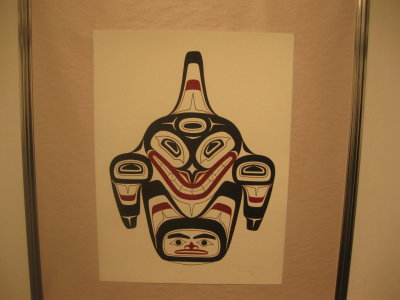
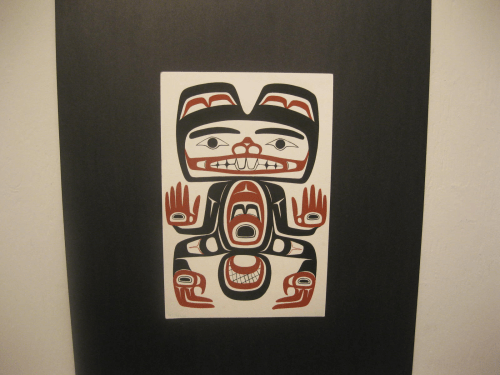
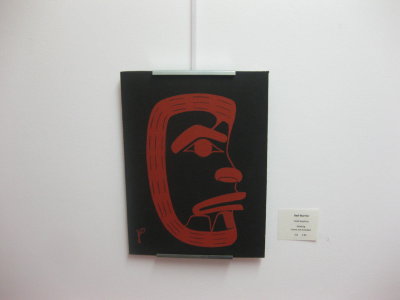
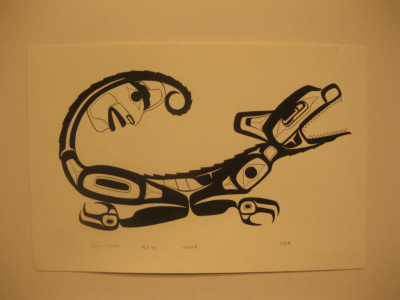
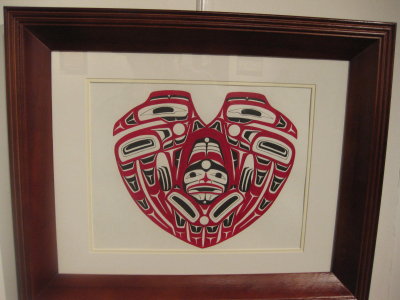
I just barely had time to go around the show (which deserves a blog of its own) snapping pictures like mad before it was time to trek across campus for the graduation ceremony. While we were milling about, Jennifer Davidson took the opportunity to photograph the copper bracelet that Henry Green did for me eighteen months ago, and Henry threated to straighten it out, evoking a squeal of dismay from me.
After rampaging through the buffet, the crowd sat through the usual round of thanks at graduation ceremonies. Mercifully we were spared long speeches, although I did notice most of the students gradually sitting lower and lower in their chairs. But an end came at last, with the most deserving students receiving awards and all of them praised for their dedication.
Two drummers, one of whom was a student, were supposed to lead a procession back to the studio, but the riff-raff like me at the back lingered so long that we missed most of it. I had a chance to look at the exhibits more carefully, and saw the sketches for one piece that I hope to eventually buy, and all too soon the show was over.
John Wilson drove me downtown, where I found a hotel and we headed out for Chinese food. A sign that we were in the north was that one of the offerings at the restaurant was salmon in black bean sauce.
I had hoped to meet sculptor Ron Telek, but he was busy with family matters, and we had to make do with a quick phone call late at night. I found myself wishing that I had booked another day, both to see Ron and to see more of the town, but, as things were, I fell asleep exhausted and buoyed by the friendly welcome I had received.
The next morning, I was at the airport before most of the staff (Memo: in small towns, the rule of arriving two hours before a flight doesn’t apply). Tired but satisfied, I flew south, putting adventures behind me for a while. But now that I’ve ventured north once, I’m sure I’ll be coming back again. Terrace may be more distant from my townhouse than Calgary, but in many ways it feels more like home.



 Off the Wall