Feeds:
Posts
Comments

Archive for the ‘indian art’ Category

On April 25, I flew to Terrace for the sixth time to attend the graduation exhibit at the Freda Diesing School of Northwest Carving. As usual, the graduation was also a gathering of alumni, and the longhouse where the show is held was so heavy with the smell of varathane as students worked to the last minute to finish their pieces that leaning into one of the display cases could leave you dazed and dizzy.

longhouse

This year’s show was stronger than last year’s on two accounts. To start with, the first year class included at least two promsing artists. Kyle Tallio exhibited a hawk mask, whose elongated shape and and striking painting made it a standout:

kyle-tallio

Another first-year standout was Reuben Mack, who continue the tradition of his extended family (including Latham, Kyle, and Lyle) with a portrait mask that showed both a steady hand on the paint brush and an attention to detail that should serve him well if he chooses an artistic career:

reuben-mack

Yet another promising first-year was Kirsten McKay, this year’s winner of the Mature Student Award, who placed a Chilkat weaving design on a spoon with pleasing results:

kirsten-mckay-chilkat-spoon

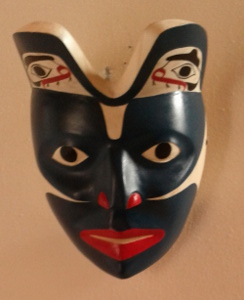
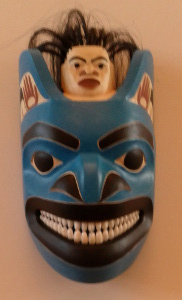
Even more importantly, the work of several second year students demonstrated that they had put the last year to good use. Cyril Bennett-Nabess showed a notable improvement in both his painting and carving, displaying several masks, including this traditionally-shaped bear mask:

cyril-bennett-nabess-becoming-a-bear

Similarly, Roberta Quock showed the same high standards that made her an Honorable Mention for the Mature Student Award in 2013:

roberta-quock-thunderbird

The work of two students in particular stood out form. Lyle Quock, who stood out in his first year, showed an originality of design and color selection in the masks he displayed this year:

lyle-quock-moon-mask

lyle-quock

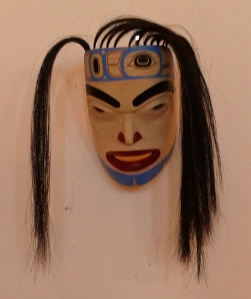
But if I had to choose a single artist as a standout, it would be Loretta Quock-Sort, an Honorable Mention for the 2013 Mature Student Award. Quock-Sort’s female portrait mask was one of the more original pieces in the show:

loretta-quock-sort-mask

loretta-quock-sort-leather-robe

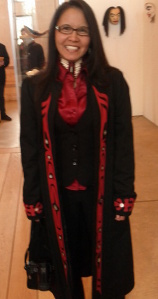
But it was her work in fabric that stood out, including a leather robe with mask in their own display case, and the black and red robe that she wore for the graduation itself.

loretta-quock-sort

The show opens at The Spirit Wrestler Gallery in Vancouver at the end of May, possibly with a few works that were not ready in April. If you want to see what the next generation of First Nations artists are doing, you won’t find a better place to satisfy your curiosity and aesthetic senses.

Read Full Post »

As an artist, Carol Young has gone from strength to strength, so when her “Wolf Mask” became available for sale, I jumped at the chance to buy. In the not-too-distance future, I may not be able to afford her work, and I wanted – at least – a second piece of work to enjoy in my townhouse.

This premonition is based on how far and how fast Young has come as an artist. Less than five years ago, Carol Young began a new career as a carver. In her second year at the Freda Diesing School of Northwest Coast Art, she emerged as one of the most accomplished students in her graduate class, winning the encouragement of master carver Dempsey Bob and becoming the first recipient of the Mature Student Award. In the four years since then, she has gone on to develop a strong original style with a strong interest in the role of women and environmentalism in First Nations Culture. Recently, at sixty, she had her “Moon Matriarch” mask adapted for gold and silver Canadian coins.

“Wolf Mask” reminds me of Bill Reid’s comment that traditionally the wolf must have been a mythical creature to the Haida, because there are no wolves on Haida Gwaii. Like Reid’s own wolves, Young’s mask depicts a degree of ferocity missing from the depictions of other animals. It is a fantasy creature, with an exaggeratedly large mouth and teeth, with fangs that cannot be contained its jaws, and large, swept-back ears that suggest an aggressive alertness. The impression is rounded off – literally – by the U-shapes at the edge of the jaws and the eye sockets that creates a clenched look, as if the grimace on the mask is habitual.

This sense of ferocity is all the stronger because Young has left the mask mostly unpainted. The lack of paint makes the carving more pronounced. And when Young does add black to the wolf’s outsized pupils, they appear larger and wilder than they possibly could have if surrounded by any other paint – even another section of black.

More often than not, fur added to a NorthWest Coast mask is a step too far – a sign, usually, that the artist is uncertain about their skill and trying to hide any errors by over-embellishing. However, the fox fur that Young adds is an exception. Its untidy shagginess on the top of the mask adds to the ferocity, while its off-white color contrasts strongly with the natural color of the wood.

Unfortunately, the fur made shipping the mask to the United States impossible. But since that technicality is why I was able to buy it, I have no complaints. However I got my hands on Young’s “Wolf Mask,” I consider it one of the outstanding treasures in my art collection.

CY-wolf-mask


Read Full Post »

Thanks to the Vancouver Art Gallery’s exhibit, I not only have a greater appreciation of Charles Edenshaw as an individual artist, but a greater understanding of his key role on the Renaissance of First Nations Art in the Pacific Northwest. But, increasingly, I wonder about the man behind the art. What was his inner life like?

Glimpses of his life do exist. In During My Time, his daughter Florence Davidson mentions how her father used to say a prayer, then sit himself down on the low chair he preferred and work for the next twelve hours. I believe, too that Davidson tells how he once said that he was tired of art, and wouldn’t do any in his next life; a great nephew who showed no interest in art but died early is suspected to have been his reincarnation. Haida friends also tell me that a lively oral tradition about Edenshaw continues to exist on Haida Gwaii, and from his art, I infer a man with great powers of concentration and attention to detail who took pride in his work.

But such glimpses are tantalizingly few, especially for such a man and such times as he lived in. Almost immediately, the reliable information trails off into surmises. He was said to have been sickly in his youth, and even in his prime, he looks small and fragile in the pictures that have survived, and possibly not too steady on his feet. His early ill-health is often surmised to be the reason he turned to art to make a living – he simply wasn’t rugged enough to earn a living by fishing and logging, like other men of his generation.

Yet what he thought about his life is completely unknown. Did he ever feel resentful at having to live a sedentary life? Or was he quiet man, content to stay close at home and perhaps see more of his family than most of his generation of men? We simply don’t know.

Nor do we know how he felt about the great events happening around him. How did he feel about the epidemics that wiped out most of his generation among the Haida? Was he grateful to survive, or did he sometimes brood at his work bench, wondering how he survived? Was he proud of the titles he accumulated due to the gaps in the successions? Or did he see himself as a caretaker of the titles, assuming them in trust for future generations?

Similarly, I wonder why he accepted baptism in middle age. Did he hope that Christianity might preserve him and his family from other epidemics? Did he see his culture as ending, and Christianity as a way into the future? Or did he see baptism as a way of hedging his bets, an accommodation that allowed him to preserve more of his culture than opposition would? Perhaps as the leader of his people, he converted to maintain his authority over the increasingly Christian Haida clans and houses. Or perhaps he was genuinely drawn to Christianity.

But we do not know any of the reasons for what he did. We do not even know what he thought of the art that such a central feature of his art. I would give a lot to know whether he ever thought of his life’s work as anything other than a way to feed his family. Did he see himself as an individual artist, the way that those from European and American cultures do? Did he hold himself responsible for preserving parts of Haida culture that the epidemics had left abandoned, or was Haida culture just a commodity that he could sell to make a living?

I wonder, too, whether the man who was known in his lifetime as Charlie among English-speakers be proud or embarrassed to be addressed in tones of respect as Charles. I imagine that a man who had taken on so many names as his importance as a chief increased would have taken taken yet another name in his stride. Still, what would he have thought about his influence on the modern art of not only the Haida, but their hereditary enemies the Tsimshian and all the other nations up and down the coast. Did he ever imagine such a role, even for a moment when talking to Franz Boas and the other ethnographers? Or was he too busy going about his life to ever imagine that anyone else would take take such an interest in his work?

At this point, the only answer to all these questions is that at this point we will never know. Fortunately, we do not have to know, because his art is eloquent by itself. But, historically, the man himself remains laconic, and frustratingly close to mute.

Read Full Post »

The Charles Edenshaw exhibit currently at the Vancouver Art Gallery is a rare opportunity to understand not only one of Canada’s greatest artists, but also his influence. The odds are against these two hundred pieces being shown together again any time soon, but, while they are together, they allow visitors to observe the elements of Edenshaw’s style, such as his growing awareness of negative space as part of the design. Just as importantly, the exhibit shows the importance of Edenshaw in the development of not only Bill Reid, but of the entire revival of Northwest Coast Art in the last sixty-five years.

This is an outcome that Charlie Edenshaw (as he was known during his lifetime until a more formal version of his name started being used as a sign of respect) could hardly imagine. We know little of his inner thoughts, but, as he started his day’s work with a prayer, preparing to hunch for hours over his latest work, he seems to have had little concern beyond making a living for his family. In fact, he once said that he was so tired of carving that in his next life he planned to avoid it altogether. When a descendant was one of the few of his generation not to experiment with art, he was widely believed to be Edenshaw’s reincarnation.

Bill Reid never hid the debt he owed to Edenshaw. I suspect, for example, that Reid’s love of deep carving may have come from seeing Edenshaw’s argillite carving, whose cutbacks are so deep that you can often stand to one side and see daylight on the other side. If you are know Reid’s work, you cannot spend ten minutes at the Edenshaw exhibit without being haunted by a sense of familiarity. Reid was not being the least bit humble in his comments about Edenshaw; he was only stating the truth about his own development.

Two exhibits make that influence especially clear. Near the start of the exhibit is Edenshaw’s famous sketch of Dogfish Woman – done, if I remember correctly, at the request of anthropologist Franz Boas. Although acknowledging that we no longer know the story of Dogfish Woman, Reid adapted the design many times in his career. Not only that, but dozens of other First Nations artists, both Haida and non-Haida, have copied the same basic pose and design in the last half century.

The second exhibit is in a display case of bracelets near the end of the exhibit. In the middle of the case are two bracelets, one by Edenshaw and one done by Reid in 1956. They are supposed to be of two different animals, but the use of negative space and even most of the features are identical – and Edenshaw’s has the strongest sense of line. Early in his career, Reid clearly not only studied Edenshaw, but, as developing artists often do, copied him almost exactly – just as dozens have studied and copied Reid since. The next time I go to the exhibit (which is so overwhelming as to be impossible to comprehend in a single visit), I mean to watch for other evidence of the influence.

Besides an appreciation for Edenshaw’s work by itself, the exhibit is important for understanding modern Northwest Coast Art. I do not think that I am detracting anything from Reid’s reputation to notice such signs of influence; one reason that Reid is so fascinating as an artist is that he began as a copyist, and the depths of his talent only blossomed fully thirty years later, in the last two decades of his life. To see what Reid owes to Edenshaw does nothing except to offer more insight into the process of his development.

Just as importantly, as a key figure in the Northwest Coast revival, Reid himself continues to influence dozens – possibly hundreds – of artists. Considering his debt to Edenshaw, it would not be too much to say that, without Edenshaw, the revival either would have been stunted, or else not happened at all.

Read Full Post »

Most of the Northwest Coast art in my townhouse is in the formline style favored by the Northern First Nations in British Columbia. However, I am always willing to learn more about other coastal traditions, and slowly that’s what I’m doing. The only trouble is, relatively little is written about these other traditions, so most of my knowledge comes from looking at what working artists like Kelly Robinson are doing.

Robinson is a young artist of mixed Nuxalk and Nu-chah-nulth descent who is exploring both sides of his ancestry. In the last year or so, much of his wood carving (he is also an accomplished jeweler) has explored Nu-chah-nulth forms. In particular, he has built on the work of artists like Joe David and Art Thompson who revived the tradition and elevating it into fine art based on his time at the Freda Diesing School.

Fortunately for me, “Ancestor of Today” became available when I had just cashed a few cheques from editors. I first saw the mask in Cathedral Close, the garden outside the Bill Reid Gallery in downtown Vancouver, and, a couple of hours later, I was taking it home on the Skytrain in a bag I was clutching in a death-grip.

The inhabitants of the west of Vancouver Island, the Nu-chah-nulth (formerly called the Nootka and the West Coast) were in a position to be influenced by both the Kwakwaka’wakw, Nuxalk, and Heiltsuk to the east, and the Haida to the north. In fact, unlike most first nations around them, by 1900, Nu-chah-nulth had at least two different styles, a newer one based on formline, and the older, original style. There also seems to have been a third style reserved for the curtains used in the ceremonial mysteries, although I am not altogether certain.

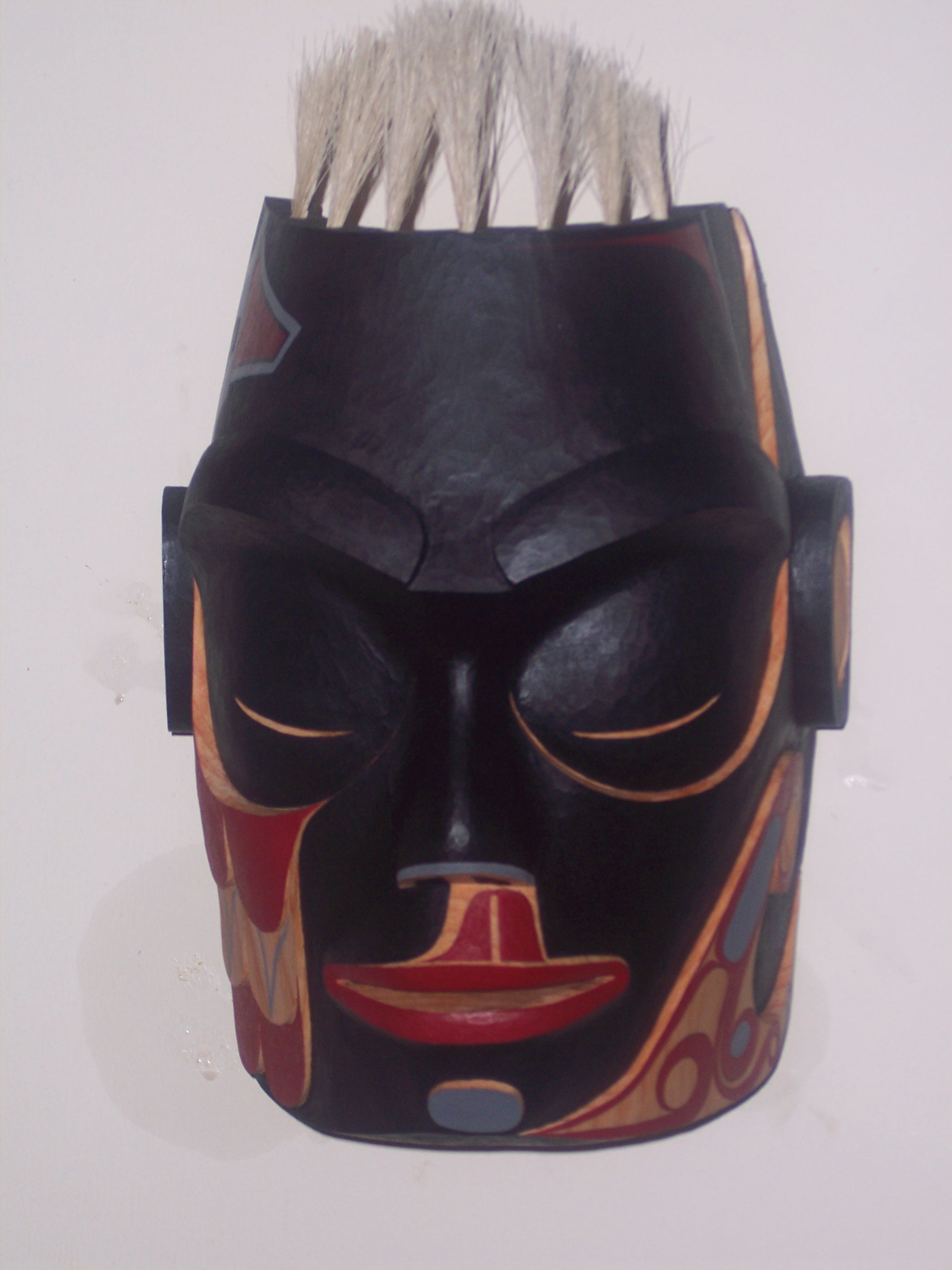
At any rate, these mixed influences may explain the mixture found on “Ancestor of Today.” On the one hand, the mask includes elements that are universal in the coastal traditions, including the U-shapes and the labret that indicates high status. The hair, too, is arranged in a buzz-cut that I have seen in works from every nation.

On the other hand, the facial features all seem to me to be typically Nu-chah-nulth origin, from the raised eyebrows to the high forehead and the nose that swells around the nostril. One of the strongest distinguishing features are the outsized, shallow eye sockets. Unlike in the northern style, the eyes themselves are barely distinguished from the sockets. Here, they are no more than crescents indicate a closed eye, although they would probably not be much more detailed if the eyes were open. The eye sockets join the high cheekbones – another distinguishing feature – not in a plane, as in a northern style, but in a single line.

The painting, too, differs strongly from the northern style. The traditional red and black are the primary colors, but, they cover most of the mask, rather than being used only to highlight features like the lips, nostrils, and brows. Moreover, instead of the designs being painted across the face without much regard for the carving, the way they would be in the north, the designs on the bottom of the cheeks are on their own planes. Between the lips and the nostrils, a different approach is taken, with the inverted U-shape merging into the top list, and the unpainted border on each side of it into the nostrils.

(The mask’s use of gray and the unpainted wood as additional colors is also untypical of the northern style, although they may be Robinson’s innovations rather than indicating any particular tradition; I’ll have to ask him next time we’re in touch.)

The overall impression is of a simpler, bolder style than would be likely to come out of the north. It is enhanced by the slightly rough knife-finish – Robinson’s first effort at this technique, he tells me. To my modern eye, the closed eyes give it Buddha-like sense of calm dignity in keeping with the mask’s name, which asserts a claim that the tradition is still alive and evolving today.

I admire Robinson’s Nuxalk style work, especially the “Four Carpenters” and “Mother of Mischief” paintings, which hang in my living room. However, his Nu-chah-nulth work has its own fascination, especially since he is one of the few artists in the tradition who is trying to evolve the tradition. With “Ancestor of Today,” he manages the difficult trick of re-introducing the tradition while adding first-rate finishing and the steady hand on the paint brush that modern buyers expect. I’m looking forward to what he does next in this style.

100_1603

Read Full Post »

Sometimes, you may find an artist whose work you admire, but have trouble finding the exact piece you want to buy. Or maybe the artist is selling privately, and few of their works are available on the open market. In such circumstances, you might consider commissioning a piece – but be sure you know what you’re doing before you go ahead. The financial arrangements, the decisions about the subject matter, and how and when the finished work is delivered all require careful thought before the commission goes ahead.

You can commission art either through a gallery, or directly from the artist. Going through a gallery gives you the advantage of expert advice, and could make getting a refund easier if too many problems arise. It is also considered proper etiquette to go through the gallery if it has introduced the artist to you.

However, one problem with commissioning through a gallery is that you will usually pay more overall. Some galleries, too, are so anxious to preserve their position as go-betweens that they will will go to extraordinary lengths to prevent you from meeting the artist, even with a gallery employee. This attitude means that deciding the subject matter is much more difficult. In fact, in one case, it caused the artist and I – both of whom were originally perfectly willing to observe proper etiquette – to make our own arrangements.

By contrast, a direct commission usually takes less time to arrange. You may receive a price closer to the wholesale price – but don’t count on it. You may also have trouble contacting the artist, although these days so many are on social media that is less of a problem than it was a few years ago.

But the most serious problem with a direct commission – for both you and the artist – is whether you can trust each other. Bad faith and outright theft sometimes happen on both sides of a direct commission, so before any money changes hands, you should learn what you can about the artist’s reputation (if they are experienced, they will be doing the same about you). After all, you could be spending thousands of dollars, and, if something goes wrong, your only recourse may be small claims court.

Whatever way you approach the artist, the subject and the design should be a balance between what you want and the artist’s interests. Personally, I see no reason to commission a standard mask such as a Hamatsa raven or a sculpture based on Raven’s theft of the light unless you have an interesting variation in mind. For me, the whole point of a commission is to get something unusual, and to give the artist a chance to do something the market might not otherwise allow them to do.

For that reason, I like to suggest a general subject or design, and hope that the artist will be intrigued enough to develop it in their own way. If possible, I ask for sketches to approve before the final work begins. What I am looking for is something that both intrigues the artist and will satisfy me.

Before the commission begins, you also need to discuss the financial arrangement. Some artists may expect no money until the commission is finished. However, a more common arrangement is for the buyer to pay one-third when the deal is accepted, one-third when the artist finishes, and one-third after any final adjustments requested by the buyer. This arrangement minimizes any possible loss for the buyer, and compensates the artist for their time if the buyer walks away from the deal.

Another matter you should specify is the approximate delivery time. Despite all the jokes artists make about “Indian time,” an increasingly number of artists these days take a professional attitude and do their best to meet their obligations, but, even so, the emphasis here is on “approximate.” You are dealing with art, not utilitarian manufacture, and by definition artists are perfectionists. As a result, a strict deadline would be almost meaningless even if you insisted on it. With the best of intention, slippage may happen, and, so long as you are kept informed, shouldn’t be a matter for concern unless it drags on indefinitely.

Even if completion is delayed, you may be content to wait. One commission took two years to complete – so long that I sometimes concluded that it would never happen. However, I felt reasonably sure that the artist meant to meet his obligation, and, in the end, he delivered a piece that I regularly describe as breathtaking.

As I said, it all comes down to how much you and the artist trust each other.

Speaking of which, it can’t hurt to write down the terms of the commission and have both you and the artist sign it, especially if the two of you have never worked together. In many cases, though, a commission is a verbal agreement, aside from any receipts you may receive from any gallery involved.

With all these considerations, commissioning can be an exhausting experience – and, sometimes, a harrowing one. So why attempt it? The answer is simple: a commission is a mental collaboration. As the buyer, you may not raise a carving tool or dip a paint brush, yet seeing the completed work can be an exhilarating experience. It gives you a small taste of what the Medicis must have felt as patrons of Renaissance Florence – a mixture of pleasure and pride that, indirectly the piece of work in front of you would never have existed except for you. Despite the many setbacks that can happen, that is an addictive feeling that you can easily come to want again and again.

Read Full Post »

At First Nations art galleries in Vancouver, Mitch and Diana Adams have a reputation as an effective sales team. Being the artist, Mitch does much of the talking, but because Diana at one remove from the discussions with gallery owners, she is an astute observer of what is happening, and is actively involved in strategic planning.

Several weeks ago when I was in Terrace for the Freda Diesing School graduation ceremony, I asked her what advice she would give young artists about dealing with galleries. Diana responded in detail as we had dinner at Boston Pizza, with Mitch throwing in the occasional comment.

Diana is able to contribute because of her own lengthy experience in sales. “I grew up in a family restaurant business,” she says, “So selling comes naturally to me. As a waitress, my job was to sell the meal. My favorite situation was when people would go, ‘I don’t know. What do you recommend?’ I’d find out what don’t they want to eat, what’s their budget, what they are allergic to, and take it from there.”

Some of what she knows about sales comes from observing her father. However, Diana has been selling her own bead work for several decades. She still remembers her first effort at a Tupperware-like party, where she sold $450 worth of merchandise, confounding her parents’ expectations.

Since then, Diana and Mitch have sold regularly at music and craft festivals through northern British Columbia. For seventeen years, they have been regulars at the Terrace farmers’ market, during which time they have fine-tuned their partnership in sales.

Preparing and handling anxiety

Some artists, especially established ones, can sell to the major galleries in southwest British Columbia without ever visiting Vancouver or Victoria. However, the business of First Nations arts remains very much a face-to-face proposition, and young artists in particular are more likely to make sales when they talk to a gallery’s buyer directly.

Asked how she approaches selling Mitch’s work to a gallery, Diana emphasizes a strategic approach. “I take it on as though I’m applying for a job,” she says. “I do my background homework. I’ll look at a store or a gallery that I want to deal with. I will go in, and not tell them that I’m looking to sell to them. I will observe how they treat their customers. I’ll also see the quality of what they sell. If they have a pamphlet, I will take one, or Google them on the Internet.” She does not worry much about prices, figuring that is not her concern, but she will note at the quality of what is sold, and how staff treats customers.

The point of this research is to decide whether they want Mitch’s work in that gallery. “What a lot of artists don’t understand,” she says, “is that they have an option of deciding whether this is a gallery to deal with or not. I want to know that I’ll be dealing with someone who is dependable, approachable, fair to deal with, and able to give criticism. If I offer them something they’re not interested in, I want to be able to dialog about it. As much as I might want to be a client of theirs, or leave works on consignment, I need to know that I can have a professional working relationship with them.”

Before approaching a gallery’s buyer, Diana and Mitch discuss what pieces to show, their prices – both the price they want, and a bottom-line figure that they will accept as a last resort – and what to say about each piece. This preparation, she stresses, is absolutely essential. “Gallery owners have told us that’s one of their pet peeves, when artists approach them and they don’t know the price of an item. That’s a death-sentence, right there.”

She also notes that, on an introductory visit, artists can expect a lot of questions. Galleries “want to make sure that you are the artist, and not someone else. If you’re the artist, you would know the answers right down to the details.” Forgery and theft are regular events in local First Nations art, so galleries want an indication that the seller truly is the artist.

Another reason for preparation is that it helps to reduce nervousness. “It’s always nerve-wracking. I’ve done it countless times, but there’s still that excitement and anxiety, because you want to do well. But you can’t be overly anxious or insecure, or you’re going to fall flat on your face.”

Another way to reduce anxiety is to take someone with you. However, Diana immediately adds, “Don’t take anyone who’s going to undermine you. Don’t take anyone who doesn’t know anything about your art or will second-guess you.”

Instead, the second person should be either silent, or an active partner. “There’s been times when Mitch has forgot something,” she says, “but I always give him a chance to speak first. But if he forgets something, I’ll come forward. I’ll look at him, and if I know that he’s done talking, I will say my piece.”

According to Diana, planning not only relieves anxiety, but also helps to present yourself as a professional who is easy to deal with. She suggests role-playing the presentation of your artwork, and even approaching galleries you do not plan to deal with so that you can rehearse and prepare yourself for visits to the galleries you hope to work with.

Making the visit and the first impression

“We don’t expect a sale on first visit,” Diana says. “We hope we make a sale, but the whole point is making contact.

Her emphasis is on professionalism throughout. “Dress as though approaching a job,” she advises, “as though leaving a resume. Make sure that the work is well-presented, not carried in a garbage bag. Because if we have no respect for the art, it’s going to show. We use an artist’s portfolio, because presentation is everything. Some of the people we’ve approached have been quite reserved, but we still put on a professional smile, and say what our purpose is.”

Diana also suggests that body-language is important. “Smile,” she advises. “Have good eye contact [with the buyer]. “Don’t cross your arms. Remember to breathe.”

After the introduction, the actual presentation of the pieces is left to Mitch, on the grounds that as the artist he is the one best qualified to talk about them.. “I try to be halfway through explaining the piece as I hand it to them,” he says.

He also gives some thought to the order of presentation. “What I like to do is not give them my best piece right off the bat. Instead, I lead up to it. And I think they see it, too, that the best piece is still to come. But they’ll be lining the pieces up, and hopefully they’ll be being wowed by the pieces that aren’t the best ones.”

If the discussion turns towards the price of any of the pieces, the Adams’ policy is to hold firm to their original asking price, falling back slowly to their minimum only if they strongly want the sale.

“You can’t be desperate,” Diana says, adding as a warning, “never say to anyone, ‘I’ve got bills to pay.’ Never say that because, really, it has nothing to do with the gallery owner. That’s a form of manipulation. It’s a really poor sales technique, because the person who’s being spoken to feels bad and put on the spot. It leaves a bad taste in their mouth, and makes them want to avoid you in the future.”

Some buyers, according to Diana, will claim to find flaws as a tactic for lowering the purchase price; they should be ignored and not cause you to waver in your price. Others may mention what they perceive as flaws as explanations as to why they are not buying; their criticism can be considered later. In fact, once or twice, Mitch has gained credibility by acting on such criticism and taking a piece back to the criticizer for another look.

Revisiting

Many inexperienced artists are disappointed when they fail to sell after a first visit. Many will give up and avoid that gallery. However, as Diana emphasizes repeatedly, you shouldn’t count on making a sale after a first visit.

In fact, at one gallery, the Adamses visited three times before making a sale. “But we kept going back, introducing ourselves, and reminding the purchasing agent who we were. We didn’t take [rejection] personally; we just thought they weren’t able to purchase.”

The truth is, you may never know why most sales fail. Often, the reason will have little to do with you or the artwork, or only in the most indirect way. For example, “there’s some galleries that only buy big items, and Mitch does only miniatures. We needed to keep that in mind, and not take it personally. There’s no reason to be rude, even when they’re rude; we just stay professional, and thank them for their time.”

After an initial visit, Diana and Mitch discuss the experience, and decide whether they want to continue trying to sell to a particular gallery. Sometimes, they may decide not to return, even if the buyer seemed interested in Mitch’s work, because they have decided to deal with only a limited number of galleries so that they can focus on building long-term rapport.

If they do return for another visit, they prepare for subsequent visits in much the same way as the first. The main difference, Diana says is that “we’re not so tense.”
Also, the introduction may become more personal and friendly. “I try to remember something about that person that they shared with me,” Diana says, such as the birth of a grandchild or a trip they have recently taken. But “the contact is still professional. It’s intimate, but it’s not stepping over a line.”

Trying to sell your work to a gallery can often be difficult and full of anxiety. Unsurprisingly, mistakes can be made. For instance, Diana recalls “one time when Mitch got so nervous that he put his hand over his mouth, and what he was saying came across as very muffled. All I could do was reach over and pull his hand down, and he kind of looked at me like, ‘What are you doing?’ Then he realized what he had done.”

Diana continues, “Some people beat themselves up about moments like that, but there’s nothing you can really do except laugh.” She advises other artists not to dwell on such circumstances, but to focus on being prepared and professional, focusing not just on a first sale, but on a long-term relationship that will also eventually produced a second and a third sale, and many more over their career.

That is the approach that Diana and Mitch are taking, and so far it seems to be working. Listening to their war stories, it is obvious that it hasn’t always worked exactly as they hoped. However, it has worked well enough that Mitch is well on his way to establishing himself as an artist.

Much of the credit is due to his finishing skills and original designs – but at least as much should probably go to the successful sales strategies and partnership that Diana and Mitch have developed. Watch them even once, as I have done, and you’ll know how professionals deal in the world of First Nations art.

Read Full Post »

Last weekend, I flew north to Terrace to give out the Mature Student Award at the Freda Diesing School graduation. This was the fourth year I have sponsored the award, and the third in which one main recipient and two honorable mentions were named. The award honors students twenty-five and older, recognizing that returning students face challenges in returning to school that younger students don’t, yet often contribute grreatly to a class.

The main recipient was Steven Wesley, a member of the Eagle side of the Haida Nation. Wesley fished for many years, then returned to school in 1997 to earn his high school diploma. “I wanted to be a role model for my daughters,” he said. “I wanted to show them that even their Dad could get his Grade Twelve.

Wesley went on to become a bus driver and trucker. However, he relates that, in 2002, “A friend handed me a knife and a block of wood and asked if I wanted to carve. And ever since I kept pursuing my dream of becoming an artist,” he says.

Although mostly self-taught and learning by observing others, Wesley was accepted at the K’san School in 2004. However, he had to turn down the position due to lack of funding. When he applied to the Freda Diesing School in 2008, he was luckier in finding support.”I just wanted to learn everything,” he says. “I taught myself how to do the ovoids and U shapes but I wasn’t sure they were the way they should be. So, coming back, I wanted to learn from the beginning again. “

However, for Wesley, the most satisfying part of his first year was learning about negative space in carving: “how deep, how high, how wide. I knew the forms, but I didn’t know how to use negative space in my designs.”

He plans to return for his second year in September, and to carve and paint over the summer. “The more you carve, the less you forget,” he says.

One of the two honorable mentions was given to Roberta Quock, a Tahltan from Telegraph Creek who grew up in Merritt and Kamloops. Long interested in painting and beadwork, she says, “I’ve always wanted to go to this school to study more and to learn carving and study more of the culture.”

Besides beginning to learn how to carve, Quock found the first year class a friendly place to learn. “We really bonded together, and we helped each other out,” she says. “We looked out for each other like a family.”

Quock also plans to return for her second year, studying beside her brother Lyle.

The other honorable mention went to Lorretta Quock Sort, a Tahltan of the Crow Clan. An experienced textile artist, for some time Sort has been making fire bags (ammunition pouches) that the president of the Tahltan nation has been distributing as gifts.

Sort’s first ventures into carving will all be given away to her parents and three children. She explains, “My Mom always told me that when you do something for the first time you should give it away. You’re not supposed to keep it or sell it. But, coming from such a large family, it was hard to decide who got what.”
Like the other winners, Sort plans to keep busy over the summer. She has already set herself the task of doing a mask and bowl over the summer, as well commissions for two button blankets and more fire bags, which these days are popular as women’s purses.

Wesley, Quock, and Sort were all among the more accomplished students in this year’s exhibition. I look forward to seeing them develop in their second year, and I’m pleased to have played a small role in their development as artists.

Read Full Post »

The more I see of Gary Minaker Russ’ work, the more I consider him the leading argillite carver working today. His attention to detail, his variety of designs, and his restrained use of inlay all combine to put him in a category all by himself. So, naturally, when he was in town a few weeks ago with two mid-sized carvings, I jumped at the chance to buy. Not being able to afford both, I narrowly turned down “Raven and Frog Inside Of a Halibut,” a formal piece squared into an upright rectangle, in favor of “Thunderbird Capturing Killer Whale.”

haida-thunderbird-capturing-killer-whale

I’m pleased with my purchase, although part of me still wonders if I should have bought the other piece – or, better yet, found a way to buy both. But, having narrowly missed buying a cedar sculpture of the same subject a few weeks previously, I still half-feel that karma was urging me to the one I chose.

The thunderbird, of course, is perhaps the best-known figure from First Nations mythology – although I would be hesitant to equate the figure found in the Pacific Northwest with similar ones in the Eastern, Plains, or Southwest cultures to any degree.

In popular modern culture, the thunderbird is simply very large, and somehow creates thunder and lightning. However, among the first nations of the Pacific Northwest, the feature that makes it stand out is simply this: The thunderbird is a creature so large that it hunts whales. Considering that the killer whale is by far the largest animal seen from shore or near it – true whales being usually found further out – that makes the thunderbird a truly monstrous size.

In “Thunderbird Capturing Killer Whale,” Russ has reduced the thunderbird’s size somewhat, making it closer to that of the killer whale, and the capture less one-sided than if the thunderbird was significantly larger. The thunderbird. It fills the left side of the piece, its head upraised in what looks like a grimace, identified by its curved beak (and, yes, those are teeth, and never mind that natural birds don’t have any). It grips the killer whale by its dorsal fin and head, almost hugging it with a wing that sweeps across the center of the piece.

Otherwise, the killer whale lies passive in its grip, bent almost double by the thunderbird’s strength, so that its tail at the top right is almost at right angles to the head at the bottom center. The thunderbird may be straining, and appears buffeted by the loose tail, but the killer whale is caught and probably moments from death.

What at first glance seems an abstract clutter of body parts becomes, on closer examination, a moment of tension, with greater violence due in a matter of seconds.

The fact that the thunderbird appears almost whole– although in profile – while the killer whale takes a moment to recognize suggests the inevitable winner of the fight. So, too, does the difference in the eyes, the killer whale’s round one suggesting passiveness, compared the thunderbird’s elongated one.

Yet this is not a formline design that keeps the eye moving around the entire composition until you have understood the various shapes. Only the wing operates in that way, the eye’s movement seemingly transferred to the wing itself, creating an impression that it is beating, another of the thunderbird’s weapon and, perhaps, helping it to hang on. On the rest of the thunderbird and all of the whale, the formline is more stiff, leading nowhere and slowing the recognition of the scene – an effect that reinforces the sense that the carving is capturing a brief moment of chaotic violence.

Although you might not be able to see clearly from the photo, Russ’ carving of the scene reinforces the struggle by the depth of carving. Most of the sculpture is in low relief, the figures looking slightly squished. But the whale’s head is carved more shallowly than any other part, barely emerging from the background surface. By contrast, its still free tail is raised almost twice as high, and the thunderbird’s head and tail three or four times.

However, for me, the master touch is that the piece is entirely in low-relief – all except for the thunderbird’s claws, which are in high-relief, and rendered realistically rather than with the usual shapes of the northern form-line. This difference literally makes the claws stand out from the rest of the design, making them identifiable when the rest of the carving is still a jumble of forms to your eye. In a very real sense, the claws are what matter most in the scene: they control the killer whale and will shortly rend it.

In the end, this reinforcement of the subject with technique that swayed me to buy “Thunderbird Capturing Killer Whale.” As I often do with sculpture, I am keeping it beside my computer desk, where I can appreciate it while I begin the leisurely process of deciding its more permanent position in my townhouse.

Read Full Post »

I love argillite. Of all the media used by the First Nations artists of the Pacific Northwest, argillite has by far the most mystique and romance, as well as the greatest visual appeal.

Argillite is a black slate found only on Slatechuck Mountain on Haida Gwaii. Similar slates have been in a few other places around the world, but have slightly different chemical compositions that make them less suitable for carving (or so I’ve been told). Only members of the Haida nation are supposed to be allowed on the mountain, and families have unofficial quarries whose exact locations they try to keep secret.

Rumors persist of a logging road that makes access to the quarries easier, but, generally, artists either have to carry out the argillite they quarry on their backs down a narrow trail, or else buy what others chose to sell – usually at about five dollars a pound on Haida Gwaii, and as much as twenty dollars a pound in Vancouver. The tradition has been to keep argillite out of the hands of non-Haida, although a black market makes small amounts generally available to other artists, who generally turn it into pendants.

The history of argillite carving is equally romantic in its obscurity. The standard account is that argillite carving did not begin until 1820, and that the pipes that were among the first carvings known were never actually used. However, while European tools and interest in curios made the 19th century a Golden Age of argillite carving, it seems unlikely that such a sophisticated art form could emerge suddenly without at least a few centuries of tradition. Studies of early pipes show a residue that prove that some early pipes were definitely used, but, since heat can crack argillite, most likely it was a medium reserved for shamans and other ceremonial use before the nineteenth century.

But whatever the truth of the matter, argillite carvings became a major trade good in the 1800s. Unlike other traditional art, these carvings consisted of far more than family crests and the stories that families and title holders held the right to tell. Instead, the carvers of the time also depicted the animals, peoples, and plants of everyday life. Sometimes, they imitated the patterns of the china plates carried by American traders. Other times, they made miniatures of houses and canoes. At times, they depicted the Haida viewpoint of the European traders and immigrants, offering some of the few contemporary depictions of colonization from the perspective of the colonized.

Nineteenth century argillite was not completely naturalistic. For instance, a head is generally one-third the length of the body. However, much of it is painstakingly detailed, with muscles on arms and legs or the individual strands of a rope all clearly delineated in a way that the more traditional wood carving almost never is. During its development, argillite carving also developed its own stock poses, such as a shaman holding a rattle in his upraised right hand and a knife in his left.

Like other art forms, argillite carving suffered because of epidemics and Christianization. However, because it was a trade good, argillite carving never declined quite as much as more traditional forms. Probably, it helped, too, that Charles Edenshaw, one of the first great Haida carvers whose name and career we know, was a skilled argillite carver – although this aspect of his art was omitted altogether from the recent exhibit of the works of Charles and Isobel Edenshaw at the Museum of Anthropology.

Today, argillite is a niche market. Bill Reid was influenced by argillite design, but only experimented with the actual medium. Similarly, while Robert Davidson as a teenager sold model totem poles in argillite for the tourist trade, it has never been his favorite medium. The same is true of artists such as Jay Simeon, Ernest Swanson, Gwaai Edenshaw or Marcel Russ, although all of these artists can produce outstanding argillite pieces when they take the time.

The trouble seems to be that argillite is more temperamental than wood, silver, or gold. It is dirty to work with, resistant to tools, and prone to flaws that can destroy hours of work with one misplaced stroke. Because of its water content, it can shatter in the cold. Artists like Christian White or Gary Minaker Russ who have done most of their work in argillite are essentially specialists, appealing to a relatively small and expensive market. Excluding pendants and miniatures, galleries rarely have more than two or three pieces of argillite at any one time, and prices usually begin at about $8000.

Nor has the reputation of argillite been helped by the growing practice in the last decade of inlaying pieces with gold, silver, and semi-precious stones. Often, such inlays are added before carving begins, seriously interfering with the artist’s ability to add detail, and, almost always, they are added in lieu of detailed carving. Moreover, because such inlays are expensive, they add substantially to prices, which means that buyers are being asked to pay more for inferior work that increases very little in value.

Quality argillite pieces are still being carved, but to find them buyers either have to visit Haida Gwaii or at least deal with artists directly. However, the effort to find quality can be well worth the effort.

Even when left with its natural finish, argillite has a reflective finish that makes a carving rich in shadows and highlights. These shadows and highlights change with the available light, but always adds a unique impression of depth and motion. They make argillite a medium that demands to be touched, and its carving traced over and over with the fingers – in fact, many believe that frequent handling prolongs the life of a carving, because the oils from human hands replenish the moisture that was originally in the slate.

Elegant and mysterious, quality argillite carvings are an under-appreciated glory of Northwest Coast art that never fail to capture and intrigue the eye.

Read Full Post »

« Newer Posts - Older Posts »