Feeds:
Posts
Comments

Archive for the ‘Northwest Coast Art’ Category

In the last few weeks, I’ve realized that my fascination with Northwest Coast art goes back further than I originally thought.

When I was seven or eight, I was mad for mythology. I started with Greek and Roman mythology, and, before I was ten, I’d worked steadily through Egyptian, Norse and every other coherent set of tales that I could get my hands on.

Part of that mix was various North American First Nation tales, and, most of all, stories from the Northwest Coast. All myth fascinated me indiscriminately, but Northwest Coast myth was special, even in the fragmented retellings for children that were – and still are – the most common form of presentation. Unlike the other mythologies, they were about places I had seen, or at least could travel to in a day or two.

That gave them a special interest and grounding in reality that even the Greek and Norse myths – my other two favorites – could never hope to match.

One off-shoot of this interest was that, while at four I was dressing up as a cowboy with chaps and cap guns, four years later I was pleased at souvenirs that included a bamboo spear with a rubber point, and a Plains-style headdress that draped my face with artificial raccoon tails. Watching westerns, I started cheering for the Indians. They had imaginative mythologies, and the cowboys had none.

At about ten, I also started buying my first pieces of art: souvenir totem poles made in Japan and China. Even then, I knew that their straight lines and garish colors showed no real knowledge of what they were representing, and that they shouldn’t be sold alongside tipis, but, so far as I knew, they were all that were available. Better, to my childish mind, an inadequate souvenir than none at all.

My aesthetic sense took a slight turn upward when my father brought home a raven graphic he had designed at work to go on the panels of a phone booth for some special event. It was a simple design, black and white, with the raven’s head turned to the right and the wings and feet symmetrical. I suspect now that it was copied from some other design, since so far as I know, my father had no interest in Northwest design. Probably, it showed no more understanding of form than another special booth he did for Vancouver Chinatown, in which his efforts to improve the characters ended up making them illegible, but it did include authentic U-shapes and ovoids, however unimaginatively they were depicted. I loved it, displaying first a version on cardboard then one on plastic for years in my bedroom.

Enough interest remained that when Trish and I went shopping for engagement rings, we quickly dubbed the conventional ones tacky and unimaginative and went shopping for Northwest Coast designs. People laugh now when we tell them that we bought our engagement rings at the Vancouver Museum and Planetarium, but, back then, the first Northwest Coast art galleries hadn’t appeared, and you could buy Bill Reid and Roy Vickers limited edition prints in the gift shop, as well as high quality silver jewelry.

Unfortunately, in those days, we weren’t much interested in the names of the artists, and now, years of daily wear have effaced the signatures inside – to say nothing of much of the detail of the designs.

Over the next few years, we bought a few limited edition prints, including one by Clarence Wells and several by Richard Hunt, and always we were thrilled to afford some real art (the memory of those souvenir totem poles were haunting me with embarrassment). But our purchases became fewer and fewer over the years, partly because of periods of poverty and partly because other interests and priorities intervened.

Then, well-sunk in middle-age, I realized that I could finally afford the bracelet I had always wanted – and did so. Within a few months, my old interest came rushing back. I started frequenting galleries. Looking at the prints on our walls, I found many of them formal and fussy compared to what was being done today. I began reading the available information about the myths, finding it hard to track down and almost as incomplete as the retellings I had read as a child, but tantalized all the same.

Now, as I write, the art-fever is on my more fiercely than ever. I suppose that the interest will taper off eventually, but maybe not — no sooner can we afford a modest piece than it seems that two or three others worth having hove into our attention. But, far from being a recent whim or interest, it’s really an interest that goes back to the days of my earliest literacy and imaginative awakening.

Read Full Post »

After several months of down payments, we’ve added the first mask to our collection of Northwest Coast art: “Spirit Moon Mask” by Ron Joseph Telek.

Telek is a great original – perhaps the great original in Northwest Coast art today. Inspired, they say, by a car accident in which he was legally dead for a few minutes, his work is largely concerned with images of transformation and shamanism. While his work obviously comes out of the northern tradition in British Columbia, it breaks with the tradition as much as it keeps it.

His work is quirky, asymmetrical, and fully of little details, and often more than a little disturbing. I’d call it the carved or sculpted equivalent of a Gothic novel – a dark, romantic, and highly individualistic style. Others have called him the first surrealist of the Northwest Coast, and likened some of his more disturbing images to Edvard Munch’s “The Scream.”

His imagination alone would make him one of the top carvers and sculptors on the coast today, but Telek is also a painstaking craftsman, much like his uncle Norman Tait, whom he once studied under. Like Tait, Telek is a master of using the grain of the wood to enhance his subject matter.

The same is true when he turns to other materials – there is a walrus tusk he did a couple of years back languishing in a Vancouver gallery which is so eeriely beautiful that it had to be moved further away from another piece of ivory so as not to outshine it.

Another characteristic of Telek’s work is that, in contrast to what might almost seem his imaginative excess, his finishing details are always meticulous and restrained – you won’t find any tarting up of a mask with rings of unmatched abalone or endless cascades of horse hair in Telek’s work, the way you do in less talented artists. And you never do see paint, which other artists sometimes cake on to hide defects. Like Tait, if Telek adds a finishing detail, it’s for effect.

And if all this wasn’t enough, Telek’s imagination seems endless. Other artists may have periods in their development, in which work after work resembles each other, but Telek’s periods don’t seem to last for more than a piece or two before he moves on to something new. Possibly, this restlessness works against him in the galleries, where many buyers want something familiar, but, I prefer to think of it as one more sign of an inventive and agile mind.

“Spirit Moon Mask” is one of Telek’s smaller, tamer pieces, but it strikes an interesting balance between tradition and the west coast contemporary style of architecture. But the type of odd details that make his other work so lively are there. The wall-eye, the bit of abalone that could either be a nose-piercing or a wound, the strained-looking cheekbones, the arms of the spirit rising from the moon that look like tentacles, the spirit’s arched back and round-mouthed scream — for such a simple piece, the number of unusual touches crammed into the mask is overwhelming.

Since our townhouse is small, we had been thinking of limiting ourselves to one work by each artist who attracted our attention. But, already, we are talking about making an exception in Telek’s case. Perhaps, too, we’ll save for eight or nine months and buy one of his really big works, even if we have to rent the townhouse next door to display it properly. Frankly, we’re hooked.

Read Full Post »

At times, I’m not sure whether I’m a romantic or a skeptic. On the one hand, I love popular legends and mythology. On the other hand, I love efforts at debunking. Was Richard III the victim of propaganda after his death? Did Benjamin Franklin pass information to the British? Was Bonnie Prince Charlie a semi-literate sot who guzzled his way through the 1745 Rebellion? Topics like this always fascinate me, even when they fail to convince. For that reason, I find Maria Tippett’s Bill Reid: The Making of an Indian endlessly fascinating, even when it seems dubious or exaggerated.

If you don’t live in Canada, particularly in British Columbia, you might not know why Bill Reid is a subject for debunking. Briefly, Bill Reid was a jeweler and a sculptor working in the Northwest Coast tradition. He is generally considered the chief figure in the renaissance of Northwest Coast art, and the major Canadian artist of the late 20th Century, with his work on the back of the Canadian $20 bill and one of his sculptures on display at the Canadian embassy in Washington. Ten years after his death, he remains so admired that if an artist, gallery owner or collector of Northwest Coast art refers to “Bill” with no surname, they are referring to Bill Reid — a touching and clear indication of his ongoing importance.

Tippett clearly admires Reid’s work, and its fusion of European and First Nations sensibilities. However, she also states that Reid was bipolar, and – on very little evidence – that he was sexually promiscuous and adulterous. More importantly, she suggests that it is wrong to see him as the sole instigator of the Northwest Coast art revival, and that, especially in the last years of his life, he carefully crafted his own image as an Indian to further his career (hence the title).

These claims were greeted with outrage by a number of reviewers when the book was first published four years ago; a review in the Georgia Straight, for example, referred to the book’s “slash-and-burn” approach to its subject. In the end, though, it is surprising how little her claims actually matter. Regardless of their truth or falsehood, even Tippett cannot deny Reid’s importance as an artist.

Personally, however, I wish that Tippett had balanced her claims more, and, in places, elaborated on them. A man struggling with mixed European and First Nations ancestry in the mid-20th century, and later with Parkinson’s disease has every right to depression and moodiness. As for her claims about his sex life, they are based to a large extent on hearsay, and, not really the concern of anyone except Reid and his wives. I suppose the claims have to be there for the sake of completeness, but they have little to do with his art, which is almost completely void of the sexual elements in 19th Century Northwest Coast art.

Similarly, it is true that other artists were keeping the tradition alive when Bill Reid began his career. However, to imply as Tippett seems to that the tradition would have its present popularity without him seems absurd. True, artists like Ellen Neel and Mungo Martin were active in the 1950s, but to suggest that they could have sparked the current interest without Reid seems questionable; he developed into a first-rate talent who influenced dozens, and Neel and Martin were second-rate at best. Might-have-beens are endless, but, without Reid, the tradition would probably not be nearly as popular as it is today. Even artists of the excellence of Robert Davidson and Norman Tait might not have been able to promote it, not because they are any less talented than Reid – they’re not – but because they lack Reid’s flare for self-promotion.

But self-promotion, of course, is something that artists are not supposed to engage in, according to many outsiders. Apparently, they are somehow truer to their craft if they live in poverty. And Tippett seems to share this self-righteous puritanism in full measure – if anything, she seems more shocked that Reid should cleverly promote himself than that he should sleep around. She reacts with a cynical naivety, using anti-Indian statements by Reid from earlier years to create the impression that his political activism in his last active years was a calculated marketing decision. She does not consider the possibility that marketing can be based on honesty, much less than Reid’s adoption of a First Nations identity may have been a resolution to his life-long conflict about who he was.

Still, better a debunking book that lacks generosity than a hagiography that ignores its subjects’ faults. Tippett could argue her case better, but, even if her interpretation is faulty she at least presents a portrayal of a human being – and one whose faults, real or imagined, don’t change his importance in the least.

Read Full Post »

Kwakwaka’wakw carver Beau Dick is one of the names on my short list of people from whom I would one day like to buy a mask (for the record, the others are master carver Norman Tait, Nishga’a surrealist Ron Telek, and Tlingit carver Stan Bevan). Not only does Dick have a subtle sense of color that is rare in Northwest Coast mask-makers, but he manages to find endless creative possibilities in two main figures — Bukwus, the wild man of the woods, and Tsonoqua (also called Dzunuk’wa), the wild woman – producing countless masks of both without repeating himself very much. And, like the others on my list, he is meticulous about finishing details, although he often chooses a rougher look than Tait, Telek, or Bevan. So, last month, when I came across a few sketches by Dick for about the price of a quality limited edition print, I was instantly tempted to buy.

The first Dick sketches I saw were at the Inuit Gallery in Gastown. One was a colored pencil sketch of a mask with a quick gradient background, one was a mask done in charcoal, and the third was a colored sketch of a dancer. At first I thought them unique, but a week later at the Latimer Gallery, I saw some similar works, as well as some colored pencil sketches of dancers that I suspected were done from photos. The Latimer Gallery pieces were dated about four years later than the Inuit Gallery mask sketch, and were about two-thirds the price, although I judged them not quite so interesting.

From what I was told at the Latimer Gallery, the mask sketches were the result of a period in which Dick had sketched his designs before carving them. He had tried this experiment at least twice, once in 1999 and again in 2003. I don’t know, but I surmise that he either was not especially satisfied with the results, or found the exercise not useful for his carving since (so far as I know), he only tried the experiment a few times with masks. I hope one day to learn more.

Meanwhile, I was disappointed to find that the sketches weren’t as unique as I had imagined. Instead of coming down the next week to buy the mask sketch at the Inuit Gallery, I went to other galleries instead.

But, last Saturday, Trish was well enough to take a brief tour of some of the downtown galleries. When we reached the Inuit Gallery, she was as intrigued by the sketch as I had been, and we bought it on the spot, bearing it home in a mailing tube sealed with tape at both ends to keep out the rain and wrapped in a plastic bag. Tomorrow, it goes to the framer.

What interests me in the sketch is partly the subject matter. If you have ever been in the northern rainforest alone, especially near nightfall, you have no trouble understanding how Tsonoqua entered the local myths; she’s the sense of something terrifying moving just behind the trees.

But, just as importantly, the sketch is interesting for the way it is rendered. If you examine the lines of the face, you’ll see that they are not lines so much as surfaces. Even a single line, like the ones on either site of the mouth are not so much lines as areas, and their shadows are likewise. In other words, Dick is sketching with a carver’s eye.

The only exception to this approach is the hair of both the head and the shaggy eyebrows (although even the individual hairs tend to be thick). The mixture of the two different approaches only adds to the oddness of the face. So does the red patch on just one of the cheeks.

The sketch is rough, but not so rough that Dick didn’t give it a bit of a finishing touch with the gradient background. I suppose that some people would consider the roughness a fault, but, really, what else do you expect in a sketch?

Anyway, a calculated roughness is a common characteristic in a lot of Dick’s work, and seems to suit a character that has been living rough.

One day, I might be lucky enough to find the mask that matches the sketch. But, for now, the sketch is a small and slightly curious addition to our small art collection.

B

Tsonoqua Mask by Beau Dick

Read Full Post »

This weekend, I scouted the Northwest Coast galleries around the south end of the Granville Bridge. Here are my impressions:

  • Eagle Spirit Gallery: Located on the edge of Granville Island, this gallery is one of the pleasanter viewing areas that I’ve seen, with lots of natural light and indirect sun. It seems aimed at the corporate or public buyer rather than the individual, with many larger-than-life plaques, masks, and sculptures. Its selection includes some of Robert Davidson’s recent sculptures (which you don’t see much of), as well as works by Lyle Campbell, but, for me, Francis Horne, Sr.’s “Spirit Raven” was the only really exceptional piece. Even browsing casually, I saw a surprising lack of finishing detail on some pieces, including some by artists whose work is usually more polished. In general, the selection seemed a little too safe for my taste.
  • Edzerza Gallery: I discovered this gallery by accident, occupying the space that used to be occupied by the Bentbox Gallery, a block from Granville Island. Owned by the young artist Alano Edzerza, it displays mostly his prints and jewelry, but includes selected pieces from up and coming artists. For a young artist, running your own gallery seems a daring move, but, I’m proof that it pays off, since it means that I noticed Edzerza’s work for the first time, and he’s now on my list of artists whose work I want to buy. While I was there, I also met another artist whose work I admire. The selection is relatively small, but I am sure that I’ll be coming back, both to support the venture and to buy.
  • Latimer Gallery: A block from the Edzerza Gallery, the Latimer features moderately priced limited edition prints, masks, and jewelry I remember this gallery as being more touristy than it was today, so either my memory is faulty or else its stock has gone upscale a little. I had no trouble finding some small treasures, including some old Bill Reid prints, and some very affordable crayon sketches by Beau Dick. I don’t think I’ll be a frequent visitor at the Latimer Gallery, but I will be dropping by now and then to check what they have.
  • Douglas Reynolds Gallery: Located in gallery row a block up from the south end of the bridge, this shop is aimed at the high end of the market. Besides the inevitable Robert Davidson and Susan Point prints, it includes a number of masks by Beau Dick, and at least two striking wall plaques by Don Yeomans. It also includes a selection of gold and silver bracelets, rings, and earrings, including a few small pieces by Gwaai Edenshaw. The stock seemed a little safe to me, but was adventurous enough here and there to make me want to return occasionally.
  • There are still Northwest Coast galleries I haven’t visited in Vancouver, but these four, together with the ones I visited last week in Gastown, are some of the better known ones. Besides finding which galleries seemed right for my own art buying, visiting a number of them has helped me to understand the market a bit better, including such as who are the established and upcoming artists, and what are the going prices for each artists’ work. This knowledge makes my visits well worth the effort, especially since you can easily see a number of galleries in an afternoon without doing much travelling.

Read Full Post »

As part of my recently renewed interest in Northwest coast art, I’ve been making the rounds of the local galleries, trying to get a sense of their specialties and whether I want to deal with them. This afternoon, I made the rounds of the Gastown galleries, which are conveniently within a few blocks of each other.

Here are my impressions – partly for my own sake, but also for anyone else who might be interested in Northwest Coast art. I say nothing about the galleries’ Inuit collections, which I am even less qualified to judge:

  • Hill’s Native Art: Coming from the Skytrain, this was the first gallery I came to, and also the one I spent the least time in. It’s basically a high-end tourist shop, and so crowded that the main impression I took away was of art as a commodity. You could probably find some reasonably decent work if you searched, but, you would have to make an effort. Hill’s has a number of two or three meter high totem poles, but if you’re willing to spend over ten thousand, you would be better off spending a little more and buying one from a name artist elsewhere.
  • Spirit Wrestler Gallery: With over two decades of experience and a number of well-regarded shows and books behind it, Spirit Wrestler is at the opposite extreme from Hill’s, appealing to the serious collector with money to invest in art. Its selection of artists is small, but carefully chosen, and it has a varied selection of work from top artists such as Robert Davidson, Norman Tait, and Susan Point. Currently, it has more Tlingit work than any other gallery that I’ve seen, and a small but select collection of bracelets. The gallery also sells (but does not always display) pieces that have just come upon the market again, so a serious collector might want to keep in touch to hear what is available. The gallery also contains a few Maori works, which should interest many people who have a passion for Northwest Coast art, since the two cultures have a lot of similarities. It’s perhaps the premier gallery in the field in Vancouver, and deservedly so.
  • Inuit Gallery of Vancouver: This gallery has no more than a fifth of its space devoted to Northwest Coast art. It does not carry jewelry, but does include a collection of Northwest Coast masks and prints, as well as some other forms of carving mostly from the Nuu-chah-nulth and Salish nations. Although the selection of artists is comparatively small, you can find some interesting pieces without searching hard.
  • Coastal Peoples Gallery: In many ways, Coastal Peoples is the most interesting of the galleries in Vancouver. In both its Yaletown and Gastown locations, it carries everything from high-end tourist pieces to work that will appeal to museums and connoisseurs. To make things even more interesting, Coastal Peoples has by far the broadest range of artists of the four galleries mentioned here, with up-and-coming artists as well as established ones represented. The newer artists are especially interesting if you have any understanding of what you are buying, because their work is reasonably priced and some of it will undoubtedly rise rapidly in value. The jewelry on display is especially fine, especially in gold, and so is the sculpture, including everything from desktop pieces to bentwood boxes and three meter poles. The sheer variety at Coastal People’s is amazing, and is one of the reasons why the gallery is my current favorite.

There are, of course, other galleries that carry Northwest Coast art outside of Gastown in Vancouver. But they will be a subject for another day.

Read Full Post »

For many people, Bill Reid is the epitome of Northwest Coast art. The reputation is both deserved, given the quality and variety of his work and unfair, given the number of artists in the same tradition who are equally worthy of acclaim. But regardless of how you view his reputation, Reid has a strong claim to being the major Canadian artist of the late twentieth century, with one of his pieces both on display at the Canadian embassy in Washington, D. C. and on the back of the Canadian twenty dollar bill. And, like any admirer of Northwest art, for a long time, I’ve lusted to have one of his works but been unable to afford one – until now.

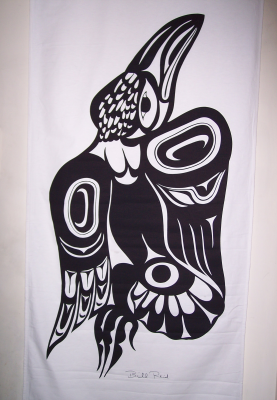
Even then, I only did so by getting into an area that the collectors haven’t discovered yet. I bought a canvas raven banner whose design is an expansion of the illustrations that Reid did for All the Gallant Beasts and Monsters, which was published in 1991. The banner was part of one of two complete sets of banners from the personal collection of Martine Reid, his widow, and was sold through the recently-opened Bill Reid Gallery in downtown Vancouver, so its provenance is unquestionable. In fact, I’ve left my email address with the gallery so that Martine Reid can give me more details about the banner.

The last stages of Reid’s development as an artist could be called his post-Haida era, in which Reid, while obviously basing his work on tradition, began incorporating more modern or personal elements into his work. The banner fits very clearly into this period.

While the ovoids and wings feathers are in the Northwest tradition, the torso, the foot at the bottom of the tail and head feathers are something else entirely. Similarly, while the twisting of the entire figure as though it is turning away from the viewer seems in keeping with the distortion of figures to fit a particular shape in classic works, Reid handles the distortion with high imagination, inverting shapes on one wing on the other, and presenting some shapes in full on one wing, but only hinting at them in another. It is as though Reid is inventing a new form of perspective that comes from neither Northwest nor modern art, although obviously drawing on both.

Raven Banner

Reid’s design is equally playful when it comes to symmetry, seeming to abandon it at first glance, but really playing some complex games with it. The body of the raven is defined by the triangle formed by the ovoids on the wings and at the base of the tail, an unusual shape in traditional art. At first, too, the body seems asymmetrical, with the left wing showing three flight feathers and the right wing four – but then you notice that the right wing’s four feathers matches the four toes on the foot and the neck feathers, and forms another triangle whose angles are an inversion of the first triangle.

Then, in contrast to this complexity, there’s the simplicity of the head, with its economical lines and the heavy beak that suggests both the classic depictions of the raven and their actual appearance.

Head Closeup

It’s a complex work, and one that could only come after decades of development, with clean lines that stand out all the more because the design is black on white.

I don’t know if I got a bargain or overpaid, or whether the purchase will prove a good investment. The price was acceptable to me, and, since I bought the work because I admired it, I don’t care if its value increases over time. But the work shows all the mastery of Reid’s last period, and I admire it hugely.

The only trouble is, I’ve hung it in our hallway, and the rest of the hallway cries out for a matching banner. So, I suspect this won’t be the only Reid banner I’ll be buying this year. But if I can get one that intrigues me as much as this one, I’ll be extremely well satisfied.

Read Full Post »

Northwest coast art is one of the healthiest schools of modern art, because it starts from a tradition yet still welcomes innovation. A juxtaposition of local First Nations mythology and the rain forest environment on one hand and advanced industrial techniques on the other, it also seems to reflect the experience of anyone who lives in the area where the artists work. For these reasons, yesterday I fought down the ‘flu that had taken root in my stomach to attend the public opening of the Bill Reid Gallery in downtown Vancouver.

Bill Reid was one of the founders of modern Northwest coast art, and his work from the late 1940s to his death in 1998 is broadly reflexive of the school’s history, starting with imitations of the past and gradually gaining originality as his confidence and knowledge of technique increased. With copies of his monumental Spirit of Haida Gwaii at the Canadian embassy in Washington D.C. and the Vancouver airport – as well as on the Canadian $20 bill – he is perhaps the best-known Canadian artist of the last forty years.

The gallery that carries his name features Reid, but, in recognition of his influence, does not confine itself to his work alone. A tribute pole by Jim Hart dominates the main gallery, and the gift shop has a large room where other Northwest artists are highlighted. Right now, the gift shop features April White, but I understand that the plan is to change the exhibit regularly.

The gallery windows are covered in semi-transparent blowups of Reid’s design, but still let in the natural light. With its high ceiling and dais for speakers, the main gallery suggests a modern version of a Northwest longhouse, the only jarring touches being the carvings around the archway and the computer screens and holograms that stand-in for pieces of Reid’s work that are not in the gallery A mezzanine allows visitors a chance to see close up the top of Hart’s pole, as well as “Mythic Messengers,” a bronze sculpture that is one of Reid’s best-known works.

Although today was the official opening, finishing touches at the gallery are still lacking. Several display cases are empty, and many are unlabeled. Nor does a guidebook or recorded tour exist. For yesterday, little of that mattered, because one or two people were giving tours, but I worry a little that the context may be lost on casual visitors.

Knowing that context is important, because otherwise the gallery might be mildly disappointing. Several of the pieces are smaller versions of Reid’s monumental works, and the change of scale makes it easy to under-estimate them. In particular, a palm-sized version of “Raven and the First Men” looks cramped and intricate where the original at the University of British Columbia’s Anthropology Museum looks spacious and simple.

Still, that is a quibble that seems ungracious when such a gift has been given to the area. With Reid’s preference for deep-carving and, in the last stages of his development, his trust of blank spaces – to say nothing of his consummate knowledge of technique and his frequent experimentation – his work consistently breathtaking. And to see so much of it in one space remains an overwhelming experience, even if his best work is not always represented. I found that I had to wander in and out of the gallery several times, just so I could appreciate all the exhibits properly. Otherwise, I would tend to wander in a sort of daze of admiration.

While I was there, I was also lucky enough to catch Martine Reid, the artist’s widow, talking about the jewelry displays. Although her French-accented English was easy to lose in the crowd, her reminisces helped to bring her husband’s development as an artist into perspective while also revealing something of his human side.

I particularly remember her story of how she bought a silver box he had made several decades previously and gave it to him as a birthday gift; he stared at it, she says, like a parent who had not seen his child for decades – then took a napkin and started polishing it.

Martine Reid also recalled that her husband used to carry a coil of wire and a pair of pliers in his pocket, and would twist the wire into shapes as he sat and talked. His “knitting,” he called it. Apparently, the habit was so ingrained that, even in his final illness, he was moving his hands as though twisting wire.

The Bill Reid Gallery is small — at least, to display an artist with such a long and varied career — but, if yesterday is any indication, I expect it will become an important center in Vancouver, not just for tourists, but for the First Nations community and art-lovers. Lingering for several hours, I completely forgot my ‘flu, swept away by the convictin that a species that can create such an artist obviously has redeeming qualities despite what you read in the newspapers.

Read Full Post »

« Newer Posts