Feeds:
Posts
Comments

Archive for the ‘Uncategorized’ Category

Forget Mick Jagger and Super Heavy. If you’re interested in British folk rock — or even aging musicians who still have their creativity intact — then the team-up of the year isn’t Jagger and associates. It’s Ragged Kingdom, the first collaborative album between diva June Tabor and Oysterband since Freedom and Rain in 1990.

That 1990 album remains a cult item, one of those rare collaborations in which the result is something that none of the participants could have managed on their own. You could hear Tabor and Oysterband lead singer John Jones inspiring one another, while the rest of Oysterband transcended their usual versatile excellence to allow Tabor to do arrangements she could never have done by herself, or even with her usual arrangement of a single supporting musician.

Freedom and Rain was also responsible for one of my most memorable concert experiences ever. It was 1991 at the night club at what was then Vancouver’s Plaza of Nations. There, Trish and I listened to two memorable sets that kept cranking the excitement higher and higher. By the encore – a deliberately campy “White Rabbit” complete with dry ice and Tabor in a leather mini-skirt – the only people that weren’t blissfully sated were the waiters, who were sulky about a crowd that had come to listen instead of drink.

Since then, Tabor and Oysterband had played together informally, most notably at Oysterband’s Big Session festivals, and done several covers of rock classics on Tabor’s On Air album. But a studio album was something else altogether, and I have to admit that I first played Ragged Kingdom expecting to be disappointed. After twenty years, how could the magic possibly be repeated?

Well, it can’t be, not in exactly the same way, even though both albums are a similar mix of contemporary and traditional pieces. However, a dozen bars into the first cut, a hard driving version of “Bonny Bunch of Roses,” I knew that I was experiencing something just as extraordinary in its own way. Ragged Kingdom has a harder sound than “Freedom and Rain” – possibly, I would say after listening to his solo album, due to Ray “Chopper” Cooper’s growing involvement in Oysterband’s arrangements – but I haven’t heard a sound with such authority since I first heard Stan Rogers at sunset at the Vancouver Folk Festival or heard Steeleye Span’s “Thomas the Rhymer” coming out of my portable radio when I was in high school.

Or in case you have different touchstones, let me put it this way: right away, I knew I was listening to something original and compelling – something that I had to sit down and listen to, not just have playing in the background as I went about my day.

All the musicians sound like they are enjoying themselves on Ragged Kingdom too much to care much about billing. However, so far as selection is concerned, the album is more June Tabor’s than Oysterband’s. None of their original songs are included. Instead, as on most of Tabor’s releases, the album has an eclectic mix of traditional and new.

Among the traditional pieces, standouts include “Bonny Bunch of Roses,” and “Judas (Was A Red-Headed Man),” two songs I believe that I have heard mentioned in passing, but whose lyrics I’ve never read, and that I have never before heard performed. Both suggest how much potential remains untapped in traditional song, “Bonny Bunch of Roses” being a dialog between Napoleon’s son and his mother about the British Empire, and “Judas” slipping in pious Christianity with decidedly pagan elements and popular tradition. Another piece, “Son David,” belongs to a well-known tradition of a dialog between a fleeing murderer and his mother, but with enough of a new slant in the arrangement to make it interesting.

The contemporary selections are equally varied, ranging from Bob Dylan’s “Seven Curses” to Joy Division’s “Love Will Tear Us Apart.” “Love Will Tear Us Apart” is especially transformed, being transmuted from Joy Divison’s quick and monotonic delivery to a slow, heart-wrenching duet between Tabor and Jones.

Ragged Kingdom has only two minor faults. First, the hard rhythm of most of the cuts could do with a little more variation. Second, “The Dark Side of the Street” seems a slightly weak ending to the album. However, I expect that these faults would disappear in live performance, and I only hope that Tabor and the Oysterband do a tour for the album in North America in the coming months. I suspect that the experience would be as memorable as the Freedom and Rain concert whose memory I still value.

Read Full Post »

One of the unavoidable facts of online publications is that you’re going to make mistakes. Mercifully, some will be typos. Others will be factual errors or passages that need to be made clearer. But no matter how carefully I or my editors proofread, the mistakes will come – in fact, I sometimes think that, the more I try to avoid mistakes, the more likely I am to make them. At any rate, when I make them, once I get over the embarrassment, like any other writer, I am left with two choices of what to do with them: redact them, adding a correction in a footnote or parentheses, or revise them, removing them from the text altogether.

Those who favor redaction argue that revision is useless, that the uncorrected original will always be available online no matter what you do. Some go further, and argue that redaction is more honest, in that you are not trying to cover up your mistakes, but leaving them for everyone to see. Ursula K. LeGuin also suggests that redaction is a feminist technique, an alternative to the pseudo-objectivity and linear thinking of traditional Western thought.

Such arguments have some validity. However, maybe it says something about my own brand of perfectionism (or maybe early toilet training) that I prefer revision to redaction.

For one thing, I’m not a fan of redaction as a reader. In all but a few cases – such as a revision of a well-known article – I react to redaction in much the same way as I react to the extras on a DVD: it’s more than I want to know. Since I suspect that many readers feel the same way, my preference is not to inflict redaction on them.

Just as importantly, redaction always feels to me like a rough draft. Worse – it feels to me that I am not living up to readers’ expectations if I redact. To me, part of my unspoken contract with readers is that I present what I have to say in as polished a form as possible.

It’s not that I’m trying to hide my mistakes – which is impossible on the Internet anyway. Rather, I feel obliged to make each article as factually accurate and as clearly written as possible. Why, I think, would readers be interested in my mistakes? If they really want to see where I went wrong, they can probably find an earlier, uncorrected version of a revised article, but at least I can make clear what the preferred text is. At any rate, that is all that most people are likely to read any way.

However, the main reason I prefer revision is that I consider redaction to be more about the writer than the topic of discussion. Look at me, redaction says to readers. Aren’t I an upright, honest person, willing to show you my imperfections and the development of my thoughts?

In fact, redaction doesn’t necessarily show anything of the sort. In one easily-locatable case, an article begins by stating that I lied. The article has been redacted several times, with an admission that the original claim was the result of a misunderstanding, but the original statement remains, and is all that people see in an online search. To my understandable ire, this is not a form of honesty, but a way of perpetuating the original attack while pretending to be honest.

At any rate, I am not interested in being a focus of readers’ attention. While I hope they want to listen to my arguments and opinions, I have zero interest in being at the center of even a modest cult of personality. To insert a claim about my personality in the form of a redaction seems only a distraction from what I have to say – and, to my George Orwell-influenced mind, anything that interferes with clear communication of my point should be edited out of existence.

If someone who convinces me that I made a mistake expresses a preference for redaction over revision, then I’ll ignore my personal preference and redact instead. But, left to myself, I’ll take revision over redaction every time. So far as I’m concerned, revision serves the argument and the readers better than redaction.

Read Full Post »

If I had to recommend a single work to would-be writers, then unquestionably that work would be George Orwell’s essay, “Politics and the English Language.” First published in 1946, the essay is dated now in its references, but no other work talks as clearly or succinctly about the purpose of writing, or gives such useful rules for accomplishing that purpose.

The larger context of “Politics” is the use of language in social situations. As Orwell had already suggested in works like Homage to Catalonia and Animal Farm (and would later explore in detail in Nineteen Eighty-Four), the essay explores how language is used to manipulate people and conceal thoughts in “the defense of the indefensible.” However, Orwell’s tone throughout the essay makes clear that he thinks such use of language is corrupt and disgusting, and should be opposed by any writer worthy of the name. So far as Orwell is concerned, a writer’s job is to communicate clearly and effectively – both as a matter of self-respect and as a duty to the language and public discourse.

Aside from dishonest intent, the main reason for corrupt language according to Orwell is that most writers and speakers don’t stop to think what they mean. Instead, they riffle through an assortment of clichés, choosing ones that approximately fit their meaning. Orwell lists the general categories of these clichés – dying metaphors, verb phrases, pretentious diction, and meaningless words – and, although many of his examples are dated after sixty-five years,  no one with any interest in language should have any trouble coming up with modern equivalents.

Talking about the role of the writer and giving negative examples would be enough by themselves to make “Politics” worth reading. But then, at the end, Orwell does something extraordinary: he reduces how to write clearly to six simple rules:

(i) Never use a metaphor, simile, or other figure of speech which you are used to seeing in print.

(ii) Never use a long word where a short one will do.

(iii) If it is possible to cut a word out, always cut it out.

(iv) Never use the passive where you can use the active.

(v) Never use a foreign phrase, a scientific word, or a jargon word if you can think of an everyday English equivalent.

(vi) Break any of these rules sooner than say anything outright barbarous.

In less than a hundred words, Orwell not only tells readers everything they need to know about writing clearly, but provides an example of  the type of writing he advocates. The result is a set of guidelines from which anyone can benefit. Considering the thousands of pages that people have written trying to explain how to write, this is an astonishing accomplishment.

One of the reasons why these rules are so useful is their flexibility. You’ll notice that Orwell does not say, for example, “Never use a long word when you can use a short one.” Such a rule would only be another type of pretentiousness, of a sort you sometimes find in Hemingway when he is parodying himself.

Instead, he says, “Never use a long word when a short one will do.” For example, if you just want to convey a general impression of size, then “big” is probably good enough. However, if you want a suggestion of humor, then “humongous” would be more appropriate. Similarly, if want to imply something out of the ordinary range of bigness, then “outsized” might be a more effective choice.

The same goes for a several of his other rules. In general, Orwell suggests, you want to use the active voice – but only when you “can.” If you have a reason for using the passive voice (for instance, to suggest helplessness, you might want to write “A groan issued from his lips” rather than “he groaned”), then do so. In the same way, a foreign expression is only valid if there is no English equivalent; use a Latin or French phrase for any other reason, and you are probably trying to sound impressive when you should be thinking of what you want to say.  Then, just to emphasize the point, he ends by urging that you ignore any of these rules if they fail to aid the clarity of thought and expression that he assumes is a writer’s goal.

If practiced, what these rules do for you is to make you think exactly what you are trying to say. Unlike the rules that other writers propose, these are not suggestions that you can apply by rote. What they really are is a set of suggestions for how to keep your purpose actively engaged while you are writing.

What makes “Politics and the English Language” so unique – and such a necessity – is that, more than any other book or essay on writing I have ever seen, it cuts through the pretenses and the posturings and the assumptions about being a writer to articulate what writing is about and to offer concrete ways to achieve the purpose of writing.

Read (and re-read) “Politics,” and when its rules become a part of your normal writing and editing, and you will understand all you need to know about writing. After that, the rest will be practice.

Read Full Post »

I haven’t written a manual for over seven years, so perhaps my opinions about technical writing don’t count for anything. All the same, I’m disappointed to see that writers are still being steered towards distractions such as writing personae I can think of little that could do more to waste a writer’s limited time or cause them to be held in lower regard.

A persona is an imaginary profile that represents one segment of your audience. The ones I’ve seen are usually 200-700 words long, and typically include not simply the segment’s subject matter expertise, but also the kind of detail more suitable for a character in a work of fiction. Age, gender, job title, hobbies, dining preferences, personal likes and dislikes – all these and more can find their way into each persona. Since the audience for technical writing can have several segments, creating personae is demanding, fun – but largely a waste of time.

Admittedly, the exercise of creating a persona can help a write fix audience segments in mind. Should they need to refresh their sense of the audience, they can simply re-read the persona. But for the most part, each of the personae that I have seen has been a nugget or two of information lost in irrelevancies.

The blunt truth is, the main facts that tech-writers need to know about their audience is their technical background and reading ability. Possibly, writers may need to know a few other facts – for instance, the audiences’ languages can affect page layout – but not much more.

And even expertise and reading ability are largely irrelevant, because, rather than trying to second-guess the audience, it’s easier to explain fully and write simply. After all, you never know who might use your manuals, or if the information you’ve received about the audience is accurate.

Under these circumstances, better to stick with the basics. After all, even experts appreciate a brief explanation of context, or may need a reminder of some aspects of your subject. Write a short, coherent explanation of the tasks at hand, and you can’t go far wrong. But spend your limited time on writing personae, and you may guess wrong or find that the context changes. In other words, writing personae just isn’t efficient time management.

My impression is that personae are favored by those who stress the writing in their job title at the expense of the technical. Desperate to have developers and managers take them seriously, they champion arcane embellishments like personae in the hopes of appearing experts and gaining the respect of those around them.

Nine times out of ten, however, such efforts fail, because they are usually made at the expense of actually learning the subject matter, and of writing and editing. The result? You’re left looking pretentious and turn in a finished manual that only reinforces everybody’s impression that you are a lightweight poseur.

If that’s your idea of being a tech-writer, fine – go ahead and fritter away your time on personae But don’t be surprised when you don’t get the respect that you think you deserve. You’ll only get that by mastering the subject matter and presenting it usefully, not by engaging in pointless intellectual exercises.

Read Full Post »

When I’m an invalid, I want reading that is light, long, and  moderately intelligent. Last week when my left knee decided to complain about its lack of cartilage, my choice was the first half dozen books of Eric Flint’s Ring of Fire or 1632 series. Mostly, the choice fit my requirements, although I have a few reservations about the books.

The premise of the series is simple: A small town in West Virginia suddenly finds itself in Germany in the middle of the Thirty Years’ War. With its technological edge, the town rapidly becomes a major power, allying itself with Gustav Adolphus of Sweden, and history begins to change. Originally a single book, the series has expanded as Flint has thrown open the series to other writers and encouraged fan fiction set in the same universe.

Beyond the actual pages, the series is also interesting because Flint is one of the first science fiction writers to see the possibility in ebooks and free downloads. Although he doesn’t go so far as Cory Doctorow and make all his books available for free downloads, Flint has seen the advantage of releasing his earlier works to keep them available, which means that the first two books in the series are free ebooks.

The series’ attractions are not stylistic ones. Flint and his growing list of co-authors are competent writers at best, and fall into the category of storytellers rather than artists or even strong plotters. Not that there is anything wrong with that; I respect an intelligent light read, and appreciate one in certain moods, such as coming home on public transit at the end of the day or — as recently, when I was doped on ibuprofen.

Rather, the series is interesting for two reasons. First, it deals with European history, a topic that most of his English-speaking audience is likely to know little about. Since the era includes such larger than life characters as Gustav Adolphus, Oliver Cromwell, and Cardinal Richelieu, there is plenty to entertain and inform, although obviously these characters soon start acting in non-historical ways. However, if you do know the characters who appear on its pages, then seeing where and how they depart from our history becomes intriguing – all the more so since Flint and the other writers largely resist the temptation to make antagonists outright or villains.

Second, the early books of the series focus on the West Virginian’s survival strategies. Their technological advantage is limited because they lack the infrastructure to support it, so much of their planning involves figuring how to downgrade their knowledge – for example, they decide to focus on 19th Century firearms rather than modern ones. These survival efforts are all the more interesting because the emergent leader and many of his supporters are unionists, and express a vision of the future that is more idealistic than the conscious or unconscious free market philosophy of most American science fiction.

However, as often happens when you read a series (or a chunk of it) in one sitting, The Ring of Fire series soon reveals itself as formula fiction. Each of the books I have read in the series revolves around a plot against the West Virginians by political opponents. Through devious means and native ingenuity, these opponents seek to even the technological odds against them, but, although these efforts keep the books from being a completely adolescent power fantasy, there is never much doubt that the moderns and their allies will win, amalgamating their noble enemies and forcing the rest into retreat. In other words, American imperialism is still very much a part of these books — even if it is a liberal imperialism — and the outcome is never much in doubt.

Another problem is that the scenes in each book tend to be one of two kinds: talking heads – often politicians – and loving descriptions of battles and action that I can only describe as war-porn.

I can mostly endure the talking heads, although I wouldn’t mind more variation in technique. However, the war porn soon becomes tedious.

By “war porn” I do not mean graphic, nauseating descriptions of violence – which are mostly absent in the series – but a devotion to action sequences for their own sake. For the most part, battles in the Ring of Fire series are not described to give background to individual characters’ actions or to make clear why other events are happening, the way they are in Bernard Cornwell’s Sharpe series. Instead, from the tone and the undue length of the descriptions, I get the impression that readers are assumed to be as fascinated with the descriptions as the writers are. I’m not, and often amuse myself in them by deciding which scenes could be deleted and thereby speed up the pace of the books.

Yet another problem is the depiction of women. The series is by no means overtly sexist –  although so far, no one has mentioned how family planning might fit into the priorities of the stranded moderns. Rather, the depiction of women tends to be token and limited. With no exception that I can readily recall, major female characters tend have one-note in a way that the male characters don’t: One is an old activist, another wise, another full of revolutionary fervor, and so on. Mostly, too, they tend to be introduced in a quirky love story, after which any attempt to develop them comes to an abrupt halt. I suppose that Flint and the others deserve points for trying, but I’d still like to see one of them tackle a story about a woman with her own concerns someday.

Some of this criticism is probably due to an overdose. After all, no series is supposed to be read over a few days. Still, while I will probably return to the series some time when I want intelligent light reading, for now I find myself in no great hurry to do so.

Read Full Post »

Twenty years ago today, Linus Torvalds sent the announcement that announced Linux to the world. The Linux Foundation has promoted the anniversary all year, displaying memorabilia and holding a Roaring Twenties theme party ( much to the evident embarrassment of Torvalds, who was conspicuously absent at LinuxCon when invited to take a bow.) – and it’s fitting that the free software ecosystem that has grown around Linux should be celebrated. However, amid all the self-congratulations, I think it’s worth remembering that what is being praised is the goal more than the reality.

I hate to insist on this cold splash of reality, I really do. Although I wasn’t around at the start, I have been involved in free software for twelve years, and I share the dream. For me, free software is as important a part of activism as recycling. One way or the other, it has been my major source of income for most of those twelve years. The community of free software is where I’ve found a modest dollop of fame. Moreover, as I rediscovered at last week’s LinuxCon, where I seem to have spent three days shaking hands and renewing old acquaintances, I feel at home in the community, and many of my closest friends come from it. So, when the keynote speakers on the first morning stood up and celebrated the accomplishments of free software, I was moved in much the same way as other people might be moved by the national anthem of their country.

And yet –

Something whispered in me that the keynotes at Linuxcon were just a little too self-congratulatory. I couldn’t help thinking that the rhetoric of co-operation was sometimes being delivered by the representatives of corporations famed for their cut-throat business practices. I thought, too, of how, despite everything that the free software ecosystem has accomplished – often contrary to the predictions of old-school business and development experts, much to my delight – the community seems to have balked at taking the final steps, putting up with cost-free drivers rather than pushing for free-license ones.

But the largest gap between rhetoric and practice came in the description of the community. The gospel was preached most vividly by Jon “Maddog” Hall.

Hall is a seemingly endless source of friendliness and good will, and part of me hates to contradict him. All the same, I had to raise an eyebrow when he proclaimed – as he had already done in his blog :

I am proud of the Free Software community in embracing diversity. And finally, it is lucky for me that the Free Software community also embraces older people…..

No one asks these programmer/entrepreneurs their age, their race, their religion, their sex or their “sexual orientation”. No one asks them if they were physically challenged, what country they came from, or their political views. No one told them “don’t go there”, “don’t do that”, “you are too young”, “you are too old”, “you are just a…” or “you can not succeed”…..because (as one of my favorite cartoons points out) “on the Internet no one knows that you are a dog”.

All the Free Software community says is “show me the code”.

It’s a wonderful dream, Jon, and I hope that one day it comes true. But read the Geek Feminism wiki, and you soon realize that it isn’t true yet. Pornographic presentations, the litany of sexist bloopers from one community leader after another, the knee-jerk, foul-mouthed hostility to even the suggestion that more should be done to encourage the participation of women – it all buzzes around in your head like loud music when you have a hangover. Before long,  you are forced into the realization that, unfortunately, the community does not always embrace diversity, and that portions of it care very much who you are. In fact, they care so much that they will do their best to prevent you from contributing your code no matter how well-written it is.

Taking time to appreciate the accomplishments of free software is only right. It’s a working community, and many of us don’t take enough time to appreciate what’s being built a bit at a time. But what Jon and the other Linuxcon keynote speakers praised was the ideal, not the way things are.

So, while we should celebrate what is after all a unique accomplishment, let’s also take time to remember that the accomplishment isn’t finished yet, and that we’ve collectively fallen short of the ideal. Forget that, and we risk always being less than we could be and betraying ourselves.

Read Full Post »

Maybe it’s a character flaw, but nostalgia for a technology puzzles me. My bewilderment has last all my adult life, and now, with the all the sentimental preference for paper books over ebooks, it returns to me stronger than ever.

I first became aware of other people’s technology nostalgia when I jumped from a typewriter to a word processor. Did I miss working with carbon paper, or having the choice of redoing a page because of a spelling mistake or getting liquid paper all over everything? Not for a moment. Revision was so much easier on a computer that I barely looked back. The IBM Selectric that I kept in a back closet just in case languished in obscurity for a decade before I realized that I would never use it.

Yet much to my surprise, many people started romanticizing the typewriter. I could understand veteran writers who after several decades were reluctant to mess with their creative processes. But other people insisted that the hum of the computer kept them from concentrating (apparently the even louder hum of an electric typewriter didn’t). Their thoughts, they insisted, were geared to the tap of the keys (as though a century of using typewriters could have produced any significant natural selection in favor of them).

Soon, distressed typefaces that mimicked typewriters with old ribbons or out of alignment keys became a fashion in graphical design. You still see these typefaces occasionally today, a sentimental attachment to all the inefficiencies of the old technology added with more ingenuity than sense to the new technology.

Now, with journalists constantly trumpeting the death of the paper book, the same thing is happening. Suddenly, people are forgetting the tendency of paperbacks to fall apart after one reading (assuming pages didn’t start flying away before then), and talking about the shape and construction of the book – which is largely an accident of cheap production – as something to get sentimental over. Again, I wonder what they are rattling on about.

Not that ebook readers are perfect technologies. You have to learn exactly how hard to tap a paper if they use a touch screen, and how often to refresh so that you can turn a page without a pause interrupting your reading. Every reader, too, could use twice the resolution, even if they have improved considerably from a decade ago. I admit, too, that the end of the standard two page spread leaves me wondering what to do with my spare hand, and that a single page looks odd to my typographically-trained eye.

The mistake that people make is imagining that the medium is the book– which isn’t true for either paper books or ebooks. If it were, then to get the full experience of Catullus or Cicero, we would have to read them on papyrus scrolls. Shakespeare would have to be read on vellum, and Jonathan Swift and George Eliot on rag paper. All of these are simply media.

The book – the play, the oration or the novel – is the words and how they are put together. And that doesn’t change, regardless of whether we read a clay tablet or have the words beamed directly into our brains. If we remember a particular technology fondly, I suspect that it’s because we transfer the pleasure of the words to the medium in which we read them.

Personally, I neither welcome nor decry the rise of ebooks. They have their points, such as reduced storage space or the ability to change fonts, but that’s not what I notice when I read, any more than I notice the convenience and portability of paperbacks, or the smallness of the loss if they fall into the bathtub. When I read, what I notice is the story or the arguments, and the skill in word use. Should I live long enough to see ebooks replaced by something else, I’ll use that something else, just as I use ebooks now.

Like those who romanticized typewriters, the people currently anticipating the end of paper books have lost sight of what’s important when we read. Maybe they’re just afraid of anything that’s new, but the medium is a minor issues so long as we can read without being distracted by inefficiency or inconvenience. What matters is the words. Always.

Read Full Post »

Widowhood is a state of transition. It’s the time when you decide what you are going to do after the most important relationship in your life is gone. Or, to be more specific, it’s the time when you decide whether you are going to risk another relationship, or spend the rest of your life solo. Fourteen months after Trish’s death, that’s a decision I haven’t made, but, what most people don’t understand is that if I end up alone, I wouldn’t be overly disturbed by the outcome.

This fatalism has nothing to do with a morbid nostalgia. Trish and I met a month after her first husband died, and became a couple two months after that, so I don’t feel any need to stay loyal to her memory. In fact, several times, she told me that she hoped I would remarry if she died. So, if anything, I suppose I should be trying to meet people.

But the truth is, while one or two intriguing possibilities exist, I don’t need a relationship merely for the sake of a relationship. I’m comfortable with my own company, and as a writer I need a degree of solitude each day regardless.

Part of my attitude is my hyper-awareness of a fact that is obvious, but that no one likes to emphasize – namely, that a relationship ends with one person either leaving or dying.. As you get older, the possibility increases that the end will involve a death. I would rather not face the other person’s death, and I am no more eager to leave her facing my death and having to settle my affairs.

As time passes, this reluctance will probably fade, of course. But the truth is, I just don’t have the pressure to be in a relationship that people younger than me have. When you’re in your twenties or early thirties, being married or in a common-law relationship is a mark of maturity and independence. It can be a way to settle any lingering doubts you have about your sexual orientation. Most of all, it’s something everyone does, which often panics people into bad relationships, just so they don’t feel left out or appear odd. To be young and single by choice takes great strength of character because a more or less permanent relationship is part of what you’re supposed to want or do.

But at my age, the situation is different. I’ve paid my own way since I was eighteen, so I have nothing to prove. I long ago discovered I was a straight male with eccentric ideas about gender roles and an indifference towards them. Nor, for some reason, does modern industrial culture have many expectations about widowhood and its aftermath.

If I were still married, no doubt I would feel the pressure of the expectations placed on long-married couples – but suddenly, and through no wish of my own, my possible choices are broader than they have been since high school. I don’t have to rush to decide whether I should be single or committed, because the decision doesn’t matter except to me and any woman with whom I might be involved.

And if I do end my days single, so what? I’ve had a relationship that was better than any I see around me. That’s not just my opinion or the distortion of romanticism, either – I lost count years ago of the people who said that Trish and I acted like newly weds or who were surprised that we were polite to each other (as though politeness was something you owed strangers, and not those you loved), or how we consulted each other about mutual decisions.
Should I never be in another serious relationship, I’ve been in one that people envied. So why should I settle for anything less?

That would be the real betrayal of my past – not staying single for the next three to five decades, but blundering into a relationship because when I’m tired or not sleeping I feel lonely. I owe the memory of Trish better, and I owe myself better, too.

Read Full Post »

Shawn Patrick Aster’s “Raven Turns the Crows Black” has a longer history than most of the art in my townhouse. Aster took over two years to deliver it, but I consider it well worth the wait.

Aster’s work was brought to my attention by another artist in late 2008, as someone whose work was admired even by master carver Dempsey Bob. I immediately commissioned a piece from him, wanting an early piece from an already skilled artist who seemed sure to make a name for himself.

A few months later in April 2009, when I attended my first year end exhibition for the Freda Diesing School, I was amused to see that others gave Aster’s work no special attention – until he won two awards. Moments later, all his work in the show had sold.

But the commission had progressed little. Aster seemed nervous (I believe it was his first commission outside his family and friends) and couldn’t satisfy himself with the design. A month later, I bought “Raven Heart” from him, but I was still waiting for the commission.

By the next year end exhibition, Aster was looking distinctly apologetic when he saw me. Jokingly, I started referring to him as “the most promising artist” I knew, since he had promised the piece for over sixteen months – although I made clear that I was more than willing to wait. Secretly, though, I had decided he was unlikely ever to deliver. I was disappointed, although I bought other pieces from him.

Then, last March, Aster told me on Facebook that he had finally completed the design. It had apparently changed since he first started designing it, but I was happy to see it. I paid indirectly at the 2011 year end exhibition, and it was delivered by Aster’s fellow Freda Diesing graduate Todd Stephens at the YVR Art Foundation’s reception in May – a good deal of which I spent showing the piece to others and worrying that food might be spilled on it.

“Raven Turns the Crows Black” depicts an episode from the Haida epic “Raven Traveling,” a work that  many now consider the common heritage property of all First Nations people on the northwest coast. In the story, Raven the Trickster sees crows roasting a salmon on the beach. They agree to share the food, and Raven falls asleep while he waits for it to cook.

Unwilling to share, the crows devour the salmon. Belatedly worried at what Raven’s reaction is going to be, they put crumbs of the salmon meat on his clothes and between his teeth. When he wakes, they try to convince him that he ate before he slept, but Raven in his anger throw them into the fire, from which the survivors emerge forever singed and black.

Aster’s rendering of the story makes for a unusual design in what is already a tradition apart. Shared by several northwest coast nations but possibly Tsimshian in origin, the Chilkat style is based on weaving patterns. The style is constrained by the limits of weaving, so it tends to consist of discrete blocks of design, rather than the flowing formline found in painting and carving. This tendency makes it both geometric and highly abstract.

Aster’s design shows Raven in the center, his teeth bared (and if you ask why Raven has teeth, I can only reply, why does the parrot in Aladdin? Although, probably, Raven was in human form in the story, shape-changing being his most common power). I interpret the design as showing Raven in two states: in the middle, hungry and asleep, with his wings folded, and at the top center, angry and awake with his wings outstretched.

On the left are the white crows, on the right the black; like the raven, their wings and other features are abstracted into blocks of forms. The designs on each side are not quite symmetrical, with only the outlines of the heads to suggest the transformation in the story.

The background includes the characteristic Chilkat blue and yellow. However, to suggest the fire – and, perhaps, the salmon meat and Raven’s anger – Aster adds red to his design. Although I am far from an expert in Chilkat design, I have never seen any other Chilkat design use red. However, Aster’s innovation succeeds, largely because the red is relatively dark and sparingly used.

The result is one of the most bold-looking pieces of art in my collection. And while I admit that I grew impatient while waiting, I’d gladly wait another twenty-eight months for another work that is equally striking.

Read Full Post »

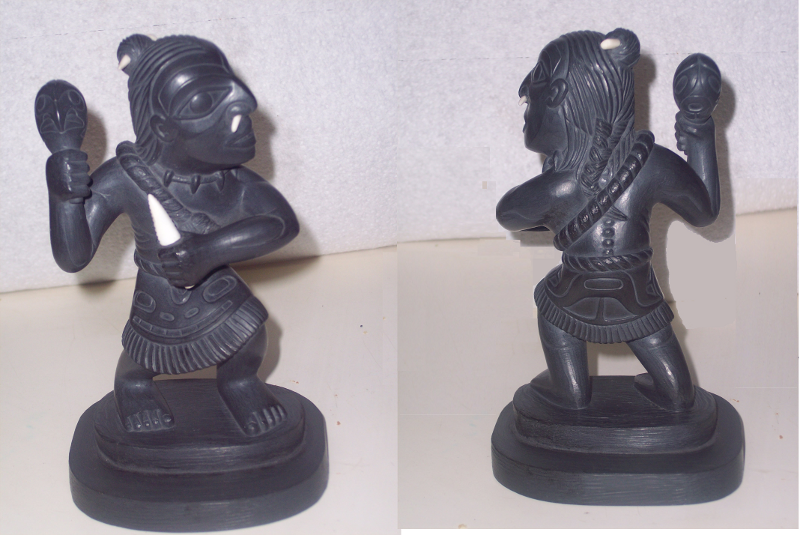
I’m at the point where I tremble when Gary Minaker Russ comes to town. I know that he will have at least one outstanding piece of argillite to sell, and that if I so much as glimpse it, I will be unable to resist the temptation to buy it, even if I can’t really afford to. That’s the story, really, of “Haida Shaman,” the latest piece I’ve bought from him.

When Russ first brought it to town, he sold it to the Inuit Gallery, where I admired it regularly. But no one bought it, and Russ prefers not to have his work languish for too long in a gallery. So he swopped it for his latest piece, and when we met at the Rhizome Cafe that afternoon, he hadn’t resold it.

A quick trip across the street to the bank machine, and it was mine, the balance to be paid  over the next month. One nervous Skytrain trip later, I had it beside my computer workstation.

“Haida Shaman” is a traditional piece. I mean that description in two senses, both complimentary. First, the pose is one that has been widely used throughout the hundred and eighty years of recorded argillite carving (as opposed to the unknown amount of time – decades? centuries? millennia? — that argillite may have been carved far more rarely, before it became one of the first cultural exports for the Haida).

The proportions, with the head a third of the body height, and the stance, one arm uplifted and the other in front of the chest, can be seen in any number of pictures, if you search libraries or even the Internet for pictures of argillite. So, in one sense, Russ is working in a very set subject, in much the same way a Renaissance European painter would be when painting a Madonna and child.

What you won’t see – at least today – is this pose done in the amount of detail that Russ has lavished on “Haida Shaman.” You’ll see the basic proportion and posture, yes, but not the detail. Most modern argillite carving is closer to engraving. It is covered with embellishments of inlaid precious and semi-precious stones, with the shapes hinted at rather than fully developed.

In several  pieces, the result is so abstract that only the posture is recognizable and there is little else to indicate that a shaman is depicted. The modern argillite market does not reward taking pains, and, in too many cases, the quality of the carving has declined while the cost of the raw materials have sent the prices soaring.

By contrast, “Haida Shaman” shows the attention to detail that I associate more with nineteenth century argillite pieces. Russ himself describes it as being more in his original – and preferred – style, and not the simpler style he has moved towards in the last decade and a half in order to make a living as an artist in an increasingly obscure art form.

This is the second sense in which the piece is traditional – in the pure sense of craft that has gone into it. For a style that is only partly representational, “Haida Shaman” packs an extraordinary amount of detail. Some of it may be hard to see in a picture, but the carving is full of realistic detail like the definition of the muscles on the arms, or the braiding of the rope the shaman wears, or the mass of hair in his topknot. I joke that the sculpture is a “traditional Haida action figure,” but behind that rather flippant comment, there is nothing but respect for the care that has gone into it.

These details are enhanced by the sparing use of ivory to contrast with the darkness of the argillite. Unlike many modern argillite carvers, Russ has not produced a gaudy piece, valued largely for its inlays. Nor has he added so many inlays before starting to carve that they get in the way of the detailing. Instead, the ivory appears where it doesn’t hide or overwhelm the details. It is used sparingly, with a restraint that allows it to work with the argillite, rather than against it.

You might say that “Haida Shaman” is an artist’s piece, done to satisfy Russ’ sense of how he should be working, with little regard for what sells. I am not in the least surprised that it didn’t sell while on display because, amid the other argillite extravaganzas available in the local galleries, “Haida Shaman” is an understated piece, with an emphasis on the craft of carving.

It’s because of pieces like “Haida Shaman” that I secretly look forward to Russ’ visits to town, not knowing what wonders he will quietly unwrap to tempt me with. I only know that most of what he brings to town will be wonders, and I will be tempted to bring at least one of them home.

Now, if I only didn’t have to explain that I wasn’t buying from a drug dealer when I deposit large sums of cash in his account, I would have nothing to complain about. I am both soothed and honoured to have pieces like “Haida Shaman” in my townhouse.

Read Full Post »

« Newer Posts - Older Posts »