Feeds:
Posts
Comments

Archive for the ‘Uncategorized’ Category

A few years ago, I posted a recent picture of myself online. I only meant it as a placeholder until I could get a better one, but I got busy. The picture became the social media equivalent of those dusty cars that strangers write, “Wash Me” on, and one acquaintance even offered to shoot a better one for me. It was only a few weeks ago that I realized that, with my book, Designing with LibreOffice, coming out, I needed something more professional, and arranged a professional shoot with Sara Paley Photography. It turned out to be one of those surreal experiences that pop up in my life from time to time.

Because my book used pictures from the Sun Yat-Sen Garden, to draw an analogy between feng shui landscaping and typography, I wanted to get the photos of me from the same location. However, Vancouver was in the rainy season, so finding a suitable day was difficult. Once, we tried to squeeze the session in during a break in the clouds, but I forgot to tell the photographer that the Garden is next to a public park, and we wasted time waiting for each other in different places. I also found out that I now needed a permit to shoot in the Garden – and that, naturally enough, since it was a Sunday, the person who could give permission was not in the office.

Ten days later, armed with a permit for an hour, we tried again. As I had suspected, the garden was a natural place to shoot, with arches and doors and windows, even trees and rocks, to frame shots naturally. Moreover, Sara was such a thorough-going professional that I soon lost my sense of the ridiculous as I tried to follow her directions for positioning myself.

What we hadn’t counted on, though, were the people.

To start with, when people see you posing for picture after picture, they immediately assume you must be someone. As I posed for shot after shot – which is much harder psychologically than I would have expected, and, to a much less degree, hard physically as well – I was constantly being distracted by people lingering as they passed, staring to see if they should recognize me. The idea was ludicrous enough to make me want to giggle.

To make matters worse, halfway through the session, the Garden was invaded by a day camp of about sixty eight or nine year olds. No sooner would we get the shot set up than the children would troop two by two between Sara and I, staring at both of us. I would try to hold my position but the children were not rushing, and at least twice, I couldn’t.

When I couldn’t, we would line up the shot again – just in time for the kids to return the way they had come. Again, giggles were a clear and present danger.

And again.

And again.

Somehow, we persevered, and the results were satisfying, even if my first reaction was to wonder how I had grown so old, and when my cheeks had become so chubby. But the process itself appealed to my sense of the ridiculous in ways I hadn’t expected.

 bruce-against-the-wall

Read Full Post »

I always appreciate recognizing talent before anybody else. What interests me is not so much the potential for a piece done early in an artist’s career to increase in value (since I never sell what I buy) so much as the satisfaction of recognizing talent before anyone else. So when Kelly Robinson, one of my favorite Northwest Coast artists, told me in December that he was teaching his brother Randall to carve, I was immediately interested in the results. And, given his selection of materials and the finish on “Rainwater,” in Randall James Robinson’s case I am already experiencing that satisfaction in the reactions of those who see the mask.

“Rainwater” is one of Robinson’s first masks. The carving is relatively simple, but a good choice for the material. The mask is carved from spalted alder – that is, alder infected with a fungus that discolors the wood. The discoloration apparently does not photograph well, and is actually much smoother-looking than it appears to be in the photo below, but the point is that the spalting is so interesting in itself that too-elaborate carving would be a distraction, especially since the spalting’s long lines of discoloration suggests long trails of rain running down the mask.

Robinson tells me that he got the wood from Gordon Dick, the carver and owner of the Ahtsik Gallery near Port Alberni, who produced the spalting, but found that it set off allergies when he tried to carve it.

Robinson is carving in the Nuxalk style. The Nuxalk have traditions that are vastly different from those of the northern first nations, such as the Haida, Nishga’a,Tsimsian, Tahltan. If I understand correctly, one of the major Nuxalk ceremonies is the thunder dance, which celebrates “the greatest of the supernatural beings in Nuxalk culture.” The thunder dance tells of four brothers’ encounter with the spirit of thunder on a lonely hillside, and is apparently the origin story of a major Nuxalk family.

I have seen the thunder dance performed several times by Latham Mack, who has carved a couple of thunder masks. However, I have never seen the rain-water dance, which is performed before the thunder dance. During the rainwater dance, the dancers sprinkle those watching with water as cleansing ritual. “It’s the bringer of rain before the thunder,” Robinson tells me, meant “to cleanse the earth before thunder.”

Since the entire coast is a rain forest from the American border to Prince Rupert and beyond into Alaska, a rain spirit seems only appropriate to a local culture. In the same way, “Rainwater”’s use of spalting to portray that rain spirit is a choice that speaks well of Robinson’s developing artistic sensibilities. Like any newcomer, Robinson has endless hard work and learning ahead of him in order to have an artistic career, but this early effort suggests that he has the talent to succeed if he chooses.

rr

Read Full Post »

In “The Naked and the Nude,” Robert Graves points out that, while the two words are generally treated as synonymous, he personally makes a distinction. To him, the naked are honestly and unconsciously clothed, while the nude are sly exhibitionists. In the same way, I make a personal distinction between “author” and “writer,” two words that in theory have the same meaning.

The distinction is more than academic to me. For thirteen years, I have made a living mainly by selling my writing, and I have had both “author” and “writer” used to describe me. However, over the years, I have come to prefer “writer” and to use it to describe myself while shying away from “author” altogether.

Part of my preference is due to the fact that “author” carries more weight to my ear. To me, authors are people who write books, and, although I have one book to my credit – my reworked master’s thesis – that was twenty-five years ago, and the rest of my publications have been articles or at the most chapters in other people’s books. Nor am I the only one to define the words this way – wannabe writers, I notice, usually prefer to call themselves “authors,” given even a small justification.

However, for me, “author” sounds too grandiose. As the first syllable suggests, both “author” and “authority” have a common origin in the Latin word “auctor,” whose various forms can mean “promoter,” “originator” as well as “expert” or “holder of power.” In other words, an author is someone who originates thought, or is the source of others. Echoes of this meaning can be read in Mathew 7:29 of the King James Bible, where Jesus is described as having “taught as one with authority, and not as the scribes” – that is, as someone with original ideas, and not someone simply repeating what others have said or someone making a scholarly article full of citations.

To claim to be an author, then, would seem to be a declaration that nobody has had thoughts similar to mine or expressed as well as mine, and that people should therefore listen to me. Yet while that should be the level of excellence to which I or any other writer should aspire, I feel uncomfortable making that claim for myself. If made at all, such claims are the rights of readers. Undoubtedly, too, the pressure of deadlines and the effort to make a living has encouraged at times to write at least than my best. In fact, I am sure that the distinction between original writers and the rest of us is not nearly as clear as the word “author” possibly implies.

By contrast, “writer” is a humbler term. It simply means someone writes, with no reference to quality or originality – and that I unarguably do. For that reason, I prefer to express no pretensions, and simply call myself a writer instead of an author.

Read Full Post »

Early in high school, the girl I had a crush on started going out with a friend of mine. I sat down and wrote all the possible outcomes of their relationship, assigning each a percentage of probability. I never showed her my calculations, but I consoled myself with the certainty that the relationship was doomed. After all, I had proved it.

My bias was obvious, of course. However, I was also guilty of reification – the mistaken belief that meaningful numbers could be assigned to abstractions like the probability of a relationship lasting.

Looking back, I can only plead wishful thinking and over-confidence in my own intellect.

However, I am far from the only person to fall prey to reification. For instance, as Stephen Jay Gould points out in The Mismeasure of Man, IQ tests as they are used today presuppose that intelligence – usually labeled g – is a concrete entity that can measured as easily as the length of a person’s foot. In fact, as Gould points out, statistical analysis can make g appear and disappear at will, a sure indicator that it does not exist. Yet for over a century, the future of millions of children in North America has been determined partially by their IQ scores.

In the same way, many online dating sites attempt to match people by asking them questions about their habits, tastes, and preferences. By comparing your answers with other people’s, the sites claim to be able to find a match for you. The sites’ implicit claim is that the concept of attractiveness or compatibility – or incompatibility, since it is often given a value as well – can be reduced to a percentage.

Unsurprisingly, most people find the results only the roughest guide to compatibility. Aside from obvious differences such as being an atheist and a practicing Catholic, a high percentage of compatibility gives little indication of who will be attracted to whom. In fact, I have met more than one person who refuses to date someone with whom they are supposed to have 90-100% compatibility, because, counter to the implied prediction, they have found themselves uninterested in such alleged soul mates.

I have heard of at least one person who tries to get around such limitations by keeping their own records of what they think of the people they meet online. Unfortunately, though, do-it-yourself reification is no more reliable than the institutionalized version. To rely on either is to base decisions on figures with only an imaginary significance – and, in do-it-yourself reification, to have a naively exaggerated faith in your own powers of analysis. That’s fine if on-line dating is a hobby, but otherwise you might just as well rely on your horoscope.

Reification is just as much a fallacy as a non-sequitur or a post hoc argument. However, just because it deals with abstractions doesn’t mean that it’s harmless. So far as clarity of thought is concerned, it can be a serious danger.

Read Full Post »

Generally, I avoid auctions, in case I get carried away and spend more than I can afford. Recently, though, I found myself caught up in an online auction for a piece of art I admired. What tempted me was not the excitement, nor the sense of competition, but the sense of tactics involved.

The auction was to raise money for a woman so that her children could have a Christmas. I happened to discover the auction while there was only one bid, so I add a hundred dollars to it in the hopes of stimulating the bidding. A few hours later, another bid added fifty dollars to the total, and I responded with another fifty – and so we went, trading the high bid back and forth in increments of fifty dollars.

The next morning, my rival had the high bid. When I added another bid, they soon added another bid. The auction was due to end at noon, so I figured it was time to get crafty.

The first thing I decided was that to add a bid too early would only drive the price up. Given the good cause, I was prepared to do that, but I was also determined to keep my bids within the limit I had set. So, instead of instantly adding another bid, I waited an hour. My rival responded within ten minutes with another high bid, raising the total by another increment of fifty dollars and confirming my assessment of the bidding pattern. I decided to wait before replying.

The second thing I decided was that I would bid with less than a minute left, to make a counter-bid less likely. However, my rival could easily do the same, even though they currently had the high bid. Accordingly, I decided to bid an extra sixty dollars, breaking the bidding pattern and, with any luck, emerging with the high bid.

I delayed my bid as planned, but I was worried that a difference in clocks might defeat me. With forty seconds to go, I could wait no longer, and placed my bid as planned.

As things happened, I cost myself ten dollars. My rival tried to enter a counter-bid, but it only increased the price by fifty dollars. I responded with a bid one dollar higher, but I had barely posted it when the holder of the auction announced that the last two bids had been submitted after the end of the auction, making my bid with forty seconds to go the successful bid.

Later, I heard that the funds from the auction came unexpectedly, and exactly when the recipient needed them. The next day, too, I received a pleasing piece of art, as well as candles, cards, T-shirts, and a couple of books of the artist’s work.

Both these outcomes pleased me, but what surprised me was the satisfaction I took from my winning tactics. While some of my tactics were unnecessary, together they ensured success, and I remain immodestly pleased with myself.

All the same, I don’t think I’ll enter another auction any time soon. Devising tactics – especially successful ones intrigue me too much for my own good. But at least I know now where the danger in auctions lies for me.

The next time I’m near an auction, perhaps I’ll see if watching other people’s tactics is anything like as satisfying as developing my own. However, I’m not sure if I can trust myself not to leap in, so I’m probably better avoiding auctions altogether – in only because, at an auction of any size, people with more tactical experience than me are sure to be bidding.

Read Full Post »

I expect to like the people I meet, and I am always surprised when they do or say something that makes me re-evaluate. Last night, however, I met a man who took an instant dislike to me for no obvious reason.

He was at least a decade older than me, and overweight. Loneliness rolled off him in waves, and most of his conversation was self-centered and querulous. We were the first of a party of half a dozen to arrive at a restaurant, so while our table was readied, I sat down beside him near the entrance, ready to make conversation.

I didn’t exactly get grunts in reply, but I might as well have. The conversation, as P. G. Wodehouse once wrote, flowed like cement. After I made several efforts at conversation, he started talking about how our table would never be ready in time, because all the large tables in the restaurant had just had people seated at them. I could have pointed out that diners were just leaving one, but instead I shrugged and said we still had some time.

From his reaction, you might have thought I had sworn at him.

Giving up, I stood and went outside, preferring the sub-zero temperature to the chilly reception I was getting from him. When our party arrived, he started complaining about the prices on the menu, although all except one were modest by local standards. Thinking to help, I pointed several of the cheaper items, and he glared at me as though I had just vomited on his shoes.

After these preliminaries, I made sure to sit as far away from him as possible. Fortunately, the group was large enough that there were usually several conversations going on at once. However, he interrupted everyone to complain about the prices again, and to tell a long, rambling story to explain the difference between winter tires and snow tires.

That story segued into how he had got his tires installed for free. If his luck gave him any pleasure, it never showed on his face. Later, while everyone was exclaiming over the food, he complained that his burger was dry and the rest of the mean was inadequate while the rest of us were exclaiming in delight.

To increase my already low standing with the man, I had to interrupt several of his stories so the overworked waitress could give us some advice, and later take our orders. At each interruption, I was treated to a glare hot enough to melt wax.

Despite my puppy-dog assumptions, I am old enough to know that I can’t please everyone, and usually I don’t worry too much if someone takes exception to me. Yet in this case, his reaction puzzles me. We had never met or talked, and, so far as I was concerned, nothing was at stake that was more important than fine dining and getting to know new acquaintances.

Did he resent that I was relatively younger and – to a casual glance – in better health than he is? That I was playing the extrovert that evening, joking and trying to draw people out? Could I possibly remind him of someone – perhaps someone who had deep-fried and eaten his cat when he was a boy?

I doubt I will ever have answers to these questions, and no great loss if I don’t. Still, I felt like he had cast me in a play without bothering to offer me a script – and projections like that make me distinctly uneasy.

I don’t mind if people dislike me, but I do prefer to know why. Usually, people don’t take such a dislike to me unless I have set out deliberately to insult them.

Read Full Post »

Cody LeCoy is a young First Nations painter. Mentored by Lawrence Paul Yuxweluptun, he favors a surrealist style that has given him some mainstream success. However, to my eye, his painting are at their most original when he applies surrealism to First Nations tradition, as he does in “Mouse Woman, Keeper of the Neighborhood.”

Mouse Woman is a figure that has young artists today are fascinated by. The truth is, however, is that little is known about her, not even how she was depicted traditionally. What is known is that she is the helper of heroes, often meeting them on their journeys as a mouse in need of assistance, then re-appearing as a woman of high status who gives them shelter for the night and wise advice to take away with them. I think of her as the opposite of Raven, a guardian of the community against his individualism, a force for order as opposed to his chaos, and a preserver where Raven is both a creator and destroyer.

“Keeper of the Neighborhood” was hanging at a pizza parlor when I saw a picture of it in LeCoy’s mail out. I immediately arranged to meet him there, and arrived early, sitting next to the picture while I waited, as though to ward off any other potential buyers. I came home with it wrapped in garbage bags, during a break in the rain, getting it indoors again just before the rain returned again.

According to my interpretation, the painting is based on the idea that Mouse Woman continues to watch over the community of the First Nations, even when most of it is living in the city. In the upper left corner, she appears in her mouse form, looking fierce with hunger, and nervous. Her other form dominates the painting, her dual nature suggested by the difference between her right and left eye and her narrow, bony fingers, which holds a sphere up where she can view it more clearly – a sign that she is still a protector of her world.

Technically, what I admire about the painting is that it is painted on plywood. The color of the plywood is blended into the painting so well that, until I saw it up close, I had no idea that the brown of her face was actually the bare plywood. The rest of the painting is full of bristly strokes that appear layered from a distance, and add a sense of restlessness that fits into the concept of a guardian from the past uneasily continuing to carry out her responsibilities in a very different cultural setting than the one where she began – one that is perhaps potentially dangerous, and where she does not naturally belong, except that her people have moved there.

Just as in”Ridicule Mask,” the other painting by LeCoy that hangs on my wall, “Mouse Woman, Keeper of the Neighborhood” takes a traditional theme, and applies it to a modern setting, using a non-traditional style. I admit to a weakness for surrealism, but in these paintings, LeCoy produces a sense of tension and restlessness all his own. I look forward to watching where his talent takes him next.Mousewoman.JPG

Read Full Post »

I always keep a close eye on the statistics for my blog. I’m not very concerned about sheer numbers, but I am fascinated by the location. Looking at the maps of recent visitors, I can see very clearly the divide between North and South. Sometimes, I can guess from the locations that one of several friends has stopped by, and other times, I wonder who is reading from Iceland or the Canary Islands. But there is one frequent visitor who intrigues me most of all.

This visitor drops by at least half a dozen times each week. Sometimes, they visit several times a day, and once they visited fourteen times in the same day. They prefer my blogs about Northwest Coast Art, although occasionally they will read more personal contents.

As much as I take pride in my writing, I doubt that anyone could impersonally admire it so much (or, perhaps, sneer at it). Surely, the thought keeps occurring to me, they must have some personal connection. Whenever their visits in a single day mount up, I start wondering if I am about to hear from them, yet they have never left a message, and I am starting to be convinced that they never will.

Perhaps they are too shy, or too uncertain of how I will respond? One way or the other, they seem to have strong feelings about me.

I have considered various people who could be the visitor. One person in particular seems a strong possibility, because about the same time that they visit my blog, they are often posting on Twitter as well. The times they don’t visit often correspond to when they are out or on holidays. I have been tempted frequently to phone them and satisfy my curiosity, but I am not completely certain of their identity, and the person I suspect has not acted as a friend, so I would add to their grievance if I did.

Still, I imagine a conversation with them, tentative at first, then increasingly relaxed as each of us explains ourselves, until at last we hang up friendly acquaintances. Yet while I am romantic enough to believe that former enemies can sometimes come to mutual respect, I am also realistic enough to know that seldom happens, and is so unlikely in this case as to be impossible. At any rate, I have promised myself that I will not approach them first.

This situation is not a great tragedy of my life. All the same, it has nagged at me for several years, and I would be glad of a resolution. However, if I’ve identified the visitor correctly, I know better than to ever expect one. So, whenever I am tempted to make contact, I force myself to wait, convinced that, by doing so, I am condemning my curiosity to remaining unfulfilled.

So if you are my phantom visitor, go ahead and contact me. I promise to be cordial (if wary) but I don’t promise to be waiting up to hear from you.

Read Full Post »

I first became aware of Nuxalk artist Latham Mack when I visited Terrace for the Freda Diesing School graduate exhibit. He had already won one YVR scholarship, and would go on to win another, and his paintings and drawings were among the best in the class – so much so that the teachers gave him the privilege in his second year of working in the Nuxalk rather than the Northern tradition. In fact, when he showed me a sketch for a painting of the Four Carpenters, I said I would buy it sight unseen. However, that painting was never done, and at the time his sculptural work was no more than competent, the best feature of his masks being the painting.

lmgbs2

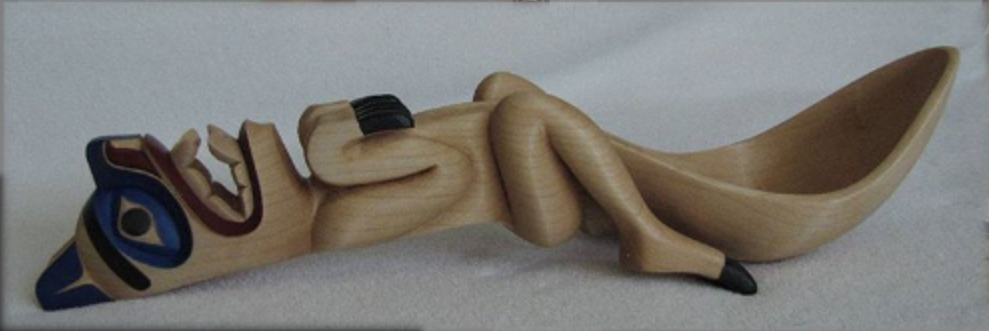
Mack’s patience and hard work, though, mean that his story today is very different. Under the mentorship of Dempsey Bob, Mack has become one of the outstanding carvers of his generation, and the prices of his work should soon edge beyond my affordability. So when he showed me his relatively inexpensive “Grizzly Bear Spoon” outside Dempsey Bob’s “North” exhibit in 2014, I jumped at the chance to buy. I had to wait six months while the spoon was on display at the Richmond Art Gallery, but in early 2015 I finally carried home an example of his work.

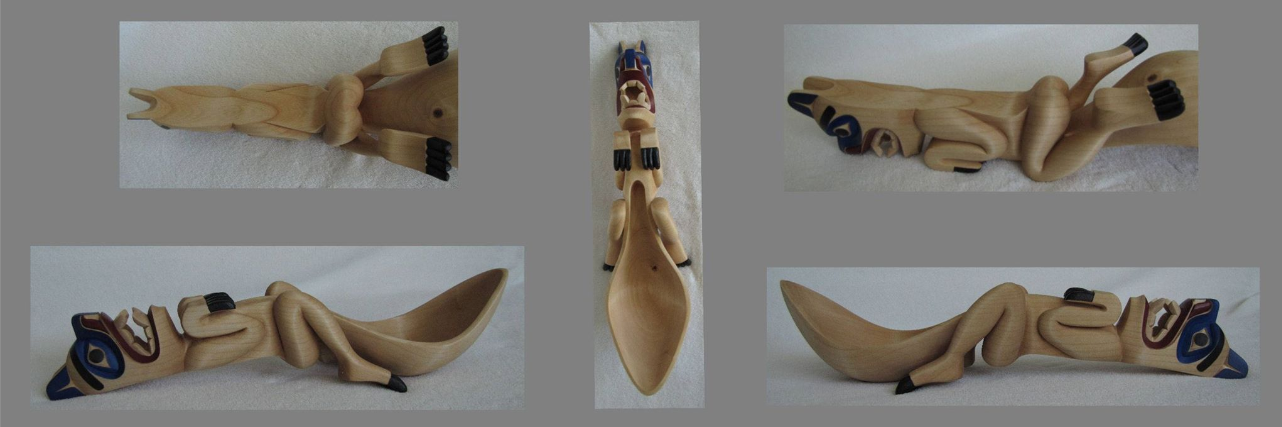
My understanding is that Mack began the spoon while still at the Freda Diesing School and finished it in 2014. Certainly its quality and execution is closer to that of his current work than his student masks. If I didn’t know Mack’s connection to Bob, I might have guessed it by the minimal paint job, although Mack does use what I mentally tag “Nuxalk Blue” around the eyes and ears. The wood is soft to the touch, and the lines of the paint completely straight, both signs of a highly-finished work (and, in the case of the paint, a steady hand. What I especially like is that, with the minimal paint, the contours of the grain because as much a part of the result as the carving.

Adding to the piece are the proportions and curves of the spoon’s bowl. They are framed by the legs, with the knees marking where the bowl begins to widen, and the descent of the bowl’s curve by the calves. Further up the handle, the start of the bowl is framed by the claws.

Most of the body is simply carved, with the roundness of legs and arms emphasizing the wood’s grain. But what really catches the eye is the depth of the carving on the head. Typically, deep carving is a sign of excellence in northwest coast carving, and this spoon is no exception. The tip of the chin is at least three centimeters from the base of the neck, and the inside of the mouth slightly more. The lips are half a centimeter thick, the eye-sockets symmetrically about the same. The result is dramatic, especially when painted, and even more so in dim light.

Currently, “Grizzly Bear Spoon” sits on a tea trolley in my living room, where I pass it twenty times a day and my glance can hardly help but linger on it. I suppose it is a minor work compared to Mack’s larger pieces, but between the curves, the grain, and the depth of the carving, I consider it every bit as much an accomplishment.

lmgbs

Read Full Post »

The arrival of new appliances later this week mean that I have to move the bookshelves on the stairs. Roused to long-overdue action I’ve been using the necessity to cull books, mostly from historical and children’s fiction. My goal is to eliminate all double rows of books on the shelves, but I’m finding it harder to condemn books than I thought.

The historical fiction will survive with only minor culls; it’s full of books by Gillian Bradshaw, Bernard Cornwell, Robert Graves,. Rosemary Sutcliff, and Henry Trease, and Patrick O’Brian. However, I won’t be keeping the Dudley Popes, which are no more than adequately written, nor the odd library remainder with a wretched-looking cover. Admittedly, I haven’t read any of the twenty or so Georgette Heyers, but I figure that anything Trish liked so well should be worth a read some time; perhaps after I’ve read them all, I’ll keep the best half dozen.

Most of my culls are from the children’s section. I’m keeping the Arthur Ransom series, figuring I’ll read them some day. However, I’ve decided that I can live without most of the Doctor DoLittles, the Green Gables, and the Mary Poppins books.

However, it’s wretched to cull any books, and harder still to cull Trish’s book and the odd volume we bought anticipating having children. But I tell myself that keeping a book I’m not going to re-read is hoarding, and denying others a chance to read is simply wrong. All the same, there’s such a clear history of my life on the shelves that I half-believe I could commit a series of murders more easily than I can discard even books I’m not going to read.

Read Full Post »

« Newer Posts - Older Posts »