Feeds:
Posts
Comments

John Wilson, who describes his work as “contemporary Haisla,” has only been selling his work for a few years. And, so far, he has confined himself largely to portrait masks, although he has also done drums and some graphics worth releasing as limited edition prints. I consider his “Blue Hand Mask” (which should actually be read as “Blue, Hand Mask”) an accomplished example of the portrait genre, and am pleased to add it to our collection.

If you have read Bill Holm’s An Analysis of Form, you will immediately identify the “Blue Face Mask” as being in the northern style: although the nostrils and lips are painted solidly, the hand and the spirit-helper on the left temple cut across the facial features. In fact, you cannot tell where the spirit-helper ends and the eyebrow begins – that is, what is natural and what is painted, or what is mundane and what is supernatural. Also typical of the northern style is the predominance of black, followed by red.

What is less typical is the band of blue. Cutting across the eye socket and eyelid, the band is an unusual shade. It has the effect of drawing your glance to the blackness of the pupils, giving a sense of fierceness or determination.

The painted hand is a visual pun. It has an umbilical-like connection to the spirit-helper that runs below the chin and up the left cheek. In other words, the spirit-helper is literally lending a hand. And, just to reinforce the pun, the obvious thumb shows that it is a left hand, originating on the same side as the spirit-helper.

One of the things that makes this mask stand out is the sheer skill of carving. Unlike many carvers early in their career, Wilson thinks in planes. That means he is working with the wood, rather than against it. At the same time, the mask is closer to realism than a strictly traditional piece in such features as the chin, the eye sockets, and eyes – which is what makes the mask contemporary.

Another outstanding feature of the mask is the way that Wilson has carved and sanded down to the grain that is suitable in different parts of the face. On the forehead, the ridges of grain meet almost in the center, while on the left cheek, the concentric circles of the grain emphasize the plane of the cheek bone. Even more interestingly, beneath the eyes are what might almost be reflections of them in the grain. Some bits of this attention to the grain are lost beneath the paint, but, because the paint is minimized, much of it remains visible.

Portrait masks are an easy genre to under-estimate. They lack the exoticness of a mythological theme or a stylized animal that many people seem to want in Northwest Coast art. But, if you look closely at the best examples of them, like the “Blue Hand Mask,” then you can start to appreciate them as a genre in which artists are thrown back entirely on their own skill. You can also understand why I think that John Wilson is an artist who is likely to make a name for himself.
low-res-blue-hand-mask

(Note: Somebody should explain to galleries that, when shipping masks with hair, they need to make some effort to keep the hair from getting tangled. As you can see, I am still trying to straighten out the hair)

I have interviewed Richard Stallman and other members of the Free Software Foundation often enough that he remembers my name (no small feat, I’m sure, considering the hundreds he meets each year). Once or twice, I think, in talking about parrots and folk music, I may have caught a personal glimpse of him. But, even if I haven’t, I generally support the Free Software Foundation. So, when Richard Stallman spoke the other night at the Maritime Labour Centre in Vancouver, I wasn’t going to see what he is really like, or to hear his arguments. I went to see his public persona, and to observe how other people reacted to it.

First, in case you are wondering, Stallman is neither three meters high, green-skinned, nor fanged like a sabertooth tiger. He is a man in his mid-fifties, surprisingly short –maybe 170 centimeters high– and apparently not given to exercise. His hair is long and graying, and so is his beard. Both are uncombed. His clothes are business-casual.

He was tired when he arrived at the hall, and perhaps feeling a little over-exposed to people, having given a speech earlier the same day at the University of British Columbia. After meeting the organizers, he immediately requested a quiet place to work. The request was probably a necessity, since Stallman keeps in close touch with the Free Software office in Boston, but I also suspect that he was relieved to have a moment to himself in the middle of a day in the public eye.

Another myth-buster: Stallman starts by being polite when you talk to him. Nor is he humorless. His comments sometimes show a wry sense of humor, often based on literal interpretations of other people’s phrases. He shows, too, an interest in dining as a social occasion, lamenting that, when he arrived the previous night, he had no one with whom to eat. And, after listening to the local band that warmed up the crowd for him with Flanders and Swann’s “The GNU Song,” he got up on stage to sing “The Free Software Song” with them, his smile not the least deterred by the fact that he is a mediocre singer and could only remember some of the words.

At the same time, Stallman is not always easy to talk to. He seems a little deaf, and impatient with the fact. He is impatient, too, when talk strays into an area where he has expressed the same opinion for decades – or perhaps he simply does not suffer fools gladly. And who can blame him? At this point in Stallman’s public career, anyone who calls him a supporter of open source software has clearly not been paying attention. Nor can it be easy to cover the same basic subjects dozens of times each year.

One on one, he might make some women uncomfortable with compliments about their attractiveness that are a little too quick and open by modern standards. Other women seem to find him chivalrous. Both sexes might accuse him of expecting to be the center of attention, but again, who can blame him? When he is on tour (and he is often on tour), he usually is the center of attention, with his hosts hovering nervously around him.

After our phone conversations, I expected some of these traits, but the overall impression that Stallman makes in person is hard to define. He is neither as obnoxious as detractors paint him, nor as selfless and charismatic as some supporters insist . Although, after meeting him, you can see how all these depictions originate, like any person, Stallman is more than the sum of such caricatures.

Stallman on stage

The fragmentary impressions I got of Stallman off-stage were reinforced when he got up to speak. Like many professional speakers, he immediately gains animation and energy when handed a mike, no matter how tired he is beforehand.

Stallman spoke for well over two hours, not using notes, but obviously covering ground (In this case, his view of copyright law) that he had gone over many times. He was fluent, with few if any pauses or interjections, but not particularly eloquent. Think of a university instructor who keeps his classes interested without being arresting or given to flights of rhetoric, and you have the right impression. The two hours went by quickly, and the audience showed no signs of boredom.

As an argument, Stallman’s speech was concrete, full of examples ranging from the personal to the legal, often enriched with small jokes, and structured with extreme clarity.

If I had to summarize Stallman’s speech in a single word, that word would be “focused.” When Stallman lays out an order to his points, he always returns that order, no matter how many digressions intervene – and, generally, he allows himself very few.

One thing that comes through very clearly as he spoke is his absolute sincerity and conviction. Whatever else anybody might think of him, those are never in doubt. He is quite willing, for instance, to do without a cell phone, DVDs with DRM, or anything else that he cannot use with a clear conscience.

But, as I watched his argument develop, what struck me was not so much any brilliance (although clearly Stallman has an above average intelligence), but his thoroughness. Although other people might possibly make connections or reach conclusions faster than he could, few could think topics through as carefully as Stallman.

In particular, Stallman pays close attention to how issues are framed by language. For example, he rejects the term “piracy” for file-sharing, pointing out that its main purpose is to demonize the practice, not to suggest an accurate analogy. Conversely, he talks about “the war on sharing,” doing his own bit of framing.

This is the same concern, of course, that leads him to insist on referring to GNU/Linux. Many people reject this idea without thinking, but, once you realize that, for Stallman, defining the terms is a necessity for clear thinking, then you realize that he is not simply being pedantic. He is well aware that language is rarely, if ever neutral, and, quite unsurprisingly, tries to influence the debate so that it is on his terms, or at least neutral.

If Stallman’s speech had a weakness, it is that he did not always think on his feet. Several times during the questions at the end, he seemed mildly at a loss, and could only refer back to his speech or declare – sometimes arbitrarily – that a questioner’s topic was irrelevant. Once, when a questioner went on and on without getting to the point, all he could do was seize on a careless use of “open source” rather than “free software,” instead of moving to take direct control of the situation. But perhaps fatigue had a lot to do with this behavior.

Watching the crowd

At any public event, watching the audience can be as rewarding as listening to the performance, and Stallman’s speech was no exception. Some audience members, I later learned, also attended his speech earlier in the day, as well as the one on the next day. However, even without that knowledge, I would still unhesitatingly describe the crowd as geeks with a small smattering of spouses. Most clearly had some familiarity with free software and Stallman’s ideas, and had not come to be challenged so much as to glimpse someone famous.

A minority had a slightly more ambitious goal: To engage Stallman, however briefly, in conversation. Since Stallman’s reputation and manner discouraged most from approaching him informally, some found a moment by getting him to autograph copies of his book, others by asking questions at the end. Many of those lining up up the mikes to each side of Stallman did not have an actual question, so much as a statement they wanted to make to Stallman. One or two seemed inclined to argue with him.

Conclusions

So what do these impressions add up to? A public event is not the place to get to know anybody, and Stallman would probably be a difficult man to get to know under any circumstances. What I saw was the public figure, with – perhaps – the occasional flash of the private man, both accustomed to his fame and occasionally irritated and trapped by it.

In the end, it occurs to me that a distinction between the public and private Stallman many not be worth making. He reminds me of the portrayal of the Wart (King Arthur) in T. H. White’s The Once and Future King. White depicts Arthur as someone inspired by a great idea that took over the rest of his life. In something of the same way, Stallman appears to have been struck by the idea of free software in the early 1980s. The decades since then, I suspect, have simply been filling in the details and taking the idea to its logical conclusions – until now it is hard for a casual observer like me to say where the public man ends and the private one begins.

“A dusty road that smells so sweet
Paved with gold beneath my feet
And I’ll be dancing down the street
When I get to the border.”
– Richard Thompson

Hugh MacLennan once said that Canada had the same relationship to the United States that Scotland did to England: we’re to the north, we like to think of ourselves as morally superior, and we go south to be successful. I’m not so sure about the last part, but I do know that the American border looms large in the minds of many Canadians. Most of us live within a hundred miles of it, and it is far more of a psychological barrier than a physical one. Although the people and the streets look much the same, they’re brasher south of the border, and more conservative. Because of such differences, for many Canadians, to cross the border is a major step, no matter how often we do it, and many of us have stories of our misadventures when crossing.

I remember that, as a child, I took many holidays south in a trailer. Whenever we crossed back in Canada, I would always feel a relief. Now, I would tell myself, if anything happens, we are not so far from home. Or, if we were, breaking down would seem less of a disaster, simply because we were in Canada.

When I was a young adult and newly married, we had a succession of rust bucket cars. It was exactly the sort of car that raised suspicion in the eyes of American border guards, who are often ex-Service types. Never mind that drug mules were most likely driving late model cars to divert suspicion; we were always grilled closely about our reasons for polluting America with our junkmobile. Often, we would have our trunk open, and, although we never had the car ripped apart, we were often given to understand that could easily happen.

The only time we were spared such ordeals was when we were on our way to visit a friend in the veteran’s home in Bremerton, Washington. As soon as we said where we were going, the border guard stopped glaring at us with suspicion, and waved us through. He didn’t give us a salute, but I thought he was considering doing so.

Another time, we were heading south for a Society for Creative Anachronism event in a car driven by a young, not very bright hothead. After pulling up to the American customs both, our driver seemed inclined to argue with the customs guard. Mindful of all the swords and other medieval weaponry in the back, the rest of us in the car cringed and silently prayed we wouldn’t have to explain what we were doing with all the metalwork crammed into our packs.

But the worst crossing we had was on our way back into Canada. I was in the front passenger seat, and, just before we pulled up to the customs booth, the driver stuffed a brown bag under my seat.

As we were pulling away from the booth, I asked the driver what was in the bag.

“My stash,” he said.

We felt strangely silent until we were dropped off. Afterwards, we stopped hanging out with the driver, and to this day, I doubt he knows why. Very few of my generation worry much about marijuana, even if we don’t use it, but, had the car been searched, the customs agent would probably have assumed that the bag beneath my seat was mine – and, given that I had to be bonded for the work I was doing then, I could have ended up unemployable.

Right about then, we stopped taking rides with people we didn’t know very well.

Strangely, all these episodes took place before the September 11th attacks, when Americans wanted tighter controls at the border (that is, measures whose main result was to make the lineups longer and those waiting unhappier). In fact, the last time we crossed in the United States, when we realized we had forgot our birth certificates, the American guard let us by. No doubt he thought that anyone so hapless couldn’t possibly be a danger to his country.

Over the years, the Museum of Northern British Columbia has gained a reputation for working with the local First Nations in Prince Rupert. But now, unless appearances deceive, museum officials seem willing to throw away that reputation just so curator Susan Marsden can flex her muscles in her ongoing struggle to assert her authority over Tsimshian master carver Henry Green and his apprentices. The conflict is being fought over the carving shed, a popular attraction where Green and the other carvers have been working, but what’s really at stake is the consistent disrespect shown by the museum and city officials.

According to the chronology provided by Green on Facebook, the carving shed has been in existence since 1980. While hardly a comfortable place – it has no washrooms, running water, nor working furnace — in the last twenty-nine years, it has been a workspace for many of the biggest names in Northwest Coast art, including Alvin Adkins, Edward Bryant, Heber Reece, Lyle Campbell – and, of course, Green himself, who has worked there on and off since it was built.

The carving shed has not always co-existed peacefully with the museum, being a place where artists came and went without ever being employees or having much regard for museum hours. But, when relations were uneasy between the museum and the carving shed in 1993, Green says, communication helped to reduce the tensions on both sides. Mostly, the shed has continued to be an important attraction despite minimal promotion by the museum.

However, since last summer, relations between the museum and the current crop of carvers have steadily worsened. The phone was removed, amidst allegations that it was being used for long distance calls, a claim that Green denies. Then the locks were changed, including the ones on Green’s private storage. Green says that he had to wait four hours to get into the shed to get his tools, and that “during this time I was berated and talked down to.”

In another episode last summer, the artists erected a carving sign directing tourists to the carving shed. When Green’s partner and his daughter investigated, they found the sign locked away by the museum, on the grounds that private signs could not be put on museum property. Not only has the sign not been returned, but, as a result of the incident, Jennifer Davidson, Green’s partner, was banned from the carving shed by Susan Marsden, while Morgan Green was told that she would have to apologize before she could return. Marsden’s claim is apparently that Morgan Green kicked and swore at her – charges that Morgan denies.

Matters came to a head in January, when all the carvers were given one week to vacate the shed. Considering the number of carvings in the shed, including some two meter poles, this is a next to impossible demand. The artists requested at least a month to vacate. Meanwhile, they are worried that their tools, many of which are highly specialized and specifically created by them or for them, will be confiscated by the museum.

The carvers have tried to talk to the museum’s board of directors, but all they have heard is secondhand accounts that the shed will be renovated, then assigned to groups for specific projects. The implication seems to be that the current group of carvers will not be among them. Moreover, since it is February and no permit for renovations appears to have been taken out, the carvers are more than a little skeptical of the claim.

The situation remained unpublicized until Morgan Green started a FaceBook group called “Expression Not Oppression” four days ago. Since then, over four hundred people have joined the group, including many local first nations people and art-lovers.
Prince Rupert mayor Jack Mussalem insists that supporters have heard only one side of the story. However, when he phoned to give it to me, he demonstrated no understanding of what upset both the carvers and their supporters (who include me).

Nobody is questioning the right of Marsden to evict the carvers, not even the carvers themselves. But what bothers people is the disrespect. If what I have heard about Marsden’s behavior is even remotely true, she seems to have abandoned common courtesy.

Even worse, Marsden, Mussalem and other officials of the museum and Prince Rupert seem to be acting with a total disregard for the sensitivities of the first nations. Considering the history of the last century and a half, many among the first nations are understandably sensitive about anything that suggests the arbitrary abuses of power, particularly by people of European descent. And when you add the fact that first nations artists are leading figures in preserving the cultures, insults directed to an internationally-known figure like Henry Green are easily seen as insults to the community itself. You can see these attitudes being expressed in the comments in the Facebook group.

Art-lovers and collectors feel much the same way. Witnessing a conflict between artists whose main desire is to continue working undisturbed and empire-building bureaucrats, you want to guess with whom they’ll side?

Possibly, there are mitigating circumstances that would explain the behavior of officials. Yet, if so, they have not bothered to explain those circumstances. Instead, they have simply asserted their right to act as they have chosen, and refused to address the question of their behavior.

Very likely, they can get their way in the short run. However, in the long run, their petty victory in what seems no more than a bureaucratic turf war threatens to be won at the expense of all the good will from the first nations that the museum has built up over the years. And, if that happens, the museum could take decades to regain that good will – assuming that it ever does.

My digital camera is a Kodak DX7630. It’s a few years old, but capable of giving me the high enough resolutions for all my needs. However, the camera uses lithium-ion batteries of a design that you can’t buy in most stores. When the battery recharger lost a small but essential part, I had to hunt for a replacement. I found one, but, in doing so, discovered a product that was built for the manufacturer and not the user.

To start with, the old recharger was maybe eight by five by two centimeters. For no apparent reason, the new one is about fifty percent larger in all dimensions – enough so that, unlike the old one, it doesn’t fit in most pockets.

More importantly, the new recharger is designed to work with a number of different battery sizes and plugs. I can guess the reason: Kodak doesn’t want to bother making a variety of different rechargers, especially for older models. Presumably, too, it would prefer that people bought its more expensive docking station, rather than a recharger. But the result is near-chaos.

On paper, the new recharger might sound like a good idea. For instance, it comes with plug extensions for just about any type of electrical outlet in the world. But the extensions barely sit in position on the power source without falling off. The same is true of the battery holder and the recharger, which for some reason are not made of one piece, but two snap-together ones that keep separating. And, as if that isn’t enough, because the battery holder is designed to accommodate several different sizes, you have to position a battery exactly right before you can recharge.

And,needless to say, the new recharger only works if you position everything exactly right. If you don’t, you have several items to jiggle and adjust before any recharging is possible.

Nor does familiarity make the process easier. The slightest movement of any part of the unit can cause recharging to cease. You need a flat surface where nothing will come near the recharger for several hours whenever you are using it.

Oh, and don’t step too heavily within a couple of meters of the recharger. That could cause something to work loose, too.

About the only good thing you can say about this product is that you can, in fact, eventually recharge a battery. But, as convenient as the recharger is for Kodak, it’s an exercise in prolonged frustration for users every time that they use it.

Personally, if something in me didn’t shy from the idea of replacing a perfectly good piece of hardware, I’d take the new charger back and buy a replacement camera; I wouldn’t have that much more to spend, anyway. But, whether I buy a new camera or endure the new battery recharger, I still seem the victim of a perversity of capitalism, no matter how little I want to be.

Manufacturing news

One of the most disturbing trends in modern journalism is the manufacturing of news. Of course, journalists – or, at least, editors – have always had the power to decide what is or isn’t news, which is why Rolling Stones’ conversion of the New York Times’ motto “All the news that’s fit to print” to “All the news that fits” is so cynically funny. But what I’m talking about goes even deeper: I mean cases where reporters from reporting the news and starts to making it – often out of very little substance.

For example, Susan Faludi, who is best-known for Backlash, her book on the reactions to feminism, but is also one of the keenest observers in general of the media in North America, notes that, after the September 11th attacks, reporters claimed that women in the United States were suddenly lusting after firefighters. As Faludi observes, this trend was based on no statistical evidence, and often nothing more than a few off-hand comments. Yet it soon became a truism that the media took for granted, its members forgetting that they had created the story themselves.

Some manufactured news is relatively benign. Stories to mark the anniversary of an event are usually fairly lame, but perhaps in an era where the cultural memory is so short, they serve more point than simply providing journalists with an easy story based on old material. And at least anniversary stories are based on real events, although the danger exists that new interpretations will be slipped in, as happened with the twentieth anniversary of Expo 86 in Vancouver, when journalists managed to pretend that the considerable political dissent that the event generated never happened.

Similarly, while journalists reporting on other journalists means that, rather disturbingly, they move from behind behind the scenes to being part of the news, that does happen naturally from time to time. About the worst thing you can say about this type of manufactured news is that journalists do not make nearly as fascinating copy as they seem to believe, and, while they are indulging their own interests, they are usually boring the general public. Still, reporting on journalists can cause an imbalance in the news, as happened when Conrad Black went on trial and dozens of eastern Canadian journalists, many of whom had either worked for Black or with him, gave him coverage that was not only wildly excessive, but so willing to give him the benefit of the doubt that the quality of reporting slipped badly.

However, other types of manufactured news undermine the supposed traditions of journalism more consistently. The manufacturing of a trend based upon a few anecdotes or wishful thinking, the sort of occurrence that Faludi is making a career out of documenting, exists on all levels of journalism, but makes a mockery of the idea of investigation and the effort to uncover truth. Instead, it is the passing off of fiction as reality through repetition – and all the deadlines in the world cannot excuse the fact that it is simply shoddy reporting.

Similarly, when a journalist interviews a celebrity, they frequently fall into the associational fallacy – the idea that, because someone famous endorses something, it must be good, or at least news-worthy enough to be on the front page rather than in the sports or entertainment sections where it belongs. Given the power of the media (and, since the Internet, that power has become greater than ever, even if those who hold that power have shifted), any promotion of sloppy thinking is an event to regret. And when that promotion becomes a regular event, it becomes even more alarming. I also have to wonder why editors are giving away free advertising.

At times, manufactured news turns even nastier, being based on outright distortions and over-simplifications. For instance, recently in the free software media, a great deal of attention was paid to the fact that Linus Torvalds, the benevolent dictator of the Linux kernel, was no longer using one piece of software (the KDE desktop), but had switched to a rival (the GNOME desktop). This switch was only a small part of an interview that covered far broader-ranging and interesting topics, and the comments were casual. Not only that, but the switch was provisional, with Torvalds saying that he would reconsider his choice the next time he set up a computer. But, by giving these comments an exaggerated importance, free software journalists ended up systematically misrepresenting the affair to the public.

What makes this manufacturing of the news particularly troublesome is that, being overworked and under deadline, journalists often borrow from one another. This habit breaks the implied contract that journalists have with readers – especially if the journalist is a columnist – since one of the claims that journalists have to their audiences’ attention is that they are supposed to offer expert information or informed opinion.

But, when manufactured news enters the picture, the habit becomes a means for distortion and poor research to become more accepted.

I can’t say that I have always resisted the temptation to manufacture news myself. I’ve done my share of anniversary reporting, just as most journalists have done. But that is minor peccadillo at best, and sometimes useful. Nor, I’m sure, can I claim that bias creeps into work despite my best efforts – real bias, I means, not the sort that people mean when my efforts to marshal facts leads to a conclusion different from theirs.

But, for me, journalism is supposed to be an effort to express the truth as I see it. Deliberately, consciously manufacturing news is an abandonment of that effort for convenience, and produces only distortion. As I struggle with mixed success to keep my own hands clean, I can only become angry at other people in my profession who no longer even try to do so.

And so, too, should their readers.

Especially if they are from outside western Canada, people often ask why I specify at the end of my biography that I am unrelated to “the conservative journalist, publisher and editor Ted Byfield of Alberta.” The other week, one contact went so far to joke that I should add that I was unrelated to the football player Darren Byfield, and any other Byfield with a slight claim to fame. But the truth is, I added the reference to my various online biographies because I was tired of fielding questions on the subject.

You see, for better or worse, Ted Byfield is one of the better known people with whom I share my last name. Add the fact that we are both journalists and inhabitants of western Canada (the difference between British Columbia and Alberta being missed by many people), and people naturally assume some relationship. Since I don’t enjoy answering the same question over and over again, I add the line in the hopes of limiting the times it is asked. For the most part, it seems to have worked.

However, to be honest, I also have another motive. As he proved time and time again with publications like The Alberta Report, Ted Byfield is almost everything I am not. He is a political conservative, while I am a left-winger with shades of green. He is religious, while I am an agnostic. Pro-American (politically-speaking) while I have reservations. Anti-gay, anti-union, pro-capital punishment, pro-life, redneck – you name one of his positions, and you probably know mine by naming its opposite.

You might say that we have little in common except the name.

That being so, I feel a touch of mortification when anyone entertains the idea that we might be related. No doubt he would feel the same about me, were he ever to learn of my existence, but, since I doubt he reads free software journalism, which is what I write, I would be surprised to learn that he had. But, at any rate, to spare us both embarrassment, I want to make very clear that there is no connection.

However, I confess that my embarrassment is compounded by the secret suspicion that, a few generations back, we probably are related somehow. Our surname is not a common one, and, whenever I encounter it, I assume that some distant connection exists. Richard Byfield, who was vicar at Stratford-on-Avon in Shakespeare’s day, Nathaniel Byfield, who was a clerk at the Assembly of Westminster, the African-descended Byfields in Jamaica, the Australian cricketer Arnold Byfield – I like to think I could be related to all of these in some tenuous way. But not Ted Byfield, even though he’s just as likely a candidate for a relative. But I can say for sure that any connection isn’t in the last few generations.

That’s enough for me. So, unless someone thrusts proof upon me that we are relatives, I will continue to say (no doubt to our mutual relief), that I am unrelated to Ted Byfield.

Denying complexity

Ask me to interpret anything – the cause of events, people’s motivations, the symbolism in a novel or a dream – and I usually opt for all the explanations that seem supported. To suggest anything else has always seemed overly simplistic to me, and so false as to be a distortion (in which case, why offer the interpretation?). For the same reason, I’m always vaguely irked by the efforts to impose banal interpretations on merchandise sold to the general public.

You know the kind of thing I mean. Buy a brooch with a Celtic knotwork design, and you’re apt to be handed a little card that insists that the design signifies the general connectedness of life. A trefoil design is a reference to the Christian Holy Trinity, and a dog faithfulness, and a ship the journey of life. Or something like that – I may be wrong on the particulars, because they’re usually too banal to remember, but you get the general idea.

People do the same thing with Northwest Coast art. The other day, for instance, I received in the mail a few pages from the gallery where I had bought a rattle by Ron Telek that depicted an eagle – the rattle – transforming into a wolf – the base. On one page, the gallery pointed out that Telek’s work, while derived from Nisga’a tradition, was intensely personal in nature. On another page, I got canned explanations about what an eagle and a wolf supposedly meant in traditional art. In other words, one information sheet clearly pointed out the inapplicability of the other.

As for the explanations themselves, each was a hundred words of meaninglessness. In brief, though, the eagle was described as being all about nobility and the wolf about savagery. To which I can only reply: Really? To all artists in all first nations? When the wolf was a clan or family crest in many cases?

And let’s not even begin to delve into the fact that no artist of any merit starts off with nothing but symbolic meanings in mind, any more than any great novelist starts off intending to write The Great Novel of Our Time. In both cases, they simply create, and leave the meaning to the critics.

But, besides the obvious falseness of such explanations, what really annoys me is that, by being handed such explanations, people are being mislead. They are encouraged to think that art is a simple and straightforward, and important only for its so-called meaning. Even worse, instead of seeing a work for themselves, they are being told what to think. And, once they are told what to think, they may never see anything else.

I suppose that there is a demand for such simple explanations. After all, many people desire simple explanations and world-views. But I don’t see why anyone should pander to this desire, especially when, ninety-nine times out of a hundred, it’s a distortion of reality. Why encourage a delusion?

Look, I want to say when faced with such explanations. Life isn’t like that. It’s convoluted, and complicated, and messy. And, rather than do violence to your powers of perception, why not just accept the general untidiness and learn to enjoy it? You miss so much by denying the complexity.

You don’t discover the fact right away, but if you start buying Northwest Coast art regularly, you soon learn that most art galleries stock two types of works: The type that gets displayed, and the type that sells without ever been hung in the gallery or appearing on a web-site.

The type that never gets displayed comes from a number of sources. It may be a piece that is being resold after the original buyer has died, lost interest, or needs to make room in their connection. Sometimes, it is a piece by a top artist for whom the demand is so great that the gallery staff have a shrewd idea of who might buy it. It may be a piece that has been brought into the store for an upcoming exhibition.

Occasionally, it is a piece that is half-finished, such as the half-finished panel in one gallery that was abandoned because it developed a crack, or the telephone chest I saw at one gallery that had Bill Gates’ initials on it because the artist thought only someone like Gates would want to buy it – but he didn’t. The origin can even be as simple as a piece that the gallery currently has no room for, and has tucked away in a closet that most potential customers never see.

Another source of undisplayed art is the artists themselves. Some artists, particularly better known ones, have enough of a following that they don’t need the galleries except as a form of marketing. Much of their work is either begun as a commission or else sold soon after completion to people on the artist’s contact list.

Whatever the exact origin, these undisplayed pieces are frequently the best or the quirkiest work available. For instance, I know of one gallery that has a collection of original acrylics by an artist who recently died. As soon as news of the artist’s death reached the gallery, the owner pulled the pieces until he could decide what to do with them, and hasn’t displayed them since.

In another case, a highly regarded but not very prolific artist delivered his latest masterpiece to the gallery. The gallery never displayed it, but sent word to a few select customers. Despite the high price tag, the work was sold within two weeks. In a similar case, a master carver placed his latest work on consignment, and the gallery sold it in less than 24 hours. Only a handful of regular customers got to see so much as an online photo.

If you want to see such work, the only way you can is to cultivate relationships with the senior staff at galleries or with the artists. Some artists prefer not to deal directly with buyers, but, otherwise, many staff members and artists are only too pleased to talk about what interests them. They can teach you a lot, and, as they get to know you, introduce you to the work of other artists, and, if you let them know your interests, they will gradually include you in the list of people who learn when undisplayed work becomes available. But building relationships is the only way you are likely to have a chance to buy – or just admire – some of the best work in the field.

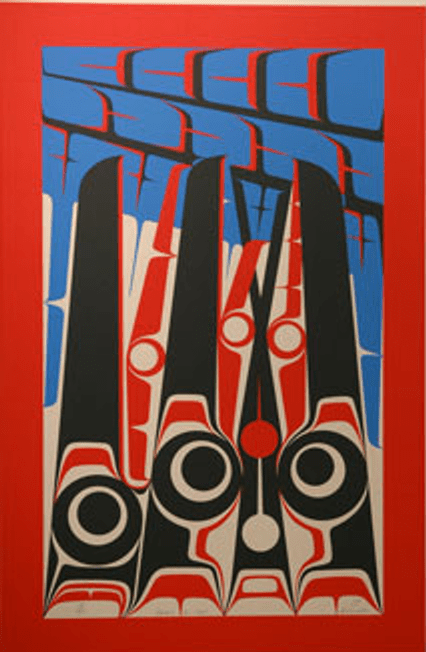
Northwest Coast art is semi-abstract to begin with, and continues to have a strong tradition. For these reasons, abstract or post-modern work in the field is rare. Perhaps the best-known movements in those directions come from Michael Nicoll Yahgulanaas’ Haida Manga or Andrew Dexel (Enpaauk)’s graffiti-inspired canvases. However, long before either of these efforts, Doug Cranmer was making his own movements towards abstraction or post-modernism. In the mid-1970s, he did a series of abstract paintings, several of which were turned into limited edition prints in 2005, and some of which have been released to a handful of galleries in the last month. Recently, we were privileged to take home a print of “Ravens in Nest,” which is compositionally the most interesting of the recently released prints.

At first, the idea of abstracts coming from someone like Doug Cranmer seems unlikely. After all , Cranmer comes from the first generation of artists in the Northwest Coast Renaissance, have learned carving from Mungo Martin. Later, he worked with Bill Reid on poles and houses that were commissioned by the University of British Columbia.

And in the mid-Seventies, who else was doing abstracts? Back then, even Bill Reid had just completed his mastery of traditional form and had yet to edge towards the free-form works of his last period. It would be almost two decades, too, before Robert Davidson would become one of the best known artists to move towards abstraction and post-modernism.

However, in an interview excerpted on the Museum of Anthropology web page, Cranmer explains that he was reacting against the orthodoxy created by Bill Holm’s book Analysis of Form, the first to codify the basic elements in Northwest Coast art.

“After the book came out, all of a sudden there was a right and a wrong way of doing things. We never had that before,” Cranmer said. “The book has served its purpose in explaining Indian designs and elements, but a lot of people followed the book to the letter: as a result, their work has come out all looking the same.”

Apparently in reaction to this tendency, in 1974-5, Cranmer began a series of 48 paintings. “I was doing them differently for the sake of being different.” he said. “I was doing things in Northwest Coast-type design elements that didn’t look like a bird, a fish, an animal, a man or a woman. It worked for a while, but then I noticed that they [the paintings] were starting to look like something again.”

If you look at “Ravens in Nest,” you can see this anarchistic outburst very clearly. The classic formline of Northwest Coat art barely puts in an appearance in the print. Instead, that flexible container of design elements which is generally black, is replaced by a thick red border. Perfect circles replace ovoids. U-shapes, unusually colored blue, float freely across the top, changing direction on each line, and change shapes along the bottom. Blue and red are the main colors, not black. The expected curve of the young ravens’ beaks – an identifying element of a raven in the traditional art — is reduced to the slightest tip possible Instead of the classic symmetry, everything is decidedly unbalanced.

You might almost say that “Ravens in Nest” is a Northwest Coast print because of all the things that it does not do. Like early post-modern works, the print works to the degree that you know the tradition that it is reacting against.

Furthermore, the more you do know, the more what Cranmer has done makes you think about traditional Northwest Coast forms. In fact, while Cranmer may have been reacting against orthodoxy, what he has produced is just as dependent on tradition as any piece that carefully follows the norms outlined by Holm. The only difference is that “Ravens in Nest” is dependent on tradition as its polar opposite, rather than as a key to its technique.

At the same time, while you can easily intellectualize about the piece, its subject remains clear: four hungry and clamoring young ravens. I don’t know if Cranmer intended the effect, but the floating U-shapes seem a graphical representation of the sound they are making, chaotic and clashing.

Such paintings were only a momentary experiment with Cranmer, but they had few if any imitators. The result is that the prints still offer a unique and challenging perspective thirty years after the original paintings. I am not fond of the average abstract, but in Cranmer’s I see a bold and innovative exception that I am proud to hang on our wall.
doug-cranmer-ravens-in-nest