Feeds:
Posts
Comments

Posts Tagged ‘art buying’

In January, we missed by hours buying a dragonfly frontlet that Nisga’a master carver Norman Tait and his carving partner Lucinda Turner sold through the Inuit Gallery. The gallery told us that its staff would ask the team to do another frontlet, but we had heard nothing for a couple of months and were just concluding that a second one would not be available when we received email notice that it had arrived.

Did we snap it up quickly? somebody asked me via chat. Put it this way: We received the notice at 3:10. I replied that we would buy it at 3:12 – despite the fact that we prefer not to buy sight unseen, and are saving to pay our taxes. Some opportunities you just have to take when they arise, and, having missed the first frontlet, we were determined not to miss this one.

You see, Norman Tait is one of the four artists we most wanted a carving from (the others were Beau Dick, Stan Bevan, and Tait’s nephew Ron Telek). Tait is one of the most acclaimed Northwest Coast artists alive – and rightfully so, given his attention to detail and his careful finishing. In the last two decades, these distinguishing features have been supplemented by Lucinda Turner, who brings the same qualities to carving.

The only problem is, Tait’s acclaim means that their masks start at about $12,000. While this price is more than deserved, it means that their work is largely out of our price range unless we do some extremely careful financial planning over a year or more. By contrast, the frontlet is more within our price range.

More importantly, the frontlet is a miniature masterpiece in its own right. While in many ways the frontlet’s depiction of a beaver is traditional, it is full of small finishing details — the flare of the nostrils, the roundness of the palms of the hands and the soles of the feet, the roundness of the tail, the prominence of the front teeth and the curled lip – that lift it out of the mundane.

I like, too, the contrast between the heavy lines and planes of the figure and the lightly inscribed shapes along the border, to say nothing of how the beaver’s ears are incorporated in the border so as not to interrupt the line of the head. All the elements in the border are traditional, yet they are so lightly carved that they almost look like the letters of some unknown alphabet.

In short, everything about the frontlet indicates that it is the work of someone who is as comfortable with carving tools as I am with a keyboard or pen. Although it is undeniably a minor work, it displays Tait’s skill so completely that you can easily extrapolate from it what his poles and larger sculptures are like. As a friend said, having the frontlet in our home is bit like having a cartoon from Picasso.

We hung the frontlet near a similarly-sized piece by Ron Telek. That position gave us the additional pleasure of comparing the work of the master and his former apprentice. We could see that the same attention to detail and finishing was present in both works, but there was nothing you could call imitative in Telek’s work. He had learned the craft from Tait, but each carver has an imagination and style all his own.

Norman Tait: Beaver Frontlet

Norman Tait and Lucinda Turner: Beaver Frontlet
Read Full Post »

You don’t discover the fact right away, but if you start buying Northwest Coast art regularly, you soon learn that most art galleries stock two types of works: The type that gets displayed, and the type that sells without ever been hung in the gallery or appearing on a web-site.

The type that never gets displayed comes from a number of sources. It may be a piece that is being resold after the original buyer has died, lost interest, or needs to make room in their connection. Sometimes, it is a piece by a top artist for whom the demand is so great that the gallery staff have a shrewd idea of who might buy it. It may be a piece that has been brought into the store for an upcoming exhibition.

Occasionally, it is a piece that is half-finished, such as the half-finished panel in one gallery that was abandoned because it developed a crack, or the telephone chest I saw at one gallery that had Bill Gates’ initials on it because the artist thought only someone like Gates would want to buy it – but he didn’t. The origin can even be as simple as a piece that the gallery currently has no room for, and has tucked away in a closet that most potential customers never see.

Another source of undisplayed art is the artists themselves. Some artists, particularly better known ones, have enough of a following that they don’t need the galleries except as a form of marketing. Much of their work is either begun as a commission or else sold soon after completion to people on the artist’s contact list.

Whatever the exact origin, these undisplayed pieces are frequently the best or the quirkiest work available. For instance, I know of one gallery that has a collection of original acrylics by an artist who recently died. As soon as news of the artist’s death reached the gallery, the owner pulled the pieces until he could decide what to do with them, and hasn’t displayed them since.

In another case, a highly regarded but not very prolific artist delivered his latest masterpiece to the gallery. The gallery never displayed it, but sent word to a few select customers. Despite the high price tag, the work was sold within two weeks. In a similar case, a master carver placed his latest work on consignment, and the gallery sold it in less than 24 hours. Only a handful of regular customers got to see so much as an online photo.

If you want to see such work, the only way you can is to cultivate relationships with the senior staff at galleries or with the artists. Some artists prefer not to deal directly with buyers, but, otherwise, many staff members and artists are only too pleased to talk about what interests them. They can teach you a lot, and, as they get to know you, introduce you to the work of other artists, and, if you let them know your interests, they will gradually include you in the list of people who learn when undisplayed work becomes available. But building relationships is the only way you are likely to have a chance to buy – or just admire – some of the best work in the field.

Read Full Post »

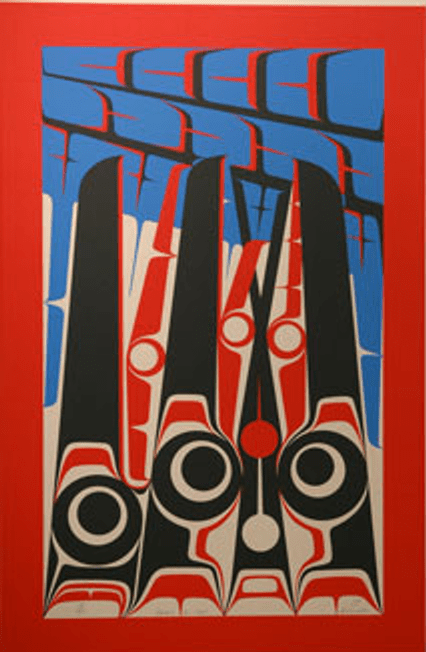
Northwest Coast art is semi-abstract to begin with, and continues to have a strong tradition. For these reasons, abstract or post-modern work in the field is rare. Perhaps the best-known movements in those directions come from Michael Nicoll Yahgulanaas’ Haida Manga or Andrew Dexel (Enpaauk)’s graffiti-inspired canvases. However, long before either of these efforts, Doug Cranmer was making his own movements towards abstraction or post-modernism. In the mid-1970s, he did a series of abstract paintings, several of which were turned into limited edition prints in 2005, and some of which have been released to a handful of galleries in the last month. Recently, we were privileged to take home a print of “Ravens in Nest,” which is compositionally the most interesting of the recently released prints.

At first, the idea of abstracts coming from someone like Doug Cranmer seems unlikely. After all , Cranmer comes from the first generation of artists in the Northwest Coast Renaissance, have learned carving from Mungo Martin. Later, he worked with Bill Reid on poles and houses that were commissioned by the University of British Columbia.

And in the mid-Seventies, who else was doing abstracts? Back then, even Bill Reid had just completed his mastery of traditional form and had yet to edge towards the free-form works of his last period. It would be almost two decades, too, before Robert Davidson would become one of the best known artists to move towards abstraction and post-modernism.

However, in an interview excerpted on the Museum of Anthropology web page, Cranmer explains that he was reacting against the orthodoxy created by Bill Holm’s book Analysis of Form, the first to codify the basic elements in Northwest Coast art.

“After the book came out, all of a sudden there was a right and a wrong way of doing things. We never had that before,” Cranmer said. “The book has served its purpose in explaining Indian designs and elements, but a lot of people followed the book to the letter: as a result, their work has come out all looking the same.”

Apparently in reaction to this tendency, in 1974-5, Cranmer began a series of 48 paintings. “I was doing them differently for the sake of being different.” he said. “I was doing things in Northwest Coast-type design elements that didn’t look like a bird, a fish, an animal, a man or a woman. It worked for a while, but then I noticed that they [the paintings] were starting to look like something again.”

If you look at “Ravens in Nest,” you can see this anarchistic outburst very clearly. The classic formline of Northwest Coat art barely puts in an appearance in the print. Instead, that flexible container of design elements which is generally black, is replaced by a thick red border. Perfect circles replace ovoids. U-shapes, unusually colored blue, float freely across the top, changing direction on each line, and change shapes along the bottom. Blue and red are the main colors, not black. The expected curve of the young ravens’ beaks – an identifying element of a raven in the traditional art — is reduced to the slightest tip possible Instead of the classic symmetry, everything is decidedly unbalanced.

You might almost say that “Ravens in Nest” is a Northwest Coast print because of all the things that it does not do. Like early post-modern works, the print works to the degree that you know the tradition that it is reacting against.

Furthermore, the more you do know, the more what Cranmer has done makes you think about traditional Northwest Coast forms. In fact, while Cranmer may have been reacting against orthodoxy, what he has produced is just as dependent on tradition as any piece that carefully follows the norms outlined by Holm. The only difference is that “Ravens in Nest” is dependent on tradition as its polar opposite, rather than as a key to its technique.

At the same time, while you can easily intellectualize about the piece, its subject remains clear: four hungry and clamoring young ravens. I don’t know if Cranmer intended the effect, but the floating U-shapes seem a graphical representation of the sound they are making, chaotic and clashing.

Such paintings were only a momentary experiment with Cranmer, but they had few if any imitators. The result is that the prints still offer a unique and challenging perspective thirty years after the original paintings. I am not fond of the average abstract, but in Cranmer’s I see a bold and innovative exception that I am proud to hang on our wall.
doug-cranmer-ravens-in-nest

Read Full Post »

Last month, a friend phoned to ask my advice about the price of a Northwest Coast mask that he had commissioned. The price the artist had quoted seemed high to him, but he was still interested in the mask. Thanks to my frequent gallery browsing – both in person and online — I was able to reassure him that, for a piece of that size by an artist of that reputation, he was getting a reasonable price.

More recently, I saw a piece by a new artist and instantly recognized the price as too high for this moment in the artist’s career.

From these two experiences, I realized that, not only is the price of Northwest Coast masks is determined by a couple of factors – the artist’s reputation and the size and finish of the mask – but that there is a rough consensus about how those factors affect the price. This consensus exists throughout British Columbia, so, contrary to what you might expect, you are unlikely to find many bargains outside of Victoria or the Lower Mainland regions. It is undoubtedly due to the fact that galleries and artists are always comparing notes and the fact that a handful of artists are widely viewed as a guide to pricing. In particular, Beau Dick, although widely recognized as a leading carver, has never priced his works as high as he probably could, but varies his prices according to the complexity and size of his work.

As near as I can construct it, here is a list of what you can expect at each price range when you buy a Northwest Coast mask. All prices are in Canadian dollars:

  • Under $2000: The largest group in this category are masks for the tourist trade, generally by artists who have few chances of selling to upscale galleries such as Douglas Reynolds. New artistically-oriented carvers and minis (masks 7×7 inches or smaller) – also fall into this category.
  • $2000-$3000: In this category, you can find average-sized masks (roughly 12-14 inches high) by artists who are starting to gain a solid reputation, or simple or experimental masks by established artists. Most artists’ work does not stay in this price range for very long, except for some long-established carvers for tourists.
  • $3000-$6000: This category is by far the largest. Most masks in most galleries usually fall within it. Here, you find works of average size and complexity by artists who have a modest reputation for their carving. You also occasionally, large works by lesser-known artists in this range, but the restrictions on beginning or relatively unknown artists are tight enough that such works appear only rarely.
  • $6000-$10,000:This price range seems reserved for large or intricate works by artists whose work usually falls within the previous category. One of the signs of consensus is that you find relatively few artists whose prices fall consistently within this category.
  • $10,000 and above: Only large and elaborate masks or normal sized ones by master carvers fall into this category. Very few masks sell above $18,000, although I have seen a Beau Dick mask over four feet tall selling for $28,000.

These ranges are only generalities. A lesser-known carver making a bid for more recognition may temporarily or permanently raise their prices, while a more established artist may lower the price on a specific piece that they feel does not represent their best work. Similarly, a smaller or larger size may bump a specific mask from the artist’s norm. Almost always, reputation trumps size: for instance, I recently saw a mini by Dempsey Bob selling for just under $5,000, a price that reflects both his fame and the fact that these days he does little non-monumental work in wood.

I should also mention that artists do not necessarily view this consensus as fair. They argue that, especially in the lower categories, it hardly pays to take the time to finish the mask – and no doubt they are right.

However, other artists figure that selling in the lower categories is a part of their career that they simply have to endure – and they are right, to. Unless an artist is lucky enough to live on commissions or has another means of exhibiting work to the public, they have little choice except to participate in a market in which both they and their work are evaluated in detail by the market.

Read Full Post »

Around the turn of the millennium, the Haida clothes designer Dorothy Grant had a shop in the Sinclair Center in downtown Vancouver. When she moved, we lost track of her. But I noticed her at a lecture a few days ago at the Bill Reid Gallery, where she was flashing a pair of earring by Gwaai Edenshaw, and yesterday we made a point of dropping by her new store and studio just off Broadway and Main.

Grant’s downtown store felt like a small clothing boutique, differing from countless of others only in her designs and impeccable tailoring. Her new location feels more like a work space; you go down a hall into a retail space, but the activity seems to be taking place either in the studio and meeting place up the stairs or the work area on the other side of it. The entire area is dedicated with art from Grant’s personal collection: A mask by Beau Dick, a print by Robert Davidson, a glass box by Alano Edzerza, and some recent glass plaques by Grant herself (which leaves no doubt that she could have become a gallery artist rather than an applied artist, had she chosen).

The location is open to the public, but you have to ring for entry, perhaps a reflection of the fact that the space is in the middle of an industrial area that, while not seedy, has probably seen better days.

Or perhaps the locked door reflects that this is more a work space than a retail outlet. It certainly seemed so during our visit, with Grant planning with a couple of other people (for a photo shoot, I think), and only stopping briefly to greet us in the friendly and energetic way that, from the little that I’ve seen, appears to be her most common public persona.

Whether you are female or male, you could easily drop a few thousand dollars going through Grants’ racks. But that few thousand would be exceptionally well-spent, especially compared to what you would get elsewhere for the same price in terms of cut and sturdiness of material, let alone the designs. And if you can’t afford that sort of money, you can still find blouses, shirts and jackets for a few hundred dollars, some of which will be heavily discounted if you arrive at the right time of year.

Even as an old-married, I can’t really speak to Grant’s line for women, although nine years ago I bought several blouses and vests as presents. But, from a male perspective, Grant’s line is a relief from mediocrity. Most men’s clothing is drab and unimaginative, and the most you can hope from more upscale offerings is better tailoring. But Northwest Coast designs are one of the few options for men who want a bit of flamboyance without being inappropriately dressed or having to fend off taunts about their sexuality (the sort that are supposed to be jokes but aren’t, if you know what I mean). And Grant’s simple, but bold designs are works of art in themselves that lend an elegance that nobody would dare to question.

Personally, I have arranged my life so that I only need a suit – much less a tuxedo – only for marriages and funeral. However, if I ever did, Grant’s versions of either, with designs on the lapels on one side would reconcile me to the uncomfortable garments. I might still feel uncomfortable wearing them, but at least I would know that I was artistically and well-dressed, and perhaps signaling to the world that I was indvidualistic, if not outright eccentric.

My life being as it is, I will settle for buying two or three buttoned shirts or polo shirts from the store – and I don’t especially like polo shirts.

I did succumb to a light black jacket with an eagle design on the back and a raven wing design on the left arm. Julie, the store manager insisted that I could carry off the look, and a survey of my image in the mirror suggested she was right. A look at the price tag reinforced her view, so I left with a different jacket than the one that was on me when I came in.

“That will bring all the ladies to you,” she said as we were leaving. I started to mutter about how little good that would be for me as a married man when an old customer arrived wearing a similar jacket.

She turned to him for reinforcement of her claim. He agreed, and called after me, “Better stay away from my part of town, man!”

I’ve looked in a mirror. Given the human material that the jacket has to work with, I remain dubious of Julie’s claims. All the same, I’m sure that I’ll return to Dorothy Grants’ the next time that I want well-made clothes with a bit of flare. When we have so much Northwest Coast art on our walls, why shouldn’t I be wearing some as well?

Read Full Post »

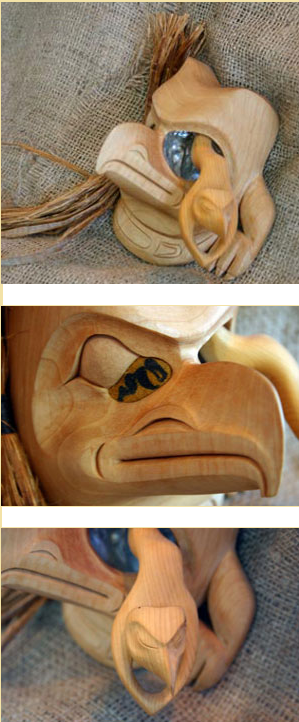
As I go through Northwest Coast galleries and web sites, one of the things I am always looking for are miniatures masks – ones under about eight inches in height. We have several wall areas – mostly above doors – that are too small for anything else. Even more importantly, a miniature is a sign of a carvers’ skill. Yet I don’t see many worth buying, perhaps because miniatures tend to be either student pieces or ones designed for the tourist trade, and experienced carvers cannot charge enough for their time to produce many. As a result, I was especially pleased when I noticed that Ron Telek’s “Transformation Mask: Human to Eagle” had come back on to the market. It’s an unusually fine miniature that shows his customary skill and imagination.

How the mask came from Terrace to Vancouver and I picked it up at the South Terminal of the Vancouver airport (which was not, to my disappointment a foggy runway used by single prop planes like something out of Casablanca) doesn’t matter. Enough to say that it did, and I did, and the mask now resides at the busiest crossroads in the hallway of our townhouse.

What makes the mask so haunting is its ambiguity. Although a human is turning into an eagle, the dominant face is more of an eagle’s. From the left eye, whose socket is lined with abalone, a human shape with a bird’s head seems to diving. Or so it appears; if you look at how the spirit’s head and arms are arranged, you’ll notice that they suggest another beak. You have to wonder, too, if the shape is the departing human soul or, given the deepness of the eye socket, if the transformation is being achieved by the plucking out of an eye.

Then, if you look at the right eye, you’ll notice that it is bare wood. However, in the eye’s lower third, like a cataract, is a piece of leather with a small shape that resembles the one leaving the left eye. Does that mean that the transformation is all in the eye of the imagination and not literal? That the transformation, or the need for it is based on faulty vision and understanding? Or is it a supreme act of will?

Also, despite the title of the mask, what dominates is a largely bird-like face with a full beak and one taloned foot where its left ear should be. So who is transforming into what? Perhaps the transformation is of the human into the form of his helper spirit or true self. Certainly, the bird face seems serene, perhaps even amused to judge by the line of its mouth on the beak. It is the human spirit that seems in pain or exaltation. By contrast, the eagle seems more stoic and less affected by the transformation. Perhaps for the eagle’s nature, transformation is natural, and it is the human spirit that finds passing from one form to the other uncomfortable.

These ambiguities make for an asymmetrical design – something that is relatively common in Northwest Coast art, but which is part of the foundation of modern mainstream design. By showing elements of both, the mask increases its ambiguity even further. To a certain extent, the asymmetry is reduced by the long cedar braid on the right, but the mask remains, like the figure it represents, halfway between two different states.

In the end, you can say so little about the mask that the uncertainty adds to its fascination. The only thing that you can say for sure about the mask is that it is finished with Telek’s usual attention to detail.

I don’t know why the previous owner decided to sell the mask, but I’m glad he did. Unlike the previous owner, we don’t plan to let it out of our hands. We wonder, though, where we will find other miniatures to match its complexity.

telek-human-eagle

Read Full Post »

One of the pleasures of buying art is the thought that you might recognize a young artist before anyone else. The pleasure is not in the fact that the piece increases in value, but in the knowledge that you recognized excellence before anyone else. Currently, buying a print in Northwest Coast art by Robert Davidson or Susan Point requires no special insight – the excellence of both has been well-established for years. By contrast, when Trish and I purchased an acrylic copy of Alano Edzerza’s “The Thief” today, we were taking a gamble.

However, it’s a gamble that we are sure will prove our foresight as Edzerza’s career continues to flourish.

Under thirty, Edzerza is an artist who is beginning to make himself known, especially in glass, graphics, and large scale installations in businesses and offices. Unlike most artists, he also knows the business side of art, and few other artists are in so many galleries, or can boast so many shows so early in their careers.

Last summer, he also became owner of the Edzerza Gallery, which showcases both his work and pieces by other up and coming actions, making him one of the only First Nations artists to run a commercial gallery. I know of several young artists who hope that he will provide a fairer deal than other galleries, and at least one who believes that he does.

I have heard one person denigrate Edzerza for producing giclee prints, as though running off prints from the computer was an abomination rather than a convenience.

More tellingly, I have seen lines in several other people’s artwork pointed out to me that Edzerza might have copied. However, if that is so, the practice is common enough among young artists. Even such an icon as Bill Reid borrowed and imitated at the start of his career, and nothing is wrong with the practice so long as an artist eventually outgrows it.

A more valid criticism is that Edzerza’s imagination is still more two-dimensional than three-dimensional, to judge by his jewelry; not that anything is wrong with his jewelry except that it is not at the same level as his graphics or glass work. Just as importantly, he is also still mastering color, tending to use only one per work.

But, at the same time, Edzerza already shows an exceptional sense of design and a strength of line in his works. Not only are his works effective compositions, but, at least twice, he has found new pieces in closeups of existing works. He simply has an eye for design, and, with this trait, I have few doubts that his limitations will cease to exist in the next few years.

It helps that he seems to have a curiosity and memory for design. The one time I met him, he seemed very current about what other artists were doing, and the way he studied the Henry Green bracelet I was wearing when I passed it to him suggests a capacity to learn.

Just as importantly, Edzerza has an eye for drama, tending to show figures in motions rather than static ones. For instance, in depicting the over-used story of how Raven stole the light, in “Smoke Hole,” he focuses on Raven erupting from the smoke hole, charred and on fire. The result is one of the most arresting retellings of that myth that I have ever seen, because he has chosen a dramatic moment to represent.

Although I find graphics like “Smoke Hole” and “Think Like a Raven” powerful, we chose to buy the acrylic of “The Thief” because we believe that it has the potential to be a breakthrough piece for Edzerza. Even if it is not, it is still one of the most effective piece that he has done in a career that already does not lack for highlights.

“The Thief” is another depiction of the Raven engaged in stealing the light. However, unusually in Edzerza’s work, it is a still and formal piece. Almost a mask, it shows the child that the Raven has transformed himself into in order to accomplish the theft, surrounded by the body of the bird that he really is. But a hint of Edzerza’s characteristic drama rests in the enigmatic smile of the child, which – unlike the sleepy eyes — is not only decidedly not innocent, but mirrored by the raven’s beak above it. The disturbing smile suggests the theft that is about to happen or is in the process of happening.

Like much of Edzerza’s latest work, “The Thief” is in grayscale. However, there are more shades within “The Thief” than in any other of Edzerza’s works that I have seen. I strongly suspect that “The Thief” is a study in chromatic complexity, and (whether he knows it or not), one of the first steps that may eventually lead to a richer use of color in his future works.

Even if it doesn’t, grayscale is a fascinating world of its own, as anyone who has ever worked in black and white photography can tell you. In “The Thief”’s case, the color palette suggests the moon, which, depending on the version of the myth, is either what Raven steals, or else soon results from his theft. Especially in the acrylic version, the composition has something of the rich sheen of argillite – and, although argillite is generally worked by the Haida, rather than by a Tahltan like Edzerza, the resemblance suggests a carving as much as a graphic. This impression is heightened by the position of the raven’s head over the child’s forehead, an arrangement often seen with transformation figures on masks. Could Edzerza also be using grayscale and the illusion of depth it creates as an exercise to improve his three-dimensional imagination?

Whatever exactly Edzerza was intending, “The Thief” remains the best northwest coast composition I’ve seen this year. It’s a contemporary piece, while remaining firmly rooted in tradition. I am proud to be one of its custodians, and look forward to ferreting out its secrets in the coming years. And if Edzerza becomes as well known as I suspect he might, I will be just as proud to loan it for the inevitable retrospective on his career, when it is recognized as a pivotal moment in his career.
cropped1

Read Full Post »

I could be wrong, but I’m starting to see a darker side to art galleries – at least, the ones that specialize in Northwest Coast art. If you are a potential customer, you are unlikely to see this side. Most of those who work in a gallery are as passionate about the art as the customers, and – especially if you are a returning customer – will happily talk for hours. I wish, though, that I could be sure that the artists receive the same courtesy. I’m starting to wonder.

This doubt began to flicker when I first became aware of a common figure in the galleries: A first nations person – almost always a man – hovering around a gallery, looking as though he feels out of place. Sometimes, such a man has a knapsack or even a large duffel bag that he lays very carefully on the floor. If he doesn’t, at some point he will take out a carefully wrapped bracelet or other piece of jewelry from his pocket. Typically, he waits until the gallery is mostly deserted, and then gingerly approaches the nearest gallery employee. He is, of course, an artist hoping to make a sale, and his manner is very much that of a supplicant, nervous if not outright afraid.

Then, yesterday, a gallery owner regaled me with stories of how artists used to be lined up outside his door in the morning. Sometimes, he said, there would half a dozen in line, including many famous ones. The first one or two might make a sale, or even the first three, but, after that, the owner said, he usually lacked the money and was suffering from too much sensory overload to buy anything else. So, at least half the line would have waited hours for nothing.

At the same time, I’ve heard grumbling from several artists. Sometimes, they’re talking about how they feel that a particular gallery has cheated them. But, just as often, it’s grumbling against the gallery system in general. They complain that the galleries sell their work for three times what they were paid for them. And the younger ones especially complain that no major gallery for Northwest Coast art in the province is owned by a member of a first nation (although perhaps Alano Edzerza’s new gallery will change that).

I don’t want to be dramatic, but such scenes make me uncomfortable. Not only are the artists at the hub of the system, but Northwest Coast art is an assertion of identity — both personal and cultural — for many artists. It’s an assertion that, despite everything, they and their culture are still here, and being respected. Yet the scenes are not so different from those associated with day-laboring farm workers. Not that people doing piecemeal work aren’t entitled to dignity – they obviously are – but it seems an added injustice that people who are the main producers, people of real talent and sometimes genius should be subjected to this kind of treatment. Yet some don’t even feel at home in the places where their work is being displayed.

Not all, of course have this reaction. Some artists are capable of handling the gallery system with skill and finesse. Others hire someone who can do the business of selling for which they personally have no aptitude. Still others either have enough talent or reputation that a gallery will adopt them and do everything in its power to promote them. But many aren’t so lucky, and they resent the situation without feeling that they can do much about it.

I don’t know what the solution is. Maybe galleries can be justified as a form of promotion that ultimately helps artists’ careers. But I’m starting to think that more artists need to learn more about business so that they can hold their own. Or maybe more Northwest Coast artists need to become gallery owners themselves. Others might group together to form an online co-operative and create a market for their work that bypasses the gallery system.

Personally, I am listening to the artists, trying to separate out individual animosities from trends in the hopes of finding which galleries, if any, are the most ethical. I am also starting to wonder if I should be dealing more with the artists directly – although I’m not much for negotiations myself, even if I have some experience with them. It’s not a situation that has clear answers, but I won’t be easy about my art-buying until I have some.

Read Full Post »

After several months of down payments, we’ve added the first mask to our collection of Northwest Coast art: “Spirit Moon Mask” by Ron Joseph Telek.

Telek is a great original – perhaps the great original in Northwest Coast art today. Inspired, they say, by a car accident in which he was legally dead for a few minutes, his work is largely concerned with images of transformation and shamanism. While his work obviously comes out of the northern tradition in British Columbia, it breaks with the tradition as much as it keeps it.

His work is quirky, asymmetrical, and fully of little details, and often more than a little disturbing. I’d call it the carved or sculpted equivalent of a Gothic novel – a dark, romantic, and highly individualistic style. Others have called him the first surrealist of the Northwest Coast, and likened some of his more disturbing images to Edvard Munch’s “The Scream.”

His imagination alone would make him one of the top carvers and sculptors on the coast today, but Telek is also a painstaking craftsman, much like his uncle Norman Tait, whom he once studied under. Like Tait, Telek is a master of using the grain of the wood to enhance his subject matter.

The same is true when he turns to other materials – there is a walrus tusk he did a couple of years back languishing in a Vancouver gallery which is so eeriely beautiful that it had to be moved further away from another piece of ivory so as not to outshine it.

Another characteristic of Telek’s work is that, in contrast to what might almost seem his imaginative excess, his finishing details are always meticulous and restrained – you won’t find any tarting up of a mask with rings of unmatched abalone or endless cascades of horse hair in Telek’s work, the way you do in less talented artists. And you never do see paint, which other artists sometimes cake on to hide defects. Like Tait, if Telek adds a finishing detail, it’s for effect.

And if all this wasn’t enough, Telek’s imagination seems endless. Other artists may have periods in their development, in which work after work resembles each other, but Telek’s periods don’t seem to last for more than a piece or two before he moves on to something new. Possibly, this restlessness works against him in the galleries, where many buyers want something familiar, but, I prefer to think of it as one more sign of an inventive and agile mind.

“Spirit Moon Mask” is one of Telek’s smaller, tamer pieces, but it strikes an interesting balance between tradition and the west coast contemporary style of architecture. But the type of odd details that make his other work so lively are there. The wall-eye, the bit of abalone that could either be a nose-piercing or a wound, the strained-looking cheekbones, the arms of the spirit rising from the moon that look like tentacles, the spirit’s arched back and round-mouthed scream — for such a simple piece, the number of unusual touches crammed into the mask is overwhelming.

Since our townhouse is small, we had been thinking of limiting ourselves to one work by each artist who attracted our attention. But, already, we are talking about making an exception in Telek’s case. Perhaps, too, we’ll save for eight or nine months and buy one of his really big works, even if we have to rent the townhouse next door to display it properly. Frankly, we’re hooked.

Read Full Post »

As I wrote a few months ago, how a building is used can create an atmosphere. A hospital, for instance, nearly always make you uncomfortable, even if you are not involved in anything going on there. After thinking for a couple of weeks, I can think this same truism helps to explain the appeal of buying art.

For me, buying art is not an investment. Nor is it a hobby like collecting coins or stamps, in which you try to collect a complete set. Still less is it a sense of ownership; I firmly believe, for instance, that you should not buy art that you have no room to display properly, which is why we wouldn’t buy a Northwest Coast button blanket – even if we could afford it. We simply don’t have the fifty square feet of wall space to display one properly.
Instead, buying art is an effort – a slow, piece by piece one, in our case – to transform the atmosphere of our living space. Consciously or unconsciously, everyone does something similar if they live in one place long enough.

But, in most cases, furnishings are chosen because they are comforting or show an awareness of the latest trend. You find very few people, even interior designers, who create rooms that are a bold statement of personality or aspirations.

About the closest you usually get to such a declaration are the people who buy an antique house and spend years living with sawdust and the noise of construction until they have refurbished it into as close a replica of the original as modern tastes can stand. In effect, such people make the house itself a work of art.

Living in a townhouse, I’m not in a position to do that. Nor do I have the tolerance for breathing dust and living with table saws and lathes for years on end. But, what I can do is decorate my living space with what I think is the most inspirational or provocative art that I can afford.

Some of the art that we have bought or hoped to buy is not comfortable – some of it makes people whose idea of decorating is pretty pictures very uneasy. But what it all has in common is that it is the product of the human mind at its best, If some of it is challenging, that is all the better, so far as I am concerned. I want to be challenged and inspired by the best as I go about my daily business. I don’t want merely pretty pictures.

In fact, I am convinced that you are better for surrounding yourself by art. Where a prison or a hospital upsets, art soothes and relaxes. It makes you more observant as, living with a piece day by day, you slowly unravel the secret of why it is a triumph of design. It also, I find, inspires you to live up to it, not only in little ways, like trying to keep the place neater so it is a suitable environment for the art, but also in large ways by challenging you to do your best in your work or pastimes, to make yourself worthy of your surroundings.

That is why those who think that art is only the concern of a small elite, as well as those who mistake art for fashion are both wrong. Art, like exercise, is good for everybody, and you can’t replace excellence with conformity. Really, it’s as simple as that.

Read Full Post »

« Newer Posts - Older Posts »