Feeds:
Posts
Comments

Posts Tagged ‘art’

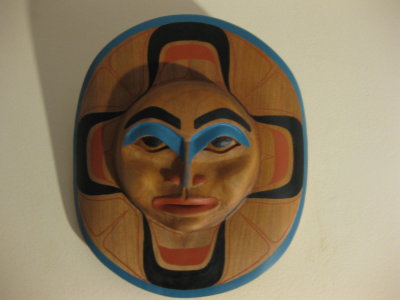
John Wilson, who describes his work as “contemporary Haisla,” has only been selling his work for a few years. And, so far, he has confined himself largely to portrait masks, although he has also done drums and some graphics worth releasing as limited edition prints. I consider his “Blue Hand Mask” (which should actually be read as “Blue, Hand Mask”) an accomplished example of the portrait genre, and am pleased to add it to our collection.

If you have read Bill Holm’s An Analysis of Form, you will immediately identify the “Blue Face Mask” as being in the northern style: although the nostrils and lips are painted solidly, the hand and the spirit-helper on the left temple cut across the facial features. In fact, you cannot tell where the spirit-helper ends and the eyebrow begins – that is, what is natural and what is painted, or what is mundane and what is supernatural. Also typical of the northern style is the predominance of black, followed by red.

What is less typical is the band of blue. Cutting across the eye socket and eyelid, the band is an unusual shade. It has the effect of drawing your glance to the blackness of the pupils, giving a sense of fierceness or determination.

The painted hand is a visual pun. It has an umbilical-like connection to the spirit-helper that runs below the chin and up the left cheek. In other words, the spirit-helper is literally lending a hand. And, just to reinforce the pun, the obvious thumb shows that it is a left hand, originating on the same side as the spirit-helper.

One of the things that makes this mask stand out is the sheer skill of carving. Unlike many carvers early in their career, Wilson thinks in planes. That means he is working with the wood, rather than against it. At the same time, the mask is closer to realism than a strictly traditional piece in such features as the chin, the eye sockets, and eyes – which is what makes the mask contemporary.

Another outstanding feature of the mask is the way that Wilson has carved and sanded down to the grain that is suitable in different parts of the face. On the forehead, the ridges of grain meet almost in the center, while on the left cheek, the concentric circles of the grain emphasize the plane of the cheek bone. Even more interestingly, beneath the eyes are what might almost be reflections of them in the grain. Some bits of this attention to the grain are lost beneath the paint, but, because the paint is minimized, much of it remains visible.

Portrait masks are an easy genre to under-estimate. They lack the exoticness of a mythological theme or a stylized animal that many people seem to want in Northwest Coast art. But, if you look closely at the best examples of them, like the “Blue Hand Mask,” then you can start to appreciate them as a genre in which artists are thrown back entirely on their own skill. You can also understand why I think that John Wilson is an artist who is likely to make a name for himself.
low-res-blue-hand-mask

(Note: Somebody should explain to galleries that, when shipping masks with hair, they need to make some effort to keep the hair from getting tangled. As you can see, I am still trying to straighten out the hair)
Read Full Post »

Over the years, the Museum of Northern British Columbia has gained a reputation for working with the local First Nations in Prince Rupert. But now, unless appearances deceive, museum officials seem willing to throw away that reputation just so curator Susan Marsden can flex her muscles in her ongoing struggle to assert her authority over Tsimshian master carver Henry Green and his apprentices. The conflict is being fought over the carving shed, a popular attraction where Green and the other carvers have been working, but what’s really at stake is the consistent disrespect shown by the museum and city officials.

According to the chronology provided by Green on Facebook, the carving shed has been in existence since 1980. While hardly a comfortable place – it has no washrooms, running water, nor working furnace — in the last twenty-nine years, it has been a workspace for many of the biggest names in Northwest Coast art, including Alvin Adkins, Edward Bryant, Heber Reece, Lyle Campbell – and, of course, Green himself, who has worked there on and off since it was built.

The carving shed has not always co-existed peacefully with the museum, being a place where artists came and went without ever being employees or having much regard for museum hours. But, when relations were uneasy between the museum and the carving shed in 1993, Green says, communication helped to reduce the tensions on both sides. Mostly, the shed has continued to be an important attraction despite minimal promotion by the museum.

However, since last summer, relations between the museum and the current crop of carvers have steadily worsened. The phone was removed, amidst allegations that it was being used for long distance calls, a claim that Green denies. Then the locks were changed, including the ones on Green’s private storage. Green says that he had to wait four hours to get into the shed to get his tools, and that “during this time I was berated and talked down to.”

In another episode last summer, the artists erected a carving sign directing tourists to the carving shed. When Green’s partner and his daughter investigated, they found the sign locked away by the museum, on the grounds that private signs could not be put on museum property. Not only has the sign not been returned, but, as a result of the incident, Jennifer Davidson, Green’s partner, was banned from the carving shed by Susan Marsden, while Morgan Green was told that she would have to apologize before she could return. Marsden’s claim is apparently that Morgan Green kicked and swore at her – charges that Morgan denies.

Matters came to a head in January, when all the carvers were given one week to vacate the shed. Considering the number of carvings in the shed, including some two meter poles, this is a next to impossible demand. The artists requested at least a month to vacate. Meanwhile, they are worried that their tools, many of which are highly specialized and specifically created by them or for them, will be confiscated by the museum.

The carvers have tried to talk to the museum’s board of directors, but all they have heard is secondhand accounts that the shed will be renovated, then assigned to groups for specific projects. The implication seems to be that the current group of carvers will not be among them. Moreover, since it is February and no permit for renovations appears to have been taken out, the carvers are more than a little skeptical of the claim.

The situation remained unpublicized until Morgan Green started a FaceBook group called “Expression Not Oppression” four days ago. Since then, over four hundred people have joined the group, including many local first nations people and art-lovers.
Prince Rupert mayor Jack Mussalem insists that supporters have heard only one side of the story. However, when he phoned to give it to me, he demonstrated no understanding of what upset both the carvers and their supporters (who include me).

Nobody is questioning the right of Marsden to evict the carvers, not even the carvers themselves. But what bothers people is the disrespect. If what I have heard about Marsden’s behavior is even remotely true, she seems to have abandoned common courtesy.

Even worse, Marsden, Mussalem and other officials of the museum and Prince Rupert seem to be acting with a total disregard for the sensitivities of the first nations. Considering the history of the last century and a half, many among the first nations are understandably sensitive about anything that suggests the arbitrary abuses of power, particularly by people of European descent. And when you add the fact that first nations artists are leading figures in preserving the cultures, insults directed to an internationally-known figure like Henry Green are easily seen as insults to the community itself. You can see these attitudes being expressed in the comments in the Facebook group.

Art-lovers and collectors feel much the same way. Witnessing a conflict between artists whose main desire is to continue working undisturbed and empire-building bureaucrats, you want to guess with whom they’ll side?

Possibly, there are mitigating circumstances that would explain the behavior of officials. Yet, if so, they have not bothered to explain those circumstances. Instead, they have simply asserted their right to act as they have chosen, and refused to address the question of their behavior.

Very likely, they can get their way in the short run. However, in the long run, their petty victory in what seems no more than a bureaucratic turf war threatens to be won at the expense of all the good will from the first nations that the museum has built up over the years. And, if that happens, the museum could take decades to regain that good will – assuming that it ever does.

Read Full Post »

You don’t discover the fact right away, but if you start buying Northwest Coast art regularly, you soon learn that most art galleries stock two types of works: The type that gets displayed, and the type that sells without ever been hung in the gallery or appearing on a web-site.

The type that never gets displayed comes from a number of sources. It may be a piece that is being resold after the original buyer has died, lost interest, or needs to make room in their connection. Sometimes, it is a piece by a top artist for whom the demand is so great that the gallery staff have a shrewd idea of who might buy it. It may be a piece that has been brought into the store for an upcoming exhibition.

Occasionally, it is a piece that is half-finished, such as the half-finished panel in one gallery that was abandoned because it developed a crack, or the telephone chest I saw at one gallery that had Bill Gates’ initials on it because the artist thought only someone like Gates would want to buy it – but he didn’t. The origin can even be as simple as a piece that the gallery currently has no room for, and has tucked away in a closet that most potential customers never see.

Another source of undisplayed art is the artists themselves. Some artists, particularly better known ones, have enough of a following that they don’t need the galleries except as a form of marketing. Much of their work is either begun as a commission or else sold soon after completion to people on the artist’s contact list.

Whatever the exact origin, these undisplayed pieces are frequently the best or the quirkiest work available. For instance, I know of one gallery that has a collection of original acrylics by an artist who recently died. As soon as news of the artist’s death reached the gallery, the owner pulled the pieces until he could decide what to do with them, and hasn’t displayed them since.

In another case, a highly regarded but not very prolific artist delivered his latest masterpiece to the gallery. The gallery never displayed it, but sent word to a few select customers. Despite the high price tag, the work was sold within two weeks. In a similar case, a master carver placed his latest work on consignment, and the gallery sold it in less than 24 hours. Only a handful of regular customers got to see so much as an online photo.

If you want to see such work, the only way you can is to cultivate relationships with the senior staff at galleries or with the artists. Some artists prefer not to deal directly with buyers, but, otherwise, many staff members and artists are only too pleased to talk about what interests them. They can teach you a lot, and, as they get to know you, introduce you to the work of other artists, and, if you let them know your interests, they will gradually include you in the list of people who learn when undisplayed work becomes available. But building relationships is the only way you are likely to have a chance to buy – or just admire – some of the best work in the field.

Read Full Post »

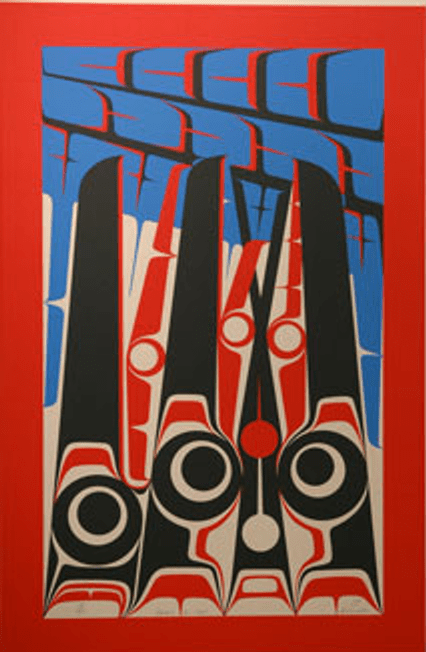
Northwest Coast art is semi-abstract to begin with, and continues to have a strong tradition. For these reasons, abstract or post-modern work in the field is rare. Perhaps the best-known movements in those directions come from Michael Nicoll Yahgulanaas’ Haida Manga or Andrew Dexel (Enpaauk)’s graffiti-inspired canvases. However, long before either of these efforts, Doug Cranmer was making his own movements towards abstraction or post-modernism. In the mid-1970s, he did a series of abstract paintings, several of which were turned into limited edition prints in 2005, and some of which have been released to a handful of galleries in the last month. Recently, we were privileged to take home a print of “Ravens in Nest,” which is compositionally the most interesting of the recently released prints.

At first, the idea of abstracts coming from someone like Doug Cranmer seems unlikely. After all , Cranmer comes from the first generation of artists in the Northwest Coast Renaissance, have learned carving from Mungo Martin. Later, he worked with Bill Reid on poles and houses that were commissioned by the University of British Columbia.

And in the mid-Seventies, who else was doing abstracts? Back then, even Bill Reid had just completed his mastery of traditional form and had yet to edge towards the free-form works of his last period. It would be almost two decades, too, before Robert Davidson would become one of the best known artists to move towards abstraction and post-modernism.

However, in an interview excerpted on the Museum of Anthropology web page, Cranmer explains that he was reacting against the orthodoxy created by Bill Holm’s book Analysis of Form, the first to codify the basic elements in Northwest Coast art.

“After the book came out, all of a sudden there was a right and a wrong way of doing things. We never had that before,” Cranmer said. “The book has served its purpose in explaining Indian designs and elements, but a lot of people followed the book to the letter: as a result, their work has come out all looking the same.”

Apparently in reaction to this tendency, in 1974-5, Cranmer began a series of 48 paintings. “I was doing them differently for the sake of being different.” he said. “I was doing things in Northwest Coast-type design elements that didn’t look like a bird, a fish, an animal, a man or a woman. It worked for a while, but then I noticed that they [the paintings] were starting to look like something again.”

If you look at “Ravens in Nest,” you can see this anarchistic outburst very clearly. The classic formline of Northwest Coat art barely puts in an appearance in the print. Instead, that flexible container of design elements which is generally black, is replaced by a thick red border. Perfect circles replace ovoids. U-shapes, unusually colored blue, float freely across the top, changing direction on each line, and change shapes along the bottom. Blue and red are the main colors, not black. The expected curve of the young ravens’ beaks – an identifying element of a raven in the traditional art — is reduced to the slightest tip possible Instead of the classic symmetry, everything is decidedly unbalanced.

You might almost say that “Ravens in Nest” is a Northwest Coast print because of all the things that it does not do. Like early post-modern works, the print works to the degree that you know the tradition that it is reacting against.

Furthermore, the more you do know, the more what Cranmer has done makes you think about traditional Northwest Coast forms. In fact, while Cranmer may have been reacting against orthodoxy, what he has produced is just as dependent on tradition as any piece that carefully follows the norms outlined by Holm. The only difference is that “Ravens in Nest” is dependent on tradition as its polar opposite, rather than as a key to its technique.

At the same time, while you can easily intellectualize about the piece, its subject remains clear: four hungry and clamoring young ravens. I don’t know if Cranmer intended the effect, but the floating U-shapes seem a graphical representation of the sound they are making, chaotic and clashing.

Such paintings were only a momentary experiment with Cranmer, but they had few if any imitators. The result is that the prints still offer a unique and challenging perspective thirty years after the original paintings. I am not fond of the average abstract, but in Cranmer’s I see a bold and innovative exception that I am proud to hang on our wall.
doug-cranmer-ravens-in-nest

Read Full Post »

One reason why Northwest Coast art thrives is the strong tradition of teaching among the artists. Artists regularly take on apprentices, and many regularly assist younger artists in their struggles to establish themselves. One of the newer artists who has benefited from the tradition of teaching and plans to teach others himself one day is John Paul Wilson, a member of the Blackfish clan of the Haisla nation for whom carving masks is both personally satisfying and a means of rediscovering his culture.

john-wilson1
Wilson was born in Kitimat in 1973, but grew up and lives in Terrace, and is currently learning northern carving styles. “I have been taught little things about my culture as I was growing up,” he says, “But I didn’t go to my village. I am now really trying to find my culture as an artist.”

After what he describes as a hard-living youth, Wilson worked in a variety of jobs, including carpentry, forestry, and sales. “Now that I look back on my life,” he says, “I see that what I was doing was training myself to be an artist, whether I knew it or not.” All his work, he believes, helped him to prepare for both the techniques and business of being a carver.

john-wilson2

Although Wilson says that “I have always been doing art,” he only began focusing on carving in 2002, when he began studying under Tsimshian artist Heber Reece. After he “took some time away” from Reece, Wilson continued to return to him for help, and later took a course Reece taught at the local college in 2004. “He always had his doors open for me,” Wilson says of Reece.

More recently, Wilson has been receiving informal advice from Nisga’a carver Ron Telek, especially on the finer points of finishing, and attending the Freda Diesing School of Northwest Coast Art at Northwest Community College, where he is being taught by Stan Bevan, Dempsey Bob and Ken McNeill. In fact, this is the second time he has enrolled in the Freda Diesing School, after a burglary of his home forced him to withdraw the first time for lack of funds.

john-wilson3

Other artists whose work Wilson admires include Robert Davidson, Norman Tait, Klatle-Bhi, and Henry Green.

“The senior artists have given me the drive to to get to where I am as an artist,” Wilson says. He is particularly enthusiastic about the Freda Diesing School, which, although he has only just started the second semester, he describes as having “helped so much that I advise anybody to take the course if they want to get serious about being an artist as a living.”

Rediscovering culture

At first, Wilson admits, his interest about carving was as much about making a living as about art. However, under the influences of his teachers and education, he finds his motivations shifting. “I now realize that it is our culture,” he says. “That means a lot to me, knowing that I am going to help keep our culture alive.”

john-wilson4

As Wilson reconnects with his culture, one of his most personally meaningful discoveries was that his great-great-grandfather was also an artist. The discovery, he says, has made him realize that “without knowing the history, I don’t think I could go forward as an artist.”

He now plans to return to his village to familiarize himself with his culture, and dreams of one day teaching there. “Our culture is our way of telling stories to hand down to the next generation,” he says. “And art is a big part of our culture. It is something we were so close to losing, but I did not find that out until I talked to senior artists at the Fred Diesing School.”

john-wilson5

Learning the life and passing it on

At the same time, Wilson finds his carving, which he describes as “contemporary Haisla,” becoming central to his life. “The art is very important,” he says. “It has changed my life for the better. I have a strong feeling that [art] is the right path, like it is what I was brought on earth to do.”

Besides the technique of carving and his reconnection to his history, one of the things that bemuses Wilson about his chosen career is the need to market himself. “When you finish a piece it’s like creating a kid of your own. Sending a piece out for sale is one of the hardest things to get used to. And I’m still learning how to market myself. A lot of people think that when you’re done your piece that it’s time to rest, but they forget the time and effort it takes to sell the piece. You have to really study the way to market yourself as an artist if you want to make a living doing the arts.”

john-wilson6

Now selling regularly to galleries, Wilson is currently able to support himself as an artist. “Some times are better than most,” he observes, “but it still gets me by comfortably.”

All in all, art has become so central to Wilson’s identity and life that he is now starting to pass on the encouragement he received from senior artists to others. “Just try it,” he advises. “You never know what will happen. Look at Freda Diesing – she didn’t start until she was in her forties, and she won a lifetime achievement award for her efforts at learning and teaching the arts.”

(John Wilson’s work is available in the Black Tusk and Path Gallery in Whistler, The Edzerza Gallery in Vancouver, The Art of Man in Victoria, The Stonington and Steinbrueck galleries in Seattle, the Arctic Raven Gallery in the San Juan Islands, and Neo Concept in White Rock).

john-wilson71

Read Full Post »

You don’t have to dig very deeply into Northwest Coast art to stumble across a representation of Raven stealing the light from the chest where its owner has cached it. Whether you’re looking at a print, a piece of jewelry or a sculpture, in any gallery, you have an almost certain chance of finding a representation of the myth. In many ways, the story is to modern Northwest Coast art what the crucifixion or a Madonna and child were to the Italian Renaissance – a standard subject that most artists tackle sooner or later. That’s why Bill Hudson’s “Raven Opens the Box of Daylight” tickled our sense of humor so much that an artist’s proof of the cartoon was under our Christmas tree this year.

Bill Hudson is the spouse of Clarissa Hudson, the Tlingit weaver and painter. From what I’ve seen, much of his own work is more mainstream and includes a good deal of commercial and theatrical design. However, some of his work shows a Northwest Coast influence, including a poster he did for the twentieth anniversary of the Alaska Folk Festival that shows Raven, human with a mask for a head, wrapped in a robe of his own feathers and strumming a balalaika.

What I like about Hudson’s cartoon is the way that he has reduced a myth from the dawn of creation to a modern, mundane scene around a breakfast table, complete with orange juice and toaster. Far from being a great treasure, the light is contained in a commercial cereal box. It’s a good-natured but hilarious comment on just how common the story is; I’ve described the piece to several Northwest Coast artists, and all of them have understood the point immediately.

At the same time, Hudson has paid close attention to detail. Outside the window, you’ll notice, the stars and moon are visible, since in any form, the story predates the sun. Also, the raven’s feathers are not just black, as ninety-nine out of a hundred people would describe them, but tinted with a dark blue, as a raven’s feathers actually are. I appreciate such close attention to detail in what, for all its satire, is essentially a slight piece – so much so, that I have started paying closer attention to the rest of Hudson’s work, on the grounds that anyone who takes such pains is (at the very least) a thorough-going professional.
box-of-daylight-small

Read Full Post »

During today’s Christmas shopping expedition, I witnessed a short scene that taught me something about my concepts of artistry.

I was in a local gallery dedicated to Inuit and Northwest Coast art. A well-known First Nations artist was working in the back, refurbishing the cedar braid on one of his works in the gallery, and doing the same for the work of his son, who is an artist in his own right, and has been for some years now.

While he was working, he looked at one of his son’s carvings. “I don’t know why he finished that with a rope,” he muttered in disgust, seeing that the rope was nylon. A few minutes later, he muttered, “And why did he use such big nails to hold it in?” As he complained to himself, he was stripping off the rope and replacing it with bundles of cedar branches.

The artist was unquestionably right in his aesthetic judgment: His son’s carving was greatly improved by the removal of the rope and its replacement with cedar bundles. Still, I found myself reacting simultaneously in two different ways.

One part of me was reflecting ruefully and with some amusement how hard it must be to study under your father, and to have him improving your work even after you are recognized as a artist yourself.

At the same time, another part of me was shocked. Like most people in modern industrial culture, I tend to view art as an individual form of expression. From this perspective, correcting another artist’s work is unacceptable, a form of aesthetic hostility and violation that seems even worse than physical harm. It is also lying to the audience, who pay expecting a work by one author, but actually get a pastiche. The fact that most audience members will never realize the switch doesn’t matter; they are still not getting what they paid for.

But, when I reflect more deeply, it’s really nothing new. I remember having the same reaction when I learned that various members of a group of writers I once knew would happily pitch in and finish each others’ work to help meet a deadline or to add a level of expertise that the person whose name would be on the cover couldn’t provide. For them, it was a sensible thing to do, especially since some of them shared a house. By volunteering their anonymous services, they were helping to ensure that the taxes and utilities would be paid.

Moreover, similar helping hands have been extended for centuries by masters to apprentices. I know, too, that many of the carvings attributed to Bill Reid were partly a collaboration, with Reid providing the design skills and other members of the team providing the carving skill. So my shock is hardly a valid reaction.

What matters, I keep telling myself, is the finished work of art. Could it really be considered a lesser piece if another artist than the accredited one contributed to it? Logically, that would be an absurd point to defend.

I suspect that my reaction shows that I am unlikely to enjoy collaboration on any of my own efforts – a fact that I might have also deduced from my uneasiness at being edited, even when the editing improves my work.

Read Full Post »

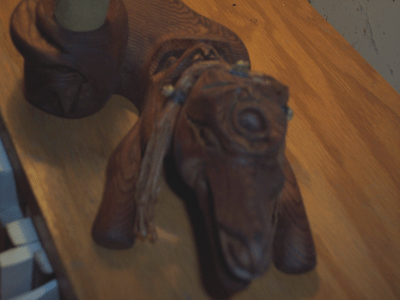
Ron Telek, the Nisga’a carver, can always be counted on for the unexpected – anything from the disturbingly haunting to the eerily beautiful, and in every form imaginable. I’ve even seen a shaman marionette by him. Our latest acquisition, “Transformation Rattle: Eagle to Wolf” is no exception. Only a handful of other Northwest Coast artists could take a utilitarian object like a rattle and turn it into a sculpture while keeping it functional.whole-small

One of the characteristics I’m starting to associate with Telek’s pieces is an unusual degree of three-dimensional awareness in the design. Like many of his pieces, “Transformation Rattle” is impossible to capture fully with a single photo. I took five pictures for our records, and I’m not sure that I shouldn’t have taken a sixth to cover it fully.

The rattle consists of two parts: The rattle, which is the eagle, and the rattle’s base, a lean-looking wolf with a curved tail and, around its neck, a garland of cedar boughs. The rattle rests inside the tail, and can be removed from it. At first glance, you are lucky to notice that it’s a functional rattle. Your first clue is the leather wrapped around the bird’s tail as a hand grip, but even that could simply be part of the surreal sculpture.

The rattle depicts the transformation perhaps two-thirds of the way through. On the right side, the bird’s features are depicted fully, but the left side of the body is mostly blank, with the features indicated by a few indentations, and the wing by the grain of the wood.

smooth-side-eagle-small

Its feet, too, are gone, absorbed into the wolf. Perhaps to indicate the transformation’s incompleteness, the bird’s wing is wrapped around its rounded stomach, as though it is pregnant with itself.

finished-side-eagle-small

The wolf is more complete, but its lack of claws and teeth or fully-formed rear legs shows that it, too, is an unfinished figure. wolf-small

Its thinness and slightly rough carving, especially in the comparison with the eagle further suggests the wolf’s incompleteness – and, perhaps, the energy expended to make the transformation.

The fact that the two figures are the same is suggested by the spirit in the middle of the eagle’s right wing and atop the wolf’s head. Furthermore, the wolf’s garland of cedar suggests that this is not a born wolf, but a human – no doubt a shaman – going through these transformations. Supporting this idea is the much larger, more human-looking spirit erupting from the wolf’s back, as well as the fact that, if you look closely, the rear legs are more human than wolf-like.wolf-front-small

All this complexity is heightened by Telek’s characteristic attention to the direction of the grain. An employee at the Art of Man Gallery in Victoria told me last week that Telek often carves down until he finds the grain he wants, and, looking at “Transformation Rattle,” I have no trouble believing it. Although both the rattle and its base is carved from a single piece of red cedar (and stop and think about the difficulty of that for a moment), the carving is literally never against the grain. Even on the wolf’s curving tail, the grain moves with the sculpture. And, on the eagle, the round pattern of the grain not only suggests the bird’s body, but creates a semi-abstract form as simple as it is beautiful.

The overall result is a contrast with the tall, rounded shape of the eagle, and the ground-hugging, angular shape of the wolf. It’s an accomplished piece of work, which I’ve place on top the shelves on my computer desk, where I can look up at it periodically, or even take the rattle out for a shake if I feel like it. We’re seriously thinking of mounting it on a lazy susan, so that it can be viewed in its entirety more easily. Meanwhile, I’ve already switched its position around several times in the day since we brought it home so I can admire another aspect of it.

Read Full Post »

Not too many years ago, you only had to walk down Government Street in Victoria to find more shops selling Northwest Coast art than you could properly absorb in a day. Looking back, I’m not sure of the quality of some of the shops, but they were there. But times are harder, with many store fronts along Government empty, and now you have to search for galleries.

Descending on Victoria yesterday, these are the galleries we managed to find:

  • Art of Man: Located in the mall in the basis of the Empress Hotel, the Art of Man specializes in Inuit and First Nations masks and sculpture. The pieces for sale included four or five from Ron Telek, including a meter high blue shaman (this from an artist who rarely uses color), and a shaman marionette fending off a spirit attacking his foot with other spirits resting in his hand. Daryl Baker, the nephew of the LaFortune brothers Doug, Perry, and Aubrey, is also represented by highly-detailed designs that border on the surreal, and that are all marked by a close attention to finishing details. The Art of Man also seems to get first pick of Tim Paul’s work – so much so that I realize that only his lesser pieces reach Vancouver. Other artists whose work is available at this gallery are John and Luke Marston, whose work shows an awareness of history that I had never realized before that it possessed. In general, the quality of the work at the Art of Man is extremely high, making it by far the premier gallery of Northwest Coast art in downtown Victoria.
  • Hill’s Native Art: Like the Vancouver store, the Victoria Hills is mainly a tourist shop. However, the Victoria store seems to have a slightly better ratio of art to high-end tourist pieces, as though it gets first choice of all the locations. But perhaps this impression is due partly to the fact that it is less crowded and better lit.
  • Alcheringa Gallery: From the web site, I had the impression that this gallery was huge. The reality, though, is that this is a gallery with only a few of its pieces on display – and about half of those are given to works from Papua New Guinea, which is worth seeing, but doesn’t engage my interest the way that the Northwest Coast tradition does. Still, you can see some works by Tim Paul and John Marston there. I was also interested in seeing two works I had seen on the Internet, one by Ron Telek and another by Dean Heron.
  • Pacific Editions: Unfortunately, this story is closed on Mondays, which meant that we walked six blocks out of our way for nothing. But what we could see through the window confirmed the impression I had from the web site: Pacific Prints has a huge collection of limited editions prints. I look forward to spending a happy few hours there the next time I’m in Victoria.
  • Eagle Feather Gallery: A mixture of art and tourist pieces, this gallery is only a block from the Empress Hotel – but on a side street that you may have trouble finding. It specializes in the work of Doug, Perry, and Aubrey LaFortune, especially Doug (in fact, he was due to drop by the day that we visited, although we missed him). Daryl Baker and Pat Amos also have a couple of pieces, while Francis Dick has at least a dozen 2-D works from throughout his career at the gallery. Whether the gallery is worth a visit probably depends on your opinions of these artists, although its stock gives you a good opportunity of evaluating Doug LaFortune thoroughly.
  • Out of the Mist Gallery: This gallery specializes in antiques. Its modern selection is devoted largely to the Hunt family, and includes a few curios like a mask carved by Richard Hunt when he was a teenager, a formal, somewhat stiff print from the start of Beau Dick’s career, and a two meter-long eagle by Roy Henry Vickers. The quality of the antiques is completely indiscriminate, and includes some pieces from across North America. If your taste runs to antiques in Northwest Coast art, you could probably find something to your taste, but the somewhat dim lightning and the bored staff makes the effort hardly seem worthwhile.

As with previous lists I’ve made of galleries, this one makes no effort to be comprehensive. We did not, for instance, have to visit the Provincial Museum’s gift shop, which I seem to remember as having a few art pieces. So if you know of any other galleries in the Victoria area that might be worth a visit, please add a comment and let me know.

Read Full Post »

As I visit Northwest Coast Galleries in Vancouver, I’m starting to notice relations between certain galleries and certain artists. Out of friendship, enthusiasm, long-term business relations, or a combination of all three, some galleries simply carry a better selection of some artists than others.
Here are the specializations I’ve been able to detect so far:

  • Coastal People’s Gallery: This gallery has a good general selection of artists, although it seems to be buying less recently, possibly because it’s overstocked. However, it is the main exhibitor in town of Henry Green, especially for his carved and increasingly colorful panels. Coastal People’s also favors Chester Patrick, a less well-known artist who has done a number of acrylic paintings notable for the complex grouping of characters, as well as panel carving. Since the summer, the gallery’s Gastown store has had space set aside for Patrick to work. I’ve heard at least one patron refer to Patrick as the store’s artist-in-residence, although I don’t know whether the arrangement is formalized.
  • Douglas Reynolds Gallery: Douglas Reynolds seems to have first right of refusal on works by Beau Dick, the Kwaguilth mask-maker and Haida artist Don Yeomans, possibly because the artists have a long friendship with the owner. At any rate, the selection of works by both Dick and Yeomans tends to be larger and more varied than at any other gallery – so much so that, in Yeoman’s case, I tended to think that he was past his creative prime based on his work in other galleries. However, based on what I’ve seen at Douglas Reynolds, that’s far from true; I just wasn’t seeing his best work. This same gallery has also started carrying a good selection of jeweler Gwaii Edenshaw.
  • Edzerza Gallery: As you might expect, this new gallery is mainly a showcase for the work of owner Alano Edzerza. However, it has also had the work of newer artists like Ian Reid and John P. Wilson.
  • Inuit Gallery: The Inuit Gallery seems to have good connection with the North, including Alaska artists like Clarissa Hudson and Norman Jackson, whom many galleries neglect – even though importing First Nations art from the United States is supposed to be duty-free. Recently, it has also had a couple of new masks from Tlingit/ Northern Tutchone artist Eugene Alfred, and a number of playful masks from Kwaguilth carver Simon Dick. Other with whom the gallery seems to have a good relation include Salish artist Jordan Seward and Nuu Chan Nulth artist Les Paul.
  • Sun Spirit Gallery: Located in West Vancouver’s Dundarave strip, this small gallery currently has a strong selection of Klatle-Bhi’s work, particularly masks. Much of this work is in Klatle-Bhi’s apparently favorite white and light-blue palette.
  • Spirit Wrestler Gallery: Robert Davidson seems to offer new works to Spirit Wrestler first, and to have an arrangement with the gallery for prints as well. The gallery also gets the pick of new works by Norman Tait, and currently has more work by Dempsey Bob than any other gallery in town. In addition, the gallery seems to cultivate some of the best of up and coming artists, such as Dean Heron and Sean Hunt, making it more adventuresome that I originally thought from my first visit.

As I was making this list, I realized that it represents my own interests as much as each gallery’s specialization. Very likely, I have left out some specializations either because I am not interested in them or haven’t got around to them yet. Still, it’s useful to know which gallery to go to if you’re interested in a particular artist, so I’ll let the list stand, even while acknowledging that it is probably incomplete.

Read Full Post »

« Newer Posts - Older Posts »