Feeds:
Posts
Comments

Posts Tagged ‘Uncategorized’

I’m always irked when people cheapen real medical and psychological conditions. To say that you have chronic fatigue syndrome when you are trying to get by on four hours’ sleep a night, or that you have post-traumatic stress when a friend of a friend dies trivializes conditions that cripple those who actually have to cope with them. However, Impostor’s Syndrome has to be the worst trendy condition of all. Not only does it not exist, but it encourages self-dramatization, and its suggested remedies are more about self-esteem than addressing any problems.

You won’t find Impostor’s Syndrome in the American Psychiatric Association’s Manual of Diagnosis. That’s because it’s not recognized as a unique condition, which leaves everyone free to self-diagnose at will. But, so far as it has any meaning at all, it refers to persistent doubts that you deserve your success or current position. Women are alleged to be especially prone to Impostor’s Syndrome, although the lack of assessment criteria means that this allegation is an assumption at best.

Needless to say, this vagueness does nothing to prevent people from believing that the term actually means something. If anything, the vagueness probably helps people to find validity in it. Like a horoscope, people have no trouble applying the vagueness to their own situation.

However, the real problem with Impostor’s Syndrome is not just that it is redundant, but the way that it converts normal behavior into a pathology. Regardless of whether you are a man or a woman, nothing is unusual about being uneasy in new circumstances or wondering whether you measure up to others. These sorts of misgivings are the natural consequence of finding yourself in new circumstances. Nobody enjoys them, but most learn to control them and carry on regardless.

In fact, those who find themselves constantly in stressful situations, such as actors or athletes, are often convinced that, without such uneasiness, they will perform poorly. Instead of dreading such feelings, they view them as a source of nervous energy that can be channeled or converted to improve their performance. To them, confidence in such situations is the abnormal reaction, and struggling to bring anxiety under control the healthy one.

By contrast, those who self-diagnose themselves with Impostor’s Syndrome take the opposite approach. They treat confidence – or, at least, comfort – as their right, rather than learning practical means to cope with their unpleasant but normal reactions.

Such is the power of naming that, once they apply the term to themselves, their anxiety and stress suddenly swim into focus. They are not facing a routine part of life; they have a condition for which they bear no responsibility. The self-drama of having a condition (never mind how it is diagnosed) becomes central to their reaction.

This self-dramatization is not only tolerated, but encouraged by the industry – both paid and unpaid – that has sprung up around Impostor’s Syndrome in much the same way as one has sprung up around Asperger’s Syndrome. Armed with a pseudo-scientific name, this industry encourages its clients to find ways to feel good about themselves. They should exchange stories with their fellow sufferers. They should seek compliments from family and friends. They should use affirmations until they hypnotize themselves into confidence through repetitions of self-praise.

Needless to say, the possibility that anyone might actually be incompetent – a fact that they would be better off admitting as soon as possible – never seems to be mentioned.

Even rarer is the obvious suggestion that the best way to overcome worries is to develop a plan, either of study or action, to develop competence that no one can question. In fact, the industry is likely to warn that such a plan will only increase the worries – which is true enough, but only in the short run. In the long run, building self-esteem with nothing to support it only results in egos that are even more fragile they originally were.

This approach leaves those who believe in Impostor’s Syndrome like people who start to exercise, then complain that they are unable to continue because it causes their muscles to hurt. They spend a fortune on salves and massage when what they really need is a program that allows them to reach a greater level of fitness with fewer side-effects.

None of this applies, of course to genuine anxiety and stress. Both are recognized conditions, and may be centered upon doubts about competence or a new situation. However, the idea of Impostor’s Syndrome is something else, too often having more to do with being comfortable than with genuine problems. I can’t help thinking that most of those who obsess about the idea would do themselves more good if they worried less about their self-esteem and more about finding practical ways to cope with the inevitable occasional uneasiness.
Read Full Post »

Ask most people in North America, and they can tell you whether they are an introvert or an extrovert. The terms are by far the best-known pieces of psychological jargon today, far more familiar than even the Oedipal Complex, or Post-Traumatic Stress Disorder. However, I often suspect that accepting either is about as meaningful as knowing whether you are a Taurus or a Capricorn.

Few others share my misgivings. If you enjoy people and being the center of attention, you consider yourself an extrovert and a leader. By contrast, if you prefer your own company and pursuits, you are an introvert, an intellectual and perhaps a power behind the scene. Either way, you pity the other type. You dismiss introverts as weak and potential high school serial killers if you identify as an extrovert, and extroverts as shallow and oblivious if you identify as an introvert.

The justification for such a firm distinction is always that these terms were devised by Carl Jung, one of the great pioneers of psychology. However, citing Jung on matters of psychology is like citing Marx about communism; few people have actually read much of his work aside from a few quotes received fourth or fifth hand.

I have some sympathy for those who avoid reading Jung. I read about three-quarters of his collected works while researching my thesis, and even in English translation, his syntax remains Germanic. More importantly, Jung had a wide ranging mind, and anything he says on a given subject represents only his thoughts as he wrote. Since Jung rarely seems to have fully made up his mind about anything, that means that whatever he wrote in one place usually needs to be compared with corrections, revisions, and even contradictions elsewhere.

The mistake that most people make about extroversion and introversion is to conclude that, because Jung sometimes as those terms refer to people – or at least personality types – in other places he seems to use them to describe behavior or tendencies.

This is a subtle but important difference in emphasis. If you apply these terms to people, then you imply an either-or distinction. Just as a person either is or is not 180 centimeters high, so a person either is or is not an introvert or an extrovert. If questioned, some might grudgingly admit that someone who is a little of both might exist, but, in practice, such exceptions tend to be overlooked by most people using the terms.

Admittedly, every now and then, you encounter someone who calls themselves an introvert pretending to be an extrovert, such these people are a minority. The majority firmly choose sides and never deviate.
By contrast, if you talk in terms of extrovert or introvert behavior, then you open the possibility that people are a mixture of both. A minority of people at opposite ends of the bell curve might be fairly defined as almost entirely introvert or extrovert, but the majority will fall somewhere between the two extremes.

This perspective seems far more descriptive of people than insisting on one label or the other in all cases. I know that in my own case, I can sometimes be unashamedly extrovert, being the first to volunteer an opinion or address a group of people. At other times, if I am distracted by an article forming in my mind, or I am moody or with people I dislike, I would be judged an introvert. I need solitude for writing, but, once I am finished for the day, I want people around me just as much.

Nor, despite their varying scores on Meyers Briggs tests or other psychological horoscopes, do I think that most people are that much different. The most that tests can do is show a person’s tendency at the time they took the test. To get an accurate picture of a person’s range of behavior, I suspect that they would have to be tested repeated over a long period of time – probably at least a month.

Of course, that sort of intensive testing is rarely done. It is easier to label a person introvert or extrovert, based on a single moment or even subjective impressions. But the price we pay for such easy assignments of categories is a view of ourselves and others that is falsified by over-simplification.

Read Full Post »

Last night, I realized I hadn’t backed up my /home directory for a while. In fact, my last backup was months ago, rather than days. Horrified, I stayed up late until my files were backed up. I knew that if I didn’t, I would spend long hours brooding, completely convinced that my hard drive would fail the next time I powered up. I have an obsession about backups, and with good reason.

I bought my first computer in the last month of thesis preparation, transitioning from an IBM Selectric, which with its swappable type-balls had once seemed the highest technology I could imagine, but which the computer quickly proved was obsolete.

For the first week, the computer sat at the dining room table, where I learned the basics of WordPerfect while adding the latest versions of my thesis chapters to the files. I was proud of my foresight in having listed about twenty of the basic formatting tasks I needed to do on file cards that I taped to the side of the monitor.

By the time I transferred the hardware a week later to the computer desk that my father made for me, I was convinced that I was adjusting well to the computer. Really, I kept thinking, what was the fuss about? Everyday, I was memorizing several commands, and my thesis was developing far better than it ever had on the typewriter.

The day came that I intended how to backup my files to a floppy. I was sitting at the computer desk, enjoying a late spring day that was warm enough for me to have the balcony door open, luxuriating in spending so many successive days just writing.

Falling into full writing mode, I took a while to realize that the weather had changed. When I finally surfaced from my work, the sun was gone, and the day had turned dark. Around me, in the middle distance, I could hear thunder and I was anticipating enjoying any lightning from my sheltered position. I had no worry at all about the computer – after all, I had a surge protector.

The thunder came closer. Above me, on Burnaby Mountain, it must have been rattling the windows on the campus of Simon Fraser University, where I was studying. I was relaxed, knowing myself safe and dry despite the approaching storm.

But maybe, I told myself, I shouldn’t take any chances. I started to shut down the computer. The thunder sounded directly overhead, and in a panic I reached for the power bar. I had one plug ripped out when the loudest crash of thunder yet sounded just above the roof of my townhouse and the monitor flashed and faded to black.

For several hours, I listened to the storm, pacing and fretting. Half an hour after the last thunder, I tried to turn on the computer and my worst fears were confirmed. I had been too late, and my computer was now an expensive door stop.
One of the worst weeks of my life followed. I was tentatively booked to defend my thesis in six weeks, which meant that I had a month at the most to put it in shape for my committee to read. Any delays, and the committee members would be dispersed for the summer, and I would have to wait three months for the fall semester to defend, instead of venturing out to teach at the community colleges.

Not knowing if anything on the hard drive might be salvaged, I couldn’t wait to find out. Dragging out the Selectric, I did my best to recreate the latest revisions that I had put on the computer. I kept thinking of Hemingway leaving a manuscript on a train and other literary disasters. I started working eighteen hours a day, and dreamed of typing in the few hours of troubled sleep I managed each day.

In the end, I was lucky. The lightning had melted a transistor on the motherboard, which had prevented any surges from reaching the hard drive. My chapters were safe.

The first thing I did was make backups. The next was to make sure that I backed up the hard drive at least once a week, and more often when I’m especially busy. I had a distracted summer, which explains my recent lapses, but you can be sure that I’m going back on a regular schedule, effective as soon as I write the necessary cron job.

Read Full Post »

For someone who has taught courses in the 19th Century English novel, I have decidedly unorthodox tastes. For instance, I have yet to read Anthony Trollope or William Thackeray extensively, because I find them almost unbearably superficial.

Instead, my preferences run to the Gothic and psychological, like William Godwin’s Caleb Williams or James Hogg’s Confessions of a Justified Sinner. Although I haven’t taught now for years now, I still keep a library of novels drawn from the century, and periodically renew my acquaintance with old favorites.

Over the years, the book I find myself returning to are:

7.) Emily Bronte, Wuthering Heights: This novel is for the young. It is a vision of romance by someone with little or no first-hand experience, who can see dying for love as a desirable ending. I suspect its intensity scares many scholars, who prefer Charlotte Bronte’s Jane Eyre to it. But if Wuthering Heights is morbid to an extreme, it has ten times the poetry of Jane Eyre, and a tighter structure as well, both of which justify the somewhat guilty pleasure of reading it.

6.) Robert Louis Stevenson, Treasure Island: You know that a writer is under-rated when they are treated as children’s writers. But the vivid descriptions and memorable characterizations show how unfair this treatment is in Stevenson’s case. His work may be light, but it is also intelligent, making it first rate reading just before bedtime.

5.) Charles Dickens, Great Expectations: Dickens is usually at his best when he fictionalizes his early life or dabbles in the macabre. In Great Expectations, he combines both, although it is his early aspirations rather than actual events that inform the plot. Scenes like the meeting of the convict Magwitch in the graveyard, or the passages about the reclusive Miss Havisham are dark and full of wonder. As always in Dickens, comic workers (Joe) and misogynistic portrayals of women (Estella) grate on modern sensibilities, but in general I agree with Dickens that Great Expectations is his finest work.

4.) Wilkie Collins, No Name: No Name is the best depiction of a woman by a man in 19th century literature. Deprived by an accident of her legal rights, a young woman descends to impersonation and fraud to retrieve what is rightfully hers, meeting a comic and grotesque set of characters that out-Dickens Dickens. Naturally, she must repent at the end of the novel, saved by her virtuous sister, but Collins clearly sympathizes with her until then.

3.) Jane Austen, Emma: Today, Austen is popularly known for only Pride and Prejudice, but Emma is far more interestingly psychologically. Somehow, Austen manages to make the protagonist’s mis-perceptions humorous while ensuring that she keeps readers’ sympathies.

2.) Thomas Hardy, Jude the Obscure: Hardy’s knowledge of rural life and lore is unique in his era; although he sometimes uses comic rustics modeled on Shakespeare’s, ultimately he has a familiarity and respect for the working class that few of his contemporaries share. The earnest, self-taught protagonist is a figure with a dignity of tragic proportions – and who surprised me by having an inner life that often sounds like an echo of my own.

1.) George Eliot, Middlemarch: This novel explores different aspects of marriage through a variety of sub-plots. The main plot involves an intelligent, but inexperienced young woman, who, restricted by the roles available to her, makes a disastrous first choice in marriage, and has to live with the consequences. Unlike most of my selections, Middlemarch is more about eccentricity than the macabre, but the depth of characterization make it the greatest English novel of its century, if not of all time.

I could easily double or triple this list, but by the end I would probably be slipping in titles to impress, or because I think more people should read them. These are the books from the 1800s that I have not only read dutifully, but five or six times of my own free will. They are the ones that catch my eye when I’m scanning my bookshelves – the ones I am likely to pull out to re-read a favorite scene, and then find myself starting all over again, renewing my acquaintance with them like with an old friend who has just come into town.

Read Full Post »

Regardless of the rights or wrongs in a case, I have always found public shaming something to avoid. People acting in a mob are rarely at their best, and they can end up harming themselves as much as their target.

My objections have nothing to do with a belief in due process. I have a lifelong cynicism about the law and its representatives. In many cases, I see nothing wrong with non-violent responses to unjust statutes. But much of the time, public shaming has nothing to do with civil disobedience or a sense of justice. Far more often, it is about imposing a small group’s interpretation of events on everyone else.

Yet, even when public shaming seems justified, I dislike what it does to the people who participate in it. They cease to be individuals, and become part of a mob. They shut down discussion because, convinced that their perspectives are correct, they see no value in discussion. For the same reason, they become disinterested in facts or nuance, and cannot wait even a day or an hour for more information.

In this mood, not even the mildest opposition is accepted. Question their rashness or the venom of their comments or suggest that they might be hasty, and the members of the mob responds as though you physically assaulted them. Almost certainly, they will conclude that you side with their target, even if you emphasize your own misgivings or suspension of judgment.

What makes this form of socially-sanctioned bullying particularly objectionable to me is that most of what I value in human beings is discarded by members of the mob in a cathartic fury of self-righteousness. From being people of reason, the members of the mob become prejudiced rednecks. In their rush to stone a supposed monster, they become another type of monster themselves.

But the consequences can be far worse. Acting rashly and on too little information, the members of the mob, just like the advocates of capital punishment, can just as easily choose an innocent target as a guilty one, or at least an unproved one – not that they are likely ever to admit the fact. Having taken an extreme position, they have an interest in maintaining it long past the point when it becomes indefensible or a half-truth at best.

In the process, they can leave an innocent target dragging a ponderous chain of innuendo and mistaken assumptions, or even a guilty one with less chance of eventual forgiveness or reform. Public shaming can destroy lives, and for me that makes it a metaphorical form of murder – a deliberate infliction of trauma.

Nor do those doing the shaming always escape the consequences. Adria Richards, for example, tried to shame a couple of men at a conference for having a private conversation laced with sexual innuendo by posting their picture without permission on Twitter. She succeeded in getting one of them fired – but she was also deluged with hate mail and lost her own job as a consequence. Historical revisionism is now in the process of making her a feminist martyr because of the hate mail, but her self-glorifying attempts at public shaming are likely to be remembered long after her targets’ names. All of which goes to show that you shouldn’t risk messing with karma.

For most of those who publicly shame, the consequences are likely to be less extreme. Probably, most former members of a mob will never receive their own public shaming, the way that Richards did. But if nothing else, I hope that some day, if only in the back of their minds, they may receive their own moment of private shaming.

Personally, I prefer the luxury of looking at myself in the mirror first thing in the morning without flinching.

Read Full Post »

I can still pinpoint the start of my interest in classical history fairly precisely. It was in the spring I was in Grade Three, when Mrs. Charlewood, the school librarian, in a desperate effort to direct my rapid consumption of the library, suggested I try a book called Hannibal’s Elephants.

I didn’t know who Hannibal was, or why the Carthaginians might be at war with Rome, but I was enthralled. If I remember correctly, the story was narrated by a teenage boy who marched with Hannibal, and possibly had some responsibility for the elephants. At one point early in the story, someone sang a song that began:\
Across the Alps and Apennines
In battles far from home,
His elephants lunge at trembling lines
When Hannibal conquers Rome.

At least once, I had a dream in which a woman with a malicious smile started to sing the song, which for some reason I dreaded hearing.

The book ended, of course, with the defeat of Hannibal’s Italian campaign and his recall to Carthage. But I was left with a burning question: how did Rome finally fall? I knew that it must have, since I had a vague idea that the Middle Ages were between Rome and my day, but I wanted to know the details.

I went to the librarian, who didn’t know. She asked a Grade 7 girl who was helping to with restacking books, who said that she wasn’t sure, but she thought that the “Greeks rose to power and destroyed them.”

Even at eight, I could sense that the girl was improvising and knew only a little more than I did. I realized that I would have to find out for myself, so that was what I started to do, reading all the Greek and Roman history and mythology I could find in the school and civic libraries. I remember that in Grade Four, after the teacher taught us about butterflies and metamorphosis, I showed her a reference to Ovid’s Metamorphoses, suggesting there might be a connection, only to receive a sniff for a reply – possibly because she thought Ovid too racy for me, but more likely because she was unprepared for the subject.

Fortunately, at that age I was not very aware of nuance, and continued reading history, branching out into the Egyptians and Babylonians at one end of the Classical era and The Middle Ages at the other.

As an adult, I’ve made some half-hearted efforts to track down the book that inspired me. The only possible candidate is a book by Alfred Powers that was first published in 1946, and just might have lingered long enough in a school library for me to have read it. So far, though, I’ve resisted the effort to purchase it online. I doubt – and worry – that it wouldn’t live up to my memories. Anyway, unlike Rosemary Sutcliffe’s Eagle of the Ninth or Robert Lancelyn Green’s Robin Hood, I value the book for the lifelong interest that it started more than for itself.

Read Full Post »

I have been meaning to buy from Haida artist Carol Young for a couple of years, but, until now my spare cash and opportunities haven’t coincided. Not only was Young the first recipient of the Mature Student Award that I fund at the Freda Diesing School, but she is also one of the strongest women carvers currently at work on the coast, with an awareness of line reminiscent of her teacher Dempsey Bob, and a realism uniquely her own. In less than five years, she has gone from an adequate beginner to a carver with a style that promises to make her one of the great originals in Northwest Coast art.

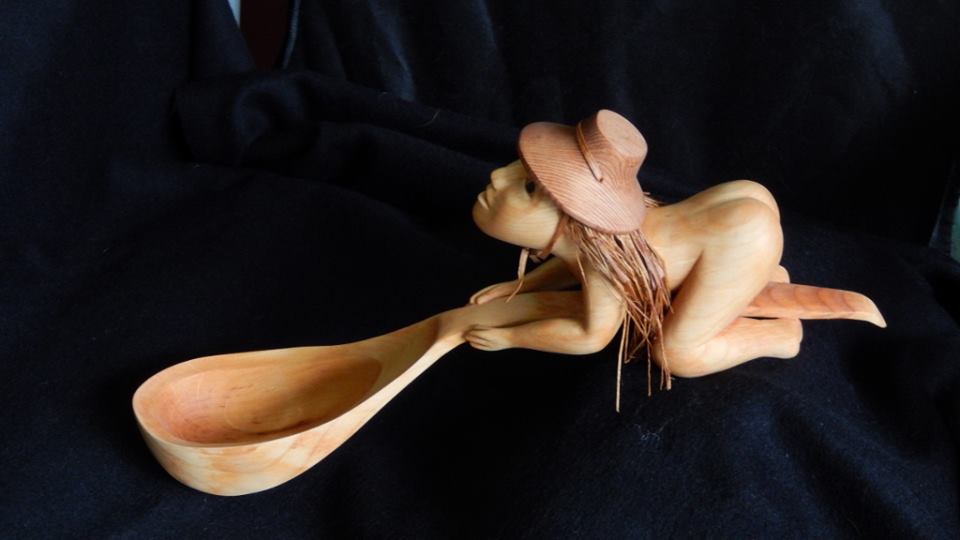
“Wind-Rider” seems an appropriate place to begin buying from Young. Before Young attended the Freda Diesing, she sold Haida dolls on the Internet, and continues to give classes in doll-making. A couple of years ago, she placed a similar figure on a mask for an all-woman show at the Steinbreuck Gallery in Seattle. With its removable hat and cedar bark hair, the figure seems to embody the entire span of her career, so much so that I suggested to her that she should use it as a logo if she ever prints business cards or sets up a web site.

One of the things that makes the carving unusual is that human forms – especially naked ones – are rare in the Northwest Coast Renaissance. Classical works and oral tales sometimes show a decided earthiness, but, by the time of the local Renaissance, Christianity had changed the standards of what was appropriate. As I write, the Bill Reid Gallery is about to host a show of native erotica, featuring younger and avant-garde artists, but in general, the current artistic tradition approaches the human form cautiously, if at all.

By contrast, “Wind-Rider” depicts a semi-realistic naked female form, with a sensuous appreciation of the curves of its spine, buttocks, and thighs. Yet, at the same time, I would hesitate to describe it as erotic, and not just because the figure suggests a young girl rather than an adult woman. This is not a figure poised for the male gaze in some impossible contortion – nor for any other gaze at all, for that matter, considering its wild array of hair. The posture suggests that the rider is absorbed with the act of balancing and holding on, while the upward tilt of the head conveys a sense of wonder, with the eyes – the only part of the sculpture that is painted – fixed on something that only the rider can see. Meanwhile, the blank expression suggests concentration and determination. Sensuousness and innocence are not usually thought of as going together, yet somehow in “Wind-Rider” they seem to co-exist without any difficulty. In fact, you might say that the figure is sensuous because she is self-absorbed. But, however you parse it, the depiction is original in a way that nudes rarely manage.

Sensibly, Young has left most of the spoon unpainted, leaving the lines of the sculpture to speak for themselves. With most of the attention focused on the rider, she has also left the spoon plain. Yet the spoon, too, is well-proportioned, with a graceful curve to the handle and a ladle that is deep enough and wide enough to serve as a visual counter weight to the rider.

One viewer on Facebook immediately thought of witches riding broomsticks (to which Young immediately replied that the Haida have no concept of Witches). Personally, though, my first thought was of Whale Rider, a film whose protagonist is a Maori girl who is determined to break with tradition and become a chief. Not only does the Maori culture resemble that of the local first nations, but, like the film, Young’s sculpture seems all about following dreams and female empowerment.

From any perspective, “Wind-Rider” is a powerful and unusual work. Examining it, I wonder why I took so long to buy from Young and I’m determined not to wait too long before I do so again.

1077994_10151516927180264_1214331885_n

Read Full Post »

Like writing, typography is an art everyone imagines that they are competent to judge. From Dorothy Sayers imagining her opinion was better than Jan Tschichold’s to Mark Shuttleworth altering his company’s direction so that he could play with design, otherwise intelligent people are constantly falling into the fallacy that they can judge typography despite having no experience with it. The latest high-profile example of this fallacy is Marissa Mayer’s comments on the new Yahoo! logo, the majority of which reveals her lack of design expertise.

I knew the process is doomed to mediocrity as soon as I read her first criteria: “We didn’t want to have any straight lines in the logo. Straight lines don’t exist in the human form . . . so the human touch in the logo is that all the lines and forms all have at least a slight curve.” Aside from how arbitrary the limitation is, what strikes me is the immediate escape into metaphorical explanation. Such explanations are rarely a sign of someone with any expertise; in my experience, they are the sign of someone who does not know what to observe. A trained designer is more likely to reflect that giving all the otherwise straight lines in the logo a slight curve is mostly wasted space for the simple reason that most people are going to look at the logo carelessly, and see straight lines regardless, simply because that is what they expect to see.

Mayer’s next criteria is: “We preferred letters that had thicker and thinner strokes – conveying the subjective and editorial nature of some of what we do.” Not only is there more meaningless metaphor, but the logo will be largely seen online, and even a beginning designer knows that online legibility generally requires fonts with consistent strokes.

Further down the list of criteria, Mayer adds a “mathematical consistency.” Although this requirement sounds impressive, it becomes meaningless when you consider that all typefaces are designed to have a mathematical consistency. She might as well have said that she wanted the logo to have a breadth and depth.

Mayer goes on to explain that “we felt the logo was most readable when it was all uppercase, especially on small screens.” However, against what Yahoo! employees “felt” are centuries of practice and study that shows that lower case letters are more legible because they have a more irregular shape that a solid block of upper case letters of the same size – especially at smaller sizes.

In the end, only two of Mayer’s seven criteria are reasonable starting points: wanting to keep a hint of the old design (although having something serif-like as that hint is somewhat odd), and wanting to do something “playful” with the final “oo.”

Judging from the final result, it was already clear that the logo’s designers were less than expert. However, Meyer’s blog does have the advantage of confirming the visual evidence. Predictably, her confused and poorly advised priorities are reflected in the result, and Yahoo! has labored to replace an outdated logo with a poorly conceived one.

Read Full Post »

A few weeks ago, an editor requested that I not start an article with a quote. They said it made them feel as though they were coming into the middle of a discussion they knew nothing about. I pride myself on being nothing less than professional, and don’t imagine that I am writing immortal prose, so I used another opening strategy as requested. However, I still believe that the request was more a matter of personal preference than a general rule.

To start with, in any opening paragraph, readers are coming into the middle of a discussion, so the same objection can be raised about any chosen tactic. Perhaps the quote I used wasn’t perfectly suited to its position, but that is no reason to condemn the use of an opening quote in general.

In fact, starting in the middle is a time-honored literary technique. It was recognized more than two millenia ago by the Roman poet Horace, who called it in media res, as opposed to ab ovo, or starting from the beginning. Admittedly, it is usually thought of as a technique for epic poetry or fiction, but a journalistic article is often a form of narrative, too. Personally, I figure that what was good enough for Homer in The Odyssey or Shakespeare in Hamlet is good enough for me.

For another, part of the purpose of an opening tactic is to attract readers’ curiosity. Sometimes the topic is novel enough or important enough that the first paragraph needs no embellishment, but that is an exception. An article published online is competing with thousands of others for readers’ attention, and, so long as you don’t mislead or make exaggerated claims, anything that helps it get noticed seems worth trying.

In this case, part of the reason that I started with a quote is that it is a reasonably uncommon tactic. But, in addition, the quote made an unusual claim, which I was counting on to raise curiosity enough for them to read the next few sentences, where they would learn more clearly what the article was about.

Moreover, because a quote implies a speaker, it is automatically personal and direct. Writers of new releases know that a quote helps interest readers – so much so that many make sure that the a quote falls in the second or third paragraph to keep readers going. In a long news release, writers will often add additional quotes further down to reduce the odds of readers’ attention straying. Although articles are less mechanically structured than news releases, quotes can have similar advantages in journalism. Starting with a quote has a strong chance of attracting readers’ attention precisely because it is so personal and direct.

Anyway, even if none of what I said here were true, a part of me always regards a general rule about writing as a challenge. Tell me that something can’t be done – or worse, shouldn’t be done – and my impulse is to try to do it successfully. So, while I have made a note to avoid using an initial quote any time that I work with this particular editor (who otherwise shows a keen sense of how to improve a piece of prose), don’t be surprised if I use one elsewhere. Being told I shouldn’t only makes me all the more likely to try.

Read Full Post »

Most of the Northwest Coast art in my townhouse is in the formline style favored by the Northern First Nations in British Columbia. However, I am always willing to learn more about other coastal traditions, and slowly that’s what I’m doing. The only trouble is, relatively little is written about these other traditions, so most of my knowledge comes from looking at what working artists like Kelly Robinson are doing.

Robinson is a young artist of mixed Nuxalk and Nu-chah-nulth descent who is exploring both sides of his ancestry. In the last year or so, much of his wood carving (he is also an accomplished jeweler) has explored Nu-chah-nulth forms. In particular, he has built on the work of artists like Joe David and Art Thompson who revived the tradition and elevating it into fine art based on his time at the Freda Diesing School.

Fortunately for me, “Ancestor of Today” became available when I had just cashed a few cheques from editors. I first saw the mask in Cathedral Close, the garden outside the Bill Reid Gallery in downtown Vancouver, and, a couple of hours later, I was taking it home on the Skytrain in a bag I was clutching in a death-grip.

The inhabitants of the west of Vancouver Island, the Nu-chah-nulth (formerly called the Nootka and the West Coast) were in a position to be influenced by both the Kwakwaka’wakw, Nuxalk, and Heiltsuk to the east, and the Haida to the north. In fact, unlike most first nations around them, by 1900, Nu-chah-nulth had at least two different styles, a newer one based on formline, and the older, original style. There also seems to have been a third style reserved for the curtains used in the ceremonial mysteries, although I am not altogether certain.

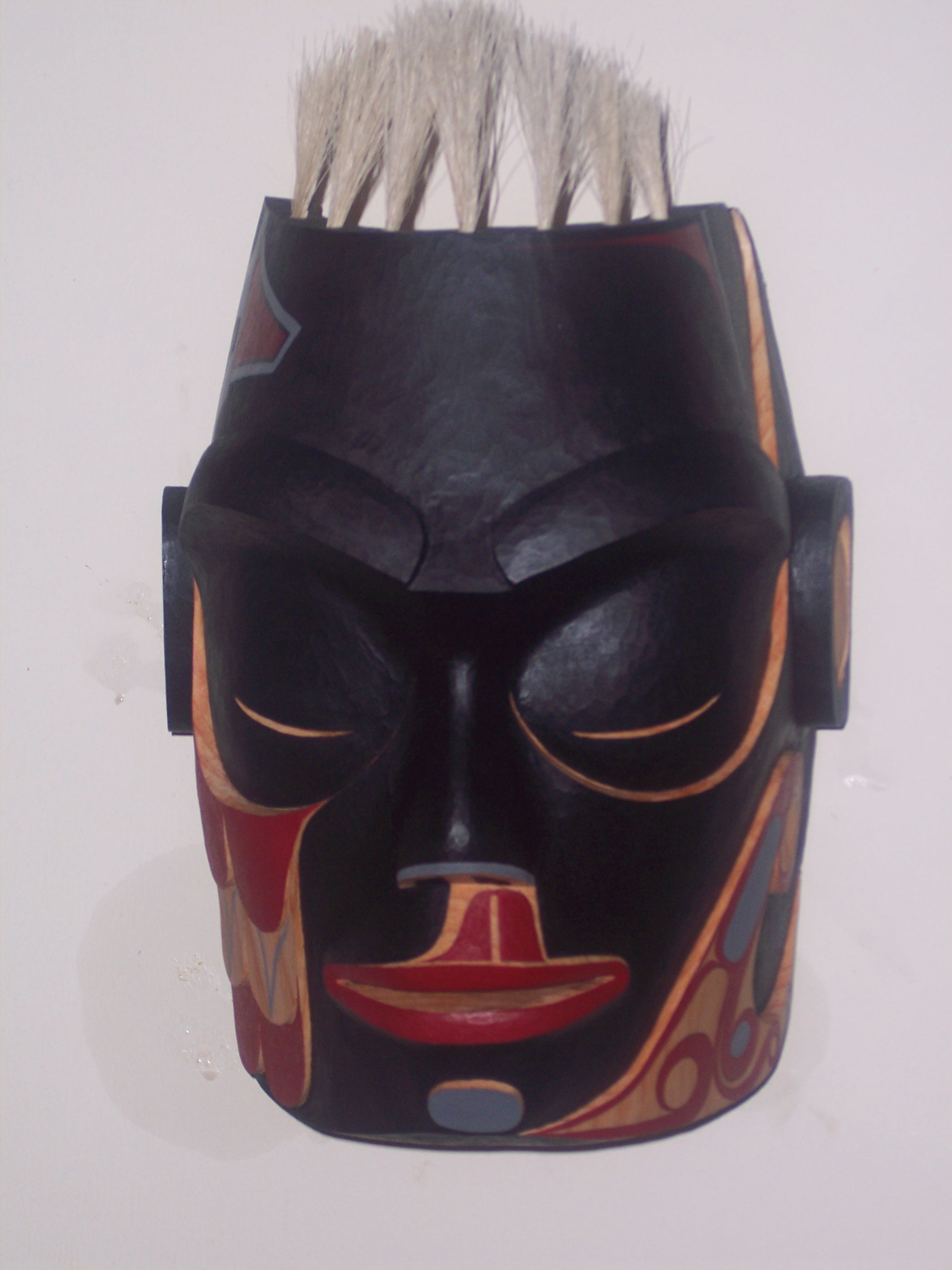
At any rate, these mixed influences may explain the mixture found on “Ancestor of Today.” On the one hand, the mask includes elements that are universal in the coastal traditions, including the U-shapes and the labret that indicates high status. The hair, too, is arranged in a buzz-cut that I have seen in works from every nation.

On the other hand, the facial features all seem to me to be typically Nu-chah-nulth origin, from the raised eyebrows to the high forehead and the nose that swells around the nostril. One of the strongest distinguishing features are the outsized, shallow eye sockets. Unlike in the northern style, the eyes themselves are barely distinguished from the sockets. Here, they are no more than crescents indicate a closed eye, although they would probably not be much more detailed if the eyes were open. The eye sockets join the high cheekbones – another distinguishing feature – not in a plane, as in a northern style, but in a single line.

The painting, too, differs strongly from the northern style. The traditional red and black are the primary colors, but, they cover most of the mask, rather than being used only to highlight features like the lips, nostrils, and brows. Moreover, instead of the designs being painted across the face without much regard for the carving, the way they would be in the north, the designs on the bottom of the cheeks are on their own planes. Between the lips and the nostrils, a different approach is taken, with the inverted U-shape merging into the top list, and the unpainted border on each side of it into the nostrils.

(The mask’s use of gray and the unpainted wood as additional colors is also untypical of the northern style, although they may be Robinson’s innovations rather than indicating any particular tradition; I’ll have to ask him next time we’re in touch.)

The overall impression is of a simpler, bolder style than would be likely to come out of the north. It is enhanced by the slightly rough knife-finish – Robinson’s first effort at this technique, he tells me. To my modern eye, the closed eyes give it Buddha-like sense of calm dignity in keeping with the mask’s name, which asserts a claim that the tradition is still alive and evolving today.

I admire Robinson’s Nuxalk style work, especially the “Four Carpenters” and “Mother of Mischief” paintings, which hang in my living room. However, his Nu-chah-nulth work has its own fascination, especially since he is one of the few artists in the tradition who is trying to evolve the tradition. With “Ancestor of Today,” he manages the difficult trick of re-introducing the tradition while adding first-rate finishing and the steady hand on the paint brush that modern buyers expect. I’m looking forward to what he does next in this style.

100_1603

Read Full Post »

« Newer Posts - Older Posts »