Feeds:
Posts
Comments

Posts Tagged ‘Uncategorized’

Most Saturdays, noon sees me barely staggering out to the gym. But today, noon or shortly after saw us arriving in Gastown for the reception to mark the opening of the Northern Exposure 2009 show at The Spirit Wrestler Gallery. The show is an exhibit of the graduating class of the Fred Diesing School of Northwest Coast Art, plus this years’ scholarship winners. It has already become a tradition in the three years that the school has existed.

With 19 carvings and no graphics, the show was a subset of the graduation show I saw in Terrace, which had some 75 pieces. One or two second year students were missing, as well as most of the first year, including some artists like Mitch Adams or John Wilson who I’d rate above some of those who were represented. Still, space was limited, so some way of reducing the numbers was probably unavoidable.

At any rate, the reduced number also had the benefit of allowing you to pay close attention to each piece – something that is impossible with four times the number. It was especially interesting to see the graduates’ work beside that of their teachers, Stan Bevan and Ken McNeil. That way, you could see the teachers’ influence, and which students were on their way to establishing their own style.

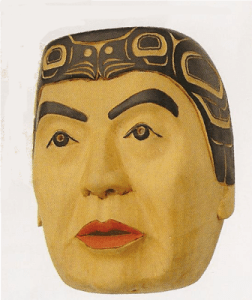
To my eye, the exhibit was somewhat weaker than last years’, which included the work of Dean Heron, who is rapidly becoming one of the major up and coming young artists in the Northwest Coast Tradition. However, the show included the paddles I had admired in Terrace by Latham Mack and Shawn Aster. Another standout was Mack’s “Northern Beauty” mask with its striking painting and individualistic detailing of the nostrils and mouth.

northern-beauty

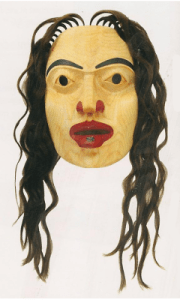
I also appreciated two samples of Reynold Collins’ detailed, often intricate work. While I think Collins’ work would be improved by more finishing and greater attention to the grain, his work never suffers from the clumsy blank spaces found in many of the other students’ work and shows a vividness of imagination that makes me suspect it is only a matter of time until I find the right piece of his work to buy.

reynold-collins

Only a half dozen students were at the reception, and their time was in demand. However, because the event was smaller than the graduate show, it was easier to have a few words with them and find what motivated them. I talked briefly with Sophia Patricia Beaton, Darryl W. Moore, and Reynold Collins, each time finding something in the conversation to bring me back for another look at the pieces they were exhibiting.

Last years’ show, as well as the work of other recent graduates was priced somewhat high – a mistake that means that the pieces do not sell, and that the artist is tempted to try to charge prices elsewhere that their reputation cannot sustain. By contrast, this year, the students seem to have priced their own work, and, thanks to the guidance of their teachers, this year, realism prevailed. Most of the pieces were under $1400, and only one over $2000. This realism seems to have helped; as I write seven hours after the start of the reception, some six of the pieces in the show have sold, including two each by YVR award-winners Todd Stephens and Shawn Aster. Not bad for a day’s display.

Especially at realistic prices, the show cannot be much of a money-maker for Spirit Wrestler, which often sells works by Robert Davidson or glass artist Preston Singletary for tens of thousands of dollars. In fact, when the cost of publicity, reception and staff wages are taken into account, the show might even cost the gallery money. That makes the show a public-spirited effort, or at the very least, a long-term investment in the next generation of artists.

Certainly, it means a considerable amount to the artists, many of whom have limited funds and some of whom had to go to some effort to get to Vancouver. But, after several days that included the YVR ceremony, and a tour of several local galleries and a CBC interview for the award-winners, the reception was clearly the highlight of their trip. Many said as much, and their sincerity was unquestionable. The reception gives them a taste of the lives they would like to live – and, thanks to Spirit Wrestler, for some of them, those lives may now be that much closer.

Read Full Post »

As a former teacher, I blame no one for ignorance. The older I get, the more painfully aware I become of my own ignorance in a dozen different areas, so the last thing I’m going to do is look down on someone else for not knowing something. But one thing I cannot endure is willful stupidity.

You’ve probably met willful stupidity, even if you didn’t give it a name. It’s a passive-aggressive behavior, often seen in bureaucracy or in low-paying jobs such as sales clerk in which a person assumes that the little they know is all there is know about a subject, and anybody who contradicts them is ignorant and wrong.

For instance, yesterday, I went into the local London Drugs for an album to hold 5×7 inch photos. Since 5×7 has been a stock size in photography for decades, I imagined I would have no trouble finding an album. However, all I could see on the shelves were albums for 4×6 photos, a size that has become common place since the rise of digital cameras and automatic photo finishing.

When I finally found a clerk, he insisted that 4×6 was the only standard size.

“Since when?” I asked.

“Fifteen years, maybe more. It’s standard everywhere.”

“Such as?”

“Future Shop, Walmart, Best Buy.”

“You mean that 4×6 is the size that your machines are set to handle.”

“No, it’s the standard size.”

“So why do professional photographers offer 5×7 as a standard size?” I asked, thinking to lead him gently out of ignorance.

“They don’t. If you have a 5×7 picture, it will come out cropped.”

“Yes, because that’s how your machines are set.” I was remembering the inadequate job that the store had done a couple of years earlier on some cropped digital photos.

“No, because that’s how it is. Everyone knows that.”

My feet were hurting after a long trek, so at this point I lost my habitual politeness. “Were you born stupid, or did you have to practice?” I asked, and limped away.

As soon as I got home, I opened the London Drugs website. Just as I suspected, it showed 5×7 albums. A phone call later, I confirmed that the store I had been in carried them, too. In fact, my conversation with the clerk took place several meters away from them.

Maybe I’m just getting cranky as I age and losing my senses of patience and humor. But it seems to me that such conversations are becoming increasingly common as I grow old. The students who seem to feel they’ve won if they don’t learn something, the expert who fails to recognize a synonym for a specialized phrase, the computer repairer who knows nothing about GNU/Linux but dismisses it even after I reveal that I have a certain amount of expertise – all these belong to the legions of the willfully stupid. And, increasingly, talking to them is like being the straight man for the collected Marx Brothers (except, of course, for the utter lack of humor). Really, I’ve had more intelligent conversations with voice mail systems.

What annoys me about such conversations is not just the stolid unhelpfulness. Long ago, I worked as a store clerk, and, if I’m being honest, I have to admit that once or twice I found petty ways of taking out my dislike of the job on customers. So I can hardly complain if I receive the same treatment.

No, what bothers me is the willfully stupid’s absolute conviction that they are correct. They know almost nothing about what they are talking about – in this case, not even what stock their store carries. Nor, despite the fact that they are focusing on a topic for much of their working life, have they made any effort to push back the limits of their ignorance, a failure that I find baffling. When I’ve been in similar situations, I’ve learned, partly despite myself and partly so the work would be more interesting. But when people choose to become willfully stupid, not learning seems the whole point of their behavior. In a perverse way, they seem to have scored some victory over the conditions of their lives by refusing to see a point or learn.

But the worst thing about such behavior is that it seems to be self-inflicted. In this sense, it is the mental equivalent of cutting yourself or some other self-destructive behavior. It seems to me that, if you play stupid long enough, you risk becoming stupid permanently. Eventually, you might reach a point where you can’t see evidence or listen to a counter-argument no matter what. And I can only imagine this state as one of diminished enjoyment and intellectual impoverishment.

That, in the end, is why such encounters disturb me. They send my scuttling to my mental mirror for a close scrutiny, wondering if my behavior is ever anything like what I’ve just seen, and wondering if I would know if it were.

Read Full Post »

The Lord of the Rings is one of the books to which I’ve kept returning in my life, and I’ve seen the movies several times. So, when I heard that a group of fans were issuing a prequel called The Hunt for Gollum, and offering it for free viewing on the web (in the hopes that, if profit wasn’t an issue, issues about copyright violation might be ignored), I was immediately intrigued. It’s far from the first movie made this way, but my interest in Tolkien meant that it’s the first that I have actually made the effort of watching. What I saw was a homage to the films, obviously made on the cheap and lacking plot, but far from the worst forty minutes I’ve spent watching a movie.

The movie is a prequel to the trilogy in which Aragorn hunts down Gollum and captures him for questioning. These events are mentioned in The Fellowship of the Ring as having happened recently, but are not shown directly (the better, no doubt to keep Aragorn off stage until he makes his mysterious entrance at Bree).

The camera work, staging, costuming, and music could almost have come straight from Peter Jackson’s Weta Workshop. Like Jackson’s movies, The Hunt has long, panoramic shots of landscapes. When something is about to happen, Aragorn – who is in-camera for most of the forty minutes – strikes a pose while the camera lingers on him. When he is wounded, he has a mystical vision of Arwen, the elf woman who has his heart. Meanwhile, the soundtrack gives unsubtle hints about what is about to happen.

In short, the grand opera mannerisms of Peter Jackson are imitated as closely as possible. Even the characters, from Gollum to Gandalf and the orcs are based heavily on the movie (even if Aragorn does look a little too much like a poetic grad student, and not enough like someone who sleeps rough most nights). You might consider this imitation a lack of originality, but I suspect it shows more the sincerity of the makers. The Hunt is above all else a homage, a re-creation of the atmosphere developed by Jackson by people who full-heartedly love it.

The trouble is, of course, is that a slight difference in budget exists. If you’re looking, you should have no difficulty in seeing where money is conserved. For example, a scene set in a house looks like a modern pub or antiqued kitchen, while a conservatory with anachronistic glass serves as a stand-in for Rivendell. You get one elf, only three or four orcs whose makeup shows. Most obviously, Gollum is seen close up in only one shot, and, in fact, spends most of his time in a sack hung over Aragorn’s shoulder, which poerhaps llows more than one person to play him.

However, most of these budget measures are unobtrusive, unless you make a point of looking for them. The one exception is the unavailability of Gollum in closeup, which reduces much of the drama, leaving poor Aragorn to respond to a sack. Adrian Webster, the actor playing Aragorn, tries valiantly, but no actor, no matter how skilled, can do much to save essentially dramaless scenes.

But the greatest problem with The Hunt for Gollum is the script. Granted, the scope of the story that can be told in forty minutes is limited. All the same, there is a difference between a string of incidents that related to each other only by when they happen, and a plot, in which one incident leads to another – and, for most of the forty minutes, the movie offers only a string of incidents. They are acceptably acted and staged incidents, but they do not form a plotted story.

Still, full credit to the production team for its ingenuity. The same team is already working on a science fiction thriller, and, while I was not absolutely entranced by this first effort, I was impressed enough that I’ll check on its progress every now and then. There are dozens, if not thousands of half hour TV shows that entertained me less, and if I sound flippant, the reason is that my interest in Tolkien made me hope for something marvelous instead of simply well-done. I only hope that, second time out, the team remembers to arm itself with a tighter script.

Read Full Post »

After six months of layaway payments, today we finally brought home our Beau Dick Bukwus mask from the Douglas Reynolds Gallery. Bukwus, the wild man of the woods, is second only to Tsonokwa among Dick’s favorite subjects, but this goblin-like rendering is by far my favorite among his treatments of the subject.

The mask is several years old, but was kept for a while by Douglas Reynolds, who put it back in the gallery only because he had limited room and other masks by Dick that were personal gifts. This bit of history alone would be an endorsement of the work, if my own taste wasn’t enough. In terms of craft, it is close to a unique piece, using a technique that Dick has used in less than half a dozen masks.

This technique is to overlay the wood with leather, using a layer of cloth to create wrinkles on the face, then moistening the leather so it dries cracked and with a broken surface. The result is a close approximation of a man who has been living rough, and whose face is pocked by cuts and sores and the lines of hard usage. In other words, it is perfect for the Bukwus.

(Whether another face is carved on the mask, hidden by the leather, I don’t know. But, suddenly, it occurs to me to wonder, although I can never know without destroying the mask).

Another unusual piece of technique is that the eye holes are drilled deep, through nearly three inches of wood, and rimmed with copper that makes them come alive when the light captures them.

Even more interestingly, the nose is a piece of copper, as though the Bukwus has ripped off his own nose, and found a crude replacement. The sinuses, which are exposed by the lack of a true nose, are stuffed with cedar shavings, just (I am told) as a corpse’s would once have been among the Kwakwaka’wakw. Is the Bukwus dead? Or has he been left for dead? Or is he simply dead to his family and past? Could he be some collector of the dead?

You can take your pick among the possibilities, but all of them are potentially ominous. Add a manic grin with an under-bite, pointed ears, eyebrows that are as long as the hair on top of the head, and a red-black color that suggests a layer of filth and open sores, and the result is an intensely eerie bit of the supernatural, even if you know nothing about the Bukwus.

In fact, it is so intense that I wouldn’t be surprised to learn that Dick had his own manic delight in his creation and laughed as he finished it. It is close to being over the top, yet stops short of being so, creating an ambiguous figure that, the longer you stare, the less certain you are whether you should be uneasy or laughing yourself.

This ambiguity makes the mask one that should not be hung in the bed room – and definitely not where you can see it when you wake up. Instead, we hung it at the top of the stairs leading up from our front door. If we are ever woken by a scream on the stairs, we will know that somebody broke in and got their first look at Dick’s creation. It’s a magnificent piece, but not something you want to take you by surprise in the dark.
beau-dick-bukwus

Read Full Post »

Patrick Amos is one of the leading Nuu Chah Nulth artists. From the first time I saw his work, I knew it was only a matter of time before I bought something by him. However, until I was browsing the Quintana Galleries web site about six weeks ago, I hadn’t found the right piece. There, I saw his acrylic on paper “Supernatural Wolf Transforming into Killer Whale,” which appealed in so many different ways that I immediately contacted the gallery before anyone else could snap it up.

I assume (but haven’t been able to verify yet) that the piece refers to a myth apparently shared by both the Nuu Chah Nulth and Haida nations of a great wolf that was such a savage and wasteful hunter that shamans transformed it into a killer whale so that it would not de-populate the animals of the land. This is a story that I have never seen depicted in art before, which gives the piece an immediate interest for me – I mean, Raven stealing the light is a powerful story, but it’s as common in Northwest Coast art as Madonnas and crucifixions are in European Renaissance art. I simply like to see my imagination stirred by a story less often told.

However, “Supernatural Wolf” is also an office in the important Wolf Society, although why one should be transforming into an orca isn’t clear to me.

At any rate, transformation is a subject that often brings out the best in many Northwest Coast Artists, and this piece is no exception. Amos’ acrylic shows the wolf twisted in the throes of transformation – throes that seem all the more agonizing as it struggles in the confines of the circle.

At the moment depicted, the most obvious sign of the transformation is the dorsal fin on the wolf’s back that it is evidently twisting to see (and maybe bite). However, at a second look, the wolf’s head is also sprouting the fin that is one of the killer whale’s distinguishing features in Northwest Coast Art. Moreover, if you look closely, one front leg may be changing into a flipper, while the other, with toes that seem elongated compared to the hind foot beside it, seems to have just started to change. The tail, too, is presented in a three-quarters view that makes it look flat, and more an orca’s flukes than a wolf’s brush.

An additional indication of change may be the irregular and asymmetrical shapes that make up the wolf’s legs. They give a strong contrast to the wolf’s body, which exists only in outline, except for the two stars that perhaps suggest the wolf’s spirit, remaining unchanged despite the physical transformations that arre happening.

For me, the piece is all the more effective because it is in stark white and black. Not everybody appreciates black and white or grayscale these days, which may be why the piece languished in the gallery for a while. Personally, though, I have always felt that, with the right subject, a lack of primary colors makes for boldness and drama, which is certainly the case here.

One additional note: The small mark in the lower right is a finger print, presumably Pat Amos’. The gallery was apologetic about this flaw, but I was more philosophical. Your eye is hardly drawn to it, after all. Besides, if I ever wanted to establish provenance, I shouldn’t have any trouble (to which the employee I was dealing with replied that you could have no doubt that Amos had a hand in the work).

pat-amos

Read Full Post »

When I was up at the Fred Diesing School Student Art Exhibition a couple of weeks ago, one of the main attractions was the paintings of Sean Aster. I bought one myself, and joked that I had traveled north just to see how he was coming on the commission we’d arranged a couple of months ago. However, the way that the reactions to his work changed over the afternoon taught me something about the way that people view and buy art.

Before the graduation ceremony, when people were gathering in the studio, very few of us gave Aster’s work any particular attention. However, during the ceremony, Aster won two scholarships, including one that master carver and senior advisor to the school Dempsey Bob gave out himself. Twenty minutes later, staff could barely put up the little red stickers indicating a sale fast enough. Suddenly, everybody wanted one of his works.

This change had nothing to do with the quality of the works. Aster is a promising artist, especially for someone still in his twenties, and his work deserved the awards and the attention he got. But his work was no finer after the ceremony than before. Nor were people necessarily buying the biggest or most original pieces.

All that had changed was that the school instructors had got up and said very publicly, in several different ways, that he was a young artist with a future. Apparently, most of the guests had missed the fact before, until recognized authorities had emphasized it to them. Those of us who had recognized his skill by ourselves were morbidly amused (to say nothing of pleased with ourselves that we had arrived at our conclusion unaided).

A week later, I repeated the story to a Vancouver director of a Northwest Coast Art gallery. He didn’t get what I was saying. How else, he asked me, would people have known what to buy?

Listening to his question, I realized, more strongly than ever before, that there were two reasons for buying art.

The first, and perhaps the most common, is based on reputation, and, much of the time, on the hopes of a profitable investment. Beyond a very limited extent, it has nothing to do with an artist’s ability. For example, it is no reflection on the ability of either artist than an original canvas by Robert Davidson can sell for seventeen times the price of one by his current apprentice David Robert Boxley; Davidson sells for so much more because of his reputation, not because he is seventeen times the artist that Boxley is (although, quite obviously, he is his elder in their craft). This was the sort of collector I saw buying Aster in Terrace – for the afternoon, at least, Aster was the one with the reputation.

The second reason to buy art is because it moves you, or because it is well-composed. This reason owes nothing to reputation; those who buy for this reason will buy a $100 sketch from an unknown as happily as a $10,000 one from a master artist if it has the right qualities, and let the potential investment take care of itself.

These two types of buyers can talk amiably, and may even wish to buy the same piece. However, the motives for buying are really quite different, and quite irreconcilable. Secretly, an enthusiast like me can’t help thinking that those whose buying decisions are based on reputation are unimaginative, even a little crass, and buying for entirely the wrong reasons. In turn, though, I don’t doubt that the reputation-buyers dismiss us enthusiasts as arrogant in our naivety.

Read Full Post »

Writing requires fewer expenses than any art except singing, and everyone who finishes grade school learns a few rudiments. For these reasons, it has never lacked wannabes. I’ve heard the claim that if you ask random strangers in Los Angeles how their screenplays are going, you have just bought yourself ten minutes of boredom – and, considering my experiences at science fiction conventions, I can believe it (except that, there, what you shouldn’t ask about are stories). But most of the wannabes never get where they would like to be, usually because they run afoul of one of the following myths:

  • You need to be inspired to write: You can have many Eureka! moments as you write, and a new love or a lost one may urge you to new heights. But if you wait for inspiration before you start to write, then you will never write six days out of seven. Like most forms of mental and physical exercise, writing is something that gets easier if you practice and keep in practice. As Peter S. Beagle said, “If the Muse shows up late to work, you start without her.”
  • Writing done when you are inspired is better than writing you do at any other time: Although you may feel better about your work when inspired, what you produce is usually no better or worse than what you write when every word comes out like a kidney stone you are passing. If you don’t believe me, save one piece you write when inspired and one written when the words come hard, and compare them a week later. Neither is likely to be much better than the other. And, if one is better, it may be the hard-won words, not the inspired ones.
  • Writing block can keep you from writing: In my experience, writer’s block is generally a luxury enjoyed by amateurs. Professionals have no time to have one. The best cure for writers’ block is a deadline. When you have to write, you have no time to play games with yourself. Real writers often have problems that they need to work out, but they view the problems as part of the process, not as an opportunity for self-dramatizing. In the few cases where writer’s block is more than that, a sleep, violent exercise, working on something else, or any other change of pace usually cures it.
  • Talking about your writing is a good idea: Not for anyone I’ve ever met. You will only bore others, and waste energy that you could use for writing in talking. If you prefer talking about your work rather than doing it, then chances are you are more in love with the idea of being a writer than with actually writing. At least, that’s how most practicing writers will view you – and most of the time they will be right.
  • Developing style is the most important thing you can do: An awareness of style is essential as you learn to write. But your own style? Don’t waste time worrying about it. It will come along without any special effort as you focus on clarity, conciseness, accuracy, and otherwise learning how to get down something like what you mean.
  • Style is hard: Even relatively inexperienced writers can learn to polish a phrase or two. By contrast, how to structure and pace your work takes much longer to learn. That’s one reason why, although many poets have done brilliant work before they were twenty-five, very few novelists produce anything memorable before they’re thirty.
  • If you’re talented, you’ll be discovered sooner or later: Possibly. But getting to know publishers, editors, and other writers works even better. Knowing you probably won’t mean that they’ll take an unpublishable work from you, but it does mean that they are more likely to give you the benefit of the doubt in borderline cases – and let you in on the industry news.
  • A work that’s rejected is no good: Often, yes. Most times, even. But works are often accepted and rejected for reasons that have nothing to with their quality. Maybe the editor is overstocked with submissions. Maybe the publisher just did a novel featuring a family much like the one in yours. The rumor is that Stephen King got his start because his publisher was looking for more works that would interest women, and Carrie opens in a high school girls’ locker room. Your rejection might be random as King’s acceptance, so try again. But collect four or five rejections on the same work and maybe you need to start thinking about revisions.
  • There’s nothing wrong with being self-published: Many good and even great books have been rejected before being published, and we’ll never know how many others disappeared before their writers got discouraged. However, the odds are that the number is far fewer than the number of self-published books that succeeded. An editor’s job is to detect salable writing, and, while one or two can make a mistake, five or six are less likely to. The prejudice against self-publishing is not irrational; it’s based on experience. If you really can’t sell your work and want to publish it, you can get free blogs on line at any number of places far more cheaply than you can publish a book or win a contest promising publication. Oh, and calling your vanity publishing an Indie Book won’t make anything said here less true, either.

Harsh words? Maybe. But who said that writing was about your ego? It’s about working to do the best job you can in the time that you have. Anything beyond that is playacting about being a writer – and if you have time to pretend to be one, you won’t have time to actually become one.

Read Full Post »

“How does this compare to a show down south?” John Wilson asked me last week, shortly after I arrived at the Freda Diesing School Student Art Exhibition in Terrace. He seemed surprised when I told him that a 23 person show with some 75 pieces almost never happened, but it’s true. The annual show is one of the largest annual exhibits of modern Northwest Coast Art anywhere.

The show lasted only two days, with a private viewing for friends and family on Friday and a public viewing on Saturday. The location is the Freda Diesing Studio on the Terrace campus of Northwest Community College, a well-lit building with a large lower floor ordinarily occupied by work benches and a loft for a more conventional class room setting:

fd-studio1

Just inside the door, above the table with the show catalog and price list were a few prints by Freda Diesing herself, including a self-portrait mask:

fd-self-portrait

These works were not for sale, but stood as tutelary spirits of the show – or, more precisely, as the standards to which the students should aspire.

Several months ago, I reviewed the school’s mid-term show via a collection of pictures sent to me by John Wilson. That show was mostly painting and sketches, the first year class in particular having not begun its study of carving at the time. By contrast, the year-end show had a few two-dimensional pieces, but consisted largely of paddles, spoons, and masks.

Painted paddles are closer to two dimensional than three dimensional works, so I was not surprised when two of the best-designed paddles were from Shawn Aster and Latham Mack, two artists who were among the standouts at the earlier shows and scholarship winners at the graduation ceremonies that accompanied the private viewing:

shawn-aster-paddle

latham-mack-paddle

However, making the transition from the two-dimensional craft of painting to the three-dimensional one of carving does not always comes easily, and many students are still making it. Latham Mack, for instance (who as a Nuxalk, is learning his second style of carving), is well on the way, using the same blue that I am starting to recognize as characteristic of his two-dimensional designs:
latham-mack

By contrast, a mask by Shawn Aster shows a sense of surfaces, but seems more tentative, with a shallowness in the carving and a thinness of line that makes you only appreciate the mask up close, as seen in this (unfortunately cropped) picture:

shawn-aster-mask

A similar lack of ease in three dimensions is true of Todd Stephens, another scholarship winner from whom I’ve bought several paintings:

todd-stephens

Other students showed similar learning curves – and, as might be expected in a student show – a certain tendency to conformity – although Norman McLean, Sr., in a triumph of social sensibility over aesthetics did do a bright pink mask, as well as a spoon with a more discrete pink ribbon around the handle as fund-raisers for breast cancer. Still, there were some interesting pieces here and there.

Sophia Patricia Beaton, another scholarship winner, had only one piece in the show, but the wavy hair and the obviously feminine face and the labret were original enough to make me wonder what the rest of her work might be like:

sophia-beaton

I also noticed James Weget-McNeil’s frog mask, which, although in a very different style, reminded me of some of the faux-artifacts that Beau Dick has been carving recently:

james-weget-mcneil1

However, much of the interesting carving came from mature students with more experience.

Charles Richard Wesley, whose work I noticed in the mid-term show, came up with two interestingly intricate masks:

charles-richard-wesley

I also appreciated John Wilson’s work, which he says represents an advance in finishing details over his earlier work – pointing, for example, an indentation of the eye sockets at the top of the nose:

john-wilson

These are just some of the pieces in the show, but, aside from the bowls (something needing to be left out), they give an idea of the variety to be seen at the show. I appreciate the chance to see students learning and mastering their craft, and while some flaws and weaknesses are apparent, there are just as many examples of solid and skilled works.

In fact, I could have come away from the show considerably poorer. Fortunately or unfortunately, depending on my shifting perspective, most of the pieces I considered buying were marked NFS, many earmarked for a show at the Spirit Wrestler Gallery in Vancouver later this month.

But buying is only one reason to attend such a show. A far better reason is spend a few hours surrounded by efforts of art – and that, so far as I am concerned, is more than enough reason for me to want to attend next year’s show.

My thanks to Stan Bevan for seeing that I got an invitation. That small kindness gave me an enriching day.

Read Full Post »

“Nasty disturbing uncomfortable things!” Bilbo Baggins says about adventures in The Hobbit. “Make you late for dinner!” Working out of our townhouse, I sympathize with that view. But, as with Bilbo, there must be something Tookish in me lying in wait. When I was invited to go to Terrace for the end of the year show at the Fred Diesing School of Northwest Coast Art, I was determined to go. To fly 1350 kilometers only to return the next day seemed more than a little quixotic, especially when I didn’t feel I could really afford the trip and had never met anyone there, but the whole idea seemed irresistible. For someone who had never been farther north than 100 Mile House, it seemed a small adventure, all the more interesting because I was moving way out of my comfort zone.

I flew out of the South Terminal of the Vancouver Airport, a relic of quieter days that services the coast and the remoter areas of British Columbia. After looping around the city, with me peering out eagerly to spot the Metrotown Towers, Swangard Stadium, Cleveland Dam and other visible landmarks, we headed north. The mountains grew progressively taller and more snowcapped, and I tried not to be disappointed that all I could see of the coast was the occasional inlet masquerading as a river at first glance.

I won a T-shirt in an on-board raffle, and hoped it was an indicator of how my luck was running.

As we circled Terrace and descended to the airport, I could see signs of logging that showed that I was flying into a resource extraction community. From the air, I could see that the evergreens flanking the highway were often only one hundred meters thick, and that the town, whatever its other virtues, was a stranger to zoning in most areas.

At every other airport I’ve ever visited, taxis are always awaiting incoming flights. But not at the Terrace-Kitimat Airport. Rather sheepishly, I retraced my steps and hunted for the direct phone for the taxi.

After twenty minutes, an Indian driver – that is, someone from India, not a First Nation – picked me up and took me directly to the college. We crossed the Skeena, brown with the spring runoff, and through the mixture of stores and industrial sites that forms the downtown, and up a hill to a suburb where small houses mixed with hobby farms of a few acres and pasturage for a cow or horse or two.

Semi-rural British Columbia, I thought, reminded of places in Surrey and Langley and the Sunshine Coast. I decided I could deal with it.

All the same, the college seemed incongruous when it suddenly appeared. Paying off the driver, I found my way to the cafeteria to fortify myself and ask directions if I needed to.

A bagel and orange juice revived me, and I headed across the parking lot in the middle of the college. A few inquiries confirmed that the building with the high roof and large windows was the Freda Diesing School, just as I had thought. Trundling my carry-on, I stepped inside.

Almost instantly, I was greeted by Jennifer Davidson, Henry Green, and Peter Jackson, at least one of whom must have a stronger ability to recognize people from their photos than I’ve ever managed. Then I started meeting people – Bill McMillian, carver and teacher Stan Bevan, and students with whom I’d been in contact with online but never met, including John Wilson, Latham Mack, Sean Aster, and Todd Stephens, to say nothing of ex-students like Dean Heron. The sheer number of people to meet was overwhelming, and their friendliness left me exhilarated. Really, a stranger couldn’t have asked for a better welcome to a group with such close internal connections.

I just barely had time to go around the show (which deserves a blog of its own) snapping pictures like mad before it was time to trek across campus for the graduation ceremony. While we were milling about, Jennifer Davidson took the opportunity to photograph the copper bracelet that Henry Green did for me eighteen months ago, and Henry threated to straighten it out, evoking a squeal of dismay from me.

After rampaging through the buffet, the crowd sat through the usual round of thanks at graduation ceremonies. Mercifully we were spared long speeches, although I did notice most of the students gradually sitting lower and lower in their chairs. But an end came at last, with the most deserving students receiving awards and all of them praised for their dedication.

Two drummers, one of whom was a student, were supposed to lead a procession back to the studio, but the riff-raff like me at the back lingered so long that we missed most of it. I had a chance to look at the exhibits more carefully, and saw the sketches for one piece that I hope to eventually buy, and all too soon the show was over.

John Wilson drove me downtown, where I found a hotel and we headed out for Chinese food. A sign that we were in the north was that one of the offerings at the restaurant was salmon in black bean sauce.

I had hoped to meet sculptor Ron Telek, but he was busy with family matters, and we had to make do with a quick phone call late at night. I found myself wishing that I had booked another day, both to see Ron and to see more of the town, but, as things were, I fell asleep exhausted and buoyed by the friendly welcome I had received.

The next morning, I was at the airport before most of the staff (Memo: in small towns, the rule of arriving two hours before a flight doesn’t apply). Tired but satisfied, I flew south, putting adventures behind me for a while. But now that I’ve ventured north once, I’m sure I’ll be coming back again. Terrace may be more distant from my townhouse than Calgary, but in many ways it feels more like home.

Read Full Post »

I am just back from COSSFest, a free software event held in Calgary, Canada. You can read about the conference on my Linux Pro Magazine blog at:

http://www.linuxpromagazine.com/online/blogs/off_the_beat_bruce_byfield_s_blog/the_calgary_open_source_symposium_festival_cossfest_2009

Read Full Post »

« Newer Posts - Older Posts »