Feeds:
Posts
Comments

Archive for the ‘Bruce Byfield’ Category

I was in high school when I realized that being observant was not just a talent or trait – that to be observant, you had to know what to observe.

I made this discovery because I had decided that, if I were going to write poetry, I needed to educate myself about traditional verse. Armed with a rhyming dictionary with a good prologue, I set out to learn about metric feet: iambs, trochees, anapests, and dactyls, along with outliers like spondees. Through repetition, reading, and practice sonnets, I learned to recognize each foot in a way that I never had naturally (although I had heard of them long ago). I learned that what you could consider an accented syllable varied with the sounds around it, and how some syllables could count as accented or unaccented depending on how you pronounced them. I learned, too, that free verse was not an absence of meter, but an absence of consistent meter (a subtlety that escapes three-quarters of modern poets, and how the whole idea of metric feet did and didn’t fit the way that English was used.

For a while, I became so obsessive that I went around mentally scanning everything that I and people around me were saying. I don’t think anyone noticed the inevitable slowness that crept into my speech, but I was relieved when I finally shook off the obsession. I soon found myself publishing my first poems, and left with a means of perception that most people lacked.

Much the same thing happened in grad school when I realized that, if I were going to teach composition to students, I needed to know more about essay structure. Accordingly, I summarized the sections of essays I admired from people like George Orwell or Gloria Steinhem, making notes of the tactics used. What were the different ways of starting an essay? Of concluding? How should points be arranged? When should opposing views be mentioned, and how should they be handled?

A few years later, I did the same with fiction, both short stories and fiction. Then, as I started exploring graphic design, I did the same with font selection and layout – so thoroughly that I still sometimes walk down a commercial street critiquing the signs. Usually, there’s a lot to criticize, since, to say the least, our culture is not exactly graphically literate.

Each of these circumstances left me with a different way of seeing from most people. Or, rather, I perceived the same things as everyone else, but I understood what details mattered. I could understand, too, how well what I perceived fit together. Instead of a generalized reaction, I could go into detail (usually more than anyone else wanted to know) about exactly what created my reaction.

Some people might argue that I have lost my spontaneous reaction as a result. They might say, for instance, than I can no longer watch a badly written movie, because I can anticipate what is going to happen and, sometimes, when the script writer has become especially lazy, even what the characters are going to say and what will happen to them.

To some extent, that claim might be true. However, my self-taught expertise can tell me to avoid the movie, which I consider an advantage. Or, depending on my mood, I might watch it anyway with a two-track mind, one responding as an uncritical consumer, and one running in parallel observing what doesn’t work and why.

Far from losing anything, I believe that I have gained from acquiring expert vision of selected fields. Because of my efforts, I not only respond, but can articulate why I respond the way I do. In looking for greater knowledge of what I was experience, I have also gained knowledge of both myself and others – and that’s never a fact that I’ll regret.

Read Full Post »

I’ve got scar tissue, I’ve got cash in hand,
Got a season’s ticket to the promised land,
And I do this for a living, Mister, don’t you understand
That I’m dancing, dancing, dancing
Dancing as fast as I can.

– Oysterband

I never knew my maternal grandmother well. She died when I was a few years old, leaving my grandfather to live alone for another two decades. I remember him as a quiet man, with a methodical way of moving and a mildly abstracted air. Even as a child, I knew I didn’t understand something about him, but I’ve only realized after being a widower myself for the last three years what I didn’t understand.

Or perhaps I don’t understand, and I am projecting my own feelings to make them seem more universal. But I suspect that, so far as he was concerned, those last two decades were an extended epilogue to his life. He never seemed particularly unhappy, but as a widower he seemed to live in a minor key, as though his life were mildly pleasant, but not very important, as though what mattered to him had already happened.

At least, that’s how I interpret him, because that’s how I feel now. I don’t lack friends or family, and I retain interests in art, books and music that keep me busy. But long range plans? A new lover or partner? I live contentedly enough without the expectation of either.

Apparently, this is a state of mind that you have to experience to understand. When I try to explain it, inevitably people conclude that I must be unhappy or in need of cheering up. They tell me to be patient and not to rule anything out. If they have been widowed themselves and remarried, they use themselves as an example of the possibilities that might await me, if only I choose.

Worst are those who ask if I’m seeing anyone. I’m not, and increasingly people are starting to urge me to try, to sign up for online dating, or take a night school course where I might meet someone. Any day, I expect efforts to set me up with a blind date. Sometimes, it feels like I’m a character in a TV episode whose problems they expect to be wrapped up neatly in an hour between the commercials and distractions of everyday life.

What they don’t understand is that I don’t feel like I have any problem that is in any urgent need of solving. Yes, I might be overly aware that implicit in letting someone new into your life is the likelihood that one of you is the fact that one of you will eventually watch the other one die. And it’s true that, after several monogamous decades, I know less about meeting women than the average fourteen year old.

But while I’m sometimes lonely, I’ve fallen into the patterns of a solitary life. You might say that I’m content with the moment, that I’m reluctant to look for more after the patterns of my life were abruptly demolished, and you wouldn’t be wrong. But I’ve found enough shreds of purpose to keep me vaguely satisfied. I’m not longing for more, nor am I feeling thwarted or incomplete. Just having a routine after wading through grief is a relief, and I don’t need a grand love or cause to give me direction.

Could everybody try to understand that’s good enough, and control their urge to interfere? Do that for me, and I promise the same studied neutrality when you go through widowhood yourself, okay?

Read Full Post »

At First Nations art galleries in Vancouver, Mitch and Diana Adams have a reputation as an effective sales team. Being the artist, Mitch does much of the talking, but because Diana at one remove from the discussions with gallery owners, she is an astute observer of what is happening, and is actively involved in strategic planning.

Several weeks ago when I was in Terrace for the Freda Diesing School graduation ceremony, I asked her what advice she would give young artists about dealing with galleries. Diana responded in detail as we had dinner at Boston Pizza, with Mitch throwing in the occasional comment.

Diana is able to contribute because of her own lengthy experience in sales. “I grew up in a family restaurant business,” she says, “So selling comes naturally to me. As a waitress, my job was to sell the meal. My favorite situation was when people would go, ‘I don’t know. What do you recommend?’ I’d find out what don’t they want to eat, what’s their budget, what they are allergic to, and take it from there.”

Some of what she knows about sales comes from observing her father. However, Diana has been selling her own bead work for several decades. She still remembers her first effort at a Tupperware-like party, where she sold $450 worth of merchandise, confounding her parents’ expectations.

Since then, Diana and Mitch have sold regularly at music and craft festivals through northern British Columbia. For seventeen years, they have been regulars at the Terrace farmers’ market, during which time they have fine-tuned their partnership in sales.

Preparing and handling anxiety

Some artists, especially established ones, can sell to the major galleries in southwest British Columbia without ever visiting Vancouver or Victoria. However, the business of First Nations arts remains very much a face-to-face proposition, and young artists in particular are more likely to make sales when they talk to a gallery’s buyer directly.

Asked how she approaches selling Mitch’s work to a gallery, Diana emphasizes a strategic approach. “I take it on as though I’m applying for a job,” she says. “I do my background homework. I’ll look at a store or a gallery that I want to deal with. I will go in, and not tell them that I’m looking to sell to them. I will observe how they treat their customers. I’ll also see the quality of what they sell. If they have a pamphlet, I will take one, or Google them on the Internet.” She does not worry much about prices, figuring that is not her concern, but she will note at the quality of what is sold, and how staff treats customers.

The point of this research is to decide whether they want Mitch’s work in that gallery. “What a lot of artists don’t understand,” she says, “is that they have an option of deciding whether this is a gallery to deal with or not. I want to know that I’ll be dealing with someone who is dependable, approachable, fair to deal with, and able to give criticism. If I offer them something they’re not interested in, I want to be able to dialog about it. As much as I might want to be a client of theirs, or leave works on consignment, I need to know that I can have a professional working relationship with them.”

Before approaching a gallery’s buyer, Diana and Mitch discuss what pieces to show, their prices – both the price they want, and a bottom-line figure that they will accept as a last resort – and what to say about each piece. This preparation, she stresses, is absolutely essential. “Gallery owners have told us that’s one of their pet peeves, when artists approach them and they don’t know the price of an item. That’s a death-sentence, right there.”

She also notes that, on an introductory visit, artists can expect a lot of questions. Galleries “want to make sure that you are the artist, and not someone else. If you’re the artist, you would know the answers right down to the details.” Forgery and theft are regular events in local First Nations art, so galleries want an indication that the seller truly is the artist.

Another reason for preparation is that it helps to reduce nervousness. “It’s always nerve-wracking. I’ve done it countless times, but there’s still that excitement and anxiety, because you want to do well. But you can’t be overly anxious or insecure, or you’re going to fall flat on your face.”

Another way to reduce anxiety is to take someone with you. However, Diana immediately adds, “Don’t take anyone who’s going to undermine you. Don’t take anyone who doesn’t know anything about your art or will second-guess you.”

Instead, the second person should be either silent, or an active partner. “There’s been times when Mitch has forgot something,” she says, “but I always give him a chance to speak first. But if he forgets something, I’ll come forward. I’ll look at him, and if I know that he’s done talking, I will say my piece.”

According to Diana, planning not only relieves anxiety, but also helps to present yourself as a professional who is easy to deal with. She suggests role-playing the presentation of your artwork, and even approaching galleries you do not plan to deal with so that you can rehearse and prepare yourself for visits to the galleries you hope to work with.

Making the visit and the first impression

“We don’t expect a sale on first visit,” Diana says. “We hope we make a sale, but the whole point is making contact.

Her emphasis is on professionalism throughout. “Dress as though approaching a job,” she advises, “as though leaving a resume. Make sure that the work is well-presented, not carried in a garbage bag. Because if we have no respect for the art, it’s going to show. We use an artist’s portfolio, because presentation is everything. Some of the people we’ve approached have been quite reserved, but we still put on a professional smile, and say what our purpose is.”

Diana also suggests that body-language is important. “Smile,” she advises. “Have good eye contact [with the buyer]. “Don’t cross your arms. Remember to breathe.”

After the introduction, the actual presentation of the pieces is left to Mitch, on the grounds that as the artist he is the one best qualified to talk about them.. “I try to be halfway through explaining the piece as I hand it to them,” he says.

He also gives some thought to the order of presentation. “What I like to do is not give them my best piece right off the bat. Instead, I lead up to it. And I think they see it, too, that the best piece is still to come. But they’ll be lining the pieces up, and hopefully they’ll be being wowed by the pieces that aren’t the best ones.”

If the discussion turns towards the price of any of the pieces, the Adams’ policy is to hold firm to their original asking price, falling back slowly to their minimum only if they strongly want the sale.

“You can’t be desperate,” Diana says, adding as a warning, “never say to anyone, ‘I’ve got bills to pay.’ Never say that because, really, it has nothing to do with the gallery owner. That’s a form of manipulation. It’s a really poor sales technique, because the person who’s being spoken to feels bad and put on the spot. It leaves a bad taste in their mouth, and makes them want to avoid you in the future.”

Some buyers, according to Diana, will claim to find flaws as a tactic for lowering the purchase price; they should be ignored and not cause you to waver in your price. Others may mention what they perceive as flaws as explanations as to why they are not buying; their criticism can be considered later. In fact, once or twice, Mitch has gained credibility by acting on such criticism and taking a piece back to the criticizer for another look.

Revisiting

Many inexperienced artists are disappointed when they fail to sell after a first visit. Many will give up and avoid that gallery. However, as Diana emphasizes repeatedly, you shouldn’t count on making a sale after a first visit.

In fact, at one gallery, the Adamses visited three times before making a sale. “But we kept going back, introducing ourselves, and reminding the purchasing agent who we were. We didn’t take [rejection] personally; we just thought they weren’t able to purchase.”

The truth is, you may never know why most sales fail. Often, the reason will have little to do with you or the artwork, or only in the most indirect way. For example, “there’s some galleries that only buy big items, and Mitch does only miniatures. We needed to keep that in mind, and not take it personally. There’s no reason to be rude, even when they’re rude; we just stay professional, and thank them for their time.”

After an initial visit, Diana and Mitch discuss the experience, and decide whether they want to continue trying to sell to a particular gallery. Sometimes, they may decide not to return, even if the buyer seemed interested in Mitch’s work, because they have decided to deal with only a limited number of galleries so that they can focus on building long-term rapport.

If they do return for another visit, they prepare for subsequent visits in much the same way as the first. The main difference, Diana says is that “we’re not so tense.”
Also, the introduction may become more personal and friendly. “I try to remember something about that person that they shared with me,” Diana says, such as the birth of a grandchild or a trip they have recently taken. But “the contact is still professional. It’s intimate, but it’s not stepping over a line.”

Trying to sell your work to a gallery can often be difficult and full of anxiety. Unsurprisingly, mistakes can be made. For instance, Diana recalls “one time when Mitch got so nervous that he put his hand over his mouth, and what he was saying came across as very muffled. All I could do was reach over and pull his hand down, and he kind of looked at me like, ‘What are you doing?’ Then he realized what he had done.”

Diana continues, “Some people beat themselves up about moments like that, but there’s nothing you can really do except laugh.” She advises other artists not to dwell on such circumstances, but to focus on being prepared and professional, focusing not just on a first sale, but on a long-term relationship that will also eventually produced a second and a third sale, and many more over their career.

That is the approach that Diana and Mitch are taking, and so far it seems to be working. Listening to their war stories, it is obvious that it hasn’t always worked exactly as they hoped. However, it has worked well enough that Mitch is well on his way to establishing himself as an artist.

Much of the credit is due to his finishing skills and original designs – but at least as much should probably go to the successful sales strategies and partnership that Diana and Mitch have developed. Watch them even once, as I have done, and you’ll know how professionals deal in the world of First Nations art.

Read Full Post »

As I write, my native British Columbia is halfway through an election. As usual, pundits looking for a subject to pronounce upon have noticed the increasing decline in voter turn out in the last couple of decades and taken on the task of lecturing everyone on the importance of voting. Apparently, they never once stop to consider that there may be valid reasons for someone not to vote.

Instead, they assume that the only virtuous choice is to vote. Voting, the pundits insist, is a civic obligation. Or, if it isn’t, then it should be, the way it is in Australia. If you don’t vote, they claim, you have no right to complain about government decisions for the next few years. They also like to point out the fact that, in other parts of the world (and usually there is at least one place people can mention) are fighting for the right to vote – all of which they suggest goes to show that non-voters are irresponsible shirkers who don’t deserve to live in Canada.

The trouble with this rhetoric is that it has gone unexamined long enough that no one notices its fallacies. To start with, currently the only legal obligation that a resident of Canada has is to pay their taxes. In World War Two, conscientious objectors weren’t even obliged to fight; they could do public service instead. Voting, so far, is not an obligation of residency. Nor is it by any means certain that compulsory voting makes for better government or anything besides a smug satisfaction at high voter turnouts.

Similarly, telling people they have no right to complain will do nothing to stop them complaining. Complaining isn’t a right; it’s something people do all the time regardless..

It is true that people are fighting for the vote in other parts of the world, but those situations are not particularly comparable to what is happening in Canada. The Arab Spring, for instance, was a series of revolts against totalitarianism, in which voting was only one aspect of the reforms that many sought. By contrast, the voting decline in Canada is about disillusion or apathy with parliamentary democracy – a problem that is the polar opposite of what is happening in places where the fight is to establish democracy in the first place..

What isn’t usually examined is the fact that voting is no longer the only way to influence government actions. Activism, ranging from polite letter writing and rallies to rioting, is a way of life in British Columbia. At times, these various forms of activism can be highly effective, as the protests against new pipelines in the province demonstrate. An activist might validly argue that they have a stronger influence on provincial policy through their activism than they could have through voting.

For other non-voters I know, their choice is a matter of conscience. Politicians, they argue, are only superficially in charge of the province. The real influence is in the hands of non-elected bureaucrats. That being so, elections are a fraud that create only the illusion of democracy. If that is so, they ask, then as people who want to behave ethically, they choose not to participate in an exercise that dis-empowers the members of the public while pretending to empower them.

Another non-voter I know was accused of a crime largely to further other people’s careers. They contracted post-traumatic stress disorder as a result, and to this day they believe that the governments of British Columbia and Canada failed them. To vote, they maintain, would be to support the forces that came close to destroying their lives — to tacitly acknowledge that the government had the right to abuse them.

None of these reasons for not voting are trivial or irresponsible. If anything, they are ethically-based reasons. You may or may not consider them logical or sufficient, but neither are they easily dismissed — unless, of course, you have closed your mind to any beliefs other than your own. Yet such motivations are never even considered when people argue that everyone should vote.

That’s not surprising, though. If such cases were considered, then one of the main causes of voter apathy would have to be addressed – the fact that politicians, on the whole, are out of touch with the public and its concerns.

And if people admitted this well-known fact publicly, who knows? There just might be a call to change the way politics are done. In the end, it’s far easier to blame those who are disillusioned than to suggest how the political process might re-engage them.

Read Full Post »

This year’s graduation exhibit at the Freda Diesing School was held on April 19 and 20. It was by far the weakest of the five I have attended. In previous years, there have always been one or two students who were ready to become professional artists, but this year there were none, although a reassonably large number could be ready if they keep working for another year or two.

Unfortunately, this year’s show featured too many shaky hands on the paint brush and failures to find the grain. Too often, what passed at a distance was flawed close up.

However, that’s not to say that the exhibit was disappointing – just that it could have been better. The longhouse on the Terrace campus of Northwest Community College is always worth a lingering visit, and I never object to a preview of those who might become promising new artists in another few years.

longhouse-interior

The work of many of the best artists was visible in the display of paddles at the entrance. This is probably no accident, since a painted paddle is one of the first assignments given to students in the school, so students had plenty of time to perfect their results.

entrance

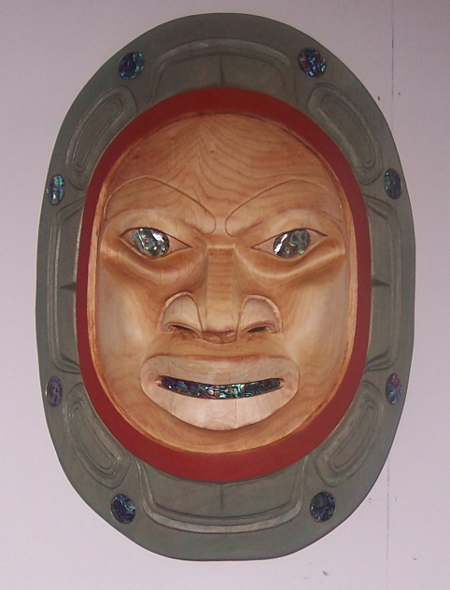
Inside, I first scanned the exhibit for artists whose works I had seen before. Sam Mackay, the winner of the 2012 Mature Student Award produced a solid effort in his “Wolf Howling in the Moon” mask:

sam-mckay-wolf-howling


I also looked for works by Jared Kane, from whom I bought two prints last year. He proved to be one of the more imaginative carvers in the show, but the fact is obscured by the lack of finishing on many of his works, as well as his attempts to use light washes of paint that only look sloppy. His potential is obvious, but he seems to be working against himself in these respects:

jared-kane

This year’s Mature Student Winners (who only found out they had won at the show) also showed considerable potential. Steven Wesley, this year’s winner of the award, produced the very solid “Eagle Transformation:”

steven-wesley-eagle-transformation


Roberta Quock, one of this year’s honorable mentions, produced “Wolf Mask,” one of the best finished and painted masks in the exhibit:

roberta-quock


This year’s other honorable mention, Lorretta Quock Sort showed a similar talent. I particularly liked her mask, “Long Face Willie Campbell,” carved in honor of a grandfather she had never met and reserved to give to her parents::

lorretta-sort-long-willie-campbell

By the time I had looked around the show a few times, two artists stood out. The first was Lyle Mack, the latest from the large and talented Nuxalk family to attend the school. The painting on Mack’s “Beholder of the Light” was imperfect in one or two places, but with some retouching this frontlet could would no trouble meeting professional standards:

lyle-mack-frontlet

However, the most promising artist in the show was Angelo Cavagnaro. His “Gitmidiik Wild Man” mask and “Lunar Eclipse Mask” owe their success to their high standard of painting, but, although their treatments of their subjects are conventional, both are competently carved:

angelo-cavagnaro-wild-man

angelo-cavagnaro-luna-eclipse

Cavagnaro also contributed to the show a bowl entitled, “Supernatural Flounder” which was the most imaginative piece in the show – so much so that I took it home with me. Despite the roughness of some of the carving, this bowl, more than anything else, suggests what he might be capable of with another year or two of practice. When I posted a picture of it to Facebook, it immediately attracted Likes from four or five proffessional artists:

100_1585

Most of the pictures in the show will be in The Spirit Wrestler Gallery’s “Northern Exposure” show in Vancouver at the end of May. Several students were also planning to add additional pieces for the southern show, which I look forward to seeing. As always, I anticipate that show, but I look forward even more to seeing what first year students like Robert Quock and Lorretta Quock Sort will be doing next year, with another twelve months of development.


Read Full Post »

When Angelo Cavagnaro was completing his projects for his second year at the Freda Diesing School of Northwest Coast Arts, senior adviser Dempsey Bob stopped by his work bench.

“What’s that?” Bob joked. “A flounder?”

Cavagnaro says that he had intended the bowl to be a halibut, as its shape and the two eyes on one side suggests. However, remembering Bob’s comment, he named it“ Supernatural Flounder.” It’s a fittingly whimsical title for what I consider a whimsical piece.

“Supernatural Flounder” reflects not only the importance of fishing to traditional Northwest Coast cultures, but of grease. While the northwest coast of North America historically supplied the abundance of food necessary for cultures centered on status and art, the diet was low in fat, or grease as it was generally known.

Just as in medieval Europe, people craved grease incessantly. In fact. stores of grease – usually from the oily oolichan or candle fish, whose season was in early spring, when supplies would be at their lowest – were a sign of wealth. To this day, it remains a traditional delicacy. Historically, it was a treat at feasts and ceremonies, where it would be served to guests in highly decorated bowls. Some of these bowls were about the size of Cavagnaro’s piece, holding enough grease for a single serving. Others were a couple of metres long, and must have served dozens.

“Supernatural Flounder” is a transformation piece, like many that I have bought. The human face in the tail suggests that the fish – whether halibut or flounder – is one of those supernatural creatures that can assume human form. Many depictions of such creatures show them in the moment of transition, which is often shown as dramatically agonizing, like some of the computer-generated transformations of werewolves in modern horror films.

However, Cavagnaro takes a somewhat different approach. The body of the bowl is simply carved, with fins indicated by rough shapes scored with a couple of lines apiece. That leaves the human and fish faces to be emphasized, their lips and nostrils painted with the same red, and their eyes with the same black. There are differences in the shapes of the eyes and their sockets, but if you look at the piece long enough, the resemblance is undeniable. Both have the same blankness, inviting a comparison which explains why I call the piece whimsical – in the end, the human face ends up looking not that different from the fish’s. The result is a creature that looks at home with its dual nature, whose stomach just happens to be where the bowl is.

As a carving, “Supernatural Flounder” could stand more attention to finishing details. The interior of the bowl is rough, and there are many places on the carving where the artist’s working against the grain is still obvious. On a piece that is so minimally painted, such details stand out, and need to be thought about. But the general shape and proportions is well-thought out, and Cavagnaro shows the same steady hand on the paint brush as in his other works.

In the end, the bowl turned out to be the only piece I bought at the graduate show. As I write, it sits on a sideboard a few paces away, where I can enjoy by turning my head a few centimeters.

100_1585

Read Full Post »

Last weekend, I flew north to Terrace to give out the Mature Student Award at the Freda Diesing School graduation. This was the fourth year I have sponsored the award, and the third in which one main recipient and two honorable mentions were named. The award honors students twenty-five and older, recognizing that returning students face challenges in returning to school that younger students don’t, yet often contribute grreatly to a class.

The main recipient was Steven Wesley, a member of the Eagle side of the Haida Nation. Wesley fished for many years, then returned to school in 1997 to earn his high school diploma. “I wanted to be a role model for my daughters,” he said. “I wanted to show them that even their Dad could get his Grade Twelve.

Wesley went on to become a bus driver and trucker. However, he relates that, in 2002, “A friend handed me a knife and a block of wood and asked if I wanted to carve. And ever since I kept pursuing my dream of becoming an artist,” he says.

Although mostly self-taught and learning by observing others, Wesley was accepted at the K’san School in 2004. However, he had to turn down the position due to lack of funding. When he applied to the Freda Diesing School in 2008, he was luckier in finding support.”I just wanted to learn everything,” he says. “I taught myself how to do the ovoids and U shapes but I wasn’t sure they were the way they should be. So, coming back, I wanted to learn from the beginning again. “

However, for Wesley, the most satisfying part of his first year was learning about negative space in carving: “how deep, how high, how wide. I knew the forms, but I didn’t know how to use negative space in my designs.”

He plans to return for his second year in September, and to carve and paint over the summer. “The more you carve, the less you forget,” he says.

One of the two honorable mentions was given to Roberta Quock, a Tahltan from Telegraph Creek who grew up in Merritt and Kamloops. Long interested in painting and beadwork, she says, “I’ve always wanted to go to this school to study more and to learn carving and study more of the culture.”

Besides beginning to learn how to carve, Quock found the first year class a friendly place to learn. “We really bonded together, and we helped each other out,” she says. “We looked out for each other like a family.”

Quock also plans to return for her second year, studying beside her brother Lyle.

The other honorable mention went to Lorretta Quock Sort, a Tahltan of the Crow Clan. An experienced textile artist, for some time Sort has been making fire bags (ammunition pouches) that the president of the Tahltan nation has been distributing as gifts.

Sort’s first ventures into carving will all be given away to her parents and three children. She explains, “My Mom always told me that when you do something for the first time you should give it away. You’re not supposed to keep it or sell it. But, coming from such a large family, it was hard to decide who got what.”
Like the other winners, Sort plans to keep busy over the summer. She has already set herself the task of doing a mask and bowl over the summer, as well commissions for two button blankets and more fire bags, which these days are popular as women’s purses.

Wesley, Quock, and Sort were all among the more accomplished students in this year’s exhibition. I look forward to seeing them develop in their second year, and I’m pleased to have played a small role in their development as artists.

Read Full Post »

Some years ago, the Vancouver Folk Festival included an activist for the disabled. When an announcer on one of the afternoon stages called him “differently abled,” he immediately took over the microphone.

“Differently abled?” he said. “Hell, I’m a bloody crip!”

I think of his reply sometimes when I see articles prefaced with a trigger warning that they discuss potentially disturbing topics. Then I wonder if the warnings really do anything for the people they are supposed to help.

To start with, isn’t a title supposed to make clear what you are talking about? With any halfway conscientious writer, most trigger warnings are redundant.

More importantly, I question whether the average traumatized person wants to be sheltered from potential upset. Possibly, just after their trauma they would prefer not to dwell on what happened. But, more than anything else, the people I know who suffer from long-term trauma have a tremendous desire to cope. They want to appear normal, even if that appearance is an illusion. They don’t want to stand out, or to talk about their problems, or to be given more special treatment than is absolutely necessary.

From this perspective, a trigger warning is not a kindness or a piece of politeness. It’s an implication that they can’t manage – that all their carefully constructed defenses aren’t enough, and that, although they are survivors, their survival tactics aren’t enough.

In their minds, I am told, such implications are, if not actually an insult, then a dismissal of their ability to survive. The truly traumatized (by which I mean the raped and assaulted, and the people with Post Traumatic Stress Disorder, not the upper middle class professional feeling thwarted at work) often take great pride in their ability to cope, so they are not going to appreciate any suggestion that they can’t.

In fact, their obsession with passing for normal is so great that a surprising number of those suffering from long-term trauma have said that, if a treatment could make them forget what happened or somehow remove its effects upon them, they would refuse it. A magic removal of their trauma would be a denial of the pride they take in having survived.

Yes, a trigger warning might spare them. But many of the traumatized don’t want to be spared. They want to prove, if only to themselves, that they can survive to some degree, even when faced with topics related to their conditions. This desire exists even when they encounter a trigger warning when browsing the Internet by themselves, and independent of how well they actually can rise above everything.

In effect, a trigger warning is an invitation for the traumatized to relax and spare themselves pain. Yet that is something that the traumatized cannot do with most people or in most situations. If they are lucky, they might be able to relax with a lover or a close friend, and resist the temptation to read past the trigger warning. But in most cases and with most people, the trigger is likely to be a challenge. If anything, some of the traumatized whom I know would be all the more tempted to click a link with a trigger warning, just to test themselves.

Those who provide trigger warnings mean well. The warnings are not just runaway political correctness, as conservatives have been known to suggest. But in their effort to pass for normal, few of the traumatized appreciate the effort to give them special consideration. From what I’ve seen, most of them would be more grateful if you let them face whatever happened along without any illusions and didn’t single them out for special treatment.

A trigger warning might seem to be a kindness. But from a traumatic perspective, it may be a subtler cruelty than a direct insult.

Read Full Post »

When I hear fundamentalists preaching hate and atheists ranting against organized religion, I am proud to be agnostic. It seems the only intellectual and moral position with any integrity. It seems the simplest position to take – the only one that avoids obsession and allows me to appreciate the Christian culture of the past while neither overvaluing it nor repudiating it. In fact, agnosticism has a sub-culture of its own that is more satisfyingly complex — and therefore closer to the real state of humanity — than fervent belief or unbelief.

When I call myself an agnostic, I mean that I take no position on the question of whether a deity exists. Given the existing evidence, I tend to doubt it. However, I reserve the right to change my mind if any evidence worth considering comes along.

I suppose that if you define deity as the underlying structure of the universe, I might grudgingly call myself a pantheist. But, while that structure deserves my admiration, I see no reason to worship it, or to think that it is sentient and would receive or want my worship. So, on the whole, I remain an agnostic.

One of the major advantages of this position is that I can put aside all questions about religion and get on with my life. This is something that neither the religious or atheistic can manage to do. On the one hand, the religious obsess over what their creed would have them to, abdicating personal responsibility for their morality, as if they are overgrown children.

On the other hand, most of the atheists I know obsess over religion at least as much as the faithful — and often more. Like alcoholics, they are pre-occupied about what they have given up, so much so that the average atheist could be described in the language of addiction as a recovering Christian or a recovering Buddhist.

By contrast, as an agnostic I no longer concern myself with faith or lack of it. Both are equally irrelevant so far as I am concerned, and if I am somewhat closer in outlook to an atheist than to a believer, unlike both I let go.

That is not to say that religion holds no interest to me. Nothing that occupied so much of humanity’s attention for so many centuries can be unimportant if you are interested in history. Over the years, I have read a variety of Christian, Islamic, and Jewish texts as well as some Buddhist, Hindu, Sikh, Sufi and Zen texts. But I approach them from a scholarly perspective. For the most part, they are not instructions about how to live and think, but rather a record of how people believed they should live and think in the past.

Encountering these beliefs can be fascinating, but I have no more urge to imitate them than I do to wear a toga or carry an assegai.

The same is true of art and history. Although religion has clearly inspired great art, I do not look for prove of my convictions in that inspiration. Nor do I expect archeology or newly discovered documents to confirm the truth of what is presented in the Bible or any other religious text.

Yet, at the same time, I feel no need to repudiate my culture’s religious past. I accept and appreciate it as an interesting example of the varieties of human experience, recognizing that it has probably shaped my thoughts to an extent – even in a post-Christian era – and see no need to dismiss the outlooks of my ancestors. As an agnostic, I have not repudiated my past so much as repositioned myself in relation to it.

To others, I know, this perspective is intolerable. Nor, in fact, is it always easy. But I have concluded that my two-way doubt is an accurate perception – or at least a more accurate one that faith or non-faith. There is a terrible certainty about faith or non-faith alike that too easily becomes strident and simplistic.

What I appreciate about agnosticism is that it encourages perception and acceptance of ambiguity. That is why, I suspect, that the English language novel did not manage to come into its own until the skepticism of the nineteenth century set in. Strong convictions make effective polemics, but they discourage observation and meditation. That is why there is such a rich sub-culture of agnosticism in the works of writers like George Eliot and Thomas Hardy. In such writers, the uncertainty of belief leads to a closer examination of people and their habitual behavior – and, ultimately, as the nineteenth century gave way to the twentieth, to psychology.

Agnosticism has no grand statements about human existence. If it did, then by definition it would not be agnosticism. But as a perspective, as a stance in relation to the rest of the world, it seems less self-deceiving and more self-correcting than either faith or atheism can ever hope to be. Agnosticism has no pre-conceived perspective, which makes it the philosophical position of choice for those who prefer to know the world as it is rather than how they would like it to be.

Read Full Post »

George Orwell’s legacy includes dozens of memorable phrases. They include “Big Brother is watching you,” “All animals are equal, but some animals are more equal than others,” and “If you want a vision of the future, imagine a boot stamping on a human face—forever,” all of which are more chilling for seeming all too probable. But if anything, he is even better known for the words he coined, like “doublethink” and “thoughtcrime.” However, one Orwellian coining that I’ve always wished had become a part of English is “duckspeak.”

According to Orwell in Nineteen Eighty-Four, “duckspeak” means superficially different things depending to whom it is applied. When used of a speaker who follows the current orthodoxy, it is a word of approval. However, when applied to an enemy, it’s an insult;.

In its vividness, the word reminds me of some the great invective of the eighteenth century, including “toady,” “bootlicker” and “lickspittle.” And now I think, the eighteenth century developed a near-synonym for duckspeak, too – “cant.”

Both cant and duckspeak refer to a bland and unthinking expression of conventional ideas, often with enthusiasm and stubbornness. The difference is that cant was usually applied to statements that the speaker disagreed with. Duckspeak retains that application, but becomes a compliment when you agree with the statement, because speaking in cliches implies an unthinking loyalty. The implication is that a person who is a duckspeaker is unlikely to be disloyal, because they have no original thoughts.

Essentially, duckspeakers are those who break every rule for clear expression that George Orwell summarized in “Politics and the English Language.” They don’t use short, effective words; they use long, vague ones that obscure their meaning. They frown on original thought, and prefer instead to string cliches together into an approximation of meaning.

Rather than communication, their goals are inter-personal. They may hope that a flow of empty phrases will silence the opposition and impress bystanders into a silent admiration of their eloquence. However, their main purpose – quite unconsciously – is to show themselves orthodox followers of whatever line of thinking they happen to support.

The idea that speech or writing might be used to get things done is foreign to their actions, although when you point out the fact, they are likely to stare at you and wonder why you are stating the obvious – thereby proving that they are also engaged in what Orwell termed “doublethink,” the holding of two completely contradictory ideas at the same time.

Examples of duckspeak are everywhere. You might say that it is the dialect of modern industrial culture. But what got me thinking about duckspeak was the incident at PyCon that people call Donglegate. Hearing two men behind her joking about big dongles, Adria Richards posted a picture of them on Twitter to shame them, and complained to the conference organizers, who reprimanded the men. Richards later blogged about the incident with what can only be called a triumphant tone, suggesting she had struck a blow for women in technology. Soon after, others started giving their opinion of what happened. Richards and one of the jokers lost their jobs, and anti-feminists sent her death and rape threats.

Anybody with a claim to impartiality might have seen these events as evidence that feminism has come to high-tech, and that exactly how it will fit into that sub-culture needs to be discussed. However, with few exceptions, people on both sides could only respond with duckspeak.

The anti-feminists attacked Richards for the joker’s loss of his job, while openly rejoicing when she lost hers. They labeled her a stereotypical feminist – dictatorial, humorless, and erratic – and suggested that she deserved what happened to her. Rather than trying to analyze the memes that might have caused Donglegate, they used it as an excuse for the same old invective, ignoring the fact that many things need to change.

But to my dismay, the feminists – the women and men I support – responded as badly.. They excused Richards’ actions on the grounds that talking to the jokers one-on- one might be difficult for a woman, ignoring the fact Richards is articulate and capable. They petitioned for Richards’ employer to rehire her, while showing little sympathy for the fired joker, suggesting that he deserved what happened to him. They painted her as the victim of racism and misogyny (which she was), but made little mention of her arrogance and carelessness.

In other words, all nuance was lost in the discussion, and with it any hope for serious discussion. Both sides were too busy proving their orthodoxy to manage anything constructive.

Aside from a possible emotional catharsis, all that came out of the affair was the tendency of some anti-feminists to quote their opponents in squeaky voices. To a reader of Orwell like me, they seemed to have independently re-invented duckspeak in the most literal sense. But of course, what they never noticed is their verbal manifestos could have been lampooned in exactly the same. way.

Most people didn’t even get that much from the affair. We are all so used to public discussion degenerating in this way that most of us forget that it could be conducted in any other way.

That’s probably why duckspeak, like cant before it, has become obsolete. You don’t need a word for the norm. It’s just how people behave.

Still, watching episodes like Donglegate unfold, I conclude that a revival at least of duckspeak, with its ambiguous meanings, would be a useful way to improve public thought. Watching the anti-feminists and feminists demonstrate their separate orthodoxies, I couldn’t help thinking of the end of Animal Farm, in which humans and pigs are mingling, and the watching animals are having an increasingly hard time telling the two apart.

That’s where duckspeak leads. And if, by any chance I’m guilty of it here, then all I can say is – quack to you, too.

Read Full Post »

« Newer Posts - Older Posts »