Feeds:
Posts
Comments

Archive for the ‘Bruce Byfield’ Category

Last week when I was in the Lattimer Gallery, I received my copy of the book for the 2010 Charity Bentwood Boxes. It’s a small but well-designed book, and it reminded me that I hadn’t blogged about the box I bought in the auction.

2010 was the fourth year of the auction, with the proceeds going to Vancouver Aboriginal Health. The concept is simple: James Michels makes and donates the boxes, which are decorated by Northwest Coast artists, and the boxes are sold in a silent auction. In 2010, $10,850 was raised – more than double the amount raised the year before.

Over the last couple of years, the decorating of the boxes has become increasingly competitive as artists try to outdo each with their concepts. In 2010, for example, Landon Gunn added copper moon faces to his box, and Jing painted his in a Chilkat design. Steve Smith made his box a rattle. Even more extravagantly, Ian Reid (Nusi) crowded his with Tibetan pray flags and images of the Buddha, while Rod Smith chopped up his box and reassembled it. Perhaps the most ingenious box was Clinton Work’s “The Shop Thief,” a little man with the box for a body and the lid for a hat surrounded by the tools he had stolen – a theme that proved especially popular with the artists. If anything, the competition to be original promises to be even fiercer next year, with some artists already planning their designs for 2011.

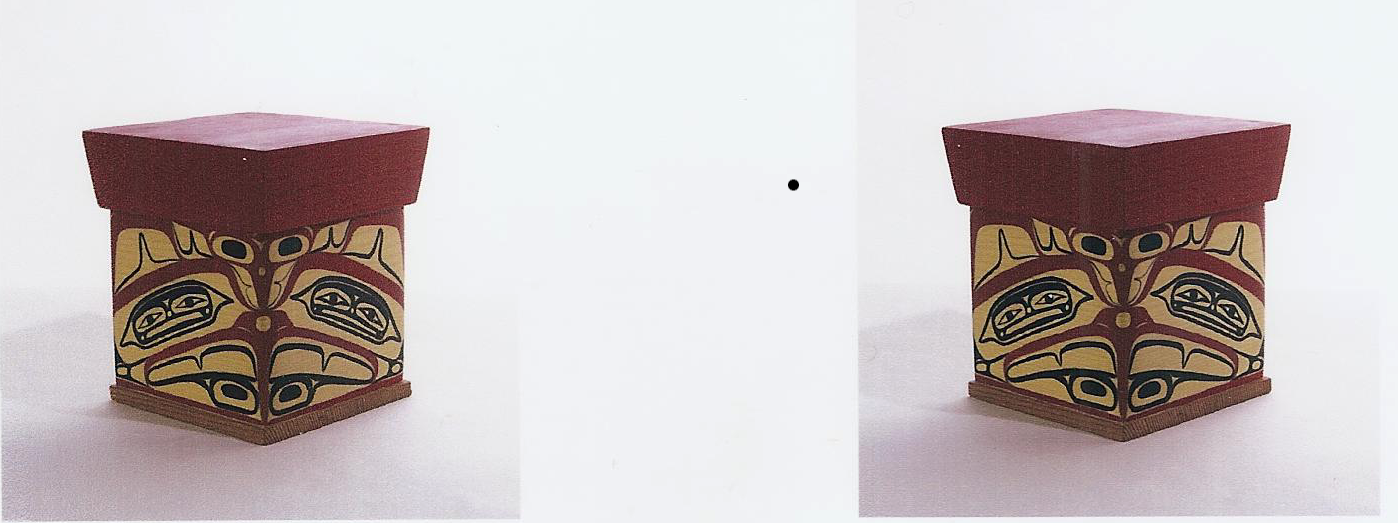
I bid on several boxes, but, as I expected, the bidding soon got out of hand (even if it was for a charity). In the end, I was pleased to bring home “Hawk,” by Haida artist Ernest Swanson, a traditional piece that many people overlooked.

Part of the reason “Hawk” was overlooked may have been that it was on the bottom shelf of the display case, so you had to get down on your hands and knees to see it properly. But a larger reason, I suspect, was that it was a traditional piece with none of the embellishments of the more extravagant designs. When I contacted him online, even Swanson sounded like he thought he should produced something more original.

For my part, I have no complaints. Although I own a number of contemporary Northwest Coast pieces, I appreciate a traditional piece, too. Moreover, despite the fact that Swanson is relatively young, he has a reputation for traditional design, and for several years he has been on my short list of artists whose work I wanted to buy some day. I was delighted to get a sample of his work for a reasonable price – a sentiment that may sound unsuitable to a charity event, but I would be less than honest if I didn’t state it.

Much of Swanson’s work seems to be jewelry, a medium in which he is rapidly reaching the stage where his prices are soon likely to take a big jump upwards. That makes “Hawk” a bit of an exception in his work.

Nonetheless, I appreciate the boldness of the design, which has relatively little variation in line thickness. At the same time, it manages to be a busy design, perhaps because of the relative lack of red as a secondary color – a design decision that is almost a necessity, since too much secondary red would be garish and overwhelming given the bright red lit.

I appreciate, too, how the fact that centering the face on corners makes the design seem abstract from most angles, with the pattern only becoming obvious as you turn the box.

“Hawk” is a piece that you have to study for a while to appreciate. It stands now on my dresser, holding spare keys (because I feel that such a practical a thing as a box should be used, so long as it is used respectfully), and I find that my appreciation has grown even greater over the months of seeing and using it.

Read Full Post »

Advice from writers is always suspect. More often than not, the advice is only what the person giving it would do, and there are several alternatives that would work just as well. That means that would-be writers really need to read several pieces of advice on the same topic before deciding what the best approach for them might be.

All the same, a time arrives for many writers when they are moved to give advice. This is my time, and I can only hope that my experience teaching first year university students how to write helps to make my advice a little more universal than most such efforts.

At any rate, for better or worse, here are seven things that I wish someone had told me when I first started writing that I think are likely to be true for most writers:

  • Read widely: How else can you know what has been done and what people think is possible? (they may be wrong, of course). Genre writers in particular need to read outside their chosen genre if they want to do more than produce a mid-list book that will fit one of a publisher’s monthly slots then disappear forever.
  • Hard work is more reliable than inspiration or natural talent: Inspiration is wonderful when it hits, but, by definition it rarely does. Working regularly, regardless of inspiration, produces far more writing than inspiration. Writing, it turns out, is like anything else: The more you do it, the easier it becomes. That’s why so many people tell you to write daily. The same goes for natural talent, too: I have seen many writers and artists of all sorts who had natural talent fail to produce anything memorable and many initially less talented writers and artists who succeed through their determination to improve.
  • Structure is more important than style: Learning how to turn a clever phrase, or even a clever paragraph, is relatively easy. Most people can learn it in a matter of a few months. By contrast, understanding structure – what needs to be said, in what order – takes years before you gain even a basic competence. A large part of the problem is that it is hard to teach, and therefore is rarely taught. Another part of the problem is that the language to discuss it often doesn’t exist (film scripts sometimes come close, but there are things you do in writing that you can’t on film). Consequently, you need to study the structure of what you admire and loath by yourself. Unfortunately, most people don’t realize the need.
  • Writing and editing are two different functions: Writing is largely intuitive and unanalytical, while editing is logical and thoughtful. Both are needed to create a piece of writing, but trying to do both at the same time only makes both harder, because you are are always stopping and starting. Except when you realize that you are completely on the wrong track, try to relax your efforts at editing when you are writing, especially in the first draft. You’ll make the process much easier on yourself.
  • Don’t worry about style: Concentrate instead on writing as well as you can. Style is the by-product of effective writing, not an end in itself. Focus on expressing yourself as well as you can, and your style will soon emerge.
  • Only the anal-retentive obsess about grammar: A writer by definition should have a better than average knowledge of the language that they write in. However, that does not mean that they need to be experts in grammar. Grammar matters when you submit a manuscript, because you want to create the best first impression possible with an editor or agent. But, until then, worry about making what you write effective. Until then, obsessing about grammar is like worrying about the wrapping on a present, or the transitions in a slide show instead of the contents.
  • You can’t please everyone: No matter how good a writer you are, nothing you write will ever please everyone. Often, some people will love and hate your work for the same quality. The reason is that everyone brings expectations and experiences to writing that are beyond your control, and very few people can distinguish between what they like and what is well-written. If most people say the same thing about a piece of writing, then they are probably right, but if one or two say something, you’re just seeing the variety of reactions to your work

Almost certainly, there are more useful pieces of advice that I could give. However,these seven points are enough to start with. Understand them and make them part of your approach to writing, and you’ll be well on your way to being a professional writer. Chances are, too, that you will have saved yourself years of development.

Read Full Post »

As I write, another Canadian federal election has come and gone. With it has gone the usual lamentations about the low voter turnout – just under 62%, this time around. Newspaper editorials have accused non-voters of being bad citizens. Radio announcers have called them irresponsible. Rick Mercer has compared young non-voters unfavorably to their counterparts in other countries who are fighting for their rights. Political leaders have frowned gravely and said that something must be done.

All of which sounds serious – and very much beside the point, because it does almost nothing to convince the average non-voter to cast a ballot. Despite all the concern expressed this past election, the voter turnout only increased by three percent this election, placing it well within the range of voter turnout for the last decade.

For one thing, I am not convinced that the problem actually exists as all the amateur and professional pundits define it. I can’t help but noting that the decline in voter turnout seems to have accelerated after 1997, when door to door enumeration for each election was eliminated as being too expensive. Possibly, part of what we are seeing is not apathy but the natural attrition as people move, change names, and otherwise fall through the bureaucratic cracks. Conscientious people, of course, might make sure that they are registered to vote, but it is far easier to register when officials come to your door than if you have to make a special trip or drop a form in the mail.

But even if the end of universal enumeration does not fully explain the decline, nagging people is not the most effective way to get them to do anything, even with the forced excitement of voter mobs. Nag nine out of ten people to do something and they will mutter incoherently and change the subject as soon as possible. Then they will go out and do exactly the opposite of what you urged.

The only way to get people to vote is to make them feel that they have a stake in the results. But that is hard to do in the current age, when people are easily kept informed but only have a say in policy every few years – and then only the indirect one of choosing who will lead them. And, in Canada, only one in 308 ridings actually votes for the Prime Minister, and only about twenty-five ridings vote for cabinet ministers (although, often, the votes don’t know that they have voted for a cabinet minister until several months after the election). The other ridings vote for back-benchers whose main job is to stand behind their leaders and look supportive. This is such a low level of involvement that it is easy to dismiss as irrelevant.

More importantly, the average politician is badly out of sync with the age. They have not caught up with the Internet, and continue to play politics in much the same way as they have been played for over a century. They haven’t fully realized, for example, how easily they can be caught out in a lie, or that their accountability is easy to check. Political parties may reject candidates who have embarrassing pictures on Facebook, but few have realized that they are subject to the same scrutiny. Consequently, they are often found wanting.

I don’t think it an accident, either, that voter turnout is lowest among those under thirty-five, and among minorities such as the First Nations. How can these groups believe that politicians can represent their interests when the average Member of Parliament is a middle-aged European ethnic? Especially when the average MP never talks about those interests, except perhaps to mouth a few noises of concern that are never followed by any action? A few years of empty promises, and you can be forgiven for thinking that an election doesn’t have much to do with you, and that voting is a waste of time.

If we as a society really wanted to increase the voter turnout, we need to make politics relevant. We need to insist on policies that attract the attention of those alienated from the mainstream, and that politicians actually listen to people and talk about what concerns them. But these courses of action are difficult to take, and sound dangerously left-wing. Instead, in the words of Gwynne Dyer talking about soldiers in the Nuclear Age, it is easier for politicians to keep the old game alive and pretend that nothing has changed in the last half century.

And if the problem of low voter turnouts is raised? Simple – just mouth a few platitudes and blame the non-voters themselves, and return as quickly as possible to business as usual.

Read Full Post »

Last weekend, I had coffee with a woman I hadn’t seen in six months. Well, actually I had a milk shake and bagel, but you know what I mean: we were eating and drinking in a public place as an excuse to talk. She was unemployed, and the doubts she was having about herself demonstrated, very concretely, one of the reasons why feminism is still important.

This woman, you should understand, is someone who could only be called accomplished. When she was young, she not only traveled around the world by herself, but lived in the Middle East and Japan. She is a mainstay of one social advocacy group, and worked for poverty wages to set up another from scratch. At times, she assists a leading civic politician. Intelligent, occasionally rowdy, committed and well-read, she is very much the sort of person I would like to be like more often, but whose example I can only occasionally match (if that).

She was just back in town after three months away, and having trouble finding work. But, where a man would probably blame the economy and try harder, she was convincing herself that the fault was hers. She had been ousted from the group she set up by office politics, and had a reputation in some circles as overbearing and aggressive.

Having worked with her a couple of times, I am in the position to say that this reputation is in no way deserved. Yes, she is business-like when organization needs to be done. But she never gives needless orders, and the way that she always pitches in with whatever work needed doing is proof that she doesn’t let authority go to her head. If she were a man, you’d say she was a competent and efficient leader.

All the same, I know the gossip that circulates about her. More to the point, I know the type of people who spread the gossip. One that comes to mind (who probably isn’t the one you’re thinking of if you’re familiar with the situation I’m describing)  is a middle-aged man who compensates for living in his mother’s basement by trying to convince everyone how important he is. Another (who probably isn’t who you think, either) is a male geek with a soccer ball for a paunch who is always getting into arguments because nobody is as impressed with his views as he believes they should be.

Both are the sort of men who not only act as though they are single (even if they happen to be married), but give the impression of not having had a date in some time. They are men who are made profoundly uneasy by women, and feel threatened by any woman who does not value them at their own estimation, and who deals with them on her own terms.

Knowing those responsible for the woman’s reputation, I suggested that the problem was theirs, not hers. That was not just a bit of coffee shop philosophy, but literally true. The sort of men I describe are rarely in positions of influence – in fact, that is one of the reasons for their bitterness and for their envy of women who succeed.

But the woman I was talking to only said, “That would be easy to believe.” She went on to describe the difficulty of getting a recommendation from the group she had setup.

Realizing that I would not persuade her easily, I said no more on the subject, not even to mention that she was exaggerating the difficulties. Sometimes, people just want to articulate their worries, and don’t want to hear suggestions. As she went on to wonder if she had made the city unlivable for herself – obviously contemplating a move elsewhere – I realized that this was one of those times.

Inside, though, I was full of indignation on her behalf. Nearly forty years after feminism’s second wave began, this smart and independent woman was blaming herself – never mind that the only alternative was to conform and to hide her talents and kowtow to those whose only claim to superiority was their sex. How dare those petty-minded men take out their own insecurities in spiteful whispers against her? And how stupid are we as a culture, that we raise such obstacles against the capable, solely because they happen to be female?

For all the progress of the last few decades, the woman I was talking to, despite her abilities, had been so worn down by the gossip about her that she was assuming blame in exactly the stereotypical way that women are supposed to do. Nor is she the first capable women whom I have seen act in this way.

Often, of course, feminism is about helping the helpless, from the working mother who needs day care to the victim of abuse. However, it seems to me that feminism is also about enabling the talented, about making sure that talents aren’t crippled by an agony of frustration by the roles that women are still expected to play.

Yet, at that moment, all I could do was provide a sympathetic ear. And let me tell you, I didn’t feel like I was doing nearly enough.

Read Full Post »

Bentwood boxes have always fascinated me. The intricacy of their making, which requires steaming the wood until it can be coaxed into shape, has always seemed an indication of just how technologically advanced the First Nations cultures of the Pacific Northwest were. In the same way, the fact that they are both decorated and utilitarian indicates the sophistication of these cultures. I have wanted a bentwood box for years, looking longingly at the works of Richard Sumner, the leading specialist in making them, but somehow never quite finding the right one.

Then last summer, after my partner Patricia Louise Williams died, Mitch Adams and John Wilson, two Terrace-based carvers and friends, said they would make a box as a memorial for me. Adams was experimenting with making the boxes (using a giant plastic bag, apparently, to trap the steam needed to shape the wood). He had already made one for his wife Diana after one or two tries, and, after another attempt had snapped, he produced a second one, passing it to Wilson to carve and paint.

For me, an agony of waiting followed, punctuated by jokes online how it was going to be the first see-through bentwood box, or would be painted pink and lime green, or some other non-traditional color, such as purple. But John had a living to make, and was nervous about wrecking the box. He also suffered a repetitive stress injury that kept him from carving for weeks, and slowed his notoriously fast carving. All too quickly, the days of waiting turned from days into weeks and from weeks into months.

I hope I didn’t nag him too often or too insistently. And I’m reasonably sure I didn’t actually utter the death-threats that impatience sent flitting through my brain, because, the last I checked, John was still talking to me.

Still, with one thing or the other, it was only when Mitch and Diana came down to Vancouver for the Chinese New Year in February that I finally held the box in my hands. I had spent the morning while we ate dim sum, wanting to ask if the box had been carried down on the plane as promised, and not wanting to ask in case it hadn’t. So, as soon as I had removed enough bubble wrap to smell the Varathane, a big sloppy grin was slapped across my face.

If possible, my first sight of the box made my grin wider still. According to John, the red side represents Trish, and the black side me. Considering that black is the primary color in formline designs and red the secondary, these seem the appropriate colors for the living and the dead, and I’ve taken to turning the box on my dresser according to my mood, turning to the red side when I’m thinking of Trish, and to the black when my grief weighs on me less than usual. So far, it tends to have the red side outwards four days out of five.

I didn’t quite hunch over my sports bag as I took the box home on the Skytrain, but it was a near thing altogether. Had anyone tried to snatch the bag from me, they would have seen my wolverine imitation, but the trip passed uneventfully.

I have no plans to sell any of the art I’ve bought. However, if I ever did, the box would be among the last. It’s become a symbol of more things than I can quickly describe, and often it’s the last thing I look at before turning off the light at night.

Thanks, guys, for the right gift at the right time. I know that Trish would have appreciated it as much as I do.

Read Full Post »

The Freda Diesing School’s year-end exhibit has become a fixture on my calendar. Not only is it one of the largest annual shows of First Nations artists anywhere in the province, but I enjoy seeing how the students develop over the two years of the program. Over the last three years, it has also become a place for renewing old friendships and acquaintances, and making new ones.

Held April 16-17, the 2011 incarnation of the show was no exception. It was smaller than previous exhibits, but made up for its size by the general quality of the work.

The variety was also impressive, although, when I heard that the final project for the second year students was a moon mask, I half-expected otherwise. Perhaps a lack of time prevented uniformity; when I arrived during setup on the afternoon of April 15, many of the students were yawning and taking every chance to sit, having been up late finishing their pieces for the show.

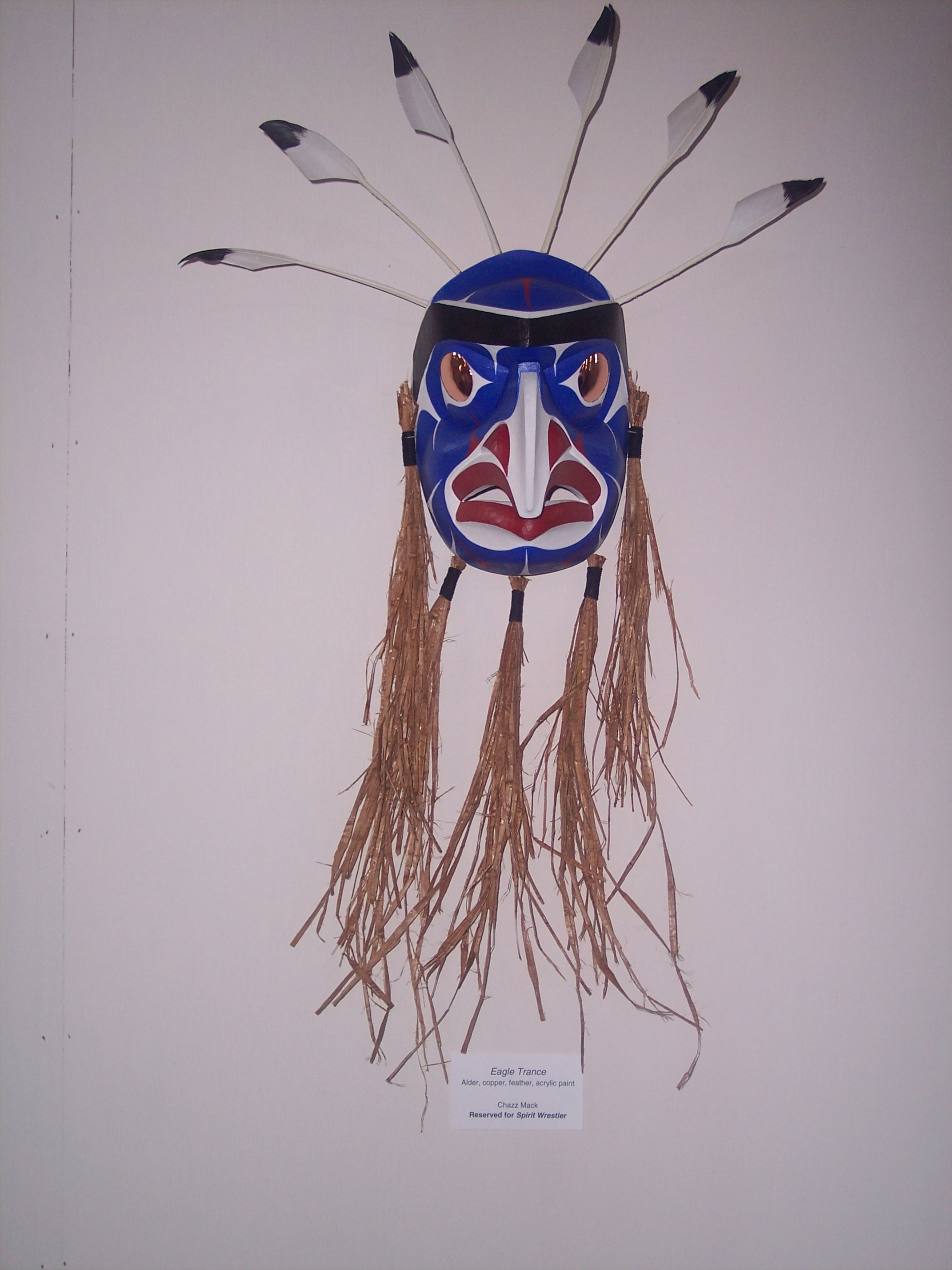
The quality of the second year students’ work was especially high, much of it equaling or surpassing the pieces seen in Vancouver galleries. Chazz Mack, who has gained a reputation for the skill seen in his two-dimensional designs in his two years at the school was forced to miss the first day of the show because of an illness that the hospital diagnosed as dehydration, but contributed “Eagle Trance,” a mask in the distinctive Nuxalk style of high head dresses, large noses and strong primary colors:

Stephanie Anderson, a winner last year of a YVR award, staggered late into setup with a striking eagle frontlet that still reeked of fixative – and was possibly the strongest piece in the show:

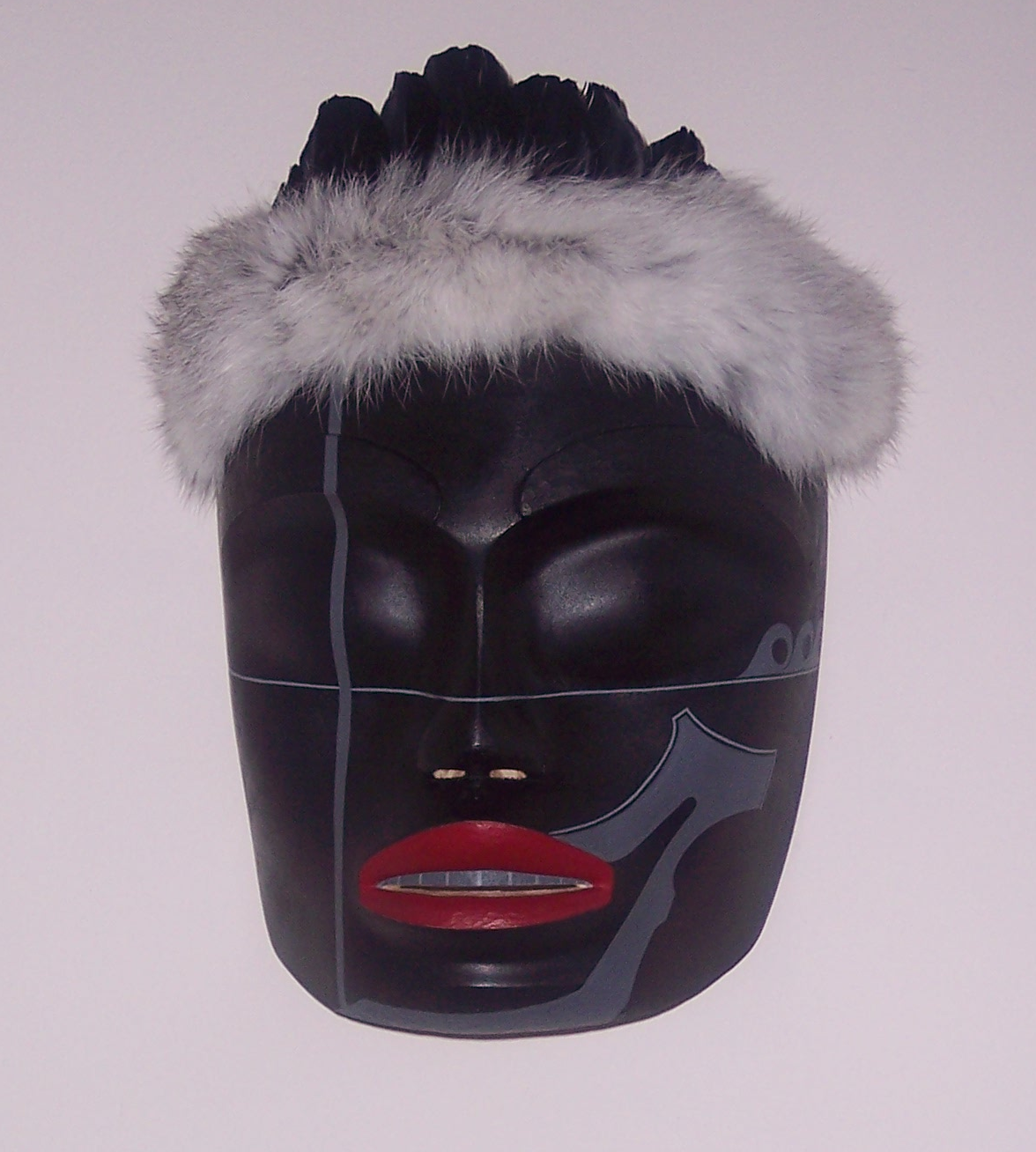
Another second year student, Colin Morrison, whose first mask I bought eighteen months ago, demonstrated his growing skill with two masks, “Resurrection of the Ancestors” and “Black Wolf,” a mask meant for a flat surface or stand:

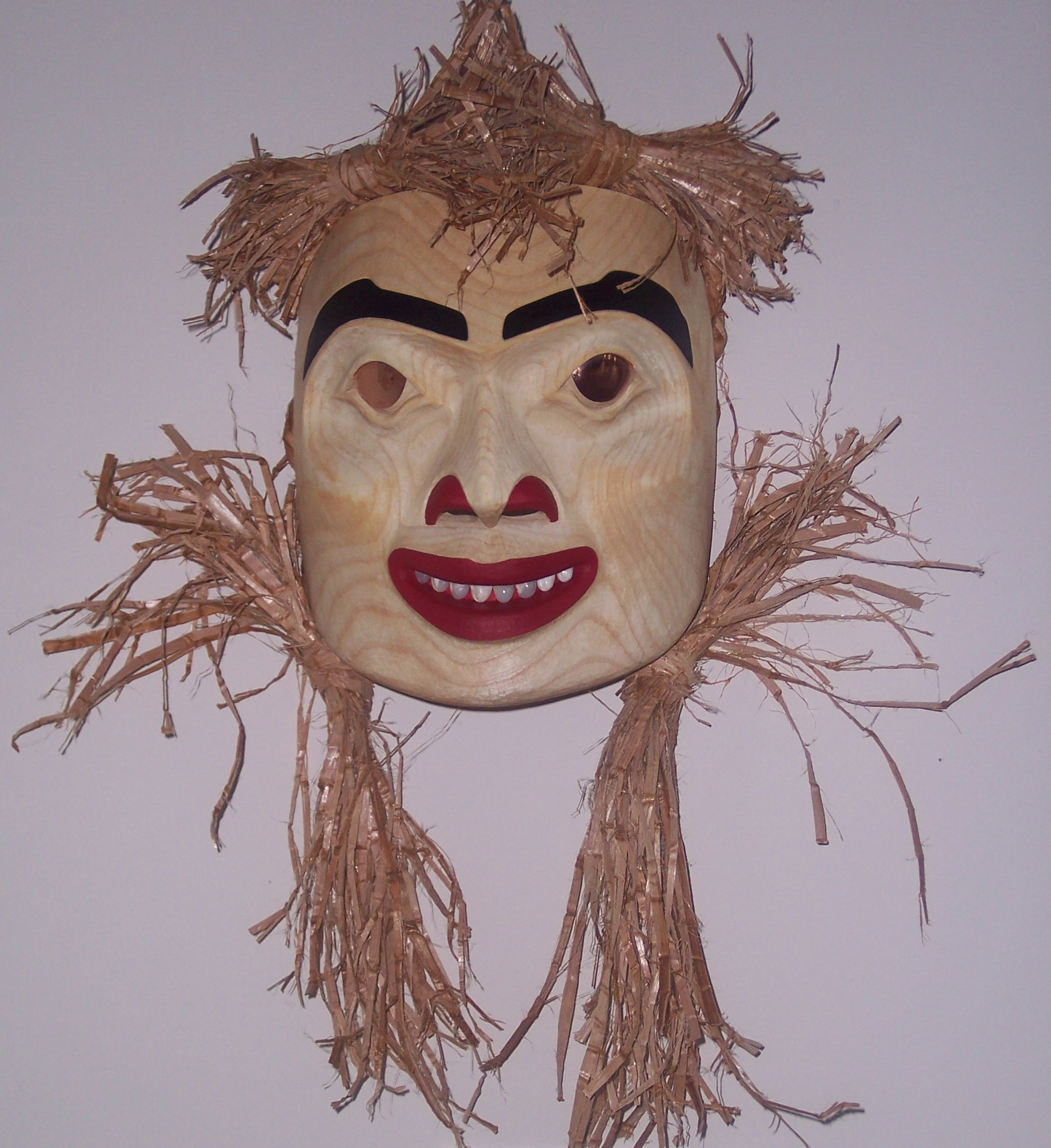
Even more development was shown in the work of Carol Young Bagshaw, the winner of last years’ Mature Student Award. While last year at this time, you could tell which teachers she was working with on each of her masks, this year, she displayed her own sense of style. Her masks are less stylized than traditional northern work, looking more like portraits, and taking full advantage of the beauty of the grain and the unpainted wood:

These graduates set a high standard, but at least some of the first year students seem likely to equal them. Nathan Wilson, who has already sold professionally, produced a solid piece entitled “Moon in Human Form,” that hinted at his skill, even though it was far from his best work:

Another emerging professional in first year, Kelly Robinson, easily rivaled the second years with “Visions Within,” even though he talked of adding some finishing touches to it:

Yet another talented first year students was Paula Wesley with the fine line and unique hair of her cannibal woman “Thu-Wixia,” which she danced at the end of the opening evening:

Accompanying Wesley in the dance was Evan Aster, who won one of this years’ Honorable Mentions for the Mature Student Award. Like Wesley, Aster promises to be a strong artist when his carving equals his painting:

The same could be said of Nigel Fox, a first year student who also paints in a style reminiscent of Canadian Impressionism. Fox’s “Surface Tension” was an interesting take on colors running together in the water:

Unfortunately, though, the painting overwhelmed the carving. Fox was on much more solid ground when he created an Escher-like design out of traditional butterflies in “Butterflies #3” (which is now in my possession):

Still other first years showed a mastery of the fundamentals of traditional design that should allow them to come into their own during their second years. They included Barry Sampare, this years’ winner of the Mature Student Award:

as well as Robert Moses White, who received an Honorable Mention for the Mature Student Award:

The pick of the show moves south on May 29 to Vancouver’s Spirit Wrestler Gallery, where I predict brisk first day sales. But although Spirit Wrestler is much closer than Terrace for me, I was glad to see the complete show, especially in Waap Galts’ap, the Northwest Community College longhouse, which is a comfortable blend of traditional design and carving and modern building and safety codes.

My thanks to everyone at the college and in the Terrace First Nations art community for making my visit such a pleasant one.

Read Full Post »

Over the past weekend, I was in Terrace in northern British Columbia to attend the graduation ceremony and exhibition for the Freda Diesing School of Northwest Coast Art. I would have wrangled an invitation anyway that I could, because the art show is worth seeing, but fortunately I didn’t have to. I was invited to attend so that I could announce the Mature Student Award, and, just before I rose to spoke, a touching thing happened.

The award was started by me and my late partner, Patricia Louise Williams two years ago, after I noticed that many of the awards for First Nations carvers required that the recipient be under twenty-five. Knowing that older students give up even more than young ones when they return to school, and how much older students add to the class room, we decided that they deserved an award, too.

This year was the first time the award had been given out since my partner died and the award was listed as being in her honor. I knew, too, that Carol Young, last year’s winner, was going to give a eulogy for Trish – something I knew that I could not possibly do without becoming incoherent with tears. So I knew going into the graduation ceremony that my emotions would be running high.

Carol gave a brief speech that had me fighting to keep control. She spoke of Trish’s lifelong interest in Northwest Coast Art and of the crafts that she was always doing. She spoke, too, of Trish’s generosity, and how she used to cut the blossoms from her miniature roses and hand them out when we were on our weekend errands.

Then she announced that, in honor of Trish, each student would take a rose and hand it to someone in the audience.

That was it. I lost all hope of control and started crying. By the time Carol announced me, I could barely see for crying.

I walked slowly to the front, buying time to dredge up some composure. To say the least, I didn’t succeed very well.

Somehow, I managed to stand straight and talk slowly. Afterwards, people said I talked well, but I don’t know if they were being kind or not. I don’t even remember what I said.

But I got through somehow. I may have said that, because of money donated at Trish’s memorial service and raised through the sale of her craft supplies, that this year the award was being given to three students, two of whom were honorable mentions. I’m not sure, though. All I know for sure is that I announced the winners, and handed each a wrapped book, and faltered back towards my seat.

The ceremony ended soon after, and the crowd followed two drummers to Waap Galts’ap, the campus longhouse, which is a happy blend of a traditional Tsimshian and a modern building. There, we heard the students talk, and watched Nuxalk and Tsimshian/Salishan dancers moving around the flats and glass cases of the exhibition.

Occasionally, as the evening continued, I saw people in the crowd holding one of the roses. Usually, they were women, and often seniors, although once I heard a lover give a male student a rose, on the grounds that men rarely receive roses. That seemed especially fitting, since Trish had said something similar to me on my twenty-first birthday.

But no matter who held the rose, the sight never failed to leave a catch in my breath and tears in my eyes. Later that night, as I stared up into the dark in my hotel room, I reflected how strange it was that a gesture carried out by people who had never known Trish should be so much more moving that the memorial service held a few weeks after her death. I was not the least ashamed of crying, because I knew that Trish would have sobbed to see it, and I knew I had to cry in her place. I drifted off in melancholy satisfaction, and slept well I awoke, grateful for the gesture and wondering if it might be repeated next year.

Read Full Post »

On July 5, 2010, I was unexpectedly widowed. I’ve spent the months since then learning how to live alone. I am starting to adjust, although I dislike parts of how I live now, and probably always will. But one thing I have not accustomed myself to is the difference in how women regard me.

For me, one of the bonuses of being in an obviously happy relationship was that other women could relax around me. They trusted me not to come on to them. If I helped them, they understood that I had no agenda beyond being helpful. If I found them attractive (and, of course, sometimes I did), I wasn’t about to act upon the attraction.

What I liked about this perception of me is that it allowed me to talk to women, and to get to know them as people. Of course, I’m sure that some women entertained lingering doubts about me, and that their interactions with me were hedged with reservations. But, so far as the culture permits, as a married man I could be friends with women.

Now that I’m suddenly single, much of that is gone. Although I’m not aware of having changed my attitudes or behavior, how I’m perceived by women is suddenly changed — even by women who have known me for years. Although I’m still operating on the assumptions built up by years of marriage, I’m reclassified as single.

Being relatively young and looking younger, I am assumed to be looking for another relationship As a widower, I’m assumed to be missing regular sex. Suddenly, my speech is being scanned for innuendo, and my actions are viewed with skepticism. At best, there’s a reserve and a questioning in the women I meet that wasn’t there before.

And, just to make matters worse, my awareness of that reserve makes me more nervous, which makes many women more nervous still, creating a vicious cycle that I don’t know how to break.

The irony is, I am far from sure that I want another relationship. I can’t say that I would turn one down, or that I don’t have excruciating bouts of loneliness, but the possibility barely registers with me. I’m still recovering from the last one, thank you very much, and I’m not sure which would be worse: being widowed a second time, or leaving someone I loved to survive my death.

I can’t help thinking, too, of how Raymond Chandler and George Orwell made fools of themselves after their wives died, begging every women they met to marry them. Orwell even went so far as to suggest that any woman who married him would soon end up a wealthy widow with control over his writings, a piece of bribery that strikes me as both gauche and as being at odds with the upright image he affected in his writing. I would hate to be a figure that attracted similar ridicule and disdain. Chandler and Orwell sounded so desperate.

But the main reason that I contemplate staying single is that I never did care much for the mating game. The ritual has changed since I was last single, but for all the loosening of outdated tradition, it still seems to degrade men and women alike. I mean, no wonder there are so many breakups and divorces: the game is so stylized that you have practically no chance of getting to know a lover or a spouse until after you’ve moved in together.

True, I was lucky once. But the odds of repeating that luck seem slight. And why should I settle for second best? The thought of looking for another relationship seems so tiresome to me that it’s hardly worth the effort.

Right now, all I really want is friends with whom I can talk, regardless of whether they are male or female. A cause or two to distract me wouldn’t hurt, either.

But the frustrating part is that there is no way to communicate this attitude to the women I meet. If I tried to express my attitude, it would either seem too personal too soon, or else some roundabout strategy in the mating game. There are no rules in the rituals of male and female for declaring that you are not playing, and no way to protest your classification.

So the fact remains: against my wishes, I am suddenly a single man. And every woman knows what a single man wants, right?

Read Full Post »

After months of wondering, now I can finally say: It turns out I’m a tidy person after all.

Probably, it seems strange that a middle-aged person wouldn’t know such a fact about themselves, so let me explain:

My late partner Trish was in many ways an exemplary person, more generous and loyal than anyone else I’ve ever known. But even those who loved her would not say that she numbered tidiness among her virtues. Although she kept herself and her clothes clean, she reacted early and strongly against her mother’s obsessive housekeeping. In her adult life, she was infamous for being able to create clutter around her within minutes of sitting down in a spot –even if she was in someone else’s home. It didn’t help, either, that she was always buying craft supplies against a possible future project.

I never cared much for the resulting clutter, although I didn’t object that much, either. I always kept tidy the areas of the townhouse that I frequented, like the computer workstation, as well as the kitchen and bathroom, but despite some vague threats, I never tried to tidy Trish’s storage areas. Anybody who has been in a long term relationship will understand why – there are some things that you just don’t do if want the relationship to stay happy.

Then, in the last couple of years as she became progressively weaker, even I had better things to do than tidy, like spending time with her.

But, one way or the other, I was so busy accommodating Trish’s preferences that I lost sight of my own. Although one of the first things I did in the months after her death, just to keep busy, was to tidy her things and give many of them to wherever they would do most good, I wasn’t sure how long the vistas of empty tables and the expanses of carpet that my efforts created would stay. Maybe, my efforts would be like weeding, and gradually I would slip into sloppier ways living by myself.

To my surprise, the tidiness has continued. It’s not that I’m obsessive about keeping the clutter down, or go to bed with discomfort gnawing at the back of my mind if something is out of place. It’s more that having worked so hard over so many weeks to make sure that every book had a place on the shelf and that drawers were free for random objects, I’d rather keep the townhouse in the same state. Besides, taking twenty seconds to put something away when I’ve finished with it is far less objectionable to me than tidying once a week or month in a massive effort that makes me feel that I’ve lost a day to drudgery.

Anyway, when you’re the only one in the house, you know that if you don’t do something, no one else will (not that Trish ever did much tidying, even when she was healthy). When the effort is up to you, you might as well act now than later.

So, apparently, I’m a tidy person after all. I might have guessed by the home directories on all my computers, which are so well organized that I almost never have to do an automated search for the files I need.

But like I said, what a strange thing to learn about myself at my age.

Read Full Post »

I’ve been interested in Mike Dangeli’s work since I saw his ridicule mask in the Continuum show at the Bill Reid Gallery. The idea of taking a traditional form of commentary and applying it to modern relations between the First Nations and industrial culture seemed far wittier – and ultimately, more meaningful – than the other post-modern statements in the show. Later, when I heard Dangeli lecture about his efforts to live his culture in a modern context, I became even more interested. But it was only in October 2010 that I got around to commissioning a piece from him.

Whenever I commission work from an artist, I like to suggest only broad guidelines, and encourage the artist to experiment and maybe do something they wouldn’t ordinarily do. Accordingly, I told Dangeli that the painting was to be in honor of my late partner Trish Williams – the second piece I had commissioned in her memory – and could have up to four raised canvases. We discussed the primary colors, and I left him the pamphlet from her memorial service and some of the feathers I had collected over the years from our parrots. Remembering, too, Mike’s association of the north wind as a messenger between this world and the creator that might appear at a funeral, I also suggested that the north wind might be part of the design.

When I came to pick up the painting three months later, it had grown in its creation, with two side panels added to give room for Dangeli’s design.

The central panel of “Honoring Her Spirit” depicts Trish in raven form, with me represented by the red face on her wing. Around her are four ravens, for the four nanday parrots in our household during her lifetime, their bodies painted in the colors of nandays.

To the right, is a panel showing the north wind in the spirit realm. Where the central panel is made of definite lines in a more or less traditional formline design, the north wind is painted with thinner and less definite lines, its breath curling in non-traditional designs. The implication seems to be that we can only see hints of the spirit world – that nothing in it is as definite to our senses as the world around us.

On the four raised canvases, the birds sit poised between the two worlds, which suggests that they are part of both, or can move between them. The red lines on the raised canvases are roughly reminiscent of traditional northern designs, and spill over into the central panel, as the feathers do, both perhaps suggesting the interconnections between the two worlds.

However, the north wind is also blowing into the central panel, suggesting the coming of death. Trish’s transition into death is shown on the left hand panel, where her image is mirrored imperfectly, simplified and disjointed and drained of color to reflect our imperfect understanding of what happens after life.

This is a simple but powerful idea, ingeniously strengthened by the different styles in the panels. Yet what is eerie is that, although Dangeli did not know while he was painting, one of our four parrots died before he completed the paining – and only one of the birds is looking into the other world. The other three, who are still alive, are facing towards the everyday world. And if that is not enough, the feathers at the top center are from the dead parrot, although Dangeli no doubt picked them out at random. Whether these touches are serendipity or an example of the heightened perceptions of an artist, I won’t say, but they do add to the already highly personalized subject matter.

The painting now hangs in my bedroom, below two examples of Trish’s needlework. That seemed the most appropriate place for it.

Read Full Post »

« Newer Posts - Older Posts »