Feeds:
Posts
Comments

Archive for the ‘John Wilson’ Category

“How does this compare to a show down south?” John Wilson asked me last week, shortly after I arrived at the Freda Diesing School Student Art Exhibition in Terrace. He seemed surprised when I told him that a 23 person show with some 75 pieces almost never happened, but it’s true. The annual show is one of the largest annual exhibits of modern Northwest Coast Art anywhere.

The show lasted only two days, with a private viewing for friends and family on Friday and a public viewing on Saturday. The location is the Freda Diesing Studio on the Terrace campus of Northwest Community College, a well-lit building with a large lower floor ordinarily occupied by work benches and a loft for a more conventional class room setting:

fd-studio1

Just inside the door, above the table with the show catalog and price list were a few prints by Freda Diesing herself, including a self-portrait mask:
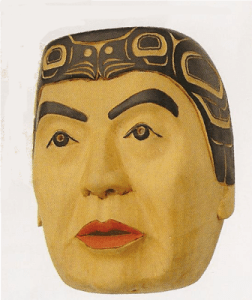
fd-self-portrait

These works were not for sale, but stood as tutelary spirits of the show – or, more precisely, as the standards to which the students should aspire.

Several months ago, I reviewed the school’s mid-term show via a collection of pictures sent to me by John Wilson. That show was mostly painting and sketches, the first year class in particular having not begun its study of carving at the time. By contrast, the year-end show had a few two-dimensional pieces, but consisted largely of paddles, spoons, and masks.

Painted paddles are closer to two dimensional than three dimensional works, so I was not surprised when two of the best-designed paddles were from Shawn Aster and Latham Mack, two artists who were among the standouts at the earlier shows and scholarship winners at the graduation ceremonies that accompanied the private viewing:

shawn-aster-paddle

latham-mack-paddle

However, making the transition from the two-dimensional craft of painting to the three-dimensional one of carving does not always comes easily, and many students are still making it. Latham Mack, for instance (who as a Nuxalk, is learning his second style of carving), is well on the way, using the same blue that I am starting to recognize as characteristic of his two-dimensional designs:
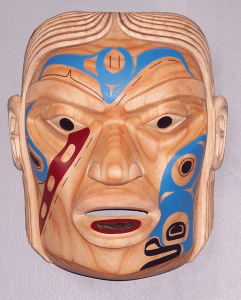
latham-mack

By contrast, a mask by Shawn Aster shows a sense of surfaces, but seems more tentative, with a shallowness in the carving and a thinness of line that makes you only appreciate the mask up close, as seen in this (unfortunately cropped) picture:

shawn-aster-mask

A similar lack of ease in three dimensions is true of Todd Stephens, another scholarship winner from whom I’ve bought several paintings:

todd-stephens

Other students showed similar learning curves – and, as might be expected in a student show – a certain tendency to conformity – although Norman McLean, Sr., in a triumph of social sensibility over aesthetics did do a bright pink mask, as well as a spoon with a more discrete pink ribbon around the handle as fund-raisers for breast cancer. Still, there were some interesting pieces here and there.

Sophia Patricia Beaton, another scholarship winner, had only one piece in the show, but the wavy hair and the obviously feminine face and the labret were original enough to make me wonder what the rest of her work might be like:
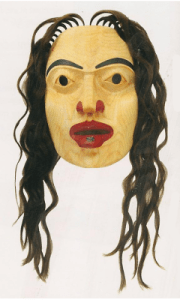
sophia-beaton

I also noticed James Weget-McNeil’s frog mask, which, although in a very different style, reminded me of some of the faux-artifacts that Beau Dick has been carving recently:

james-weget-mcneil1

However, much of the interesting carving came from mature students with more experience.

Charles Richard Wesley, whose work I noticed in the mid-term show, came up with two interestingly intricate masks:

charles-richard-wesley

I also appreciated John Wilson’s work, which he says represents an advance in finishing details over his earlier work – pointing, for example, an indentation of the eye sockets at the top of the nose:

john-wilson

These are just some of the pieces in the show, but, aside from the bowls (something needing to be left out), they give an idea of the variety to be seen at the show. I appreciate the chance to see students learning and mastering their craft, and while some flaws and weaknesses are apparent, there are just as many examples of solid and skilled works.

In fact, I could have come away from the show considerably poorer. Fortunately or unfortunately, depending on my shifting perspective, most of the pieces I considered buying were marked NFS, many earmarked for a show at the Spirit Wrestler Gallery in Vancouver later this month.

But buying is only one reason to attend such a show. A far better reason is spend a few hours surrounded by efforts of art – and that, so far as I am concerned, is more than enough reason for me to want to attend next year’s show.

My thanks to Stan Bevan for seeing that I got an invitation. That small kindness gave me an enriching day.

Read Full Post »

John Wilson, who describes his work as “contemporary Haisla,” has only been selling his work for a few years. And, so far, he has confined himself largely to portrait masks, although he has also done drums and some graphics worth releasing as limited edition prints. I consider his “Blue Hand Mask” (which should actually be read as “Blue, Hand Mask”) an accomplished example of the portrait genre, and am pleased to add it to our collection.

If you have read Bill Holm’s An Analysis of Form, you will immediately identify the “Blue Face Mask” as being in the northern style: although the nostrils and lips are painted solidly, the hand and the spirit-helper on the left temple cut across the facial features. In fact, you cannot tell where the spirit-helper ends and the eyebrow begins – that is, what is natural and what is painted, or what is mundane and what is supernatural. Also typical of the northern style is the predominance of black, followed by red.

What is less typical is the band of blue. Cutting across the eye socket and eyelid, the band is an unusual shade. It has the effect of drawing your glance to the blackness of the pupils, giving a sense of fierceness or determination.

The painted hand is a visual pun. It has an umbilical-like connection to the spirit-helper that runs below the chin and up the left cheek. In other words, the spirit-helper is literally lending a hand. And, just to reinforce the pun, the obvious thumb shows that it is a left hand, originating on the same side as the spirit-helper.

One of the things that makes this mask stand out is the sheer skill of carving. Unlike many carvers early in their career, Wilson thinks in planes. That means he is working with the wood, rather than against it. At the same time, the mask is closer to realism than a strictly traditional piece in such features as the chin, the eye sockets, and eyes – which is what makes the mask contemporary.

Another outstanding feature of the mask is the way that Wilson has carved and sanded down to the grain that is suitable in different parts of the face. On the forehead, the ridges of grain meet almost in the center, while on the left cheek, the concentric circles of the grain emphasize the plane of the cheek bone. Even more interestingly, beneath the eyes are what might almost be reflections of them in the grain. Some bits of this attention to the grain are lost beneath the paint, but, because the paint is minimized, much of it remains visible.

Portrait masks are an easy genre to under-estimate. They lack the exoticness of a mythological theme or a stylized animal that many people seem to want in Northwest Coast art. But, if you look closely at the best examples of them, like the “Blue Hand Mask,” then you can start to appreciate them as a genre in which artists are thrown back entirely on their own skill. You can also understand why I think that John Wilson is an artist who is likely to make a name for himself.
low-res-blue-hand-mask

(Note: Somebody should explain to galleries that, when shipping masks with hair, they need to make some effort to keep the hair from getting tangled. As you can see, I am still trying to straighten out the hair)

Read Full Post »

One reason why Northwest Coast art thrives is the strong tradition of teaching among the artists. Artists regularly take on apprentices, and many regularly assist younger artists in their struggles to establish themselves. One of the newer artists who has benefited from the tradition of teaching and plans to teach others himself one day is John Paul Wilson, a member of the Blackfish clan of the Haisla nation for whom carving masks is both personally satisfying and a means of rediscovering his culture.

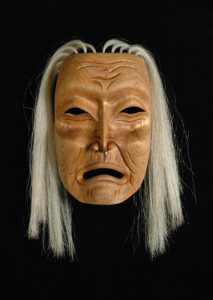
john-wilson1
Wilson was born in Kitimat in 1973, but grew up and lives in Terrace, and is currently learning northern carving styles. “I have been taught little things about my culture as I was growing up,” he says, “But I didn’t go to my village. I am now really trying to find my culture as an artist.”

After what he describes as a hard-living youth, Wilson worked in a variety of jobs, including carpentry, forestry, and sales. “Now that I look back on my life,” he says, “I see that what I was doing was training myself to be an artist, whether I knew it or not.” All his work, he believes, helped him to prepare for both the techniques and business of being a carver.

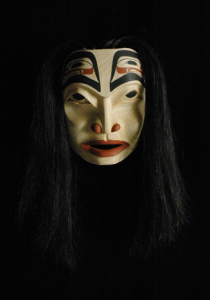
john-wilson2

Although Wilson says that “I have always been doing art,” he only began focusing on carving in 2002, when he began studying under Tsimshian artist Heber Reece. After he “took some time away” from Reece, Wilson continued to return to him for help, and later took a course Reece taught at the local college in 2004. “He always had his doors open for me,” Wilson says of Reece.

More recently, Wilson has been receiving informal advice from Nisga’a carver Ron Telek, especially on the finer points of finishing, and attending the Freda Diesing School of Northwest Coast Art at Northwest Community College, where he is being taught by Stan Bevan, Dempsey Bob and Ken McNeill. In fact, this is the second time he has enrolled in the Freda Diesing School, after a burglary of his home forced him to withdraw the first time for lack of funds.

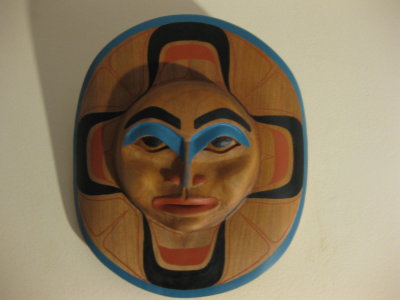
john-wilson3

Other artists whose work Wilson admires include Robert Davidson, Norman Tait, Klatle-Bhi, and Henry Green.

“The senior artists have given me the drive to to get to where I am as an artist,” Wilson says. He is particularly enthusiastic about the Freda Diesing School, which, although he has only just started the second semester, he describes as having “helped so much that I advise anybody to take the course if they want to get serious about being an artist as a living.”

Rediscovering culture

At first, Wilson admits, his interest about carving was as much about making a living as about art. However, under the influences of his teachers and education, he finds his motivations shifting. “I now realize that it is our culture,” he says. “That means a lot to me, knowing that I am going to help keep our culture alive.”

john-wilson4

As Wilson reconnects with his culture, one of his most personally meaningful discoveries was that his great-great-grandfather was also an artist. The discovery, he says, has made him realize that “without knowing the history, I don’t think I could go forward as an artist.”

He now plans to return to his village to familiarize himself with his culture, and dreams of one day teaching there. “Our culture is our way of telling stories to hand down to the next generation,” he says. “And art is a big part of our culture. It is something we were so close to losing, but I did not find that out until I talked to senior artists at the Fred Diesing School.”

john-wilson5

Learning the life and passing it on

At the same time, Wilson finds his carving, which he describes as “contemporary Haisla,” becoming central to his life. “The art is very important,” he says. “It has changed my life for the better. I have a strong feeling that [art] is the right path, like it is what I was brought on earth to do.”

Besides the technique of carving and his reconnection to his history, one of the things that bemuses Wilson about his chosen career is the need to market himself. “When you finish a piece it’s like creating a kid of your own. Sending a piece out for sale is one of the hardest things to get used to. And I’m still learning how to market myself. A lot of people think that when you’re done your piece that it’s time to rest, but they forget the time and effort it takes to sell the piece. You have to really study the way to market yourself as an artist if you want to make a living doing the arts.”

john-wilson6

Now selling regularly to galleries, Wilson is currently able to support himself as an artist. “Some times are better than most,” he observes, “but it still gets me by comfortably.”

All in all, art has become so central to Wilson’s identity and life that he is now starting to pass on the encouragement he received from senior artists to others. “Just try it,” he advises. “You never know what will happen. Look at Freda Diesing – she didn’t start until she was in her forties, and she won a lifetime achievement award for her efforts at learning and teaching the arts.”

(John Wilson’s work is available in the Black Tusk and Path Gallery in Whistler, The Edzerza Gallery in Vancouver, The Art of Man in Victoria, The Stonington and Steinbrueck galleries in Seattle, the Arctic Raven Gallery in the San Juan Islands, and Neo Concept in White Rock).

john-wilson71

Read Full Post »

« Newer Posts