Feeds:
Posts
Comments

Archive for the ‘Northwest Coast Art’ Category

Every piece of art, several collectors have told me, comes with a story. Gradually, as I’ve bought art, I realized that this statement is true, so on my spreadsheet for insurance purposes, I’ve created a column where I can type the story of how the piece was acquired.

I have no trouble remembering the first piece of serious art I bought. It was a three inch copper bracelet by Tsimshian artist Henry Green. I’d wanted such a piece for years, and suddenly realized I could afford one. I still remember my breathlessness as I approached the gallery to pick it up, and my sigh of relief when it proved more awe-inspiring than I could ever have hoped.

A couple of months later, I saw that the Bill Reid Gallery was selling canvas banners from a set that had been stored in Bill Reid’s house since 1991. Trish and I bought one, realizing that it was our best chance of affording any work by Bill Reid, then quickly bought another to balance the wall where the first one hung. Soon after, we bought our first mask, a moon by Ron Telek that is both eerie and strangely modernistic.

More soon followed. There was a Beau Dick sketch of a mask, unusual in that, with his carver’s eye, he depicted planes, not lines. The Lyle Wilson pendant Trish won in a raffle at an exhibit – the best $5 that either of us had ever spent. The small Telek mask that I fetched from the South Terminal of the Vancouver airport by walking from the end of the bus line and back again. The Gwaii Edenshaw gold rings we bought for our anniversary. The miniature argillite transformation mask by Wayne Young that I trekked over to Victoria for after Trish’s death and repaired and remounted because it was so magnificently unique. The wall-hanging commissioned by Morgan Green to help her through goldsmith school. And so the stories accumulate, so far as I’m concerned, as innate as the aesthetics of the piece.

For instance, there’s Mitch Adam’s “Blue Moon Mask,” which I saw in 2010 at the Freda Diesing School’s year end exhibit. It was labeled NFS, bound for the Spirit Wrestler show for the school’s graduates a month later. I happened to mention to Mitch that I would have written a cheque right away had it been for sale – not hinting, just praising – and a few hours later he came back and said the piece was mine if I were still interested. I was, and immediately became the envy of half a dozen other people who also wanted to buy it, but had never had the luck to ask. One of them still talks enviously when we meet.

Then there’s Shawn Aster’s “Raven Turns the Crows Black,” a painting that we had discussed in 2009, but didn’t seem to gel in his mind. After a year, I had stopped expecting him to finish it, and took to calling him a promising artist, because he kept saying that he was still working on it. But he did complete it – making it a Chilkat design (which I had not expected), and showing a promise of a different kind.

Two other pieces were commissions in memory of Trish after her death: John Wilson’s “Needlewoman” and Mike Dangeli’s “Honoring Her Spirit.” I made “Needlewoman” a limited edition of twenty, and gave it to family members for Christmas 2010. Mike’s painting, more personal, I kept for myself, carrying it up Commercial Drive from Hastings Street on a chilly January Sunday, because cabs wouldn’t come to the Aboriginal Friendship Center where I picked it up.

Other pieces were gifts from friends: a print of “January Moon” by Mitch Adams in return for some advice on galleries I gave him; a bentwood box Mitch Adams made and John Wilson carved and painted in memory of Trish; a remarque of Ron Telek’s “Sirens” print, and an artist’s proof by John Wilson and another print by Shawn Aster, both apologies for the late delivery of other pieces.

Of course, such stories mean that I can never sell any of the pieces I buy. The associations have become too much a part of me. But since I never buy to invest, only to appreciate, that is no hardship – my appreciation is only deeper for the personal connections.

Read Full Post »

Todd Stephens is one of maybe a dozen First Nations artists whose work I watch closely. A graduate of the Freda Diesing School and two-time winner of the YVR Art Foundation Scholarships, he paints in a style that is traditional, yet displays his technical skill and individuality. “Jorja and I,” a painting of Stephens and his young daughter, remains one of my favorite pieces in my collection, hanging above my workstation. So, a couple of months ago, when Stephens was selling another major painting, “Txeesim’s Escape,” (“Raven’s Escape”) I jumped at the chance to buy, also purchasing two smaller pieces, “Midiik” (“Bear”) and “Ganaa’w” (“Frog”).

To my surprise, I’ve heard another art buyer dismissed Stephen’s work as scholastic, suggesting that he hadn’t evolved a style of his own. However, that description confuses classicism with lack of originality. In a classically oriented piece in any field of art, what you look for is discipline, and originality within the tradition. By these criteria, Stephens’ work sets a high standard – in fact, it often shows a surprising amount of variation, even with the same piece.

Look, for example, at “Ganaa’w.” Even in this relatively simple piece, the formline varies from the length of the back to the thinness of the hind leg, parts of which are half, or even a quarter the thickness of the back. As you trace the formlines, you will also find variations in how they are joined, with most tapering long and dramatically in the primary black formlines, and often hardly at all in the secondary red formlines. Notice, too, how often the black formlines create a T-shape out of negative space, especially at the throat and the base of the back, reducing the overall weight of the forms. The contents of the ovoids shows a similar variation in their contents, although the feet, naturally enough, are nearly identical.

Many of the same things happen in “Midiik.” In this piece, though, the thick black formlines are used together with the ovoids and U-shapes to create a sense of the bear’s powerful legs – in fact, there is a distinct impression of musculature in the upper legs that, more than the claws or the rough outlines of the teeth, convey a sense of the bear’s strength. Another interesting aspect is that the asymmetry of the eye leaves the impression that the bear is looking out at the observer, possibly in a menacing way.

However, of these three pieces, “Txeesim’s Escape” is by far the most accomplished. The title refers, of course, to the story or raven causing himself to be born as the grandson of the chieftain who keeps the light in a chest so that he can steal it (you can see the light at the tip of his beak, and the shape of the grandson in the tail). It’s an old story, and one that I sometimes think is depicted too often at the expense of equally interesting stories, but one that can always be renewed by originality or craft, as Stephens proves.

The design of “Txeesim’s Escape” is a bold one. It makes me think of house-fronts, the decorative boards that the northern First Nations of British Columbia brought out of storage to decorate their longhouses during celebrations. Evidently, that is what Stephens had in mind as well, since the painting is not only just short of three feet by two, but also so busy that many of the details are lost at a smaller size.

The design is economical. The raven’s body is hardly shown at all, except for a thick formline. Instead, the design is dominated by the head, wing, and tail, with a single foot whose main purpose is to balance the design. These body parts are shown in a profile that would be almost impossible to hold for any bird to hold for more than a second in reality. Here, though, the position suggests startlement, as though the raven has heard or glimpsed something behind him, and is flashing a quick glance over his shoulder to check for pursuers.

But the most outstanding feature of the design is the sheer amount of variation in the ovoids, U-shapes, and other elements within the form lines. The amount of variation seems almost disorganized in the tongue and upper beak, but Stephen keeps it partly in control in the wing and tail feathers by having the design elements in the outer feathers match. As for the many faces in the ovoids – or appearance of faces – they serve as a reminder that the raven is a master shape changer, capable of assuming many forms. The overall impression is a pleasing confusion that seems not only suitable to a creature being chased, but completely appropriate to a being that is, in many ways, the embodiment of chaos.

I have no idea how conscious Stephens is about such things – some artists are very conscious of the effects they create, while others are either unaware or wary of examining the process too closely. However, these comments should be enough to show why I consider Stephens an artist skilled in working in a classic mode. He displays his work regularly on his Facebook page, and is currently selling glicée prints of the four main clan crests at a surprisingly affordable price.

Read Full Post »

Recently, a gallery owner said to me, “Your collection of Northwest Coast Art has some really unusual pieces in it. After a moment’s thought, I replied, “Why would I want pieces I could find anywhere?” I’m not buying tourist junk, and most artists are at their most interesting when they are doing something outside of their normal range. Certainly, that is one reason why I bought Kwakwaka’wakw artist Steve Smith’s “Raven Mask.”

Smith’s work is regularly on sale at the Lattimer and Coastal Peoples Galleries in Vancouver. Most of his work has two characteristics: first, it is painted with intricate geometric shapes, primarily in black,green, and red, and, second, it has a wide varieties of forms – everything from boxes and vases to canvases, baseball caps, leather cuffs and Munnies. It’s a highly distinctive style, one identifiable from a distance, and I’ve enjoyed it for some years without being quite moved to buy, although I figured it was only a matter of time before I found the right piece.

I found the right piece while attending the opening of the Lattimer Gallery’s Annual Bentbox Charity Auction in November 2010. Having admired the boxes being auctioned, I was leaning on the main display case when I glimpsed “Raven Mask” out of the corner of my eye, and went over for a closer look. I looked several times again that evening, and a few times more on subsequent visits to the gallery, until I bought it a few weeks later.

Perhaps because I remember black and white television and photographs from my early childhood, I often find monochromatic work more dramatic than colored work, especially when in shadows. But even without this personal preference, Smith’s “Raven Mask” is striking among his more colorful other works. Even the black is more faded than on his other works, and the white is closer to a dirty silver color. And instead of Smith’s usual geometric shapes, the piece is simply painted with a few basic shapes. It could almost be a survivor from the 19th century, except that it is not a functional mask.

Not only that, but it seems a survivor that has come through fire, singed so that it looks like charcoal or ash, and the paint has started to blister. So far, I have not been able to ask Smith why he departed so far from his usual color palette, but to me the piece seems a reminder of the art that was burned as unacceptably pagan in the late nineteenth and early twentieth centuries. At the same time, its appearance of being lightly damaged suggests the artistic tradition of the coast today – damaged, yet still powerful. Extending the metaphor even further, you might say that the bundled cedar and the feathers are a literal grafting of new media and techniques on to the old.

However you view it, it remains an arresting piece, especially in darkness. As I type, it is a few meters away on a tea tray, pointed so that it catches my attention when I glance over my left shoulder. I have to be deep in the torments of writing before it fails to capture my attention and make my glance linger for a few moments.

Read Full Post »

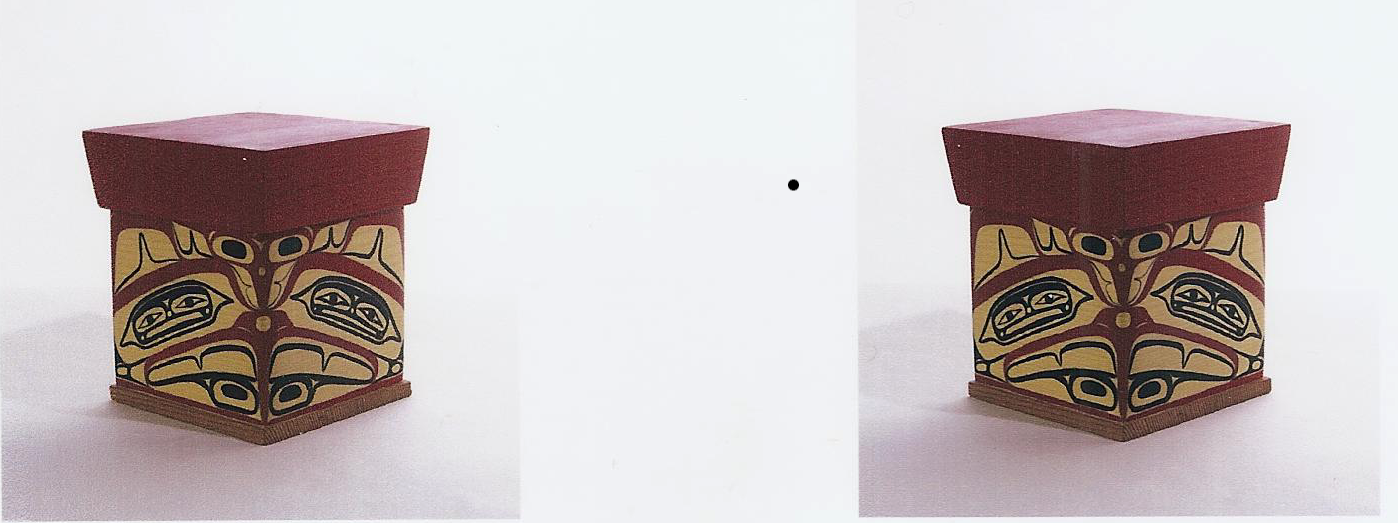
Last week when I was in the Lattimer Gallery, I received my copy of the book for the 2010 Charity Bentwood Boxes. It’s a small but well-designed book, and it reminded me that I hadn’t blogged about the box I bought in the auction.

2010 was the fourth year of the auction, with the proceeds going to Vancouver Aboriginal Health. The concept is simple: James Michels makes and donates the boxes, which are decorated by Northwest Coast artists, and the boxes are sold in a silent auction. In 2010, $10,850 was raised – more than double the amount raised the year before.

Over the last couple of years, the decorating of the boxes has become increasingly competitive as artists try to outdo each with their concepts. In 2010, for example, Landon Gunn added copper moon faces to his box, and Jing painted his in a Chilkat design. Steve Smith made his box a rattle. Even more extravagantly, Ian Reid (Nusi) crowded his with Tibetan pray flags and images of the Buddha, while Rod Smith chopped up his box and reassembled it. Perhaps the most ingenious box was Clinton Work’s “The Shop Thief,” a little man with the box for a body and the lid for a hat surrounded by the tools he had stolen – a theme that proved especially popular with the artists. If anything, the competition to be original promises to be even fiercer next year, with some artists already planning their designs for 2011.

I bid on several boxes, but, as I expected, the bidding soon got out of hand (even if it was for a charity). In the end, I was pleased to bring home “Hawk,” by Haida artist Ernest Swanson, a traditional piece that many people overlooked.

Part of the reason “Hawk” was overlooked may have been that it was on the bottom shelf of the display case, so you had to get down on your hands and knees to see it properly. But a larger reason, I suspect, was that it was a traditional piece with none of the embellishments of the more extravagant designs. When I contacted him online, even Swanson sounded like he thought he should produced something more original.

For my part, I have no complaints. Although I own a number of contemporary Northwest Coast pieces, I appreciate a traditional piece, too. Moreover, despite the fact that Swanson is relatively young, he has a reputation for traditional design, and for several years he has been on my short list of artists whose work I wanted to buy some day. I was delighted to get a sample of his work for a reasonable price – a sentiment that may sound unsuitable to a charity event, but I would be less than honest if I didn’t state it.

Much of Swanson’s work seems to be jewelry, a medium in which he is rapidly reaching the stage where his prices are soon likely to take a big jump upwards. That makes “Hawk” a bit of an exception in his work.

Nonetheless, I appreciate the boldness of the design, which has relatively little variation in line thickness. At the same time, it manages to be a busy design, perhaps because of the relative lack of red as a secondary color – a design decision that is almost a necessity, since too much secondary red would be garish and overwhelming given the bright red lit.

I appreciate, too, how the fact that centering the face on corners makes the design seem abstract from most angles, with the pattern only becoming obvious as you turn the box.

“Hawk” is a piece that you have to study for a while to appreciate. It stands now on my dresser, holding spare keys (because I feel that such a practical a thing as a box should be used, so long as it is used respectfully), and I find that my appreciation has grown even greater over the months of seeing and using it.

Read Full Post »

Bentwood boxes have always fascinated me. The intricacy of their making, which requires steaming the wood until it can be coaxed into shape, has always seemed an indication of just how technologically advanced the First Nations cultures of the Pacific Northwest were. In the same way, the fact that they are both decorated and utilitarian indicates the sophistication of these cultures. I have wanted a bentwood box for years, looking longingly at the works of Richard Sumner, the leading specialist in making them, but somehow never quite finding the right one.

Then last summer, after my partner Patricia Louise Williams died, Mitch Adams and John Wilson, two Terrace-based carvers and friends, said they would make a box as a memorial for me. Adams was experimenting with making the boxes (using a giant plastic bag, apparently, to trap the steam needed to shape the wood). He had already made one for his wife Diana after one or two tries, and, after another attempt had snapped, he produced a second one, passing it to Wilson to carve and paint.

For me, an agony of waiting followed, punctuated by jokes online how it was going to be the first see-through bentwood box, or would be painted pink and lime green, or some other non-traditional color, such as purple. But John had a living to make, and was nervous about wrecking the box. He also suffered a repetitive stress injury that kept him from carving for weeks, and slowed his notoriously fast carving. All too quickly, the days of waiting turned from days into weeks and from weeks into months.

I hope I didn’t nag him too often or too insistently. And I’m reasonably sure I didn’t actually utter the death-threats that impatience sent flitting through my brain, because, the last I checked, John was still talking to me.

Still, with one thing or the other, it was only when Mitch and Diana came down to Vancouver for the Chinese New Year in February that I finally held the box in my hands. I had spent the morning while we ate dim sum, wanting to ask if the box had been carried down on the plane as promised, and not wanting to ask in case it hadn’t. So, as soon as I had removed enough bubble wrap to smell the Varathane, a big sloppy grin was slapped across my face.

If possible, my first sight of the box made my grin wider still. According to John, the red side represents Trish, and the black side me. Considering that black is the primary color in formline designs and red the secondary, these seem the appropriate colors for the living and the dead, and I’ve taken to turning the box on my dresser according to my mood, turning to the red side when I’m thinking of Trish, and to the black when my grief weighs on me less than usual. So far, it tends to have the red side outwards four days out of five.

I didn’t quite hunch over my sports bag as I took the box home on the Skytrain, but it was a near thing altogether. Had anyone tried to snatch the bag from me, they would have seen my wolverine imitation, but the trip passed uneventfully.

I have no plans to sell any of the art I’ve bought. However, if I ever did, the box would be among the last. It’s become a symbol of more things than I can quickly describe, and often it’s the last thing I look at before turning off the light at night.

Thanks, guys, for the right gift at the right time. I know that Trish would have appreciated it as much as I do.

Read Full Post »

I’ve been interested in Mike Dangeli’s work since I saw his ridicule mask in the Continuum show at the Bill Reid Gallery. The idea of taking a traditional form of commentary and applying it to modern relations between the First Nations and industrial culture seemed far wittier – and ultimately, more meaningful – than the other post-modern statements in the show. Later, when I heard Dangeli lecture about his efforts to live his culture in a modern context, I became even more interested. But it was only in October 2010 that I got around to commissioning a piece from him.

Whenever I commission work from an artist, I like to suggest only broad guidelines, and encourage the artist to experiment and maybe do something they wouldn’t ordinarily do. Accordingly, I told Dangeli that the painting was to be in honor of my late partner Trish Williams – the second piece I had commissioned in her memory – and could have up to four raised canvases. We discussed the primary colors, and I left him the pamphlet from her memorial service and some of the feathers I had collected over the years from our parrots. Remembering, too, Mike’s association of the north wind as a messenger between this world and the creator that might appear at a funeral, I also suggested that the north wind might be part of the design.

When I came to pick up the painting three months later, it had grown in its creation, with two side panels added to give room for Dangeli’s design.

The central panel of “Honoring Her Spirit” depicts Trish in raven form, with me represented by the red face on her wing. Around her are four ravens, for the four nanday parrots in our household during her lifetime, their bodies painted in the colors of nandays.

To the right, is a panel showing the north wind in the spirit realm. Where the central panel is made of definite lines in a more or less traditional formline design, the north wind is painted with thinner and less definite lines, its breath curling in non-traditional designs. The implication seems to be that we can only see hints of the spirit world – that nothing in it is as definite to our senses as the world around us.

On the four raised canvases, the birds sit poised between the two worlds, which suggests that they are part of both, or can move between them. The red lines on the raised canvases are roughly reminiscent of traditional northern designs, and spill over into the central panel, as the feathers do, both perhaps suggesting the interconnections between the two worlds.

However, the north wind is also blowing into the central panel, suggesting the coming of death. Trish’s transition into death is shown on the left hand panel, where her image is mirrored imperfectly, simplified and disjointed and drained of color to reflect our imperfect understanding of what happens after life.

This is a simple but powerful idea, ingeniously strengthened by the different styles in the panels. Yet what is eerie is that, although Dangeli did not know while he was painting, one of our four parrots died before he completed the paining – and only one of the birds is looking into the other world. The other three, who are still alive, are facing towards the everyday world. And if that is not enough, the feathers at the top center are from the dead parrot, although Dangeli no doubt picked them out at random. Whether these touches are serendipity or an example of the heightened perceptions of an artist, I won’t say, but they do add to the already highly personalized subject matter.

The painting now hangs in my bedroom, below two examples of Trish’s needlework. That seemed the most appropriate place for it.

Read Full Post »

I first became aware of Calvin Morberg’s work through a shark mask he sold to the Inuit Gallery. I was too late to buy it, but I did catch a glimpse of it. Although the finishing was a little rough, I was impressed by the originality of the design, and decided to keep an eye on his work. I tracked him down on Facebook, and, a couple of months later, I bought this eagle frontlet from him.

With its red background, abalone and harbour seal whiskers, in many ways, the frontlet is a typical Tlingit design. The general design is one that I have always admired for its boldness and embellishment – two traits that seem more common in Tlingit work than in any of the other northern First Nations. Tlingit work, I have always thought, has a touch of exoticness missing in Haida or Tsimshian or Nisga’a work, which I like to think helps to explain the traditional Tlingit reputation for being shamans. But, regardless of whether that is true or not, Morberg has carved a striking version of a common general form.

True, like the shark mask, this frontlet has a rough touch or two. In particular, the abalone is not well-matched, and, if you look closely, you can see the drilled hole in each piece that suggests Morberg has bought what was convenient – and not what best suited the piece.

However, these are minor flaws. As in all the other frontlets of this general design that I have seen, they are part of the background. What draws the eye is the central figure, and there Morberg shows his skill.

The central figure offers a set of planes consisting of the lower and top beak and the nares, all at contrasting and complementary angles, drawing the eye down to the wing feather tips at the bottom. From the bottom, the wing tips draw the eye back to the painted lower half, circling the design there until the inverted T-shapes at the top draws the eye back up to the eyes, and finally back to the beak via the eyebrows so that the process begins again. This is exactly what successful formline should do – trapping the eye, and keeping it moving around the entire shape. In fact, in moving about the central figure, you soon stop to notice the rest of the frontlet.

Nor is there any roughness to the finishing that would distract the eye in its progress. If the abalone provides a rough surface, the central figure provides a smooth one without sharp edges, and together they create a contrast as obvious at a glance as at a touch.

Another part of the central figure that I appreciate is the painting. To start with, Morberg has taken the unusual step of adding paint to the lower half; in several other eagle frontlets that I have seen, this area is usually occupied entirely by carved wings.

But even more interesting is the pale copper green, which seems to be a hallmark of Morberg’s work just now. Given the red background, he could hardly use red as the secondary color, and the green is an ideal choice, because it complements some of the shades in the abalone.

Also, of course, for those in the know, the color is a reminder that copper was a measure of wealth on the coast – a reminder that is especially fitting since frontlets are an indication of chieftainship, or at least high rank.

I don’t know where Morberg’s developing talent will go next. However, because of pieces like this eagle frontlet, I expect to hear more of him in years to come. I wouldn’t be the least surprised if, sooner or later, I buy other pieces from him.

Read Full Post »

One of the dangers of knowing artists (pity me!) is that, when they’re in town, they usually have pieces for sale. That is what happened a few weeks ago when Mitch and Diana Adams were in Vancouver a few weeks ago for the Chinese New Year celebrations. After dim sum, Mitch took my back to his mother-in-law’s apartment to show me what he had brought with him – and, inevitably I bought two: A Gagiid mask and a Killer Whale Comb.

The Gagiid features in the dances of Haida secret societies. The Gagiid is a castaway who, as he wanders the shoreline by himself, grows so crazed that in his endless foraging he devours sea urchins without removing the quills, which embed themselves around his mouth. Cryptozoologists often take the story as evidence for the existence of the Sasquatch, but this identification requires a giant leap of illogic, since the Gagiid is originally a normal man, and in the dances (if what I have heard is correct), the point is to reintegrate him into society. Today, at least, the Gagiid is frequently green, a depiction that often encourages Incredible Hulk jokes – a comparison that is actually closer than you might at first think, since the story of the Hulk is also about reintegrating him into society.

Mitch Adam’s Gagiid caught my attention because of the attention to details. His mask’s blue eyes are not an anomaly, and most likely not an effort to connect the Gagiid with Europeans; blue-eyed Haida were apparently noted by the first Europeans to reach Haida Gwaii in the eighteenth century. However, like a shaman, this Gagiid has eyes with pupils that roll upward, suggesting he is in an altered state of consciousness.

Other details follow naturally from the story. The Gagiid’s face is long and thin, as though he is half-starved. The gaps between his teeth suggest that some are missing, while those that remain are irregularly shaped and sized, as though they have been chipped, either through eating hard food or perhaps after too many falls on the rocks that line the shore. Moreover, not only are the lips swollen, but the the lower face is out of proportion, as though it has swelled, too. Similarly, the blood drawn by the sea-urchin quills (on the mask depicted as porcupine quills) is fresh and running on some, as though the wounds were fresh, and simply a ring of red on others, as though the wounds were made some time ago and the blood has dried.

What makes this detailing all the more impressive is the size of the mask: approximately sixteen by ten centimeters. I have seen masks twice or three times the size with less attention to detail (several with woolly eyebrows that give the Gagiid the appearance of Groucho Marx, an effect that Adams has avoided, I’m glad to say).

The same attention to detail is found in Adam’s Killer Whale comb, which is about the same height as the mask. Combs of this design, he tells me, were not for tidying a head of hair, as most people assume, but for untangling the warp of wool on a loom. Perhaps this knowledge of the shape’s purpose encouraged him – unlike the designers of many combs in Northwest art – to carve a comb that is actually functional, with flat sizes and tapering ends, and not just an approximation of the shape.

Made of yew, Adam’s comb benefits from the beauty of the tight and highly visible grain. However, the grain probably caused him trouble, too, since it runs vertically while the design is horizontal. On one side, the pupil of the eye looks as though it might been a knot, and, if you look closely, you can see several other places, such as the outer curves of the mouth or the shape of the nostrils, in which the two sides are not perfect mirror images. At any rate, even were identical sides possible, differences would remain, because the grain is much darker on one side than the other.

Ironically, the most regular part of the carving is the front design – probably the part least likely to be observed. Yet it is an indication of Adam’s determination and skill that the irregularities are minimized and unnoticeable to the casual eye. Having set himself a difficult task, he proves his skill by doing it extremely well.

Notice, too, how the design conforms to the shape of the comb. Only one design feature positively identifies the carving as a killer whale – the fin depicted on both sides of the handle.

Like “Peaceful Warrior,” the laminate mask I bought several months ago, these two pieces show Adams’ ability to work in miniature. He is perfectly capable of a stunning work at larger sizes, as his “Blue Moon Mask” demonstrates, but Adam’s attention to detail makes his smaller works consistently stand out from similarly-sized pieces from other artists.

My only reservation about buying these pieces is that, when I did, Adams lost the opportunity to show these work to the galleries while he was in town, and extend his reputation. I am sure that both would have sold. But, despite the danger of visiting an artist, I feel privileged to have had first chance at them, and to display them in my townhouse.

Read Full Post »

Organizing a meetup group, I’ve discovered, is a good way to find new things to worry about.

When I first started the Northwest Coast Art Meetup Group in Vancouver, I worried that no one would show up to the first meeting. I tried to minimize the worry by asking artist and dancer Mike Dangeli to be the first speaker. Then Mike sent out an invitation to all his Facebook friends, and I worried whether the space I’d booked – the lobby of The Network Hub – would be large enough for everyone who said they planned to attend.

However, I shouldn’t have worried (although I did, of course, being the sort of person I am: About whether the third floor of a building without an elevator was too high for anybody, or too inaccessible; whether the food that co-organizer Nathan Bauman brought would be eaten, whether everybody enjoyed the talk; you name it, and I worried about it).

I counted eighteen at the meetup’s first event yesterday evening – fewer than I had expected or feared, but better than most first meetup events can manage from what several people told me. I suspect that predictions of snow kept the numbers down.

Mike had agreed to talk about “Art and the Potlatch.” It’s a subject that he is well-equipped to discuss, having given fifteen potlatches, and given away hundreds of thousands of dollars in art at them.

I knew in the abstract the importance of potlatches in First Nations cultures, and the importance that art played in them. However, it is one thing to understand something in theory and entirely another to see overwhelming proof of it. As Mike talked, I gained an appreciation of the wide variety of events covered by the term. Births, puberty, betrothal, marriage, the assumption of titles or responsibility – listening to the passing mentions of all the different occasions, I appreciated in a way that I hadn’t really before just how many rites of passage were contained within that simple word from the Chinook jargon. A single word didn’t seem enough to cover so many different occasions.

In fact, it occurs to me that this poverty of expression helped to hide just how devastating the banning of the potlatch from 1884 to 1951 actually was – and why they continued to be celebrated in secret. The same missionaries who urged the banning of the potlatch would have been outraged had anyone tried to ban their own baptisms, marriages and funerals. Yet either they didn’t notice or they didn’t care that that was what they were doing by passing the anti-potlatch legislation.


Another impression I took from Mike’s talk is how closely the art of the coastal First Nations is connected to these rites of passage. Not only the amount of art given, but the sheer variety – paintings, hats, masks, robes, jewelry, dancing regalia – on Mike’s slides impressed this point. Since that was what I hoped would come from his talk, I was glad to feel that realization sinking into me, and I hope that others at the meetup did as well. I didn’t want the group to be a bunch of dilettantes, but to provide a real understanding of the art’s roots and connections – and there’s no doubt that Mike started the meetings off the right way.

No one had any questions at the end, but few were in a hurry to leave, either. Most stood talking for the next forty minutes, and seemed enthused by what they had just heard. One or two, who were artists themselves, or the recent recipients of gifts, showed their own pieces of art. Many thanked me for starting the group.

I’d call the evening a moderately successful beginning. Now, I want to arrange the next event, and see if a bit of a community can’t be organized from the group.

Read Full Post »

Gary Minaker Russ is probably the most imaginative argillite carver at work today. Resisting the pressure to do endless imitations of Bill Reid’s “Raven and the First Men” or to embellish his work with flashy but overdone inlays, he approaches each piece with imagination and integrity. The disadvantage of this approach is that his work is sometimes overlooked because it lacks the predictability needed for a successful brand, but the advantage is that he often produces works that are both beautiful and original, such as “Octopus Eating a Cockle Clam.”

“Octopus Eating a Cockle Clam” is an argillite rattle, with abalone eyes. The rattle itself is a clam shell with broken shell inside and surrounded by a web of red cedar made by weaver Maxine Edgar. Leather wraps the handle of a rattle, which rests in an argillite base.

Although the top of the base has a simple salmon-eye design, the rattle as a whole is a naturalistic rather than a formline design – an approach you sometimes see in historic argillite pieces, but rarely see in modern work. All eight tentacles are present, and, if you look closely, you can see the striations of muscle along the tentacles, and the lines of suckers where the underside of the tentacles are visible. The imitation of life is not total, giving way to artistic considerations in such details as the roundness of the head, the abalone eyes, and the darkness of the argillite, but in general the realism is much greater than you normally find in Haida art.

There is realism, too, in the general concept of the rattle; an octopus actually does crush clams and other shellfish in the way that the rattle depicts. Once you see it, the idea seems simple and ideally suited to the shape of a rattle – yet, so far as I have been able to find, no other artist, historic or contemporary, or in any medium has seen the analogy except Minaker Russ. The day that I bought it, he showed it to several passing Haida friends, and not one failed to exclaim about how unique the design was.

Another important aspect of “Octopus Eating a Cockle Clam” is the fact that it is mixed media. Viewing Northwest Coast Art, it is easy to forget that what you see would have been historically a part of everyday life. However, the fact that this piece is not only a functional rattle but also includes a staple seafood and the work of another artist firmly embeds it in the culture that it comes from.

The connection is all the stronger because, according to Minaker Russ, the clam shell was picked up on North Beach near Masset on Haida Gwaii, which is traditionally the place where Raven discovered the first people in a shell. Historically, the shell was not a clam until Bill Reid depicted it as one, nor did Reid depict a cockle shell; yet, all the same, to a modern audience, the clam shell emphasizes the cultural connection.

I admit to a certain guilt at buying a functional rattle that I will only shake gently from time to time, for fear of breaking the shell. But, aesthetically and culturally, “Octopus Eating a Cockle Clam” is a piece I feel privileged to see every day. It naturally draws the eye, so I’ve given in to the inevitable and positioned it on the focal point of the living room, where it belongs.


Read Full Post »

« Newer Posts - Older Posts »