Feeds:
Posts
Comments

Archive for the ‘Personal’ Category

Bentwood boxes have always fascinated me. The intricacy of their making, which requires steaming the wood until it can be coaxed into shape, has always seemed an indication of just how technologically advanced the First Nations cultures of the Pacific Northwest were. In the same way, the fact that they are both decorated and utilitarian indicates the sophistication of these cultures. I have wanted a bentwood box for years, looking longingly at the works of Richard Sumner, the leading specialist in making them, but somehow never quite finding the right one.

Then last summer, after my partner Patricia Louise Williams died, Mitch Adams and John Wilson, two Terrace-based carvers and friends, said they would make a box as a memorial for me. Adams was experimenting with making the boxes (using a giant plastic bag, apparently, to trap the steam needed to shape the wood). He had already made one for his wife Diana after one or two tries, and, after another attempt had snapped, he produced a second one, passing it to Wilson to carve and paint.

For me, an agony of waiting followed, punctuated by jokes online how it was going to be the first see-through bentwood box, or would be painted pink and lime green, or some other non-traditional color, such as purple. But John had a living to make, and was nervous about wrecking the box. He also suffered a repetitive stress injury that kept him from carving for weeks, and slowed his notoriously fast carving. All too quickly, the days of waiting turned from days into weeks and from weeks into months.

I hope I didn’t nag him too often or too insistently. And I’m reasonably sure I didn’t actually utter the death-threats that impatience sent flitting through my brain, because, the last I checked, John was still talking to me.

Still, with one thing or the other, it was only when Mitch and Diana came down to Vancouver for the Chinese New Year in February that I finally held the box in my hands. I had spent the morning while we ate dim sum, wanting to ask if the box had been carried down on the plane as promised, and not wanting to ask in case it hadn’t. So, as soon as I had removed enough bubble wrap to smell the Varathane, a big sloppy grin was slapped across my face.

If possible, my first sight of the box made my grin wider still. According to John, the red side represents Trish, and the black side me. Considering that black is the primary color in formline designs and red the secondary, these seem the appropriate colors for the living and the dead, and I’ve taken to turning the box on my dresser according to my mood, turning to the red side when I’m thinking of Trish, and to the black when my grief weighs on me less than usual. So far, it tends to have the red side outwards four days out of five.

I didn’t quite hunch over my sports bag as I took the box home on the Skytrain, but it was a near thing altogether. Had anyone tried to snatch the bag from me, they would have seen my wolverine imitation, but the trip passed uneventfully.

I have no plans to sell any of the art I’ve bought. However, if I ever did, the box would be among the last. It’s become a symbol of more things than I can quickly describe, and often it’s the last thing I look at before turning off the light at night.

Thanks, guys, for the right gift at the right time. I know that Trish would have appreciated it as much as I do.

Read Full Post »

The Freda Diesing School’s year-end exhibit has become a fixture on my calendar. Not only is it one of the largest annual shows of First Nations artists anywhere in the province, but I enjoy seeing how the students develop over the two years of the program. Over the last three years, it has also become a place for renewing old friendships and acquaintances, and making new ones.

Held April 16-17, the 2011 incarnation of the show was no exception. It was smaller than previous exhibits, but made up for its size by the general quality of the work.

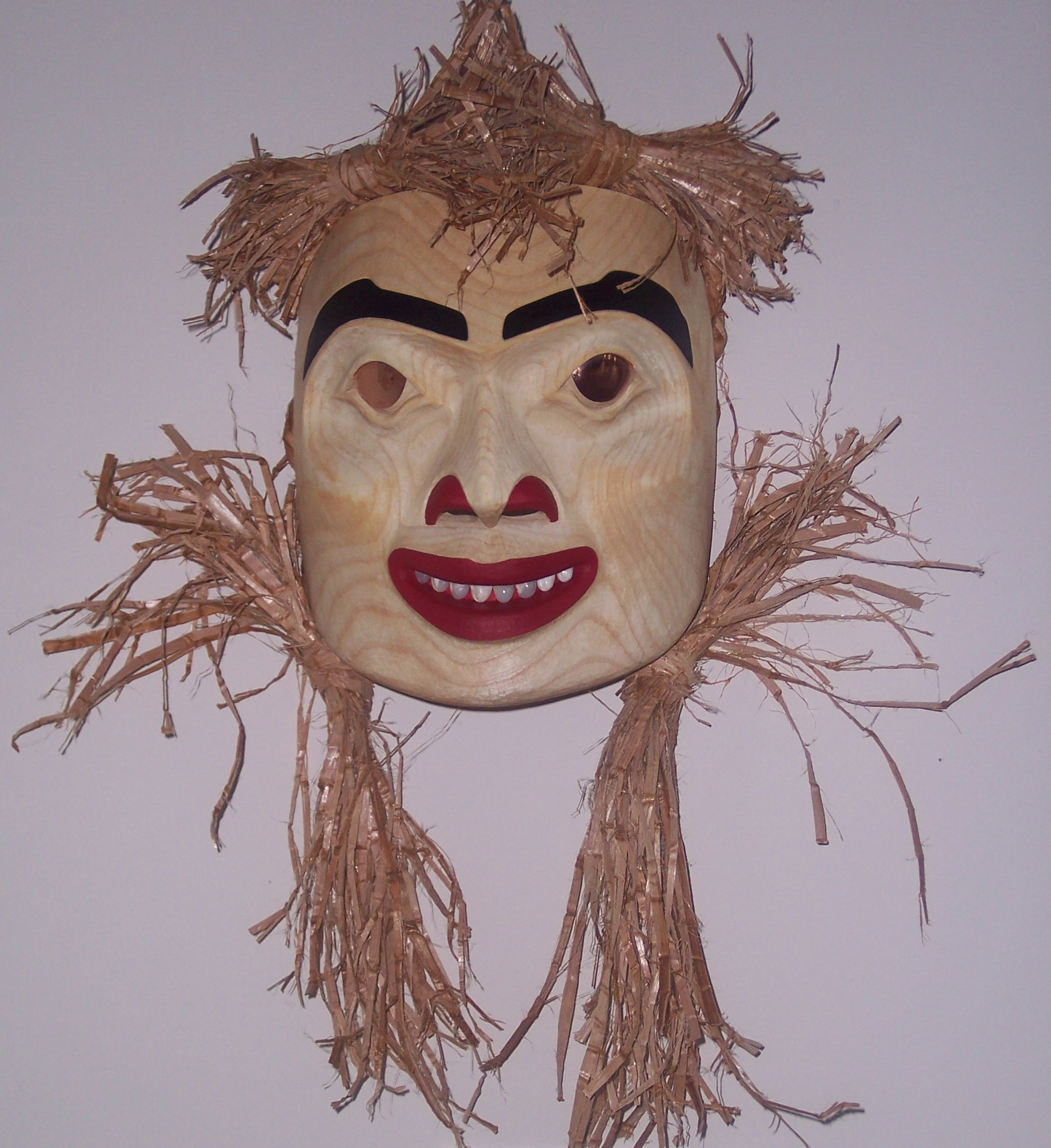
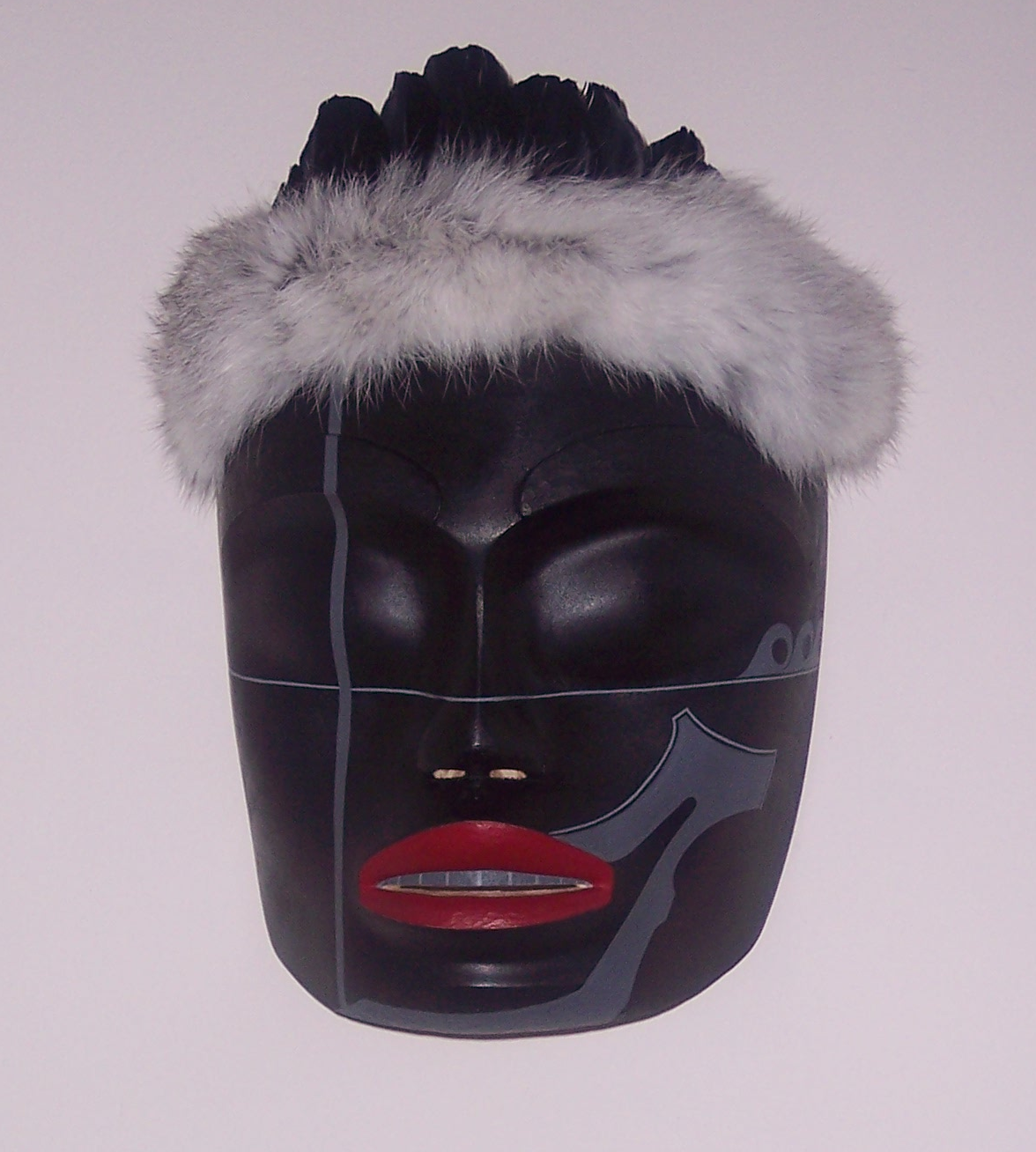
The variety was also impressive, although, when I heard that the final project for the second year students was a moon mask, I half-expected otherwise. Perhaps a lack of time prevented uniformity; when I arrived during setup on the afternoon of April 15, many of the students were yawning and taking every chance to sit, having been up late finishing their pieces for the show.

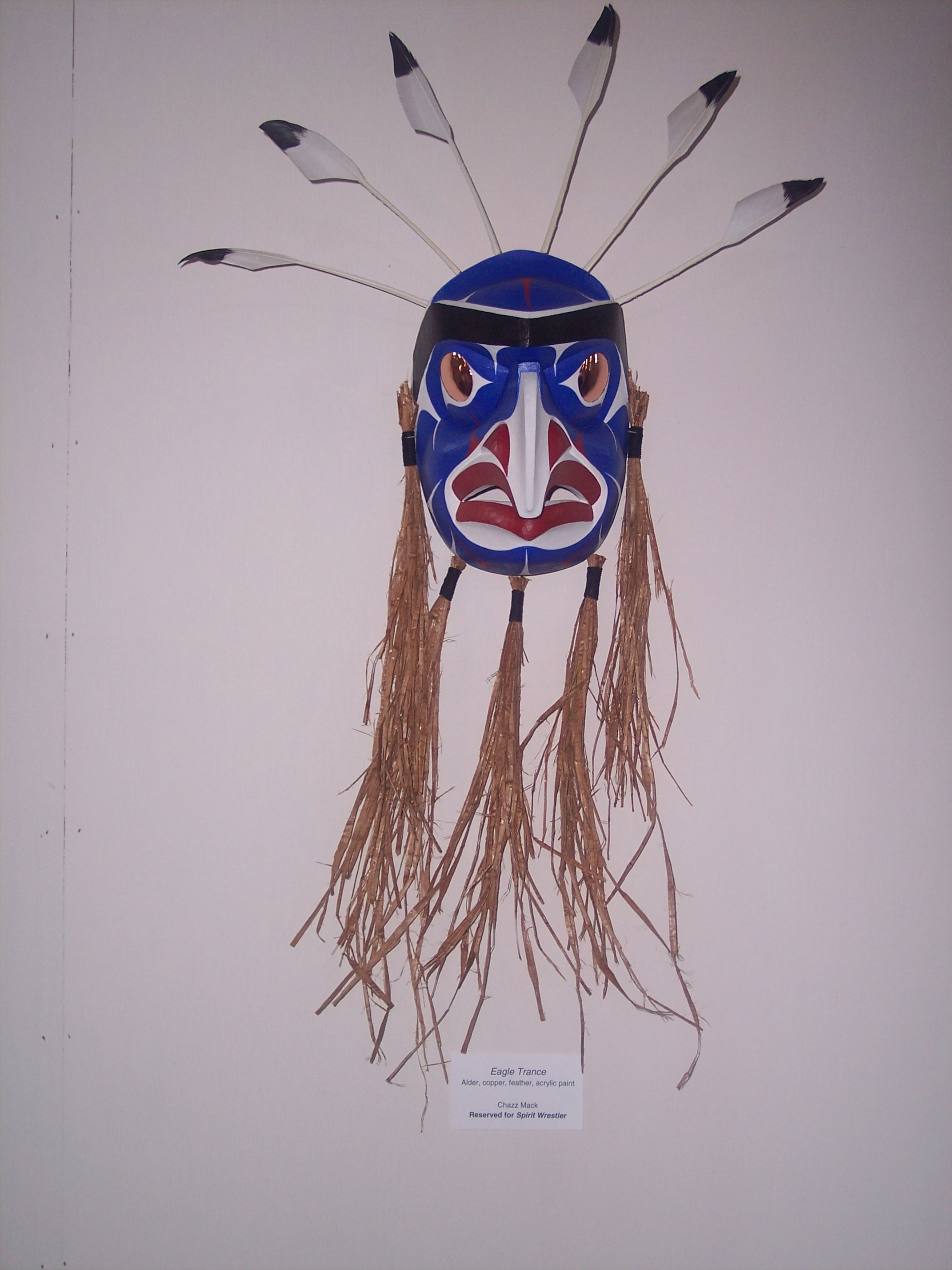
The quality of the second year students’ work was especially high, much of it equaling or surpassing the pieces seen in Vancouver galleries. Chazz Mack, who has gained a reputation for the skill seen in his two-dimensional designs in his two years at the school was forced to miss the first day of the show because of an illness that the hospital diagnosed as dehydration, but contributed “Eagle Trance,” a mask in the distinctive Nuxalk style of high head dresses, large noses and strong primary colors:

Stephanie Anderson, a winner last year of a YVR award, staggered late into setup with a striking eagle frontlet that still reeked of fixative – and was possibly the strongest piece in the show:

Another second year student, Colin Morrison, whose first mask I bought eighteen months ago, demonstrated his growing skill with two masks, “Resurrection of the Ancestors” and “Black Wolf,” a mask meant for a flat surface or stand:

Even more development was shown in the work of Carol Young Bagshaw, the winner of last years’ Mature Student Award. While last year at this time, you could tell which teachers she was working with on each of her masks, this year, she displayed her own sense of style. Her masks are less stylized than traditional northern work, looking more like portraits, and taking full advantage of the beauty of the grain and the unpainted wood:

These graduates set a high standard, but at least some of the first year students seem likely to equal them. Nathan Wilson, who has already sold professionally, produced a solid piece entitled “Moon in Human Form,” that hinted at his skill, even though it was far from his best work:

Another emerging professional in first year, Kelly Robinson, easily rivaled the second years with “Visions Within,” even though he talked of adding some finishing touches to it:

Yet another talented first year students was Paula Wesley with the fine line and unique hair of her cannibal woman “Thu-Wixia,” which she danced at the end of the opening evening:

Accompanying Wesley in the dance was Evan Aster, who won one of this years’ Honorable Mentions for the Mature Student Award. Like Wesley, Aster promises to be a strong artist when his carving equals his painting:

The same could be said of Nigel Fox, a first year student who also paints in a style reminiscent of Canadian Impressionism. Fox’s “Surface Tension” was an interesting take on colors running together in the water:

Unfortunately, though, the painting overwhelmed the carving. Fox was on much more solid ground when he created an Escher-like design out of traditional butterflies in “Butterflies #3” (which is now in my possession):

Still other first years showed a mastery of the fundamentals of traditional design that should allow them to come into their own during their second years. They included Barry Sampare, this years’ winner of the Mature Student Award:

as well as Robert Moses White, who received an Honorable Mention for the Mature Student Award:

The pick of the show moves south on May 29 to Vancouver’s Spirit Wrestler Gallery, where I predict brisk first day sales. But although Spirit Wrestler is much closer than Terrace for me, I was glad to see the complete show, especially in Waap Galts’ap, the Northwest Community College longhouse, which is a comfortable blend of traditional design and carving and modern building and safety codes.

My thanks to everyone at the college and in the Terrace First Nations art community for making my visit such a pleasant one.

Read Full Post »

Over the past weekend, I was in Terrace in northern British Columbia to attend the graduation ceremony and exhibition for the Freda Diesing School of Northwest Coast Art. I would have wrangled an invitation anyway that I could, because the art show is worth seeing, but fortunately I didn’t have to. I was invited to attend so that I could announce the Mature Student Award, and, just before I rose to spoke, a touching thing happened.

The award was started by me and my late partner, Patricia Louise Williams two years ago, after I noticed that many of the awards for First Nations carvers required that the recipient be under twenty-five. Knowing that older students give up even more than young ones when they return to school, and how much older students add to the class room, we decided that they deserved an award, too.

This year was the first time the award had been given out since my partner died and the award was listed as being in her honor. I knew, too, that Carol Young, last year’s winner, was going to give a eulogy for Trish – something I knew that I could not possibly do without becoming incoherent with tears. So I knew going into the graduation ceremony that my emotions would be running high.

Carol gave a brief speech that had me fighting to keep control. She spoke of Trish’s lifelong interest in Northwest Coast Art and of the crafts that she was always doing. She spoke, too, of Trish’s generosity, and how she used to cut the blossoms from her miniature roses and hand them out when we were on our weekend errands.

Then she announced that, in honor of Trish, each student would take a rose and hand it to someone in the audience.

That was it. I lost all hope of control and started crying. By the time Carol announced me, I could barely see for crying.

I walked slowly to the front, buying time to dredge up some composure. To say the least, I didn’t succeed very well.

Somehow, I managed to stand straight and talk slowly. Afterwards, people said I talked well, but I don’t know if they were being kind or not. I don’t even remember what I said.

But I got through somehow. I may have said that, because of money donated at Trish’s memorial service and raised through the sale of her craft supplies, that this year the award was being given to three students, two of whom were honorable mentions. I’m not sure, though. All I know for sure is that I announced the winners, and handed each a wrapped book, and faltered back towards my seat.

The ceremony ended soon after, and the crowd followed two drummers to Waap Galts’ap, the campus longhouse, which is a happy blend of a traditional Tsimshian and a modern building. There, we heard the students talk, and watched Nuxalk and Tsimshian/Salishan dancers moving around the flats and glass cases of the exhibition.

Occasionally, as the evening continued, I saw people in the crowd holding one of the roses. Usually, they were women, and often seniors, although once I heard a lover give a male student a rose, on the grounds that men rarely receive roses. That seemed especially fitting, since Trish had said something similar to me on my twenty-first birthday.

But no matter who held the rose, the sight never failed to leave a catch in my breath and tears in my eyes. Later that night, as I stared up into the dark in my hotel room, I reflected how strange it was that a gesture carried out by people who had never known Trish should be so much more moving that the memorial service held a few weeks after her death. I was not the least ashamed of crying, because I knew that Trish would have sobbed to see it, and I knew I had to cry in her place. I drifted off in melancholy satisfaction, and slept well I awoke, grateful for the gesture and wondering if it might be repeated next year.

Read Full Post »

On July 5, 2010, I was unexpectedly widowed. I’ve spent the months since then learning how to live alone. I am starting to adjust, although I dislike parts of how I live now, and probably always will. But one thing I have not accustomed myself to is the difference in how women regard me.

For me, one of the bonuses of being in an obviously happy relationship was that other women could relax around me. They trusted me not to come on to them. If I helped them, they understood that I had no agenda beyond being helpful. If I found them attractive (and, of course, sometimes I did), I wasn’t about to act upon the attraction.

What I liked about this perception of me is that it allowed me to talk to women, and to get to know them as people. Of course, I’m sure that some women entertained lingering doubts about me, and that their interactions with me were hedged with reservations. But, so far as the culture permits, as a married man I could be friends with women.

Now that I’m suddenly single, much of that is gone. Although I’m not aware of having changed my attitudes or behavior, how I’m perceived by women is suddenly changed — even by women who have known me for years. Although I’m still operating on the assumptions built up by years of marriage, I’m reclassified as single.

Being relatively young and looking younger, I am assumed to be looking for another relationship As a widower, I’m assumed to be missing regular sex. Suddenly, my speech is being scanned for innuendo, and my actions are viewed with skepticism. At best, there’s a reserve and a questioning in the women I meet that wasn’t there before.

And, just to make matters worse, my awareness of that reserve makes me more nervous, which makes many women more nervous still, creating a vicious cycle that I don’t know how to break.

The irony is, I am far from sure that I want another relationship. I can’t say that I would turn one down, or that I don’t have excruciating bouts of loneliness, but the possibility barely registers with me. I’m still recovering from the last one, thank you very much, and I’m not sure which would be worse: being widowed a second time, or leaving someone I loved to survive my death.

I can’t help thinking, too, of how Raymond Chandler and George Orwell made fools of themselves after their wives died, begging every women they met to marry them. Orwell even went so far as to suggest that any woman who married him would soon end up a wealthy widow with control over his writings, a piece of bribery that strikes me as both gauche and as being at odds with the upright image he affected in his writing. I would hate to be a figure that attracted similar ridicule and disdain. Chandler and Orwell sounded so desperate.

But the main reason that I contemplate staying single is that I never did care much for the mating game. The ritual has changed since I was last single, but for all the loosening of outdated tradition, it still seems to degrade men and women alike. I mean, no wonder there are so many breakups and divorces: the game is so stylized that you have practically no chance of getting to know a lover or a spouse until after you’ve moved in together.

True, I was lucky once. But the odds of repeating that luck seem slight. And why should I settle for second best? The thought of looking for another relationship seems so tiresome to me that it’s hardly worth the effort.

Right now, all I really want is friends with whom I can talk, regardless of whether they are male or female. A cause or two to distract me wouldn’t hurt, either.

But the frustrating part is that there is no way to communicate this attitude to the women I meet. If I tried to express my attitude, it would either seem too personal too soon, or else some roundabout strategy in the mating game. There are no rules in the rituals of male and female for declaring that you are not playing, and no way to protest your classification.

So the fact remains: against my wishes, I am suddenly a single man. And every woman knows what a single man wants, right?

Read Full Post »

After months of wondering, now I can finally say: It turns out I’m a tidy person after all.

Probably, it seems strange that a middle-aged person wouldn’t know such a fact about themselves, so let me explain:

My late partner Trish was in many ways an exemplary person, more generous and loyal than anyone else I’ve ever known. But even those who loved her would not say that she numbered tidiness among her virtues. Although she kept herself and her clothes clean, she reacted early and strongly against her mother’s obsessive housekeeping. In her adult life, she was infamous for being able to create clutter around her within minutes of sitting down in a spot –even if she was in someone else’s home. It didn’t help, either, that she was always buying craft supplies against a possible future project.

I never cared much for the resulting clutter, although I didn’t object that much, either. I always kept tidy the areas of the townhouse that I frequented, like the computer workstation, as well as the kitchen and bathroom, but despite some vague threats, I never tried to tidy Trish’s storage areas. Anybody who has been in a long term relationship will understand why – there are some things that you just don’t do if want the relationship to stay happy.

Then, in the last couple of years as she became progressively weaker, even I had better things to do than tidy, like spending time with her.

But, one way or the other, I was so busy accommodating Trish’s preferences that I lost sight of my own. Although one of the first things I did in the months after her death, just to keep busy, was to tidy her things and give many of them to wherever they would do most good, I wasn’t sure how long the vistas of empty tables and the expanses of carpet that my efforts created would stay. Maybe, my efforts would be like weeding, and gradually I would slip into sloppier ways living by myself.

To my surprise, the tidiness has continued. It’s not that I’m obsessive about keeping the clutter down, or go to bed with discomfort gnawing at the back of my mind if something is out of place. It’s more that having worked so hard over so many weeks to make sure that every book had a place on the shelf and that drawers were free for random objects, I’d rather keep the townhouse in the same state. Besides, taking twenty seconds to put something away when I’ve finished with it is far less objectionable to me than tidying once a week or month in a massive effort that makes me feel that I’ve lost a day to drudgery.

Anyway, when you’re the only one in the house, you know that if you don’t do something, no one else will (not that Trish ever did much tidying, even when she was healthy). When the effort is up to you, you might as well act now than later.

So, apparently, I’m a tidy person after all. I might have guessed by the home directories on all my computers, which are so well organized that I almost never have to do an automated search for the files I need.

But like I said, what a strange thing to learn about myself at my age.

Read Full Post »

I’ve been interested in Mike Dangeli’s work since I saw his ridicule mask in the Continuum show at the Bill Reid Gallery. The idea of taking a traditional form of commentary and applying it to modern relations between the First Nations and industrial culture seemed far wittier – and ultimately, more meaningful – than the other post-modern statements in the show. Later, when I heard Dangeli lecture about his efforts to live his culture in a modern context, I became even more interested. But it was only in October 2010 that I got around to commissioning a piece from him.

Whenever I commission work from an artist, I like to suggest only broad guidelines, and encourage the artist to experiment and maybe do something they wouldn’t ordinarily do. Accordingly, I told Dangeli that the painting was to be in honor of my late partner Trish Williams – the second piece I had commissioned in her memory – and could have up to four raised canvases. We discussed the primary colors, and I left him the pamphlet from her memorial service and some of the feathers I had collected over the years from our parrots. Remembering, too, Mike’s association of the north wind as a messenger between this world and the creator that might appear at a funeral, I also suggested that the north wind might be part of the design.

When I came to pick up the painting three months later, it had grown in its creation, with two side panels added to give room for Dangeli’s design.

The central panel of “Honoring Her Spirit” depicts Trish in raven form, with me represented by the red face on her wing. Around her are four ravens, for the four nanday parrots in our household during her lifetime, their bodies painted in the colors of nandays.

To the right, is a panel showing the north wind in the spirit realm. Where the central panel is made of definite lines in a more or less traditional formline design, the north wind is painted with thinner and less definite lines, its breath curling in non-traditional designs. The implication seems to be that we can only see hints of the spirit world – that nothing in it is as definite to our senses as the world around us.

On the four raised canvases, the birds sit poised between the two worlds, which suggests that they are part of both, or can move between them. The red lines on the raised canvases are roughly reminiscent of traditional northern designs, and spill over into the central panel, as the feathers do, both perhaps suggesting the interconnections between the two worlds.

However, the north wind is also blowing into the central panel, suggesting the coming of death. Trish’s transition into death is shown on the left hand panel, where her image is mirrored imperfectly, simplified and disjointed and drained of color to reflect our imperfect understanding of what happens after life.

This is a simple but powerful idea, ingeniously strengthened by the different styles in the panels. Yet what is eerie is that, although Dangeli did not know while he was painting, one of our four parrots died before he completed the paining – and only one of the birds is looking into the other world. The other three, who are still alive, are facing towards the everyday world. And if that is not enough, the feathers at the top center are from the dead parrot, although Dangeli no doubt picked them out at random. Whether these touches are serendipity or an example of the heightened perceptions of an artist, I won’t say, but they do add to the already highly personalized subject matter.

The painting now hangs in my bedroom, below two examples of Trish’s needlework. That seemed the most appropriate place for it.

Read Full Post »

Wanting to feel useful, today I tackled a task I’ve been putting off: cleaning up the plant pots from the courtyard outside my door. I imagined that I shirked the task because it would be dirty and exhausting, but I had barely begun before I understood that the real reason was I didn’t want to face the memories that lay in wait for me.

Except for the laurel, none of the several dozen pots had been planted by me. It was the sole survivor of three that Trish and I had bought years ago when the strata council had chopped down the fir that shaded our balcony. The others had quickly died, and this one had been moved to the courtyard when our deck was last rebuilt, only to die in last summer’s heat wave when I was too distracted to notice. Our parrots Ning and Sophy had enjoyed having it against the outside of the living room window, since it gave them a hidden place from which to peer out at the world.

The rest were the remnants of miniature roses and one or two efforts at growing mint and other herbs. I had never had a hand in those. They were Trish’s, and among some people she was as well-known for her roses as for always carrying a craft project with her.

Before the carcinoids took hold, an hour or two in the evening or weekends was a part of her life. She was proud of them, having never had much success with gardening before, and she kept her notes about them in a leather-bound book stamped with Celtic knotwork designs. She enjoyed, too, going to the monthly meeting of the local rose society, and she delighted in the names of each rose: Pandemonium, Golden Amber, Black Jade, Pinwheel, and all the rest.

But the real point of growing the roses was distributing the blossoms, few of which were over three centimeters in diameter. Regardless of whether she was going to her job, or we were going shopping at Westminster Quay, the parrot shop, or a bookstore, her departure was always delayed by her snipping the latest blossoms. At summer’s height, she would soak paper towels and carefully wrap the blossoms to preserve them. When she got to wherever she was going, she would hand them out, to the delight and occasional puzzlement of the recipients.

I suppose you could rationalize the distribution of the blossoms by the fact that Trish had several dozen plants, and, when they were blossoming, we hardly had room in our townhouse for more than a few blossoms. But, although we never talked about why she went to such efforts, I knew that she enjoyed offering the small gifts that she had produced to those she saw regularly.

Once, a cashier snootily refused them, and we never shopped at that bakery again. For my part, I was furious that such an innocent and pleasant gesture should be met with hostility. Most people were pleased by the gesture in the middle of their workday, and some came to look forward to it so much that they were visibly disappointed if Trish had run out of blossoms or the plants weren’t producing that day. To some distant acquaintances at Westminster Quay, she was simply the Rose Lady.

But as Trish sickened, she had less energy for roses. One by one, their numbers feel due to frost or disease, and, increasingly, the losses were not replaced. When she could, she still enjoyed tending them and distributing the blossoms, but, with each year she had less energy for anything so active. Nor did she want my help; the roses were her activity, and, not being a gardener and increasingly worried myself, I did not offer help as often as I could.

Two years ago, her health was poor enough that she hardly had time to fertilize the roses, let alone prune or keep them free of disease. Last year, as she struggled with pneumonia and slowly died, she had no time for them at all.

Today, I found that only three rose bushes survived, and one of them will need some concentrated attention to thrive again. But I decided that, despite my lack of gardening skills, I will do my best to keep them alive. The effort is a way I can continue to connect to a time that, nine months later, already seems so fabulous and distant that sometimes I wonder if it existed at all.

Read Full Post »

In an era when many women hesitate to call themselves feminists, I consider myself a male one. This self-identification is not always easy. On the one hand, some women believe that a man can never be a feminist, and only makes the claim in the hopes of getting laid. On the other hand, many men ridicule the claim as proof of effeminacy or homosexuality, and while I haven’t been called a traitor to my gender in so many words, I have been called a “neutered male” and worse.

Fortunately, I am more inclined to laugh at both these extremes than be insulted, because, as I usually tell people who ask why I take this position, I suspect I have little choice in the matter. If I weren’t a feminist, then I simply wouldn’t be me. I certainly couldn’t live with myself.

If I were feeling flippant, I’d say that I call myself a feminist because that’s what I am. In the simplest terms, a feminist is anyone who believes in the equality of men and women. Since that is what I believe, what else would I call myself?

However, when people ask me why I call myself a feminist, they’re usually not looking for taxonomy. What they really mean is: what makes me a feminist, anyway?

One reason, I suspect, is that I have always quicker to see similarities rather differences, and patterns and continuities rather than chaos and separation. I am not unaware of the biological and social differences between men and women (I am, in that sense, a healthy heterosexual), but except in matters of sex, gestation, and lactation, they mean little to me.

With this perspective, I never got the habit of thinking of men and women as separate species. As I have observed before, gender is not a large part of my self-identity, so I am always surprised to find a man or a woman for whom it is.

More – I remain unconvinced by studies that claim innate gender differences. I consider most of them poorly designed efforts to prove the researchers’ own prejudices. Admittedly, men and women are socialized differently, but watch them talking and thinking about important matters, as I did as a university instructor, and these differences disappear. Or, at the very least, they become no greater than those between individuals of the same gender, or people from different cultures. So, to me, the idea that men and women have the same range of intelligence and talent requires no great feat of imagination. Based on what I notice, the idea seems merely self-evident.

Another psychological reason for my feminism is that, having started life with a speech impediment that caused many people to denigrate me, I have an instinctive sympathy for anyone who is too quickly dismissed by society. And when such a person attempts self-assertion, my sympathy only increases. The frustration of not being taken seriously, the anger at being held back, the mixture of self-despair and determination to prove your judges wrong – few of the attitudes expressed by feminists are completely foreign to me, and I could not ignore their positions without denying some essential parts of me as well.

Still another reason that I call myself a feminist is that I am a clumsy liar, both to myself and others. My sense of self depends strongly on me being the sort of person who faces facts – even unpleasant ones – and I would be ashamed to pretend that the inequality of women didn’t exist for no better reason than my own convenience.

True, I may not always see an observation first for myself. Yet when someone points out (for example), that my life has probably been shaped by male privilege as much as my own abilities, I have admit that they have a point. Although I squirm, evading the obvious would only make me ashamed.

That same interest in truth also leads me to want my life to be based on something solid. If my sense of self-worth were based – like many men’s’ – on a sense of superiority to women (or anyone else), part of me would know how meaningless it was. It would be like mistaking a job title or empty praise and an award for actual accomplishment. Instead of clinging to such a fragile sense of self-worth and being afraid of womens’ equality, I would rather cultivate a generosity of spirit and support it. To be perfectly selfish about it, I know that the only way that I can be confident of my own self-worth is if I support the right of other people to assert theirs as well.

At any rate, even if I were not temperamentally inclined to be a feminist, do you realize how much feminism has done for modern culture? My own chief field of literature has been transformed in the last thirty years because of feminism. Its re-examination of the past alone would make it worthwhile. Without feminist scholars, Aphra Behn would be less than a footnote, and Ann Radcliffe barely a name. Only two of the Bronte sisters would be known, and each of them for one book apiece. Elizabeth Barrett Browning would be the writer of a handful of conventionally soppy sonnets, and Christina Rossetti dismissed as a quaint writer of children’s doggerel. Or so I would have been told, and without feminism I would have happened on the truth inconsistently, and probably missed it sometimes altogether.

Thanks to feminism, dead branches of the past have flowered unexpectedly, and literature is enriched – no, better than it used to be. And you can make a similar list for all the arts and many of the sciences. These changes are so far-reaching that, even if I disagreed with the criticisms or aims of the many branches of feminism, I’d still be grateful for the broader artistic and scientific perspective it offers.

Really, how can people keep asking why I am a feminist? Under the circumstances, what else could I be?

Read Full Post »

Once every decade or two, something I am into becomes popular. The situation is rare enough that I am still recovering from my chagrin when the local TV news used The Pogues’ “Fairy Tale of New York” as background music to an account of a dinner for the homeless a decade ago and from everyone knowing the plot of The Lord of the Rings when the movies were released. But by far my most frequent moments of unintentional trendiness and the resulting breakup of my routine revolve around exercise.

Since I’m built like a cement mixer, you might not realize by looking at me, but I have been a regular exerciser all my teen and adult years. Any day in which I don’t burn a minimum of seven hundred calories running, swimming, or cycling, I count as a slack day. I’m the sort you see doggedly jogging in a snow storm, or being unfashionably sweaty at one end of the gym. I consider exercise a necessary balance to all my hours at the keyboard, and a form of meditation besides. Unlike many people, I like exercise, and the heavier the better.

The trouble is, people are always discovering exercise. That means that the shoes I need periodically sprout velcro buckles and thick tread more suitable for a tank, or blossom in outlandish colors – anything so that their prices can double. Functional sweat tops disappear, replaced by tailored suits made of synthetic fibers that cause me to break out in a rash, and the gyms are always crowded in the first few weeks of January until the newcomers find the courage to break their New Year’s resolutions (much to everybody’s relief).

All this is superfluously annoying when all I want is ankle and arch support in my shoes, natural fabric, logo-free gear and a quiet place to sweat. But, this time, the fashionistas have gone too far. Noticing the popularity of basketball among males under twenty five, the sports stores have decided that all they need to carry for any sort of exercise is basketball shorts – baggy shorts that fall to the knees, and that generally amount to free advertising for an American team.

The least of my problems with the stores only selling basketball shorts is that I look ridiculous in them. Most of my height is in my torso, and I’m considerably below two meters tall. Wearing basketball shorts, I only look like a kid who’s growing too quickly for the length of his trousers. That’s how I feel, too.

But what I really object to is that basketball shorts are completely unsuited to strenuous exercise (and, for all I know, that includes basketball). They might be barely tolerable for the genteel weight-lifting that most of the men at the gym do, in which ten reps are followed by twenty minutes of conversation. But on the pavement or on the saddle of a bike, nothing is more unsuitable.

When I’m working up a sweat, I want my legs as unencumbered as possible. I don’t want them tangling in folds of loose fabric that bind them and prevent them moving freely. That is almost as bad as wearing sweat pants while doing strenuous exercise.

Yet because of the whims of fashion, a day is fast approaching when I won’t have the simple clothes I need to continue doing what I’ve done for decades. Within a few months, unless I abandon exercising altogether, I’ll be forced to choose between three unsatisfactory alternatives: wearing what’s easily available and feeling confined and uncomfortable; shortening a pair of shorts with one of my unsatisfactory hemming jobs (assuming that the synthetic fabric allows me to do that), or else ordering pairs of rugby shorts online and enduring the chafing of the thick material.

Probably, I’ll end up ordering the rugby shorts. But I resent having to make the extra effort simply because trendiness has touched down like a tornado in an area that I happen to frequent. My best hope is that it will move on before my present crop of shorts falls apart, and I can go back to being unfashionable for another ten years.

Read Full Post »

I first became aware of Calvin Morberg’s work through a shark mask he sold to the Inuit Gallery. I was too late to buy it, but I did catch a glimpse of it. Although the finishing was a little rough, I was impressed by the originality of the design, and decided to keep an eye on his work. I tracked him down on Facebook, and, a couple of months later, I bought this eagle frontlet from him.

With its red background, abalone and harbour seal whiskers, in many ways, the frontlet is a typical Tlingit design. The general design is one that I have always admired for its boldness and embellishment – two traits that seem more common in Tlingit work than in any of the other northern First Nations. Tlingit work, I have always thought, has a touch of exoticness missing in Haida or Tsimshian or Nisga’a work, which I like to think helps to explain the traditional Tlingit reputation for being shamans. But, regardless of whether that is true or not, Morberg has carved a striking version of a common general form.

True, like the shark mask, this frontlet has a rough touch or two. In particular, the abalone is not well-matched, and, if you look closely, you can see the drilled hole in each piece that suggests Morberg has bought what was convenient – and not what best suited the piece.

However, these are minor flaws. As in all the other frontlets of this general design that I have seen, they are part of the background. What draws the eye is the central figure, and there Morberg shows his skill.

The central figure offers a set of planes consisting of the lower and top beak and the nares, all at contrasting and complementary angles, drawing the eye down to the wing feather tips at the bottom. From the bottom, the wing tips draw the eye back to the painted lower half, circling the design there until the inverted T-shapes at the top draws the eye back up to the eyes, and finally back to the beak via the eyebrows so that the process begins again. This is exactly what successful formline should do – trapping the eye, and keeping it moving around the entire shape. In fact, in moving about the central figure, you soon stop to notice the rest of the frontlet.

Nor is there any roughness to the finishing that would distract the eye in its progress. If the abalone provides a rough surface, the central figure provides a smooth one without sharp edges, and together they create a contrast as obvious at a glance as at a touch.

Another part of the central figure that I appreciate is the painting. To start with, Morberg has taken the unusual step of adding paint to the lower half; in several other eagle frontlets that I have seen, this area is usually occupied entirely by carved wings.

But even more interesting is the pale copper green, which seems to be a hallmark of Morberg’s work just now. Given the red background, he could hardly use red as the secondary color, and the green is an ideal choice, because it complements some of the shades in the abalone.

Also, of course, for those in the know, the color is a reminder that copper was a measure of wealth on the coast – a reminder that is especially fitting since frontlets are an indication of chieftainship, or at least high rank.

I don’t know where Morberg’s developing talent will go next. However, because of pieces like this eagle frontlet, I expect to hear more of him in years to come. I wouldn’t be the least surprised if, sooner or later, I buy other pieces from him.

Read Full Post »

« Newer Posts - Older Posts »