Feeds:
Posts
Comments

Archive for the ‘Personal’ Category

Several times in the last few months, I’ve closed discussion on one of my blogs. Each time, some people have howled in outrage. Their anger makes them nearly inarticulate, but their position is apparently that I have no right to stop discussion. I am an enemy of free speech, they proclaim, a censor and cowardly, and downright evil as well.

I don’t see that, myself.

For one thing, free speech is not an absolute right, even if you believe that it should be. It is limited by laws against libel, hate-crimes, and terrorism, among others. Nor can you invoke free speech as a defense against mischief.

Admittedly, violations of these laws appear dozens of time each day on the Internet, and most of them are not prosecuted unless someone complains. Even in 2010, the Internet retains more of a frontier unruliness than other forms of media. But the point is that idea that free speech is unlimited is disproved with a moment’s thought.

Moreover, in each of these cases, some of these limits seemed to apply. Whether they actually would have been grounds for legal actions, I can’t say, of course. However, I think that erring on the side of caution is reasonable, especially since at least one determined commenter seems to have been required to close down his own blog.

At any rate, I have no desire to be involved, however indirectly, in a court action. And, in the case of one blog, I would be irresponsible if I exposed the company that owns the site to litigation. These motivations are not a matter of courage so much as caution. If I am going to be dragged into a legal action, it is going to be for something worth fighting for, and not because I provided a forum for the indiscreet and feckless.

However, my strongest motivation was that I simply lacked the time to either police my blog every half hour or to enter into discussions that were unfolding in which, so far as I can see, there was little to distinguish one set of claims from another.

I have been writing about free and open source software for five years now, and I have gained a limited amount of recognition. That recognition is not on the scale of a Linus Torvalds’ or a Richard Stallmans’, but it does mean that I get a lot of email and other contacts – so much that I can only answer some of it if I hope to get any writing done. Unless I am contacted by a friend or an unusually interesting stranger, I generally try to limit an exchange to a couple of communications.

I don’t always follow this rule strictly, but when someone is repetitive, abusive, and fails to address what I have to say, I am sure to apply it. By nature, I am easy-going and love to talk, but trying to hold a discussion with such people leaves a deadening feeling of futility. They are not going to sway me by bludgeoning tactics, and all too clearly, I am not going to convince them in a discussion. So why should I waste my time? A couple of exchanges is enough for them to have a say, and for me to know the type of people with whom I am dealing.

In other words, I choose to focus on the people who are interesting to have in a discussion, and/or can teach me something. So far as I’m concerned, declining to spend much time on the obsessive is not censorship, any more than refusing to publish bad writers in an anthology you are editing is censorship. It’s selection, plain and simple. i am hardly the only person I know who has to resort to this kind of selection in order to do what’s important to them, either.

Nor can I navigate the rights and wrongs of the feud that, in a couple of cases, is the reason for me shutting down comments. Both sides accuse the other of criminal behavior, and both sides claim to present evidence. However, all I can tell for sure is that I don’t want to be involved. Being hectored, abused, and threatened two or three times a day makes me even less likely to want to get involved; attempts to intimidate only make me stubborn, and, when people act like spammers, I treat them like spammers.

At any rate, to talk about censorship on the Internet is more of a rhetorical flourish than a reference to reality. If I refuse to post someone’s comments, that’s two out of – what? Several billion sites? If a commenter can’t find a place to publish what I won’t, they aren’t trying.

Under all these circumstances, you’ll excuse me if I find myself unmoved by the accusations when I close comments. I don’t do so quickly or easily, because I value freedom of expression myself. But I do so to create a space to work, and so I can focus on what’s important.

The peace of mind that results tells me, more than anything else, that I am doing the right thing.

Read Full Post »

“It’s not personal. I’m just saying what needs to be said.”

In the last few months, I’ve been hearing this statement frequently, or at least variations on it: Twice from people who are trying to jump start their own journalism careers by attacking me, and more recently from both sides of various online vendettas. And every time I hear it, I’m curious about how the people involved can say it.

Not, you understand, that I believe such comments for a second. When people focus on someone and attack them obsessively, claims that the attacks are impersonal quickly become unbelievable. Ditto for viciousness that is out of all proportion to the overt subject matter. A couple of people making this claim even made it immediately after explaining why the situation was personal, apparently never noticing the contradiction.

However, I do wonder why they even try to make a claim that so obviously fails to fit easily available evidence.

The most convenient answer would be that they are deliberately lying. Yet I hesitate to accept it, because to do so feels like evoking an explanatory principle to stop the discussion – like saying that opium puts people to sleep because it contains a dormitive principle. All you are really saying is that they are lying because they are lying. And my impression is that none of the people who make the claim are consciously lying.

Or, possibly, some of them are lying to themselves first, convincing themselves of the righteousness of their position before persuading anyone else. This tactic would allow them to make the claim of impersonality with utter conviction. At the same time, lying to themselves would let them ignore any evidence in their own behavior or words that contradicts the claim.

In other cases, denying personal motivations seems like a deliberate effort to elevate their words and actions. After all, in our culture, impersonal motivations are considered the only ones to legitimately act upon. Even in this post-modern age of doubts, to claim objectivity is also to covertly claim the highest of motives – to claim nothing less than you are acting like a scientist, that modern icon of impersonal reasoning.

By contrast, admit that you are attacking someone because you are jealous or because they made a comment that hit too close to home for you, and you might as well admit that your argument lacks validity. The first admission will be automatically equated with the second. Far better to claim a dedication to truth, or at least to disinterested criticism than to acknowledge that grubby bits of spite might be powering our actions.

Also, of course, if you stake the first claim of objectivity, you exclude your opponent from making a similar claim, casting them into the nether darkness of subjectivity, and all the evils that lurk within it.

Yet, even while I make this supposition, I wonder how such a claim can be sustained. I don’t know about anyone else, but when I try to make such a claim (and most of us do, at some time or the other), I am distracted by nagging doubts just beneath the level of consciousness. I start to notice that my actions and words are odds with the claim, and the claim soon collapses. Increasingly as I age, I find it mentally easier not to make such claims and suffer the embarrassment (if only privately) of backing down or continuing to assert what I no longer believe.

Could that explain the viciousness that often accompanies the claim? Could its makers be sensing the instability of their claim, and, instead of abandoning it, defending it as hard as they can? Are they, in fact, in denial?

I hope so, because otherwise I will have to admit that I don’t know people at all (a distinct possibility, I admit). All I really know for sure is that, when someone says that their behavior isn’t personal, you can be confident that it is not only personal, but deeply so.

Read Full Post »

I first crossed paths with John Paul Wilson a year ago. Another artist wanted to send me pictures, and John agreed to take and send them. Since then, we have been in touch once or twice a week, and I have enjoyed watching his art move from promising to a first maturity. It is hardly surprising, then, that “Summer Moon Maskette” was under our Christmas tree this year.

The moon is a popular subject in Northwest Coast art. So far as I know, the moon is nobody’s crest, so the question of having permission to use it never arises. Perhaps just as importantly, it is a subject that requires no special knowledge of mythology to appreciate. Wilson himself describes the moon as one of his favorite subjects, and, if you look at his Flickr site, you can see several different ways that he has approached it.

What makes “Summer Moon Maskette” stand out is its simplicity. It has no complicated design, and no red, the second most important color in the northern style. Even the black paint is applied sparingly, being confined to the mouth, nostrils, and eyebrows, and not to the pupils.

This simplicity means that the piece’s carving stands out more than usual. Wilson has responded to this situation by carving with more realism than usual. He has shaped the mouth more, and made the nose fuller than usual on the sides. He has also given close attention to the cheekbones and the area where the nose, eyes, and eyebrows meet.

However, what really makes “Summer Moon Maskette” stand out is the eyes. Slanted, with an inner fold and no pupils, they are very different from most eyes in the northern style – so much so that I almost wonder if they are a portrait. They seem to be closed, suggesting a sleepiness that is appropriate to a hot summer night.

Another result of the simplicity is that, after the paint, most of what catches your eyes is the grain. Wilson has always excelled in sanding the grain until it conforms with the contours of his carving, but “Summer Moon Maskette” is an especially fine example of this practice. For example, if you look, you can see how the grain conforms to the line of the cheekbones and the forehead, or the hollow beneath the eyes. The effect is almost hypnotic in itself, relieved only by a small imperfection which is confined to the chin – and which is also a relief after your eye has been following the apparently billowing lines of the grain.

This simplicity is an indication of how far Wilson has advanced in his art. A less experienced artist would be tempted to tart up the mask with abalone or copper. By contrast, Wilson lets the maskette speak for itself, which makes it all the more powerful. That is a risky approach, but the fact Wilson succeeds is a measure of his advancing skill and confidence.

Read Full Post »

When the news came that Vancouver would be hosting the 2010 Winter Olympics, I was jogging down from the Stadium-Chinatown Skytrain station to the Yaletown office where I was working. I didn’t hear the announcement, but I heard a cheer go up from the offices on all sounds of me.

Personally, I was surprised. At that point, I had no strong feelings about the Olympics one way or the other. But I had thought that the logistical problems of keeping people moving along the road between Vancouver and Whistler would prevent the bid from being successful. Even more importantly, my own contact with the bid committee hadn’t impressed me much.

About six months earlier, I had applied for a job as a writer on the bid. It wasn’t a position that strongly interested me, but I thought it worth a hour or two of my time to satisfy my curiosity. So, I duly strapped myself into my interview suit, stripped any obvious signs of eccentricity from my person, and presented myself at the Gastown office of the bid committee.

I was interviewed by two women who I quickly classified as marketing and communication workers. That isn’t prejudice; I’ve done similar work myself, after all. But, after a while, you get to know the signs. The two women talked in generalities, and displayed an artificial optimism and enthusiasm at all times. Somehow, I couldn’t imagine them taking part in a casual Friday.

Mostly, the conversation went well enough, so far as conversations during a job interview can ever be said to go well. But when I asked about how the logistical problems might be overcome, the women’s reply boiled down to, “Somehow, everything will work out..” I could also see that, in their minds (and probably on their clipboards), I had set a black mark against my name. That was all right; their replies had cost them points with me, too.

However, two other points were what really disturbed me. First, they said that working on the bid committee would be no guarantee of a continued job if the bid was successful. Since I was sure that the leaders of the committee would land jobs in Vanoc, that seems a lack of loyalty to staff members.

Secondly, as part of the interview, they asked me to go home and write seven or eight pages on how I would promote the Olympics. That is a considerable effort to ask someone to do on spec. Combined with the lack of a guarantee of continuation, I concluded that the request showed a cavalier attitude towards employees. I thought for a couple of days, then phoned the interviewers to say that I would not be responding to their request and that the job no longer interested me.

I have no idea whether those particular women found work with Vanoc. I no longer even remember their names. But it seems to me that their attitudes are echoed in everything I’ve heard from Vanoc ever since, from the feeling that problems would work themselves out to the assumption that local residents will put their lives on hold for the duration of the games next month.

It is not an echo that promotes happy thoughts about how the games will be organized and what the after-effects will be. Frankly, it has kept me from supporting the games ever since. I might talk about the financial and social costs, but behind them is an emotional core of distrust based on this one brief encounter.

This attitude puzzles people from outside the Vancouver area. When I was in Calgary last spring, people were surprised by my lack of enthusiasm. Remembering the Calgary games twenty years and the very different social attitudes in which they took place, everyone assumed that I must be looking forward to the occasion. They were surprised by my lack of enthusiasm, even when I explained my reasons. I’m not sure they ever did understand.

However, I don’t think my attitude is unique in anything other than its origins. No doubt it’s the company I keep, but I’ve found that only one in four – or thereabouts – actually supports the upcoming games. The intial cheering at the news of the bid just doesn’t seem to have lasted.

In fact, I’ve only found one person who defended the games with any passion, and her criticisms were bizarre – she argued that nobody who objected or even questioned the games should use the newly improved highway to Whistler (never mind that she also insisted on the official line that such improvements were not part of the costs of the games). But of eight or nine people in the store, nobody felt like taking her side in the discussion.

Maybe more people will show enthusiasm as the games approach, but, I don’t expect that most people will. The average person in the Vancouver region seems resigned to the games, largely indifferent and if anything mildly hostile, although you wouldn’t know that from the media.

You might say that, for most of us, 2010 will be divided into two parts: enduring the preparations and the games themselves, and the rest of the year. And, like most people, I find myself looking forward to the rest of the year far more than the preparations and the games. If I became dubious earlier than others, it is because I was exposed to the spirit of the games earlier than others.

Read Full Post »

A couple of months ago, Haisla artist John Wilson told me about a promising first year student at the Freda Diesing School named Colin Morrison. After seeing some minor pieces by him, I commissioned a painting. It turned out to be his first professional sale.

I am absolutely confident that it won’t be his last – and not just because I would like to boast ten years from now that I had the foresight to see his potential before he became well-known. “The Spirit of the Wolf” is an accomplished piece that illustrates Morrison’s potential better than anything I can say. It is all the more remarkable because it comes from a man in his mid-twenties.

On the surface, “The Spirit of the Wolf” is a traditional piece, reminiscent of Roy Henry Vickers’ work. It shows a strong interest in style, with a variety of ovoids and U-shapes used throughout and a variety of tactics used to control the thickness and joints of the formlines. The sheer number of tactics could easily result in a mishmash, but Morrison controls it by having shapes mirror and contrast each other in disciplined way. The mirroring is especially obvious when the primary and secondary formlines are adjacent to one another.

At the same time, you do not have to look very long before you realize that “The Spirit of the Wolf” has a playfulness that suggests a very contemporary outlook as well. The design is basically a play on the various interpretations of the title, with wolves spread throughout the design – everything from the physical wolf to the Wolf as a clan crest. This dichotomy is suggested by the vaguely yin-yang shape of the overall design.

There is even, Morrison says, several spirits in the metallic paint of the design. So far, I have to admit, I have been unable to detect what kind of spirits they might be, or if anything specific is intended, but I find the idea immensely appealing all the same.

You could even go one step further and say that, since Morrison himself is a member of the Tsimshian Wolf Clan, that the painting itself is a manifestation of a wolf’s spirit.

You might call the painting a kind of Northwest Coast “Where’s Waldo?” If you wanted to say the same thing more seriously, you could say that the content is as inventive as the style.

Asked to say something about himself, Morrison replied, “I’m Tsimshian, Ginadoiks tribe, Wolf Clan. I’ve been an artist since I was young; I started painting when I was 18, and didn’t take it seriously till I was 23 years old. I’ve been painting off and on since that time, trying to figure out what I was going to do with my life.

“Then, one day last year, my Mom started going to a carving class in school. She wanted me to go and dragged me there. I started painting again, and liked what I was doing. My instructor (Harvy Ressel) saw the raw talent and asked me if I wanted to go to the Freda Diesing School. I said yes. Since then, I have found my calling.”

Since doing “The Spirit of the Wolf,” Morrison has completed his first mask and is in the process of finishing his second. I expect that the world of Northwest Coast art will be hearing more from him, but remember (I said, with a certain pride) – you heard of him first from me.

Read Full Post »

Every Christmas, after the turkey and stuffing and yams and mashed potatoes and trifle, the other members of my surviving family settle down for a nap. While they are snoring, I go for a walk or a run. By then, the restlessness that comes when I don’t exercise is stealing over me. Besides, I don’t get to my native West Vancouver very often, so the exercise is a chance to see what has changed in the neighborhood where I grew up.

Superficially, very little has changed over the years. True, the distances seem shorter than I remember, and the streets seem slightly shabbier, no doubt thanks to the small size of contemporary budgets for infrastructure. But the traffic is as light as ever and the trees as many, and overall, the reality syncs with my memory of a quiet suburb of moderate privilege.

The main difference is in the houses. Real estate prices being what they are, the middle class bungalows that I remember from my teen years are being steadily replaced by monster houses built as high and as close to the edges of the lots as the bylaws allow. Also, places that once seemed not worth building on are now subdivisions – never mind that they are so close to creeks that the basements are rumored to have their own pumping system. No doubt owners call these changes maximizing their investment, but to me these monster houses always seem a decline in aesthetics, especially when they pop up in unlikely places.

Every year since I moved away from my parents’ house, I half-hope that I’ll see someone I knew at school. The possibility isn’t completely unlikely; a surprising number of classmates never left the municipality, and others, like me, have family ties that might take them back on Christmas Day.

But I never have seen anyone I know, not once in all these years, although I peer hopefully at everyone I see walking or jogging, and often pass by the track at my old high school, where some of the people with whom I used to run might be expected.
Instead, as I pass by familiar scenes, I remember.

That house used to belong to a fellow athlete who, the last I heard, had been living where he grew up to take care of his mother. She’s supposed to be dead now, but I wonder if he is still living there. I heard Eighties rock from the sidewalk and wonder if he is spending Christmas alone, but somehow I don’t have the courage or the inclination to knock.

I look up at the house where a girl I once knew grew up. We never dated – we just exchanged sympathies on the miserable states of our separate (mostly theoretical) love lives – but I wouldn’t mind seeing her again. Too bad her family moved away years ago.
I pass the house where four of us used to gather for blackjack and board games when I was in grade eleven. I wonder if my former friend still has family there, but I see a basketball hoop and a hockey net, signs of teenagers, and judge it unlikely.

Cutting through a park, I glance on the bridge on the house where a boy I thought obnoxious once lived. Then I remember that at the reunion three years ago the boy had grown into an equally obnoxious man, and increase my pace, as if thinking about him might make him reappear.
Now heading home, I consider passing by the house where a girl lived who was once the object of my unrequited crush. But I tell myself that would be indulgent, to say nothing of several blocks out of my way, so I continue on my planned path.

Nearing my old elementary school, I look up at the house where yet another crush lived. After the last reunion, we emailed each other a few times, but we haven’t had any contact in months, and aren’t likely to in the future.

A few houses further on, another crush used to live. At the reunion, she had seemed prematurely aged and bitter, and somehow I hadn’t had the heart to talk to her. I wonder what her story is, and part of me is glad to realize that I’ll probably never know.

By now, the sunset is near, and what little heat remains is being leeched with the light from the air. I ask myself what I am doing, growing melancholy over people who probably haven’t thought of me in years. I am no better, I tell myself, than the ex-friend who phoned us on Christmas Eve, full of news of other ex-friends in whom I have only a passing interest.

If anything, I am worse, because I have no reason to suddenly feel lonesome. I hurry through the school grounds and back to my parents’ house, my exercise in sustained nostalgia over for another year, and no more successful than it has been in the past.

Read Full Post »

When I was a university instructor, the semester was over by Christmas Eve.When I was a consultant, I could usually contrive to take the day off. Consequently, I’ve rarely had to work on Christmas Eve. But looking back, I think that the last Christmas Eve I did work was a major reason why I made the move into freelance journalism.

At the time, I was working in Yaletown, at a small software company that had limped along for twenty years without ever finding much of a market for its product. Realizing that the company’s time was running out, its board had hired a new CEO for one last shot at profitability. The CEO was full of management theories, and was fond of saying that he wanted passionate employees. At the same time, his core approach to leadership must have been modeled on Josef Stalin’s, because he had the habit of periodic purges.

In six months, the CEO had three purges. Between the difficulties of losing key information with key employees and the waiting for the next purge, morale was deeper than the Mariana Trench, and falling.

Having just come off two successful positions in which I had been in the inner circle of decision makers, I found the CEO’s antics hard to tolerate. My frequent thought that I could do a better job was not conceit – I had done so, and little credit to me. Frankly, anyone with sense could have done a better job than the CEO, too.

Surprisingly, the CEO sprung for a Christmas party. Looking back, I wonder if he calculated that, the office being in Yaletown, an ex-warehouse district where every block had half a dozen restaurants, most people would have put in a full day before the party began. More likely, he had simply read in one of his management books that a Christmas party was a way to win over the staff.

Whatever his motivations, the party was not exactly a success. The food was better than average, but the talk was about the rumors of a new purge, which made the occasion as festive as a school tour of a slaughter-house. Spirits rose a little with the gift exchange, but it seemed a dismal occasion compared to the one in which I had participated a couple of years earlier in Indianapolis. A few games of pool and foosball later, everyone had gone except the CEO and a couple of other company officers.

Still, the party had encouraged everyone to think that the CEO might unbend enough to let people go home early on Christmas Eve. But he had said nothing on December 23, so everyone arrived the next day uncertain what was expected.

The CEO showed up early in the morning, then went out. As usually happens in an office on Christmas Eve, most people made a pretense of trying to work, and the more conscientious actually put in an hour or two . But by 11AM, people were drifting between offices, leaning in door frames and chatting. Occasionally, they shifted positions so as not to be too obvious.

By 12:30, people were concluding that the CEO wasn’t coming back. In fact, he had left without a seasonal greeting to anyone – and no mention of whether people were expected to work the entire day.

Before long, people started to sneak out. By 2PM, the last of us decided that there was no point being martyrs, and exited together. I don’t think the CEO ever did learn what had happened.

Being a contractor, I noted that I owed two hours, and made up the time in the next week. But I kept thinking of the CEO’s abandonment of his responsibilities.

Perhaps he felt that he could not officially condone people going home early, and his disappearance allowed him to offer the holiday without officially knowing what people were doing. But, considering his purges, I doubted he had such a humanitarian gestures in him. I think he left early to please himself, and never considered the employees at all – and that his behavior was only an extreme form of what I had seen elsewhere in business.

Frankly, I was fed up.

I am not one for New Years’ Resolutions, but, that year, I promised myself that I would not celebrate another Christmas at that company. By next summer, I had moved on. But the company officers at my new consulting gig proved just as unempathic, so, with Christmas approaching again, I took the jump into journalism.

I have never worked in an office since. But this year, as I’ve spent a leisurely Christmas Eve going to the bank to pay for our latest work of art, then coming home to exercise and wrap the last few presents, I feel overwhelming relieved not to be in an office at Christmas. So far as I’m concerned, people like this CEO rank next to malls crowded with shoppers – both are things I’m grateful to be able to can avoid.

Read Full Post »

Last Friday, the Queen Charlotte Islands in British Columbia were officially renamed Haida Gwaii, the name preferred by the First Nations people who live there. I suppose I should have a twinge of uneasiness about the fact that part of the geography I learned so painfully in elementary school has disappeared into the recycle bin with Czechoslovakia and Yugoslavia, but my main feeling is that the change was long overdue.

In fact, in the last couple of decades, I’ve hardly heard anyone refer to the Queen Charlotte Islands. The only exceptions I can recall are The Globe and Mail, which I often think of a newspaper written by seventy-year-olds for seventy-years-old (and as too Eastern to know better), and members of the Monarchist League, who blindly defend anything with the remotest connection to royalty. The people who live on the islands call them Haida Gwaii, and that is enough for most people, either because they’re polite or out a vague sense that the people who live there should have a right to determine the name.

I mean, it’s not as though one person in ten knows who Queen Charlotte was. I know, but, then I read history. Yet although in theory I have a good deal of sympathy for Queen Charlotte, who had to endure George III’s madness, in which he sometimes yearned for a woman other than her, in practice she doesn’t have much to do with British Columbia. Her sole association is that a ship on George Dixon’s voyage of discovery in 1786 was named for her. She probably would have hard-pressed to locate the islands without help.

At any rate, the 18th century explorers of the Pacific, Cook and Vancouver included, may have been fine surveyors, but I don’t see why we should regard their poverty of imagination as unchangeable. When they came to naming landmarks, their resources were painfully limited: First, their officers, then their ships, then all the members of the English royal family they could remember, then start all over again. If you read about their voyages of discovery, you soon sense an air of desperation about their names. Sometimes, I’m surprised that we don’t have coast lines full of No Name Bays, Capes #42, and Mounts Whatyoumacallit.

By contrast to the arbitrary names of the European explorers, Haida Gwaii is deeply meaningful to those who live there. Translated as something like “Islands of the People,” the new name acknowledges the people who have lived there for a minimum of ten thousand years, developed and still practice some of the most genuinely moving art that I have seen, and who are now moving rapidly towards self-determination. All this seem far more worth acknowledging in a name than a half-forgotten royal consort. Besides, if anyone wants to remember Charlotte of Mecklenburg-Strelitz, the islands still include a Queen Charlotte City.

But when you think of it, the name change isn’t really radical at all. It’s just a recognition of how things are – and have been for some time.

Read Full Post »

Last year, when I attended the Freda Diesing School Student Art Exhibition in Terrace, I noticed that most of the awards were for students 25 years old or younger. The school has some fine younger artists, but I thought that the older students deserved some recognition, too. To fill the gap, Trish and I decided to sponsor a Mature Student Award of $1000 per year, and to work towards making the award self-funding.

The official description of the award reads:

This award is given annually to a mature student (25 and over) from the
Freda Diesing School of Northwest Coast Art who has demonstrated
leadership and mentoring qualities in the classroom. Faculty from the
School of Northwest Coast Art will select a student after confirmation of
enrollment in the second semester of the certificate or diploma program.

The award recipient must; be a First Nations Freda Diesing School of
Northwest Coast Art student; identify and work with a mentor to facilitate
the ongoing learning process; reside in British Columbia; demonstrate
potential in visual arts in the Northwest Coast style; and display
mentoring and leadership qualities in their relationships with other
students in the school both inside and outside class.

The award will be given for the first time in January 2010.

I have two main reasons for starting the award. First, as a late bloomer in my own craft of writing, I sympathize with the mature students. Being a student is hard enough when you are twenty, but when you are thirty-five or fifty, returning to school is even harder, because you probably have a family, and you are more set in your ways. Often, it means giving up a steady income when you’ve been used to one for years.

At the same time, I know from years as a university English instructor that older students are worth encouraging. They add a maturity to the discussion, and often serve as role-models and mentors to younger students.

Second, I am a buyer and lover of northwest coast art, especially art in the northern style taught at the school. I am not one of those people descended from Europeans who feel personally responsible for the wrongs against the First Nations that began before I was born, but I do believe in paying my debts and in doing the little I can to alleviate current problems. Northwest Coast art has given me hours of pleasure and learning, and I want to repay those hours with more than simple payment for each piece. I’d like to think that the award would help a student a little in the short term and in the long term maybe help them to launch their careers.

Compared to the other awards that the school gives, the Mature Student Award is starting off slowly. But I hope that it will eventually match the other awards, and become self-perpetuating.

If you are an artist, an art dealer, or someone who appreciates Northwest Coast art, please consider donating to the Mature Student Award. But don’t contact me. Instead, please contact Jill Girodat, the Associate Registrar at the Terrace campus of Northwest Community College at 250-638-5477 or jgirodat AT nwcc DOT bc DOT ca.

Read Full Post »

“I’ve been doing art all my life,” Mike Dangeli, the up and coming Northwest Coast artist says. But although he identifies himself mainly as an artist, you cannot talk to him for very long before realizing that he is also many other things — a member of the Git Hayetsk Dancers, the heir to a chieftainship, and a man passionately committed to living in the culture of his Nisga’a, Tlingit, and Tsimshian ancestors within the context of modern technological society. Nor can you separate any of these things from the others, because Dangeli is at least as well known for his artistic work for ceremonies and regalia as for his commercial offerings.

Mike Dangeli

The interconnections go a long way back, although Dangeli took some time to bring them all together. He got his start in art early, making his own dance regalia when he was four or five with his grandmother, artist Louise Barton-Dangeli. He went on to learn acrylics, water colors and oils from her, as well cedar pouches, bags, and beaded necklaces.

At the same time, he learned “everything from weaving to painting to beadwork” from his mother, Arlene Roberts, both individually and as part of the yearly programs at the Chilkoot Cultural Camp in southeast Alaska.

At the camp, he learned from its organizers, Richard and Julie Folta and Tlingit artist Austin Hammond . From an old couple he only remembers as Mr. and Mrs. King, he also learned how to make drums — “that’s everything from taking a deer skin and scraping off the fat to making your own rawhide to string the drum,” Dangeli explains. He enjoyed the process so much that he estimates that by the time he became a professional artist at the age of 27, he had made “over five hundred drums.”
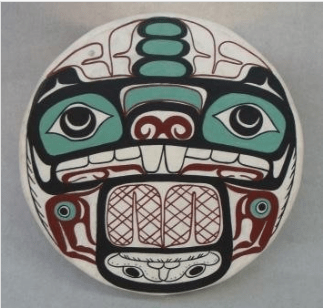
Beaver Drum

Another important early experience was spending the summer travelling on the Alaska ferries with his mother and grandmother, stopping at each port to sell what they made. Dangeli recalls that they did well enough to pay for their fares and his clothes for the coming school year. Through this experience, he also learned from his guardians “how to talk to galleries, to tourist shops, and cultural centers.”

Dangeli’s first training in carving came from his uncle in Prince George. “I spent a summer with him learning basic design and carving bowls and helping him with his work,” Dangeli says. “It was a lot harder than it looked, and I was a teenybopper with a lot of different interests.”

The road to an artist’s life

As a young man, Dangeli staged his own form of rebellion by joining the American army as an Air Ranger. He explains, “I’ve heard all my life that I’m in line to take a chief’s name. When you hear something like that all your life and you have to be good because of it, you decide you’re missing out and think, ‘I’m going to do my own thing.'”

The army seemed a natural choice, because he was thinking of going into law enforcement. “I didn’t see myself as an artist and living that kind of of lifestyle.”

Dangeli spent ten years in the military, rising to Staff Sergeant, but continued carving and designing in his spare time, and visiting family members when possible. It was on these visits that he started gaining a more deliberate understanding of his nation’s Angiosk –traditional territory — and Ayaawx — customs.
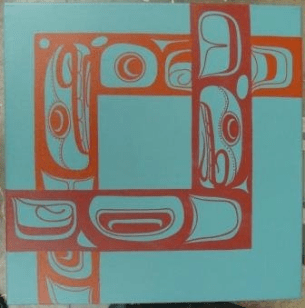
Adjusting our frame of reference

When he became a reservist, he attended the University of Alaska and working with his uncle Reggie Dangeli, a historian with the Alaska State Historical Commission. Eventually, he transferred to Washington state.

Matters came to a crisis when he got into a fight with another Staff Sergeant. “He said, ‘That’s the problem with you Indians,’ and of course he said effing Indians, so I smacked him up one side of his head.” At least partly because of the experience, Dangeli decided to leave the military, a move that cost him his university funding.

Finding himself in a well-paying but dead end job, Dangeli drifted towards Robert Boxley’s Seattle dance troupe and eventually apprenticed to him. He went through “a nasty divorce” due to his change of lifestyle, and headed “home to the Nass Valley to lick my wounds.”

The trip got sidetracked in Vancouver when he was asked to finish a pole in Woodland Park.

“I didn’t want to do it,” he says. “It wasn’t a very nice chunk of wood, and I didn’t want to do someone else’s work. So I said, ‘If I do it, it won’t be mine. It will be a community project.'” Hiring ten youths, he finished the pole and celebrated its completion with a potlatch — and, in the process, discovered that he had found himself a community.

“It was such a sad little pole,” he says. “It had been stolen twice, spray painted and a chunk was taken off the side, and someone took a Louisville [baseball bat] to it. It was horrible. But I look at it in retrospect as a physical manifestation of where I was in that moment in time — just beat up and kind of sad. It ended up being something very beautiful — not necessarily the totem pole itself, although it’s still up there and humbling to look at, but because it represents a massive amount of growth. What I created was a community here in Vancouver.”
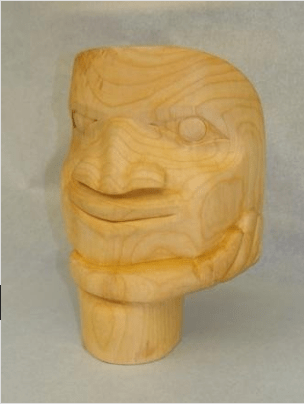
Lifting up my god-son mask

While carving the pole, Dangeli found studio space at the Aboriginal Friendship Centre at Hastings and Commercial. He remains there to his day, running a program called The House of Culture. At first, the program was a cooperative, through which artists passed like Robert Davidson, Reg Davidson, Henry Green, Simon Dick, and Lyle Campbell, as well as younger artists such as Ian Reid and Phil Gray.

More recently, The House of Culture has become a rental space, because “there were a couple of people who had abused the space because they were abusing themselves in their addiction,” as Dangeli explains the situation. Dangeli now shares the space with Woodlands artist Don McIntyre, and Mari Torizane, a Japanese master painter who works as Dangeli’s assistant. Space is also found from time to time for other artists, such as Ian Reid, whom Dangeli regards as a brother.

Such experiences have left him with a strong interest in collaboration. One such result can be seen on the west side of the Friendship Centre, where Dangeli recently painted a mural with Don McIntyre.

Dangeli now works in a variety of media, including stone carving, wood carving, jewelry making, painting, and sculpture. He works twelve to fourteen hours a day and completes 10-30 pieces per month.

“I love a bit of everything,” he says. “You get lost in what you’re working in, so there is no favorite medium. It’s whatever I’m working on. but I always have five of six projects on the go in various stages. You get bored with one and you want to pick up something else. but then the clock’s ticking on a couple of pieces, and you’ve got to get going on them.”

Ceremonial, commissioned, and commercial art

“What’s become really important to me is the performance and ceremonial part of our art,” Dangeli says. “You can ask every Northwest Coast artist, and they’ll tell you that some of the best carvers and west coast artists are the ones who have an understanding of ceremony. It’s a lot different than creating something for the galleries.”

Part of the difference is that a mask intended to be danced “needs the inside to be functional. It needs to be carved to the dimensions of the face of the person who’s wearing the mask.”

Another part is the “responsibility and rights and privileges that you learn by attending ceremonies and understanding them.”

However, the largest difference, Dangeli says, is the spirituality. “In our languages, masks were naxnox— ‘beyond human power.’ These naxnox embodied the wind, they embodied the spirits, and were able to connect us to that spirit world. There’s an understanding that if you don’t treat these naxnox right, they’ll bite you.

“And I’ve seen that happen. I’ve seen a guy who played around too much with a mask and he was dancing on stage at this one event, and he fell right off the stage. It was a good five foot drop. That was part of the mask saying, ‘I didn’t appreciate that.’ I’ve seen it happen in our own dance group. I’ve even had it happen to me.”

Another consideration is the stories that are told in ceremonial and commercial art. “With a lot of our naxnox, there’s an oral history that’s owned by families that I don’t have the right to go and use. There’s even traditions that belong to my family that I would never go and openly sell. When I do art for potlatching or for individuals who ask me for things that display their clan crest, there’s always a different price. I don’t ever charge the full price in these cases, because the best payment is having one of your pieces used. It’s more of an exchange” of services or goods or artwork.

By contrast, “when I’m doing things for a gallery, there are certain stories that are universal to everybody” that can be used instead. Dangeli suggests that this is not a limitation, so much as a situation that calls upon his ingenuity as an artist. He likens the distinction to his experience of dancing, where there are some dances that are not recorded and others that are brought out for public performance.

Dangeli acknowledges that other artists do not observe the same distinctions, but seems to feel that their choices are not his business. “I find it really sad when I see artists breaking those laws [about what can be publicly displayed], but it’s up to their elders, their chiefs and their matriarchs to put them back into line, not us as artists. Although there are some things you look at and think, ‘Gosh, I can’t believe they did that.'”

These distinctions are increasingly easy for Dangeli to observe because, while he has had work in galleries, today, commissions and ceremonial work mean that he does not rely on the commercial art market to make his living. While he praises some galleries like the Eagle Spirit and the Leora Lattimer Gallery, and speaks of their owners with respect, he is concerned that meeting the galleries’ needs can be restrictive for artists.

In fact, in some cases, dealing with galleries can be “abusive,” he says. He recalls selling a drum and a mask to one gallery, and being told by the owner, “‘Now, don’t go drinking this all up in one spot.’ So I looked at him and said, ‘I don’t need this,’ and I ripped up the cheque and handed it back, and took my pieces.”

This experience was reinforced a few years ago by an incident online in which his building and launching of a canoe received condescending criticism from an academic, and others rallied around him.

“It was really wonderful having support from my own people, indigenous people, and people from museums from all over the place, and I let go of that final fear about what people think of my art. It’s none of my business. If you like it, you like it. If you don’t, that’s fine. I think [this attitude] has made me a better artist, and that taking on more commissions has helped me to focus on more personal items and concentrating more on things for potlatches. It’s wonderful to have that freedom, and I would wish it for every artist.”

Art and the community

Dangeli takes his role as an interpreter of his culture seriously. “There is a responsibility, because artists are our historians. They are people who are able to act as a conduit between our culture and our people to the outside world. They’re historians, they’re writers, they’re creators of things that will be used inside those ceremonies. So, yeah, there’s a lot of importance in being a leader and an artist.”

For Dangeli in particular, this responsibility and importance is augmented because he is heir to two chieftainships, one of which he grew up expecting to inherit and one which he has only recently become heir to. This situation, he says, “has affected me in wanting to convey more of my messages. And taking on that larger chieftainship means that I have more responsibilities, both financially and culturally. Financially in the way of making sure that I can get home to attend feasts and potlatches, culturally by being able to create things for my people. It has affected some of what I create and definitely the responsibility not to do anything embarrassing as well.”

Sunset

However, asked if artists help to restore pride to First Nations communities, Dangeli characterizes the idea as an outsider’s view. “I think that, as an outsider looking in, yeah, it could be construed that way. But are you being made aware of it because individual artists are opening your eyes to what’s going on inside those communities? Because, growing up and witnessing all these wonderful things happening within my community, there’s always been pride. There’s always been this sense of beauty and right and wrong and putting your best foot forward. A lot of artists, especially in the generation before mine, have all grown up with that responsibility.

“There’s a huge responsibility being an artists and growing up in that culture, which is why some artists choose not to be part of it. It is too much responsibility. Everyone always wants you to create things for some sort of giveaway or to do this or that. So there has to be a balance.” For instance, Dangeli will often repurpose a piece, or ask permission to make a print of an original painting, so that he can respond to a request without taking too much of his time. He cites Joe David and Beau Dick as two of the older artists who are models of how to find this sort of balance.

“We have a responsibility because we’re able to function in so many worlds, whether it be the white world, within the art world — and it’s not just the art world, it’s the First Nation’s art world as well — within our communities, culturally, and academically and with art historians. I’ve been able to walk in all these worlds, and been intimidated in all of them.

“I remember when Mique’l [his financee] had moved up here. I was looking through some of the readings she had to do for her Master’s in Art History, and I became worried because art historians analyze everything. And I was like, ‘Look, I was poor this month, and people will say, this is Mike Dangeli’s blue period because I didn’t have anything else but blue paint. That was part of my fear: Is what I’m doing now going to be analyzed and picked apart twenty, forty years down the line?. And that was something else I had to let go.”

But, for all the fears, the responsibilities, the obligations and the need for balance, Dangeli clearly remains committed to all that he has taken on. “I love what I do. It’s not a job, and it’s not a career –although it is both — it’s a passion. I absolutely love it. So to be able to have that opportunity to take what’s inside me, to make my thoughts tangible –”

He trails off for a second, then starts in a new direction.

“I’m able only to put out so much in thirty or forty years. That’s a short time in a person’s life. And I started this when I was a little older than most artists. I was 27 when I decided to become a professional artist. so I have a lot of catching up to do. And, at the same time, I’m grateful to be able to create art and to have people see value in it.”

Read Full Post »
« Newer Posts - Older Posts »