If an artist has an apprentice work on a piece, are they dishonest if they sign the piece as though it were their own? By coincidence, two acquaintances have found themselves confronting that question. How each of them answered says something about how we regard art and the definition of authenticity.
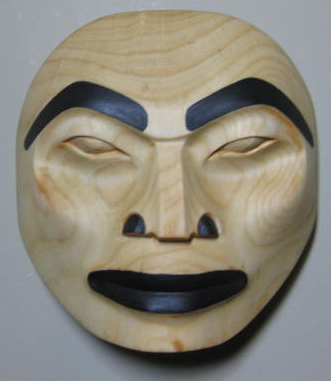
In the first case, my acquaintance commissioned a mask from a well-known Northwest Coast artist (I am deliberately not mentioning names or any identifying details, because the issue touches on artists’ integrity). When the artist passed the mask to an apprentice to finish, my acquaintance was furious. I supposed my acquaintance would say that they paid for a work by the artist, not by the apprentice, although the fact that the artist gave the mask to the apprentice in front of them suggests that, the artist was not trying to be deceitful.
In the second case, an acquaintance bought a mask, and was contacted by the artist’s former apprentice, who claimed that the mask was theirs. The artist had frequently stolen their work, the apprentice claimed. However, investigation showed the matter was not so simple. The apprentice’s carving style was similar to the artist’s to begin with, and the apprentice had roughed out the mask, but most likely under the artist’s supervision. From the one picture of the apprentice with the mask, the artist seems to have finished the carving, painted the mask, and added many characteristic details. The result was far beyond the apprentice’s usual level of skill, and, according to one rumor, the apprentice had formally sold rights in the mask to the artist.
I suppose that, at some point, an apprentice’s work becomes extensive enough that they deserve credit on a work. Yet, while that should be true, the practice of having apprentices help with an artist’s work without receiving credit is extremely old. With many paintings done in the European Renaissance, the question of how much of a work is an apprentice’s remains a disputed point.
Similarly, in modern Northwest Coast art, it is an open secret that Bill Reid’s “Raven and the First Men” may have been designed by Reid, but was carved by Reg Davidson, Jim Hart, Gary Edenshaw and George Rammell, with Reid doing mostly finishing details. As for “The Black Canoe – The Spirit of Haida Gwaii,” Reid is supposed to have contributed only the design, partly because of his illness and partly because he knew next to nothing about bronze casting. Although these collaborators were chosen for their expertise, no one suggests that general credit for these works should not go to Reid, although many (including me) think that their contributions should be more generally known.
So why is the buyer in the first case and the apprentice in the second case angry? Part of the reason may be that, although collaboration is widespread in Northwest Coast cultures, especially on large projects, the idea persists in Euro-North American culture that fine art is done by one person. If the work is not the artist’s, then it must belong to the apprentices who worked on it.
A work on which more than one person deserves credit can easily be seen as inauthentic – and definitely not what the buyer paid for. And, possibly, a collaborative work will be less valuable than a work by a single artist, although that does not seem to have happened with the collaborations between Norman Tait and Lucinda Turner in Northwest Coast art.
Aesthetically, however, does who created the piece matter? I have not seen the mask in the first case, but the mask in the second case is an accomplished and sophisticated work, no matter who deserves credit for it. In this light, arguing over who deserves credit seems almost crass, even thought it might be the legitimate grounds for a law suit.
My own take is that the acquaintance in the first case has no reason to complain, given the traditional relationship between artist and apprentice. Letting an apprentice finish a mask may seem high-handed, yet it was done so openly that the artist probably did not intend to deceive. Nor does it seem likely that an artist would let an inferior piece out of their hands; to do so would affect their reputation. Before my acquaintance received the mask, it was almost certainly finished to the artist’s usual standards, no matter who did the work.
The second case seems just as clear. Although the apprentice’s hands may have been on the tools, the artist seems to have guided the making of the mask at every stage. Just as with the first step, conventional practice would attribute the mask to the artist, and not the apprentice.If the artist was feeling generous, they might acknowledge the apprentice’s contribution, but they are not obliged to.
Of course, in real life, the matter is not so simple. The buyer in the first case and the apprentice in the second might have a law suit over the expectations created by their positions. And possibly the apprentice might try to assert ownership and create a miniature nightmare for the buyer of the piece.
However, based on common practice, I doubt that either would get very far. If the facts are anything like those I’ve summarized, then by precedence, the art work should be attributed to the artist, and not the apprentice.



 Off the Wall
The right to comment
Posted in Blogging, Bruce Byfield, censorship, comments, communication, Internet, journalism, Personal, time-management, Uncategorized, writing, tagged Blogging, Bruce Byfield, censorship, comments, communication, Internet, journalism, Personal, time-management, Uncategorized, writing on January 15, 2010| 9 Comments »
Several times in the last few months, I’ve closed discussion on one of my blogs. Each time, some people have howled in outrage. Their anger makes them nearly inarticulate, but their position is apparently that I have no right to stop discussion. I am an enemy of free speech, they proclaim, a censor and cowardly, and downright evil as well.
I don’t see that, myself.
For one thing, free speech is not an absolute right, even if you believe that it should be. It is limited by laws against libel, hate-crimes, and terrorism, among others. Nor can you invoke free speech as a defense against mischief.
Admittedly, violations of these laws appear dozens of time each day on the Internet, and most of them are not prosecuted unless someone complains. Even in 2010, the Internet retains more of a frontier unruliness than other forms of media. But the point is that idea that free speech is unlimited is disproved with a moment’s thought.
Moreover, in each of these cases, some of these limits seemed to apply. Whether they actually would have been grounds for legal actions, I can’t say, of course. However, I think that erring on the side of caution is reasonable, especially since at least one determined commenter seems to have been required to close down his own blog.
At any rate, I have no desire to be involved, however indirectly, in a court action. And, in the case of one blog, I would be irresponsible if I exposed the company that owns the site to litigation. These motivations are not a matter of courage so much as caution. If I am going to be dragged into a legal action, it is going to be for something worth fighting for, and not because I provided a forum for the indiscreet and feckless.
However, my strongest motivation was that I simply lacked the time to either police my blog every half hour or to enter into discussions that were unfolding in which, so far as I can see, there was little to distinguish one set of claims from another.
I have been writing about free and open source software for five years now, and I have gained a limited amount of recognition. That recognition is not on the scale of a Linus Torvalds’ or a Richard Stallmans’, but it does mean that I get a lot of email and other contacts – so much that I can only answer some of it if I hope to get any writing done. Unless I am contacted by a friend or an unusually interesting stranger, I generally try to limit an exchange to a couple of communications.
I don’t always follow this rule strictly, but when someone is repetitive, abusive, and fails to address what I have to say, I am sure to apply it. By nature, I am easy-going and love to talk, but trying to hold a discussion with such people leaves a deadening feeling of futility. They are not going to sway me by bludgeoning tactics, and all too clearly, I am not going to convince them in a discussion. So why should I waste my time? A couple of exchanges is enough for them to have a say, and for me to know the type of people with whom I am dealing.
In other words, I choose to focus on the people who are interesting to have in a discussion, and/or can teach me something. So far as I’m concerned, declining to spend much time on the obsessive is not censorship, any more than refusing to publish bad writers in an anthology you are editing is censorship. It’s selection, plain and simple. i am hardly the only person I know who has to resort to this kind of selection in order to do what’s important to them, either.
Nor can I navigate the rights and wrongs of the feud that, in a couple of cases, is the reason for me shutting down comments. Both sides accuse the other of criminal behavior, and both sides claim to present evidence. However, all I can tell for sure is that I don’t want to be involved. Being hectored, abused, and threatened two or three times a day makes me even less likely to want to get involved; attempts to intimidate only make me stubborn, and, when people act like spammers, I treat them like spammers.
At any rate, to talk about censorship on the Internet is more of a rhetorical flourish than a reference to reality. If I refuse to post someone’s comments, that’s two out of – what? Several billion sites? If a commenter can’t find a place to publish what I won’t, they aren’t trying.
Under all these circumstances, you’ll excuse me if I find myself unmoved by the accusations when I close comments. I don’t do so quickly or easily, because I value freedom of expression myself. But I do so to create a space to work, and so I can focus on what’s important.
The peace of mind that results tells me, more than anything else, that I am doing the right thing.
Read Full Post »