Feeds:
Posts
Comments

The first thing you need to know about bringing a parrot into your life is that taming isn’t the issue. Unlike dogs or cats, most domesticated parrots are only a few generations away from the wild, and their ancestors haven’t been selected for their ability to get along with humans. Consequently, if you expect a bird that will obey you instantly and never challenge you, you’re bound to be disappointed. Rather than taming, I prefer to talk about “socializing” – convincing a parrot that you are part of their flock and can be trusted.

The second thing you need to know is that an aggressive parrot is rarely a mean one. More likely, they have had some bad experiences with the humans it has previously encountered. If they are more than a few years old, they may have been abused, or even traumatized. They will need their personal space, and will probably need time to accept you. Keep this fact in mind when the bird you are socializing seems to be delighting in scaring you or getting you angry – it will help you to keep perspective. Otherwise, your fear or frustration will reinforce the aggressive behavior, and in turn it will reinforce your fear and frustration.

As you start to work with a parrot, you have five basic tools. The chances are, you will need all of them, even if the bird has been in contact with humans since it was a few days old:

  • Time spent: You wouldn’t expect a person to instantly accept you, and a parrot is at least as smart as a two year old human. Place your bird’s cage where it can see you most of the time you are home. Sit beside the cage, and say a few words when you pass the cage. Establish yourself as part of the bird’s environment.
  • Your voice: Talk to the bird whenever you can. Better yet, sing to them. Parrots are a highly social species, and they are used to members of the flock vocalizing to each other. If you vary your intonation, the bird may also become curious about you, and start to try to figure you out.
  • Food: Adult parrots feed hatchlings. Mates feed each other. Sometimes, even friends feed each other. Offering food is one of the best ways you can show a parrot that you want to be trusted. It’s also a way to encourage your bird to try new foods, by letting them receive it from a trusted source.
  • Your movement: Parrots are a prey species, and at first your every move will be a potential threat. You especially want to avoid sudden, quick movements. Concentrate on slowing down your movements and keep them steady and regular. If you study a bird long enough, you will soon find the speed that makes the bird the most comfortable.
  • Your patience: How fast a bird accepts you varies with personality and past experience. Some birds may accept you in a matter of minutes. By contrast, the badly abused may take months or even years, and never fully accept you. No matter how long socializing takes, you have to keep your patience; if you find yourself losing it, then you need to calm yourself before interacting with the parrot again.

In effect, socializing a parrot is like trying to function as a child psychologist. It requires energy, effort, and time, and is far more demanding than working with a dog or a cat.

If you think it sounds too demanding, the solution is simple: Don’t bring a parrot into your life. There are already too many abandoned and neglected parrots, so the last thing you should do is add to their number.

However, if you are willing to try, the results are worth the demands. The first time that a parrot flies to you or preens the side of your face is one of the most endearing signs of trust imaginable. And with luck, you will have started a relationship that will last several decades, or possibly even longer, depending on the species.

Anyone who troubles to think knows that traditional male roles are outdated. They started going stale fifty years ago, and by now they are too moldy for anyone to digest. Yet almost no discussion takes place about what – if anything – should replace them.

As with any trend, the media is eager to seize on every explanation for the unsuitability of traditional male roles. The decline of heavy industry and the outsourcing of jobs are popular explanations. Often, too, the changes in women’s roles is cited, sometimes with urban legends like reverse discrimination, but increasingly by even uglier methods such as personal misogyny and laws about reproductive issues that have been called a war on women (and that have about as much chance of succeeding as demands to ship both legal and illegal immigrants home). But the shallowness of these explanations is suggested by the facts that they are inevitably voiced in aggrieved and puzzled tones, and that they offer no alternatives.

The trouble is, men are the least politically conscious gender. Robert Bly’s mythic men’s movement was never much more than another media-manufactured craze, while modern male supremacists sound like a parody of the popular stereotypes of feminism and provoke laughter more than serious consideration.

Even more importantly, such efforts are essentially reactionary. They demand a return to the roles of a past that lasted very briefly. To the extent that these roles were widely accepted, they existed from about 1850 to 1960, and never did manage to influence the working or lower middle classes very thoroughly.

While gender roles certainly existed before that, and were often weighted in favor of men, any social history reveals that they were rarely those that we think of as traditional. Nobody thought it odd that a medieval English merchant’s widow should take over his business, while women in tenth century Iceland had legal rights that women in modern society only regained midway through the twentieth century. Nor, as we find increasingly, is there much evidence of our social roles having an evolutionary origin – all of which only makes the arguments of male supremacists even more desperate than they initially sound.

So far, the best analysis of modern male roles can be found in Susan Faludi’s Stiffed. Faludi, who is best known for Backlash!, an analysis of the reactions against the second wave of feminism, is equally insightful in talking about men’s roles. She suggests that the generation of men who fought World War 2 returned home emotionally distant, losing themselves in their careers in their overwhelming desire for normality. As a result, they became distant parents, and failed to pass on an image of responsible masculinity to their Baby Boomer sons.

Left to shape their own images of masculinity based on the movies, these sons focused on the more superficial aspects of their father’s roles. They expected control of both family and society, but failed to notice that this control was supposed to be justified by their support and loyalty. Male roles became such a caricature of themselves that today, watching sports is supposed to have more to do with masculinity than making sacrifices for your family, or worrying about the moral values of your children.

In a few places, some of the old masculine roles survived. Faludi notes, for example, that until just before the millennium, father and son roles were common in places like shipyards, where new workers were routinely assigned to the care of older men. These mentorships, by Faludi’s accounts, were highly valued by everyone involved. But most Baby Boomers had no opportunity for a similar experience, and had to make up masculinity as they went along.

Many never got past an adolescent concept of masculinity. If you doubt that,check the leading movies of the last twenty years, especially the comedies.

Yet even if they learned their father’s values, the usefulness of these values in recent decades would have been limited. As self-actualization and economic necessity brought more women into the workplace, the justifications for traditional sex roles quickly declined. In particular, the economic justification of marriage for women diminished. At the most, a woman might marry to extend the prosperity of herself and her future children. No longer needing marriage for basic survival, why should any woman put up with even the appearance of deferring to her partner?

In this light, the confusion and anger of many modern men about feminism is understandable – not admirable and by no means excusable, but understandable. Unsure of their roles, then finding those roles diminished, they could hardly be expected to react except with fear and anger, especially when no obvious alternative exists.

This subject is, of course, endless. But it seems to me that, in the same way that women are starting to learn to move beyond their traditional roles, men need to learn to move beyond theirs. The trouble is, the average modern man is completely unprepared to do so. For many men, their gender role is central to their identity. More – making sure that no one can accuse them of being in any way female is important to their sense of self-worth. Yet, with the social differences between men and women diminishing in industrialized culture, men have less and less to compare themselves to. They can only fall back on trivialities, such as preferring beer to wine – which in the end makes their gender identities even less secure.

What men need is to analyze their recent history as thoroughly as feminists have analyzed women’s. Once they do that, more men might manage to identify themselves less as men and more as humans, and even learn to ally with feminists.

But that is an effort that many men are still reluctant to make. Instead of recognizing the inadequacy of the roles they model themselves upon, they would rather cling to those roles and ignore their increasing irrelevancy. But, until they are ready to move on, the personal and social cost is going to be as high as it is needless.

The car leaves

I’ve never care much about cars. Sometimes, Trish and I would give a car a name, like Wodwo Tulk or Macaw, but a car has never been much more than transportation to me, and definitely not a source of pleasure or status. Yet today when the tow truck disappeared around the corner with our last car, bound for the garage, the moment seemed solemn. Except for the townhouse, the car was the last major piece of our life together.

We bought the car in 2006, a silver gray Toyota Corolla like thousands of others, distinguishable only by its manual transmission. It was used, but in such good shape that it might almost have been new, and Trish was so excited that she hugged the salesman (much to his surprise).

We never did make any long trips in it. By that time, Trish’s health was already too compromised for anything more than a trip across town. But for several years, the car made her more mobile, until she started struggling for the alertness to drive safely. I almost never rode in it myself, except on weekends, when, like many couples, we would run errands, the CD player blaring Oysterband or The Pogues or Ray Wylie Hubbard while we enjoyed each other’s company.

Then came Trish’s final hospitalization. For a month, the car stayed in the underground parking, unused except for the few moments each week when I turned on the engine to keep the battery charged. But in the aftermath of her death, I forgot the task for so long that, by the time I remembered it, I was too late.

In the months following her death, I quickly took care of about ninety percent of her affairs, including cleaning out her belongings. But that last ten percent was something I evaded as being more final than I could bear. When the car’s insurance came up for renewal, I put it in storage, but I couldn’t stand to do anything more. It was twenty months before I could even bring myself to transfer the car from Trish’s estate to me.

Meanwhile, the car gathered dust. Local children wrote “Wash me!” in the dust on the window. A couple of neighbors hinted repeatedly that I really should do something with it. Someone taped to the window the contact information for a scrap metal buyer, who would pay $150 for the vehicle (I angrily recycled the information, and took to glaring at the person I suspected of making the suggestion). But I couldn’t bring myself to do anything except wash the car and clean out its contents.

Still, I was slowly edging towards repairing and selling the car when, two weeks ago, over a hundred cars in the neighborhood had their tires slashed in a night. I was lucky, and was left with two intact tires. But since the car had to go to the garage anyway, I might as well ready it for sale.

When the tow truck arrived this morning, I realized I was dragging my feet as I went down to meet it. I stood to one side as the driver prepared the car for towing, carefully working around the slashed tires. Despite myself, I found myself thinking of what the car had meant for Trish, and how she was long past needing it. For no good reason, I reached out and touched it one last time.

The driver said that I didn’t need to stay around. I told him I would anyway. It seemed like something that I had to do.

Finally, the car was ready. I watched the tow truck carry the car out of the garage and on to the road. As I climbed the stairs to the townhouse, I paused at the top to watch it out of site, feeling as empty as an orange peel.

In a week or two, I should get good money for the car. But that wasn’t what I was thinking about. As it disappeared, I was thinking that another piece of my past was disappearing, too.

Contrary to narrative conventions, very little of anyone’s personality is decided in a single moment. More often, our traits and beliefs are the result of a number of incidents and how we choose to link them. However, an exception for me is the moment that steered me towards being a leftist.

It was at my maternal grandfather’s house when I was ten. His house was a block away from the United Church where I attended Sunday school, and I used to wait there for my mother to pick me up afterwords. In fact, for several years, the main reason I kept going to Sunday school was so I could spend time with my grandfather afterwords, and be fed milk and cookies and read Prince Valiant in the local newspaper to which my parents didn’t subscribe.

A federal election campaign was on, and my mother and grandfather were in his kitchen, talking about. I was in the living room waiting for them. I wasn’t really listening; just letting their conversation wash over me without really following it, the way that you do when you’re a child and the adults around you are discussing something that doesn’t really interest you.

As we were leaving, I went out into the kitchen to say goodbye, and my grandfather asked me, “And who are you going to vote for?”

This was the election of Trudeaumania, which Pierre Trudeau was busy kissing all the women in the crowds and showing himself all elegance and gallantry and supposed youth. In fact, he was forty-nine, and only a few years younger than his main opponent, and even at ten, I thought him insincere. So I wasn’t going to answer with his name.

The only trouble was, I couldn’t remember the leaders of the other parties. Wanting to say something so I wouldn’t sound stupid, I remembered a name I had heard in my mother’s and grandfather’s discussion.

“Tommy Douglas,” I said.

Both my mother and grandfather laughed, long and loudly. My grandfather, I remembered too late, had been denigrating Tommy Douglas, the leader of the New Democrats, so he was the last person I should have named, although I wasn’t sure why.

At the moment, all I knew is that I had tried to be clever and knowing, and had failed spectacularly.

But that was enough for the name to lodge in my mind. Over the next few months, I learned that Tommy Douglas had been premier of Saskatchewan, and a well-respected one. Not only that, he had organized the first universal health care in all of North America, and made it work. As for the New Democrats, they were social democrats and socialists, and talked about change and justice for all. They were also the perennial underdogs, always the third party in federal politics. They never formed a government, but somehow their ideas slowly became mainstream enough that Trudeau’s Liberal party always borrowed them.

I was already addicted to stories about King Arthur and Robin Hood, each of whom was looking in his own way for justice. So it wasn’t long before I decided that “Tommy Douglas” was a pretty good reply after all, no matter who laughed at it. I kept following what the New Democrats were doing, and, started being interested in other social causes. Eight years after my answer to my grandfather, my first vote was for a local New Democrat candidate. I’ve sometimes chafed at the mildness of the New Democrat’s platform, but I’ve never voted for any other party since.

I sometimes wonder, though, what would have happened if my answer had been taken seriously, or if I had been asked the reason for my choice. I couldn’t have explained, but maybe I would have quickly forgot the name I blurted out, and arrived at my current political positions by some other route. But sometimes, the memory makes me feel that personality is a fragile and mysterious thing, that it can depend on something so small as a moment of failed cleverness and embarrassment.

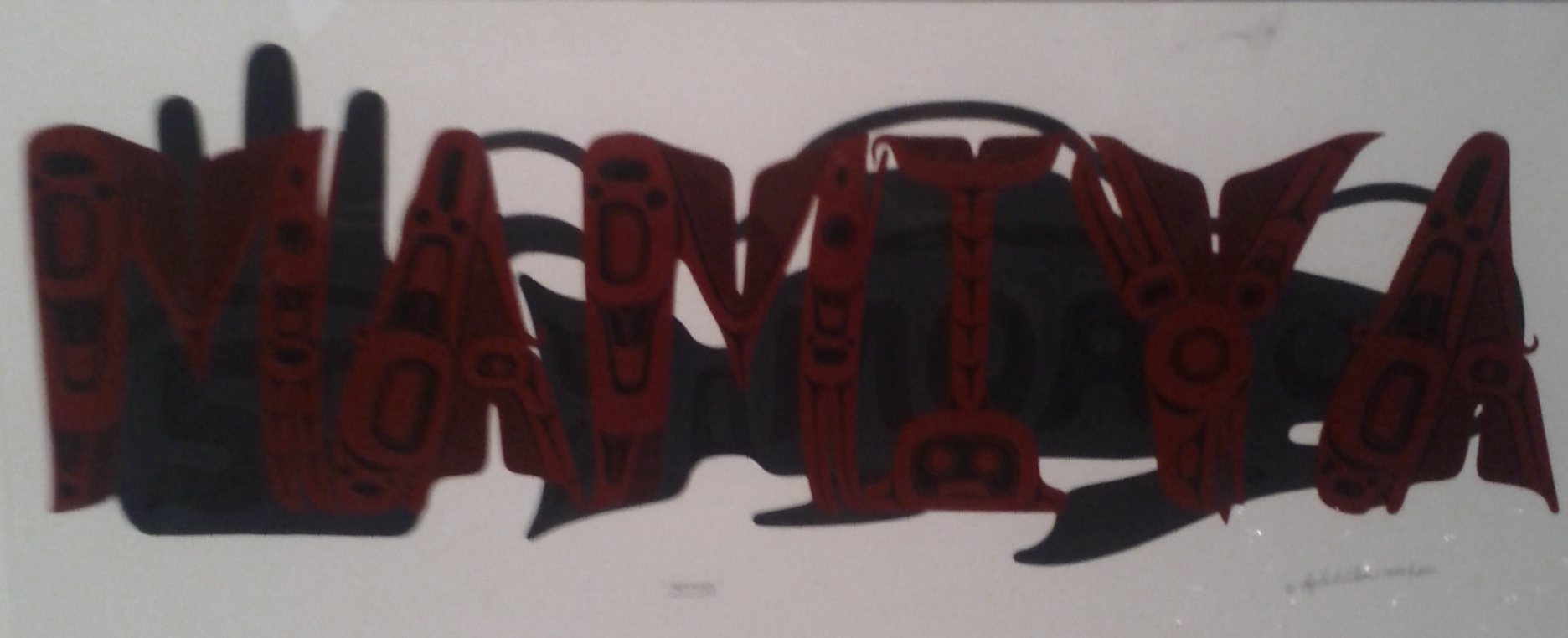
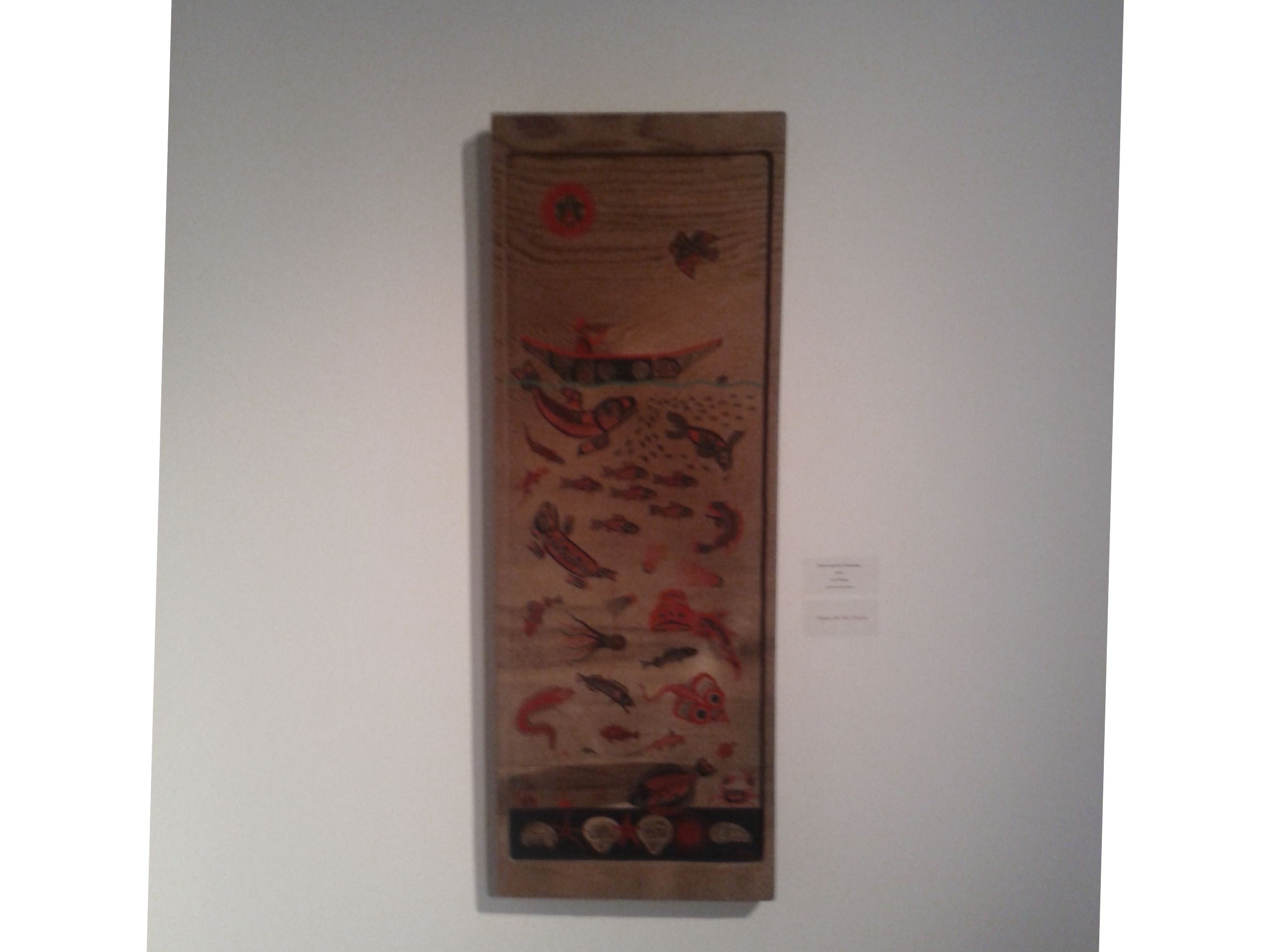
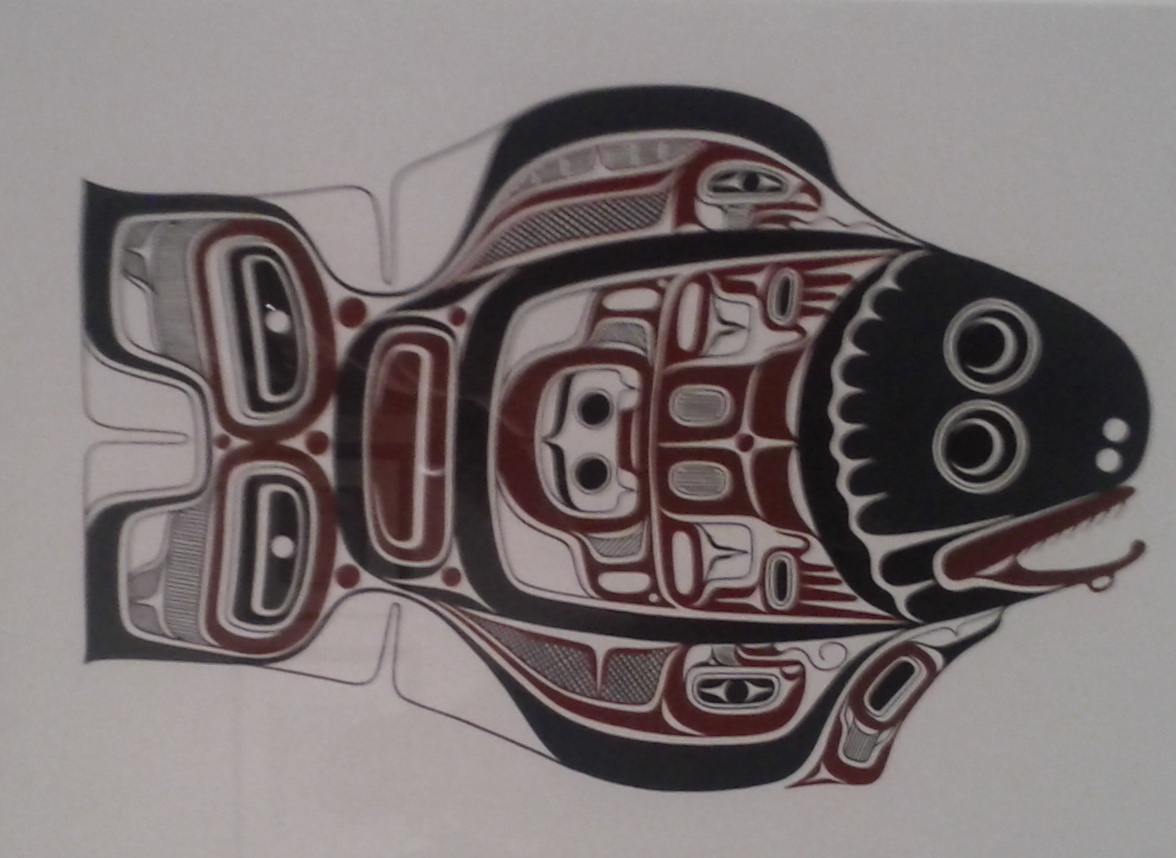
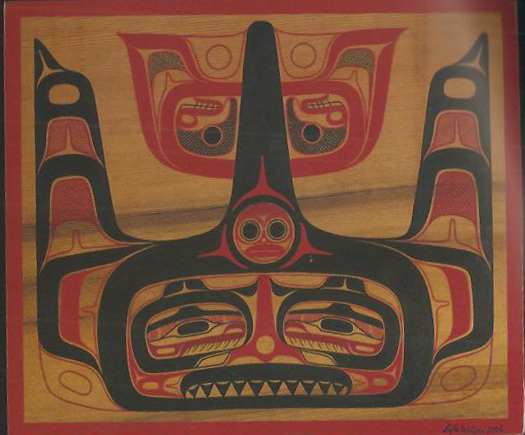
Any exhibit by Haisla artist Lyle Wilson is worth seeing. With a career spanning thirty-five years, in media varying from wood to metal and from jewelry to sculpture, Wilson is one of the major figures in Northwest Coast Art, deserving to be mentioned alongside names like Robert Davidson and Dempsey Bob. However, “Paint,” his current exhibit at the Maple Ridge Art Gallery, is more worth lingering over than most.

For one thing, paint is not a medium that is popular in Northwest Coast art. Its place has largely been taken by limited edition prints, despite the fact that many artists experiment with it. Wilson in particular is not known for it, and went so far at the reception as to say that it was a medium that he disliked. However, given that Wilson says in the program book that he has done over seventy paintings in his career – forty of which are on display in “Paint” – and has stored many unsold for decades, this professed dislike should probably be received with some skepticism.

When Wilson talks about painting, especially the superiority of wood rather than canvas or paper, his tone is calm but clearly engaged, so perhaps the lack of a market has more to do with his claim than any personal preference. Wood, as he pointed out when I talked to him, is the traditional medium for most of the painting on the coast, and he agreed that “warmth” was a suitable adjective for describing its effect compared to canvas or paper.

Which brings up another point: unlike Wilson’s “North Star” exhibit three years ago, which was mostly a display of Wilson’s versatility in different media, “Paint” is about tradition and its role in modern art as much as media. This concern is highlighted in pieces like his illuminated map of traditional Haisla territory, or in his word paintings or his designs that include the major crests of the Haisla nation.

Less obviously, it shows in his attempts to trace ovoids and other elements from the northern style of design to the anatomy of local wildlife; for instance, he suggest that ovoids originate in the eyes of the skate fish.

Tradition, shows, too, in the marine life that crowds Wilson’s work. Skate, halibut, octopi, red cod, salmon – always salmon, the mainstay of traditional life – cluster in much of his work, like “Raven and the Fisherman.”

Other designs are closeups of marine life, or designs made from their intertwined bodies. Their predators, such as the raven, eagle, and the heron also appear. More than most local First Nations artists, Wilson is always mindful that the traditional culture was one that harvested the ocean and depended upon it.

Another way to look at “Paint” is from a personal level. A miniature Tsimshian-style house front and moon reflect Wilson’s personal studies.

One or two small paintings are studies for larger works, such as “Orca Chief,” which was the model for the sculpture “Orca Chief” at the Vancouver airport.

The exhibit shows, too, how Wilson mixes contemporary life with his artistic tradition, as in his alphabet or maps – the closest, perhaps, in contemporary culture that he can come to the role of art in Haisla tradition – and in his traditional orca spouting rainbows of color.

Circle the exhibit several times, and you can also start getting a sense of his preferred palette, a muted selection of colors far less vivid than, for instance, that of Robert Davidson. In fact, much of Wilson’s strongest work is black and white, where his control of contrast is as subtle as it is effective.

“Paint” is a show that is as intellectual as it is personal. Thankfully, it is accompanied by a sixty-six page catalog that combines Wilson’s artistic statements with personal memories and the sometimes fragmentary remnants of his culture past, as well as a strong plea for a revival of interest in the Haisla language, which is quickly approaching extinction. Far from being the usual collection of glittering generalities, this is a catalog rich in personal and cultural biography that adds genuine aesthetic and intellectual appreciation to the exhibit itself.

In fact, ideally, anyone interested in Northwest Coast art should attend the exhibit, then take the catalog home and read it slowly and carefully in preparation for a second, more informed visit (which is what I hope to do myself, even though Maple Ridge is a ninety minute bus ride away). But even if you can only manage one trip, “Paint” is a major show by a major artist, and you are sure to come away with a stronger sense not just of the artist and his art, but also of the culture behind them.

“Who writes the story?
I don’t know any more,
And maybe nothing’s what it seems,
Spare me the glory
Just get me safe on shore
And I’ll only put to sea in my dreams.”
– OysterBand

The Victorians were wiser than I imagined, having a year of mourning followed by a period of half-mourning. The convention wasn’t just a social restriction; as I’ve found, you need a couple of years after the death of a spouse before you’re ready for normal life. So, with that need in mind, and with the second year anniversary of Trish’s death approaching, I’m declaring the end of widowhood.

I don’t mean, of course, that I’m forgetting our life together. I still have memories that paralyze me in the middle of whatever I’m doing, and that make me frown in the effort not to tear up. I’ll probably have such moments for the rest of my life, like a joint that aches in the rain, although they might become less common.

Nor do I mean that another woman is in my life. I’m laughably unfit for online dating, and while I’ve met several women in the last two years who have become friends, that’s all they are. The only woman in whom I’ve had the faintest interest isn’t speaking to me, and is unlikely to, and I’m not much concerned. I’ve had one spectacularly successful relationship, and I can’t expect another one.

I am not even suggesting that I have a new direction in life. I don’t, and I’m not likely to. Three years ago, I thought I knew what the next couple of decades would be like, and, with those expectations gone, I don’t see any point in aspiring to new ones. Despite some recent efforts to find new directions, I expect that thirty or forty or fifty years from now I’ll be found dead or ill among amid my books, music, computers, birds and exercise equipment, living much the same as I do now. The thought doesn’t worry me much, and I’m not in the least suicidal; it’s just the way things are likely to happen. Generally speaking, I accept that, just as I accept that I’m on the short side of medium height or have heavy shoulders.

So what do I mean? Simply that a time comes when living in the past feels like futility. For me, that time has come. The immediacy of the thirty-two years I spent with Trish is fading. Not that I forget much, not even my failures. Yet, emotionally, that era seems so distant from the way I live now that at times I have trouble believing that I am the same person who did or said what I remember. To deny that my past is gone out of loyalty or nostalgia would be perverse, and not at all what Trish herself would want for me. I know that, because in the final weeks of her life, she was often worried about what would happen to me without her.

Maybe to you, embedded in your relationships and children, what I’m saying sounds melancholy, or a sign of depression. But, contrary to our cultural expectations, none of us has a natural right to be a happy idiot smiling through out days, although, if you haven’t been widowed or traumatized yourself, you probably don’t understand that. However, from where I am, that’s a truth so obvious it hardly seems worth repeating. To you, it may not seem like much of a step to stop living in the past and start moving into the present, but trust me – it’s an immense one.

But what about the future, you ask?

I don’t rule anything out. However, right now, the future is more than I can think about. I have half-formed plans and intentions, and I’ll probably realize a few of them as I look for ways to fill my time. But they don’t have the urgency they did a few years ago. In that, I’m not much different from most people, if they would be honest with themselves. I’m just more likely to express uncomfortable facts.

What I am trying to say is that I’ve decided to quit feeling sorry for myself. Instead, I’m cultivating stoicism. My intention is to keep moving, one step at a time, not looking backward and not looking ahead, either. And if that seems inadequate to you, all I can say is that from running and writing, I know that’s the only way that most things get done.

Once a year, I teleconference with the instructors of the Freda Diesing School of Northwest Coast Art to decide who will receive the Mature Student Award. We discuss candidate’s financial situation, and weigh their artistic skills and leadership, whittling down the list until we have this year’s recipients and – funds permitting – honorable mentions.

But this year, the discussion was short. Kelly Robinson, one of this year’s leading students, was quickly chosen as one of the honorable mentions. After a brief discussion, the second honoable mention was awarded to Stacey Calder, who was technically underage for the award, but judged someone who could make best use of it. Then, unanimously, the instructors urged Sam McKay as the main recipient, a nomination to which I quickly agreed.

In barest outlines, McKay’s story is one that sounds all too common for First Nations people of his generation. A member of the Nisga’a wolf clan, he was forced out of his culture to go to residential school. He ended up on skid row, addicted first to alcohol, and later to crack.

But unlike many versions of this story, McKay’s has an upbeat ending. After thirty years on skid row, in 1991 McKay started to turn his life around. He went to university, and started doing social work with the homeless in Victoria. Eventually, he took a job in the Terrace area, and rediscovered his culture, becoming a dancer and a carver and holding a major chieftainship.

Speaking in a soft, hesitant voice, McKay recalls that “I was well into my fifties” when he changed his life. “I remember when I was getting my driver’s license, and there were all these sixteen year olds waiting for their tests. I told my instructor, ‘All those kids must think I’m a road hazard.’”

McKay had always admired his namesake grandfather, and remembers watching him carve spoons and bowls. At various times, he had also also studied with master carvers like Henry Robertson and Tom Dawson. However, just like getting his drivers’ license, learning to carve was part of the process of the last twenty years.

“I always wanted to learn how to carve a bowl, how to carve a paddle and a totem pole,” he says, adding that he appreciates the talent of the young students in the class, and the school graduates who occasionally drop by to help with the classes.

He finds art essential to both his re-discovery of his cultural history and his personal journey, saying, “When I feel out of place, I just pick up a pencil and start sketching. I’m an artist. It’s natural.

“I always say that I’ve come full-circle. It’s funny, because when I was younger, my grandfather told me my story. It didn’t dawn on me until a few years ago. ‘Be careful,’ he said, because somewhere in your life you will run into trouble. But you are going to realize the situation and get out of it. And when you do, you’ll come full circle.’”

With all the efforts he has made, McKay is exactly the kind of person whom the Mature Student Award was meant to help. I wish him continued success when he returns next year to complete his studies.

Last week, I flew into Terrace to attend the end exhibit at the Freda Diesing School of Northwest Coast Art.

Of the four year end exhibits I’ve attended, this years’ was the weakest, with the fewest number of pieces on display and the lowest quality, but there were compensations. The show was partly a reunion of alumni, with former students such as Mitch Adams, Latham Mack, John Wilson, and Carol Young in attendance. And, as always, Waap Galts’ap, the longhouse on the campuse of Northwest Community College in Terrace, made for a setting that was both aesthetic and relaxing.

Nor was the show entirely lacking in pieces worth lingering over.

Larry Darrick displayed an abstract panel design that was all the more striking for being in black and white:

Darrick’s “Boogie Mask- Myth of Hairy Man, Bigfoot & Boogie Mask” was also worth a second look for its use of woven cedar for its mess of hair, although its copper nostrils and eyebrows seemed more elaborate than the simplicity of the carving would justify:

Among the spoons and bowls, the painting and lines of Lyle Mack’s “Transformation Spoon” was noticeable, so much so that I found myself wishing he had finished a mask or a painting for the show:

I was especially pleased to see that some of the high-quality work was done by last years’ winners of the Mature Student Award, which I sponsor. Barry Sampare, last years’ winner, showed more attention to detail and finish than most students:

Similarly, Evan Aster, who last year received an Honorable Mention for the Mature Student Award, displayed the same attention to the painted design as in last year’s exhibit to produce a mask of mildly eerie paleness:

Last year’s other Honorable Mention, Moses White, produced the strongest work of his that I’ve seen to date in “Oil Stained Warrior – Blood will spill before oil.” White’s mask had one side slightly higher than the other, but managed to be eye-catching just the same.

One of the standouts of the show was Nathan Wilson, who has already had some commercial success in the galleries. His “Defend the Village: Warrior Mask” seemed to show traces of the influence of John Wilson, with whom he worked privately in the past, but the boldness of design, as well as the mixture of materials (alder, horse hair, abalone, cedar bark, acrylic) was a a rare example of embellishments not overwhelming the design:

My only regret was that Wilson was not displaying more in the show.

First year student Jared “Citizen” Kane was another standout, with prints that were somewhat lacking in detail, but intricate enough that I bought both of them:

Still another standout was Paula Wesley, who plans to continue her art studies at Emily Carr next September. Although Wesley’s carvings looked a little rushed, and were not her best work, her two-dimensional pieces showed a pleasing discipline of line and a complexity of design, as in her “Releasing the Light”:

Wesley also created one of the strongest pieces in the show, a family box design that, had it been for sale, I would happily have bought:

However, pride of place in the show literally went to Kelly Robinson. Already a professional jeweler and painter, Robinson showed that he is equally promising as a carver. The central area of the exhibit was dominated by a display case with a spoon by Robinson, while two of his masks hung facing each other on either side:

In addition, Robinson’s painting, “Box Design (The 4 Carpenters)” hung at the main entrance of the longhouse, and was the most accomplished piece of the entire show:

The title refers to what might be called the celestial contractors in Nuxalk mythology who were charged with making the sun and other aspects of the world. The painting has a boldness and a mixture of traditional and contemporary that many visitors to the show admired, and I am proud to say that it will soon be on my living room wall.

With such artists as Kane, Robinson, Wilson and Wesley, the show was still worth seeing, and, as in past years, both the students and instructors couldn’t have been more welcoming. I look forward to seeing what the grads do next (and maybe buying more of their work), and how the first year students improve after another year of instruction.

List stories are one of the most heavily criticized forms of journalism. According to detractors, list stories show a lack of thought, and are simply a lazy way to produce an article. However, I believe that, with a little planning, list stories can be as legitimate a form as any other. They simply have different considerations from most types of journalism.

Not that the criticisms aren’t justified. The structure and logic of list stories are different from the typical story. Instead of offering an obvious path of development of the central idea, list stories are constantly starting over again.

It’s also perfectly true that list stories often feel easier to write than an in-depth story that builds on a single point. Instead, list stories rarely have room to go beyond the general. As a writer, you just start to get into the discussion when it’s time to move on to the next item in the list. Rightly or wrongly, this can feel much less demanding than sticking to one topic throughout the article.

Still, I like list stories – maybe because one of my strengths or weaknesses as a writer is that I’m always tempted to make lists. Instead of squeezing the lists into conventional paragraphs, sometimes it just seems easier to give in and acknowledge the point by putting list items into a bullet list or using sub-headings.

If nothing else, a story divided by bullet lists or sub-headings looks more approachable online. Its blocks of text look smaller because they are divided. There are fewer formidably long paragraphs, and readers have more natural places to pause and return to the article later. Particularly on-line, you have more chance of being read if you organize your thoughts in a list than a conventional story.

Besides, list stories are a good place to use random thoughts and observations that are too short to make stories in themselves. All you have to do is generate some related points to go along with them – which is easier than it sounds, because often one point suggests another.

Developing the story

The trick of writing a successful list story is the same as with any article. You need to find what William Goldman calls “the spine of the story:” The central, unifying idea that justifies talking about all the points in the same story. Without the spine, a list story is just as bad as critics contend that it always is. With the spine, a list story can be as meaningful as any other piece. State the central idea in the introduction, and you’re well on the way.

Then there’s the question of the points themselves. For the article to work, all the points in the story need to be as strong as possible. Since you don’t have much space for each point, any that are vague or obviously padding are going to stand out.

At the same time, for some reason — call it the unspoken numerology of popular culture – some numbers of list items seem to be more widely read than others, such as 7, 9, 11, or 12. Any fewer than seven items looks more like a teaser than a story, while some numbers, such as 6 or 8, simply look wrong somehow.

But, in reaching one of the magical numbers, you need to be careful to avoid padding. Instead, you need to think more deeply, or perhaps see if any of the existing list items is complex enough to be divided into more than one section. If so, as a bonus you have at least two items than can follow one another, the second maybe referring back to the first and thereby increasing the unity of the entire article.

Pay attention, too, to the order of the list items. I always think in terms of what I call “relay order,” based on the order of runners in a team race in track and field. Typically in a four-runner relay race, coaches would have the second fastest runner begin, followed by the third and the fourth and ending with the first. By approximating this order, you start off strongly and end strongest of all. The middle might sag a little, so you want to mix the stronger points with the weakest so that there isn’t a downward descent in interest.

By the time readers reach the end, the original statement of the unifying theme may have grown vague with the details, especially with a longer article. For this reason, a list item needs to end like any other story, with a re-emphasis of what you want readers to take away. Nor does it hurt to explain why what readers have just read is interesting or worthwhile.

 More than a list

Done thoughtfully, a list item is more than a collection of random thoughts. It may look simple and unassuming, but, behind the scenes, a conscientious writer needs to have a good idea of what the points add up to, and be ready to experiment with the order of items as they write. Often, you’re only know the most effective order after you write.

But that’s another part of what makes list items so suitable for online articles. Text editors and word processors are all about rearranging blocks of text – and, with list stories, you’ll have plenty of opportunities and needs for rearranging before you’re done.

I’ve never been a supporter of proprietary formats. So far as I’m concerned, they’re an imposition on the rights I acquire when I buy. But knowing something intellectually is one thing, and knowing something deep-in-the-gut, blind-raging and foaming at the mouth is quite another, as I discovered recently when I bought an audio book.

The fact that I eventually managed to access my property is entirely besides the point. The access was all of my doing, and none of the manufacturer’s. In fact, if I wasn’t so bloody-minded, I would have given up entirely. As things were, I ended by spending half the price of the purchase again just so I could do what I have a right to do.

OK, part of the blame is mine. I should have known that the promise that I could freely play the ebook I purchased on any of my devices was too good to be true. The manufacturer wasn’t proclaiming its dedication to open standards with that statement, which is how I interpreted its statements in my eagerness – it meant that I could play my purchase on any devices so long as was willing to load the manufacturer’s codec on the devices just so I could play that one purchase.

(Actually, from accounts on the Internet, the promise didn’t even mean that it. It meant any device that the manufacturer had arranged for a hardware manufacturer to pay for for support.)

After I downloaded my purchase, I quickly discovered how I had been misled – or misled myself, perhaps, through excitement. My purchase wouldn’t play on GNU/Linux, like any decently open or semi-public format. I found a seldom-used netbook computer that still had a Windows partition on it, and discovered I could play the proprietary format in iTunes. So at least I could listen.

However, I didn’t want to start up another computer whenever I wanted to listen. Nor did I want to use Windows, or to carry the netbook around, nor to have seven hours-long files. Why? Because I didn’t want to, that’s why, and I shouldn’t have to give any other reason.

All I had in mind was to listen on the operating system of my choice or maybe a music player, with files in a format I could play and divided neatly into individual stories for my private use – all modest and completely sensible goals, I think you’ll agree.

Trusting that where there’s a proprietary format there’s a way, I searched the Internet. A few pieces of software from companies of which I never heard promised to do the conversion for me, but I was dubious.

Then I discovered that iTunes included a loophole that the proprietary manufacturers hadn’t considered: the ability to burn playlists to audio CDs in .wav format.

However, as part of the plot to drive me mad, the function is a feeble ghost of what it should be. For one thing, it doesn’t burn to DVDs. For another, while it supports using multiple CDs on large files, with each new CD, it has to scan the source all over. As a result, each 80 minute CD takes some 12 minutes to burn. When you’re dealing with files seven hours long, that’s a lot of delay. It’s as though iTunes executives rationalize that, just because making a backup copy for personal use is a right in many countries (including my own), that doesn’t mean that anyone has to make creating that backup easy.

My conviction that the manufacturer wasn’t going to make things easy took another giant leap when I discovered that the files were all in ten minute segments, each labeled with another writer’s name — a mistake so amateurish that it seems designed mainly to add to the confusion. At times, too, the last minute or so of one CD would overlap with the start of another CD, so I had to listen carefully when the breaks came.

But the resulting files would at least play on my computer of choice, and I used the free software sound editor Audacity to splice them together, tantalized by the few seconds I heard while working.

Of course, it takes time to copy seventeen full CDs over to the hard drive, and still more time to reassemble the 170 files and to manually rip them into stories. Let’s call it a long evening’s project that was only slightly less fun than washing dishes for five hours. Only a fanatic would have bothered, I’m sure.

But now I’m done, and finally I can sit back and enjoy the stories.

Still, my enjoyment is tempered by the extraordinary efforts I required to do such very ordinary things when, by any sane standard I have absolutely no criminal intent. There’s a basic lack of respect for customers in such practices, no matter how widespread they are — and, after going through this experience, all I can say is that I return it. I’m forewarned now, and I’m going to think twice or three times before buying again from the manufacturer. But if I do, I think it’s only fair to return disrespect for disrespect and to assert the basic rights that the manufacturer has decided to take away.