Feeds:
Posts
Comments

Posts Tagged ‘aboriginal art’

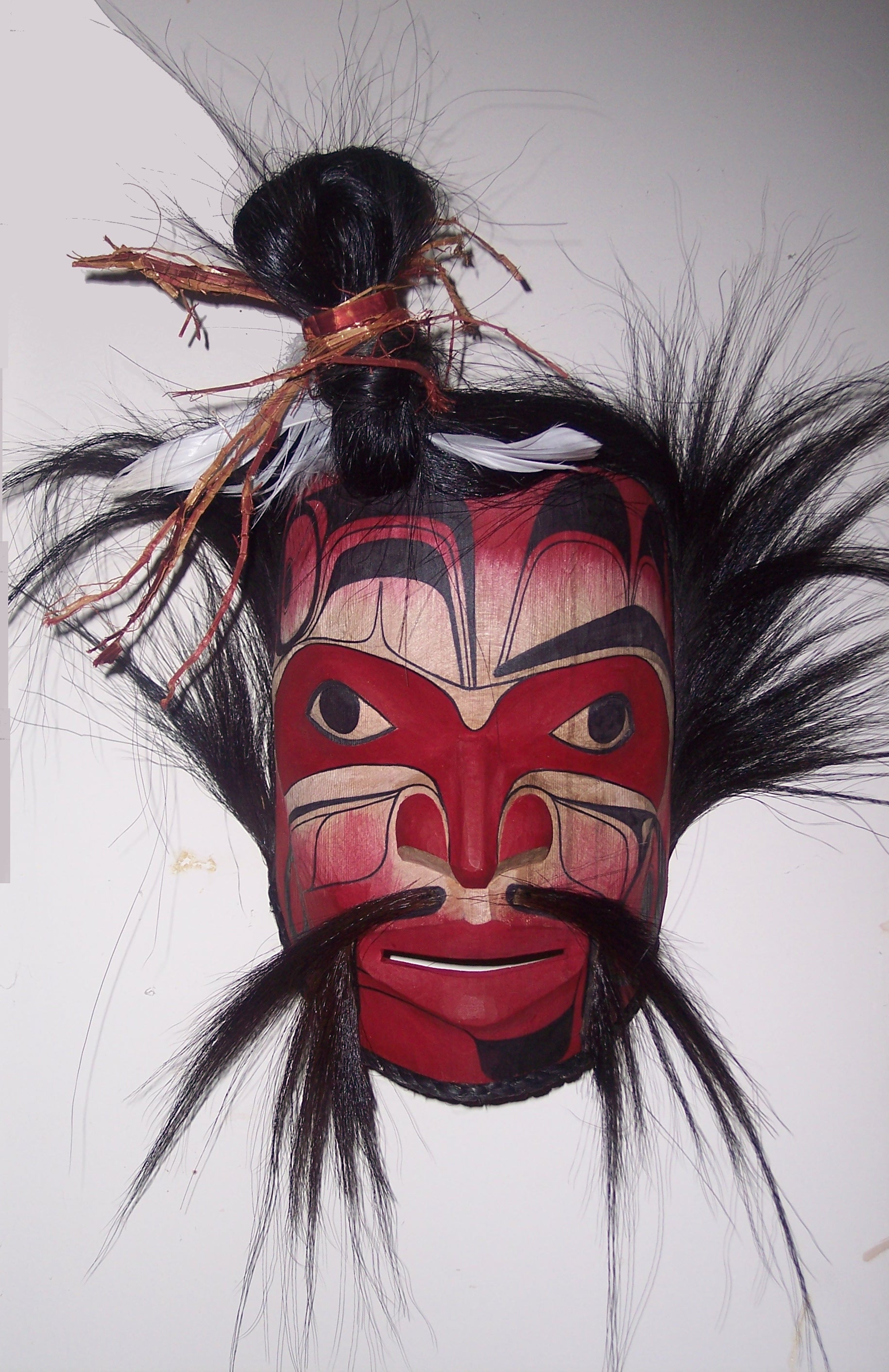
Ian Reid (Nusi) is a Heiltsuk artist whose work I have been watching for a while. For a long time, I was determined that the first Reid piece that I would buy would be one of his Chilkat ravens, like the one that was in the Continuum show at the Bill Reid Gallery. However, when “Working Shaman” came into the Inuit Gallery last month, I leaped at the chance to buy it. The mask is a simple one in some aspects, but all the more appealing for that reason.

If you have read anything about shamanism on the Northwest Coast, you may remember that shamans typically did not wash or cut their hair. This is the main element in Reid’s mask, with its unkempt hair and mustache, its carelessly-tied topknot, and the white feathers. The blending of the red paint into the color of the unpainted wood also suggests a lack of cleanliness, or at least the chapped complexion of someone who spends most of his time outdoors.

Many shamans had a fearsome reputation (certainly, their graves were isolated, and not places where people lingered). This reputation is played upon in many modern renderings of shamans, but Reid has taken a different approach. His shaman is not so much a figure of fear as an eccentric. The unfocused eyes and slightly parted lips suggest the trance state of someone imperfectly grounded in the everyday world.

This is the first Heiltsuk piece I have bought, and I admit to knowing almost nothing of the Heiltsuk artistic traditions, mainly because they do not seem to have been studied in their own right. However, the carving and the painting suggest a tradition that I would expect from the Heiltsuk’s physical location: It mostly resembles the Kwakwaka’wakw, but also has a touch of northern formline as well.

Saying more is complicated by the fact that Reid seems to be drawing on 19th century sensibilities, rather than working as a modern artist familiar with the formal rules of formline. The formline on the mask is looser than modern artists usually draw today, and the U-shapes are independent decorations, not elements contained by the formline. In fact, such formline as appears is thin and almost overwhelmed by the red of the eye sockets and nose, and around the mouth.

Where you can see the plain wood, it looks old rather than recently carved. Add the smearing of the red, and the general impression is of an old mask – dug up, perhaps, from a shaman’s grave to put on display in a museum.

Given that much of Reid’s work is ceremonial and communal, this impression is probably deliberate. Artists who work both commercially and cultural generally make a distinction between the two types of work and, looking for a tradition for non-cultural work, what better place to find it than in a museum? That this is a mask to look at, not to be danced, is emphasized by the fact that not only are there no eye holes, but neither are there are any holes for the nostrils — not even an indication of where they would be.

Portrait masks can be hard to do well. Many carvers – and buyers – prefer bird or animal masks, that seem more imaginative. But in depicting a shaman and giving the mask a patina of historicity, in “Working Shaman,” Reid shows that a portrait mask can be as imaginative as any.
Read Full Post »

Limited edition prints are a standard medium for art, but no school of art has made them its own as much as Northwest Coast art. One reason, I think, is that they were popularized in the 1960s by such leading artists as Robert Davidson. Another reason is that limited prints bridge the gap in price between fine art and tourist curios, with the majority selling for under $400 and many for under $200, and therefore can provide a steady income to printmakers. For buyers, they are a step up from buying a reproduction – although you need to know a bit about prints if you are going to buy sensibly.

The first thing you should know before buying a print is how it was made. The highest quality prints are lithographs or serigraphs (silk screens), but increasingly you find giclee prints, or prints run off a computer via a high-end ink jet printer. Some artists and galleries refuse to handle giclee prints, citing poor quality examples, but their cheapness and the fact that artists can print them on demand mean that giclee prints are increasingly popular. Still, if you do buy one, look closely at how the ink sticks to the paper. If the ink seems loose, or riding above the paper, then your giclee print may have a very short lifespan compared to one made by other methods.

Many people buy a print for the art. However, if you think that you might sell the print someday, notice the print run, which is usually penciled in beside the artist’s name and the title of the print. Forty years ago, print runs of 500 or even 600 were common in Northwest Coast art, but now, a counterfeiting scandal or two later, the norm is now under 200. Private editions, such as those released for an artist’s wedding, may number 25 or less. As a general rule, the lower the number of prints in the edition, the more valuable each print will be in theory.

In practice, however, the number of prints in the run is not always a reliable guide to value. Especially with giclee prints, an artist may not produce the full number of prints in the edition if they are not selling. And, even with traditional prints, some may be spoiled or destroyed, especially as the years go by. Conversely, an artist may deliberately withhold prints from the market in hopes of artificially creating a demand. Unless you know something about a limited edition, it is almost impossible to know how many are actually in circulation. Understandably, artists and galleries are sometimes reluctant to talk about such matters.

For the same reason, buying a print with a low number, such as 1/200 does not always result in a more valuable print. If you later resell a lower numbered print – or a collection of prints with the same number on each print – you may actually get a price that is higher than usual, but the increased value is entirely in the eyes of the buyer.

Similarly, Artist Proofs (AP)are often sold for more than a standard print – often for up to twice the price of an ordinary print. Artist Proofs are supposed to be copies run during printing to check the quality of reproduction. However, today, Artist Proofs are just as likely to be five prints – possibly the first five – run off and labeled as Artist Proofs. Except for their designation, Artist Proofs are unlikely to differ in any way from other prints in the run.

Another way that a print can increase in value is if it is a Remarque (RM). A Remarque is an addition to the print, often hand-drawn, by the artist themselves. A Remarque is usually a small doodle, but it can almost be a substantial edition to the print. Either way, a remarque print often goes for twice the price of other prints.

Still another way to give a print added value is a personal message from the artist. However, such prints rarely come on the market.

However, unless you are a serious collector, worrying about Artist Proofs, Remarques, or personal messages is rarely worth your while unless the artist is well-known, and the print is already about $400. Most prints will only rise slightly in value in two or three decades, regardless of their embellishments.Only a few artists, such as Susan Point or Robert Davidson, release prints that quickly rise in value, and the value of their works rests mostly on the consensus that their work is collectible.

With most prints, therefore, you should probably not think of added value at all. Instead, buy what pleases you. That should be your first criterion anyway — not the return on your investment.

Read Full Post »

With few exceptions, the collecting of Northwest Coast Art did not begin until the 1970s. That means that pieces from those collections are just now starting to appear in estate sales – sometimes at bargain prices, if the heirs are more interested in quick cash than obtaining the full value. Consequently, when a copy of Lyle Wilson’s 1980 limited edition print “Shaman’s World “ showed up at the Inuit Gallery during the summer, I quickly snapped it up.

The print would be unusual today, but, when it first appeared, it must have seemed utterly unique. I tag it in my mind as a Northwest Coast Gothic, a kind of predecessor of Ron Telek’s work. It is also Gothic in a modern sense: monochromatic, macabre, and, quite possibly, self-consciously over the top.

The shaman’s world, apparently is actually two worlds, one the mundane world of light, and the other the dark world of the supernatural and other realms like the sky and the depths of the ocean. In the mundane world is the head of an eagle – perhaps a tutelary spirit to judge from the hand above it – while below it is a figure that may be a man terrified of the shaman, but which I suspect is a masked dancer, trying to make sense of reality through his dance. Meanwhile, in the spirit world, a man transforms into an eagle while below it swims a killer whale, another figure of power.

Neither world has much in common with the other except the shaman, who stands in the middle like a sort of ying-yang symbol, half of him in each world. Both worlds are contained in a frame of human figures (whose formline shapes suggest that they are intended as skeletons), birds and monsters that are apparently wolves. The tops and bottom of the frame are mirror images, perhaps adding the additional dimension of life and death to the cosmology contained within the print.

The shaman’s position, clearly enough, indicates that the shaman mediates between all aspects of the world, as well as their different methods of understanding. It might also be significant that the shaman is less skeletal than the human figures in the outer frame and has a differently shaped-head; perhaps the suggestion is that the shaman is the only piece truly alive.

The formlines in “Shaman’s World” are wonderfully simple, defined largely by interior elements to indicate knees and hips and chests. They flow from one shape to another, as good formline should, but so do the elements of the design. For instance, although the shaman’s arms are held in front his chest, the body of the human transforming into a bird and the first sprouting feathers look, at first, like an additional arm. Similarly, the twisted body and tail-flukes of the killer whale suggest a third leg. Together with the formlines, these flowing shapes help assure that the viewer’s eyes are never still, picking out a detail here and there, but always moving around the design.

Another obvious element is the use of blank space. Although much of the design is symmetrical, especially in the frame, the blank spaces on both sides of the shaman are highly irregular, being open and broad on the mundane side, and narrow and twisting on the spirit side. In this way, both the traditional symmetry of most Northwest Coast art and the asymmetrical preferences of modern design appear in the design – yet another set of elements that the shaman mediates between.

By restricting himself to black and white, Wilson relinquishes whatever a secondary or tertiary formline color might have brought to the print, but probably it is just as well – had he added red or blue or green, the design might have collapsed under its own weight. As things are, it is still a restless piece, full of contrasts and new elements to discover as your eye travels around it again and again.

Read Full Post »

Alano Edzerza is a thirty-year-old Tahltan artist whose work ranges from architectural commissions and uniforms for the Dutch Olympic team to T-shirts and hoodies. Although he sometimes duplicates the same design in different media a little too often, on the whole, his work is a good example of how you can find something for every budget in Northwest Coast art. So long as you’re not looking for one-of-a-kind pieces, you can often find pieces of work for $200-$500 in the gallery that carries his name.

For example, one of the pieces usually available at his shop is this Chilkat belt buckle:

Edzerza has often worked with Chilkat designs, but, because they originate in weaving patterns, seeing a single element like this is startling. More often, a Chilkat design will have a number of elements, often repeated, with the result that you rarely linger over a single element. Isolated here, the design gives you the chance to study the face at length. In fact, it wasn’t until seeing this belt buckle that I realized that Chilkat designs (of which I know very little) are structurally closer to the formline designs of paintings and carvings than I had realized.

Edzerza also occasionally sells castings of other artists’ work, like this one taken from a pendant by Mark Prescott, whose prints have been available in the Edzerza Gallery:

The pendant is non-traditional, of course – if anything, the crouching figure of the shaman reminds me of some Old Norse drawings I have seen of Woden. This (presumably) accidental resemblance seems appropriate, since, like the Old Norse god, this shaman with a rattle in his right hand and a knife in his left combines elements of both the magician and the warrior.

Edzerza has also done a casting of an eagle pendant by Marcel Russ. I believe the original is in argillite:

Unfortunately, this picture suffers from the limitations of my digital camera. As a result, you will have to take my word that this casting manages to capture the strong sense of line for which Russ is famous. That is not an easy thing to do, and many casts I have seen of original works are muddied versions of the original. But here, Edzerza – who also shows a love of a good line, both in the occasional borrowing and his own original ones – has managed to give a strong suggestion of what the original must look like.

Works like these do not increase in value like exclusive works. But, at their best – as in these three pieces – such commercial works make a bit of beauty accessible to any budget.

Read Full Post »

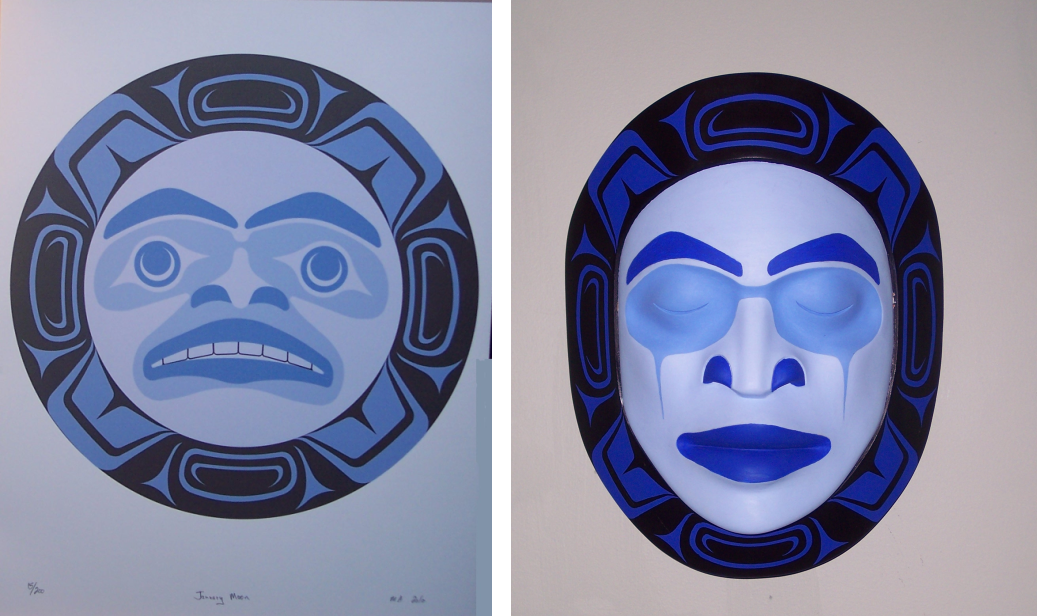
Back in June, I had dinner at the Steamworks pub with Haida / Tsimshian artist Mitch Adams and his wife Diana. Mitch kindly offered me a selection from the giclee prints that he was in Vancouver to sell. Few things feel so luxurious as a choice like that, and I could have selected several from his portfolio. However, eventually I decided on “January Moon,” which was the inspiration for his “Blue Moon Mask,” which was one of the standouts at the 2010 graduation exhibit for the Freda Diesing School of Northwest Coast Art.

The connection between the two pieces would have been obvious even if Mitch had not mentioned it. But the differences are interesting, because they show the evolution from a good execution of an idea to an outstanding one. There is little in “January Moon” that is not improved in “Blue Moon Mask.”

"January Moon" (left) and "Blue Moon Mask" (right)

The most obvious differences are in the shape and color. With its perfectly round shape, “January Moon” feels relatively static, and more abstract. In comparison, the change to an oval face in “Blue Moon Mask” is more ambiguous, as well as more realistic. Just as importantly, the colors are bolder and more glossy in the mask, as well as the contrast between them. In the print, the colors are muted, and the tones are a better match, but the result is that design tends to fade into the paper.

The exception to this general observation is the blue and black design on the rim. “January Moon”’s rim has more contrast between the colors, while “Blue Moon Mask”’s uses a darker blue that is much closer to the black. This change works because it frames the face most clearly; in “January Moon,” the blue of the rim is closer to those of the face, so that the rim frames less effectively.

However, the greatest changes are in the face. Some elements remain the same, most noticeably using the same colors for the lips, nostrils, and eyebrows. But, in “January Moon,” the eyes are also the same color, which is probably one feature too many for the design, which seems much busier than the mask.

By contrast, on “Blue Moon Mask,” the design is simplified. The teeth are gone, whose black outline is mildly discordant in “January Moon,” and much of the complication of the highlighting as well. The eyes shrink from an angry glare to closed eyelids, and the lips are smaller and barely parted instead of scowling.

The only element that is added is the tear tracks from the eyes, which I suspect originated in an accidental trickle of paint, but which works brilliantly, helping to emphasize the elongation of the face and suggesting an undercurrent of suppressed intense emotion beneath the surface appearance of serenity.

Somewhere in the middle of all these changes, the gender changes as well. “January Moon” registers as masculine to my eye (and that of those who have seen it), perhaps because of the mouth and bared teeth. “Blue Moon Mask,” however, seems female, or at least sexually ambiguous. Added to the suggestion of intense emotion being controlled, this ambiguity makes most eyes keep returning to “Blue Moon Mask” in a way that they do not to “January Moon.” Despite “January Moon”’s aggressive expression – or perhaps because of it – the eye has a hard time lingering over it. Its anger has nothing of the mystery found in “Blue Moon Mask.”

None of this is to dismiss “January Moon.” Its non-traditional eyes with their crescent moon and the creation of the nose through a clever use of negative space are admirable in themselves – so much so that I could wish they could have somehow been retained in “Blue Moon Mask.” But in the end, “January Moon” could be described as a first draft for “Blue Moon Mask.” Although “Blue Moon Mask” is the superior work, very likely it would not have succeeded if “January Moon” had not been created first. Together, they show an artist taking a leap in his development – and, I suspect, learning a lot in the process himself.

Read Full Post »

The last time I saw a Robert Davidson retrospective was his Eagle of the Dawn show in 1993. Back then, all I knew about Northwest Coast Art was that I liked it. But, having learned a little since then, I appreciated the Surrey Art Gallery’s “Eagle Transforming: The Prints of Robert Davidson” as a chance to put my thoughts about Davidson’s work in some sort of order.

My superficial impression has always been that Davidson’s prints have changed dramatically in the last forty-two years. However, my second time around the gallery, I started to see the continuities.

For instance, from the start of his career, Davidson’s formlines have varied dramatically in thickness. He is especially fond of long tapers at the end of a line, such as the end of a feather, or at the end of elongated fingers or claws. Because of this habit, his formlines keep the eye moving far more than most artists’, which would account for the sense of movement in many of his designs.

Frequently, too, Davidson promotes red from the secondary to the primary formline color (although he uses a brighter red now than when he started), sometimes omitting black altogether, or else using it as the background for a print. When he does use a traditional black formline, he often used red as the primary formline on limbs or figures inside a larger one.

In addition, from very early in his career, Davidson has looked for unusual shapes to contain his designs. Although working in an art tradition that tends towards the symmetrical, Davidson often makes his designs asymmetrical. He is perfectly capable of a traditionally symmetrical design, as in “Eagle: Oliver Adan’s Potlatch Gift,” but his symmetrical designs have a stiffness (or perhaps a formality) that his other work does not. You might almost think that his symmetrical designs were exercises – and not wholly successful exercises, at that. Other artists succeed with symmetrical designs, but Davidson, I would suggest, is not strongly interested in them.

Accompanying the asymmetry is a search for form. A few years into his print designs, Davidson is already projecting his design on to a whale fin. Circular designs are also frequent in his work, both confining shapes and appearing as negative spaces in such works as the 1987 “Seven Ravens.” I was surprised not to see many split forms in the exhibit, but perhaps the reason is that split forms tend to be symmetrical by definition.

This interest in irregular and different shapes has served Davidson well over the years. “Butterflies,” printed in 1977, escapes the potential banality of its subject by placing the design into two circles. Similarly, a hummingbird design from a couple of years later avoids the usual cuteness of the subject by making it a stocky creature with wings attached to powerful shoulders.

Davidson’s least successful works? Those with extensive areas of cross-hatching, which work well in engraved metals or on carved wood, but tend to look unfinished in a print – especially since Davidson does little to vary them.

Nor is Davidson at his best with more than a few colors. Davidson’s palette is relatively small. In addition to red and black, it includes a royal blue and a turquoise. But, when he ventures beyond these four colors, the result can seem garish rather than bold, which may be why his color choice remains relatively cautious.

For me, one result of seeing so much of Davidson’s work side by side is that I now realize that his movement towards abstraction in the last decade is less of a break than I had previously thought. I knew, of course, that he had continued to do more traditional works while doing his annual prints, but I had tended to view the abstractions as facile works – as small ideas printed large to lend them an interest that they wouldn’t otherwise have.

I still think of these abstractions, which often take the form of closeups of a small part of a larger design, as working against themselves, because they expect the eye to linger when the basic tenets of the tradition have the effect of keeping the eye moving. However, even though I consider them unsuccessful, I can see now that they are a natural extension of interests that he has had all along.

My only complaint about the exhibit as a whole is that, by including only prints, it robs the individual pieces of part of their context. Davidson is a carver and jewelry-make as well as a print designer, and, to my eye, many of the prints in the show show the influence of these other media (for example, the cross-hatching).

However even with this omission, “Eagle Transforming” is well-worth a few hours and several trips around it. If you are like me, you will only notice some aspects on the second or third viewing.

And to those visitors who left comments saying that they don’t care much for Northwest Coast Art, all I can say is that they are barbarians who don’t know fine art when they are confronted by it. For myself, the only reason that I don’t look forward to the day when some of Davidson’s designs join Bill Reid’s on Canadian currency is that, when that day comes, he will probably be dead, and then we will have nothing new from him to admire.

Read Full Post »

I’ve been looking forward to the virtual gallery of Bill Reid’s works ever since I heard a first whisper of it over a year ago. However, perhaps I anticipated too much, because, now that The Raven’s Call is online, I find myself disappointed. I’ve bookmarked the site, and plan to return to it regularly, but, all the time I’m using it, I keep thinking that it could have been something much more.

The first problem with the site is the navigation. The home page offers four menu items – of which only two, Who was Bill Reid? and Bill Reid’s Art, actually deserve to be at the top of the menu. Of the other two, The Unfinished Story is amusing but slight, while In the Classroom appeals to a narrow group of visitors, and suggests possibly unjustified assumptions about the users of the site. Are visitors really elementary and high school classes, or are they mainly adult art lovers and students of First Nations culture?

The second problem is that while the site has an astonishing amount of material, both visual and aural, most of it is simply categorized and labeled as though it is a museum specimen. For instance, in Who Was Bill Reid? You can view a pictorial history of his life, and a series of aural clips by both Reid and others. Similarly, in Bill Reid’s Art, you can see slide shows labeled Sculptures and Containers; Paintings, Prints and Drawings, and Jewelery. However, because nothing is done to place any of this material in context, the effect is like browsing through the drawers of a museum archive.

The result is an experience is interesting but dry and minimally engaging – so much so that it fails to do justice to either Reid or his work. It is only in the biography Bill Reid’s Journey that any of this material is put into context. Rather than just the bare facts about where a photo was taken or when a piece of jewelry was created and what it is made of, I suspect that most users would prefer to have a few hundred words giving anecdotes and explanations of how each item fits into Reid’s life or development of an artist.

Still another problem is that site designers show more interest in fitting graphics into the viewing page that displaying them at a size where they can be studied in detail. This tendency is especially obvious in larger pieces like “Mythic Messengers,” where the insistence on presenting the work as a whole results in a view that is only marginally better than the thumbnail. Some details of these larger pieces would go a long way towards helping viewers appreciate Reid’s work.

I would like to say that The Raven’s Call is the online monument that Reid’s genius deserves. If nothing else, I would prefer to offer praise commensurate with the three years that the site took to assemble. However, in all honesty, I cannot. The Raven’s Call might almost be a remnant from the mid-1990s, rather than a modern site.

Even its terms of use, which tries to limit borrowing from the site to fair use, seems archaic in web terms. After all, Reid’s work is well known, so there can be no question of anyone claiming it as their own. For another, the pictures are low resolution, so any use of them is going to be extremely limited anyway. Had the site designers contented themselves with a Creative Commons Attribution license, asking only that borrowers acknowledge the source of the material they were using, there might be some chance of the license being respected. Instead, the site simply looks old-fashioned in opting for terms of use that cannot possibly be enforced.

I’d like to think that the present version of the site is only the beginning – that, slowly, it will evolve the context that is currently lacking. But, for now, the main impression I take away (aside from the awe that Reid’s work always leaves me with) is of good intentions and results that were far less than should have been.

Read Full Post »

I spent the afternoon at the opening for the Northern Exposure show at the Spirit Wrestler Gallery. This is an annual show for the Freda Diesing School of Northwest Art, featuring the graduating class and the pick of the work by first year students. Besides giving students some extra cash, the show also teaches students how to deal with a gallery and an exhibition. So, naturally, when I was talking to the students, a common topic was whether they should try to place more pieces in galleries or find other ways to make a living from their art.

The question, I found, is hard to answer in the abstract. Not only does the answer depend on the galleries involved, but I suspect that the details of the answer are starting to change.

On the one hand, a gallery that is enthusiastic about an artists’ work can be the best advertising that the artist can have. The gallery staff can draw visitors’ attention to the artist to increase their sales. The gallery can act as an unofficial agent, passing commissions on to the artist. I’ve heard of gallery owners advising artists about what is selling, and the prices that buyers are willing to pay. They can promote an artist in a group show – or, better yet, a solo show. Artists can’t expect a gallery to promise to buy regularly (“That would mean we were taking on responsibility for an artist earning a living,” one gallery employee remarked to me), but an unofficial agreement that an artist will give a gallery first right of refusal for new works can benefit everyone.

On the other hand, horror stories about galleries are common. I have on good – but strictly anonymous – authority that certain gallery owners regularly break verbal agreements, all the while insisting that written contracts aren’t necessary. Some, too, delay payment for months; in one case I know about, the artist had to wait ten months for over ten thousand dollars. Artists who ask about such delays have had gallery owners scream abuse at them.

However, regardless of how a gallery treats artists, all of them have one thing in common: They stand between artists and their audience. This relation has the advantage of freeing artists from having to promote themselves. But it also means that 40-60% of the total price of a piece goes to the gallery. Considering that literary agents charge 15-20% for the same services, artists may feel that the price is too high, no matter how good the services are.

Fortunately, for artists who feel that way, the Internet provides some alternatives. Websites, Facebook fan pages, and microblogs like Twitter all provide ways for artists to interact directly with their audiences, bypassing the galleries entirely, if they choose. With free software content management systems like Joomla! or Drupal, artists can even conduct online auctions, using Paypal or credit card services for payment. As for pricing, artists can charge more than the wholesale price they receive and still offer prices that are lower than a gallery would charge.

And, increasingly, artists are taking full advantage of these alternatives. One senior First Nations artist says that 80% of his sales come from the Internet. Another estimates that about one-third of his sales are online, and is trying to boost that fraction every way he can.

But artists pay a price when taking control of their sales in this way. They have to learn marketing skills, which can make them nervous and uncomfortable if they are inexperienced or introverted. They have to learn the principles of commercial design, which are very different from the art they create. They not only have to create their initial web pages or Facebook pages, but keep them constantly replenished with new content, because nothing looks less professional than a long outdated web presence. If buyers are unsatisfied, they have to deal with the problem themselves. Most important of all, they either have to spend time on business and promotion – perhaps as much as a third of their working hours, especially at first – or find a sympathetic friend or family member or maybe a consultant to do the work for them. With these demands, some artists might feel that the price for taking full control of their career is too high.

Yet another problem is that an artist can make a living promoting themselves, but, in doing so, they become invisible to the traditional art market. If that happens, then the artists may not be mentioned in art books, or approached by governments and other institutions for large commissions.

My own suspicion is that, despite the disadvantages, an increasing number of artists will start to market themselves. Most Northwest Coast artists I know are doing some online promotion, although none (so far as I know) are doing all they could. In the future, galleries will continue to exist, but they may have less control over artists than they have traditionally had, because the alternatives will be too well-known.

Whatever happens, artists today have a choice that they didn’t have fifteen years ago. However, what choices they should make depends very much on their own skills, personality, and preferences.

Read Full Post »

The Northwest Coast art in our home includes many contemporary pieces. However, I am also fascinated by traditional pieces, particularly recreations of historical masks according to modern sensibilities. That is why, when John Wilson’s “Voices of Our Ancestors” (aka “Portrait Mask”) became available, I jumped at the chance to buy it.

John Wilson, "Spirit of Our Ancestors"

“Voices of Our Ancestors” is based on two historical Haisla masks in J. C. H. King’s “Portrait Masks from the Northwest Coast of America,” a book first published in 1979. It is a mask well worth studying for its own sake, all the more so because examples of Haisla design are relatively rare. When you do see them, you have no trouble placing the Haisla geographically, because their art often seems like a combination of Kwakwaka’wakw and Tsimshian traditions. Nor is Wilson’s mask an exception.

Artists Unknown, Historic Haisla Masks

However, what especially interests me is Wilson’s reinterpretation of the historic masks. To start with, Wilson chooses a less rounded, more northern shape for the mask. This change is accompanied by some changes in proportions, such as a wider space between the lips and nose, and a higher placement of the ears. He has also decided not to include the teeth that are in the originals, and replaced the originals’ rounded eyes with more smaller, more slanted ones. In addition, the cheekbones of Wilson’s mask are far less prominent than in the originals. The result is a less human, more supernatural look – a fitting change, considering that the mask is a work of a modern man looking back on the past.

Another noticeable difference is in the selection of colors. This difference is not just a matter of what was available; one of the older masks actually has a brighter red than the one that Wilson uses. By contrast, even allowing for aging, the historical piece has a more subdued blue than Wilson uses. Wilson also accents the red by drawing thicker formlines, and using it in places where the historical piece uses blue.

Wilson has followed the general designs of the original, including the stylized mustache and goatee, but almost always he has put his own interpretation on them. For instance, he has taken the rows of parallel lines just visible on the colored original, and added them as a design element below the nose, replacing the rather uninspired blobs of cross-hatching, and perhaps suggesting mustache stubble.

However, the largest difference between Wilson’s mask and its inspiration is in the form lines. Although formline influence is obvious in the originals, Wilson’s formlines are more disciplined, with more variation in thickness and more balance. For instance, where the formlines on the forehead in the original meets above the left eye, Wilson’s meet between the eyes. Similarly, where the original has formlines meet on on the cheeks, Wilson’s meet at the nostril.

Probably the most obvious difference in the design is on the cheeks, where the formline helps to replace the cross-hatching, and the blue u-shapes are greatly reduced in size. Even more importantly, the red formline that follows the line of the cheek curves upwards rather than downwards as in the original, doing more than any single element to make the modern mask less human and more arresting than the originals.

“Spirit of Our Ancestors” is obviously influenced by the sources that Wilson acknowledges, but clearly it is more than imitation, or an unthinking copying of a classical piece. Wilson’s mask is more balanced piece of work than either of the originals, with a stronger northern influence as well. Although somewhat of a new direction for Wilson, it more than succeeds on its own terms. Wilson has not simply copied, but repeatedly improved as well.

Read Full Post »

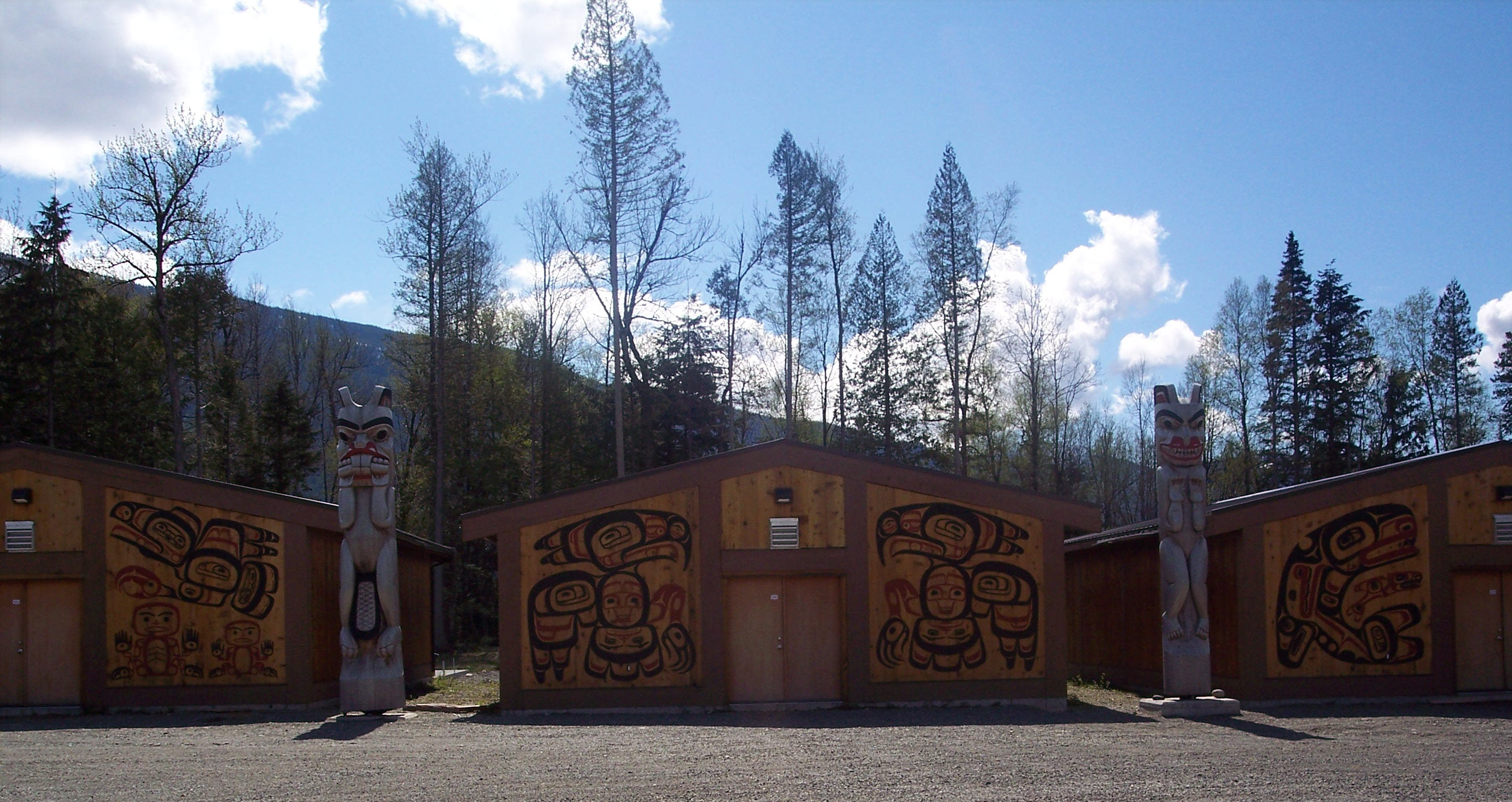
A couple of weeks ago when I was in Terrace, Dean Heron drove me the fifteen kilometers northeast to the Kitselas Canyon National Historic Site. We left the highway, bounced up a gravel road through some second growth forest to a gate and, after opening it, descended to the top of the site.

I’ve been hearing about construction on the site for a couple of years and the work that teachers, students, and graduates of the Freda Diesing School of Northwest Coast Art had been doing there, but nothing really prepared me for the site or the scope of the effort. The top of the site was dominated by a nearby mountain, so dramatically close that I could never quite keep it out of my glance, or resist looking up at it (or be unaware of it at my back):

To date, four longhouses have been completed. A fifth is largely complete but unpainted and will eventually display a wolf design, if I remember correctly.

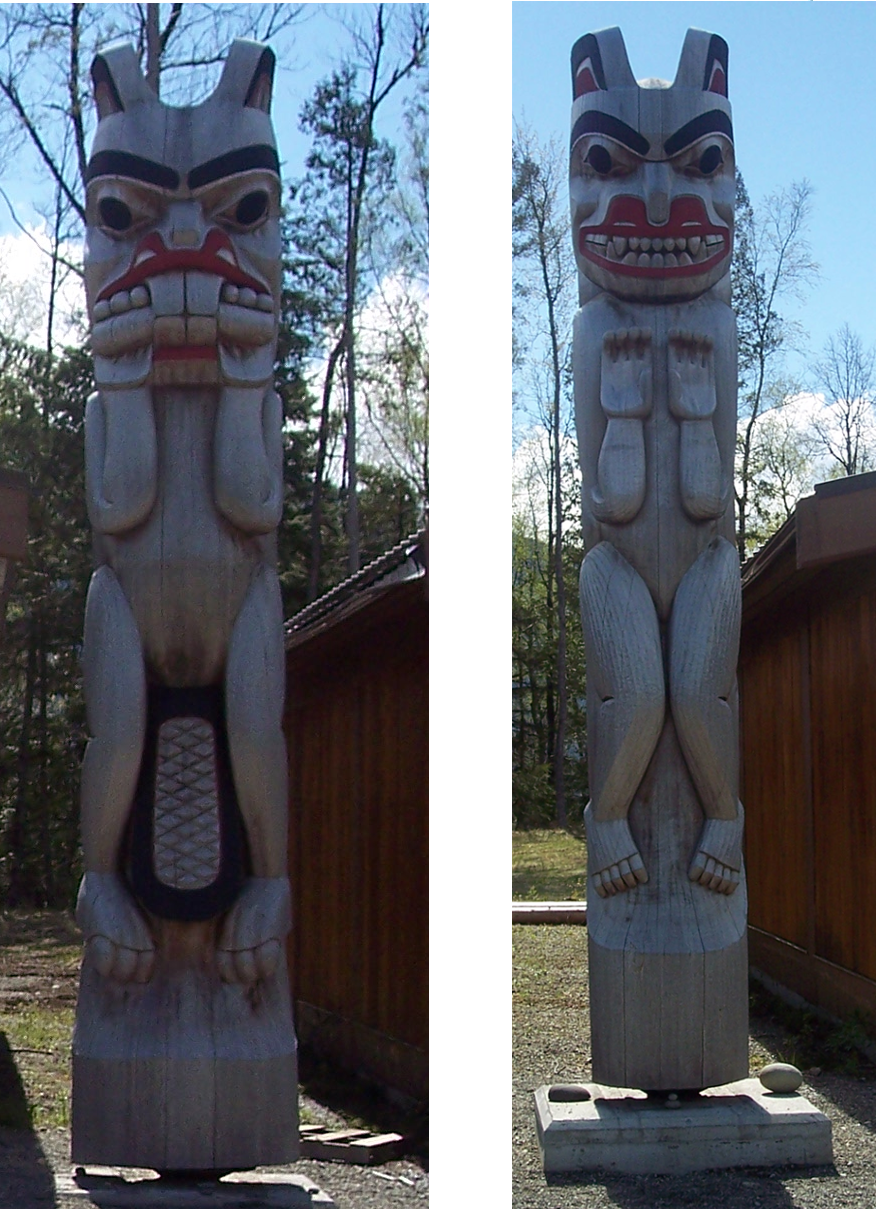
In front of the line of longhouses, are the carved figures of a grizzly bear and a beaver:

Each of the longhouses, Heron explained to me, would become the showcase for a different aspect of the local Tsimshian culture. About a hundred meters across the gravel was the future gift shop and the washroom.

However, the current buildings were just the start of the plans. Eventually, part of the leveled gravel will become a ground for dances and ceremonies. And, behind the gift house, a path lead down to the archaeological site where the original village had been located. I would have liked to descend to the site, where an interpretive center was being built, but Heron was unsure of his right to go there. He had a key to the gate, and having worked on the top of the site, had no hesitation about going there, but the archaeological site was another matter – perhaps because he was not a member of the Kitselas First Nation.

Nor could we enter any of the longhouses, because alarms had been added recently to them. Naturally, I was disappointed, but I was glad that some pre-cautions were being taken, because apparently one of the longhouses had already been broken into. In fact, considering some of the art work there, I can see a day coming when the site has security staff around the clock.

Still, even without seeing everything, I was impressed, both by what had been done and what I imagined the finished result would be. Between the magnificence of the setting and the carvings by Dempsey Bob, Stan Bevan, and their current and ex-pupils, Kitselas Canyon has every chance of being the cultural and tourist landmark it is intended to become. Personally, I can’t wait to see what it should become in a few years — and I’m grateful to Dean for the preview.

Read Full Post »

« Newer Posts - Older Posts »