Feeds:
Posts
Comments

Posts Tagged ‘art’

The Nu-chu-nulth (formerly known as the Nootka and West Coast) were among the earliest First Nations to have contact with European explorers. Yet today, very few Nu-chu-nulth artists are well-known. I can think of Patrick Amos, Joe David, and Tim Paul, and have to do a web search to come up with any other names. This lack is unfortunate, because, while the Nu-chu-nulth sometimes work in the northern formline tradition, their art also includes at least one other – possibly two — schools of design that are unparallelled anywhere on the Northwest Coast.

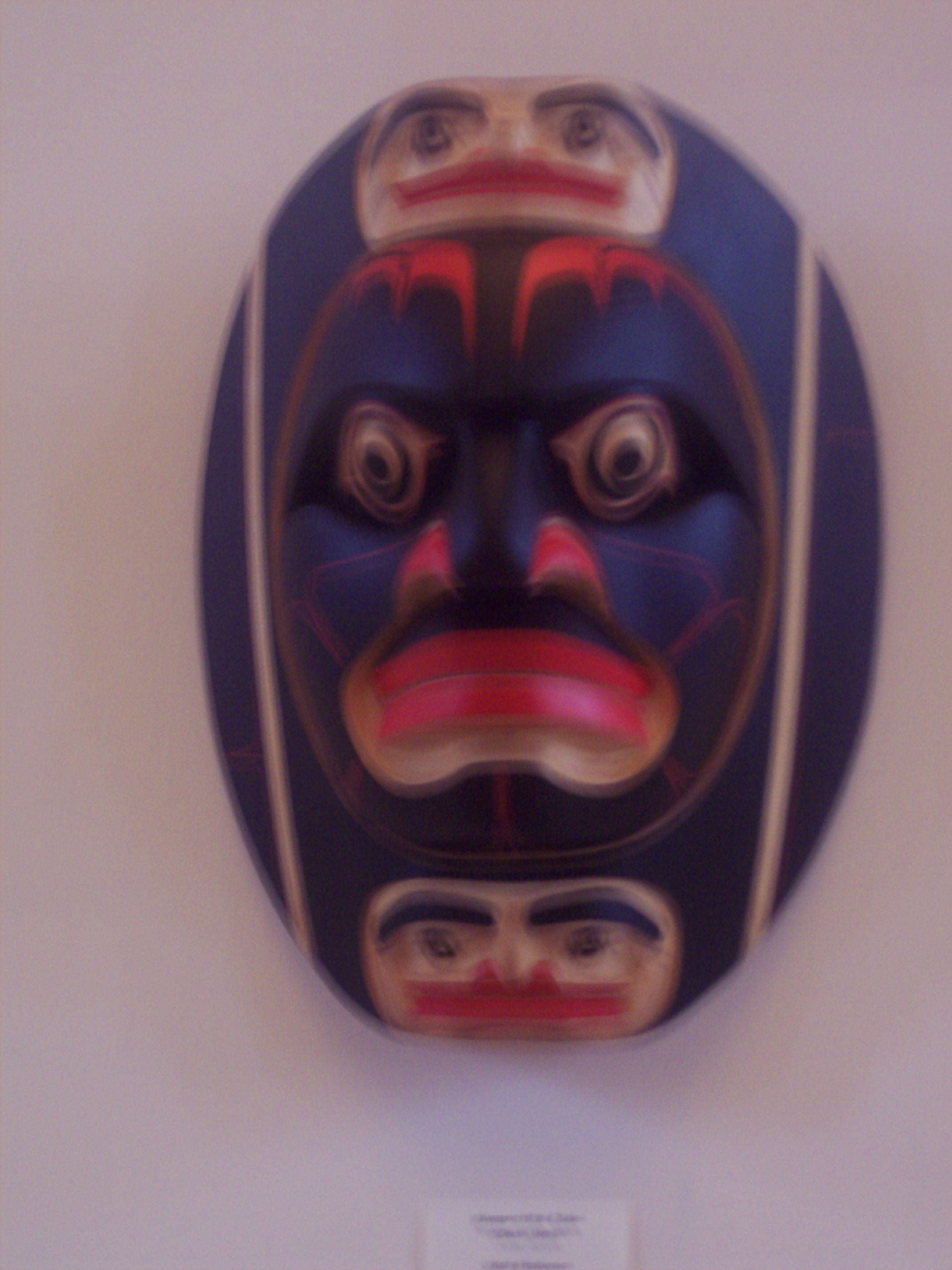
For that reason alone, a few months ago when Kelly Robinson recently offered his “West Coast Wild Man” mask for sale, I was happy to add it to the works on the walls of my townhouse. But I was also glad to buy because the mask was not like anything I had ever seen before.

A 2012 graduate of the Freda Diesing School, Robinson has been selling his jewelry to galleries for several years. More recently, at the Northern Exposure show at the Spirit Wrestler Gallery, three of his four pieces sold within the first three hours of the show. He is also a skilled painter, and one of his canvases, “Mother of Mischief,” already hangs on my wall.

However, most of Robinson’s work is in the Nuxalk style. He has only occasionally explored the other side of his heritage and worked in the Nu-chu-nulth style, but if “West Coast Wild Man” is any indication, he could have a significant contribution to make to that tradition as well.

There are few references for Nu-chu-nulth stories, no matter what name you search under. I assume that the Nu-chu-nulth wild man has some similarities to the Bukwus of the neighboring Kwakwaka’wakw or possibly the Gagiid of the Haida. All three are often depicted with large hook noses and grimaces, and probably their symbolic taming was a feature of the midwinter dances in all three cultures.

Probably, though, the parallel is not exact. The Bukwus is a dwarf, often conceived as being dead, who tries to tempt the living into eating its ghost food so that he can carry them away. Often,  like the Gagiid, he is said to originate as a shipwrecked voyager.  The Nu-chu-nulth wild man seems to share these characteristics, since the culture often raised memorials of skulls to shipwrecked sailors, but almost certainly some of the other context is missing.

To even a casual observer, Robinson’s mask shows obvious signs of the Nu-chu-nulth style, with the inverted skull dangling below the chin, the straggling hair, and the unusually large eye sockets and relatively small eyes. Whether the hair, which resembles dreadlocks, is also traditional or Robinson’s own innovation, I am uncertain, but either way, the general influence is obvious when you compare the mask to the work of carvers like David or Paul.

However, if you continue the comparison, you will notice something else. If you search on the Internet, you will soon notice that David’s or Paul’s work has an air of historical re-creation. Both artists reach a high level of quality, but their work is little different from that done a century and a half ago in the same tradition.

There is nothing even mildly wrong with this choice, and I look forward someday to having works by both David or Paul around the house to enjoy. But, having trained with some of the leading woodworkers on the coast today at the Freda Diesing School – artists like Dempsey Bob, Stan Bevan, and Ken McNeil – Robinson is trying to do something more.

Consciously or unconsciously, Robinson is following his teachers, and thinking of his work as fine art. His use of both paint and abalone is restrained, and his wood is finished to modern standards. He also takes full advantage of the grain, shaping it to fit his carving. While obviously based on past Nu-chu-nulth tradition, the result is something that – so far as I am aware – no other Nu-chu-nulth artist has attempted. And what is even more important, Robinson succeeds, producing a work that is both contemporary and not quite like that of any other artist.

This originality – admirable in anyone, but especially so in such a comparatively young artist – is sensed almost immediately by anyone who views the mask. Robinson delivered the mask to me at the opening of the Northern Exposure show, and the first response of each of the half dozen people I showed the mask to responded was a sigh of wonder. “West Coast Wild Man” is an original work of unexpected power, and if Robinson can continue to meet the same high standards in other works, his future as a major artist on the coast seems assured.

Read Full Post »

Paintings have never been a large part of modern Northwest Coast Art. Since the 1960s, artists have preferred to release limited edition prints instead. Recently, though, this trend has shown signs of changing.

Ever since the 1960s, limited prints have been far more common than paintings. The reason is simple economics: A limited print costs the buyer anywhere from half to one-tenth the price of a painting, which pleases buyers not interested in an investment. If a run of a hundred can be sold, the artist makes much more than they would from a painting – enough, with luck, to allow them to earn a living from their art.

As a result, limited prints have long been the norm in Northwest Coast Art, despite the forgeries that have been periodically discovered. By contrast, artists interested in painting have often found selling their work to galleries difficult. A few exceptions exist, such as Robert Davidson in the last decade, but they are exceptions because of their fame.

A better indication of the status of paintings in Northwest Coast art is the fact that even an artist as accomplished as Lyle Wilson could only manage a show consisting entirely of paintings this year – and at least two-thirds of the pieces were completed decades ago and had never sold. Meanwhile, an artist’s first limited print is still seen as an important step in their career.

However, the days when prints could be counted on to fund an artist’s career are rapidly coming to an end. Hundreds are entering a market that once sustained dozens, thanks in part to the relative cheapness of producing a print from a computer compared to traditional silk screening.

Perhaps as a result, the average price of a print has declined or remained static, with many prints available for well under a hundred dollars unless the artist is well-known. Moreover, where, thirty-five years ago, so-called limited prints could have a release of five or six hundred copies, now releases of a hundred, or fifty, or even twenty have become common, partly to reduce forgery and partly to ensure that artists are not left with a large inventory of unsellable prints.

At the same time, Northwest Coast artists are more closely connected to other schools of art than they have been at any time in the last sixty years. Artists like Dean and Shawn Hunt have succeeded to some extent in selling canvases outside the usual Northwest Coast markets, and new artists – an increasing number of whom have attended art school – are becoming more interested in painting as well. In fact, I know several young artists who began working on canvas and only learned carving and metalwork later.

Whether on wood, paper, or canvas, painting has suddenly become semi-respectable. The Douglas Reynolds Gallery has been showing an increasing number of high-end paintings over the last couple years. Similarly, Lyle Wilson may have had to go to the suburb of Maple Ridge rather than downtown Vancouver to mount his recent Paint show, but the point is he managed to have the exhibit. And, as I write, I have just returned from the Lattimer Gallery’s opening reception for “medium: Painting on Canvas,” an exhibit of over fifteen canvases by both new and leading artists.

Slowly, painting is becoming acceptable in Northwest Coast art. It still has a ways to go – according to Peter Lattimer, for many of the artists in his exhibit, working on canvas was a new and not wholly comfortable experience. But the change is coming, all the same.

Most likely, painting will not replace limited prints. A handful of top artists are still doing well with limited prints, and will probably continue to do so for years. However, a day might come within the next decade when most limited prints are viewed as tourist wares and no longer as fine art.

Read Full Post »

When I travel to Terrace every April, I spend three days submerged in art. Not only is the Freda Diesing School’s graduation and year end exhibit my official excuse for the trip, but I meet other artists and view their works in progress. This year, one of those artists was Ivan Adams, a Haida carver doing some unique work in argillite.

Ivan Adams is the father of Mitch Adams, a middle-aged artist from whom I’ve bought half a dozen pieces in the last three years. Last year, I met Ivan over Sunday brunch, and several times Mitch has mentioned his father as an artist, but until this year, I had never seen any of his work.

This year, Mitch drove me up to his parent’s house, and we sat in their kitchen while his father showed what he was working on. The three or four pieces I saw were literally like nothing I had ever seen before.

They were not in the argillite style of the nineteenth century, nor were they the inlaid and embellished pieces that most modern argillite carvers favor. As Mitch said, Ivan’s work is a little reminiscent of some Inuit work, but the resemblance is mostly in the scenes of everyday life he favors, rather than the carving style.

What Ivan Adams is doing is a naturalistic, detailed style all his own. One piece is a bear with silver teeth rearing on two legs while a much small hunter attacks with a spear; the base comes apart so you can position each figure separately. Another is a legendary strong man straddling a bull sea-lion and tearing it apart with his bare hands, with the exposed muscle suggested by artfully positioned catlinite (reddish brown argillite). A smaller piece is an eagle, so ungainly that it suggests an archeopteryx. All the pieces I saw were obviously mature pieces, done by an artist with a strongly developed style of his own.

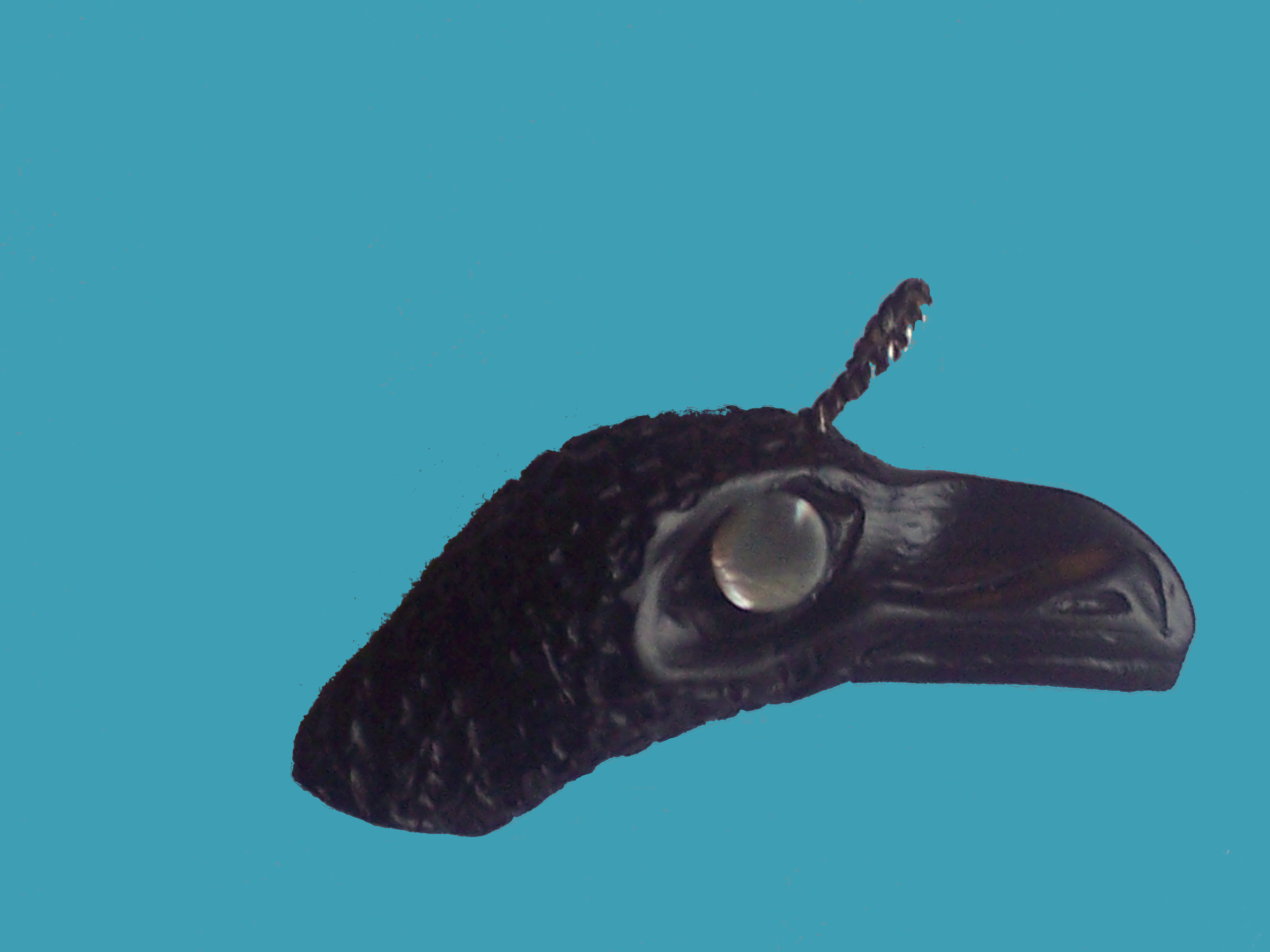
Unfortunately, I couldn’t afford one of Ivan Adams’ larger pieces. However, he also had a raven pendant about the size and thickness of my thumb, which I was pleased to take home with me as consolation.

I suspect the pendant was a left over piece of argillite whose shape suggested its subject. But, like Adams’ larger pieces,what makes the piece standout is the attention to detail. The shape of the beak and how the upper and lower beak fit together are absolutely accurate. Adams has even included the striations that make every raven’s beak as individual as human finger prints, and suggested the soft tissue that connects the lower beak to the body – even though that part of the carving is not seen when the pendant is hanging from a chain. Similarly, the off-white of the inlaid eyes is a close approximation of the natural color of some raven’s eyes.

Yet as if that were not enough, on the head and neck, Adams has indicated individual feathers. Most of these feathers are aligned in rows, but only roughly, with some out of alignment and skewed from the rest, and most of them not quite the same shape. On the top the head, too, the feathers grown smaller as they approach the beak. I have no idea whether Adams has observed live ravens or worked from pictures in a book or on the Internet, but the only way that the pendant does not closely reflect a living raven is that the argillite lacks the blue oil-like highlights of actual feathers.

Ivan Adams is not well-known, and you won’t find his work in any Vancouver or Victoria galleries – at least, not yet. But anyone who takes the pains he obviously does is an artist worth paying attention to. Perhaps one day I will be able to afford one of his larger pieces, but meanwhile the pendant is a very satisfactory consolation.

Read Full Post »

Any exhibit by Haisla artist Lyle Wilson is worth seeing. With a career spanning thirty-five years, in media varying from wood to metal and from jewelry to sculpture, Wilson is one of the major figures in Northwest Coast Art, deserving to be mentioned alongside names like Robert Davidson and Dempsey Bob. However, “Paint,” his current exhibit at the Maple Ridge Art Gallery, is more worth lingering over than most.

For one thing, paint is not a medium that is popular in Northwest Coast art. Its place has largely been taken by limited edition prints, despite the fact that many artists experiment with it. Wilson in particular is not known for it, and went so far at the reception as to say that it was a medium that he disliked. However, given that Wilson says in the program book that he has done over seventy paintings in his career – forty of which are on display in “Paint” – and has stored many unsold for decades, this professed dislike should probably be received with some skepticism.

When Wilson talks about painting, especially the superiority of wood rather than canvas or paper, his tone is calm but clearly engaged, so perhaps the lack of a market has more to do with his claim than any personal preference. Wood, as he pointed out when I talked to him, is the traditional medium for most of the painting on the coast, and he agreed that “warmth” was a suitable adjective for describing its effect compared to canvas or paper.

Which brings up another point: unlike Wilson’s “North Star” exhibit three years ago, which was mostly a display of Wilson’s versatility in different media, “Paint” is about tradition and its role in modern art as much as media. This concern is highlighted in pieces like his illuminated map of traditional Haisla territory, or in his word paintings or his designs that include the major crests of the Haisla nation.

Less obviously, it shows in his attempts to trace ovoids and other elements from the northern style of design to the anatomy of local wildlife; for instance, he suggest that ovoids originate in the eyes of the skate fish.

Tradition, shows, too, in the marine life that crowds Wilson’s work. Skate, halibut, octopi, red cod, salmon – always salmon, the mainstay of traditional life – cluster in much of his work, like “Raven and the Fisherman.”

Other designs are closeups of marine life, or designs made from their intertwined bodies. Their predators, such as the raven, eagle, and the heron also appear. More than most local First Nations artists, Wilson is always mindful that the traditional culture was one that harvested the ocean and depended upon it.

Another way to look at “Paint” is from a personal level. A miniature Tsimshian-style house front and moon reflect Wilson’s personal studies.

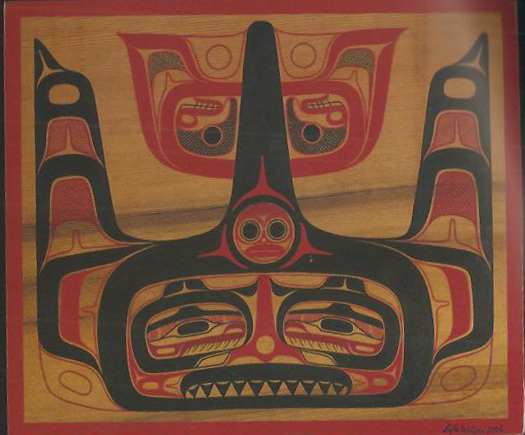
One or two small paintings are studies for larger works, such as “Orca Chief,” which was the model for the sculpture “Orca Chief” at the Vancouver airport.

The exhibit shows, too, how Wilson mixes contemporary life with his artistic tradition, as in his alphabet or maps – the closest, perhaps, in contemporary culture that he can come to the role of art in Haisla tradition – and in his traditional orca spouting rainbows of color.

Circle the exhibit several times, and you can also start getting a sense of his preferred palette, a muted selection of colors far less vivid than, for instance, that of Robert Davidson. In fact, much of Wilson’s strongest work is black and white, where his control of contrast is as subtle as it is effective.

“Paint” is a show that is as intellectual as it is personal. Thankfully, it is accompanied by a sixty-six page catalog that combines Wilson’s artistic statements with personal memories and the sometimes fragmentary remnants of his culture past, as well as a strong plea for a revival of interest in the Haisla language, which is quickly approaching extinction. Far from being the usual collection of glittering generalities, this is a catalog rich in personal and cultural biography that adds genuine aesthetic and intellectual appreciation to the exhibit itself.

In fact, ideally, anyone interested in Northwest Coast art should attend the exhibit, then take the catalog home and read it slowly and carefully in preparation for a second, more informed visit (which is what I hope to do myself, even though Maple Ridge is a ninety minute bus ride away). But even if you can only manage one trip, “Paint” is a major show by a major artist, and you are sure to come away with a stronger sense not just of the artist and his art, but also of the culture behind them.

Read Full Post »

Last week, I flew into Terrace to attend the end exhibit at the Freda Diesing School of Northwest Coast Art.

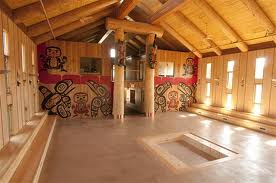
Of the four year end exhibits I’ve attended, this years’ was the weakest, with the fewest number of pieces on display and the lowest quality, but there were compensations. The show was partly a reunion of alumni, with former students such as Mitch Adams, Latham Mack, John Wilson, and Carol Young in attendance. And, as always, Waap Galts’ap, the longhouse on the campuse of Northwest Community College in Terrace, made for a setting that was both aesthetic and relaxing.

Nor was the show entirely lacking in pieces worth lingering over.

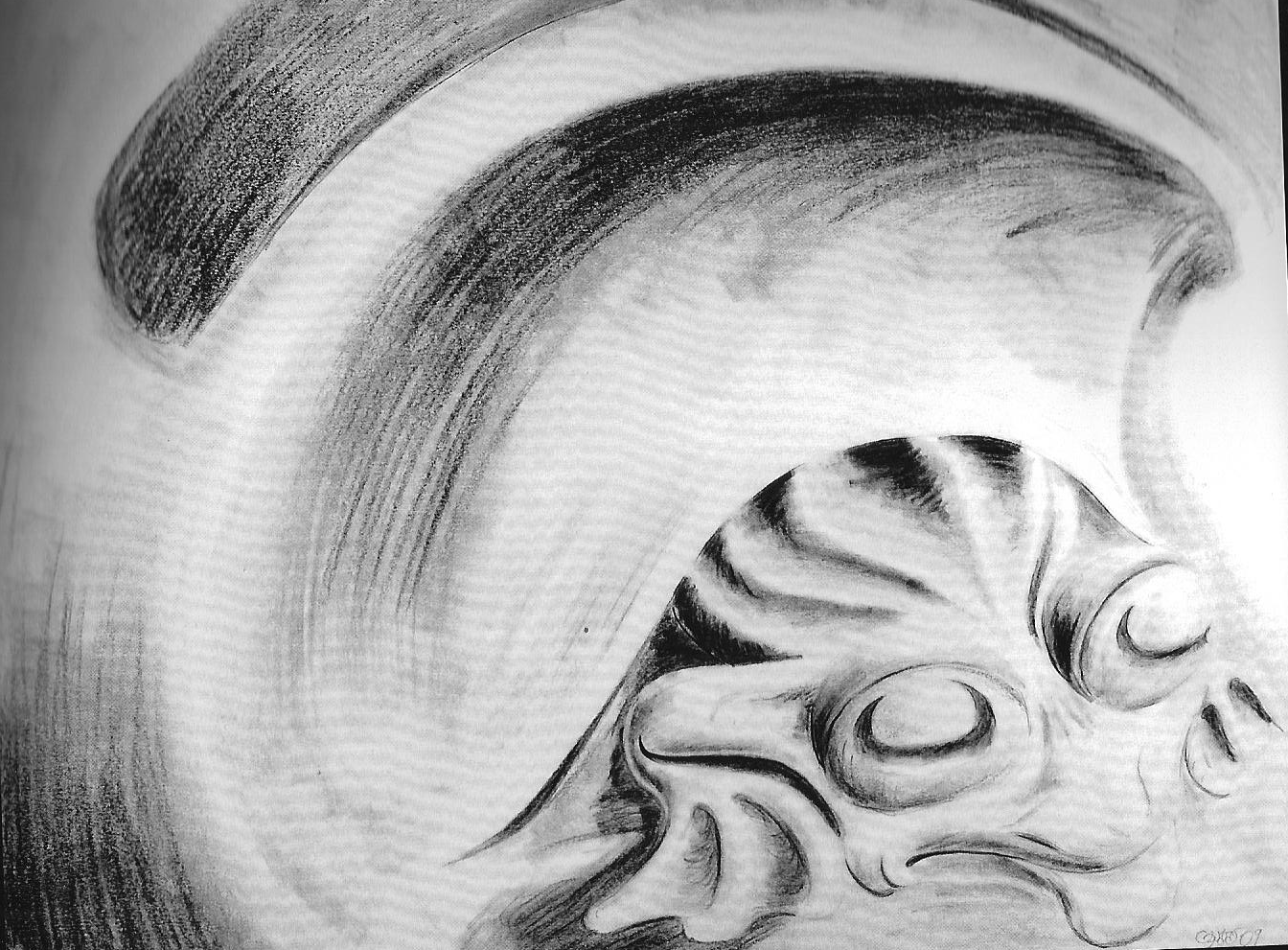
Larry Darrick displayed an abstract panel design that was all the more striking for being in black and white:

Darrick’s “Boogie Mask- Myth of Hairy Man, Bigfoot & Boogie Mask” was also worth a second look for its use of woven cedar for its mess of hair, although its copper nostrils and eyebrows seemed more elaborate than the simplicity of the carving would justify:

Among the spoons and bowls, the painting and lines of Lyle Mack’s “Transformation Spoon” was noticeable, so much so that I found myself wishing he had finished a mask or a painting for the show:

I was especially pleased to see that some of the high-quality work was done by last years’ winners of the Mature Student Award, which I sponsor. Barry Sampare, last years’ winner, showed more attention to detail and finish than most students:

Similarly, Evan Aster, who last year received an Honorable Mention for the Mature Student Award, displayed the same attention to the painted design as in last year’s exhibit to produce a mask of mildly eerie paleness:

Last year’s other Honorable Mention, Moses White, produced the strongest work of his that I’ve seen to date in “Oil Stained Warrior – Blood will spill before oil.” White’s mask had one side slightly higher than the other, but managed to be eye-catching just the same.

One of the standouts of the show was Nathan Wilson, who has already had some commercial success in the galleries. His “Defend the Village: Warrior Mask” seemed to show traces of the influence of John Wilson, with whom he worked privately in the past, but the boldness of design, as well as the mixture of materials (alder, horse hair, abalone, cedar bark, acrylic) was a a rare example of embellishments not overwhelming the design:

My only regret was that Wilson was not displaying more in the show.

First year student Jared “Citizen” Kane was another standout, with prints that were somewhat lacking in detail, but intricate enough that I bought both of them:

Still another standout was Paula Wesley, who plans to continue her art studies at Emily Carr next September. Although Wesley’s carvings looked a little rushed, and were not her best work, her two-dimensional pieces showed a pleasing discipline of line and a complexity of design, as in her “Releasing the Light”:

Wesley also created one of the strongest pieces in the show, a family box design that, had it been for sale, I would happily have bought:

However, pride of place in the show literally went to Kelly Robinson. Already a professional jeweler and painter, Robinson showed that he is equally promising as a carver. The central area of the exhibit was dominated by a display case with a spoon by Robinson, while two of his masks hung facing each other on either side:

In addition, Robinson’s painting, “Box Design (The 4 Carpenters)” hung at the main entrance of the longhouse, and was the most accomplished piece of the entire show:

The title refers to what might be called the celestial contractors in Nuxalk mythology who were charged with making the sun and other aspects of the world. The painting has a boldness and a mixture of traditional and contemporary that many visitors to the show admired, and I am proud to say that it will soon be on my living room wall.

With such artists as Kane, Robinson, Wilson and Wesley, the show was still worth seeing, and, as in past years, both the students and instructors couldn’t have been more welcoming. I look forward to seeing what the grads do next (and maybe buying more of their work), and how the first year students improve after another year of instruction.

Read Full Post »

Gwaai Edenshaw was long overdue for a solo exhibit. Both a goldsmith and a traditional carver, he is an artist’s artist, and his work is in popular demand. However, for his first exhibit, he has chosen to emphasize another aspect of his work: his graphite and ink drawings, and their role in his artistic process. “Sounds Good on Paper,” currently at the Petley Jones Gallery, does include some his work in gold, but largely to illustrate the importance of his preliminary drawing in his jewellry.

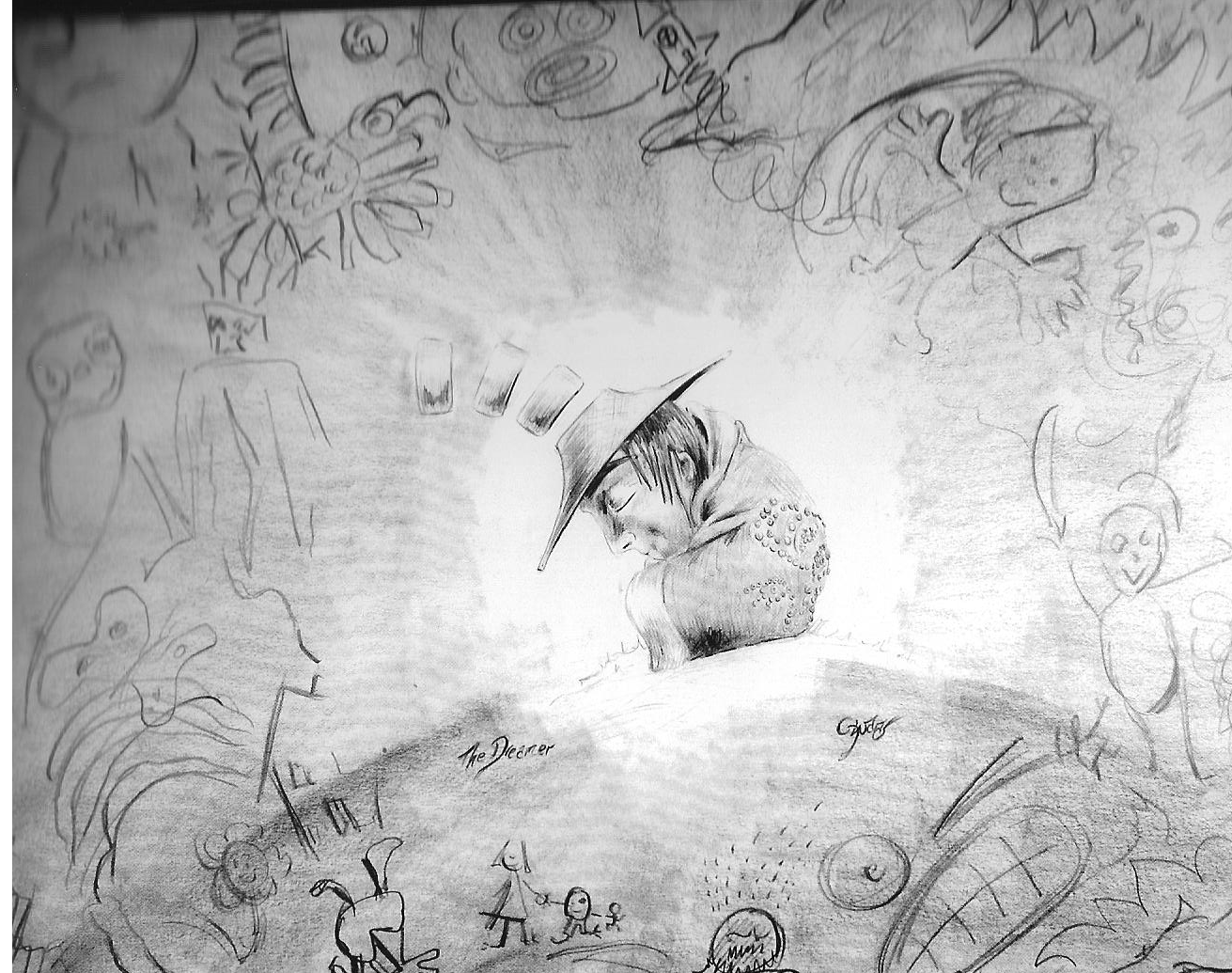
With this theme, the show’s catalog inevitably chooses “The Dreamer” as the piece on the cover. The piece is not only an obvious choice for the theme of the artistic process, but for Gwaai himself (to use the name with which he signs his work). The cartoon style is a reminder of his animation prototypes for teaching the Haida language, and the rings on the hat, a sign of high status in traditional culture an indication of the importance of art among the Haida today. At the same time, the doodles around the margin, as rough as they are, have a non-traditional look. Also, to anyone who has sat down with Gwaai for any length of time, they are a reminder of his constant doodling.

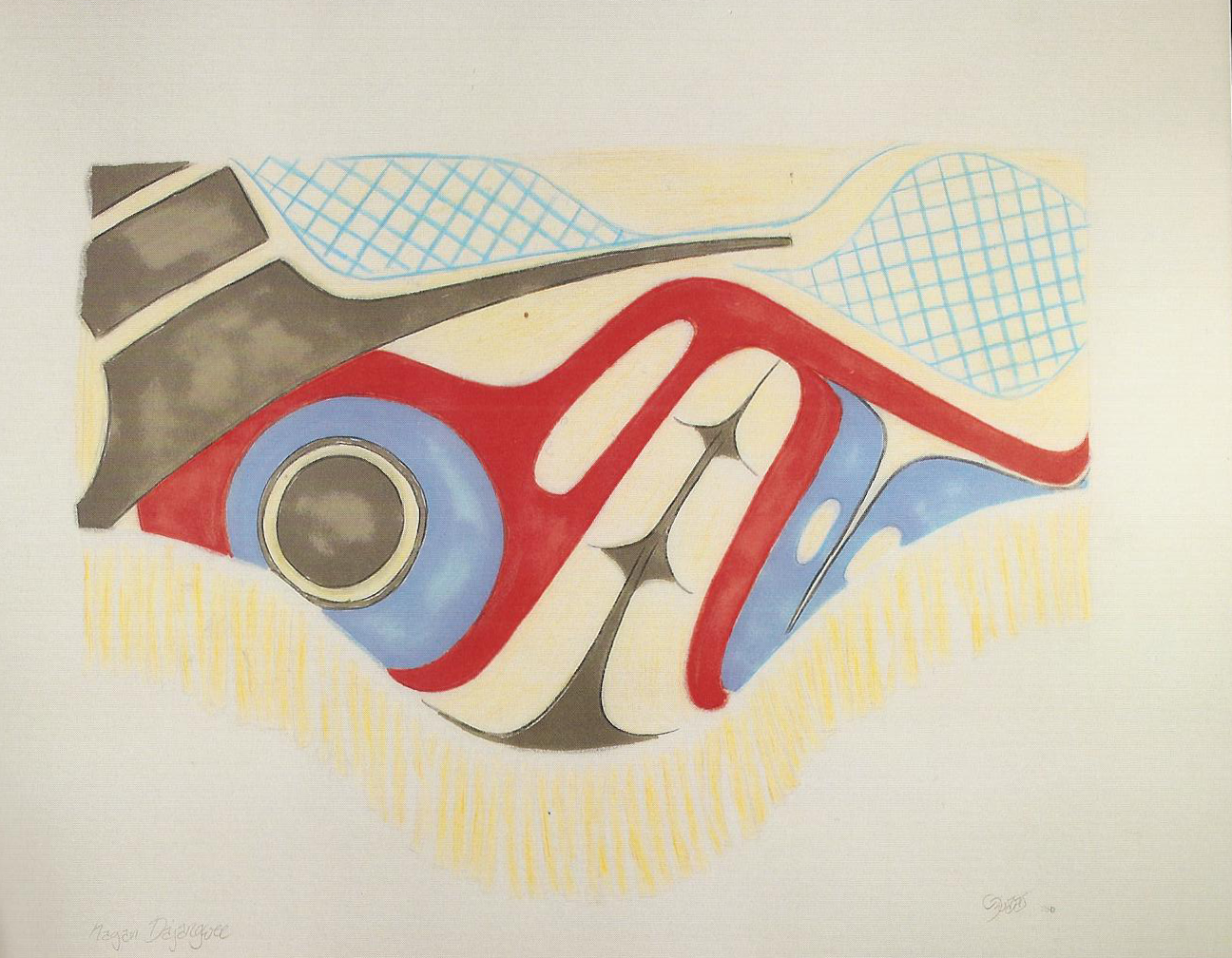
Other pieces in the show emphasize Gwaai’s different traditions and influences. Some, like “Kagan Dajangwee,” are slightly stiff exercises in the northern First Nations style, with their formline and cross hatching:

Others, like “Nanasimget,” a depiction of an Orpheus-like figure in Haida mythology, look like a two-dimensional rendering of a metal casting (and, perhaps not coincidentally, are reminiscent of some of the sketches of Bill Reid, Gwaai’s mentor when he was a teenager):

At the opposite extreme are more mainstream pieces. “Ts’aahl Girl” (Eagle Girl), for instance, combines realism with a touch of whimsy:


Similarly, the two studies of Gagiid, the Haida wildman whose lower face is pierced by the spines of the sea-urchins he is forced to eat after being castaway, bear a distinct resemblance to Gollum as portrayed by Andy Sirkis in The Lord of the Rings:

This movement between traditional Haida culture and urban industrial life – so effortless that it includes analogies – suggest the position of the modern First Nations artist. For those of us who have met him, it also seems very typical of Gwaai’s wide-ranging mind.

Some of the most interesting pieces in the show offer a glimpse of the creative process.For example, “Detail: The Two Brothers Pole” shows the precision-drafted plans for a pole that Gwaai recently completed with his brother Jaalen, and a view of the raised pole. The pole is located in Jasper National Park, and was a replacement for a repatriated pole that was appropriated from the Haida in 1907 and that is often attributed to Charles Edenshaw:

A more personal glimpse of the relation between sketches and other media is provided by “Sons of Djillaquon” and the gold pendant “Sons of Djillaquons:”

Both the sketch and the pendant are powerful works in their own right, but together they illustrate what is gained and lost in the transfer between media, as well as the limitations of each. It is this relationship that makes the oxymoron title of “Sounds Good on Paper” a suitable title for the exhibit.

Casual observers might be tempted to to describe “Sounds Good on Paper” as a minor show. And, in one sense, they would be right: most of what is displayed are not the pieces for which Gwaai has rightfully gained his growing reputation.

Yet such a view would also be short-sighted. More than anything else, “Sounds Good on Paper” is a very personal show. It displays many different aspects of Gwaai’s personality – probably not all –and offers a tantalizing hint or two of his creative process and his interest in different media.

My only regret is that the show couldn’t include some examples of Gwaai’s argillite prototypes for his jewellry. Placed beside the finished jewellry, these prototypes could have provided yet another perspective on the concerns of the show.

However, even without this touch, “Sounds Good on Paper” remains interesting both aesthetically and psychologically. It’s been a long time since I’ve seen an exhibit that shows so much of the artist without a hint of arrogance.

Asked the day after the opening what I thought of the exhibit, my first response was, “It’s very Gwaai.” Having had a few more days to think, I still that response the most accurate I could have given.

Read Full Post »

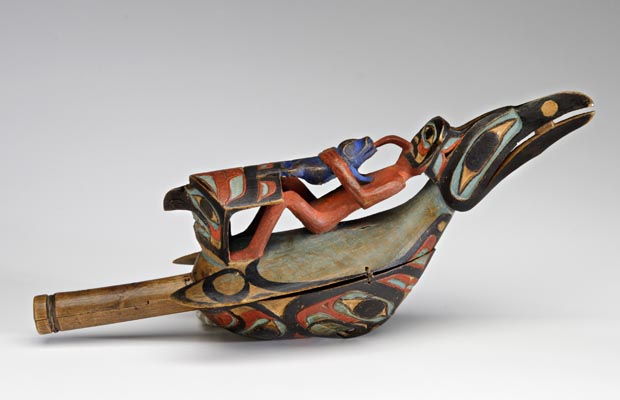
Haida/Tsimshian artist Mitch Adams seems to be making a career out of smaller pieces. Not that he avoids larger pieces; his “Blue Moon Mask” is one of my favorite pieces on the walls of my townhouse. However, in the last year or so, he has done masks from laminated blocks of wood about the height of my finger, a brass magnifier, a couple of combs, and, most recently, a briarwood pipe, filling a niche shared by few other artists. With a length of ten centimeters, his “Raven Rattle” is another of his miniatures – and one of my favorites among his work.

Contrary to what you might think, rattles of this size are not a recent development. Although modern tools makes carving at smaller sizes much easier, rattles the size of this one appear in artifacts of a century and a half ago. Some might have been used, concealed, in the magic and theatrics of the winter ceremonies. More likely (since the sound doesn’t carry far), small rattles might have been used by shamans, working up close with sick patients.

Aside from the obviously modern paint, Adam’s main innovation is his material – boxwood. The stand is a piece of driftwood, or (as I like to think of it), two-thirds the price of a Special Platter at The Afghan Horseman, where I last had dinner with Mitch and his wife Diana and took the rattle home with me. Unpainted, the base provides a contrast with the largely painted rattle. The rattle can be left on the base, in a position in which it resembles a rocket, or else lifted free and used, in which case it gives a delicate, half-hissing sound.

Like the size, the subject and composition is also traditional. The rattle depicts Raven the trickster, the face in his belly representing the light that he has stolen from the chief who hoarded it. On his back is a red human figure facing a raven’s head, their tongues intertwining to suggest communication, and a reminder of Raven’s ability to change from human to bird shape. You might also take the quasi-sexual posture of the two figures, as well as the round belly containing the face in the light of some of the details of the story: Raven has impregnated the chief’s daughter with himself to be reborn as the chief’s grandson, so he might have a chance to get close to the light.

As for the composition, it, too, has a long tradition. For instance, just before writing this entry, I came across a picture of this two centuries-old Haida piece in the McCord Museum in Montreal:

The subject is different, but the composition similar, although Adam’s piece was never meant to rest on its bottom, and has a more streamlined look. With a few minutes’ research, I could easily turn up another two of three similarly arranged rattles.

None of these comments are meant to suggest in any way that Adams lacks originality. Rather, I’ve made them to point out that the rattle is a piece within a tradition. Its shape and intricate painting of details are more than enough to establish Adam’s ability – and to make me curious about what he will do next.

Read Full Post »

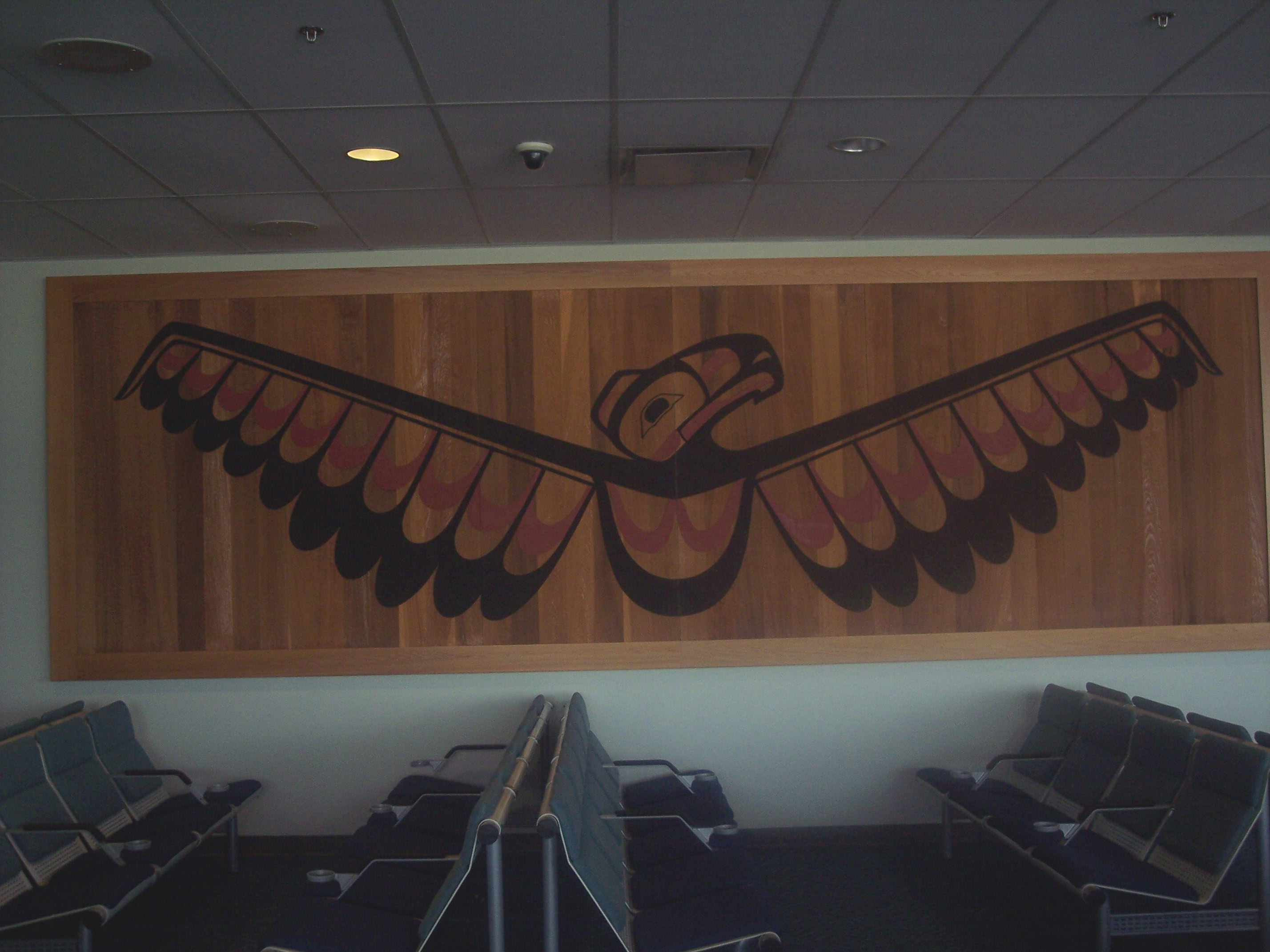
YVR, Vancouver’s airport, is noted for its collection of local First Nations art. I’ve wanted a tour for over a year, but they aren’t always easy to come by, since they involve weaving in and out of security areas. However, today my chance came at last. Together with Ann Cameron, the editor of Coastal Art Beat and my colleague on the YVR Art Foundation board, we followed Rita Beiks, the airport’s art consultant, back and forth through the terminal until I was throughly lost, but marveling at the airport’s collection.

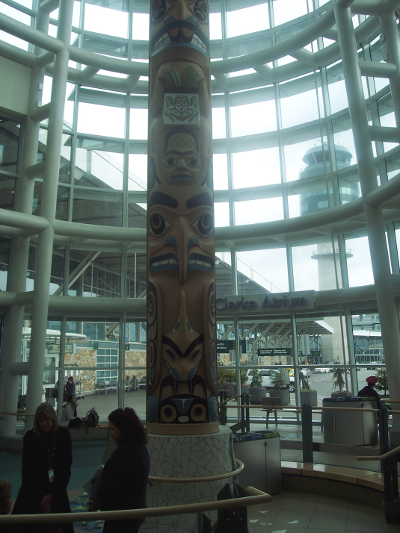
We met at the foot of Don Yeoman’s “Celebrating Flight,” a four-story pole that mixes Haida mythology with Celtic knotwork and a greeting in Chinese. The knotwork and Chineese characters, Rita said, replaced the originally planned figures because of some knots in the wood that made the figures impossible. By itself, the pole is impossible to photograph without a crane and bucket, but when you realize (as I had not) that everything from the panels representing the northern lights at the top to the mosaic on the floor and the moon some distance away are all part of the installation, then taking a complete picture becomes even more impossible.

From the pole, we walked to the terminal’s best-known installation: Bill Reid’s “Jade Canoe,” version of “The Spirit of Haida Gwaii.” The “Jade Canoe” is a copy of the “Black Canoe” at the Canadian embassy in Washington, D.C. However, while the “Black Canoe” is barely visible for security reasons, the “Jade Canoe” is so accessible that people have rubbed the bronze patina off the paddles and some of the other reachable parts of the sculpture. A sign telling people not to climb the sculpture is necessary, and the tradition has grown up that rubbing Mouse Woman’s nose is good luck.
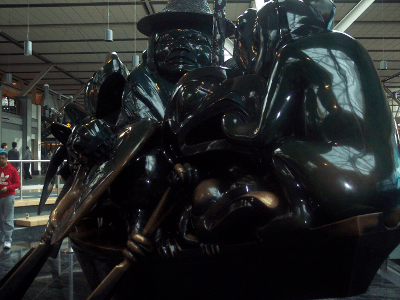
Rita gave a brief history of the negotiations for the piece, which cost three million – an unheard of figure for an airport to spend on art in the early 1990s, and mentioned that the piece was orginally intended to have a copper patina, and changed to bronze only after a phone call from airport official Frank O’Neil to Reid, who at the time was in intensive care. She also pointed out that Lutz Haufschild’s “The Great Wave Wall,” which replaces the nearby windows on the terminal, was chosen as a suitable backdrop to Reid’s iconic piece.

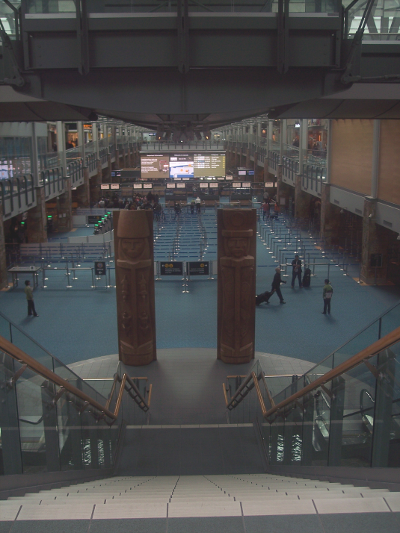
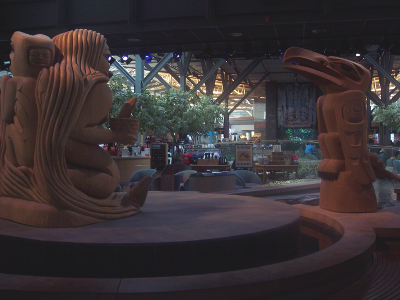
Leaning over the railing, we looked down at the arrival level to Nu-chu-nualth artist Joe David’s “Clayoquot Welcome Figures.” Originally carved for Expo 67, the figures are on permanent loan from the Vancouver museum. Their popularity is so great that they needed a railing to protect them; even so, money is still regularly found in their hands.
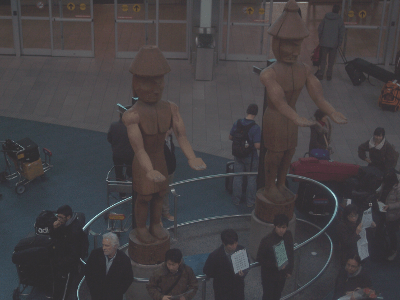
We then moved into the secure area for departure and arrivals. Strangely enough, Rita and Brenda Longland, the airport official with us, both had to submit to the usual inspection of their belongings, while Ann and I sailed through without any problems with our visitors’ badges.
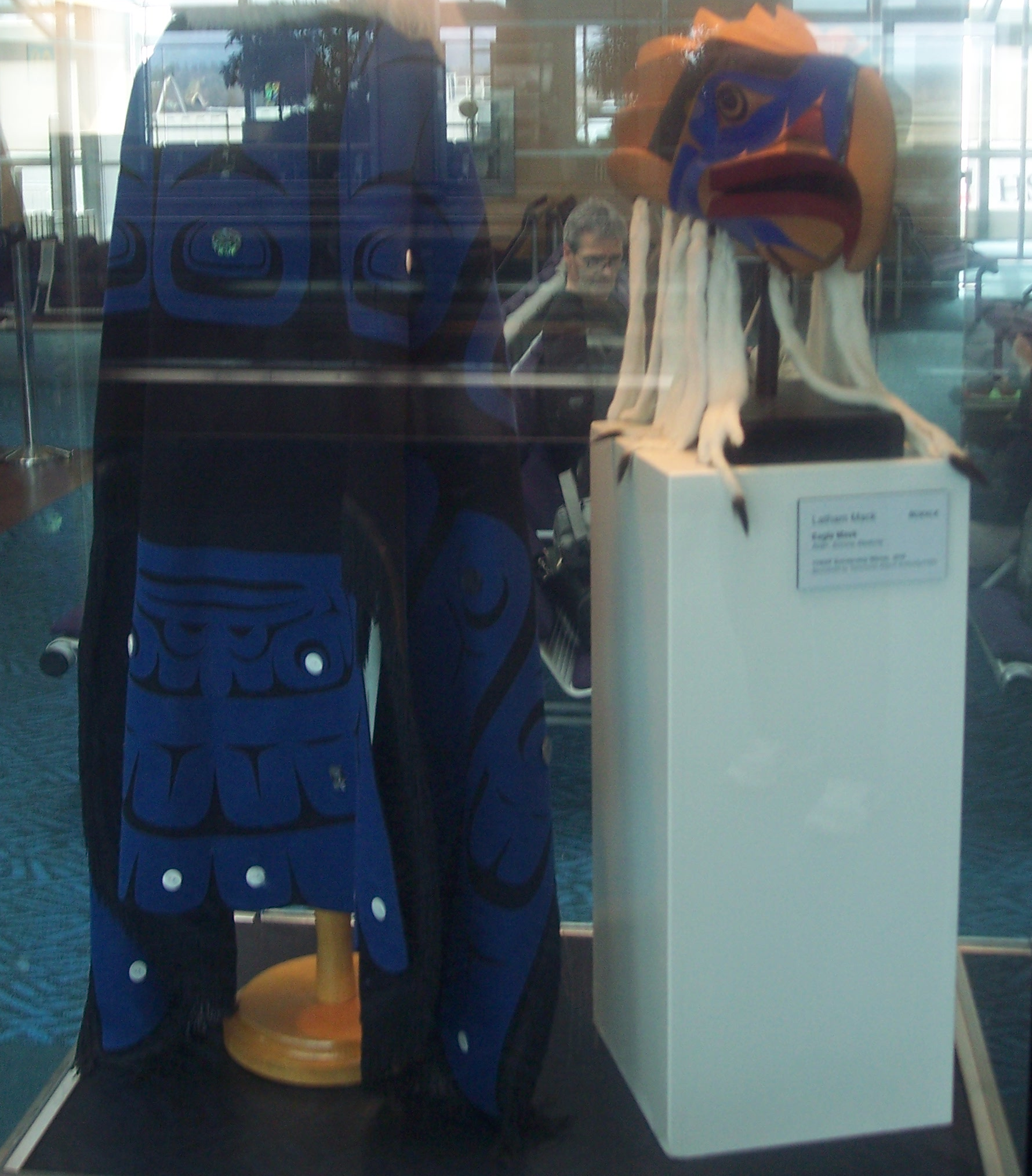
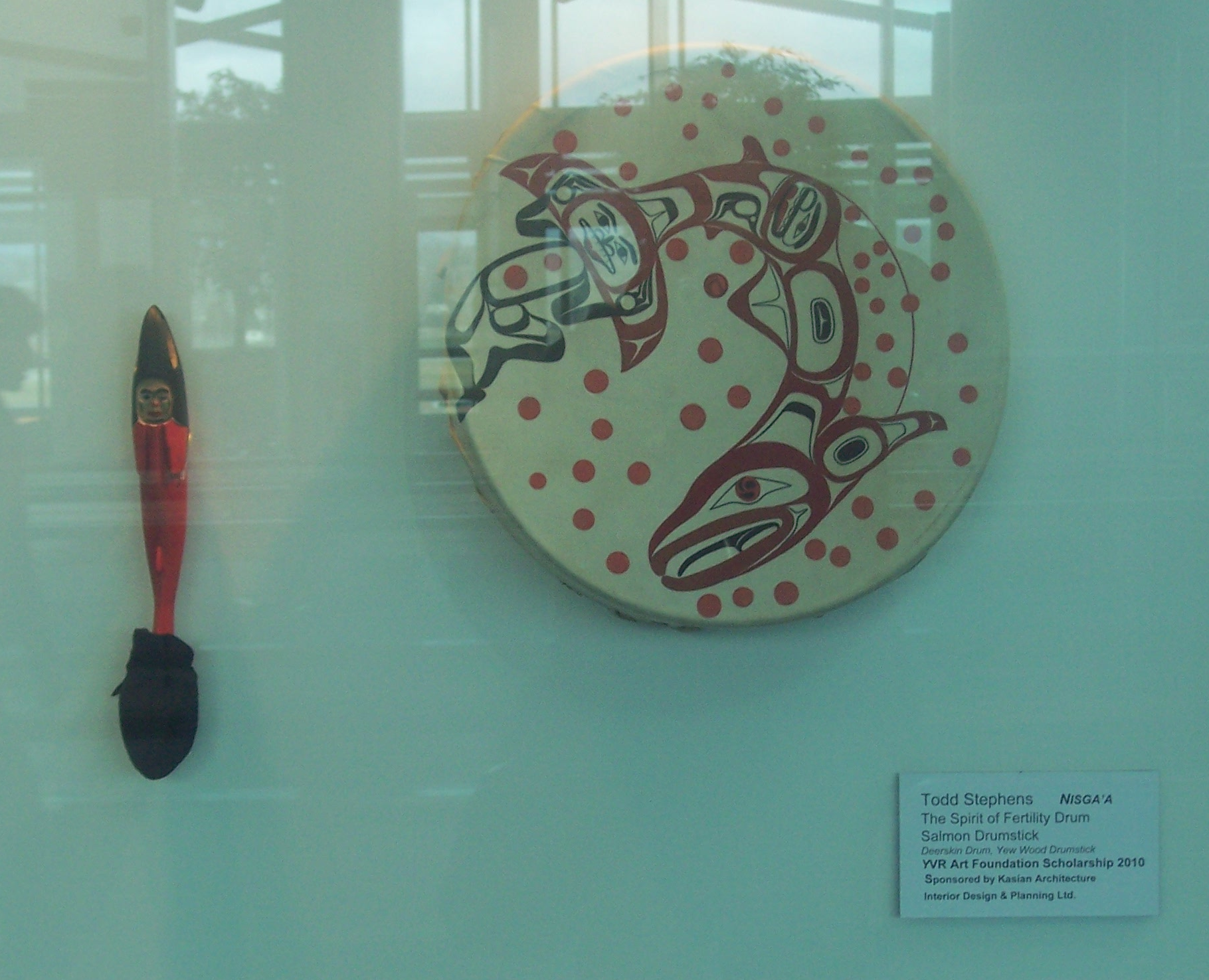
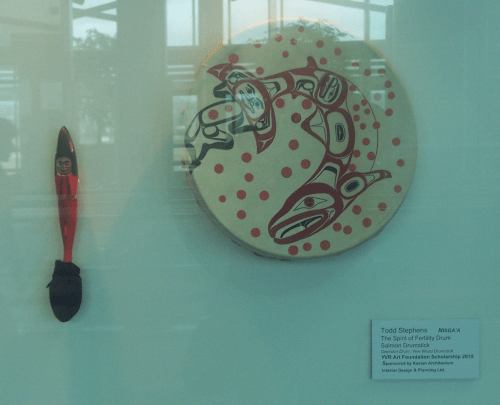
We passed display cases with the works of YVRAF scholarship winners from 2010, including Latham Mack’s Nuxalk mask and robe, and Todd Stephen’s drum. Like the other scholarship pieces scattered throughout the terminal, these pieces will be on display until June 2012, when they will be replaced by the work of the 2011 scholarship winners.

The next permanent display was the Pacific Passage in the arrivals area, a combination of diorama and original art.
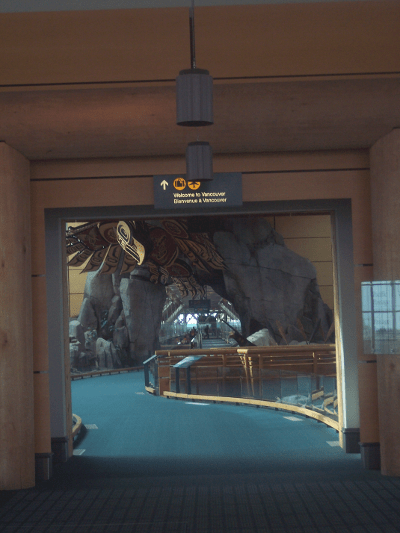
I had seen the Pacific Passage several times, but always after a long flight that left me rushing to the fresh air, and uninclined to give the art treasures on display more than a passing glance.
That was a mistake on my part, because the display is well worth lingering over. It is dominated by Connie Watt’s thunderbird.

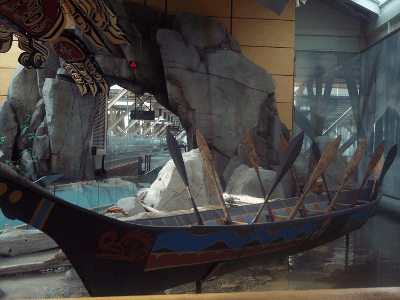
Also in the area is an aluminium panel by Lyle Wilson and a canoe by Tim Paul, as well a number of smaller pieces. Bird sounds start as soon as you enter the area, and I was amused to see the swallows who live in the terminal sheltering in the empty eagle’s nest that was added to the dioramas for realism.
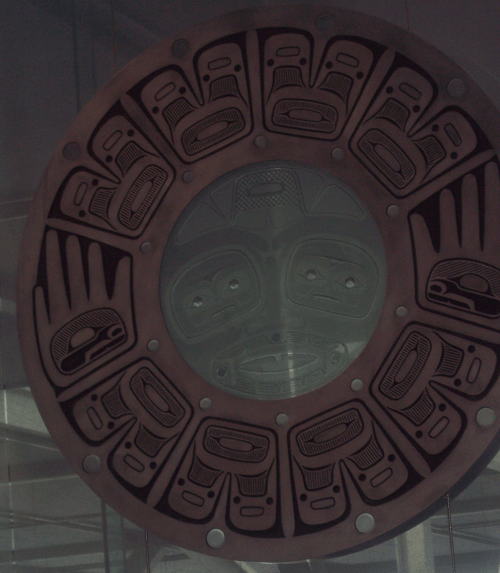
Walking down the overhead walkways, we stopped next at the Musqueam Welcome area, the contribution of the First Nations people on whose territory the airport stands. According to Rita, Frank O’Neill, the airport official responsible for the idea of the First Nations collection, was convinced of the need for the area when the Musqueam chief told him that not having the local nation included there would be like having a sign in Ireland saying, “Welcome to the United Kingdom.”

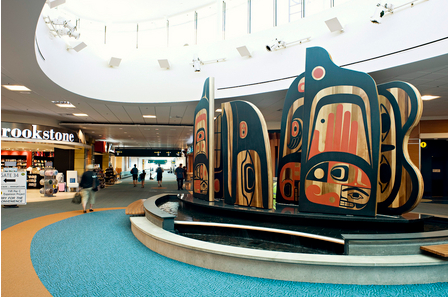
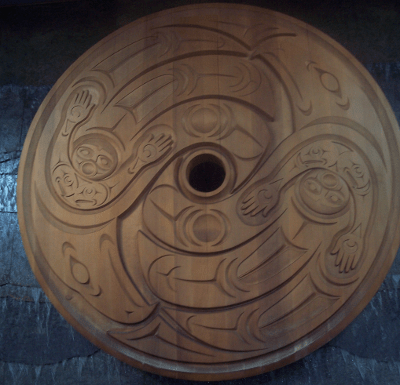
Accordingly, arrivals are greeted first by the Musqueam, and then by Canada. One of the first sites arrivals see is Susan Point’s giant spindle whorl set against a waterfall – an impressive site even if you have been flying all night (although the palms to each side are incongruous; can’t native plants be used instead?).
Turning to the stairs and escalators that lead down to the custom booths, the first thing arrivals see are free-hanging samples of Musqueam weaving.

Moving to the steps and escalators, below them arrivals see the Musqueam welcome figures. These were originally carved by Shane Point, but when Musqueam women complained about the sagging breasts on the female figure, it was replaced by the less controversial figure by Susan Point that stands there today.

Only as you descend do you appreciate the sheer size of the figures; by the time you are on the same level, you realize that they are enormous.

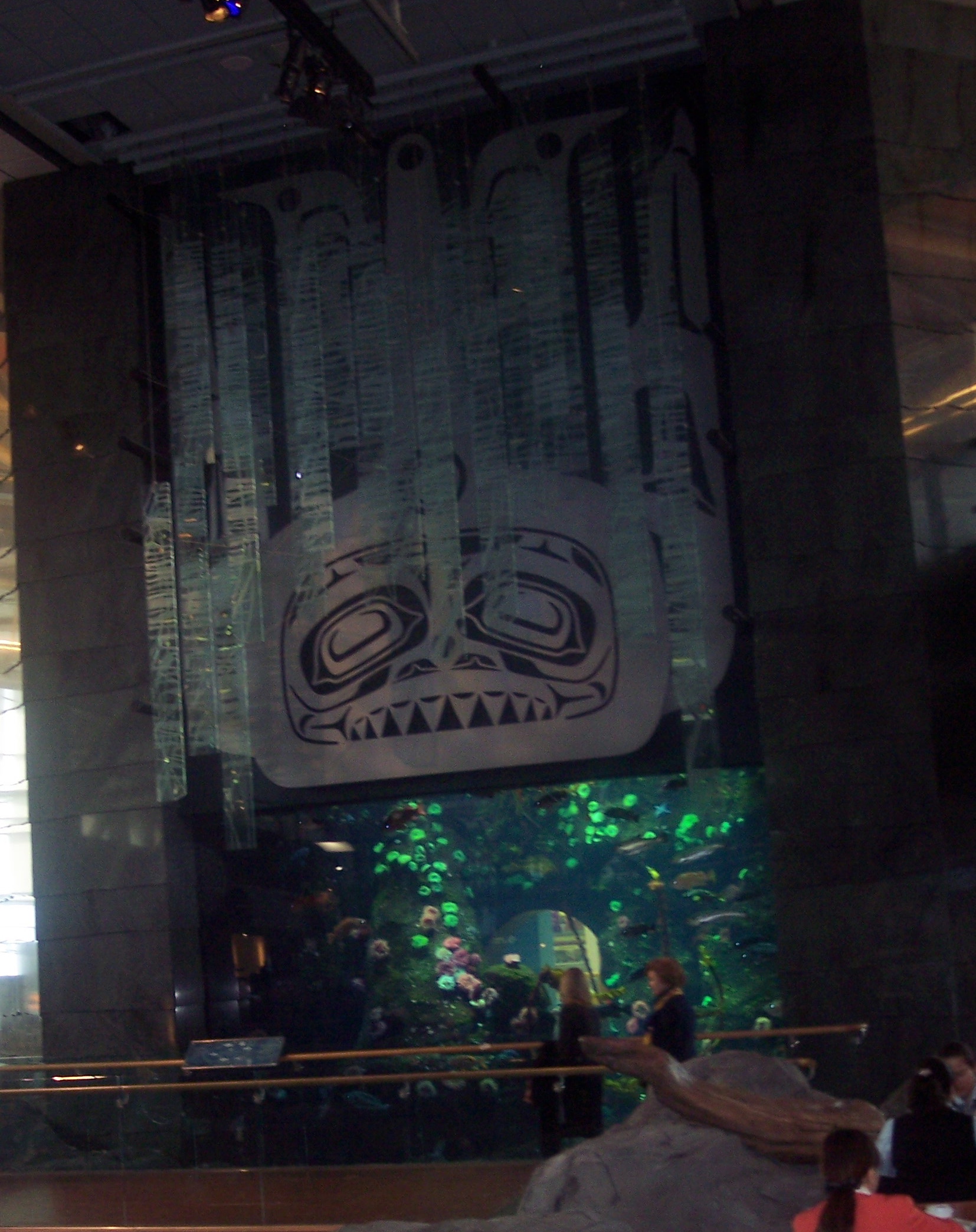
Our next stop was the artificial river that begins with an installation by Tahltan master carver Dempsey Bob, and winds down to an oceanic aquarium dominated by another piece by Haisla master Lyle Wilson.

Bob’s piece is “Fog Woman and Raven.” It is based on the tale of how Fog Woman, mistreated by her husband Raven, gathers up all the salmon from the streams and smoke houses, and prepares to depart the world with them. A little stiffer than many of Bob’s works, it is still a piece worth lingering over because of the details like the salmon caught in Fog Woman’s hair.

The figures are carved from laminated blocks of cedar – an expensive process that is rarely done because it involves shutting down a mill for the better part of a day. In fact, the first laminted block for Fog Woman was found to be punky inside, and had to be abandoned.

Bob’s tableau is surrounded by chairs, and would be a pleasant piece to linger beside, but, unfortunately no food vendors are nearby, so nobody does. Annoyingly, too, small merchandise displays are crowding the piece (we asked a cashier to move an obscuring sign, but it was back when we passed by again half an hour later)

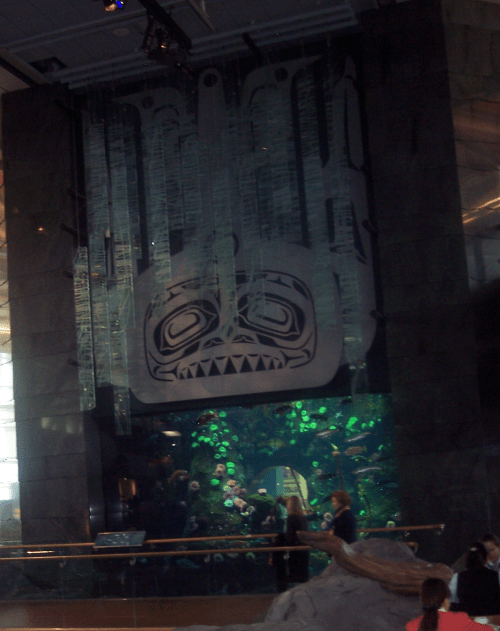
At the far end of the river, Lyle Wilson’s “Orca Chief and the Kelp Forest” rest on top of an aquarium of fish, so that the chief lies half hidden in the kelp made from glass and looks down at the subjects whom he protects. Rita says that few people look up, and reactions to Wilson’s piece proves her point, since most people looked at the fish moving back and forth, but few ever glanced up to see the art above them.
Our last major stops on the tour were two pieces by Steve Smith. The first, “Freedom to Move,” is a series of painted panels that are intended to slow people down in their hurry through the airport.

Unfortunately, the piece is squeezed into a space too small for it, and the pool that is supposed to surround it is dry, but Smith still managed to slow me down for an appreciative moment or two.

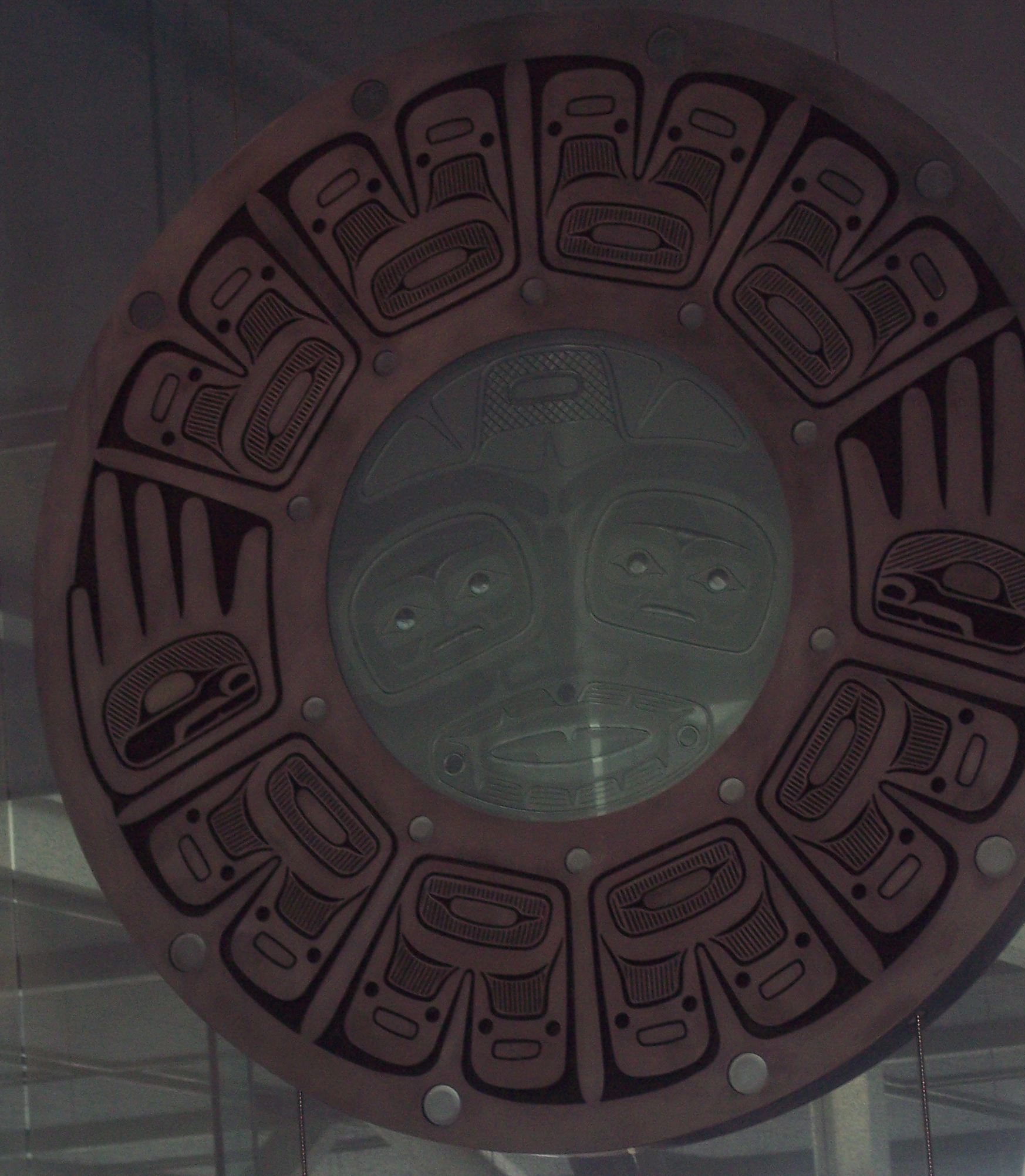
The second of Smith’s installations, “Sea to Sky,” named for the highway to Squamish and Whistler, is a series of drums hung beneath a sky light. What we saw was the second version of the piece, parts of the first having been damage by temperature problems, crumbling with a sound like artillery one winter day (fortunately without anyone being hurt. Smith took advantage of the incident to paint bolder designs, and sold what remained of the first version.

These are only some of the collection we saw today. There were also a number of pieces by Roy Henry Vickers that were originally part of a longhouse that has since been destroyed. The longhouse’s pillars and several other designs are now temporarily scattered throughout the airport, most of them unlabeled.
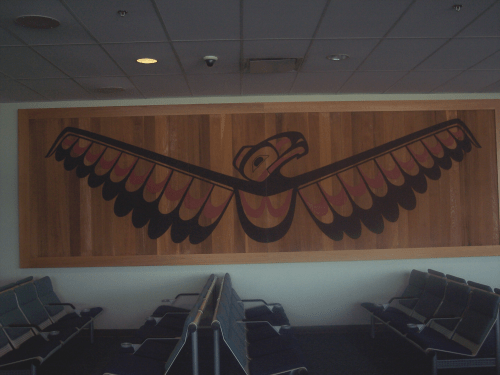
Display cases throughout the terminal also carried such treasures as Hazel Wilson’s famous “Golden Spruce” blanket, which commemorates the recent felling of a particular tree famous in Haida mythology, Tim Paul’s “ClearCut and Dressed,” and some outstanding non-native work by local artists such as Graham Smith. However, enumerating the entire collection would require a blog five times as long as this one.

For lack of time, we also didn’t get to the “Supernatural World” installation by Dempsey Bob, Robert Davidson, and Richard Hunt on the domestic arrivals level. And the only reason Susan Point’s “Cedar Connection” was included in the tour was that we passed it on the way to the Skytrain and the parking lot as we left.

Still, I didn’t feel cheated by any omissions. After four and a half hours, my brain was as numb as my kneecaps. I had taken in as much art as I could appreciate for the day, and rode the Skytrain home, full of the dazed content that comes from prolonged exposure to fine art.

Read Full Post »

Last year, I started the Northwest Coast Art Meetup Group. But the assistant organizer proved unreliable, and, I couldn’t afford renting meeting space in downtown Vancouver every month – a necessity, since I’m in the suburbs. Lacking support, I stepped down as organizer. But I regretted the failure, and was as pleased as I could possibly be when Stacey Jessiman. took over and announced a new meeting.

Last night, a half dozen of us met at Stacey’s house on the west side of Vancouver to hear Bill McClennan, a curator at the Museum of Anthropology, deliver a slide show on the recently-concluded Charles and Isabella Edenshaw exhibit. Meeting in her house helped to keep the atmosphere informal, and the expenses down.

Charles Edenshaw is generally considered the premier Nineteenthh Century Haida artist, and recently his wife Isabella has received the credit she deserves for spruce root weaving of baskets and hats, many of which were painted by her husband. The show at the Museum was an unprecedented bringing together of his silver work (although not, unfortunately, his argillite carving) and her surprisingly well-preserved weaving, and I had visited it twice in the last year.

Not that I objected to seeing slides of some of the pieces, many of which came from private collections or distant museums, and aren’t easy to see. Charles Edenshaw’s work, with its use of negative space, remains surprisingly modern, especially in its use of blank space – perhaps because he heavily influenced artists like Bill Reid and Robert Davidson. Similarly, I am intrigued by the thought that Isabella’s work has distinct knots and patterns that, to an expert, identifies it as hers.

In addition, Bill did a good job of putting the Edenshaws in context, showing surviving pictures of the houses where they lived, and even the general store on the banks of the Skeena where Charles Edenshaw sold his art while Isabella Edenshaw labored in the salmon canneries down the beach.

However, I was equally intrigued by Bill ‘s behind-the-scenes account of the exhibit. The Edenshaws’ descendants number in the hundreds, and perhaps a quarter attended a private viewing and celebration the night before the official opening.

For example, Bill relates that as the descendants entered the exhibit’s gallery, he was surprised to see that many left quickly. Apparently, some were concerned that the spirits connected to the pieces were upset by the chaos of the crowd, and only re-entered after elders performed a ceremony to calm the atmosphere.

Bill also explained that, at any exhibit, some pieces always receive more attention than others, and that he was curious to see what those pieces would be at this one. To his surprise, the main attraction was a blown-up photograph of Isabella Edenshaw. Although the Haida were forced to become patrilineal by English and Canadian society, matrilineal remnants are still strong among the Haida (so much so that some thought the patrilineal descendants shouldn’t be invited), so Isabella was of of more interest than Charles. Many, too, were interested in the Edenshaw’s four daughters for the same reason, and some had never seen pictures of their female ancestors.

In fact, interest was so strong that the pictures were carried out of the gallery into the main hall for the celebration. In the slides Bill showed, the pictures stand in the background, almost, as he said, as though Isabella and her daughters were waiting to speak or to enter the dance floor. For me, hearing about these personal touches helped me to recognize that the exhibit was not just an artistic event, but a cultural and familial one as well.

This information was delivered informally, with Bill propped against a cushion on the floor next to the projector, and the rest of us arranged on the furniture around the fire. It was an atmosphere that rented space could never have matched, even without the buffet of salad, bread, cheese, and drinks that Stacey prepared.

All in all, I’d call it a successful re-launch. I look forward to the next meetings (although I suggest they be potluck, so that everyone can enjoy them). Obviously, the meetup is now in much more capable hands than before.

Read Full Post »

Over the last few years, I’ve received four masks and three prints from Haisla artist John Wilson, as well as a bentwood box carved and painted by him. The masks in particular are among my favorites hanging in the townhouse, and show Wilson’s increasing expertise as an artist. My latest purchase from Wilson, “Blind Shaman in a Trance,” illustrates the level he’s reached – one that makes his work stand out among the artists who have established themselves in the last five years.

“Blind Shaman” depicts a common theme in historical Northwest Coast art, and one popular among many modern artists: a shaman going about his business as the mediator between different aspects of reality. A blind shaman was thought to be compensated for his lack of sight by greater inward vision, and this one has the additional support of frogs as spirit helpers. As creatures who change form as they grow, and as adults move freely between the water and the land, frogs are especially suitable as helpers, because they embody exactly the freedom of movement between planes of existence that the shaman tries to develop. Unsurprisingly, the placement of spirit helpers like mice or frogs on the cheeks and forehead are a common feature in shamanistic masks in the northern tradition, particularly among the Tlingit.

Like much of the work that Wilson has done this year, “Blind Shaman” is more complex than the portrait masks that comprise the bulk of his work. Although his past work shows that a face alone can be interesting, “Blind Shaman adds additional figures, making for a more complex composition, even before painting. In fact, in some ways, a picture of the mask in progress that Wilson posted on Facebook is more interesting than the final version, because the lack of paint emphasizes the carving more, as well as the shadows it creates.

However, the mask has an effect when painted that it could never have when unpainted. By rising to the top of the nose, the blue triangle that covers the lower face allows an easy reversal of figure and ground. At first glance, the mask appears to be a face surrounded by frogs, all much smaller than the face. But if you focus on the mouth of the figure on the forehead, then suddenly the frogs on the cheeks look like hands, and a much larger figure is looming over the shaman’s face, consisting of mostly uncarved wood. Focus again, and the mask appears in its original form. This reversal emphasizes the fact that the shaman’s trance involves him opening up to forces larger than himself, perhaps even inviting possession.

From either perspective, “Blind Shaman in a Trance” is an arresting piece of work. I look forward to seeing what Wilson does next – and, meanwhile, this latest mask is a welcome addition to one wall of my bedroom.

Read Full Post »

« Newer Posts - Older Posts »