Feeds:
Posts
Comments

Posts Tagged ‘Terrace’

Last year, when I attended the Freda Diesing School Student Art Exhibition in Terrace, I noticed that most of the awards were for students 25 years old or younger. The school has some fine younger artists, but I thought that the older students deserved some recognition, too. To fill the gap, Trish and I decided to sponsor a Mature Student Award of $1000 per year, and to work towards making the award self-funding.

The official description of the award reads:

This award is given annually to a mature student (25 and over) from the
Freda Diesing School of Northwest Coast Art who has demonstrated
leadership and mentoring qualities in the classroom. Faculty from the
School of Northwest Coast Art will select a student after confirmation of
enrollment in the second semester of the certificate or diploma program.

The award recipient must; be a First Nations Freda Diesing School of
Northwest Coast Art student; identify and work with a mentor to facilitate
the ongoing learning process; reside in British Columbia; demonstrate
potential in visual arts in the Northwest Coast style; and display
mentoring and leadership qualities in their relationships with other
students in the school both inside and outside class.

The award will be given for the first time in January 2010.

I have two main reasons for starting the award. First, as a late bloomer in my own craft of writing, I sympathize with the mature students. Being a student is hard enough when you are twenty, but when you are thirty-five or fifty, returning to school is even harder, because you probably have a family, and you are more set in your ways. Often, it means giving up a steady income when you’ve been used to one for years.

At the same time, I know from years as a university English instructor that older students are worth encouraging. They add a maturity to the discussion, and often serve as role-models and mentors to younger students.

Second, I am a buyer and lover of northwest coast art, especially art in the northern style taught at the school. I am not one of those people descended from Europeans who feel personally responsible for the wrongs against the First Nations that began before I was born, but I do believe in paying my debts and in doing the little I can to alleviate current problems. Northwest Coast art has given me hours of pleasure and learning, and I want to repay those hours with more than simple payment for each piece. I’d like to think that the award would help a student a little in the short term and in the long term maybe help them to launch their careers.

Compared to the other awards that the school gives, the Mature Student Award is starting off slowly. But I hope that it will eventually match the other awards, and become self-perpetuating.

If you are an artist, an art dealer, or someone who appreciates Northwest Coast art, please consider donating to the Mature Student Award. But don’t contact me. Instead, please contact Jill Girodat, the Associate Registrar at the Terrace campus of Northwest Community College at 250-638-5477 or jgirodat AT nwcc DOT bc DOT ca.

Read Full Post »

“How does this compare to a show down south?” John Wilson asked me last week, shortly after I arrived at the Freda Diesing School Student Art Exhibition in Terrace. He seemed surprised when I told him that a 23 person show with some 75 pieces almost never happened, but it’s true. The annual show is one of the largest annual exhibits of modern Northwest Coast Art anywhere.

The show lasted only two days, with a private viewing for friends and family on Friday and a public viewing on Saturday. The location is the Freda Diesing Studio on the Terrace campus of Northwest Community College, a well-lit building with a large lower floor ordinarily occupied by work benches and a loft for a more conventional class room setting:

fd-studio1

Just inside the door, above the table with the show catalog and price list were a few prints by Freda Diesing herself, including a self-portrait mask:

fd-self-portrait

These works were not for sale, but stood as tutelary spirits of the show – or, more precisely, as the standards to which the students should aspire.

Several months ago, I reviewed the school’s mid-term show via a collection of pictures sent to me by John Wilson. That show was mostly painting and sketches, the first year class in particular having not begun its study of carving at the time. By contrast, the year-end show had a few two-dimensional pieces, but consisted largely of paddles, spoons, and masks.

Painted paddles are closer to two dimensional than three dimensional works, so I was not surprised when two of the best-designed paddles were from Shawn Aster and Latham Mack, two artists who were among the standouts at the earlier shows and scholarship winners at the graduation ceremonies that accompanied the private viewing:

shawn-aster-paddle

latham-mack-paddle

However, making the transition from the two-dimensional craft of painting to the three-dimensional one of carving does not always comes easily, and many students are still making it. Latham Mack, for instance (who as a Nuxalk, is learning his second style of carving), is well on the way, using the same blue that I am starting to recognize as characteristic of his two-dimensional designs:
latham-mack

By contrast, a mask by Shawn Aster shows a sense of surfaces, but seems more tentative, with a shallowness in the carving and a thinness of line that makes you only appreciate the mask up close, as seen in this (unfortunately cropped) picture:

shawn-aster-mask

A similar lack of ease in three dimensions is true of Todd Stephens, another scholarship winner from whom I’ve bought several paintings:

todd-stephens

Other students showed similar learning curves – and, as might be expected in a student show – a certain tendency to conformity – although Norman McLean, Sr., in a triumph of social sensibility over aesthetics did do a bright pink mask, as well as a spoon with a more discrete pink ribbon around the handle as fund-raisers for breast cancer. Still, there were some interesting pieces here and there.

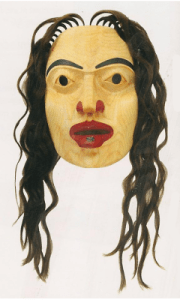
Sophia Patricia Beaton, another scholarship winner, had only one piece in the show, but the wavy hair and the obviously feminine face and the labret were original enough to make me wonder what the rest of her work might be like:

sophia-beaton

I also noticed James Weget-McNeil’s frog mask, which, although in a very different style, reminded me of some of the faux-artifacts that Beau Dick has been carving recently:

james-weget-mcneil1

However, much of the interesting carving came from mature students with more experience.

Charles Richard Wesley, whose work I noticed in the mid-term show, came up with two interestingly intricate masks:

charles-richard-wesley

I also appreciated John Wilson’s work, which he says represents an advance in finishing details over his earlier work – pointing, for example, an indentation of the eye sockets at the top of the nose:

john-wilson

These are just some of the pieces in the show, but, aside from the bowls (something needing to be left out), they give an idea of the variety to be seen at the show. I appreciate the chance to see students learning and mastering their craft, and while some flaws and weaknesses are apparent, there are just as many examples of solid and skilled works.

In fact, I could have come away from the show considerably poorer. Fortunately or unfortunately, depending on my shifting perspective, most of the pieces I considered buying were marked NFS, many earmarked for a show at the Spirit Wrestler Gallery in Vancouver later this month.

But buying is only one reason to attend such a show. A far better reason is spend a few hours surrounded by efforts of art – and that, so far as I am concerned, is more than enough reason for me to want to attend next year’s show.

My thanks to Stan Bevan for seeing that I got an invitation. That small kindness gave me an enriching day.

Read Full Post »

“Nasty disturbing uncomfortable things!” Bilbo Baggins says about adventures in The Hobbit. “Make you late for dinner!” Working out of our townhouse, I sympathize with that view. But, as with Bilbo, there must be something Tookish in me lying in wait. When I was invited to go to Terrace for the end of the year show at the Fred Diesing School of Northwest Coast Art, I was determined to go. To fly 1350 kilometers only to return the next day seemed more than a little quixotic, especially when I didn’t feel I could really afford the trip and had never met anyone there, but the whole idea seemed irresistible. For someone who had never been farther north than 100 Mile House, it seemed a small adventure, all the more interesting because I was moving way out of my comfort zone.

I flew out of the South Terminal of the Vancouver Airport, a relic of quieter days that services the coast and the remoter areas of British Columbia. After looping around the city, with me peering out eagerly to spot the Metrotown Towers, Swangard Stadium, Cleveland Dam and other visible landmarks, we headed north. The mountains grew progressively taller and more snowcapped, and I tried not to be disappointed that all I could see of the coast was the occasional inlet masquerading as a river at first glance.

I won a T-shirt in an on-board raffle, and hoped it was an indicator of how my luck was running.

As we circled Terrace and descended to the airport, I could see signs of logging that showed that I was flying into a resource extraction community. From the air, I could see that the evergreens flanking the highway were often only one hundred meters thick, and that the town, whatever its other virtues, was a stranger to zoning in most areas.

At every other airport I’ve ever visited, taxis are always awaiting incoming flights. But not at the Terrace-Kitimat Airport. Rather sheepishly, I retraced my steps and hunted for the direct phone for the taxi.

After twenty minutes, an Indian driver – that is, someone from India, not a First Nation – picked me up and took me directly to the college. We crossed the Skeena, brown with the spring runoff, and through the mixture of stores and industrial sites that forms the downtown, and up a hill to a suburb where small houses mixed with hobby farms of a few acres and pasturage for a cow or horse or two.

Semi-rural British Columbia, I thought, reminded of places in Surrey and Langley and the Sunshine Coast. I decided I could deal with it.

All the same, the college seemed incongruous when it suddenly appeared. Paying off the driver, I found my way to the cafeteria to fortify myself and ask directions if I needed to.

A bagel and orange juice revived me, and I headed across the parking lot in the middle of the college. A few inquiries confirmed that the building with the high roof and large windows was the Freda Diesing School, just as I had thought. Trundling my carry-on, I stepped inside.

Almost instantly, I was greeted by Jennifer Davidson, Henry Green, and Peter Jackson, at least one of whom must have a stronger ability to recognize people from their photos than I’ve ever managed. Then I started meeting people – Bill McMillian, carver and teacher Stan Bevan, and students with whom I’d been in contact with online but never met, including John Wilson, Latham Mack, Sean Aster, and Todd Stephens, to say nothing of ex-students like Dean Heron. The sheer number of people to meet was overwhelming, and their friendliness left me exhilarated. Really, a stranger couldn’t have asked for a better welcome to a group with such close internal connections.

I just barely had time to go around the show (which deserves a blog of its own) snapping pictures like mad before it was time to trek across campus for the graduation ceremony. While we were milling about, Jennifer Davidson took the opportunity to photograph the copper bracelet that Henry Green did for me eighteen months ago, and Henry threated to straighten it out, evoking a squeal of dismay from me.

After rampaging through the buffet, the crowd sat through the usual round of thanks at graduation ceremonies. Mercifully we were spared long speeches, although I did notice most of the students gradually sitting lower and lower in their chairs. But an end came at last, with the most deserving students receiving awards and all of them praised for their dedication.

Two drummers, one of whom was a student, were supposed to lead a procession back to the studio, but the riff-raff like me at the back lingered so long that we missed most of it. I had a chance to look at the exhibits more carefully, and saw the sketches for one piece that I hope to eventually buy, and all too soon the show was over.

John Wilson drove me downtown, where I found a hotel and we headed out for Chinese food. A sign that we were in the north was that one of the offerings at the restaurant was salmon in black bean sauce.

I had hoped to meet sculptor Ron Telek, but he was busy with family matters, and we had to make do with a quick phone call late at night. I found myself wishing that I had booked another day, both to see Ron and to see more of the town, but, as things were, I fell asleep exhausted and buoyed by the friendly welcome I had received.

The next morning, I was at the airport before most of the staff (Memo: in small towns, the rule of arriving two hours before a flight doesn’t apply). Tired but satisfied, I flew south, putting adventures behind me for a while. But now that I’ve ventured north once, I’m sure I’ll be coming back again. Terrace may be more distant from my townhouse than Calgary, but in many ways it feels more like home.

Read Full Post »

« Newer Posts