Feeds:
Posts
Comments

Posts Tagged ‘Uncategorized’

If I want a day of bird-watching, I don’t have to leave the living room. With four Nanday conures – a type of small South American parrot – in residence, I can even do my bird-watching from the comfort of a chair. And, since three of the four Nandays are male, much of what I watch is territorial posturing.

The dominant cock is Ning. He has several advantages over the rest: He has been here the longest, he is the only one with a mate (Sophy), and he fathered one of the other males and has always lorded it over him. His disadvantage is that he is perhaps a little complacent and starting to get on in years, so he is no longer as aggressive as in his youth.

Of the other cocks, Ram is little competition. Not only is he Ning’s son, but he has a bad leg and is reluctant most of the time to compete – although he can surprise everyone at times with unexpected outbursts of ferocity.

Beau is the third cock, and the relative newcomer. However, he is younger, larger, and feistier than Ning, and probably the most cunning of the three. At first, Ning used to dive bomb him with impunity, threatening him without actually making contact. However, after about six months, he started dive bombing Ning in return, and now he gives as good as he gets.

This is how the living room is divided: Ning and Sophy have a cage on the right side of the room, and Beau’s cage is on the left. Ram’s cage is in the kitchen, but he uses the back of a chair and an arm of the couch by Beau’s cage with impunity, either because Beau doesn’t regard him as a threat, or on the principle that the enemy of my enemy is my friend. Occasionally, though, Beau will chase Ram away from his cage, especially if Ning isn’t there to vent his anger upon.

The dining room table between the two cages is contested ground. However, the futon by the window is definitely Ning’s, although Ram will brave it if Ning and Sophy are in their cage. Beau doesn’t quite dare, although he will pace to the end of the couch and sit as close to the futon as he can without actually being on it.

That is one of the main characteristics of the territorial posturing: Like kids in the backseat of a car who have been told to keep to their side of an imaginary line, Ning and Beau will come as close to the border of the other bird’s territory as they dare, apparently with the sole purpose of taunting each other. Just as Beau crowds the futon, so Ning will often see that his foraging on the carpet brings him close to Beau’s cage, apparently just to have the pleasure of disconcerting him. From their actions, the boundary couldn’t be clearer if it was painted on the carpet.

When not crowding each other, all the males will sometimes shriek at each other, so loudly that we have to pause the DVD we’re watching until we can hear it again. Sometimes, Beau will ambush Ning in mid-flight, too.
Apparently, the urge to defend his nest is strong in the typical Nanday cock. However, what is interesting is that the defense never seems to go beyond posturing, even in what must be the rather limited space in the living room. Not only is there never any real violence, but at times, as they call back and forth, the males seem almost friendly – as though their aggressiveness is only intramural, and, on some level, mutual identification as members of the same flock is as important as claiming territory.

And what does Sophy do in all of this? Mostly, she ignores it. Although sometimes she will loyally give one scream for every dozen of Ning’s, mostly she pretends it’s not going on. But, then, from Sophy’s frequent look of strained tolerance, I suspect she views the cocks — and the local humans as well – as slightly addled fledglings. Somehow, in the middle of all the male battles, she manages to look as though she is humoring all of us in the manner of a benevolent dictator. Her attitude suggests it would be beneath her dignity to notice the feuding in any way.

Read Full Post »

Like most enthusiasts of Northwest Coast art, I am familiar with Haisla artist Lyle Wilson mainly because of his gold and silver jewelry. I was vaguely aware that he was also a carver, but for every pole I’ve seen by him, I must have seen a dozen of his gold or silver bracelets or pendants. That is what makes the West Vancouver Museum’s show “North Star: The Art of Lyle Wilson” so interesting: by focusing on his painting and carving, it shows a side of Wilson that most people only occasionally see.

The show consists of about fifty pieces chosen by Wilson. Ranging from the most traditional of designs painted on cedar to stylized aluminum and a painted acoustic guitar, and from a map of British Columbia’s first nations displayed on the PNE to pieces from his own collection of his works, the selections in the show show Wilson not just as a master artist (I already knew he was that), but also as far more versatile than I realized. The exhibit does include several pieces of Wilson’s jewelry, including one piece that was designed specially for the show, and is being raffled off . However, in size as well as number, it is the paintings on cedar and other sculptures that dominate the two rooms of the museum’s gallery.

At least half a dozen pieces in the show were paintings on cedar. The local first nations, of course, have been painting designs on cedars for centuries, but most Northwest Coast artists today prefer paper to cedar, and prints to painting. By contrast, Wilson’s apparent liking for cedar is not only traditional, but gives his paintings a three-dimensionality that even canvas cannot match, bringing them closer to masks and other carved objects. The grain also gives his painting an additional aspect to catch the eye. On one small painting of a heron, Wilson even combines a background of red cedar with a yellow cedar frame, the contrast adding another source of visual appeal.

Although the show does include several paintings on paper, and one sketch of a miniature pole that is also in the show, they are easy to overlook compared to the works on cedar. One especially interesting piece, which several visitors have declared the best in the show, is a marine scene called “Raven and the Fisherman,” with a blue line separating the canoe, raven and sun above the water from the teeming undersea world of orcas, seals, salmons, sharks, octopuses, eels, and crabs that take up three-quarters of the the painting and bisected by a red fishing line. While individual figures conform to the northern formline tradition, apart from their heavy use of red, the overall composition is asymmetrical and chaotic. Yet, far from appearing naive, the crowded painting against the wooden medium is more suggestive of a classical Chinese screen than anything else.
Another masterful work is of a dogfish, and seems to represent the moment when Dogfish Woman transformed for life in the sea. With its sheer size and the two red eyes with cross-hatched irises and pupils with designs in them, it easily dominated its space, and the gallery wisely placed it as far as possible from other works. Even by the door, across two rooms, it caught and held the eye.

Other examples of Wilson’s woodwork in the show ranged from two intricately carved wooden plates – one designed around salmon, and another, a freestanding sculpture, a yew pendant, and a model spirit canoe.

However, what vied most with the paintings on cedar for my attention were Wilson’s recent works in aluminum. New media are more the rule than the exception in Northwest coast art (consider the rise of silver, gold and argillite in the 19th century, or the recent popularity of glass), but the metal sculptures I have seen by other artists have largely seemed to me simplistic and too post-modern to be wholly successful.

By contrast, Wilson’s four aluminum works in the show manage to be both modern and traditional at the same time. They include a sculpture done for the show, a small version of the “Orca Chief” that is in the international departures lounge of the Vancouver airport, and one in which the medal is painted red. Set parallel to the wall by posts, they pose new design questions to the traditional forms – for instance, how do you minimize the thickness of the juncture of formlines when the freestanding parts have to be supported by one another? Wilson’s answer is a mixture of layers, a cutting away of corners and other techniques. At the same time, the sculptures are so detailed and finely cut that they are easily a match for traditional media in visual interest.

Another interesting aspect of the aluminum sculptures is that, because they stand away from the wall, they create interesting labyrinths of shadows on the walls behind them. In effect, the shadows become part of the sculpture – and, when you consider that, for centuries, many pieces of Northwest Coast art were seen largely by firelight, a completely appropriate part.

The museum staff member on duty obligingly let me take pictures so long as they were only done with a digital camera. However, she asked that I not use them professionally. I take that to mean that they should not be published in any way, which means that, unfortunately, I cannot add the pictures I took to this blog entry. Instead, all I can do is to recommend the Lyle Wilson show in the highest possible terms. If you’re like me, you’ll come away with a whole new perspective on Wilson, and even greater respect (if that were possible) for his skill and versatility as an artist.

Read Full Post »

I wrote for Linux.com for five years, so anything I say about the transfer of the site from SourceForge to the Linux Foundation is hopelessly biased. Still, while I wish the Linux Foundation every success with its new community-oriented version of the site and hope to do some writing for it, I am sorry to hear that the new site will not be focusing on journalism. The free and open source software (FOSS) community had something special in Linux.com, and many people don’t seem to recognize what’s been lost.

Quite simply, the old Linux.com site and its sister-site NewsForge were the largest source of original news in the FOSS community. That is not just bias, but objective fact. The FOSS community has other sources of original material (and I’m pleased to write for them), incuding Datamation, Linux Journal, and Linux Planet, but only LWN is in the same league as the old Linux.com’s average of four stories per day, plus one one two on weekends.

And these weren’t just links to other stories, or quick rewrites of news releases, the sort of content that you find on many technology sites. These were independently researched stories, ranging from breaking news and opinion pieces to how-tos and reviews, each averaging 800 to 1200 words.

Even more importantly, the quality of Linux.com stories was consistently high, thanks to the general policies of editor-in-chief Robin “roblimo” Miller and the copy editing skills of executive editor Lee Schlesinger and his various assistants over the years. Sometimes, a regular contributor slipped up, or a new one published a shoddy piece, or the submissions didn’t include enough pieces to maintain both the highest standards and the busy publishing schedule, but the overall quality surprisingly high (I’m talking about other people’s work here, you understand, and saying nothing one way or the other about my own).

Again, this statement is not just bias. If you don’t have time to re-read the archive (which I’m grateful to hear that the Linux Foundation will preserve), consider some of the people who wrote for Linux.com: Chris Preimesberger, who moved to eWeek; Joe “Zonker” Brockmeier, now community manager for openSUSE; Lisa Hoover, now a successful freelancer, or award-winning writer Joe Barr, who died at his workstation last summer.

And that list is just the start of a list of regulars that includes such writers as Nathan Willis, Dimitri Popov, Susan Linton, Ben Martin, Federico Kereki, and Marco Fioretti. Not every successful writer covering FOSS and technology had a stint at Linux.com – not by any means – but a surprising number did, and I think they were better for the experience and the consistent market for their work.

Both Robin and Lee might be embarrassed if I called Linux.com a center of excellence, but that’s what it was, and my own experience shows that. Virtually everything I know about journalism, I know from selling stories to Linux.com. I learned journalistic ethics from Robin and impartiality, pitching a story, and structure from interacting with Lee. I learned editorial writing from the example of Joe Barr, and how to cover breaking news by being given a chance to try it.

Five years ago, if anyone had told me that I would be writing and selling some twenty thousand words per month and surviving as a freelance writer, I wouldn’t have believed them. But, thanks largely to my experience at Linux.com, I do. Linux.com taught me so well that I have even managed to survive its end as a news site – sometimes less comfortably than I did when it was a going concern, and scrambling more as I write for half a dozen editors, but surviving all the same.

Some readers criticized Linux.com for not being blindly supportive of everything and everyone claiming the FOSS label, or for not sharing their opinions. Others mistook covering a topic for support of it. But what such readers failed to understand, and what made Linux.com important for the FOSS community was its honesty. You might disagree with what writers said on the site (I frequently did), but you could trust that they were giving an honest opinion, uninfluenced by advertisers, counter-opinions from editors, or even their general sympathies for FOSS. You could trust, too, that, except in obvious commentary, they were making a good faith effort at fairness (whether or not they achieved it), and not engaging in the demagoguery that passes for journalism on some other kinds of sites. This truth-oriented journalism is more important to a community than blind reinforcement of basic tenets, because it genuinely and reliably informs in the short run, and, in the long run, becomes a first draft of history.

I knew three months ago that Linux.com was being transferred to the Linux Foundation, but I have been under non-disclosure until now. In the mean time, I’ve moved on, writing for other sites and expanding my existing association with other sites. But, the news of the transfer brings the regret back to me, and I wonder if SourceForge ever knew the value of what it had.

Still, looking back, I’m proud to have been accepted as part of Linux.com, and to have learned the writing trade there. I couldn’t have asked for a better school in which to learn.

Read Full Post »

When you hit middle age, how you face change can become a dilemma. Either you decide to accept every change that comes along in an effort to feel that you are still part of the mainstream in our youth-oriented culture, or else you reject every change as something dangerous that should be denigrated at every turn. Only a few seem to find an alternative to these reactions.

The reasons for this dilemma are not hard to see. As most people age, they start to associate change with decay and, ultimately, with death. It becomes something to deny, either by taking on the mannerisms of someone half your age, or by denouncing it.

The trouble is, neither of the usual two reactions is very satisfying. Nothing is more undignified or embarrassing as a middle-aged person trying to pretend that they are young. A fifty year old woman who tries to dress as a teenager risks being ridiculous, because they don’t have the body of a teenager. The same is true of a fifty year old man who tries to keep up physically with a twenty year old.

Similarly, if either tries to keep up to date on the latest music or Internet fad, they risk acting like an over-aged puppy pathetically trying to please. The fact is, youth culture is not something you are expected to understand or belong to when you’re middle-aged – one of the whole purposes of youth culture is establish an identity that’s different from that of the middle-aged.

By contrast, by rejecting the culture of your generation, you risk losing your own roots for the shallowness of a wannabe who can never belong. You might as well apply to a club whose entire purpose is to blacklist you.

The trouble is, going to the opposite extreme and denying the value of everything new is no better. By doing so, you only increase the impression that you are out of touch (which most people younger than you tend to believe anyway).

Just as importantly, you risk missing new things that you might otherwise appreciate. All that lies behind the elderly curmudgeon is a constant, unending complaint that the world has changed since you first became an adult, and you don’t like it. That is a petty and small-minded attitude for anyone around you to endure; you can see it almost any day in The Globe and Mail, which on subjects such as Facebook or file-sharing often gives the impression of being written by embittered seventy-five year olds for seventy-five year olds.

All the same, pursuit or rejection are by far the most common ways that the middle-aged respond to their growing perception of the unavoidability of change. It takes tremendous sense of structure to resist either response and simply have faith in your own taste, accepting the changes that suit your taste and rejecting those that do no, and fostering a tolerance for other people’s preferences. Yet, considering that the alternative is either to be ridiculous or unpleasant, it seems the only acceptable alternative.

Read Full Post »

The Freda Diesing School of Northwest Coast Art in Terrace teaches not only design and carving, but also the business of being an artist. For this reason, its program includes several school shows. A few weeks ago, when I heard that the mid-term show was being held, my Internet acquaintance John Wilson said he would take some pictures for me.

I expected maybe half a dozen pictures. Instead, he sent fifty, covering most of the show and giving me a preview of the next generation of Northwest Coast artists, at least so far as sketches and paintings go.

The presentation of some of the works left something to be desired (unless, of course, you think brown parcel paper or cardboard makes a good matting), but I hardly noticed such shortcomings. Since I am just learning some of the fine points of formline and other elements of Northwest Coast design – strictly from an enthusiast’s viewpoint – I’ve had many pleasurable hours over the last few weeks pouring over the photos.

I can’t hope to mention every picture I looked at. In particular, I won’t mention John Wilson’s contributions, since I’ve blogged about his work in some detail before. However, when I narrowed them down to eight or nine, I found that I was consistently picking the same three or four artists – one of whom I already knew, and the rest of whom were new to me.

One of the pictures that stood out for me was Charles Wesley’s double whale. I am always partial to split designs, and this one caught my eye immediately, with its symmetry of lines and color. The formlines on the top of the body of the whales might be a little thick, especially at the shoulders where they meet the bottom formline, but the thickness does give a boldness to the design. Elsewhere, though, the junction of formlines is neatly minimized – especially where the bodies meet the tail. Moreover, the u-shapes between the heads and shoulders and the matching red and black designs on the body and outside it show the attention to detail of a true perfectionist.

46

By contrast, Latham Mack’s killer-whale uses a different perspective, showing its subject head-on in a style that is more common to carving that two-dimensions, and that seems to flatten the snout . In this piece, the formlines are so thick that the design could easily have been a disaster, but mack manages to pull them off with lots of tapering and white space. at the joins I like, too, the way that the design is framed by ovoids, and similar shapes are re-used in slightly different positions throughout. Another interesting element is the way that the design on the fin suggests a hat with a potlatch ring, a detail that suggests both chieftainship and transformation.

13

Another artist whose work caught my eye is Todd Stephens, who had several works in the show, including a beaver and a simple mask. What appeals to me is the elegant simplicity of his designs. For instance, on Stephen’s beaver, the formlline becomes the arms. Stephens also consistently minimizes the thickness of merging formlines, inserting spaces and spacers to control them. All these formlines nearing but only touching at a point or two give a realistic restlessness to the beaver, adding up to more than what Bill Reid called “the obligatory Canadian content.”

03

As for Stephen’s mask, it is interesting for being more a sketch of a mask than a two-dimensional face and for its inversion of the primary colors. Add the simplicity, and the result is a surprisingly contemporary look.

29

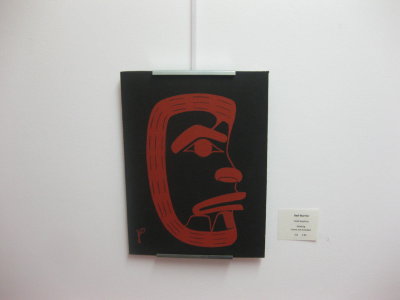
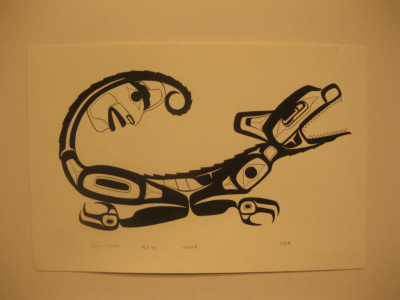
But perhaps the most interesting pieces in the show were by Shawn Aster, a young artist from whom I’ve already commissioned a painting, but whose show pieces I picked out without knowing who did them. Aster has several pieces in the show, but two in particular are strikingly original. The wolf seems almost archaic in its design (look at the teeth and the body decorations) while having enough traditional elements to place it squarely within the northern tradition. The spikiness in the design, which suggests fur, and the spirit in the tail, as well as the posture, which seems a mixture of a howl and a crouching to spring are other details I appreciate.

49

Aster’s conjoined birds are equally intriguing. The compression of the elements into the overall shape brings the already abstract elements of Northwest Coast design to an even greater level of abstraction. Meanwhile, the contrast between the serenity of the birds’ faces and the tormented, imprisoned figure between them adds another element of interest to the composition. Considering the timing of the show and the overall shape, I suppose you could consider this a Valentine’s Day design, with the central figure representing the strain of two people in a relationship – but, no matter how you interpret this design, it is one of the standouts of the show.

22

Some of these artists I hope to buy a painting or two from. Others I plan to keep an eye on. John Wilson tells me that another show is planned for the end of term in April, and I can only hope to get a remote viewing of it as well.

Read Full Post »

In the last six months, a free Saturday or Sunday afternoon will likely find me down at a Northwest Coast art gallery. For me, it’s a pleasure that ranks with a good book or music store.

In fact, in one particular sense, an art gallery has an advantage over a book or music store. In a music store, you are lucky to get a quick sampling of an album if you get one at all; usually, if you want to listen before you buy, you have to do so via your own home Internet connection. A book store is much better, but, even so, reading more than a few pages will quickly make you unwelcome.

By contrast, at a gallery you are expected to give pieces a careful look. So long as you don’t touch anything without an invitation, few staff members in a gallery are going to mind if you examine piece after piece for a long time. After all, nobody expects you to drop a few thousand dollars on a mask or print without making up your mind. Paradoxically, because you are surrounded by expensive items, nobody expects you to be in a hurry to spend.

This attitude has the advantage of making your browsing session inexpensive nine times out of ten (the tenth time, admittedly, you are apt to find yourself putting down the cash that would buy dozens of books or albums, or talking about lay away plans). But unless the lust to acquire hits you, usually you can stand and admire a formline or the use of color for hours and not spend a cent.

To some extent, of course, you can browse online. But online, you miss many of the details, and your opinion of a piece can change drastically depending on whether you see it online or up close. Moreover, even the most conscientious galleries do not always have all their stock online, so you never know what you might see when you actually visit. Once or twice, I’ve even seen new pieces that have just arrived.

Art galleries are businesses, and, sooner or later, a staff member may ask if you need help, the same as in any other store. But while someone selling music or books is likely working at minimum wage and has a corresponding minimal interest in what they are selling unless they work in a small specialty store, most members of a gallery staff are only too pleased to talk art, too. If you are a novice, many are happy to educate you. If you have deeper knowledge, most are just as willing to share their enthusiasms with you. After all, they are interested in the art as well, and, while they have more to do than deal with customers, on the weekends gallery staff members expect to be busy with customers. And, because they know that most people don’t buy lightly, they are quite willing to cultivate customers to encourage another visit.

For these reasons, you have a good chance of combining aesthetic pleasure with a bit of education – or even some friendly gossip about various artists and an informal sociology lesson. If you keep returning, before long, you may have struck up something that is not quite a friendship (since, after all, money is ultimately the basis of the relationship), but is certainly a friendly acquaintance or professional relationship. In fact, of half a dozen galleries which I visit with any regularity, there is only one in which the staff is unfriendly – and, not coincidentally, it’s the gallery that I visit least, enjoy least, and have not bought from.

Best of all, though, is the time you take to enjoy the art itself. Northwest Coast art has its banalities of form and its mediocre artists, just like any other art form, but the standards of craft tend to be higher than in most forms of modern art. Even if a piece doesn’t make me want to buy, I can still learn from it, if only by trying to codify why it succeeds.

And when a piece does succeed – well, I am simply lighter of heart for seeing it. I don’t have to possess it (and good thing, too, since some of the best pieces are well beyond my price range); I am simply happier with being alive for having had the privilege of seeing the really first-rate.

The modern world, it seems to me, does little to encourage the cultivation of aesthetic emotions. Even much modern art is so tangled in consumerism and posturing that aestheticism is often ignored, if not actually ridiculed. But such attitudes have never completely taken hold in Northwest Coast art, perhaps because it is still partly rooted in culture and tradition, no matter how innovative it becomes. All I know for sure is that I come away from an afternoon at the Northwest Coast galleries feeling subtly relaxed, and never regretting the time I spend indulging my aesthetic senses.

Read Full Post »

For some reason, writers in late middle age feel compelled to denigrate Facebook. The Globe and Mail seems particularly insistent, and hardly a week goes by without at least one of its columnists going on at length about how shallow Facebook friendships are or how trivial the quizzes and games often are. I’ve always thought that such rants are part of the general complaint that the world has changed since the late middle-aged were young; although I agree that Facebook is superficial, I’ve found it a useful way to maintain some business and hobby contacts. But, recently, I have had direct experience of another reason to appreciate Facebook: as an organizing tool for social action.

My newfound appreciation started at the end of January, when I stopped by the Edzerza Gallery while on a wander to celebrate having finished my work for the month. There, I struck up a conversation with carver Morgan Green, who told me about the trouble she and her father and the rest of his apprentices were having over their use of the carving shed at the Museum of Northern British Columbia.
After listening, I spoke fifteen fateful words: “Why don’t you start a Facebook group? Facebook has got to be good for something.”

That night, Morgan started the group “Expression not oppression” and issued invitations to all her Facebook friends to join. Within twenty-four hours, the group had two hundred members. It now has over 900 members, including prominent Northwest Coast artists such as Lyle Campbell, Ron Telek, and Ya’ Ya, and has become the focus for the discontent that many among the northern first nations feel about the museum and its curator and for the lack of respect that even prominent native artists sometimes face from the dominant culture and its bureaucracy.

Looking at what has happened, I like to joke that now I know what the pebble feels like when it starts the avalanche.

Even that, of course, is too much credit for me to claim. Apart from a few emails of support and my previous blog entry on the subject, I have really done very little, and nothing somebody else might not have been done. The truth is, the success of the group has everything to do with the carvers involved and their friends and family, and next to nothing to do with me. And that’s how it should be; I’m more than content to be part of the supporting crowd and leave the speaking roles to more suitable people.

However, because I was a bit of a catalyst, I have been following the growth of the group more than I might have done otherwise. And it strikes me that any tool that can help organize a community as quickly as Facebook did has more value than you might expect. Ninety-nine percept of everything that happens on Facebook may be shallow, but observing the “Expression not oppression” group has convinced me that the remaining one percent is powerful and more than enough to justify the rest of the activity.

Really, the late middle-agers have got hold of the wrong perspective – instead of insisting on the triviality of Facebook, they should be having a closer look at how it can be used to organize people. To me, any tool that has such a positive effect deserves to be taken seriously, not dismissed because it’s new and different.

Read Full Post »

For a freelancer, complacency can mean loss of income. This is a lesson that freelancers can never hear too many times – and one that I apparently need repeated more than most. A few weeks after I blogged about how I had managed to replace the income I lost with the closing of Linux.com with other assignments, I found some of those assignments failing, and suddenly found myself scrambling to replace them.

Fortunately, the job-hunting skills I’d learned as a communications and marketing consultant soon paid off.

As before, basic survival wasn’t an issue. We had income for basic survival, and, since we own our townhouse and have never lived beyond our means, we had no worries about debt. All the same, the situation was disconcerting. I thought I’d solved the income problem.

The problem arose because of two clients. In the first case, the client had at first seemed willing to commit to two stories per week from me. However, after a few weeks, they confessed what I had already concluded from their actions: That they were unable or unwilling to take more than one story per week.

In the second cases, the editor forgot that they had agreed to take two stories from me in February, and budgeted the money instead for articles from other people. Since this was a short term arrangement, it wasn’t as important as the first one, but it was still the first time that an editor had reneged on me for any reason, so it came as a shock. For one thing, I rather liked the editor, and preferred to think well of them. For another, I had counted on having a month to figure out a replacement for that income. Coming on top of the other case and some personal bad news that I choose to keep private, it felt like one damned thing after another.

For a day or so, the situation got to me. I even went so far as to consider revising my resumes and looking for straight work. Despite the recession, the work for writers, editors, and instructors of my experience were plentiful in the Vancouver area, but it all seemed dull and routine compared to what I have accustomed to in the last four years.

Then common sense took me by the scruff of the neck. There were still plenty of outlets for free and open source software articles that I hadn’t got around to trying. I spent an afternoon on the Internet learning about the potential clients (something no freelancer or job-hunter should ever neglect), and prioritizing them according to how their needs compared with my areas of knowledge, the size of their audience (which is often found on pages for advertisers), and, where possible, how much they pay per article.

The next morning, I started phoning. I could have emailed, and my queries easier on my nerves, but, for serious business conversations, there’s still nothing as direct as a phone call. Hearing a voice is personal in a way that email or even chat isn’t, which makes a phone call a way to distinguish yourself from anyone else and have yourself remembered.

To my surprise, I appear to have been lucky the first time out. Details are still being worked out, but I expect to be doing an online blog and a print column, as well as contributing other articles.

You’ll have to imagine me dancing around my living room and pumping my fist in the air (or maybe you shouldn’t; it isn’t a pretty site).
But, while I’m glad of the respite, I hope I’ve learned my lesson. I can’t say that I don’t make the same mistake twice, but I hope to say that I won’t make it three times. I still have other a prioritized list of markets (something I should have readied a long time ago), and, if any other client disappears on me, I’m ready to find replacements.

Given the current economic conditions, I wouldn’t be surprised if I’ll have a use for that list again in the next few months. But, so far, I can still repeat what I said in my earlier post: Freelancers are better equipped to survive the recession than most – and should generally survive better.

Now, though, I would add: A few job-hunting skills don’t hurt, either.

Read Full Post »

John Wilson, who describes his work as “contemporary Haisla,” has only been selling his work for a few years. And, so far, he has confined himself largely to portrait masks, although he has also done drums and some graphics worth releasing as limited edition prints. I consider his “Blue Hand Mask” (which should actually be read as “Blue, Hand Mask”) an accomplished example of the portrait genre, and am pleased to add it to our collection.

If you have read Bill Holm’s An Analysis of Form, you will immediately identify the “Blue Face Mask” as being in the northern style: although the nostrils and lips are painted solidly, the hand and the spirit-helper on the left temple cut across the facial features. In fact, you cannot tell where the spirit-helper ends and the eyebrow begins – that is, what is natural and what is painted, or what is mundane and what is supernatural. Also typical of the northern style is the predominance of black, followed by red.

What is less typical is the band of blue. Cutting across the eye socket and eyelid, the band is an unusual shade. It has the effect of drawing your glance to the blackness of the pupils, giving a sense of fierceness or determination.

The painted hand is a visual pun. It has an umbilical-like connection to the spirit-helper that runs below the chin and up the left cheek. In other words, the spirit-helper is literally lending a hand. And, just to reinforce the pun, the obvious thumb shows that it is a left hand, originating on the same side as the spirit-helper.

One of the things that makes this mask stand out is the sheer skill of carving. Unlike many carvers early in their career, Wilson thinks in planes. That means he is working with the wood, rather than against it. At the same time, the mask is closer to realism than a strictly traditional piece in such features as the chin, the eye sockets, and eyes – which is what makes the mask contemporary.

Another outstanding feature of the mask is the way that Wilson has carved and sanded down to the grain that is suitable in different parts of the face. On the forehead, the ridges of grain meet almost in the center, while on the left cheek, the concentric circles of the grain emphasize the plane of the cheek bone. Even more interestingly, beneath the eyes are what might almost be reflections of them in the grain. Some bits of this attention to the grain are lost beneath the paint, but, because the paint is minimized, much of it remains visible.

Portrait masks are an easy genre to under-estimate. They lack the exoticness of a mythological theme or a stylized animal that many people seem to want in Northwest Coast art. But, if you look closely at the best examples of them, like the “Blue Hand Mask,” then you can start to appreciate them as a genre in which artists are thrown back entirely on their own skill. You can also understand why I think that John Wilson is an artist who is likely to make a name for himself.
low-res-blue-hand-mask

(Note: Somebody should explain to galleries that, when shipping masks with hair, they need to make some effort to keep the hair from getting tangled. As you can see, I am still trying to straighten out the hair)

Read Full Post »

I have interviewed Richard Stallman and other members of the Free Software Foundation often enough that he remembers my name (no small feat, I’m sure, considering the hundreds he meets each year). Once or twice, I think, in talking about parrots and folk music, I may have caught a personal glimpse of him. But, even if I haven’t, I generally support the Free Software Foundation. So, when Richard Stallman spoke the other night at the Maritime Labour Centre in Vancouver, I wasn’t going to see what he is really like, or to hear his arguments. I went to see his public persona, and to observe how other people reacted to it.

First, in case you are wondering, Stallman is neither three meters high, green-skinned, nor fanged like a sabertooth tiger. He is a man in his mid-fifties, surprisingly short –maybe 170 centimeters high– and apparently not given to exercise. His hair is long and graying, and so is his beard. Both are uncombed. His clothes are business-casual.

He was tired when he arrived at the hall, and perhaps feeling a little over-exposed to people, having given a speech earlier the same day at the University of British Columbia. After meeting the organizers, he immediately requested a quiet place to work. The request was probably a necessity, since Stallman keeps in close touch with the Free Software office in Boston, but I also suspect that he was relieved to have a moment to himself in the middle of a day in the public eye.

Another myth-buster: Stallman starts by being polite when you talk to him. Nor is he humorless. His comments sometimes show a wry sense of humor, often based on literal interpretations of other people’s phrases. He shows, too, an interest in dining as a social occasion, lamenting that, when he arrived the previous night, he had no one with whom to eat. And, after listening to the local band that warmed up the crowd for him with Flanders and Swann’s “The GNU Song,” he got up on stage to sing “The Free Software Song” with them, his smile not the least deterred by the fact that he is a mediocre singer and could only remember some of the words.

At the same time, Stallman is not always easy to talk to. He seems a little deaf, and impatient with the fact. He is impatient, too, when talk strays into an area where he has expressed the same opinion for decades – or perhaps he simply does not suffer fools gladly. And who can blame him? At this point in Stallman’s public career, anyone who calls him a supporter of open source software has clearly not been paying attention. Nor can it be easy to cover the same basic subjects dozens of times each year.

One on one, he might make some women uncomfortable with compliments about their attractiveness that are a little too quick and open by modern standards. Other women seem to find him chivalrous. Both sexes might accuse him of expecting to be the center of attention, but again, who can blame him? When he is on tour (and he is often on tour), he usually is the center of attention, with his hosts hovering nervously around him.

After our phone conversations, I expected some of these traits, but the overall impression that Stallman makes in person is hard to define. He is neither as obnoxious as detractors paint him, nor as selfless and charismatic as some supporters insist . Although, after meeting him, you can see how all these depictions originate, like any person, Stallman is more than the sum of such caricatures.

Stallman on stage

The fragmentary impressions I got of Stallman off-stage were reinforced when he got up to speak. Like many professional speakers, he immediately gains animation and energy when handed a mike, no matter how tired he is beforehand.

Stallman spoke for well over two hours, not using notes, but obviously covering ground (In this case, his view of copyright law) that he had gone over many times. He was fluent, with few if any pauses or interjections, but not particularly eloquent. Think of a university instructor who keeps his classes interested without being arresting or given to flights of rhetoric, and you have the right impression. The two hours went by quickly, and the audience showed no signs of boredom.

As an argument, Stallman’s speech was concrete, full of examples ranging from the personal to the legal, often enriched with small jokes, and structured with extreme clarity.

If I had to summarize Stallman’s speech in a single word, that word would be “focused.” When Stallman lays out an order to his points, he always returns that order, no matter how many digressions intervene – and, generally, he allows himself very few.

One thing that comes through very clearly as he spoke is his absolute sincerity and conviction. Whatever else anybody might think of him, those are never in doubt. He is quite willing, for instance, to do without a cell phone, DVDs with DRM, or anything else that he cannot use with a clear conscience.

But, as I watched his argument develop, what struck me was not so much any brilliance (although clearly Stallman has an above average intelligence), but his thoroughness. Although other people might possibly make connections or reach conclusions faster than he could, few could think topics through as carefully as Stallman.

In particular, Stallman pays close attention to how issues are framed by language. For example, he rejects the term “piracy” for file-sharing, pointing out that its main purpose is to demonize the practice, not to suggest an accurate analogy. Conversely, he talks about “the war on sharing,” doing his own bit of framing.

This is the same concern, of course, that leads him to insist on referring to GNU/Linux. Many people reject this idea without thinking, but, once you realize that, for Stallman, defining the terms is a necessity for clear thinking, then you realize that he is not simply being pedantic. He is well aware that language is rarely, if ever neutral, and, quite unsurprisingly, tries to influence the debate so that it is on his terms, or at least neutral.

If Stallman’s speech had a weakness, it is that he did not always think on his feet. Several times during the questions at the end, he seemed mildly at a loss, and could only refer back to his speech or declare – sometimes arbitrarily – that a questioner’s topic was irrelevant. Once, when a questioner went on and on without getting to the point, all he could do was seize on a careless use of “open source” rather than “free software,” instead of moving to take direct control of the situation. But perhaps fatigue had a lot to do with this behavior.

Watching the crowd

At any public event, watching the audience can be as rewarding as listening to the performance, and Stallman’s speech was no exception. Some audience members, I later learned, also attended his speech earlier in the day, as well as the one on the next day. However, even without that knowledge, I would still unhesitatingly describe the crowd as geeks with a small smattering of spouses. Most clearly had some familiarity with free software and Stallman’s ideas, and had not come to be challenged so much as to glimpse someone famous.

A minority had a slightly more ambitious goal: To engage Stallman, however briefly, in conversation. Since Stallman’s reputation and manner discouraged most from approaching him informally, some found a moment by getting him to autograph copies of his book, others by asking questions at the end. Many of those lining up up the mikes to each side of Stallman did not have an actual question, so much as a statement they wanted to make to Stallman. One or two seemed inclined to argue with him.

Conclusions

So what do these impressions add up to? A public event is not the place to get to know anybody, and Stallman would probably be a difficult man to get to know under any circumstances. What I saw was the public figure, with – perhaps – the occasional flash of the private man, both accustomed to his fame and occasionally irritated and trapped by it.

In the end, it occurs to me that a distinction between the public and private Stallman many not be worth making. He reminds me of the portrayal of the Wart (King Arthur) in T. H. White’s The Once and Future King. White depicts Arthur as someone inspired by a great idea that took over the rest of his life. In something of the same way, Stallman appears to have been struck by the idea of free software in the early 1980s. The decades since then, I suspect, have simply been filling in the details and taking the idea to its logical conclusions – until now it is hard for a casual observer like me to say where the public man ends and the private one begins.

Read Full Post »

« Newer Posts - Older Posts »