Feeds:
Posts
Comments

Posts Tagged ‘Northwest Coast Art’

At First Nations art galleries in Vancouver, Mitch and Diana Adams have a reputation as an effective sales team. Being the artist, Mitch does much of the talking, but because Diana at one remove from the discussions with gallery owners, she is an astute observer of what is happening, and is actively involved in strategic planning.

Several weeks ago when I was in Terrace for the Freda Diesing School graduation ceremony, I asked her what advice she would give young artists about dealing with galleries. Diana responded in detail as we had dinner at Boston Pizza, with Mitch throwing in the occasional comment.

Diana is able to contribute because of her own lengthy experience in sales. “I grew up in a family restaurant business,” she says, “So selling comes naturally to me. As a waitress, my job was to sell the meal. My favorite situation was when people would go, ‘I don’t know. What do you recommend?’ I’d find out what don’t they want to eat, what’s their budget, what they are allergic to, and take it from there.”

Some of what she knows about sales comes from observing her father. However, Diana has been selling her own bead work for several decades. She still remembers her first effort at a Tupperware-like party, where she sold $450 worth of merchandise, confounding her parents’ expectations.

Since then, Diana and Mitch have sold regularly at music and craft festivals through northern British Columbia. For seventeen years, they have been regulars at the Terrace farmers’ market, during which time they have fine-tuned their partnership in sales.

Preparing and handling anxiety

Some artists, especially established ones, can sell to the major galleries in southwest British Columbia without ever visiting Vancouver or Victoria. However, the business of First Nations arts remains very much a face-to-face proposition, and young artists in particular are more likely to make sales when they talk to a gallery’s buyer directly.

Asked how she approaches selling Mitch’s work to a gallery, Diana emphasizes a strategic approach. “I take it on as though I’m applying for a job,” she says. “I do my background homework. I’ll look at a store or a gallery that I want to deal with. I will go in, and not tell them that I’m looking to sell to them. I will observe how they treat their customers. I’ll also see the quality of what they sell. If they have a pamphlet, I will take one, or Google them on the Internet.” She does not worry much about prices, figuring that is not her concern, but she will note at the quality of what is sold, and how staff treats customers.

The point of this research is to decide whether they want Mitch’s work in that gallery. “What a lot of artists don’t understand,” she says, “is that they have an option of deciding whether this is a gallery to deal with or not. I want to know that I’ll be dealing with someone who is dependable, approachable, fair to deal with, and able to give criticism. If I offer them something they’re not interested in, I want to be able to dialog about it. As much as I might want to be a client of theirs, or leave works on consignment, I need to know that I can have a professional working relationship with them.”

Before approaching a gallery’s buyer, Diana and Mitch discuss what pieces to show, their prices – both the price they want, and a bottom-line figure that they will accept as a last resort – and what to say about each piece. This preparation, she stresses, is absolutely essential. “Gallery owners have told us that’s one of their pet peeves, when artists approach them and they don’t know the price of an item. That’s a death-sentence, right there.”

She also notes that, on an introductory visit, artists can expect a lot of questions. Galleries “want to make sure that you are the artist, and not someone else. If you’re the artist, you would know the answers right down to the details.” Forgery and theft are regular events in local First Nations art, so galleries want an indication that the seller truly is the artist.

Another reason for preparation is that it helps to reduce nervousness. “It’s always nerve-wracking. I’ve done it countless times, but there’s still that excitement and anxiety, because you want to do well. But you can’t be overly anxious or insecure, or you’re going to fall flat on your face.”

Another way to reduce anxiety is to take someone with you. However, Diana immediately adds, “Don’t take anyone who’s going to undermine you. Don’t take anyone who doesn’t know anything about your art or will second-guess you.”

Instead, the second person should be either silent, or an active partner. “There’s been times when Mitch has forgot something,” she says, “but I always give him a chance to speak first. But if he forgets something, I’ll come forward. I’ll look at him, and if I know that he’s done talking, I will say my piece.”

According to Diana, planning not only relieves anxiety, but also helps to present yourself as a professional who is easy to deal with. She suggests role-playing the presentation of your artwork, and even approaching galleries you do not plan to deal with so that you can rehearse and prepare yourself for visits to the galleries you hope to work with.

Making the visit and the first impression

“We don’t expect a sale on first visit,” Diana says. “We hope we make a sale, but the whole point is making contact.

Her emphasis is on professionalism throughout. “Dress as though approaching a job,” she advises, “as though leaving a resume. Make sure that the work is well-presented, not carried in a garbage bag. Because if we have no respect for the art, it’s going to show. We use an artist’s portfolio, because presentation is everything. Some of the people we’ve approached have been quite reserved, but we still put on a professional smile, and say what our purpose is.”

Diana also suggests that body-language is important. “Smile,” she advises. “Have good eye contact [with the buyer]. “Don’t cross your arms. Remember to breathe.”

After the introduction, the actual presentation of the pieces is left to Mitch, on the grounds that as the artist he is the one best qualified to talk about them.. “I try to be halfway through explaining the piece as I hand it to them,” he says.

He also gives some thought to the order of presentation. “What I like to do is not give them my best piece right off the bat. Instead, I lead up to it. And I think they see it, too, that the best piece is still to come. But they’ll be lining the pieces up, and hopefully they’ll be being wowed by the pieces that aren’t the best ones.”

If the discussion turns towards the price of any of the pieces, the Adams’ policy is to hold firm to their original asking price, falling back slowly to their minimum only if they strongly want the sale.

“You can’t be desperate,” Diana says, adding as a warning, “never say to anyone, ‘I’ve got bills to pay.’ Never say that because, really, it has nothing to do with the gallery owner. That’s a form of manipulation. It’s a really poor sales technique, because the person who’s being spoken to feels bad and put on the spot. It leaves a bad taste in their mouth, and makes them want to avoid you in the future.”

Some buyers, according to Diana, will claim to find flaws as a tactic for lowering the purchase price; they should be ignored and not cause you to waver in your price. Others may mention what they perceive as flaws as explanations as to why they are not buying; their criticism can be considered later. In fact, once or twice, Mitch has gained credibility by acting on such criticism and taking a piece back to the criticizer for another look.

Revisiting

Many inexperienced artists are disappointed when they fail to sell after a first visit. Many will give up and avoid that gallery. However, as Diana emphasizes repeatedly, you shouldn’t count on making a sale after a first visit.

In fact, at one gallery, the Adamses visited three times before making a sale. “But we kept going back, introducing ourselves, and reminding the purchasing agent who we were. We didn’t take [rejection] personally; we just thought they weren’t able to purchase.”

The truth is, you may never know why most sales fail. Often, the reason will have little to do with you or the artwork, or only in the most indirect way. For example, “there’s some galleries that only buy big items, and Mitch does only miniatures. We needed to keep that in mind, and not take it personally. There’s no reason to be rude, even when they’re rude; we just stay professional, and thank them for their time.”

After an initial visit, Diana and Mitch discuss the experience, and decide whether they want to continue trying to sell to a particular gallery. Sometimes, they may decide not to return, even if the buyer seemed interested in Mitch’s work, because they have decided to deal with only a limited number of galleries so that they can focus on building long-term rapport.

If they do return for another visit, they prepare for subsequent visits in much the same way as the first. The main difference, Diana says is that “we’re not so tense.”
Also, the introduction may become more personal and friendly. “I try to remember something about that person that they shared with me,” Diana says, such as the birth of a grandchild or a trip they have recently taken. But “the contact is still professional. It’s intimate, but it’s not stepping over a line.”

Trying to sell your work to a gallery can often be difficult and full of anxiety. Unsurprisingly, mistakes can be made. For instance, Diana recalls “one time when Mitch got so nervous that he put his hand over his mouth, and what he was saying came across as very muffled. All I could do was reach over and pull his hand down, and he kind of looked at me like, ‘What are you doing?’ Then he realized what he had done.”

Diana continues, “Some people beat themselves up about moments like that, but there’s nothing you can really do except laugh.” She advises other artists not to dwell on such circumstances, but to focus on being prepared and professional, focusing not just on a first sale, but on a long-term relationship that will also eventually produced a second and a third sale, and many more over their career.

That is the approach that Diana and Mitch are taking, and so far it seems to be working. Listening to their war stories, it is obvious that it hasn’t always worked exactly as they hoped. However, it has worked well enough that Mitch is well on his way to establishing himself as an artist.

Much of the credit is due to his finishing skills and original designs – but at least as much should probably go to the successful sales strategies and partnership that Diana and Mitch have developed. Watch them even once, as I have done, and you’ll know how professionals deal in the world of First Nations art.

Read Full Post »

This year’s graduation exhibit at the Freda Diesing School was held on April 19 and 20. It was by far the weakest of the five I have attended. In previous years, there have always been one or two students who were ready to become professional artists, but this year there were none, although a reassonably large number could be ready if they keep working for another year or two.

Unfortunately, this year’s show featured too many shaky hands on the paint brush and failures to find the grain. Too often, what passed at a distance was flawed close up.

However, that’s not to say that the exhibit was disappointing – just that it could have been better. The longhouse on the Terrace campus of Northwest Community College is always worth a lingering visit, and I never object to a preview of those who might become promising new artists in another few years.

longhouse-interior

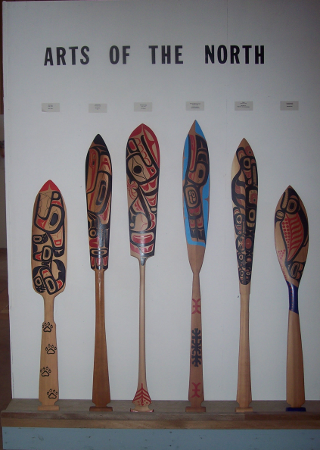
The work of many of the best artists was visible in the display of paddles at the entrance. This is probably no accident, since a painted paddle is one of the first assignments given to students in the school, so students had plenty of time to perfect their results.

entrance

Inside, I first scanned the exhibit for artists whose works I had seen before. Sam Mackay, the winner of the 2012 Mature Student Award produced a solid effort in his “Wolf Howling in the Moon” mask:

sam-mckay-wolf-howling


I also looked for works by Jared Kane, from whom I bought two prints last year. He proved to be one of the more imaginative carvers in the show, but the fact is obscured by the lack of finishing on many of his works, as well as his attempts to use light washes of paint that only look sloppy. His potential is obvious, but he seems to be working against himself in these respects:

jared-kane

This year’s Mature Student Winners (who only found out they had won at the show) also showed considerable potential. Steven Wesley, this year’s winner of the award, produced the very solid “Eagle Transformation:”

steven-wesley-eagle-transformation


Roberta Quock, one of this year’s honorable mentions, produced “Wolf Mask,” one of the best finished and painted masks in the exhibit:

roberta-quock


This year’s other honorable mention, Lorretta Quock Sort showed a similar talent. I particularly liked her mask, “Long Face Willie Campbell,” carved in honor of a grandfather she had never met and reserved to give to her parents::

lorretta-sort-long-willie-campbell

By the time I had looked around the show a few times, two artists stood out. The first was Lyle Mack, the latest from the large and talented Nuxalk family to attend the school. The painting on Mack’s “Beholder of the Light” was imperfect in one or two places, but with some retouching this frontlet could would no trouble meeting professional standards:

lyle-mack-frontlet

However, the most promising artist in the show was Angelo Cavagnaro. His “Gitmidiik Wild Man” mask and “Lunar Eclipse Mask” owe their success to their high standard of painting, but, although their treatments of their subjects are conventional, both are competently carved:

angelo-cavagnaro-wild-man

angelo-cavagnaro-luna-eclipse

Cavagnaro also contributed to the show a bowl entitled, “Supernatural Flounder” which was the most imaginative piece in the show – so much so that I took it home with me. Despite the roughness of some of the carving, this bowl, more than anything else, suggests what he might be capable of with another year or two of practice. When I posted a picture of it to Facebook, it immediately attracted Likes from four or five proffessional artists:

100_1585

Most of the pictures in the show will be in The Spirit Wrestler Gallery’s “Northern Exposure” show in Vancouver at the end of May. Several students were also planning to add additional pieces for the southern show, which I look forward to seeing. As always, I anticipate that show, but I look forward even more to seeing what first year students like Robert Quock and Lorretta Quock Sort will be doing next year, with another twelve months of development.


Read Full Post »

When Angelo Cavagnaro was completing his projects for his second year at the Freda Diesing School of Northwest Coast Arts, senior adviser Dempsey Bob stopped by his work bench.

“What’s that?” Bob joked. “A flounder?”

Cavagnaro says that he had intended the bowl to be a halibut, as its shape and the two eyes on one side suggests. However, remembering Bob’s comment, he named it“ Supernatural Flounder.” It’s a fittingly whimsical title for what I consider a whimsical piece.

“Supernatural Flounder” reflects not only the importance of fishing to traditional Northwest Coast cultures, but of grease. While the northwest coast of North America historically supplied the abundance of food necessary for cultures centered on status and art, the diet was low in fat, or grease as it was generally known.

Just as in medieval Europe, people craved grease incessantly. In fact. stores of grease – usually from the oily oolichan or candle fish, whose season was in early spring, when supplies would be at their lowest – were a sign of wealth. To this day, it remains a traditional delicacy. Historically, it was a treat at feasts and ceremonies, where it would be served to guests in highly decorated bowls. Some of these bowls were about the size of Cavagnaro’s piece, holding enough grease for a single serving. Others were a couple of metres long, and must have served dozens.

“Supernatural Flounder” is a transformation piece, like many that I have bought. The human face in the tail suggests that the fish – whether halibut or flounder – is one of those supernatural creatures that can assume human form. Many depictions of such creatures show them in the moment of transition, which is often shown as dramatically agonizing, like some of the computer-generated transformations of werewolves in modern horror films.

However, Cavagnaro takes a somewhat different approach. The body of the bowl is simply carved, with fins indicated by rough shapes scored with a couple of lines apiece. That leaves the human and fish faces to be emphasized, their lips and nostrils painted with the same red, and their eyes with the same black. There are differences in the shapes of the eyes and their sockets, but if you look at the piece long enough, the resemblance is undeniable. Both have the same blankness, inviting a comparison which explains why I call the piece whimsical – in the end, the human face ends up looking not that different from the fish’s. The result is a creature that looks at home with its dual nature, whose stomach just happens to be where the bowl is.

As a carving, “Supernatural Flounder” could stand more attention to finishing details. The interior of the bowl is rough, and there are many places on the carving where the artist’s working against the grain is still obvious. On a piece that is so minimally painted, such details stand out, and need to be thought about. But the general shape and proportions is well-thought out, and Cavagnaro shows the same steady hand on the paint brush as in his other works.

In the end, the bowl turned out to be the only piece I bought at the graduate show. As I write, it sits on a sideboard a few paces away, where I can enjoy by turning my head a few centimeters.

100_1585

Read Full Post »

Last weekend, I flew north to Terrace to give out the Mature Student Award at the Freda Diesing School graduation. This was the fourth year I have sponsored the award, and the third in which one main recipient and two honorable mentions were named. The award honors students twenty-five and older, recognizing that returning students face challenges in returning to school that younger students don’t, yet often contribute grreatly to a class.

The main recipient was Steven Wesley, a member of the Eagle side of the Haida Nation. Wesley fished for many years, then returned to school in 1997 to earn his high school diploma. “I wanted to be a role model for my daughters,” he said. “I wanted to show them that even their Dad could get his Grade Twelve.

Wesley went on to become a bus driver and trucker. However, he relates that, in 2002, “A friend handed me a knife and a block of wood and asked if I wanted to carve. And ever since I kept pursuing my dream of becoming an artist,” he says.

Although mostly self-taught and learning by observing others, Wesley was accepted at the K’san School in 2004. However, he had to turn down the position due to lack of funding. When he applied to the Freda Diesing School in 2008, he was luckier in finding support.”I just wanted to learn everything,” he says. “I taught myself how to do the ovoids and U shapes but I wasn’t sure they were the way they should be. So, coming back, I wanted to learn from the beginning again. “

However, for Wesley, the most satisfying part of his first year was learning about negative space in carving: “how deep, how high, how wide. I knew the forms, but I didn’t know how to use negative space in my designs.”

He plans to return for his second year in September, and to carve and paint over the summer. “The more you carve, the less you forget,” he says.

One of the two honorable mentions was given to Roberta Quock, a Tahltan from Telegraph Creek who grew up in Merritt and Kamloops. Long interested in painting and beadwork, she says, “I’ve always wanted to go to this school to study more and to learn carving and study more of the culture.”

Besides beginning to learn how to carve, Quock found the first year class a friendly place to learn. “We really bonded together, and we helped each other out,” she says. “We looked out for each other like a family.”

Quock also plans to return for her second year, studying beside her brother Lyle.

The other honorable mention went to Lorretta Quock Sort, a Tahltan of the Crow Clan. An experienced textile artist, for some time Sort has been making fire bags (ammunition pouches) that the president of the Tahltan nation has been distributing as gifts.

Sort’s first ventures into carving will all be given away to her parents and three children. She explains, “My Mom always told me that when you do something for the first time you should give it away. You’re not supposed to keep it or sell it. But, coming from such a large family, it was hard to decide who got what.”
Like the other winners, Sort plans to keep busy over the summer. She has already set herself the task of doing a mask and bowl over the summer, as well commissions for two button blankets and more fire bags, which these days are popular as women’s purses.

Wesley, Quock, and Sort were all among the more accomplished students in this year’s exhibition. I look forward to seeing them develop in their second year, and I’m pleased to have played a small role in their development as artists.

Read Full Post »

The more I see of Gary Minaker Russ’ work, the more I consider him the leading argillite carver working today. His attention to detail, his variety of designs, and his restrained use of inlay all combine to put him in a category all by himself. So, naturally, when he was in town a few weeks ago with two mid-sized carvings, I jumped at the chance to buy. Not being able to afford both, I narrowly turned down “Raven and Frog Inside Of a Halibut,” a formal piece squared into an upright rectangle, in favor of “Thunderbird Capturing Killer Whale.”

haida-thunderbird-capturing-killer-whale

I’m pleased with my purchase, although part of me still wonders if I should have bought the other piece – or, better yet, found a way to buy both. But, having narrowly missed buying a cedar sculpture of the same subject a few weeks previously, I still half-feel that karma was urging me to the one I chose.

The thunderbird, of course, is perhaps the best-known figure from First Nations mythology – although I would be hesitant to equate the figure found in the Pacific Northwest with similar ones in the Eastern, Plains, or Southwest cultures to any degree.

In popular modern culture, the thunderbird is simply very large, and somehow creates thunder and lightning. However, among the first nations of the Pacific Northwest, the feature that makes it stand out is simply this: The thunderbird is a creature so large that it hunts whales. Considering that the killer whale is by far the largest animal seen from shore or near it – true whales being usually found further out – that makes the thunderbird a truly monstrous size.

In “Thunderbird Capturing Killer Whale,” Russ has reduced the thunderbird’s size somewhat, making it closer to that of the killer whale, and the capture less one-sided than if the thunderbird was significantly larger. The thunderbird. It fills the left side of the piece, its head upraised in what looks like a grimace, identified by its curved beak (and, yes, those are teeth, and never mind that natural birds don’t have any). It grips the killer whale by its dorsal fin and head, almost hugging it with a wing that sweeps across the center of the piece.

Otherwise, the killer whale lies passive in its grip, bent almost double by the thunderbird’s strength, so that its tail at the top right is almost at right angles to the head at the bottom center. The thunderbird may be straining, and appears buffeted by the loose tail, but the killer whale is caught and probably moments from death.

What at first glance seems an abstract clutter of body parts becomes, on closer examination, a moment of tension, with greater violence due in a matter of seconds.

The fact that the thunderbird appears almost whole– although in profile – while the killer whale takes a moment to recognize suggests the inevitable winner of the fight. So, too, does the difference in the eyes, the killer whale’s round one suggesting passiveness, compared the thunderbird’s elongated one.

Yet this is not a formline design that keeps the eye moving around the entire composition until you have understood the various shapes. Only the wing operates in that way, the eye’s movement seemingly transferred to the wing itself, creating an impression that it is beating, another of the thunderbird’s weapon and, perhaps, helping it to hang on. On the rest of the thunderbird and all of the whale, the formline is more stiff, leading nowhere and slowing the recognition of the scene – an effect that reinforces the sense that the carving is capturing a brief moment of chaotic violence.

Although you might not be able to see clearly from the photo, Russ’ carving of the scene reinforces the struggle by the depth of carving. Most of the sculpture is in low relief, the figures looking slightly squished. But the whale’s head is carved more shallowly than any other part, barely emerging from the background surface. By contrast, its still free tail is raised almost twice as high, and the thunderbird’s head and tail three or four times.

However, for me, the master touch is that the piece is entirely in low-relief – all except for the thunderbird’s claws, which are in high-relief, and rendered realistically rather than with the usual shapes of the northern form-line. This difference literally makes the claws stand out from the rest of the design, making them identifiable when the rest of the carving is still a jumble of forms to your eye. In a very real sense, the claws are what matter most in the scene: they control the killer whale and will shortly rend it.

In the end, this reinforcement of the subject with technique that swayed me to buy “Thunderbird Capturing Killer Whale.” As I often do with sculpture, I am keeping it beside my computer desk, where I can appreciate it while I begin the leisurely process of deciding its more permanent position in my townhouse.

Read Full Post »

I love argillite. Of all the media used by the First Nations artists of the Pacific Northwest, argillite has by far the most mystique and romance, as well as the greatest visual appeal.

Argillite is a black slate found only on Slatechuck Mountain on Haida Gwaii. Similar slates have been in a few other places around the world, but have slightly different chemical compositions that make them less suitable for carving (or so I’ve been told). Only members of the Haida nation are supposed to be allowed on the mountain, and families have unofficial quarries whose exact locations they try to keep secret.

Rumors persist of a logging road that makes access to the quarries easier, but, generally, artists either have to carry out the argillite they quarry on their backs down a narrow trail, or else buy what others chose to sell – usually at about five dollars a pound on Haida Gwaii, and as much as twenty dollars a pound in Vancouver. The tradition has been to keep argillite out of the hands of non-Haida, although a black market makes small amounts generally available to other artists, who generally turn it into pendants.

The history of argillite carving is equally romantic in its obscurity. The standard account is that argillite carving did not begin until 1820, and that the pipes that were among the first carvings known were never actually used. However, while European tools and interest in curios made the 19th century a Golden Age of argillite carving, it seems unlikely that such a sophisticated art form could emerge suddenly without at least a few centuries of tradition. Studies of early pipes show a residue that prove that some early pipes were definitely used, but, since heat can crack argillite, most likely it was a medium reserved for shamans and other ceremonial use before the nineteenth century.

But whatever the truth of the matter, argillite carvings became a major trade good in the 1800s. Unlike other traditional art, these carvings consisted of far more than family crests and the stories that families and title holders held the right to tell. Instead, the carvers of the time also depicted the animals, peoples, and plants of everyday life. Sometimes, they imitated the patterns of the china plates carried by American traders. Other times, they made miniatures of houses and canoes. At times, they depicted the Haida viewpoint of the European traders and immigrants, offering some of the few contemporary depictions of colonization from the perspective of the colonized.

Nineteenth century argillite was not completely naturalistic. For instance, a head is generally one-third the length of the body. However, much of it is painstakingly detailed, with muscles on arms and legs or the individual strands of a rope all clearly delineated in a way that the more traditional wood carving almost never is. During its development, argillite carving also developed its own stock poses, such as a shaman holding a rattle in his upraised right hand and a knife in his left.

Like other art forms, argillite carving suffered because of epidemics and Christianization. However, because it was a trade good, argillite carving never declined quite as much as more traditional forms. Probably, it helped, too, that Charles Edenshaw, one of the first great Haida carvers whose name and career we know, was a skilled argillite carver – although this aspect of his art was omitted altogether from the recent exhibit of the works of Charles and Isobel Edenshaw at the Museum of Anthropology.

Today, argillite is a niche market. Bill Reid was influenced by argillite design, but only experimented with the actual medium. Similarly, while Robert Davidson as a teenager sold model totem poles in argillite for the tourist trade, it has never been his favorite medium. The same is true of artists such as Jay Simeon, Ernest Swanson, Gwaai Edenshaw or Marcel Russ, although all of these artists can produce outstanding argillite pieces when they take the time.

The trouble seems to be that argillite is more temperamental than wood, silver, or gold. It is dirty to work with, resistant to tools, and prone to flaws that can destroy hours of work with one misplaced stroke. Because of its water content, it can shatter in the cold. Artists like Christian White or Gary Minaker Russ who have done most of their work in argillite are essentially specialists, appealing to a relatively small and expensive market. Excluding pendants and miniatures, galleries rarely have more than two or three pieces of argillite at any one time, and prices usually begin at about $8000.

Nor has the reputation of argillite been helped by the growing practice in the last decade of inlaying pieces with gold, silver, and semi-precious stones. Often, such inlays are added before carving begins, seriously interfering with the artist’s ability to add detail, and, almost always, they are added in lieu of detailed carving. Moreover, because such inlays are expensive, they add substantially to prices, which means that buyers are being asked to pay more for inferior work that increases very little in value.

Quality argillite pieces are still being carved, but to find them buyers either have to visit Haida Gwaii or at least deal with artists directly. However, the effort to find quality can be well worth the effort.

Even when left with its natural finish, argillite has a reflective finish that makes a carving rich in shadows and highlights. These shadows and highlights change with the available light, but always adds a unique impression of depth and motion. They make argillite a medium that demands to be touched, and its carving traced over and over with the fingers – in fact, many believe that frequent handling prolongs the life of a carving, because the oils from human hands replenish the moisture that was originally in the slate.

Elegant and mysterious, quality argillite carvings are an under-appreciated glory of Northwest Coast art that never fail to capture and intrigue the eye.

Read Full Post »

Which upcoming First Nation artists in the Pacific Northwest are worth having a look at? Giving an answer is not easy, because traditional art forms and contemporary variations are thriving as never before.

Still, if I had to give answer, these are the seven artists I would tell people to look for. Many post their work on Facebook, or somewhere else on the Internet:

  •  Mitch Adams (Haida): Adams has made a specialty of miniatures – everything from masks to combs and usable pipes – and of exploring different kinds of woods – including ebony and laminated blocks in which the layers substitute for paint. However, his best work so far has been in carving sculptures about thirty to forty centimeters high.
  •  Morgan Green (Tsimshian): Many Northwest Coast artists show versatility, but few can match Green. Her work includes cloth and leather design, wood carving, ceramics, and, more recently, metal work. Although in the past she seemed more interested in experimenting with new media than in developing her art, for the past couple of years, she has focused on jewelry and metal sculpture.
  •  Latham Mack (Nuxalk): Mack first attracted attention at the Freda Diesing School for his design work. However, since graduating, Mack has continued to apprentice with Dempsey Bob, and his discipline and carving is starting to reach the same standards as his designs.
  •  Kelly Robinson (Nuxalk, Nuchunulth): Robinson began as a painter, but since branched out into jewelry and carving. His work in both of his traditions has a strong sense of individuality, but in Nuchunulth style, he has the distinction of being one of the first to treat his subject as high art, rather than historical re-creation.
  • Todd Stephens (Nisga’a): As a carver, Stephens still needs practice, but few artists of any experience can match him as a designer. Study the details of his paintings, such as the different ways that the join of two formlines is thinned out, and you will soon know most of what you should be looking for.
  •  John Wilson (Haisla): Primarily a carver, Wilson is known for the speed with which he can finish high-quality masks. More recently, he has landed commissions for corporate logos and artwork. He is rapidly becoming the best Haisla artist since Lyle Wilson, but, right now, his work is extremely reasonably priced.
  •  Carol Young (Haida): The first winner of the Freda Diesing School’s Mature Student Award, Young first emerged as an artist to watch during her second year at the school, when she started doing naturalistic, unpainted masks. Since then, she has gone from strength to strength with more traditional carvings, some painted, some not. Once or twice, she has introduced female themes into her work.

Other artists who are less successful (so far) but still worth searching out include:

  •  Sean Aster (Tsimshian): Aster is one of the strongest designers who has graduated from the Freda Diesing School. Unfortunately, he does not seem to have marketed his work as well as it deserves.
  • Cody McCoy(Salishan): McCoy has won two YVR art awards, but he is marketing his work in both First Nations galleries and in mainstream shows as surrealism. The best of his work is strikingly original, with traditional forms half-hidden in the thick, restless brush strokes.
  •  Colin K. Morrison (Tsimshian): Morrison is an outstanding carver. However, he only produces a few pieces a year, so the danger is that he might eventually choose another way to earn a living.
  •  Chazz Mack (Nuxalk): Well-known for his design work, Mack seems to do much of his work for family and friends, instead of making many attempts to develop his reputation.
  •  Nathan Wilson (Haisla): Wilson’s high-standards of craft are obvious, but his design sense is sometimes no more than adequate and could use more individuality. However, sooner or later, I expect consistently strong work from him.

Neither of these lists is anything like complete. There are always promising artists whose work does not appear in Vancouver or Victoria, or in galleries anywhere, so I am sure to have missed some. If so, my apologies – chances are, my ignorance explains any omissions, not any judgment of quality.

Read Full Post »

Six weeks ago, Haida/Tsimshian artist Mitch Adams and his wife Diana were in Vancouver on a selling expedition. We sat on the shaded porch of a Starbucks, and Mitch unwrapped the pieces he hoped to sell to one of the galleries. They included a variety of pipes (“They’ll make you look taller! Cooler!” Mitch claimed), several miniature masks carved from ebony, and a couple of sculptures I would have bought on the spot if I’d had the money. Then Mitch brought out a framed painting from the back of the car.

I remembered the painting. I’d seen it when I was in Terrace the previous April, sitting at the back of Mitch’s workshop. It was a design that he had done while a student at the Freda Diesing School. An injury had left him temporarily unable to carve, so, rather than sit idle (or more like, kibbitzing with the other students, if I know anything), he began to do designs on paper.

At the time, I asked him if he would sell it, but he was unsure of the price, and I had enough to carry back on the plane already. “Throw it in the trunk next time you come to Vancouver,” I said, but, to be honest, I’d forgot all about the piece until I saw it again. However, once I got over my surprise, I was happy to buy it.

As you might guess from the story about its origin, “Haida Box Design” is a formal exercise, but no less interesting for that. Like Celtic knotwork, abstract Northwest Coast designs fascinate me in their intricacy. When you know a bit about the artistic tradition, you can appreciate the breakdown of the figures in a series of basic shapes, each of which is varied by such details as how the thickening of the formlines where they meet is minimized, or the designs inside the U-shapes. At its best, the result is a strong sense of individualism within a detailed tradition – which is certainly the case here.

Adams’ individual touches are numerous. To start with, rather than designing primarily in black, he balances red and black almost perfectly. The design puts round shapes, rather than the more common ovoids, in the center where they can hardly be missed. Many of the lines are straight, rather than curved, as you would expect in most designs on paper, although that would make them ideal for carving. Tapering of the lines is minimal, and Adams makes wider use of thin lines than most artists would.

However, what fascinates me most about the design is how, despite being symmetrical, it manages to avoid some of the stiffness usually associated with symmetry – especially to a modern eye, trained to consider asymmetry of design the norm. Day after day as I’ve done my morning stretching exercises, I’ve watched the piece and considered the elements that undermine the potential symmetry.

First, there’s the easy interchange of figure and ground between the black and red that changes depending on what you focus on. Then there’s the mild variation of rounded shapes in the center of the design. Most of all, however, what really offsets the symmetry are the shapes positioned on an angle.

All things considered, I’m tempted to say that I’d appreciate seeing “Haida Box” design carved in yellow cedar and painted. The only thing that keeps me from doing so is the fear that, the next time we meet, Mitch will present me with exactly that, and I won’t be able to resist pulling out the cash to buy.

Read Full Post »

When I was in Terrace last April, I returned with two artist proofs from Jared “Citizen” Kane, a young First Nations artist who affects hip-hop clothes and attitudes. Both these works – one entitled simply “Moon” and the other “Love Birds” – interested me as examples of what computer-assisted art does easily and what it struggles with in Northwest Coast art.

Both these pieces are based on popular images. Neither image is claimed by a particular family, so artists can use them without being accused of appropriating someone else’s property. “Moon” is a successful blending of the traditional crescent of the moon with a more modern sketch of a face, while “Love Birds” combines a traditional split image with lightly concealed heart-shapes of European origin. “Moon” is striking for its simplicity, “Love Bird” for its intricacy, as well as for the placement of a central T-shape with foreshortened arms that could be interpreted as either male or female genitals, but both are identifiable at a glance as being designed on the computer.

I spend far too much time on a computer myself to see anything wrong with making art on the computer. The days are long past when people objected to pole makers rough-shaping the wood with chainsaws, and computers seem to me nothing more than another way that artists can make their work easier.

However, the idea of computer-assisted art remains far from generally accepted in Northwest Coast Art. In the case of several established artists who dislike the very idea, part of the reaction may be due to their own lack of computer literacy. However, they will add that they consider computer-assisted art lacking in warmth and individualism. But artists like Alano Edzerza have shown the possibility of bold, original works designed on the computer. And, really, the idea is no different from the manual templates used by some artists on the coast for over two centuries.

Still, computer-assisted art generally leaves its mark. Like many of the pieces created since Bill Holm in the 1960s codified the conventions of the northern formline tradition, it emphasizes geometry and symmetry in a way that traditional art did only part of the time. It is not so much that a piece like Kane’s “Moon” adds an unnecessary line to create a complete circle instead of a crescent, but that each of the ovoids, U-forms, and other shapes has a single template. Graphics software allows these templates to be scaled and rotated, or even distorted, but they remain obviously based on the same source.

In addition, because the templates are available, computer-generated designs tend to be less varied in general. In formline design, part of the craft is how the thickness of the formlilne changes according to the need of the design. Look, for example, at the work of Todd Stephens, a Terrace-based Nisga’a artist, and you will see that the broadest formline can be up to ten times that of the thinnest, which is often as thin as single brushstroke can make it. By contrast, in Kane’s “Love Bird,” the difference is may be four times.

Another place for variation in formline design is the variety of techniques for avoiding too much thickening of the line where two formlines meet. These techniques can include thinning the tips of one or both lines, or adding a T-shape or some other element in the middle of the two lines to thin out the filled space between them. Kane uses both techniques, but the thinning is minimal in both pieces, and he uses fewer varieties of techniques than many manual artists.

Although I suppose that in theory there is no reason that artists working on a computer could not make asymmetrical designs (which were a much larger part of the local traditions than is sometimes credited in these post-Holm days), or vary technique more, in practice they seldom do. The natural tendency is against both asymmetry and variation and for consistency. There is nothing wrong with this tendency, but it means that computer-assisted design is more likely to be bold rather than nuanced and varied. Even the relative intricacy of “Love Birds” looks far less detailed and more striking than a hand-drawn similar design, like Shawn Aster‘s “Raven Heart,”) another piece on display in my townhouse.

In general, though, Kane makes the computer work for him rather than against him, producing designs that almost insist on being enlarged, and, in “Love Birds,” adding more variation than many artists who have attempted to work on the computer. In the future, I’m going to keep my eye out for what he is designing – manually as well as on the computer.

Read Full Post »

As a current director of the YVR Art Foundation, I first saw the work of Coast Salish artist Cody LeCoy as part of his successful scholarship applications in 2011 and 2012. I was immediately struck by his impressionistic technique and surreal composition, as well as the thickness of the acrylic paint on his canvases. Buying one of his works was only a matter of waiting for the right canvas. The canvas turned out to be “Ridicule Mask,” which was hanging in the Lattimer Gallery.

Like the potlatch, the ridicule mask is one of the unique customs of many First Nations in the Pacific Northwest. When someone of high rank behaved improperly – for instance, by destroying goods in a display of pride and greed instead of distributing them – a ridicule mask would be displayed until they made retribution.

Often, ridicule masks show a half-ruined face, referring to a story of one chieftain who, in destroying oolichan grease – a form of wealth – in an effort to outdo rivals, badly burned himself. His injuries are considered a just punishment for his boastfulness and pride.

Modern first nations artists have often used the concept of the ridicule mask creatively. For example, several years ago in the Continuum exhibit at the Bill Reid Gallery, Mike Dangeli presented a ridicule mask whose subject was the treatment of the first nations by modern society.

However, LeCoy’s painting is more personal. Asked to comment on the painting, he emailed back that the painting was about “the idea of wealth coming from what is given away rather than what is hoarded. The main theme of the painting is awareness of one’s self to know the value of gifting, and to recognize thoughts and behaviors within – hopefully before others catch on – where greed can lurk around the corner.”

In other words, LeCoy makes the ridicule mask a private warning to avoid greed, instead of the traditional public shaming – a re-interpretation, perhaps, that highlights one of the differences between traditional and modern ways of life.

The split between ideal and incorrect behavior is seen throughout “Ridicule Mask.” On the left are unbalanced faces, divided vertically and horizontally. But where on a traditional mask, the division would be clearly defined, on canvas LeCoy can have them overlap, which makes their relationship even more psychologically ominous. In the middle are images of traditional ceremonies – specifically, the potlatch – which was the traditional mechanism for spreading wealth among the community and preventing hoarding by offering status and respect in return for generosity. The canvas ends on the right with an old growth tree that towers above the other figures, contrasting with the ridicule mask faces on the left and suggesting that the sharing of talents is what is natural.

These figures are reinforced by the mixed palette, which LeCoy describes as a mixture of “stagnancy and rejuvenation.” The stagnant colors, he writes, “represent the decay of something that is hoarded for one’s self. The original vitality of something (an object, an idea) goes stale if [it is only used] as a means of personal gain.” By contrast, the images of the potlatch are more brightly colored, and sky beside the tree is blue. However, in all sections of the painting, the colors are mixed, the bright colors highlighting the stagnant colors on the left, and darker colors creeping in between the color images in the rest of the canvas, as though to suggest that the two opposites are never far apart and, perhaps, only exist in relation to each other.

At twenty-three, LeCoy is still a young artist. For this reason, it is possible to see the influences of other artists in his work. Several people with whom I have discussed “Ridicule Mask” suggest that its surrealism is the influence of Lawrence Paul Yuxweluptun, LeCoy’s mentor for his YVR Art Foundation Scholarships. Similarly, the tree on the right is strongly reminiscent of Emily Carr.

Yet if such influences are visible, they are combined with elements that are LeCoy’s own. The crowded canvas is saved from chaos by solid composition; mentally subtract the raven mask in the top center, for example, and the entire painting falls apart. Similarly, in the brush work with its mixture of colors and thickness of paint, LeCoy creates a sense of restlessness and variety that gives his work an originality that proves that he is an artist to watch.

I look forward to watching LeCoy’s talents develop. I suspect that, while “Ridicule Mask” is the first painting of his that I’ve bought, it won’t be the last.

Read Full Post »

« Newer Posts - Older Posts »