Feeds:
Posts
Comments

Posts Tagged ‘Uncategorized’

Four years ago, a doctor diagnosed me as having a mild case of osteoarthritis in my knees. I had run too many kilometers for too many years on blacktop, and now I was paying the price. My running days, he told me, were over, and the best I could do was light exercise. But trial and painful error has shown that the doctor was mostly wrong. If I was selective, I found, I could still do the kind of heavy daily exercise I’ve been accustomed to since I was eight. I simply had to make some changes in my routine.

The first change was to add some exercises to my daily routine. Half-squats, I’ve found, are ideal for building up the muscles around my knees to take some of the strain from them. I also do some stretching, one leg at a time, with a piece of surgical tubing while sitting on a bed or mat, and lie on the floor and walk an exercise ball up the wall.

For my main exercise, I’ve left the road for the gym. I now do repetitions on an exercise bike, varying the speed, tension, and duration from day to day and repetition to repetition to keep my interest up. The bike allows me a sweaty workout, but, because my weight is off my legs, pedaling puts very little pressure on my knees – in fact, even more than the exercises, it helps to reduce the aches around my knees. True, switching from running to cycling has changed the shape of my leg muscles, but that’s a small price to pay.

Recently, I’ve also added sessions on the summit climber. At first, I thought the motion would be too much like climbing stairs for me to manage, but the machine is designed to minimize pressure on the legs. If anything, the summit climber is even better than the bike for strengthening my leg muscles so I can work around my lack of meniscus. However, it is harder on the knees than the exercise bike, so I only use it in moderation.

Sometimes, too, three or four kilometers of walking is beneficial. I’ve never liked the slow pace of walking, but I can do it.

The doctor was right that I can’t sustain the sixteen kilometer runs that I used to do. I can run one without trouble, but on the second day, my knees start to give way. If I am stupid enough to persist for four or five days, my knees start to swell.

But I can manage five kilometers a day indefinitely, especially when they are added to my time on the bike and the summit climber. And, every now and then, for a change of pace when I’m feeling nostalgic, I can do ten or twelve kilometers. If my speed isn’t what it was – well, growing older was slowing me anyway.

At first, I worried that these exercises would hurry the degeneration of my knees. However, from experience, I doubt that is the case. My legs are stronger and my knees hurt less after a session on the bike, and I am now healthier and more active than I was when the doctor delivered his verdict of doom, and generally have much less discomfort in my knees, too.

Obviously, how active you can be with osteoarthritis depends on its severity. I’ve been lucky that my problems are relatively mild. But I’m convinced that the exercises I have discovered can not only help alleviate the symptoms of osteoarthritis, but also keep many of those with the condition far more active than they (or my former doctor) imagines. My only regret is that the doctor who diagnosed me has since moved away, so I can’t have the satisfaction of telling him that he was wrong.

Read Full Post »

For many modern Northwest Coast artists, improving their skills means discovering their culture. Kaska/Tlingit artist Dean Heron is no different, except that he came to his art and culture later than most of his peers – and, that, in pursuit of both, last year he moved north to Terrace, instead of staying in the south where many NorthWest Coast artists now spend at least part of the year.

“I was adopted as a child,” Dean explains, “and grew up in a non-First Nations family,” mostly in Whitehorse, Kitimat, and Powell River. “I had grandparents who lived in Victoria, so we’d often go down to Victoria in the summer time. My parents always used to drag me to the Royal British Columbian Museum to look into my culture, but at that point I was six or seven, and I was more interested in riding my bike, playing street hockey – being a kid.”

Creating the Watchmen

Then, when Heron grew up, he worked as an assistant manager at a Milestones restaurant, and later in the IT department of the British Columbia Ministry of Health in Victoria.

Heron did have a general interest in art of all sorts, and he remembers a two-week survey of First Nations art when he was in Grade Seven in Kitimat. However, it was only after he met his wife Therese that his interest in his ancestral culture and art began to take shape.

“She was very inquisitive, always asking me questions about Tlingit culture,” Heron recalls. “We’d go down to the Royal BC Museum and she’d ask me all sorts of questions. And I was just blank. I didn’t really have any idea.”

Then, one Christmas in the early 1990s, when they were both students and short of money, Heron was pondering how he could give presents. “I had no idea. So Therese said, ‘Why don’t you create something?’ I think I laughed out loud, actually. I didn’t think I had an artistic bone in my body. But she went out and bought a book on First Nations art, and that was the beginning.”

Returning Sockeye

Making the artistic connections

Even then, for years art was more a hobby than anything else. Heron know no artists, but he received encouragement from Victoria gallery directors such as John Black and Elaine Monds. “I would take my early paintings down to Elaine or John Black, and get criticisms on them and come back and produce something else.”

At the time, Monds’ Alcheringa Gallery was displaying the works of master carver Dempsey Bob and his star pupils Stan Bevan and Ken McNeil, although most of them sold quickly. Heron also remembers visiting Vancouver to see the Inuit Gallery.

“But what really did it for me was a book that Dempsey Bob had produced with the Grace Gallery called Dempsey Bob Tahltan Tlingit – Carver of the Wolf Clan. It was this little catalog, way out of print now – I don’t know if you could even find it. There was a picture of a wolf forehead mask, and I had never seen anything like it. It was distinctly Dempsey Bob’s style – it was brilliant. And I just went, ‘Wow! That’s exactly what I want to be doing’ – although at that time I didn’t really know how I was going to do it.”

Moon Mask

Then, somehow, “it all just sort of fell into place for me.” A few weeks after his family moved into a house in Victoria, he met Dempsey Bob’s son and his family at a children’s birthday barbecue. A couple of weeks later, he met Bob himself, “and it changed everything.”

Bob invited Heron to Manawa – Pacific Heartbeat, an event sponsored by the Spirit Wrestler Gallery in Vancouver featuring Maori and First Nations artists from British Columbia. There, Heron says, “I realized just how rich the culture was, and just how much I’d been missing.” Near the end of the event, Bob mentioned that the Freda Diesing School was about to open at the Terrace campus of Northwest Community College, and invited him to enroll and learn to carve.

Finding roots in the north

Deciding to accept Bob’s offers “was a giant leap of faith for me,” Heron recalls. His children were six and one, and both Heron and his wife had jobs in the provincial Ministry of Health. “But I never looked back. I think it was the best decision I ever made.”

Killer Whale Comb

After Victoria, life in Terrace “was a huge culture shock. We had everything in Victoria. That’s probably what I miss the most – having a good theater and good restaurants to choose from,” Heron says.
However, the adjustments in daily life soon seemed unimportant compared to what Heron was learning about his ancestral culture and art. Suddenly, Heron was being taught by Dempsey Bob, Stan Bevan, and Ken McNeil – three artists he had admired for years.

Today, Heron praises them for their commitment towards art, their professionalism and work ethic, and their dedication. “Although established artists, they are always learning and pushing themselves forward – and thus pushing the art forward,” Heron says. “As well, they share all their knowledge with their students. Dempsey always says, ‘Why wouldn’t I share it? If I did not, we could lose all that we have gained in a generation – it is why I am here.’”

In the new environment, Heron found his relationship to traditional culture and art changing.

“Back when I was working on art on my own, I didn’t know the rules completely. Working with Stan and Ken and Dempsey, the whole idea is that you learn the rules and make them your own. Then, you can star innovating. But you have to work from a base of tradition, which the school does.

“The first eight weeks of school, all we did was draw ovoids and U forms and secondary figures. And they break down the components of the design, so they do wing design one week and they do head designs another week. Then they’ll do feet designs and tail designs, and then you put the pieces together. The first year, there were only seven [students], so it was a really tight group of friends.

SmallTlingit Portrait Mask

“Another thing that Stan and Dempsey have really convinced me of is [the value of] collecting books. At the time I was working on my own, I was looking at galleries and contemporary works of artists like Robert Davidson, Joe David, and Art Thompson, and I never really gave any validity to the old works that are in museums and collections. That was my mentality – that’s a long time ago, that’s history. But I think everybody’s who’s doing the art and is a professional will look at the old art. [The old artists] are still pertinent today. Their advantage was they lived the art. The art was around them all the time. They used the spoons, they used the bowls, and they saw the regalia all the time.”

The result of this discipline and re-evaluation, according to Heron, is that “I’m starting to realize that there’s a lot more rules involved in creating pieces. You can’t just go out and create a frog headdress without getting permission from chiefs or elders. I’m starting to learn a lot more of those rules, where before I just drew and painted what I wanted without any thought of the culture itself. Now, I’m more careful with what I’m creating.”

Killer Whale Plaque

This new attitude created a crisis of faith when Heron, perhaps motivated by his new sense of traditional culture, looked for his birth family. Although his biological mother declined to contact him, Heron did learn that he was part Kaska, not completely Tlingit, as he had assumed.

“I remember the day I found out, my first thought was, ‘I can’t practice the art. I’m tied to those Kaska roots.’ But I found digging into my family history that there was more of a Tlingit side. So I paint particularly in the Tlingit style.”

Today and Onwards

Now, Heron thinks he might explore the Kaska side of his heritage. “I’m starting to think that as a person I have the right to know where I’m from,” he says. “So I’m looking more into the Kaska side.” In the summer of 2010, he hopes to take his family to Watson Lake for Kaska Days.

However, whether he will explore Kaska art remains uncertain. “It’s much different from the coastal art. A lot of it is beading, and moose antler carving, drumming and singing. I think they were a more nomadic people [than the Tlingit]. There’s not a lot of information out there.”

Meanwhile, Heron is keeping busy. In the fall of 2009, he completed a mural for the Snowboard Pavilion at Cypress Mountain for the Vancouver 2010 Olympic Games. “I’ve had lots of people comment on it, via email and letters,” he says.

Snowboarding Mural, Cypress Mountain

.
In addition, for much of the last year, he has been painting designs for a longhouse on the grounds of the Terrace campus of Northwest Community College. Stan Bevan is doing the formlines, and Heron and student Shawn Aster are doing the secondary elements. Currently, the interior screens are done, and the house front is being completed. The longhouse is scheduled to be completed in early May.
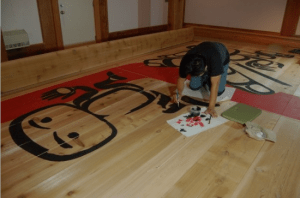
Dean Heron at work in the longhouse

When the longhouse is complete, Heron plans to continue carving his own work. In addition, “I have lots of images that I’d like to get printed.” He would also like to begin doing clothing designs, and learning jewelry-making.

Dedicating himself to art and moving into a community that was strange to him was a huge gamble, but Heron clearly feels that it has paid off for him.

“Growing up, I always felt that I was at the front door, but not right inside – always looking through the window and looking at these sculptures and not understanding the whole of them. I mean, I still don’t. And I think that’s part of the experience of being adopted and being First Nations. I’m at the point now where I’m straddling two different cultures, really. I have a non-first Nations family, so I’m getting an outsider’s point of view, but now I’m living in the community and understanding a lot more of it.”

Read Full Post »

Well, that was unexpected.

Passing through downtown Vancouver yesterday on my last errands until the end of the Winter Olympics, I imagined I’d be affected by the games preparations in any number of ways. Not being a sports fan, I thought I might be offended by the waste. I might flee the crowds and the traffic prepared to be a hermit. I might be angry for the sake of the business owners who had to close down because the traffic restrictions mean that their staff can’t get in and they can’t get deliveries. I might even have been blown away by the spectacle and find myself looking forward to the games after all.

What I didn’t expect was to look around and feel that I had been dipped in tacky excess. Everything I saw was so over the top that it might have been orchestrated by Albert Speer.

The first thing that caught my eye were the banners covering a few of the buildings. Do we really need blowups of athletes six stories high? A Canadian flag ditto, covering most of two sides of a building? Boasts that the corporate owner of a building was an Olympic sponsor? Endless urgings to “Go, Canada, Go?”

Descend to the Skytrain stations, and the excess continued. So far as I can figure, three advertisers had each won the privilege of monopolizing a transit station, and responded by covering as much of their station as possible. At Granville, it was Coca Cola, at Burrard, Macdonald’s, and Acer Computers at Waterfront.

Junk food and cheap computers? How does Vanoc square these with the Olympic ideals of athleticism and excellence? And I wonder who first imagined that repeated the same half dozen ads fifty or sixty times in a confined space was effective advertising, instead of an annoyance.

And everywhere, there were the officials and athletes from out of town, wearing their team uniforms that were not only gaudy but usually with the manufacturers’ names as large as the names of the country. Again, the connection to the Olympics eluded me. The out of towners were so gaudy that they might almost have been wearing Hawaiian shirts.

Yet the out of towners were restrained compared to some of the locals. Well over three-quarters were simply going about their Sunday business, but a minority were as gaudy as the out of towners and jingoistic as well, with Canadian flags flying from their cars and the marquees on their buses giving us a “Countdown to Gold” and urging Canadian athletes on. It was like the hockey playoffs, only on a larger scale.

A two year old might be fascinated by all the bright colors and larger-than-life consumerism, but it’s been a while since I was a child. Surrounded by such general tackiness, I could only complete my errands as fast as possible, and get out of the downtown. Except, perhaps, to see the Aboriginal Pavilion, I don’t plan on coming back until after the Olympics, when the city is back to itself.

Read Full Post »

If an artist has an apprentice work on a piece, are they dishonest if they sign the piece as though it were their own? By coincidence, two acquaintances have found themselves confronting that question. How each of them answered says something about how we regard art and the definition of authenticity.

In the first case, my acquaintance commissioned a mask from a well-known Northwest Coast artist (I am deliberately not mentioning names or any identifying details, because the issue touches on artists’ integrity). When the artist passed the mask to an apprentice to finish, my acquaintance was furious. I supposed my acquaintance would say that they paid for a work by the artist, not by the apprentice, although the fact that the artist gave the mask to the apprentice in front of them suggests that, the artist was not trying to be deceitful.

In the second case, an acquaintance bought a mask, and was contacted by the artist’s former apprentice, who claimed that the mask was theirs. The artist had frequently stolen their work, the apprentice claimed. However, investigation showed the matter was not so simple. The apprentice’s carving style was similar to the artist’s to begin with, and the apprentice had roughed out the mask, but most likely under the artist’s supervision. From the one picture of the apprentice with the mask, the artist seems to have finished the carving, painted the mask, and added many characteristic details. The result was far beyond the apprentice’s usual level of skill, and, according to one rumor, the apprentice had formally sold rights in the mask to the artist.

I suppose that, at some point, an apprentice’s work becomes extensive enough that they deserve credit on a work. Yet, while that should be true, the practice of having apprentices help with an artist’s work without receiving credit is extremely old. With many paintings done in the European Renaissance, the question of how much of a work is an apprentice’s remains a disputed point.

Similarly, in modern Northwest Coast art, it is an open secret that Bill Reid’s “Raven and the First Men” may have been designed by Reid, but was carved by Reg Davidson, Jim Hart, Gary Edenshaw and George Rammell, with Reid doing mostly finishing details. As for “The Black Canoe – The Spirit of Haida Gwaii,” Reid is supposed to have contributed only the design, partly because of his illness and partly because he knew next to nothing about bronze casting. Although these collaborators were chosen for their expertise, no one suggests that general credit for these works should not go to Reid, although many (including me) think that their contributions should be more generally known.

So why is the buyer in the first case and the apprentice in the second case angry? Part of the reason may be that, although collaboration is widespread in Northwest Coast cultures, especially on large projects, the idea persists in Euro-North American culture that fine art is done by one person. If the work is not the artist’s, then it must belong to the apprentices who worked on it.

A work on which more than one person deserves credit can easily be seen as inauthentic – and definitely not what the buyer paid for. And, possibly, a collaborative work will be less valuable than a work by a single artist, although that does not seem to have happened with the collaborations between Norman Tait and Lucinda Turner in Northwest Coast art.

Aesthetically, however, does who created the piece matter? I have not seen the mask in the first case, but the mask in the second case is an accomplished and sophisticated work, no matter who deserves credit for it. In this light, arguing over who deserves credit seems almost crass, even thought it might be the legitimate grounds for a law suit.

My own take is that the acquaintance in the first case has no reason to complain, given the traditional relationship between artist and apprentice. Letting an apprentice finish a mask may seem high-handed, yet it was done so openly that the artist probably did not intend to deceive. Nor does it seem likely that an artist would let an inferior piece out of their hands; to do so would affect their reputation. Before my acquaintance received the mask, it was almost certainly finished to the artist’s usual standards, no matter who did the work.

The second case seems just as clear. Although the apprentice’s hands may have been on the tools, the artist seems to have guided the making of the mask at every stage. Just as with the first step, conventional practice would attribute the mask to the artist, and not the apprentice.If the artist was feeling generous, they might acknowledge the apprentice’s contribution, but they are not obliged to.

Of course, in real life, the matter is not so simple. The buyer in the first case and the apprentice in the second might have a law suit over the expectations created by their positions. And possibly the apprentice might try to assert ownership and create a miniature nightmare for the buyer of the piece.

However, based on common practice, I doubt that either would get very far. If the facts are anything like those I’ve summarized, then by precedence, the art work should be attributed to the artist, and not the apprentice.

Read Full Post »

A couple of weeks ago, I was contacted by Robert Cleary, a member of an online group whose members collect copies of Wargamer’s Digest. I was not surprised to hear about the group, since the Internet has something for every interest imaginable. But what surprised me was that he wanted to hear about how I came to make my first professional sale to the magazine – a short article called “Fantasy – Battles for the Runestaff”. He sent me a copy of the article (mine not being easily locatable), and, once I had reassured myself that the article was not too badly written, I started to remember.

I like to say that I sold the article when I was fourteen. Strictly speaking, though, that’s an exaggeration. To be completely accurate, I pitched the idea when I was fourteen and it was accepted. I didn’t actually finish the article until I was sixteen, and it wasn’t published for several more years. Nor did I find out that it had been published until long after it appeared; I can only assume that the editor was as casual about such things as I was then. By the time I actually pocketed the $40 I made from the sale, the idea was well over five years old.

Fantasy readers might recognize a reference to a series of books written by Michael Moorcock. Set in the future, The History of the Runestaff series is the story of how a group of heroes centered around a kingdom in Provence resist the expansion of Granbretan, a feudal empire whose nobles wear metal animal masks and show a pathological fear of revealing their bare faces.

Looking back, I realize that to call the books in the series potboilers is to insult the kitchen industry. Even their author does not claim that they were literature. However, in my early throes of adolescence, they seemed heady enough stuff, and I re-read them at least three times.

While I was reading about the Runestaff (and every other fantasy or science fiction book I could find), I was also absorbed by board games and history. I collected at least a dozen Avalon Hill games, and was especially fond of Feudal, a chess-like war game that used 3-D figures of medieval warriors for pieces. Whenever the erratic magazine deliveries to the local hobby store allowed, I picked up Wargamer’s Digest. I painted countless figures for wargaming – mostly medieval, classical and fantasy – and devised the rules for games of my own imagination, in some cases even finishing them.

My one problem was that, if other wargamers existed in my neighborhood, I didn’t know about them. Today, a teenager like me could probably find someone to play against on the Internet, but, in the 1970s, my options were more limited. Occasionally, I dragooned a friend into playing, but those games rarely got finished. More often, I took turns playing one side then another.

Looking back, it wasn’t a bad education in how perspectives change with circumstances. But it wasn’t very satisfying. For one thing, I could never surprise myself.

At the same time, I had writing ambitions. What exactly I wanted to write, I was unsure, but, hearing how early some famous authors had begun, I thought I should get a move on. The summer I was 14, I knew, would probably be the last one I had free. With university starting to loom, I would almost certainly be working the next summer. I had one last chance.

Half-overcome by my own chutzpah, I submitted a query letter to Wargamer’s Digest. I chose the Runestaff series both because I was re-reading it when I made the query and because the magazine didn’t publish much about fantasy gaming, so I figured I had more of a chance with that topic than with one that was more mainstream.

My query was accepted, and I promptly had a failure of nerve for a year and a half. Then, timidly, after two or three false starts, I wrote to ask if the editor was still interested. He was, and over the Christmas holidays, I pounded my game notes on the Runestaff into what I hoped was a reasonable imitation of the magazine’s style.

Then – nothing. I received my first payment for my writing when a poem of mine took third place in the Alberta Poetry Yearbook. I graduated from high school and started university, and otherwise got on with my life.

Moving out of my parents’ house at the start of my third year in university, I came across my old stack of Wargamer’s Digest, and thought to query about the article. To my surprise and delight, it had been published some months before, and I had the profound pleasure of seeing my work in a magazine, and finding it, after all that time, not only free of typos, but more authoritative in tone than I had hoped.

I wish I could say that the experience was the start of my professional writing life. But the truth is, the experience was so fragmented and so drawn out that it proved to be a false spring. It was another seven years before I ventured into writing articles again (although I did sell the odd poem and story), and another decade before I started to make a living as a freelance journalist).

The fault was mine for not following up, I realize now. Still, I wonder what might have happened if I had. Would the early success have given me the courage earlier in life to freelance? Impossible to tell now, but I still get a small thrill re-reading my long ago article in PDF form and wondering how it fits into my early life.

Fantasy-battles-for-the-Runestaff

Read Full Post »

The first piece an artist does in any medium is frequently a labor of love. The artist has poured all their ability into the piece, and, even if the work is flawed, you can often tell the artist’s quality and interests from it. It was with these thoughts in mind that I jumped at the chance to buy Colin Morrison’s “Naxnox” which, as he wrote on its inside, is his “first mask ever.”

Even so, I was lucky to get it. A picture of the mask sent out in early December received a dozen replies within twenty-four hours, including eight or nine from galleries. This level of interest in an unknown artist’s work, especially at a time of year when sales are difficult, tells you all you need to know about the quality, even if you can’t judge it for yourself. It is a level of interest that, in fact, is almost unheard of.

The design is arresting to the casual eye for a number of reasons, starting with the contrast between the black and red and the thickness of their lines, and continuing with the unpainted nostrils and the ovoid in the middle of the forehead like a supernatural third eye. On the right, the mask looks dark and brooding; on the left, carnal and scowling. The result is a mask with an unusual degree of presence.

In terms of the northern school, the mask is even more interesting because it seems both traditional and contemporary at the same time. On the one hand, the shape of the mask is a standard one in Tsimshian art. The painting across the face without regard for individual features is also common in the northern schools. On the other hand, I have never seen paint applied in such an angular slash across the face to create such an asymmetrical, modern effect. You might almost say that the traditional and contemporary are at war across the mask – a suggestion of conflict that contributes to the strong sense of presence.

This sense of conflict seems especially apt when I remember Morrison’s description of his own background: “I’ve learnt as much as I could about traditional life as I could, but I feel as if I don’t know as much as the elders. I know a little more then the next guy, but not a lot. Most of what I learnt, came from books, my granny, and uncle. I don’t know a lot of my Sm’algyax, but some words I do know. I don’t dance, and don’t sing. I’m getting a Sm’algyax name when we have a feast, but I have been waiting for years for it to happen.”

Traditionally, naxnox was used to refer to the masks and regalia used in ceremonies. In Tsimshian languages like Sm’algyax (Coast Tsimshian), naxnox means “beyond human understanding.” Or, if you prefer, you might translate the word as “supernatural” or “spiritual.” Such works were often concealed when not being used, and, should they not be treated with the proper respect, were capable of extracting revenge.

Obviously, Morrison’s mask is not naxnox in the literal sense, since it is meant to hang on a wall rather than being danced. Yet, metaphorically, the name seems to suit the mask’s presence and its mixture of the traditional and modern.

I wonder: Could the meaning be extended to mean “psychological?” Or, more to the point, could it cover the latent power revealed in a first work? Although I’m not a linguist, I like to think that it could. Because, however you regard it, “Naxnox,” like Morrison’s “The Spirit of the Wolf,” is a work that holds great potential for Morrison’s future career.

Read Full Post »

I have an embarrassing confession: I almost never watch television. It’s nothing I decided or planned – it just happened — but it’s probably the most socially awkward thing about me.

Part of my embarrassment is that I am always missing half of what people are talking about. If everyone is watching a popular show, or a notorious commercial is making the rounds, I wouldn’t know. I can only gather indirect hints, because I am unlikely to actually witness what everyone is talking about.

Another part of my embarrassment is that nobody can process the fact that I don’t watch television. Just as people can’t believe that I really don’t drink coffee (which is another faux pas of mine), so they can’t believe that I don’t watch TV. I must have seen something, I’m always being told – everybody’s seen it. Or surely, I must at least watch the news. And what do I mean, we disconnected the cable because we never used it?

Nobody can accept that the average person watches more scheduled television in an evening than I do in half a year. I can tell that most people are humoring me, thinking that I am being perverse or joking, or trying to make some obscure point.

That brings up the greatest reason for my embarrassment: When I do get through to people, they usually assume that I’m being an intellectual snob – one of those people who establish their mental superiority by claiming to disdain TV fare, or a latter day disciple of Neil Postman, who refers to television as “the boob tube” and believes that it makes people stupid.

I wince at being lumped in with these snobs because I find them pretentious, lacking in anything but received taste, and not knowing if a show is bad or good unless someone else tells them.

Besides, I’m hardly one to suggest that only high culture is worth having. I’m no stranger to high culture, and I enjoy parts of it, but I also think that some of it is over-rated and trite. And I mean, I did do my thesis on a science fiction writer. I also believe that the graphic novel is a serious art form. With such opinions, I am far from likely to look down on TV.

Admittedly, I don’t care for commercials. I consider them the enemy of drama, breaking up the mood and twisting the story into unnatural shapes. But that’s hardly a judgment on the quality of the shows. When a season of show comes out on DVD, I frequently buy it.

The truth is, I simply got out of the habit of watching scheduled shows. When I first moved out of my parents’ house, I didn’t have a television, so I filled my evenings in other ways. Later, as a student and an instructor and a freelance consultant, I have kept irregular hours through much of my adult life, often working into the evening rather than relaxing.

As a result, even when I hear of a show that might be worth watching, I almost always forget about it until after its aired. I’m just not used to thinking about television, which is why so often I suddenly find – as now – it’s been eighteen months since I watched a regularly scheduled show.

But don’t imagine that I’m proud of the record, or putting you down if you watch four hours a night.

I’ve just been busy, that’s all.

Read Full Post »

I love science fiction and fantasy. They were the bulk of my reading in childhood, and they are still a sizable chunk of my fiction reading. When I go to a movie, it is almost always science fiction or fantasy. In young adulthood, I even went to conventions, although I was never much into fandom. Yet I have a confession that I will be lucky to make without being flamed and receiving death-threats: I’ve never warmed to Star Trek. I much prefer Doctor Who, that other long-running series.

My distaste for Star Trek began with the original series, and has remained largely unchanged in all the subsequent incarnations and movies. With a few exceptions, the scripts are primitive by print standards, with plots barely a step above the pulps of the 1930s and heavy-handed humor. In later incarnations, the quality of the scripts is sometimes hidden by a quotation or reference, but these are like gingerbread along the roof line of a Victorian house – non-functional decoration that fails to fit into anything around it. Mostly, they seem heavy-handed or gimmicky, such as having Stephen Hawking play himself.

As for the characters, how anyone can believe the pudgy and sententious James Kirk as an action hero or a leader is beyond me. Nor am I enthralled by the one-dimensional Spock, whom I suspect must have suffered regular wedgies outside his locker at the Academy. True, Patrick Stewart deserves credit for delivering the clumsy lines that were dumped upon him with some degree of conviction, but he is the only one of the supernumeraries and re-treads who deserves any respect.

But the real problem for me is the military gloss and doctrine of American liberal expansionism that runs through all the series, despite some recent efforts at revisionism. For all the change of costumes, the Star Trek universe has not progressed far beyond the John F. Kennedy era in which it was conceived: The rest of the world (or the universe) needs fixing, and Americans (or humans) are just the ones to do so – for everyone’s own good, of course, but with a firm hand if necessary. This connection is so close that the first series even had an episode in which Kirk encountered a post-holocaust duplicate of the United States, which he helped to put on track by reciting the American Declaration of Independence. Much of the time, Star Trek is all too ponderously self-important for me to take seriously for a moment.

But Doctor Who – that series is everything that Star Trek is not. Even limited as it was by being a TV serial for children for much of its run, Doctor Who has consistently shown more imagination than anything on Star Trek. Whoever invented the silly yet frightening Daleks was a borderline genius – they are frightening even to adults precisely because they are silly. As for the fact that The Doctor periodically regenerates into someone entirely different, that may have been a plot element introduced to explain the change in actors, but it’s an ingenious example of turning a liability into an asset.

Yes, Doctor Who has had its share of weak scripts and poor production values. But what has been surprising is how often, despite the cheap sets, the scripts have managed to be interesting, thoughtful, and even provocative. That is especially true of the modern revival under the direction of Russell T. Davies, which has maintained a level of excellence unparalleled in science fiction TV, and often turned the storyline into a critique of the series itself. But before everything else, Doctor Who has always been about character – not just about the anarchic and eccentric Doctor himself, but about those around him as well. It’s a subtlety that Star Trek’s producers rarely understand.

I have sometimes heard people suggest that Doctor Who captures the spirit of post-empire England, compared to Star Trek‘s echoes of the jingoistic American Empire. I suspect that may be true, but, whatever its origins, the spirit of Doctor Who is far more appealing than Star Trek‘s.

For me, the difference was captured in one episode a couple of decades ago when his arch-enemy The Master invited him to assist in conquering the galaxy. “But I don’t want to conquer the galaxy,” The Doctor replied (or something very similar). “I just want to see it.”

Essentially, Doctor Who is a humanistic view of the cosmos. And while in Star Trek, The Prime Directive seems like a marketing gloss on an essentially militaristic outlook, The Doctor’s ethos suffers from no such contradiction, being consistent all the way through. It is an ethos of loyalty, of being engaged, and of trying despite trauma and odds. Always, it is a story of individuals against bureaucrats and hierarchy — a story that Star Trek could only match if it was about a group of aliens resisting the encroachment of The Federation.

But, just to keep this mix from being too grim, there is always a flamboyant self-mockery in the central figure, from the recorder of the Patrick Troughton Doctor to the scarf of Tom Baker and the verbal free association of David Tennant. Brooding, mecurial, and brilliant, The Doctor in all his incarnations has a complexity that Kirk, Spock, Picard and the others can never match, for all their detailed back stories.

No, give me Doctor Who over Star Trek any day. For me, Star Trek is just cardboard characters moving dully against a rote background. I’ll watch it occasionally, but I have less and less time for it as I grow older. But Doctor Who fires my imagination, remaining fresh where Star Trek long ago went stale.

Read Full Post »

Several times in the last few months, I’ve closed discussion on one of my blogs. Each time, some people have howled in outrage. Their anger makes them nearly inarticulate, but their position is apparently that I have no right to stop discussion. I am an enemy of free speech, they proclaim, a censor and cowardly, and downright evil as well.

I don’t see that, myself.

For one thing, free speech is not an absolute right, even if you believe that it should be. It is limited by laws against libel, hate-crimes, and terrorism, among others. Nor can you invoke free speech as a defense against mischief.

Admittedly, violations of these laws appear dozens of time each day on the Internet, and most of them are not prosecuted unless someone complains. Even in 2010, the Internet retains more of a frontier unruliness than other forms of media. But the point is that idea that free speech is unlimited is disproved with a moment’s thought.

Moreover, in each of these cases, some of these limits seemed to apply. Whether they actually would have been grounds for legal actions, I can’t say, of course. However, I think that erring on the side of caution is reasonable, especially since at least one determined commenter seems to have been required to close down his own blog.

At any rate, I have no desire to be involved, however indirectly, in a court action. And, in the case of one blog, I would be irresponsible if I exposed the company that owns the site to litigation. These motivations are not a matter of courage so much as caution. If I am going to be dragged into a legal action, it is going to be for something worth fighting for, and not because I provided a forum for the indiscreet and feckless.

However, my strongest motivation was that I simply lacked the time to either police my blog every half hour or to enter into discussions that were unfolding in which, so far as I can see, there was little to distinguish one set of claims from another.

I have been writing about free and open source software for five years now, and I have gained a limited amount of recognition. That recognition is not on the scale of a Linus Torvalds’ or a Richard Stallmans’, but it does mean that I get a lot of email and other contacts – so much that I can only answer some of it if I hope to get any writing done. Unless I am contacted by a friend or an unusually interesting stranger, I generally try to limit an exchange to a couple of communications.

I don’t always follow this rule strictly, but when someone is repetitive, abusive, and fails to address what I have to say, I am sure to apply it. By nature, I am easy-going and love to talk, but trying to hold a discussion with such people leaves a deadening feeling of futility. They are not going to sway me by bludgeoning tactics, and all too clearly, I am not going to convince them in a discussion. So why should I waste my time? A couple of exchanges is enough for them to have a say, and for me to know the type of people with whom I am dealing.

In other words, I choose to focus on the people who are interesting to have in a discussion, and/or can teach me something. So far as I’m concerned, declining to spend much time on the obsessive is not censorship, any more than refusing to publish bad writers in an anthology you are editing is censorship. It’s selection, plain and simple. i am hardly the only person I know who has to resort to this kind of selection in order to do what’s important to them, either.

Nor can I navigate the rights and wrongs of the feud that, in a couple of cases, is the reason for me shutting down comments. Both sides accuse the other of criminal behavior, and both sides claim to present evidence. However, all I can tell for sure is that I don’t want to be involved. Being hectored, abused, and threatened two or three times a day makes me even less likely to want to get involved; attempts to intimidate only make me stubborn, and, when people act like spammers, I treat them like spammers.

At any rate, to talk about censorship on the Internet is more of a rhetorical flourish than a reference to reality. If I refuse to post someone’s comments, that’s two out of – what? Several billion sites? If a commenter can’t find a place to publish what I won’t, they aren’t trying.

Under all these circumstances, you’ll excuse me if I find myself unmoved by the accusations when I close comments. I don’t do so quickly or easily, because I value freedom of expression myself. But I do so to create a space to work, and so I can focus on what’s important.

The peace of mind that results tells me, more than anything else, that I am doing the right thing.

Read Full Post »

“It’s not personal. I’m just saying what needs to be said.”

In the last few months, I’ve been hearing this statement frequently, or at least variations on it: Twice from people who are trying to jump start their own journalism careers by attacking me, and more recently from both sides of various online vendettas. And every time I hear it, I’m curious about how the people involved can say it.

Not, you understand, that I believe such comments for a second. When people focus on someone and attack them obsessively, claims that the attacks are impersonal quickly become unbelievable. Ditto for viciousness that is out of all proportion to the overt subject matter. A couple of people making this claim even made it immediately after explaining why the situation was personal, apparently never noticing the contradiction.

However, I do wonder why they even try to make a claim that so obviously fails to fit easily available evidence.

The most convenient answer would be that they are deliberately lying. Yet I hesitate to accept it, because to do so feels like evoking an explanatory principle to stop the discussion – like saying that opium puts people to sleep because it contains a dormitive principle. All you are really saying is that they are lying because they are lying. And my impression is that none of the people who make the claim are consciously lying.

Or, possibly, some of them are lying to themselves first, convincing themselves of the righteousness of their position before persuading anyone else. This tactic would allow them to make the claim of impersonality with utter conviction. At the same time, lying to themselves would let them ignore any evidence in their own behavior or words that contradicts the claim.

In other cases, denying personal motivations seems like a deliberate effort to elevate their words and actions. After all, in our culture, impersonal motivations are considered the only ones to legitimately act upon. Even in this post-modern age of doubts, to claim objectivity is also to covertly claim the highest of motives – to claim nothing less than you are acting like a scientist, that modern icon of impersonal reasoning.

By contrast, admit that you are attacking someone because you are jealous or because they made a comment that hit too close to home for you, and you might as well admit that your argument lacks validity. The first admission will be automatically equated with the second. Far better to claim a dedication to truth, or at least to disinterested criticism than to acknowledge that grubby bits of spite might be powering our actions.

Also, of course, if you stake the first claim of objectivity, you exclude your opponent from making a similar claim, casting them into the nether darkness of subjectivity, and all the evils that lurk within it.

Yet, even while I make this supposition, I wonder how such a claim can be sustained. I don’t know about anyone else, but when I try to make such a claim (and most of us do, at some time or the other), I am distracted by nagging doubts just beneath the level of consciousness. I start to notice that my actions and words are odds with the claim, and the claim soon collapses. Increasingly as I age, I find it mentally easier not to make such claims and suffer the embarrassment (if only privately) of backing down or continuing to assert what I no longer believe.

Could that explain the viciousness that often accompanies the claim? Could its makers be sensing the instability of their claim, and, instead of abandoning it, defending it as hard as they can? Are they, in fact, in denial?

I hope so, because otherwise I will have to admit that I don’t know people at all (a distinct possibility, I admit). All I really know for sure is that, when someone says that their behavior isn’t personal, you can be confident that it is not only personal, but deeply so.

Read Full Post »

« Newer Posts - Older Posts »