Feeds:
Posts
Comments

Archive for the ‘British Columbia’ Category

Over the past weekend, I was in Terrace in northern British Columbia to attend the graduation ceremony and exhibition for the Freda Diesing School of Northwest Coast Art. I would have wrangled an invitation anyway that I could, because the art show is worth seeing, but fortunately I didn’t have to. I was invited to attend so that I could announce the Mature Student Award, and, just before I rose to spoke, a touching thing happened.

The award was started by me and my late partner, Patricia Louise Williams two years ago, after I noticed that many of the awards for First Nations carvers required that the recipient be under twenty-five. Knowing that older students give up even more than young ones when they return to school, and how much older students add to the class room, we decided that they deserved an award, too.

This year was the first time the award had been given out since my partner died and the award was listed as being in her honor. I knew, too, that Carol Young, last year’s winner, was going to give a eulogy for Trish – something I knew that I could not possibly do without becoming incoherent with tears. So I knew going into the graduation ceremony that my emotions would be running high.

Carol gave a brief speech that had me fighting to keep control. She spoke of Trish’s lifelong interest in Northwest Coast Art and of the crafts that she was always doing. She spoke, too, of Trish’s generosity, and how she used to cut the blossoms from her miniature roses and hand them out when we were on our weekend errands.

Then she announced that, in honor of Trish, each student would take a rose and hand it to someone in the audience.

That was it. I lost all hope of control and started crying. By the time Carol announced me, I could barely see for crying.

I walked slowly to the front, buying time to dredge up some composure. To say the least, I didn’t succeed very well.

Somehow, I managed to stand straight and talk slowly. Afterwards, people said I talked well, but I don’t know if they were being kind or not. I don’t even remember what I said.

But I got through somehow. I may have said that, because of money donated at Trish’s memorial service and raised through the sale of her craft supplies, that this year the award was being given to three students, two of whom were honorable mentions. I’m not sure, though. All I know for sure is that I announced the winners, and handed each a wrapped book, and faltered back towards my seat.

The ceremony ended soon after, and the crowd followed two drummers to Waap Galts’ap, the campus longhouse, which is a happy blend of a traditional Tsimshian and a modern building. There, we heard the students talk, and watched Nuxalk and Tsimshian/Salishan dancers moving around the flats and glass cases of the exhibition.

Occasionally, as the evening continued, I saw people in the crowd holding one of the roses. Usually, they were women, and often seniors, although once I heard a lover give a male student a rose, on the grounds that men rarely receive roses. That seemed especially fitting, since Trish had said something similar to me on my twenty-first birthday.

But no matter who held the rose, the sight never failed to leave a catch in my breath and tears in my eyes. Later that night, as I stared up into the dark in my hotel room, I reflected how strange it was that a gesture carried out by people who had never known Trish should be so much more moving that the memorial service held a few weeks after her death. I was not the least ashamed of crying, because I knew that Trish would have sobbed to see it, and I knew I had to cry in her place. I drifted off in melancholy satisfaction, and slept well I awoke, grateful for the gesture and wondering if it might be repeated next year.

Read Full Post »

I’ve been interested in Mike Dangeli’s work since I saw his ridicule mask in the Continuum show at the Bill Reid Gallery. The idea of taking a traditional form of commentary and applying it to modern relations between the First Nations and industrial culture seemed far wittier – and ultimately, more meaningful – than the other post-modern statements in the show. Later, when I heard Dangeli lecture about his efforts to live his culture in a modern context, I became even more interested. But it was only in October 2010 that I got around to commissioning a piece from him.

Whenever I commission work from an artist, I like to suggest only broad guidelines, and encourage the artist to experiment and maybe do something they wouldn’t ordinarily do. Accordingly, I told Dangeli that the painting was to be in honor of my late partner Trish Williams – the second piece I had commissioned in her memory – and could have up to four raised canvases. We discussed the primary colors, and I left him the pamphlet from her memorial service and some of the feathers I had collected over the years from our parrots. Remembering, too, Mike’s association of the north wind as a messenger between this world and the creator that might appear at a funeral, I also suggested that the north wind might be part of the design.

When I came to pick up the painting three months later, it had grown in its creation, with two side panels added to give room for Dangeli’s design.

The central panel of “Honoring Her Spirit” depicts Trish in raven form, with me represented by the red face on her wing. Around her are four ravens, for the four nanday parrots in our household during her lifetime, their bodies painted in the colors of nandays.

To the right, is a panel showing the north wind in the spirit realm. Where the central panel is made of definite lines in a more or less traditional formline design, the north wind is painted with thinner and less definite lines, its breath curling in non-traditional designs. The implication seems to be that we can only see hints of the spirit world – that nothing in it is as definite to our senses as the world around us.

On the four raised canvases, the birds sit poised between the two worlds, which suggests that they are part of both, or can move between them. The red lines on the raised canvases are roughly reminiscent of traditional northern designs, and spill over into the central panel, as the feathers do, both perhaps suggesting the interconnections between the two worlds.

However, the north wind is also blowing into the central panel, suggesting the coming of death. Trish’s transition into death is shown on the left hand panel, where her image is mirrored imperfectly, simplified and disjointed and drained of color to reflect our imperfect understanding of what happens after life.

This is a simple but powerful idea, ingeniously strengthened by the different styles in the panels. Yet what is eerie is that, although Dangeli did not know while he was painting, one of our four parrots died before he completed the paining – and only one of the birds is looking into the other world. The other three, who are still alive, are facing towards the everyday world. And if that is not enough, the feathers at the top center are from the dead parrot, although Dangeli no doubt picked them out at random. Whether these touches are serendipity or an example of the heightened perceptions of an artist, I won’t say, but they do add to the already highly personalized subject matter.

The painting now hangs in my bedroom, below two examples of Trish’s needlework. That seemed the most appropriate place for it.

Read Full Post »

I first became aware of Calvin Morberg’s work through a shark mask he sold to the Inuit Gallery. I was too late to buy it, but I did catch a glimpse of it. Although the finishing was a little rough, I was impressed by the originality of the design, and decided to keep an eye on his work. I tracked him down on Facebook, and, a couple of months later, I bought this eagle frontlet from him.

With its red background, abalone and harbour seal whiskers, in many ways, the frontlet is a typical Tlingit design. The general design is one that I have always admired for its boldness and embellishment – two traits that seem more common in Tlingit work than in any of the other northern First Nations. Tlingit work, I have always thought, has a touch of exoticness missing in Haida or Tsimshian or Nisga’a work, which I like to think helps to explain the traditional Tlingit reputation for being shamans. But, regardless of whether that is true or not, Morberg has carved a striking version of a common general form.

True, like the shark mask, this frontlet has a rough touch or two. In particular, the abalone is not well-matched, and, if you look closely, you can see the drilled hole in each piece that suggests Morberg has bought what was convenient – and not what best suited the piece.

However, these are minor flaws. As in all the other frontlets of this general design that I have seen, they are part of the background. What draws the eye is the central figure, and there Morberg shows his skill.

The central figure offers a set of planes consisting of the lower and top beak and the nares, all at contrasting and complementary angles, drawing the eye down to the wing feather tips at the bottom. From the bottom, the wing tips draw the eye back to the painted lower half, circling the design there until the inverted T-shapes at the top draws the eye back up to the eyes, and finally back to the beak via the eyebrows so that the process begins again. This is exactly what successful formline should do – trapping the eye, and keeping it moving around the entire shape. In fact, in moving about the central figure, you soon stop to notice the rest of the frontlet.

Nor is there any roughness to the finishing that would distract the eye in its progress. If the abalone provides a rough surface, the central figure provides a smooth one without sharp edges, and together they create a contrast as obvious at a glance as at a touch.

Another part of the central figure that I appreciate is the painting. To start with, Morberg has taken the unusual step of adding paint to the lower half; in several other eagle frontlets that I have seen, this area is usually occupied entirely by carved wings.

But even more interesting is the pale copper green, which seems to be a hallmark of Morberg’s work just now. Given the red background, he could hardly use red as the secondary color, and the green is an ideal choice, because it complements some of the shades in the abalone.

Also, of course, for those in the know, the color is a reminder that copper was a measure of wealth on the coast – a reminder that is especially fitting since frontlets are an indication of chieftainship, or at least high rank.

I don’t know where Morberg’s developing talent will go next. However, because of pieces like this eagle frontlet, I expect to hear more of him in years to come. I wouldn’t be the least surprised if, sooner or later, I buy other pieces from him.

Read Full Post »

One of the dangers of knowing artists (pity me!) is that, when they’re in town, they usually have pieces for sale. That is what happened a few weeks ago when Mitch and Diana Adams were in Vancouver a few weeks ago for the Chinese New Year celebrations. After dim sum, Mitch took my back to his mother-in-law’s apartment to show me what he had brought with him – and, inevitably I bought two: A Gagiid mask and a Killer Whale Comb.

The Gagiid features in the dances of Haida secret societies. The Gagiid is a castaway who, as he wanders the shoreline by himself, grows so crazed that in his endless foraging he devours sea urchins without removing the quills, which embed themselves around his mouth. Cryptozoologists often take the story as evidence for the existence of the Sasquatch, but this identification requires a giant leap of illogic, since the Gagiid is originally a normal man, and in the dances (if what I have heard is correct), the point is to reintegrate him into society. Today, at least, the Gagiid is frequently green, a depiction that often encourages Incredible Hulk jokes – a comparison that is actually closer than you might at first think, since the story of the Hulk is also about reintegrating him into society.

Mitch Adam’s Gagiid caught my attention because of the attention to details. His mask’s blue eyes are not an anomaly, and most likely not an effort to connect the Gagiid with Europeans; blue-eyed Haida were apparently noted by the first Europeans to reach Haida Gwaii in the eighteenth century. However, like a shaman, this Gagiid has eyes with pupils that roll upward, suggesting he is in an altered state of consciousness.

Other details follow naturally from the story. The Gagiid’s face is long and thin, as though he is half-starved. The gaps between his teeth suggest that some are missing, while those that remain are irregularly shaped and sized, as though they have been chipped, either through eating hard food or perhaps after too many falls on the rocks that line the shore. Moreover, not only are the lips swollen, but the the lower face is out of proportion, as though it has swelled, too. Similarly, the blood drawn by the sea-urchin quills (on the mask depicted as porcupine quills) is fresh and running on some, as though the wounds were fresh, and simply a ring of red on others, as though the wounds were made some time ago and the blood has dried.

What makes this detailing all the more impressive is the size of the mask: approximately sixteen by ten centimeters. I have seen masks twice or three times the size with less attention to detail (several with woolly eyebrows that give the Gagiid the appearance of Groucho Marx, an effect that Adams has avoided, I’m glad to say).

The same attention to detail is found in Adam’s Killer Whale comb, which is about the same height as the mask. Combs of this design, he tells me, were not for tidying a head of hair, as most people assume, but for untangling the warp of wool on a loom. Perhaps this knowledge of the shape’s purpose encouraged him – unlike the designers of many combs in Northwest art – to carve a comb that is actually functional, with flat sizes and tapering ends, and not just an approximation of the shape.

Made of yew, Adam’s comb benefits from the beauty of the tight and highly visible grain. However, the grain probably caused him trouble, too, since it runs vertically while the design is horizontal. On one side, the pupil of the eye looks as though it might been a knot, and, if you look closely, you can see several other places, such as the outer curves of the mouth or the shape of the nostrils, in which the two sides are not perfect mirror images. At any rate, even were identical sides possible, differences would remain, because the grain is much darker on one side than the other.

Ironically, the most regular part of the carving is the front design – probably the part least likely to be observed. Yet it is an indication of Adam’s determination and skill that the irregularities are minimized and unnoticeable to the casual eye. Having set himself a difficult task, he proves his skill by doing it extremely well.

Notice, too, how the design conforms to the shape of the comb. Only one design feature positively identifies the carving as a killer whale – the fin depicted on both sides of the handle.

Like “Peaceful Warrior,” the laminate mask I bought several months ago, these two pieces show Adams’ ability to work in miniature. He is perfectly capable of a stunning work at larger sizes, as his “Blue Moon Mask” demonstrates, but Adam’s attention to detail makes his smaller works consistently stand out from similarly-sized pieces from other artists.

My only reservation about buying these pieces is that, when I did, Adams lost the opportunity to show these work to the galleries while he was in town, and extend his reputation. I am sure that both would have sold. But, despite the danger of visiting an artist, I feel privileged to have had first chance at them, and to display them in my townhouse.

Read Full Post »

Organizing a meetup group, I’ve discovered, is a good way to find new things to worry about.

When I first started the Northwest Coast Art Meetup Group in Vancouver, I worried that no one would show up to the first meeting. I tried to minimize the worry by asking artist and dancer Mike Dangeli to be the first speaker. Then Mike sent out an invitation to all his Facebook friends, and I worried whether the space I’d booked – the lobby of The Network Hub – would be large enough for everyone who said they planned to attend.

However, I shouldn’t have worried (although I did, of course, being the sort of person I am: About whether the third floor of a building without an elevator was too high for anybody, or too inaccessible; whether the food that co-organizer Nathan Bauman brought would be eaten, whether everybody enjoyed the talk; you name it, and I worried about it).

I counted eighteen at the meetup’s first event yesterday evening – fewer than I had expected or feared, but better than most first meetup events can manage from what several people told me. I suspect that predictions of snow kept the numbers down.

Mike had agreed to talk about “Art and the Potlatch.” It’s a subject that he is well-equipped to discuss, having given fifteen potlatches, and given away hundreds of thousands of dollars in art at them.

I knew in the abstract the importance of potlatches in First Nations cultures, and the importance that art played in them. However, it is one thing to understand something in theory and entirely another to see overwhelming proof of it. As Mike talked, I gained an appreciation of the wide variety of events covered by the term. Births, puberty, betrothal, marriage, the assumption of titles or responsibility – listening to the passing mentions of all the different occasions, I appreciated in a way that I hadn’t really before just how many rites of passage were contained within that simple word from the Chinook jargon. A single word didn’t seem enough to cover so many different occasions.

In fact, it occurs to me that this poverty of expression helped to hide just how devastating the banning of the potlatch from 1884 to 1951 actually was – and why they continued to be celebrated in secret. The same missionaries who urged the banning of the potlatch would have been outraged had anyone tried to ban their own baptisms, marriages and funerals. Yet either they didn’t notice or they didn’t care that that was what they were doing by passing the anti-potlatch legislation.


Another impression I took from Mike’s talk is how closely the art of the coastal First Nations is connected to these rites of passage. Not only the amount of art given, but the sheer variety – paintings, hats, masks, robes, jewelry, dancing regalia – on Mike’s slides impressed this point. Since that was what I hoped would come from his talk, I was glad to feel that realization sinking into me, and I hope that others at the meetup did as well. I didn’t want the group to be a bunch of dilettantes, but to provide a real understanding of the art’s roots and connections – and there’s no doubt that Mike started the meetings off the right way.

No one had any questions at the end, but few were in a hurry to leave, either. Most stood talking for the next forty minutes, and seemed enthused by what they had just heard. One or two, who were artists themselves, or the recent recipients of gifts, showed their own pieces of art. Many thanked me for starting the group.

I’d call the evening a moderately successful beginning. Now, I want to arrange the next event, and see if a bit of a community can’t be organized from the group.

Read Full Post »

Gary Minaker Russ is probably the most imaginative argillite carver at work today. Resisting the pressure to do endless imitations of Bill Reid’s “Raven and the First Men” or to embellish his work with flashy but overdone inlays, he approaches each piece with imagination and integrity. The disadvantage of this approach is that his work is sometimes overlooked because it lacks the predictability needed for a successful brand, but the advantage is that he often produces works that are both beautiful and original, such as “Octopus Eating a Cockle Clam.”

“Octopus Eating a Cockle Clam” is an argillite rattle, with abalone eyes. The rattle itself is a clam shell with broken shell inside and surrounded by a web of red cedar made by weaver Maxine Edgar. Leather wraps the handle of a rattle, which rests in an argillite base.

Although the top of the base has a simple salmon-eye design, the rattle as a whole is a naturalistic rather than a formline design – an approach you sometimes see in historic argillite pieces, but rarely see in modern work. All eight tentacles are present, and, if you look closely, you can see the striations of muscle along the tentacles, and the lines of suckers where the underside of the tentacles are visible. The imitation of life is not total, giving way to artistic considerations in such details as the roundness of the head, the abalone eyes, and the darkness of the argillite, but in general the realism is much greater than you normally find in Haida art.

There is realism, too, in the general concept of the rattle; an octopus actually does crush clams and other shellfish in the way that the rattle depicts. Once you see it, the idea seems simple and ideally suited to the shape of a rattle – yet, so far as I have been able to find, no other artist, historic or contemporary, or in any medium has seen the analogy except Minaker Russ. The day that I bought it, he showed it to several passing Haida friends, and not one failed to exclaim about how unique the design was.

Another important aspect of “Octopus Eating a Cockle Clam” is the fact that it is mixed media. Viewing Northwest Coast Art, it is easy to forget that what you see would have been historically a part of everyday life. However, the fact that this piece is not only a functional rattle but also includes a staple seafood and the work of another artist firmly embeds it in the culture that it comes from.

The connection is all the stronger because, according to Minaker Russ, the clam shell was picked up on North Beach near Masset on Haida Gwaii, which is traditionally the place where Raven discovered the first people in a shell. Historically, the shell was not a clam until Bill Reid depicted it as one, nor did Reid depict a cockle shell; yet, all the same, to a modern audience, the clam shell emphasizes the cultural connection.

I admit to a certain guilt at buying a functional rattle that I will only shake gently from time to time, for fear of breaking the shell. But, aesthetically and culturally, “Octopus Eating a Cockle Clam” is a piece I feel privileged to see every day. It naturally draws the eye, so I’ve given in to the inevitable and positioned it on the focal point of the living room, where it belongs.


Read Full Post »

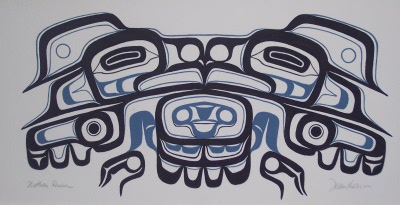
I’ve long admired the graphics work of Dean Heron, but a couple of months ago I realized that I didn’t have any in the townhouse. I quickly remedied that by buying “Northern Raven,” a small acrylic on paper painting that I’m sure will be the first of many purchases.

“Northern Raven” is a split design, with two views of the same figure connected to a central core. Historically, split designs were often used to fill a space, or to wrap the design around a curved surfaced like a handle or the bowl of a spoon. However, they were also frequently used, as here, on a flat surface. They have always struck me as one of the most pleasing forms of symmetrical design, because the fact that one side of the design mirrors the other reduces the static repetition of a perfectly balanced design.

In addition to this natural advantage, “Northern Raven” has several other qualities that make it stand out. To start with, split designs usually have the heads facing outward, leaving a space in the middle. Although reversals of this arrangement are not entirely unknown, they are still rare enough to be noticeable when you see them. By replacing what is usually blank space with design, here Heron creates a far busier design than he would otherwise have, which further helps to break down the staticness of the design.

Another departure from the norm is the use of blue as the secondary color in place of red. This is not an unheard-of innovation in contemporary art, but seeing it in what in other ways is a very traditional piece is somewhat unusual. Added to the pale blue of the paper itself, this choice of colors suggest a cool, icy quality that suggests the first half of the painting’s name (which I otherwise take as referring to the fact that Heron describes himself as a Kaska/Tlingit artist). It also has the advantage of being less arresting than any shade of red, which forces the eye to linger over the design and discover its details at leisure.

However, what really stands out for me is the hand-painted quality of the piece. In some modern First Nations art, the ovoids and u-shapes are geometrically precise, and often drawn by a template, with their curves created by a compass (or, at least, so it appears). If the design is split, the two sides are literally, not just figuratively mirrored, and often created by flipping one side over in a computer drawing application.

By contrast, “Northern Raven”has the appearance of being less geometrically oriented. Much of this sense is created by the thin blue lines outlining the heads. But there is also a suggestion of irregularity in some of the interior elements. Moreover, if you look closely, some of the mirrored elements, like the U and T shapes at the bottom left and right of the design are not completely identical. Such irregularities might easily give a sense of amateurishness, but in this design they add a more human quality, breaking down the symmetry and keeping the design from becoming an exercise in applied geometry.

My only criticism of “Northern Raven” is its scale. With its bold, regular formlines throughout much of the design, the piece deserves to twenty or thirty times its size, and serving as the house front to a longhouse. Otherwise, I consider it a fine place to begin my collection of Heron’s work.

Read Full Post »

Luke Marston is a Coast Salish artist whose work is much in demand. In the summer of 2009, he and his brother John had an exhibit at the Inuit Gallery that must have set records for the prices obtained by artists in their mid-careers. Since then, neither has sustained those prices, but each continues to be much sought-after (Luke, for the record, is the brother who does the astonishing masks and historical recreations). Never having had the money when I saw one of his works that I admired, I was glad to pick up a remarque of his print “Family.”

Released for his wedding, according to Elaine Monds of The Alcheringa Gallery, “Family” (I suppose) shows Marston’s eagle crest embracing the wolf crest of his bride. Because of its thick, dark lines, the wolf is the figure that stands out the most – the wing and leg of the eagle are noticeable only after your eye discerns the wolf, and the rest of the eagle only comes later.

However, as the eye takes in the complete design, the wolf – contrary to the ferocity you might expect – seems smaller and more fragile than the eagle, clinging for protection to the eagle. By contrast, the eagle seems more rigid and less emotional or vulnerable.

Given the occasion, it is tempting to speculate on whether this contrast suggests Marston’s view of his personality and his wife, or perhaps his feeling of protectiveness for her, although I have no idea whether that is true. However, the interpretation gains credibility when you consider that the eagle’s wing is raised as though sheltering the wolf, and that the wolf almost seems to be burrowing beneath it.

There is also a formalized sexuality in the design, with the eagle’s hock joint pointing towards the wolf’s mid-section suggesting a penis, although of course birds lack external sex organs. Similarly, while the interior design elements in the wolf’s thigh serve the practical purpose of reducing the thickness of the leg, the ovoid is almost positioned high enough to suggest an x-ray view of the uterus. This ovoid is echoed in the ovoid formed by the eagle’s claws, which are point at the wolf’s thigh.

Another contrast between the two figures is that the thinner lines of the eagle’s head and beak (and, to a lesser extent, the tail feathers) seem more realistically rendered than the rest of the design. Again, armchair psychology is tempting; in choosing to depict his crest in two different design styles, is Marston suggesting that he sees himself as belonging to two worlds or traditions? Or is the depiction merely a matter of design, created simply to balance the thicker lines of the rest of the design?

You can see comparable figures in most Northwest Coast traditions without having to search very far. However, despite that obvious fact, in some ways, this design hardly registers to my eye as a Northwest Coast design at all.

For one thing, few Northwest Coast designs leave the top and bottom of the design space undecorated except for a few simple lines.

Even more importantly, the all-black design and the sweeping curves remind me strongly of the work of Aubrey Beardsley. In fact, it is the curves that first draw my eye: The long line from the top of the eagle’s wing to the bottom of the design, the coat hanger-like design element at the top, and the curling line of the wolf’s tail. These three lines enclose most of the rest of the design in an off-centered oval, positioning the gaze of the viewer without being perfectly symmetrical itself. Supporting them are mirror-image angles such as those on the two heads, or the inversion of the two legs that is emphasized by the ovoid element in each. All these things give “Family” something approaching an Art Nouveau sensibility.

Last summer, I saw “Family” for sale without any additions. However, Marston has also chosen to release a number of the prints with a remarque in pencil in the blank space at the bottom of the design. The remarque shown here is frog. I have asked whether the frog is a family crest, but have not received any reply from Marston.

However, given the metamorphis in the frog’s life cycle and its amphibious habits, frogs are generally seen as figures of power throughout the Northwest Coast cultures. This background makes the frog a fitting symbol of a life transition such as marriage. But whether Marston himself chose it for that reason is uncertain; since other remarques include a raven or eagle, perhaps he doesn’t.

But whichever way you look at “Family,” it remains an elegant piece from an artist with an accomplished sense of design. I might even say that its simplicity and small size – about fifteen by forty centimeters – makes it more accessible than some of Marston’s larger pieces. I still hope to afford a major work by Marston one day, but, meanwhile, “Family” is a small sample of what he can do.

Read Full Post »

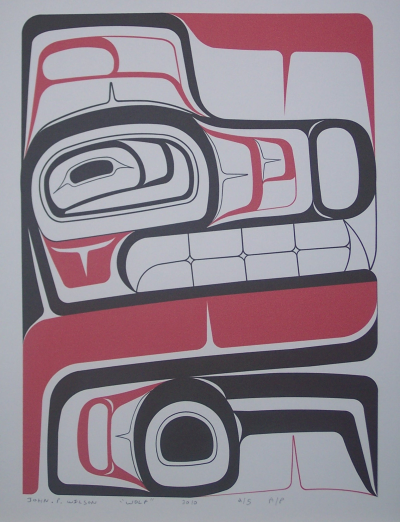
I think of Haisla artist John Wilson as primarily a mask carver, and certainly that is where most of his efforts have gone in the last few years. However, his prints show a certain talent for two-dimensional design as well, which is why I was pleased to pick up this abstract “Wolf.”

Most Northwest Coast Art is abstract to a greater or lesser extent, of course, in that it is highly stylized and uses a number of basic shapes not found in nature to achieve its effects. However, the sub-genre specifically referred to as abstract is less naturalistic than most. In an abstract piece, some of the distinguishing features of a subject are often missing or distorted and often only one or two remain. The figure is further distorted by the surface it is on. The end result is a figure far removed from the semi-naturalistic figures in the tradition – so much so that viewers either need the title or some familiarity with the art in order to know what is being depicted. These conditions open up possibilities for original self-expression that are often harder to find in semi-naturalistic figures.

All these generalities are true in “Wolf.” The bushy tail that is one of the defining characteristics of wolf figures (and often an opportunity for considerable ingenuity by artists) is squeezed into the rectangle of the figure below the jaw, so that at first you might mistake it for ornamentation. Only the short ears and perhaps the muzzle and teeth are left to identify the figure – and the muzzle and teeth might easily be a bear’s. Since the figure is turned sideways and presented upright, there is only one foot and a couple of claws, which increases the abstraction even further

What is left is mostly teeth and claws, creating an impression of fierceness, especially since the claws are outsized. This impression is strengthened further by the elaborateness of the eye with its tilt, as well as the red of the tail bisecting the image.

Technically, the print might be called a study in threes. Three parts of the wolf – the head, the tail, and the foot – are depicted. There are three black ovoids — the eye, foot and nostril – that frame the image, each with a slightly different shape as well as different interior decorations. In addition, three parallel lines –the tail itself, the bottom line of the heat and the top of the foot – cut across the picture. Three black lines form the foot, although only part of the two claws are parallel. In addition, the eye is made elaborate by three clusters of U-shapes, each with some variation of a T-shape inside it to thin it out. For variation, the patterns of three are sometimes broken, as in the red decorations around the eye, only two of which have a tripartite structure, but the grouping are enough to give the figure of “Wolf” a strong unity.

An especially interesting cluster of threes is the tail with its knick in the middle. It is minimalistically echoed in the thin red line beneath the claws, and in the mirror image that touches the ear on one side and the muzzle on the other.. I am not absolutely sure of Wilson’s intention, but the way that the top structure mirrors that of the tail suggests to me that it is part of the tail, so you have to imagine the tail wrapping around the wolf, stretching from the bottom of the image to the top behind the figure, where you can’t see it.

The formlines, too, are worth pointing out. For much of their lengths, they are a uniform thickness, and bend at almost the same angle. However, they are saved from being monotonous by their long, tapering ends, and surprisingly few other techniques. Instead, they create a sense of boldness that seems to fit with the ferocity of the wolf.

In fact, if I had to use one word for “Wolf,” that word would be “bold.” In a way, I regret that the print is so small, because “Wolf” is a design that almost demands to be blown up for a house-front or some other large-scale depiction.

(Note: Being a responsible blogger, I want to take this opportunity to strongly deny the rumor that the print is also available in a limited edition of one in pink and mauve. This alleged alternative version does not exist, and you should not ask the artist about it. Nor did you view it here if you are interrogated. Okay?.)


Read Full Post »

For as long as I can remember, I have wanted to find the magic shop. You know the one I mean: the one heaped with treasures like a vial containing seven tears of an angel or a battered purse of gold coins that is never empty, the one that is there one day and gone the next. To my lasting disappointment, I have never found it, although I have found occasional intimations of it in occasional antique stores and book shops. But this fascination explains why this afternoon found me at the Circle Craft Christmas Market, treading every inch of the seemingly endless aisles of artists and artisians.over and over – even though, this year, the fascination was muted.

What I like about such events is the diversity. Usually, I spend very little – usually less than $100. But the diversions for the eyes seem endless. Jewelry, purses, saris, wooden game boards, rubber stamps, glasswork with streams of color running through it, woven Metis blankets, cedar hats, soup mixes, ,keychains, wallets, children’s songs, carved wooden bowls, clocks with slate faces, fudge from Calgary, soup mixes from Saltspring Island, vinegars as exotic as wine, CDs of children’s songs, lamps made from spirals of wood, Christmas cake, silk scarfs, birch bark bitings, canned salmon, chocolates, jellies, james, woven cedar roses, china flowers, table place settings – even with all the booths of women’s clothing, the variety seems impossible to summarize.

The fact that many of the items seem too unique for everyday use, if not outright useless and unnecessary only adds to the glamor. There is a kind of glorious excess to such displays, and some of the exhibitors seem to be present largely to share their delight in their own creations, although I know that others are counting on their sales at such markets for their winter income.

However, this was the first craft fair I had visited since I was widowed. As a result, my enjoyment was diminished by the fact that I no longer had someone to buy for. Several times, a set of earrings caught my eye, and I picked them up, weighing it in my hand as I studied its engraving, only to put it down again as I remembered I had no one to give them to. “Trish would like this,” I would think, fingering a purse, only to remember that she had no more need of one. I would imagine her describing a curve in a wood sculpture with her hand, or how she would have lingered over the racks of spice mixes or the gauzy scarfs hanging around a booth like a curtain, and suddenly, the enchantment would falter. Suddenly, I would find that I was not in the magic shop at all, but a cavernous convention center, where there were very few obscure corners in which I could sit and regain control of myself.

The enchantment never faded altogether. I came home with a vegan belt (so-called because it contains no leather) that fitted a silver buckle I bought months ago. And, remembering our habit in recent years of filling Christmas stockings with gourmet food, I also crowded my bag with bread dips and mustards and sauces and candied almonds.

But although a chance-met friend walked me to the station, it was a cold and dark ride home on the Skytrain, with an empty townhouse waiting at the end of the line.

A good thing the fair wasn’t the actual magic shop, I kept thinking, because now I had no one with whom to share the discovery.

And somewhere during the day, I had lost faith that I ever would find it now.

Read Full Post »

« Newer Posts - Older Posts »