Feeds:
Posts
Comments

Archive for the ‘Freda Diesing School of Northwest Coast Art’ Category

Three and a half months after my spouse died, I found myself attending another memorial service for her. Officially, that wasn’t what the Trish’s Stash Sale was about, but in practice that’s what it was, particularly for me.

Trish had many virtues, but tidiness was never one of them. When she died, she left three decades’ worth of craft supplies in our townhouse. Crochet, cross-stitch, hardanger, blackwork, ribbon embroidery, weaving, knitting – you name it, and at one time or other Trish had practiced it. With the help of her friend Lin, Lin’s husband, and Trish’s sister Marion, I hauled nearly a hundred boxes and bags out of the townhouse,divided into rough categories. Then, the Coquitlam Needlearts Guild (to which Trish had belonged for many years) started sorting it, and eventually decreed the sale to make sure that as much as possible of Trish’s craft supplies found someone who could use it.

I was asked to contribute a picture of Trish, and a picture of our parrots with the caption, “We Contributed the Seeds!” (apparently, some Guild members with poor closeup vision had worried during the sorting that the seeds were an insect infestation). I also provided frame art cards for some forty of those who helped with the sale, and a box full of Trish’s trademark origami ornaments to give out as further mementos.

When I arrived at the Scout Hall in Blue Mountain Park in Coquitlam today, I was prepared to help with setup. As the technical owner of the craft supplies, I felt a certain obligation – similar, I joked, to that of Doctor Frankenstein to his monster. But, despite the fact that it was barely 8AM (on a Saturday!), most of the work was already done.

I knew that some of the supplies had been already claimed by the volunteers for their unpaid efforts. Other things were being held back for Guild members to counter the increasing rarity of craft stores in greater Vancouver. Even so, Lin had told me yesterday that she was worried that what remained would never fit into the hall.

Fortunately, her concern was unwarranted. With an efficiency I can admire but never hope to match, the Guild had gone beyond my crude sorting to bag and price everything, and arrange it on tables. Working alone, I doubt I could have done the job in less that a couple of years – although, as the day wore on, that estimate expanded slowly to ten years. The effort was both extraordinary and unexpected.

I set up just inside the door, and found a stool to perch on. I was given a blue ribbon to wear to mark me as a volunteer – or “a friend of Trish,” as the organizer put it. By 8:40, the volunteers had turned into customers, and the first part of the sale began. It was for Guild members only, at half the price the general public would be charged.

I quickly settled down to a morning of urging ornaments and copies of the program from Trish’s memorial service to anyone who passed by my table. Often, people stopped to express their condolences. At times, I walked through the sale, remembering some of the items for sale, and sternly resisting the urge to buy anything back. More than once, a kind word or hug sent me stumbling outside until I could master the tears that were never far away.

At lunch, I wandered down to Austin Avenue for a sandwich, and returned with a dozen donuts. Almost all the volunteers bemoaned the calories, but most took at least half a donut.

In the afternoon, Trish’s sister Marion arrived, and so did their friend Nancy, who had visited Trish during her last stay in the hospital. The afternoon continued much as before.

As expected, the slowest sellers were the magazines, even though they had priced to sell. But the reference books, patterns, yarn, buttons, beards and fabric squares all sold between 50-70% of what was on the tables. But by 3:30, people had stopped coming, so takedown began with the same efficiency as setup.

At the last moment, a woman took all the miniatures magazines. That still leaves all sorts of charities doing baby clothes for poor mothers, quilts for women’s shelters or fire victims, and school craft programs to benefit in the coming weeks. Meanwhile, although expenses still have to be calculated, $2000 seems to have been raised for the Mature Student Award at the Freda Diesing School, which Trish and I founded in 2009.

Trish had wanted to make sure that her craft supplies went to those who could use them, and the Mature Student Award was something she was proud to have helped create. For these reasons, the sale felt like a last gesture of respect to Trish from some of her closest friends.

I’d like to thank them for that, and for their kind words about Trish and their kind treatment of me. Although I was left emotionally exhausted, so far as I’m concerned, I couldn’t have too many days like today while I actively mourn for her. Short of her still being alive and healthy, seeing good done in her name was the best thing that could have happened for me.
Read Full Post »

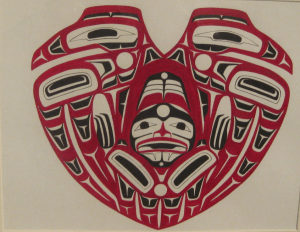
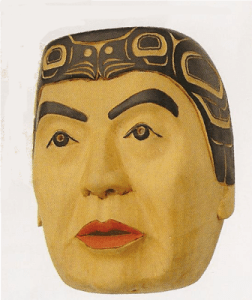
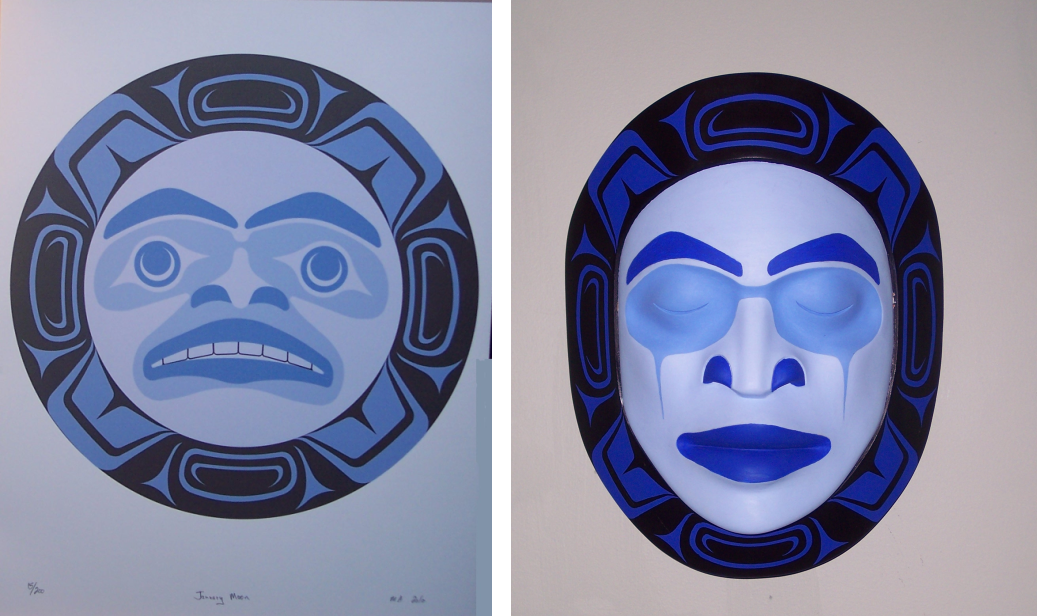
Back in June, I had dinner at the Steamworks pub with Haida / Tsimshian artist Mitch Adams and his wife Diana. Mitch kindly offered me a selection from the giclee prints that he was in Vancouver to sell. Few things feel so luxurious as a choice like that, and I could have selected several from his portfolio. However, eventually I decided on “January Moon,” which was the inspiration for his “Blue Moon Mask,” which was one of the standouts at the 2010 graduation exhibit for the Freda Diesing School of Northwest Coast Art.

The connection between the two pieces would have been obvious even if Mitch had not mentioned it. But the differences are interesting, because they show the evolution from a good execution of an idea to an outstanding one. There is little in “January Moon” that is not improved in “Blue Moon Mask.”

"January Moon" (left) and "Blue Moon Mask" (right)

The most obvious differences are in the shape and color. With its perfectly round shape, “January Moon” feels relatively static, and more abstract. In comparison, the change to an oval face in “Blue Moon Mask” is more ambiguous, as well as more realistic. Just as importantly, the colors are bolder and more glossy in the mask, as well as the contrast between them. In the print, the colors are muted, and the tones are a better match, but the result is that design tends to fade into the paper.

The exception to this general observation is the blue and black design on the rim. “January Moon”’s rim has more contrast between the colors, while “Blue Moon Mask”’s uses a darker blue that is much closer to the black. This change works because it frames the face most clearly; in “January Moon,” the blue of the rim is closer to those of the face, so that the rim frames less effectively.

However, the greatest changes are in the face. Some elements remain the same, most noticeably using the same colors for the lips, nostrils, and eyebrows. But, in “January Moon,” the eyes are also the same color, which is probably one feature too many for the design, which seems much busier than the mask.

By contrast, on “Blue Moon Mask,” the design is simplified. The teeth are gone, whose black outline is mildly discordant in “January Moon,” and much of the complication of the highlighting as well. The eyes shrink from an angry glare to closed eyelids, and the lips are smaller and barely parted instead of scowling.

The only element that is added is the tear tracks from the eyes, which I suspect originated in an accidental trickle of paint, but which works brilliantly, helping to emphasize the elongation of the face and suggesting an undercurrent of suppressed intense emotion beneath the surface appearance of serenity.

Somewhere in the middle of all these changes, the gender changes as well. “January Moon” registers as masculine to my eye (and that of those who have seen it), perhaps because of the mouth and bared teeth. “Blue Moon Mask,” however, seems female, or at least sexually ambiguous. Added to the suggestion of intense emotion being controlled, this ambiguity makes most eyes keep returning to “Blue Moon Mask” in a way that they do not to “January Moon.” Despite “January Moon”’s aggressive expression – or perhaps because of it – the eye has a hard time lingering over it. Its anger has nothing of the mystery found in “Blue Moon Mask.”

None of this is to dismiss “January Moon.” Its non-traditional eyes with their crescent moon and the creation of the nose through a clever use of negative space are admirable in themselves – so much so that I could wish they could have somehow been retained in “Blue Moon Mask.” But in the end, “January Moon” could be described as a first draft for “Blue Moon Mask.” Although “Blue Moon Mask” is the superior work, very likely it would not have succeeded if “January Moon” had not been created first. Together, they show an artist taking a leap in his development – and, I suspect, learning a lot in the process himself.

Read Full Post »

A couple of weeks ago when I was in Terrace, Dean Heron drove me the fifteen kilometers northeast to the Kitselas Canyon National Historic Site. We left the highway, bounced up a gravel road through some second growth forest to a gate and, after opening it, descended to the top of the site.

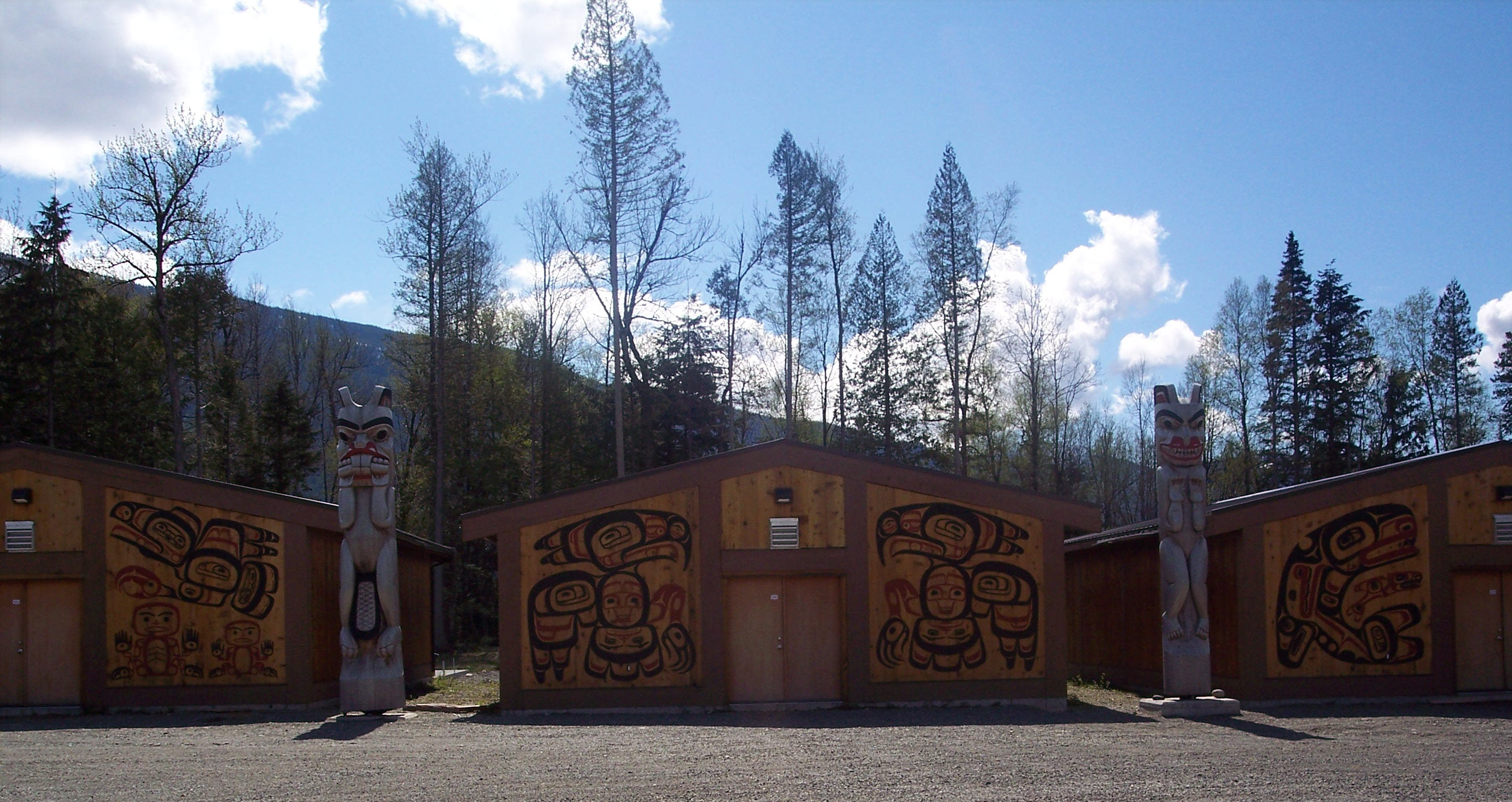
I’ve been hearing about construction on the site for a couple of years and the work that teachers, students, and graduates of the Freda Diesing School of Northwest Coast Art had been doing there, but nothing really prepared me for the site or the scope of the effort. The top of the site was dominated by a nearby mountain, so dramatically close that I could never quite keep it out of my glance, or resist looking up at it (or be unaware of it at my back):

To date, four longhouses have been completed. A fifth is largely complete but unpainted and will eventually display a wolf design, if I remember correctly.

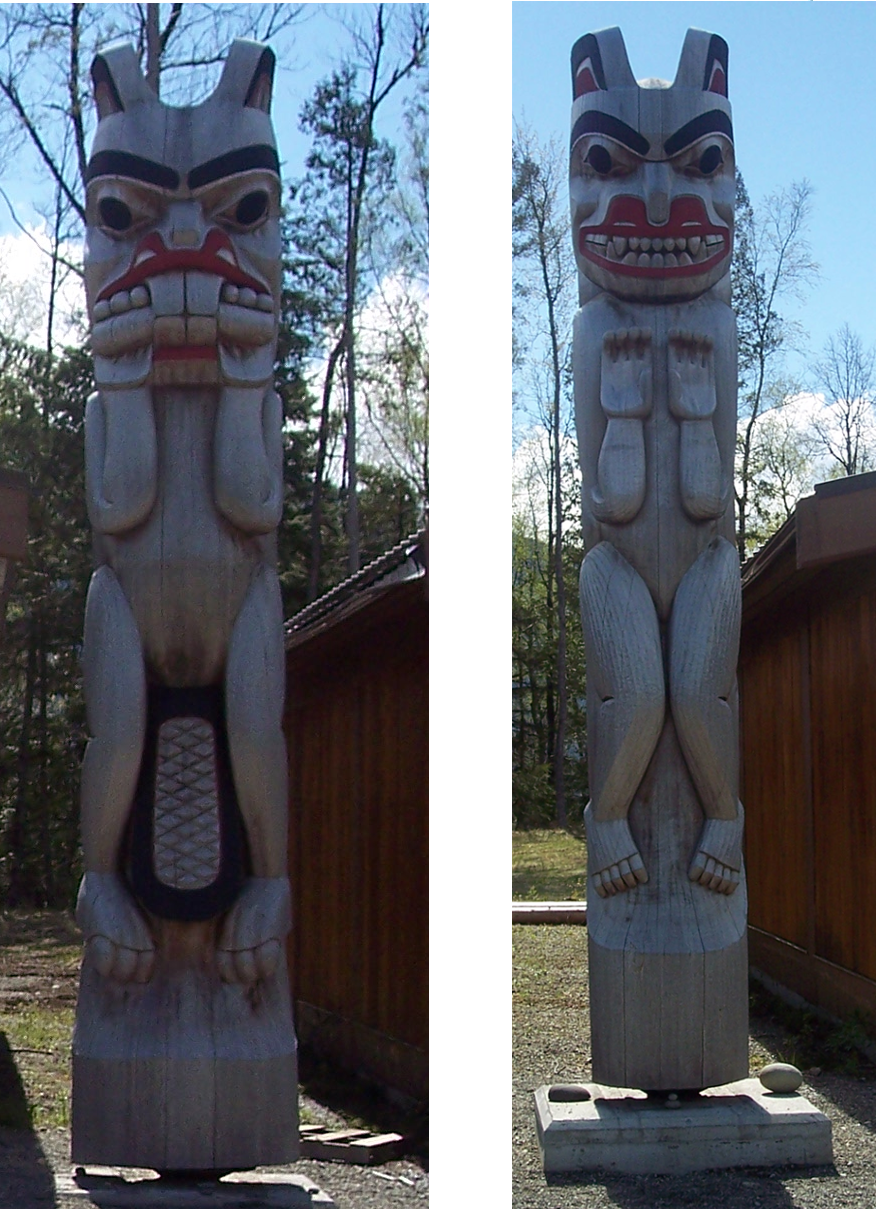
In front of the line of longhouses, are the carved figures of a grizzly bear and a beaver:

Each of the longhouses, Heron explained to me, would become the showcase for a different aspect of the local Tsimshian culture. About a hundred meters across the gravel was the future gift shop and the washroom.

However, the current buildings were just the start of the plans. Eventually, part of the leveled gravel will become a ground for dances and ceremonies. And, behind the gift house, a path lead down to the archaeological site where the original village had been located. I would have liked to descend to the site, where an interpretive center was being built, but Heron was unsure of his right to go there. He had a key to the gate, and having worked on the top of the site, had no hesitation about going there, but the archaeological site was another matter – perhaps because he was not a member of the Kitselas First Nation.

Nor could we enter any of the longhouses, because alarms had been added recently to them. Naturally, I was disappointed, but I was glad that some pre-cautions were being taken, because apparently one of the longhouses had already been broken into. In fact, considering some of the art work there, I can see a day coming when the site has security staff around the clock.

Still, even without seeing everything, I was impressed, both by what had been done and what I imagined the finished result would be. Between the magnificence of the setting and the carvings by Dempsey Bob, Stan Bevan, and their current and ex-pupils, Kitselas Canyon has every chance of being the cultural and tourist landmark it is intended to become. Personally, I can’t wait to see what it should become in a few years — and I’m grateful to Dean for the preview.

Read Full Post »

I have read about and seen something of the culture of the Haida, Tsimshian, Nisga’a and other First Nations of the northern British Columbia coast. However, I know little about the Nuxalk of the central coast beyond the fact that the nation prefers not to be referred to as the Bella Coola, as they once were. For that reason, when Latham Mack, one of this years’ graduates of the Freda Diesing School danced a Nuxalk mask, I was an attentive member of the audience.

I am used to thinking of Latham Mack, who twice won the YVR Art Foundation scholarship, as a designer more than a carver. Certainly, he has done far more designs than masks to this point, including a limited edition print. However, as part of his final work in the Freda Diesing program, Mack finished two Thunder masks, a blue one for the year end exhibit and the upcoming  show at the Spirit Wrestler gallery, and a black one that he has announced that he will keep in his private collection.

Both masks reflect the story of the four brothers who saw a dancing figure on the mountain who created the thunder – an important story in the Nuxalk tradition. The hooked nose and flaring nostrils are a traditional part of the figure’s depiction.The small branches attached to the head, presumably to suggest lightning, are also traditional, although Mack’s mask makes greater use of them than several others that I’ve seen pictures of. This tradition, as Mack emphasized to me, is separate from the Thunderbird of the Kwakwaka’wakw or other First Nations, with the central figure representing the spirit of the storm.

Latham Mack tells me, “Two major dance rituals make up our winter dance ceremonies, the Sisaok (ancestral family dances) and the Kusiut (secret society ceremonies). The Thunder dance is performed by members of the Kusiut society. According to Bella Coola belief, the supernatural ones in the upper land resemble human beings in performing Kusiut dances. Corresponding to the prowess of his patron, the dance of his human protégé is one of the most important Kusiut rituals. Only the strongest of course danced the Thunder because of the movements and physical fitness you had to be in to actually dance it. Only the families who owned the story actually danced it, but as the years have gone by, we have lost the identity of those owners. So now it’s basically owned by the whole Nuxalk people.”

Mack goes on to say that, “The dance of Thunder can be performed with four, two or one masked dancers, depending on the prerogative of the protégé. When the dance is done with four Thunders, these represent the four brothers in the oral tradition. Numerous dances lead up to the Thunder dance, the Herald introduces the dance of Thunder. He beats his stick on the floor and announces the impending Thunder dance.”

Many dances can lead up to the Thunder dance, but, in this case, the performance was divided into three sections, each introduced and narrated by a member of Mack’s family who also provided a rattle accompaniment.

Since the mask had never been used before, the ceremony began with a blessing of the mask by sprinkling down over it.

Then, before Mack’s actual dance, three female members of his family prepared the area in which he would dance with their own dance. It was a stately dance, done with upraised palms and constant circular steps. The narrator explained that this preparation was a traditional role for women in Nuxalk dances.

Then Mack danced. He wore an apron threaded with loose pieces of wood that he shook for percussion, and wooden clappers on his back.

Frequently, he threw himself down on his knees and climbed to his feet again.

His hands and lower arms made constant flickering gestures, as if to shoo people away, but actually to bestow blessings upon the audience.

It was an energetic dance, enough to scare several young children at the front of the audience, who quickly moved away. He also wore cuffs around his ankles and wrists and the modern innovation of knee pads (which was wise, since he was dancing on a concrete floor, and would have otherwise damaged his knees). It was an obviously exhausting performance, powerful and contrasting sharply with the graceful motions of the women’s dance a few moments before

All too often, those of us who are not directly involved in First Nations culture can forget that the masks that we admire have a ceremonial purpose — or are supposed to have. Mack’s dance was a small reminder of this basic fact, and left me wondering where I could find more about Nuxalk culture.

(Note: Ordinarily, this dance is not photographed, but Latham Mack’s grandfather, Lawrence Mack (Lhulhulhnimut), a chief of the Grizzly clan from the ancestral village of Nusq’lst gave permission for those in attendance to photograph it. He also graciously gave me permission to post the pictures I took on this blog. Needless to say, any mistaken cultural references here are due to my ignorance or to lapses in my memory, and not to his kindness. Should anyone see any mistakes, please let me know so that I can correct them.).

Read Full Post »

One of the many songs inspired by the Jacobite Rebellion of 1745 is “Little wot ye wha’s coming.” It is little more than a list of the clans that supported Bonnie Prince Charlie, and I’ve heard it sung slowly by Ewan MacColl, and faster and faster by The Corries. Just back from the Freda Diesing School graduation exhibit in Terrace, I’m reminded of the song because I feel as though I’ve spent the last two days meeting people.

Some I knew online but had never met, others by reputation. But let me see if I can generate a list, roughly in order since I arrived at the exhibit at 2PM on Friday:

  • Jill Girodat, the Associate Registrar at Northwest Community College, who helped us set up the Mature Student Award, and is well-known among students in need for her ability to find funding for them. Jill kindly volunteered to show me around the campus.
  • Stephanie Forsyth, Northwest’s president, who saw me taking photographs when I arrived and was puzzled about who I was until I got up to give the Mature Student Award that night, but remained polite.
  • Todd Stephens, a graduate last year from the Freda Diesing, who supervises the carving shed at the George Little House. Last year, we bought his “Jorja and I,” which hangs over my computer desk.
  • Shawn Aster, one of this year’s graduates, who remains a promising artist, both in terms of his ability and in terms of his promise that one day he will finish the painting we’ve discussed.
  • Gayton Nabess, one of the first year students, who showed me a left-handed stone paint pot found on the banks of the Skeena, and pictures of a non-traditional piece he recently completed (which I’m sorry that I never had time to see).
  • Dean Heron, the newest teacher at the Freda Diesing,who kindly gave me a tour of the nearly completed longhouse on the Northwest campus, and drove me out to see the work being done at the Kitselas Canyon project.
  • Ken McNeil, one of the teachers at the school, whose work I have long admired.
  • Stan Bevan, the program coordinator at the school, who let me see not only the four crests for the longhouse, but also his home and work area, and drove me around on Saturday evening. I also appreciate the book he presented me — a reprinting of a transcript of oral tales that were originally recorded almost a century ago. It’s the sort of genuine record of First Nations culture I’m always looking for, but rarely find.
  • Rocque Berthiaume, who teaches art history at the school, whom I’ve heard praised by many students but whom I had never previously met.
  • Carol Young Bagshaw, this year’s winner of the Mature Student Award, who introduced the first year students at the graduation ceremony, and saw that I not only had my own cap and T-shirt from the school, but also a shirt to bring home to Trish.
  • Colin Morrison, whose first mask we bought. He turns out to be much taller in person than I had imagined.
  • Mitch Adams, who kindly agreed to let me buy his “Blue Moon Mask” rather than send it down to the upcoming Spirit Wrestler Show. It was one of the most sought-after pieces in the end of year exhibit, and he could have had half a dozen other buyers, had he chose. Mitch also invited me down to hear his band play, although by 10PM on Saturday, I no longer had the energy.
  • John Wilson, who is clearly the most accomplished artist in this years’ graduating class, even if he doesn’t always receive the credit he deserves. Over the last year, we’ve chatted so often on Facebook that, when he walked up, we started talking as if we met face to face everyday.
  • Latham Mack, another of this year’s graduates, who danced his Thunder Spirit Mask on Friday night, and kindly got me permission from his elders to post pictures online of the performance (which I plan to do some time this week).
  • Chaz Mack, who showed me some of his vivid and powerful works in his dorm room.
  • Dempsey Bob, the school’s Senior Advisor and one of the master carvers of his generation, who made some effort to draw me out at dinner on Saturday, when I looked overwhelmed by all the new faces.
  • Diana Wong Adams, Mitch’s spouse, whose taste for the Pogues instantly told me she was a person worth knowing.
  • Ron Telek, whose work we’ve been collecting for several years. Somehow the disasters and mishaps that have averted our previous efforts to meet were absent this time, and we actually got to hang out.
  • Peter Jackson, who drove up from Prince Rupert to talk over dessert.

These are only the people I had extended conversations with (although possibly I’ve left out one or two). Were I to include everybody I was introduced to, or exchanged a few brief remarks with, the list would be over twice as long.


But whether I mentioned people or not, my thanks to all those I met for their friendship, kindness, and hospitality. Together, you stimulated and exhausted me in equal measure. I look forward to renewing our acquaintance at the Spirit Wrestler show next month, and at next year’s graduation.

Read Full Post »

One of the pleasures of buying work from beginning artists is watching them fulfill their potential. Last January, I saw enough promise in John Wilson’s work to buy one of his masks. Now, in masks like “Shaman and His Helpers,” his work has reached its first maturity.

Compared to most of Wilson’s earlier works, “Shaman and His Helpers” is a busy piece, both in subject and execution. It benefits, too, from Wilson’s study of traditional masks through pictures, the most obvious benefit being the use of eye holes instead of painted irises and pupils.

The mask depicts a shaman and his spirit helpers. One of the spirit helpers sits in the shaman’s mouth, as though resting after a long climb up his esophagus. The other sits in the middle of his forehead like a frontlet. Both these positions suggest that the helpers are indicators of the shaman’s true nature.

The helpers look more or less human, but the one in the mouth is in a vaguely frog-like position, while the one on the forehead is round enough to be a moon. While the shaman’s eyes are narrowed as though he is entering a trance, both helpers have closed eyes, as if asleep or focusing inwardly.

One way or the other, you sense, the shaman’s and the helpers’ eyes are going to be in the same state shortly: Either the shaman is about to enter their world of perception or else the spirits will come into his. No matter which happens, the result is a mask of a half-realized transition.

Interestingly, too, the spirit on the forehead is painted similarly to the shaman, while the spirit at the mouth is left unpainted. That may be an artistic decision made because any paint would be overwhelmed by the red of the shaman’s lips. But the effect is to suggest that the spirits are in some ways opposite.
Are the spirits different aspects of the shaman’s nature? Or perhaps the helper in the mouth is unrevealed, a creature of the dark, and the moon-like one on the forehead is a creature of light? At the point portrayed in the mask, they do not seem at odds, so perhaps they are opposites needed for balance and insight. Whatever the case, a moment of magic and transition is depicted.

The awe of the moment is heightened by the design of the mask. Tall, thin masks are common in the northern tradition, but in this case, the physical dimensions suggest a lean asceticism that seems fitting for a shaman. This asceticism is heightened by the high cheekbones and the deepness of the eye sockets near the nose, which suggest that the shaman might have been fasting. The black eyebrows reinforce this sense of gauntness, especially in a bright light that emphasizes the cheekbones and eye sockets.

At the same time, the mask carries a hint of menace or pain. Especially from a distance, the hands of the spirit in the mouth suggest fangs. Similarly, the unusually bright red used in the mask leave a half-unconscious impression of blood, as though the shaman’s trance is accompanied by a nosebleed and his biting of his own lip. Or perhaps the redness of the lips suggests that the shaman is giving a sort of birth to the spirit clinging to his lips. The suggestions are understated – there are no blatant riverlets of blood trickling from the nostrils or down the chin – but they are only more effective for being subtle.

And always the grain, which Wilson has carefully matched to the contours of the face, stands out, suggesting a movement or fluidity just below the skin. Influenced by his teachers at the Fred Diesing School, Wilson has always shown an awareness of the grain as a finishing detail, but here that awareness is not just a reflection of technical skill, but also an addition to the design.

When this mask first went on the market, I missed the chance to buy it, and cursed my slowness to make a decision. Luckily for me, the first owner changed their mind, and I was able to buy it after all. The more I study “Shaman and His Helpers,” the more I think it is Wilson’s best mask to date. At the same time, knowing that he is a constant carver and likely to have decades to continue his learning of his craft, I can’t wait to see what levels he will reach next.

shaman-and-helpers

Read Full Post »

Someday, I am going to jot down the stories of my art acquisitions. There’s the story of how I had to trek to the South Terminal of the Vancouver Airport not knowing the distance, and the story of how a simple bank transfer assumed nightmare proportions as I returned again and again to the bank. And now, after yesterday, I have the story of stopping by the Chateau Granville to pick up Shawn Aster’s “Raven Heart” to the befuddlement and bemusement of the desk clerk and manager, who had obviously never heard of such a thing.

The situation was no one’s fault – just one of those times when the perversity of the universe seems set to stun. I had reserved the painting when I was in Terrace five weeks ago, but I didn’t have the time to get to a bank machine and return before the show closed for the day. As a result, I didn’t pay until after I returned home. We had floated various schemes for delivery, ranging from leaving the piece at the Grayhound station to picking it up at the Spirit Gallery reception yesterday. But an emergency had forced Aster to return home early, and the hotel desk was his improvised way of getting the piece to me.

Now that Aster has won a couple of scholarships at the Freda Diesing School, his work is starting to sell, and people are expecting a successful career ahead of him. As he takes his first steps, I can’t resist a bit of self-congratulation for having discovered the young Tsimshian artist’s work several months ago at the school’s mid-term show (and some mild complementary scorn for those who needed the scholarships to realize the quality of his work).

Many young artists seem to enjoy designs in which Northwest Coast designs are incorporated into the shapes of modern culture. For instance, Latham Mack, another scholarship winner at the Freda Diesing, did a group figure of traditional designs that formed the outline of a Playboy bunny on a T-shirt. In the same way, “Raven Heart” takes two traditional ravens and constrains them in a heart design.

This practice, I suppose, is the extension of the tradition of adjusting a design to fit the contours of the shape it is on – a pole, or a bowl, spoon, hat, or box. The main difference, of course, is that the possibilities for innovation and commentary open up when a modern shape informs the design. In the case of “Raven Heart,” the two ravens resemble a traditional split design, but, when put into a heart, suggest a rather unhappy relationship, the raven of mythology being associated more with promiscuity than faithfulness, and more with clever and expedient lies than the truthfulness that is generally thought to be a necessity for a successful relationship. A confirmation that the relationship is less than smooth is the constrained feathers on the wings that seem almost like bars confining the trapped figure inside the heart — which has a decidedly unhappy look on its face.

It is probably no accident, either, that the piece was first exhibited at a show shortly before Valentine’s Day this year. The piece seems to play one culture against the other, using each to comment sarcastically upon the other.

But what interests me most about “Raven Heart,” like all of Aster’s work that I have seen, is its technical skill. Its form lines do not have the most graceful curves that I have seen, but for the most part they are suitably varied in thickness, and the use of interior U-shapes to minimize the thickness of the intersections is well done. In addition, of course, the use of red as the primary color – a relatively rare practice, traditionally-speaking – is suited to the heart shape.

The design itself is made up of only a few shapes – notably the U-shapes and T-shapes – which vary in length and whose colors are sometimes inverted. The composition has an obvious horizontal symmetry, but it also includes a less noticeable vertical symmetry, made up of groups of threes and fours: three feathers on the stylized wings, three fingers on the trapped figure’s hands (or are they the claws of the ravens?), four interior shapes on the outer wings, and four tail feathers on the bottom. Each side, too, has three large ovoids filled with black. Similarly, the circles at the joints of the wings are balanced by one that might be the tail-bone, while three circles, irregularly shaped, are also at the center of the trapped figure’s design. There is an economy in the relatively few shapes used in the design, and an almost mathematical precision in the vertical symmetry that is rare in any Northwest Coast art, but especially rare in an artist over thirty.

I have talked off and on with Aster about a commission, and I still hope to see it one day. Meanwhile, “Raven Heart” is a masterful small performance that makes me believe that Aster has a future every bit as promising as everyone is saying.

aster

Read Full Post »

Most Saturdays, noon sees me barely staggering out to the gym. But today, noon or shortly after saw us arriving in Gastown for the reception to mark the opening of the Northern Exposure 2009 show at The Spirit Wrestler Gallery. The show is an exhibit of the graduating class of the Fred Diesing School of Northwest Coast Art, plus this years’ scholarship winners. It has already become a tradition in the three years that the school has existed.

With 19 carvings and no graphics, the show was a subset of the graduation show I saw in Terrace, which had some 75 pieces. One or two second year students were missing, as well as most of the first year, including some artists like Mitch Adams or John Wilson who I’d rate above some of those who were represented. Still, space was limited, so some way of reducing the numbers was probably unavoidable.

At any rate, the reduced number also had the benefit of allowing you to pay close attention to each piece – something that is impossible with four times the number. It was especially interesting to see the graduates’ work beside that of their teachers, Stan Bevan and Ken McNeil. That way, you could see the teachers’ influence, and which students were on their way to establishing their own style.

To my eye, the exhibit was somewhat weaker than last years’, which included the work of Dean Heron, who is rapidly becoming one of the major up and coming young artists in the Northwest Coast Tradition. However, the show included the paddles I had admired in Terrace by Latham Mack and Shawn Aster. Another standout was Mack’s “Northern Beauty” mask with its striking painting and individualistic detailing of the nostrils and mouth.

northern-beauty

I also appreciated two samples of Reynold Collins’ detailed, often intricate work. While I think Collins’ work would be improved by more finishing and greater attention to the grain, his work never suffers from the clumsy blank spaces found in many of the other students’ work and shows a vividness of imagination that makes me suspect it is only a matter of time until I find the right piece of his work to buy.

reynold-collins

Only a half dozen students were at the reception, and their time was in demand. However, because the event was smaller than the graduate show, it was easier to have a few words with them and find what motivated them. I talked briefly with Sophia Patricia Beaton, Darryl W. Moore, and Reynold Collins, each time finding something in the conversation to bring me back for another look at the pieces they were exhibiting.

Last years’ show, as well as the work of other recent graduates was priced somewhat high – a mistake that means that the pieces do not sell, and that the artist is tempted to try to charge prices elsewhere that their reputation cannot sustain. By contrast, this year, the students seem to have priced their own work, and, thanks to the guidance of their teachers, this year, realism prevailed. Most of the pieces were under $1400, and only one over $2000. This realism seems to have helped; as I write seven hours after the start of the reception, some six of the pieces in the show have sold, including two each by YVR award-winners Todd Stephens and Shawn Aster. Not bad for a day’s display.

Especially at realistic prices, the show cannot be much of a money-maker for Spirit Wrestler, which often sells works by Robert Davidson or glass artist Preston Singletary for tens of thousands of dollars. In fact, when the cost of publicity, reception and staff wages are taken into account, the show might even cost the gallery money. That makes the show a public-spirited effort, or at the very least, a long-term investment in the next generation of artists.

Certainly, it means a considerable amount to the artists, many of whom have limited funds and some of whom had to go to some effort to get to Vancouver. But, after several days that included the YVR ceremony, and a tour of several local galleries and a CBC interview for the award-winners, the reception was clearly the highlight of their trip. Many said as much, and their sincerity was unquestionable. The reception gives them a taste of the lives they would like to live – and, thanks to Spirit Wrestler, for some of them, those lives may now be that much closer.

Read Full Post »

When I was up at the Fred Diesing School Student Art Exhibition a couple of weeks ago, one of the main attractions was the paintings of Sean Aster. I bought one myself, and joked that I had traveled north just to see how he was coming on the commission we’d arranged a couple of months ago. However, the way that the reactions to his work changed over the afternoon taught me something about the way that people view and buy art.

Before the graduation ceremony, when people were gathering in the studio, very few of us gave Aster’s work any particular attention. However, during the ceremony, Aster won two scholarships, including one that master carver and senior advisor to the school Dempsey Bob gave out himself. Twenty minutes later, staff could barely put up the little red stickers indicating a sale fast enough. Suddenly, everybody wanted one of his works.

This change had nothing to do with the quality of the works. Aster is a promising artist, especially for someone still in his twenties, and his work deserved the awards and the attention he got. But his work was no finer after the ceremony than before. Nor were people necessarily buying the biggest or most original pieces.

All that had changed was that the school instructors had got up and said very publicly, in several different ways, that he was a young artist with a future. Apparently, most of the guests had missed the fact before, until recognized authorities had emphasized it to them. Those of us who had recognized his skill by ourselves were morbidly amused (to say nothing of pleased with ourselves that we had arrived at our conclusion unaided).

A week later, I repeated the story to a Vancouver director of a Northwest Coast Art gallery. He didn’t get what I was saying. How else, he asked me, would people have known what to buy?

Listening to his question, I realized, more strongly than ever before, that there were two reasons for buying art.

The first, and perhaps the most common, is based on reputation, and, much of the time, on the hopes of a profitable investment. Beyond a very limited extent, it has nothing to do with an artist’s ability. For example, it is no reflection on the ability of either artist than an original canvas by Robert Davidson can sell for seventeen times the price of one by his current apprentice David Robert Boxley; Davidson sells for so much more because of his reputation, not because he is seventeen times the artist that Boxley is (although, quite obviously, he is his elder in their craft). This was the sort of collector I saw buying Aster in Terrace – for the afternoon, at least, Aster was the one with the reputation.

The second reason to buy art is because it moves you, or because it is well-composed. This reason owes nothing to reputation; those who buy for this reason will buy a $100 sketch from an unknown as happily as a $10,000 one from a master artist if it has the right qualities, and let the potential investment take care of itself.

These two types of buyers can talk amiably, and may even wish to buy the same piece. However, the motives for buying are really quite different, and quite irreconcilable. Secretly, an enthusiast like me can’t help thinking that those whose buying decisions are based on reputation are unimaginative, even a little crass, and buying for entirely the wrong reasons. In turn, though, I don’t doubt that the reputation-buyers dismiss us enthusiasts as arrogant in our naivety.

Read Full Post »

“How does this compare to a show down south?” John Wilson asked me last week, shortly after I arrived at the Freda Diesing School Student Art Exhibition in Terrace. He seemed surprised when I told him that a 23 person show with some 75 pieces almost never happened, but it’s true. The annual show is one of the largest annual exhibits of modern Northwest Coast Art anywhere.

The show lasted only two days, with a private viewing for friends and family on Friday and a public viewing on Saturday. The location is the Freda Diesing Studio on the Terrace campus of Northwest Community College, a well-lit building with a large lower floor ordinarily occupied by work benches and a loft for a more conventional class room setting:

fd-studio1

Just inside the door, above the table with the show catalog and price list were a few prints by Freda Diesing herself, including a self-portrait mask:

fd-self-portrait

These works were not for sale, but stood as tutelary spirits of the show – or, more precisely, as the standards to which the students should aspire.

Several months ago, I reviewed the school’s mid-term show via a collection of pictures sent to me by John Wilson. That show was mostly painting and sketches, the first year class in particular having not begun its study of carving at the time. By contrast, the year-end show had a few two-dimensional pieces, but consisted largely of paddles, spoons, and masks.

Painted paddles are closer to two dimensional than three dimensional works, so I was not surprised when two of the best-designed paddles were from Shawn Aster and Latham Mack, two artists who were among the standouts at the earlier shows and scholarship winners at the graduation ceremonies that accompanied the private viewing:

shawn-aster-paddle

latham-mack-paddle

However, making the transition from the two-dimensional craft of painting to the three-dimensional one of carving does not always comes easily, and many students are still making it. Latham Mack, for instance (who as a Nuxalk, is learning his second style of carving), is well on the way, using the same blue that I am starting to recognize as characteristic of his two-dimensional designs:
latham-mack

By contrast, a mask by Shawn Aster shows a sense of surfaces, but seems more tentative, with a shallowness in the carving and a thinness of line that makes you only appreciate the mask up close, as seen in this (unfortunately cropped) picture:

shawn-aster-mask

A similar lack of ease in three dimensions is true of Todd Stephens, another scholarship winner from whom I’ve bought several paintings:

todd-stephens

Other students showed similar learning curves – and, as might be expected in a student show – a certain tendency to conformity – although Norman McLean, Sr., in a triumph of social sensibility over aesthetics did do a bright pink mask, as well as a spoon with a more discrete pink ribbon around the handle as fund-raisers for breast cancer. Still, there were some interesting pieces here and there.

Sophia Patricia Beaton, another scholarship winner, had only one piece in the show, but the wavy hair and the obviously feminine face and the labret were original enough to make me wonder what the rest of her work might be like:

sophia-beaton

I also noticed James Weget-McNeil’s frog mask, which, although in a very different style, reminded me of some of the faux-artifacts that Beau Dick has been carving recently:

james-weget-mcneil1

However, much of the interesting carving came from mature students with more experience.

Charles Richard Wesley, whose work I noticed in the mid-term show, came up with two interestingly intricate masks:

charles-richard-wesley

I also appreciated John Wilson’s work, which he says represents an advance in finishing details over his earlier work – pointing, for example, an indentation of the eye sockets at the top of the nose:

john-wilson

These are just some of the pieces in the show, but, aside from the bowls (something needing to be left out), they give an idea of the variety to be seen at the show. I appreciate the chance to see students learning and mastering their craft, and while some flaws and weaknesses are apparent, there are just as many examples of solid and skilled works.

In fact, I could have come away from the show considerably poorer. Fortunately or unfortunately, depending on my shifting perspective, most of the pieces I considered buying were marked NFS, many earmarked for a show at the Spirit Wrestler Gallery in Vancouver later this month.

But buying is only one reason to attend such a show. A far better reason is spend a few hours surrounded by efforts of art – and that, so far as I am concerned, is more than enough reason for me to want to attend next year’s show.

My thanks to Stan Bevan for seeing that I got an invitation. That small kindness gave me an enriching day.

Read Full Post »

« Newer Posts - Older Posts »