Feeds:
Posts
Comments

Archive for the ‘native art’ Category

Organizing a meetup group, I’ve discovered, is a good way to find new things to worry about.

When I first started the Northwest Coast Art Meetup Group in Vancouver, I worried that no one would show up to the first meeting. I tried to minimize the worry by asking artist and dancer Mike Dangeli to be the first speaker. Then Mike sent out an invitation to all his Facebook friends, and I worried whether the space I’d booked – the lobby of The Network Hub – would be large enough for everyone who said they planned to attend.

However, I shouldn’t have worried (although I did, of course, being the sort of person I am: About whether the third floor of a building without an elevator was too high for anybody, or too inaccessible; whether the food that co-organizer Nathan Bauman brought would be eaten, whether everybody enjoyed the talk; you name it, and I worried about it).

I counted eighteen at the meetup’s first event yesterday evening – fewer than I had expected or feared, but better than most first meetup events can manage from what several people told me. I suspect that predictions of snow kept the numbers down.

Mike had agreed to talk about “Art and the Potlatch.” It’s a subject that he is well-equipped to discuss, having given fifteen potlatches, and given away hundreds of thousands of dollars in art at them.

I knew in the abstract the importance of potlatches in First Nations cultures, and the importance that art played in them. However, it is one thing to understand something in theory and entirely another to see overwhelming proof of it. As Mike talked, I gained an appreciation of the wide variety of events covered by the term. Births, puberty, betrothal, marriage, the assumption of titles or responsibility – listening to the passing mentions of all the different occasions, I appreciated in a way that I hadn’t really before just how many rites of passage were contained within that simple word from the Chinook jargon. A single word didn’t seem enough to cover so many different occasions.

In fact, it occurs to me that this poverty of expression helped to hide just how devastating the banning of the potlatch from 1884 to 1951 actually was – and why they continued to be celebrated in secret. The same missionaries who urged the banning of the potlatch would have been outraged had anyone tried to ban their own baptisms, marriages and funerals. Yet either they didn’t notice or they didn’t care that that was what they were doing by passing the anti-potlatch legislation.


Another impression I took from Mike’s talk is how closely the art of the coastal First Nations is connected to these rites of passage. Not only the amount of art given, but the sheer variety – paintings, hats, masks, robes, jewelry, dancing regalia – on Mike’s slides impressed this point. Since that was what I hoped would come from his talk, I was glad to feel that realization sinking into me, and I hope that others at the meetup did as well. I didn’t want the group to be a bunch of dilettantes, but to provide a real understanding of the art’s roots and connections – and there’s no doubt that Mike started the meetings off the right way.

No one had any questions at the end, but few were in a hurry to leave, either. Most stood talking for the next forty minutes, and seemed enthused by what they had just heard. One or two, who were artists themselves, or the recent recipients of gifts, showed their own pieces of art. Many thanked me for starting the group.

I’d call the evening a moderately successful beginning. Now, I want to arrange the next event, and see if a bit of a community can’t be organized from the group.

Read Full Post »

Ten years ago, Wayne Young was a promising journeyman in Northwest Coast art. Taught by such well-known figures as Dempsey Bob and Robert and Norman Tait, he had an enviable reputation for imaginative, often asymmetrical designs, and for fine finishing details on his carving. Now, however, illness keeps him from working. Since new works from him seem unlikely, when I first noticed this miniature argillite transformation mask of a raven and a human on the Alcheringa Gallery web site two years ago, I was immediately interested in buying it.

Not only was I interested in the artist, but I figured that the piece had to be one of a kind. I mean, a mask not only made of argillite, but with two faces? And one no more than fifteen centimeters long and six high? The thick hinges that the outer face swings upon and the fine screws drilled into the argillite are evidence of the difficulty in the construction – and also all the explanation necessary of why no one else is likely to try to imitate the piece.

However, obtaining the piece proved a challenge. When I visited the gallery fifteen months ago, none of the staff knew where it was. In fact, despite the fact it was still on the web site, they could never remember seeing it, and were sure it must be lost. However, three months ago, I queried again. This time, the gallery director answered, and could locate it.

Ordinarily, I don’t haggle over price. However, ten months previous, the mask had been part of an on-site auction, with a quick price that was two-thirds the listed price. Since the gallery had had the piece for seven years, I sensed it might be eager to sell it, so I offered the quick price. It was accepted, and I took a day trip to Victoria primarily to carry it safely home.

I declined the frame and beige and brown matting the gallery had added. I thought the frame did not do the mask justice; I am currently awaiting an argillite stand to display it properly.

Unfortunately, too, time has not been kind to the piece. Another artist who remembers seeing the piece when it was new remembers the outer mask closing evenly. Now, one hinge is slightly twisted, and one side of the mask is lower than the other when closed. A drop of glue on a couple of the screws might be useful, too, and perhaps a replacement of the black cord on the controls.

However, despite these imperfections, I consider the mask well worth having. The carving is simpler than most of Young’s work, but the lines need to be bold on a piece of such minute dimensions if they are to be discernible. Finer lines would be nearly invisible, and therefore wasted – nor would argillite lend itself to them. The fact that Young knew the restrictions of the size and the medium says a lot about his skill as an artist.

I could almost believe that Young deliberately set out to challenge himself by putting obstacles in his own path. If he didn’t, he must have soon discovered them. But, either way, he overcame the obstacles, not with inlays and other distractions, but with a well-designed, cleanly carved, understated bit of excellence. I consider myself lucky to have obtained it, and my only regret is that new pieces from Young are unlikely.

Read Full Post »

The last time I saw a Robert Davidson retrospective was his Eagle of the Dawn show in 1993. Back then, all I knew about Northwest Coast Art was that I liked it. But, having learned a little since then, I appreciated the Surrey Art Gallery’s “Eagle Transforming: The Prints of Robert Davidson” as a chance to put my thoughts about Davidson’s work in some sort of order.

My superficial impression has always been that Davidson’s prints have changed dramatically in the last forty-two years. However, my second time around the gallery, I started to see the continuities.

For instance, from the start of his career, Davidson’s formlines have varied dramatically in thickness. He is especially fond of long tapers at the end of a line, such as the end of a feather, or at the end of elongated fingers or claws. Because of this habit, his formlines keep the eye moving far more than most artists’, which would account for the sense of movement in many of his designs.

Frequently, too, Davidson promotes red from the secondary to the primary formline color (although he uses a brighter red now than when he started), sometimes omitting black altogether, or else using it as the background for a print. When he does use a traditional black formline, he often used red as the primary formline on limbs or figures inside a larger one.

In addition, from very early in his career, Davidson has looked for unusual shapes to contain his designs. Although working in an art tradition that tends towards the symmetrical, Davidson often makes his designs asymmetrical. He is perfectly capable of a traditionally symmetrical design, as in “Eagle: Oliver Adan’s Potlatch Gift,” but his symmetrical designs have a stiffness (or perhaps a formality) that his other work does not. You might almost think that his symmetrical designs were exercises – and not wholly successful exercises, at that. Other artists succeed with symmetrical designs, but Davidson, I would suggest, is not strongly interested in them.

Accompanying the asymmetry is a search for form. A few years into his print designs, Davidson is already projecting his design on to a whale fin. Circular designs are also frequent in his work, both confining shapes and appearing as negative spaces in such works as the 1987 “Seven Ravens.” I was surprised not to see many split forms in the exhibit, but perhaps the reason is that split forms tend to be symmetrical by definition.

This interest in irregular and different shapes has served Davidson well over the years. “Butterflies,” printed in 1977, escapes the potential banality of its subject by placing the design into two circles. Similarly, a hummingbird design from a couple of years later avoids the usual cuteness of the subject by making it a stocky creature with wings attached to powerful shoulders.

Davidson’s least successful works? Those with extensive areas of cross-hatching, which work well in engraved metals or on carved wood, but tend to look unfinished in a print – especially since Davidson does little to vary them.

Nor is Davidson at his best with more than a few colors. Davidson’s palette is relatively small. In addition to red and black, it includes a royal blue and a turquoise. But, when he ventures beyond these four colors, the result can seem garish rather than bold, which may be why his color choice remains relatively cautious.

For me, one result of seeing so much of Davidson’s work side by side is that I now realize that his movement towards abstraction in the last decade is less of a break than I had previously thought. I knew, of course, that he had continued to do more traditional works while doing his annual prints, but I had tended to view the abstractions as facile works – as small ideas printed large to lend them an interest that they wouldn’t otherwise have.

I still think of these abstractions, which often take the form of closeups of a small part of a larger design, as working against themselves, because they expect the eye to linger when the basic tenets of the tradition have the effect of keeping the eye moving. However, even though I consider them unsuccessful, I can see now that they are a natural extension of interests that he has had all along.

My only complaint about the exhibit as a whole is that, by including only prints, it robs the individual pieces of part of their context. Davidson is a carver and jewelry-make as well as a print designer, and, to my eye, many of the prints in the show show the influence of these other media (for example, the cross-hatching).

However even with this omission, “Eagle Transforming” is well-worth a few hours and several trips around it. If you are like me, you will only notice some aspects on the second or third viewing.

And to those visitors who left comments saying that they don’t care much for Northwest Coast Art, all I can say is that they are barbarians who don’t know fine art when they are confronted by it. For myself, the only reason that I don’t look forward to the day when some of Davidson’s designs join Bill Reid’s on Canadian currency is that, when that day comes, he will probably be dead, and then we will have nothing new from him to admire.

Read Full Post »

I’ve been looking forward to the virtual gallery of Bill Reid’s works ever since I heard a first whisper of it over a year ago. However, perhaps I anticipated too much, because, now that The Raven’s Call is online, I find myself disappointed. I’ve bookmarked the site, and plan to return to it regularly, but, all the time I’m using it, I keep thinking that it could have been something much more.

The first problem with the site is the navigation. The home page offers four menu items – of which only two, Who was Bill Reid? and Bill Reid’s Art, actually deserve to be at the top of the menu. Of the other two, The Unfinished Story is amusing but slight, while In the Classroom appeals to a narrow group of visitors, and suggests possibly unjustified assumptions about the users of the site. Are visitors really elementary and high school classes, or are they mainly adult art lovers and students of First Nations culture?

The second problem is that while the site has an astonishing amount of material, both visual and aural, most of it is simply categorized and labeled as though it is a museum specimen. For instance, in Who Was Bill Reid? You can view a pictorial history of his life, and a series of aural clips by both Reid and others. Similarly, in Bill Reid’s Art, you can see slide shows labeled Sculptures and Containers; Paintings, Prints and Drawings, and Jewelery. However, because nothing is done to place any of this material in context, the effect is like browsing through the drawers of a museum archive.

The result is an experience is interesting but dry and minimally engaging – so much so that it fails to do justice to either Reid or his work. It is only in the biography Bill Reid’s Journey that any of this material is put into context. Rather than just the bare facts about where a photo was taken or when a piece of jewelry was created and what it is made of, I suspect that most users would prefer to have a few hundred words giving anecdotes and explanations of how each item fits into Reid’s life or development of an artist.

Still another problem is that site designers show more interest in fitting graphics into the viewing page that displaying them at a size where they can be studied in detail. This tendency is especially obvious in larger pieces like “Mythic Messengers,” where the insistence on presenting the work as a whole results in a view that is only marginally better than the thumbnail. Some details of these larger pieces would go a long way towards helping viewers appreciate Reid’s work.

I would like to say that The Raven’s Call is the online monument that Reid’s genius deserves. If nothing else, I would prefer to offer praise commensurate with the three years that the site took to assemble. However, in all honesty, I cannot. The Raven’s Call might almost be a remnant from the mid-1990s, rather than a modern site.

Even its terms of use, which tries to limit borrowing from the site to fair use, seems archaic in web terms. After all, Reid’s work is well known, so there can be no question of anyone claiming it as their own. For another, the pictures are low resolution, so any use of them is going to be extremely limited anyway. Had the site designers contented themselves with a Creative Commons Attribution license, asking only that borrowers acknowledge the source of the material they were using, there might be some chance of the license being respected. Instead, the site simply looks old-fashioned in opting for terms of use that cannot possibly be enforced.

I’d like to think that the present version of the site is only the beginning – that, slowly, it will evolve the context that is currently lacking. But, for now, the main impression I take away (aside from the awe that Reid’s work always leaves me with) is of good intentions and results that were far less than should have been.

Read Full Post »

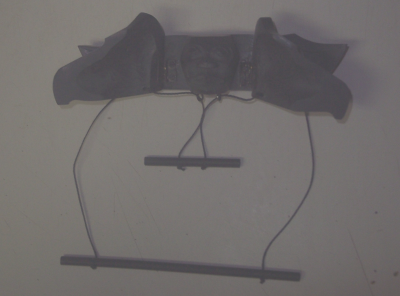
The Northwest Coast art in our home includes many contemporary pieces. However, I am also fascinated by traditional pieces, particularly recreations of historical masks according to modern sensibilities. That is why, when John Wilson’s “Voices of Our Ancestors” (aka “Portrait Mask”) became available, I jumped at the chance to buy it.

John Wilson, "Spirit of Our Ancestors"

“Voices of Our Ancestors” is based on two historical Haisla masks in J. C. H. King’s “Portrait Masks from the Northwest Coast of America,” a book first published in 1979. It is a mask well worth studying for its own sake, all the more so because examples of Haisla design are relatively rare. When you do see them, you have no trouble placing the Haisla geographically, because their art often seems like a combination of Kwakwaka’wakw and Tsimshian traditions. Nor is Wilson’s mask an exception.

Artists Unknown, Historic Haisla Masks

However, what especially interests me is Wilson’s reinterpretation of the historic masks. To start with, Wilson chooses a less rounded, more northern shape for the mask. This change is accompanied by some changes in proportions, such as a wider space between the lips and nose, and a higher placement of the ears. He has also decided not to include the teeth that are in the originals, and replaced the originals’ rounded eyes with more smaller, more slanted ones. In addition, the cheekbones of Wilson’s mask are far less prominent than in the originals. The result is a less human, more supernatural look – a fitting change, considering that the mask is a work of a modern man looking back on the past.

Another noticeable difference is in the selection of colors. This difference is not just a matter of what was available; one of the older masks actually has a brighter red than the one that Wilson uses. By contrast, even allowing for aging, the historical piece has a more subdued blue than Wilson uses. Wilson also accents the red by drawing thicker formlines, and using it in places where the historical piece uses blue.

Wilson has followed the general designs of the original, including the stylized mustache and goatee, but almost always he has put his own interpretation on them. For instance, he has taken the rows of parallel lines just visible on the colored original, and added them as a design element below the nose, replacing the rather uninspired blobs of cross-hatching, and perhaps suggesting mustache stubble.

However, the largest difference between Wilson’s mask and its inspiration is in the form lines. Although formline influence is obvious in the originals, Wilson’s formlines are more disciplined, with more variation in thickness and more balance. For instance, where the formlines on the forehead in the original meets above the left eye, Wilson’s meet between the eyes. Similarly, where the original has formlines meet on on the cheeks, Wilson’s meet at the nostril.

Probably the most obvious difference in the design is on the cheeks, where the formline helps to replace the cross-hatching, and the blue u-shapes are greatly reduced in size. Even more importantly, the red formline that follows the line of the cheek curves upwards rather than downwards as in the original, doing more than any single element to make the modern mask less human and more arresting than the originals.

“Spirit of Our Ancestors” is obviously influenced by the sources that Wilson acknowledges, but clearly it is more than imitation, or an unthinking copying of a classical piece. Wilson’s mask is more balanced piece of work than either of the originals, with a stronger northern influence as well. Although somewhat of a new direction for Wilson, it more than succeeds on its own terms. Wilson has not simply copied, but repeatedly improved as well.

Read Full Post »

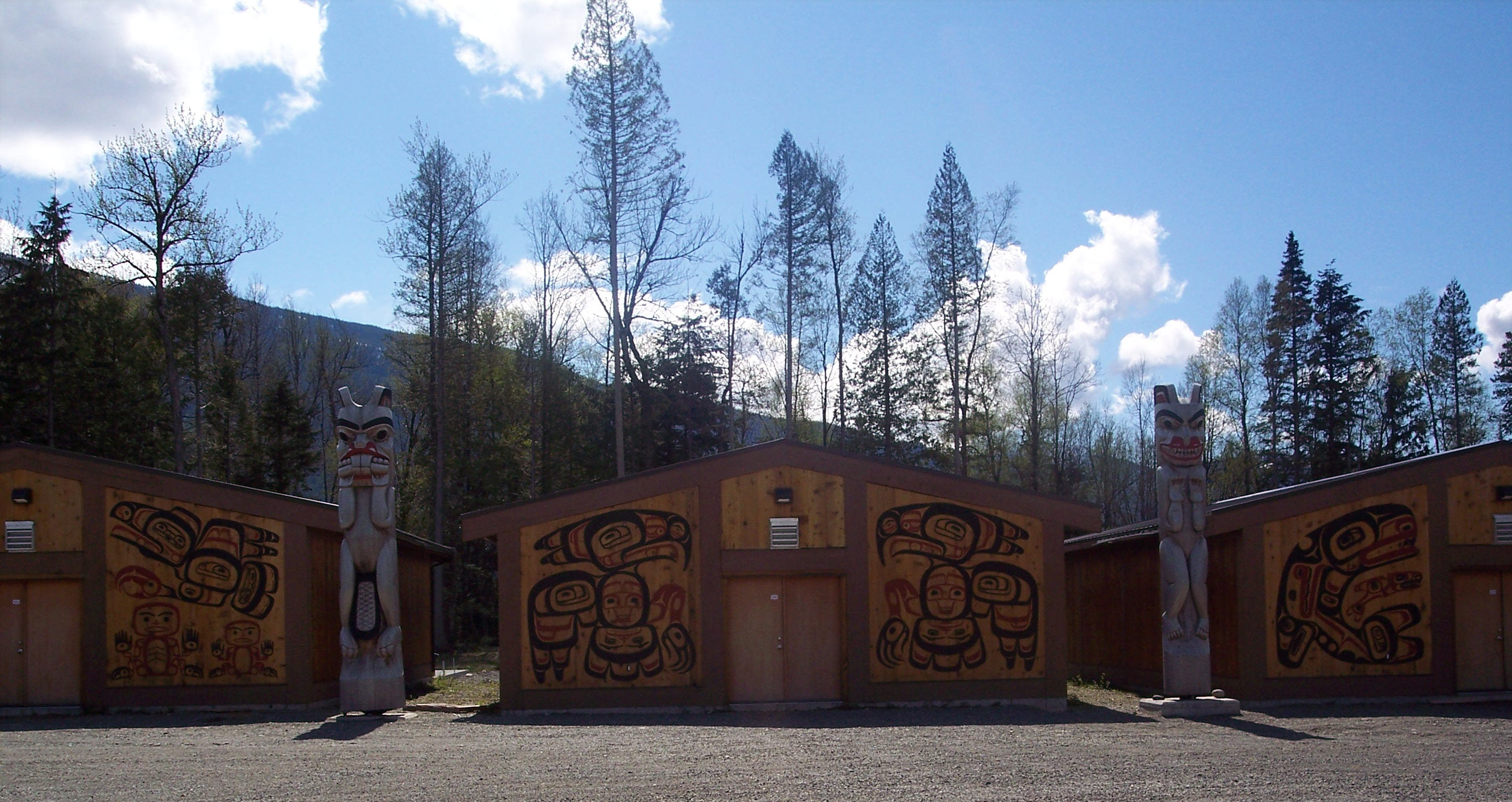
A couple of weeks ago when I was in Terrace, Dean Heron drove me the fifteen kilometers northeast to the Kitselas Canyon National Historic Site. We left the highway, bounced up a gravel road through some second growth forest to a gate and, after opening it, descended to the top of the site.

I’ve been hearing about construction on the site for a couple of years and the work that teachers, students, and graduates of the Freda Diesing School of Northwest Coast Art had been doing there, but nothing really prepared me for the site or the scope of the effort. The top of the site was dominated by a nearby mountain, so dramatically close that I could never quite keep it out of my glance, or resist looking up at it (or be unaware of it at my back):

To date, four longhouses have been completed. A fifth is largely complete but unpainted and will eventually display a wolf design, if I remember correctly.

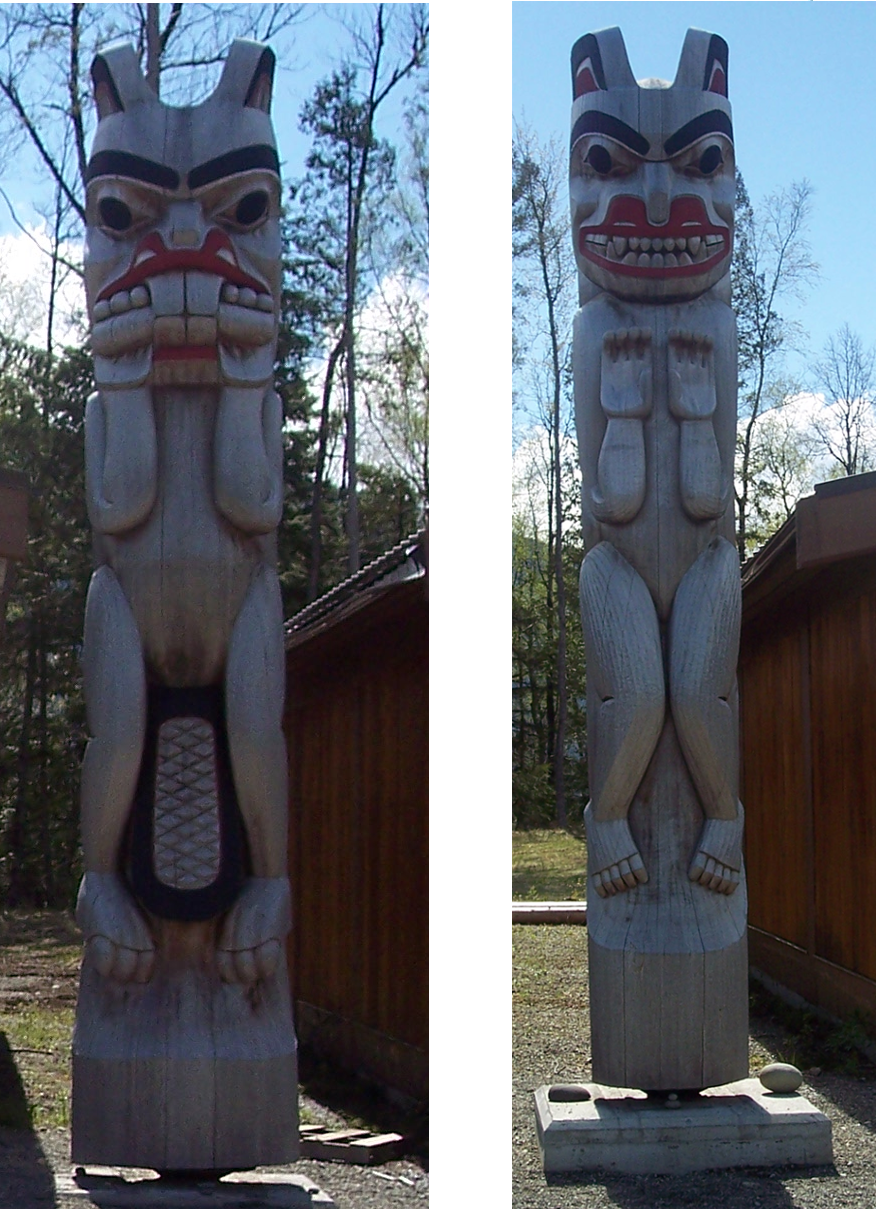
In front of the line of longhouses, are the carved figures of a grizzly bear and a beaver:

Each of the longhouses, Heron explained to me, would become the showcase for a different aspect of the local Tsimshian culture. About a hundred meters across the gravel was the future gift shop and the washroom.

However, the current buildings were just the start of the plans. Eventually, part of the leveled gravel will become a ground for dances and ceremonies. And, behind the gift house, a path lead down to the archaeological site where the original village had been located. I would have liked to descend to the site, where an interpretive center was being built, but Heron was unsure of his right to go there. He had a key to the gate, and having worked on the top of the site, had no hesitation about going there, but the archaeological site was another matter – perhaps because he was not a member of the Kitselas First Nation.

Nor could we enter any of the longhouses, because alarms had been added recently to them. Naturally, I was disappointed, but I was glad that some pre-cautions were being taken, because apparently one of the longhouses had already been broken into. In fact, considering some of the art work there, I can see a day coming when the site has security staff around the clock.

Still, even without seeing everything, I was impressed, both by what had been done and what I imagined the finished result would be. Between the magnificence of the setting and the carvings by Dempsey Bob, Stan Bevan, and their current and ex-pupils, Kitselas Canyon has every chance of being the cultural and tourist landmark it is intended to become. Personally, I can’t wait to see what it should become in a few years — and I’m grateful to Dean for the preview.

Read Full Post »

I have read about and seen something of the culture of the Haida, Tsimshian, Nisga’a and other First Nations of the northern British Columbia coast. However, I know little about the Nuxalk of the central coast beyond the fact that the nation prefers not to be referred to as the Bella Coola, as they once were. For that reason, when Latham Mack, one of this years’ graduates of the Freda Diesing School danced a Nuxalk mask, I was an attentive member of the audience.

I am used to thinking of Latham Mack, who twice won the YVR Art Foundation scholarship, as a designer more than a carver. Certainly, he has done far more designs than masks to this point, including a limited edition print. However, as part of his final work in the Freda Diesing program, Mack finished two Thunder masks, a blue one for the year end exhibit and the upcoming  show at the Spirit Wrestler gallery, and a black one that he has announced that he will keep in his private collection.

Both masks reflect the story of the four brothers who saw a dancing figure on the mountain who created the thunder – an important story in the Nuxalk tradition. The hooked nose and flaring nostrils are a traditional part of the figure’s depiction.The small branches attached to the head, presumably to suggest lightning, are also traditional, although Mack’s mask makes greater use of them than several others that I’ve seen pictures of. This tradition, as Mack emphasized to me, is separate from the Thunderbird of the Kwakwaka’wakw or other First Nations, with the central figure representing the spirit of the storm.

Latham Mack tells me, “Two major dance rituals make up our winter dance ceremonies, the Sisaok (ancestral family dances) and the Kusiut (secret society ceremonies). The Thunder dance is performed by members of the Kusiut society. According to Bella Coola belief, the supernatural ones in the upper land resemble human beings in performing Kusiut dances. Corresponding to the prowess of his patron, the dance of his human protégé is one of the most important Kusiut rituals. Only the strongest of course danced the Thunder because of the movements and physical fitness you had to be in to actually dance it. Only the families who owned the story actually danced it, but as the years have gone by, we have lost the identity of those owners. So now it’s basically owned by the whole Nuxalk people.”

Mack goes on to say that, “The dance of Thunder can be performed with four, two or one masked dancers, depending on the prerogative of the protégé. When the dance is done with four Thunders, these represent the four brothers in the oral tradition. Numerous dances lead up to the Thunder dance, the Herald introduces the dance of Thunder. He beats his stick on the floor and announces the impending Thunder dance.”

Many dances can lead up to the Thunder dance, but, in this case, the performance was divided into three sections, each introduced and narrated by a member of Mack’s family who also provided a rattle accompaniment.

Since the mask had never been used before, the ceremony began with a blessing of the mask by sprinkling down over it.

Then, before Mack’s actual dance, three female members of his family prepared the area in which he would dance with their own dance. It was a stately dance, done with upraised palms and constant circular steps. The narrator explained that this preparation was a traditional role for women in Nuxalk dances.

Then Mack danced. He wore an apron threaded with loose pieces of wood that he shook for percussion, and wooden clappers on his back.

Frequently, he threw himself down on his knees and climbed to his feet again.

His hands and lower arms made constant flickering gestures, as if to shoo people away, but actually to bestow blessings upon the audience.

It was an energetic dance, enough to scare several young children at the front of the audience, who quickly moved away. He also wore cuffs around his ankles and wrists and the modern innovation of knee pads (which was wise, since he was dancing on a concrete floor, and would have otherwise damaged his knees). It was an obviously exhausting performance, powerful and contrasting sharply with the graceful motions of the women’s dance a few moments before

All too often, those of us who are not directly involved in First Nations culture can forget that the masks that we admire have a ceremonial purpose — or are supposed to have. Mack’s dance was a small reminder of this basic fact, and left me wondering where I could find more about Nuxalk culture.

(Note: Ordinarily, this dance is not photographed, but Latham Mack’s grandfather, Lawrence Mack (Lhulhulhnimut), a chief of the Grizzly clan from the ancestral village of Nusq’lst gave permission for those in attendance to photograph it. He also graciously gave me permission to post the pictures I took on this blog. Needless to say, any mistaken cultural references here are due to my ignorance or to lapses in my memory, and not to his kindness. Should anyone see any mistakes, please let me know so that I can correct them.).

Read Full Post »

Mitch Adams is an artist I’ve been watching for some time. From the pictures he’s posted on Facebook in the last year, I suspected that it was only a matter of time before I saw one of his works that I wanted to buy. And, sure enough, when I walked into the 2010 Freda Diesing School Student Art Exhibition, his “Blue Moon Mask” immediately caught my eye. I consider it one of the finer examples of contemporary Northwest Coast art that I’ve seen in the last year – an opinion with which some traditionalists strongly disagree.

I am not the only one to think so highly of the mask. I know of at least half a dozen people who would have been happy to buy it, and who wished that it had not been marked as not for sale. Two of those people were frankly envious when I told them that, after I expressed my admiration, Adams decided not to send it to the upcoming Spirit Wrestler show after all, but to sell it to me. One even asked me if I would resell it.

Similarly, when I posted a picture of it in my review of the exhibition, one viewer called it “the most stunning mask I have ever seen.”

To me, such reactions seem perfectly logical for anyone who has troubled to look at the mask. Although “Blue Moon Mask” is covered entirely with paint, the paint is not so thick that you cannot see the smoothness of the carving.If anything, the palest blue on the mask tends to emphasis the plans of the carving, making them into shadows rather than lines.

The careful selection of the shades of blues is equally obvious, from the pale, almost white skin color to the darker blue on the outer rim, and makes the mask seem ever-changing, especially with the tear tracks falling from the eyes. Depending on the light and the angle, the mask can look serene, corpse-like, or even like the heavy makeup of a Goth on Friday night. It is a work that is both accessible and ambiguous at the same time.

Some aspects of the work are traditional. Looking through galleries or museums, you should have no trouble finding other moon masks of the same general shape. Many details are traditional, too, including the eyebrows and nostrils, and the array of U-shapes and ovoids surrounding the face.

Yet the work departs from the northern tradition in at least two key ways. For one thing, in the northern tradition, blue is a third color, used in small amounts if it is present at all. Black and red are the typical colors, with a third being added by the natural color of the wood. A departure from this norm is, by itself, enough to define a work as contemporary.

For another thing, the use of paint on the entire mask is unusual in Adam’s Haida and Tsimshian tradition (although not entirely unheard of, either). The northern tradition tends to be sparing in its use of paint, with designs painted across the mask that ignore the features beneath them. Adams’ decision to paint the entire mask would be more common in the Kwakwaka’wakw tradition, although, even there, his use of different shades of the same color instead of contrasting ones would be more characteristic of modern artists such as Beau Dick or perhaps Simon Dick.

To make these departures is a risk – but I believe it is a necessary one, of the kind needed to keep Northwest Coast art developing and relevant. Nor is it a unique one. Historically, the art form has long been a combination of local conventions meeting industrial societies’ technologies and sensibilities. So-called tradition has long changed and benefited from artists’ discoveries of metal tools, industrially produced paints, and, much later, of power tools. Similarly, the first European influence on subject matter is over a century and a half old, in top-hatted figures on poles and sailing ships on argillite plates. From this perspective, what Adams does in “Blue Moon Mask” is not radical, and should be easy to appreciate.

Yet, sadly, a minority noticed “Blue Moon Mask”’s departure from strict tradition and could not get past it. I am told that one teacher reacted strongly to it, and that another one joked about it. Even worse, some students, seeing the teachers’ reactions, immediately imitated them rather than using their own eyes.

These reactions strike me as both unfortunate and short-sighted. The basis of Northwest Coast art will always be the traditional work. If nothing else, the contemporary needs the traditional to react against.

Yet I do not see why admiration for the traditional must include a rejection of everything contemporary. True, you may prefer one over the other, or prefer one in your own work. But what you like and what is done well are by no means synonymous. Nor does preferring one require that you condemn the other.

Personally, I refuse to take sides. “Blue Moon Mask” is a technically skilled piece, and amidst our collection of traditional works by artists like Norman Tait or Richard Hunt and of contemporary pieces by artists like Alano Edzerza or Ron Telek, it claims a place on our wall on its own merits. It’s a piece that I consider myself lucky to live with, and I’m proud to have our keeping.

Read Full Post »

A couple of months ago, Haisla artist John Wilson told me about a promising first year student at the Freda Diesing School named Colin Morrison. After seeing some minor pieces by him, I commissioned a painting. It turned out to be his first professional sale.

I am absolutely confident that it won’t be his last – and not just because I would like to boast ten years from now that I had the foresight to see his potential before he became well-known. “The Spirit of the Wolf” is an accomplished piece that illustrates Morrison’s potential better than anything I can say. It is all the more remarkable because it comes from a man in his mid-twenties.

On the surface, “The Spirit of the Wolf” is a traditional piece, reminiscent of Roy Henry Vickers’ work. It shows a strong interest in style, with a variety of ovoids and U-shapes used throughout and a variety of tactics used to control the thickness and joints of the formlines. The sheer number of tactics could easily result in a mishmash, but Morrison controls it by having shapes mirror and contrast each other in disciplined way. The mirroring is especially obvious when the primary and secondary formlines are adjacent to one another.

At the same time, you do not have to look very long before you realize that “The Spirit of the Wolf” has a playfulness that suggests a very contemporary outlook as well. The design is basically a play on the various interpretations of the title, with wolves spread throughout the design – everything from the physical wolf to the Wolf as a clan crest. This dichotomy is suggested by the vaguely yin-yang shape of the overall design.

There is even, Morrison says, several spirits in the metallic paint of the design. So far, I have to admit, I have been unable to detect what kind of spirits they might be, or if anything specific is intended, but I find the idea immensely appealing all the same.

You could even go one step further and say that, since Morrison himself is a member of the Tsimshian Wolf Clan, that the painting itself is a manifestation of a wolf’s spirit.

You might call the painting a kind of Northwest Coast “Where’s Waldo?” If you wanted to say the same thing more seriously, you could say that the content is as inventive as the style.

Asked to say something about himself, Morrison replied, “I’m Tsimshian, Ginadoiks tribe, Wolf Clan. I’ve been an artist since I was young; I started painting when I was 18, and didn’t take it seriously till I was 23 years old. I’ve been painting off and on since that time, trying to figure out what I was going to do with my life.

“Then, one day last year, my Mom started going to a carving class in school. She wanted me to go and dragged me there. I started painting again, and liked what I was doing. My instructor (Harvy Ressel) saw the raw talent and asked me if I wanted to go to the Freda Diesing School. I said yes. Since then, I have found my calling.”

Since doing “The Spirit of the Wolf,” Morrison has completed his first mask and is in the process of finishing his second. I expect that the world of Northwest Coast art will be hearing more from him, but remember (I said, with a certain pride) – you heard of him first from me.

Read Full Post »

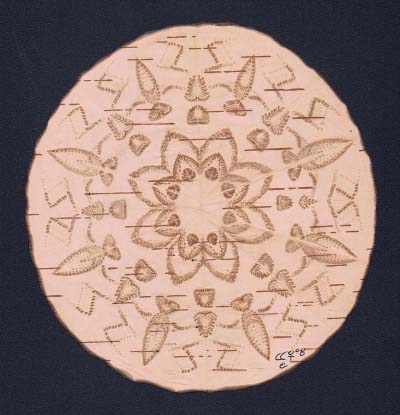
When you first hear of birch bark biting, it seems so unlikely you might assume that someone is having a joke at your expense.

But the truth is, birch bark biting is one of the most intricate and least known of First Nations arts. Concrete knowledge of the art is hard to come by, but, according to Jadeon Rathgeber of Half Moon Studios, whose mother and sister are two of the last practitioners, birch bark biting was widely practiced through North America for centuries, and very likely millennia. Rathgeber and his family are trying to revive the art, both in education and in business.

birch bark

Birch bark biting is exactly what it sounds like: The making of patterns in bark through careful bites. Traditionally, it is an art done by women, in which the artists fold the bark so that it can fit in their mouths, and visual a pattern as they create it with delicate bites, at times one tooth at a time.

“What I’ve found out about the art is that anywhere they had birch trees, they’ve had birch bark biting,” Rathgeber says. “It could have a ten thousand year old history. Nobody really knows. When Contact happened, it sort of got lost along with all our other ceremonies because it was outlawed.”

What is known is that three century old Chippewa examples are in the Smithsonian in the United States. Rathgeber has heard of a recent dig in Shuswap territory that unearthed samples that may be three thousand years old. The art is definitely known to have been widely practiced in eastern and central North America, and there are even rumors of it being practiced on the northern coast of British Columbia. A student at the Freda Diesing School, for example, reports hearing his teachers list birch bark biting among the lost local arts.

Exactly what samples of the art were used for is equally undocumented. However, Rathgeber suggests that the art may have been used to create hunting and fishing maps, and to pass cultural and ceremonial secrets between generations.

“I call it the first Indian printing press,” Rathgeber says.

Examples of the art may also have been used as the equivalent of wampum belts to commemorate exchanges between different groups. Among the Cree, it was also used in historical times as the pattern of bead work, laid directly over the leather the beads were sown to.

The best-known biter in modern times was Angelique Merasty of the Cree Nation, who lived much of her life in Beaver Lake, Manitoba. Rathgeber’s mother, Pat Bruderer (also known as Half Moon Woman), knew Merasty for over two decades, and sometimes assisted in the sale of her work. When Merasty died about fifteen years ago, Bruderer began teaching herself the craft. Bruderer is now regarded as the foremost birch bark biting artist. Perhaps three or four other biters exist, but none approach her skill.

The making of a piece of birch bark biting begins with the gathering of the raw materials. In Rathgeber’s family, the gathering is usually done by his step-father. The bark is taken by trees of the right size that are free of knots after a tobacco ceremony in which the harvester asks forgiveness for what he is about to take. Large strips are sometimes taken, but never enough to kill the tree.

When Bruderer receives the bark, she sorts out the most suitable pieces, and peels them away until they are only one layer thick. The peeling is a delicate craft in itself, in which one rough motion can destroy a piece of bark. Perhaps that is why, when Rathgeber says, “No one can peel birch bark like my Mom can,” he speaks with such obvious pride.

birch bark2

Bruderer has her own ceremony to put here in the right mood of calm alertness to work. According to Rathgeber, she does not need absolute silence in which to work, but prefers a setting that is quiet where she will not be distracted. She folds the bark up to sixteen times — “like a xylophone,” Rathgeber says – and works using different teeth for different effects, with one tooth for drawing lines, her incisors for shading, and another for large details. She can use only very light pressure, or else the bark will tear.

Even so, she sometimes does as many as five or six pieces before getting one that is up to her standards. Rathgeber reports that his mother has as many as five hundred rejects that he hopes one day to use in collages. Each piece takes a couple of hours to complete, and is usually done in one session, since it would be next to impossible to resume work after quitting.

When a piece is finished, Bruderer flattens her pieces using a secret twelve step technique that is one of the hallmarks of her work. Another mark of her work is the singeing the edges of her work to give it give it a border. Her work is either framed by itself between two pieces of glass, or else incorporated into other work, such as boxes by other artists.

For many years, the family sold Bruderer’s work for two hundred dollars and upwards. However, now, as Bruderer talks of retirement and focusing on preserving her skills by teaching thems to another generation, the family is starting to husband her output more carefully, limiting sales and raising prices considerably.

More importantly, Rathgeber is also searching for a museum or teaching institution to display the best of her work as well as Bruderer’s collection of Merasty’s pieces. He hopes that by making some of this work public, he can encourage academic study of the art – study that might, for example, help to determine how bite patterns differed culturally, or even through the ages.

When I talked with Rathgeber, he had just heard that the Bill Reid Gallery’s gift shop and the Path Gallery at Whistler had agreed to take some pieces of birch bark biting for sale.

Should you see any pieces, you should have no trouble identifying it for what it is. Mysterious and meticulous, birch bark biting is like no other art you have ever seen.

bbb3

Read Full Post »

« Newer Posts - Older Posts »