Feeds:
Posts
Comments

Posts Tagged ‘Freda Diesing School of Northwest Coast Art’

Kelly Robinson is a new artist of mixed Nuxalk and Nu-chu-nualth ancestry. His silver jewelry is starting to become a regular feature of Vancouver galleries, and in the last year he has begun carving masks in both his traditions. However, he tells me that his first medium was painting, and, to judge from “Mother of Mischief,” it remains one that he is deeply interested in developing.

“Mother of Mischief” is done in the Nuxalk style, and is the first art in that tradition that I have bought. Geographically located between the northern nations such as the Haida and the Tsimshian and the central Kwakwaka’wakw, the Nuxalk culture has been comparatively overlooked and has had little written about it – so much so that an artist of another nation spent most of an afternoon trying to figure out how to carve the eyes of a Nuxalk mask with Robinson.

However, from what I have been able to learn from first and second hand sources, the Nuxalk tradition might be called loosely-rendered formline. By that I mean that it shares many of the individual elements of the northern formline, such as the ovoids and U shapes, but follows more informal rules about their positioning. Nor, on the whole, are Nuxalk designs as intricate as any of those in the northern tradition. Instead, Nuxalk designs have a bold simplicity that give them a strong visual appeal, especially when shown at large sizes.

Another characteristic of Nuxalk art appears to be a wider variation of colors than in the northern formline traditions. While northern formline favors black for the primary formline and red for the secondary, only occasionally reversing the color scheme or adding a third color, the Nuxalk palette seems broader, with greater use of blue and green, as in Kwakwaka’wakw work.

From this brief description, you can see why “Mother of Mischief” seems to me to be rooted firmly in the Nuxalk tradition. Centering on a Raven hen and her offspring ,at three feet by three feet, the painting has all the boldness of the best Nuxalk work, with three realms of existence – the land, water, and sky – depicted by rectangles of different blues.

Once you see realize the organization, the picture falls into place, with the middle blue strip representing the water where the salmon swim and the sun positioned both in the sky and, because of its reflection, in the water as well. On the land is a salmon or salmon roe that that the mother has found (for, contrary to common belief, ravens are not just scavengers; they can fish and hunt as well as other birds, but often carrion makes for an easier meal).

At the same time, the painting has a surprisingly modern feel to it. Parts, such as the ovoid at the top of the mother’s wing resembles the simple outlines of a sports logo, in particular, the old hockey stick logo of the Vancouver Canucks, a team that I happen to know that Robinson follows. Other parts of the design, such as the bent wing tips and the reduction of the mother’s body to a single tapering line, are reminiscent of late period Bill Reid.

Nor, do I think that a traditional design would be so strongly asymmetrical, or depict the raven fledgling as mirroring the mother’s positioning and design, with minor differences. Maybe you would have to be familiar with birds to notice, but, to me, the fledgling’s bare beginnings of a curved beak suggests immaturity.

Similarly, the lack of an oval in the eye or a visible tongue between the upper and lower beak suggests that the fledgling doesn’t share the mother’s watchfulness. Instead, it seems to be looking fixedly at the salmon on the shore, ready to waddle after it without worrying about the possibility of danger.

Robinson may be a newcomer, but”Mother of Mischief”shows that he is already an artist to reckon with. I’ve hung it over the largest couch in the living room, and, sooner or later, I expect it to be joined by either another of Robinson’s paintings, or perhaps one of his masks.

Read Full Post »

As a general rule, I never buy Northwest Coast Art depicting butterflies. But when I was in Terrace last April, I made an exception for Nigel Fox’s “Butterflies #3.”

The reason for my rule is that butterflies (and hummingbirds, for that matter) are among the most popular designs for tourist pieces. You rarely see them depicted in more serious artistic works. I believe that there used to be a Butterfly family crest among the Haida, and there are still Hummingbird crests among several of the northern First Nations, but today, these designs are often trite and blatantly designed to appeal to tourists. Often, they show a degree of cuteness unlike any other designs.

I’ve joked that these designs are the Hello Kitty of Northwest Coast Art. But the northern First Nations, as I understand things, are even more scathing: satirically, they call butterflies and hummingbirds the white people’s crests.

However, Nigel Fox, a student now in his second year at the Freda Diesing School, has a different take on butterflies. In his blog, he writes about “Butterflies #3,” the third in a series of paintings featuring butterflies, “The piece is about teamwork and is part of a series that I am exploring on the theme of respect, especially among peers, even among “outsiders” or butterflies. Within many northwest coast native cultures, there are crests that are usually animals, that represent families or bloodlines. The butterfly crest is reserved for people who are not part of a nation by blood.”

Fox goes on to explain that his work is about harmony and teamwork.

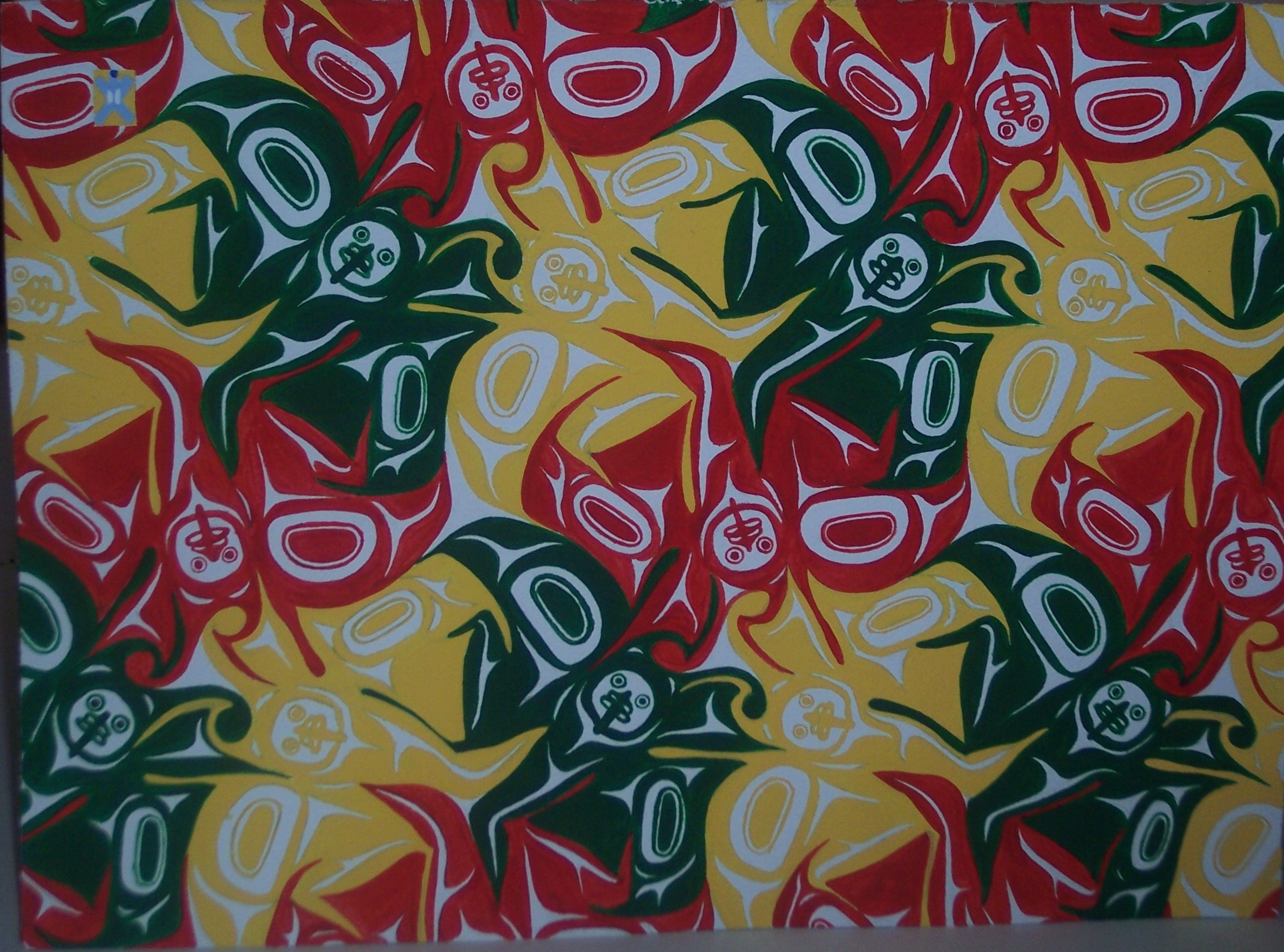
I’m not sure if he is missing the satiric intent, but it is hard to argue with his results. Fox has a separate career as a painter mostly in the Canadian Impressionist style, and in his butterfly studies, he has combined traditional designs with patterns inspired by the surrealism of M. C. Escher.

Like Escher’s work, “Butterflies #3” has a constant shifting of figure and ground. At the same time, the shape of the butterflies’ wings, with their ovoids and elongated T-shapes continually suggest other shapes, such as the beaks of ravens. By combining his interests in mainstream and Northwest Coast Art, Fox has created a series of paintings unlike anything anyone else is doing, and I look forward to seeing how his work matures in the next few years.

Meanwhile, his butterfly series is a promising start.

Read Full Post »

Shawn Patrick Aster’s “Raven Turns the Crows Black” has a longer history than most of the art in my townhouse. Aster took over two years to deliver it, but I consider it well worth the wait.

Aster’s work was brought to my attention by another artist in late 2008, as someone whose work was admired even by master carver Dempsey Bob. I immediately commissioned a piece from him, wanting an early piece from an already skilled artist who seemed sure to make a name for himself.

A few months later in April 2009, when I attended my first year end exhibition for the Freda Diesing School, I was amused to see that others gave Aster’s work no special attention – until he won two awards. Moments later, all his work in the show had sold.

But the commission had progressed little. Aster seemed nervous (I believe it was his first commission outside his family and friends) and couldn’t satisfy himself with the design. A month later, I bought “Raven Heart” from him, but I was still waiting for the commission.

By the next year end exhibition, Aster was looking distinctly apologetic when he saw me. Jokingly, I started referring to him as “the most promising artist” I knew, since he had promised the piece for over sixteen months – although I made clear that I was more than willing to wait. Secretly, though, I had decided he was unlikely ever to deliver. I was disappointed, although I bought other pieces from him.

Then, last March, Aster told me on Facebook that he had finally completed the design. It had apparently changed since he first started designing it, but I was happy to see it. I paid indirectly at the 2011 year end exhibition, and it was delivered by Aster’s fellow Freda Diesing graduate Todd Stephens at the YVR Art Foundation’s reception in May – a good deal of which I spent showing the piece to others and worrying that food might be spilled on it.

“Raven Turns the Crows Black” depicts an episode from the Haida epic “Raven Traveling,” a work that  many now consider the common heritage property of all First Nations people on the northwest coast. In the story, Raven the Trickster sees crows roasting a salmon on the beach. They agree to share the food, and Raven falls asleep while he waits for it to cook.

Unwilling to share, the crows devour the salmon. Belatedly worried at what Raven’s reaction is going to be, they put crumbs of the salmon meat on his clothes and between his teeth. When he wakes, they try to convince him that he ate before he slept, but Raven in his anger throw them into the fire, from which the survivors emerge forever singed and black.

Aster’s rendering of the story makes for a unusual design in what is already a tradition apart. Shared by several northwest coast nations but possibly Tsimshian in origin, the Chilkat style is based on weaving patterns. The style is constrained by the limits of weaving, so it tends to consist of discrete blocks of design, rather than the flowing formline found in painting and carving. This tendency makes it both geometric and highly abstract.

Aster’s design shows Raven in the center, his teeth bared (and if you ask why Raven has teeth, I can only reply, why does the parrot in Aladdin? Although, probably, Raven was in human form in the story, shape-changing being his most common power). I interpret the design as showing Raven in two states: in the middle, hungry and asleep, with his wings folded, and at the top center, angry and awake with his wings outstretched.

On the left are the white crows, on the right the black; like the raven, their wings and other features are abstracted into blocks of forms. The designs on each side are not quite symmetrical, with only the outlines of the heads to suggest the transformation in the story.

The background includes the characteristic Chilkat blue and yellow. However, to suggest the fire – and, perhaps, the salmon meat and Raven’s anger – Aster adds red to his design. Although I am far from an expert in Chilkat design, I have never seen any other Chilkat design use red. However, Aster’s innovation succeeds, largely because the red is relatively dark and sparingly used.

The result is one of the most bold-looking pieces of art in my collection. And while I admit that I grew impatient while waiting, I’d gladly wait another twenty-eight months for another work that is equally striking.

Read Full Post »

Every piece of art, several collectors have told me, comes with a story. Gradually, as I’ve bought art, I realized that this statement is true, so on my spreadsheet for insurance purposes, I’ve created a column where I can type the story of how the piece was acquired.

I have no trouble remembering the first piece of serious art I bought. It was a three inch copper bracelet by Tsimshian artist Henry Green. I’d wanted such a piece for years, and suddenly realized I could afford one. I still remember my breathlessness as I approached the gallery to pick it up, and my sigh of relief when it proved more awe-inspiring than I could ever have hoped.

A couple of months later, I saw that the Bill Reid Gallery was selling canvas banners from a set that had been stored in Bill Reid’s house since 1991. Trish and I bought one, realizing that it was our best chance of affording any work by Bill Reid, then quickly bought another to balance the wall where the first one hung. Soon after, we bought our first mask, a moon by Ron Telek that is both eerie and strangely modernistic.

More soon followed. There was a Beau Dick sketch of a mask, unusual in that, with his carver’s eye, he depicted planes, not lines. The Lyle Wilson pendant Trish won in a raffle at an exhibit – the best $5 that either of us had ever spent. The small Telek mask that I fetched from the South Terminal of the Vancouver airport by walking from the end of the bus line and back again. The Gwaii Edenshaw gold rings we bought for our anniversary. The miniature argillite transformation mask by Wayne Young that I trekked over to Victoria for after Trish’s death and repaired and remounted because it was so magnificently unique. The wall-hanging commissioned by Morgan Green to help her through goldsmith school. And so the stories accumulate, so far as I’m concerned, as innate as the aesthetics of the piece.

For instance, there’s Mitch Adam’s “Blue Moon Mask,” which I saw in 2010 at the Freda Diesing School’s year end exhibit. It was labeled NFS, bound for the Spirit Wrestler show for the school’s graduates a month later. I happened to mention to Mitch that I would have written a cheque right away had it been for sale – not hinting, just praising – and a few hours later he came back and said the piece was mine if I were still interested. I was, and immediately became the envy of half a dozen other people who also wanted to buy it, but had never had the luck to ask. One of them still talks enviously when we meet.

Then there’s Shawn Aster’s “Raven Turns the Crows Black,” a painting that we had discussed in 2009, but didn’t seem to gel in his mind. After a year, I had stopped expecting him to finish it, and took to calling him a promising artist, because he kept saying that he was still working on it. But he did complete it – making it a Chilkat design (which I had not expected), and showing a promise of a different kind.

Two other pieces were commissions in memory of Trish after her death: John Wilson’s “Needlewoman” and Mike Dangeli’s “Honoring Her Spirit.” I made “Needlewoman” a limited edition of twenty, and gave it to family members for Christmas 2010. Mike’s painting, more personal, I kept for myself, carrying it up Commercial Drive from Hastings Street on a chilly January Sunday, because cabs wouldn’t come to the Aboriginal Friendship Center where I picked it up.

Other pieces were gifts from friends: a print of “January Moon” by Mitch Adams in return for some advice on galleries I gave him; a bentwood box Mitch Adams made and John Wilson carved and painted in memory of Trish; a remarque of Ron Telek’s “Sirens” print, and an artist’s proof by John Wilson and another print by Shawn Aster, both apologies for the late delivery of other pieces.

Of course, such stories mean that I can never sell any of the pieces I buy. The associations have become too much a part of me. But since I never buy to invest, only to appreciate, that is no hardship – my appreciation is only deeper for the personal connections.

Read Full Post »

The Freda Diesing School’s year-end exhibit has become a fixture on my calendar. Not only is it one of the largest annual shows of First Nations artists anywhere in the province, but I enjoy seeing how the students develop over the two years of the program. Over the last three years, it has also become a place for renewing old friendships and acquaintances, and making new ones.

Held April 16-17, the 2011 incarnation of the show was no exception. It was smaller than previous exhibits, but made up for its size by the general quality of the work.

The variety was also impressive, although, when I heard that the final project for the second year students was a moon mask, I half-expected otherwise. Perhaps a lack of time prevented uniformity; when I arrived during setup on the afternoon of April 15, many of the students were yawning and taking every chance to sit, having been up late finishing their pieces for the show.

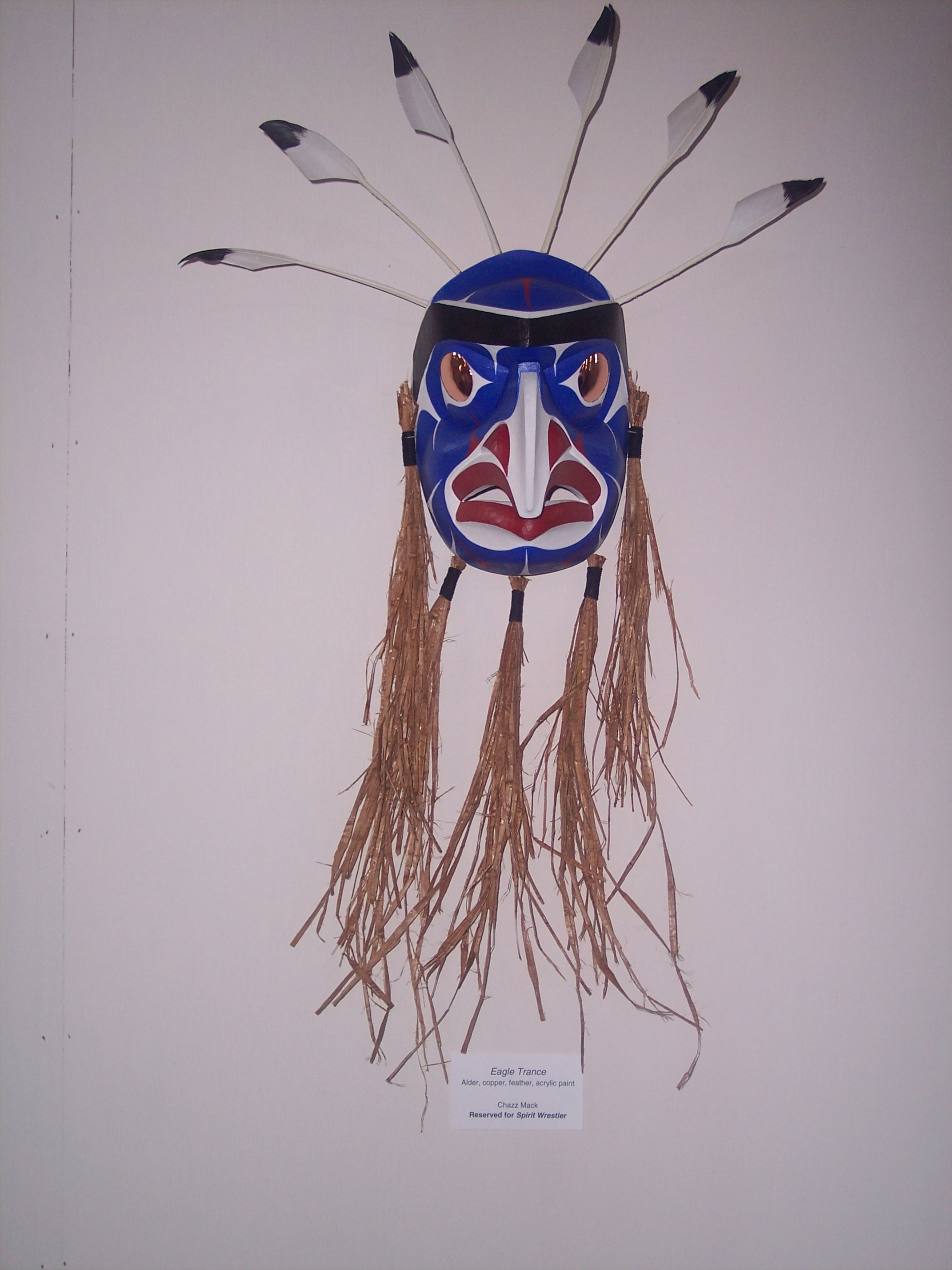
The quality of the second year students’ work was especially high, much of it equaling or surpassing the pieces seen in Vancouver galleries. Chazz Mack, who has gained a reputation for the skill seen in his two-dimensional designs in his two years at the school was forced to miss the first day of the show because of an illness that the hospital diagnosed as dehydration, but contributed “Eagle Trance,” a mask in the distinctive Nuxalk style of high head dresses, large noses and strong primary colors:

Stephanie Anderson, a winner last year of a YVR award, staggered late into setup with a striking eagle frontlet that still reeked of fixative – and was possibly the strongest piece in the show:

Another second year student, Colin Morrison, whose first mask I bought eighteen months ago, demonstrated his growing skill with two masks, “Resurrection of the Ancestors” and “Black Wolf,” a mask meant for a flat surface or stand:

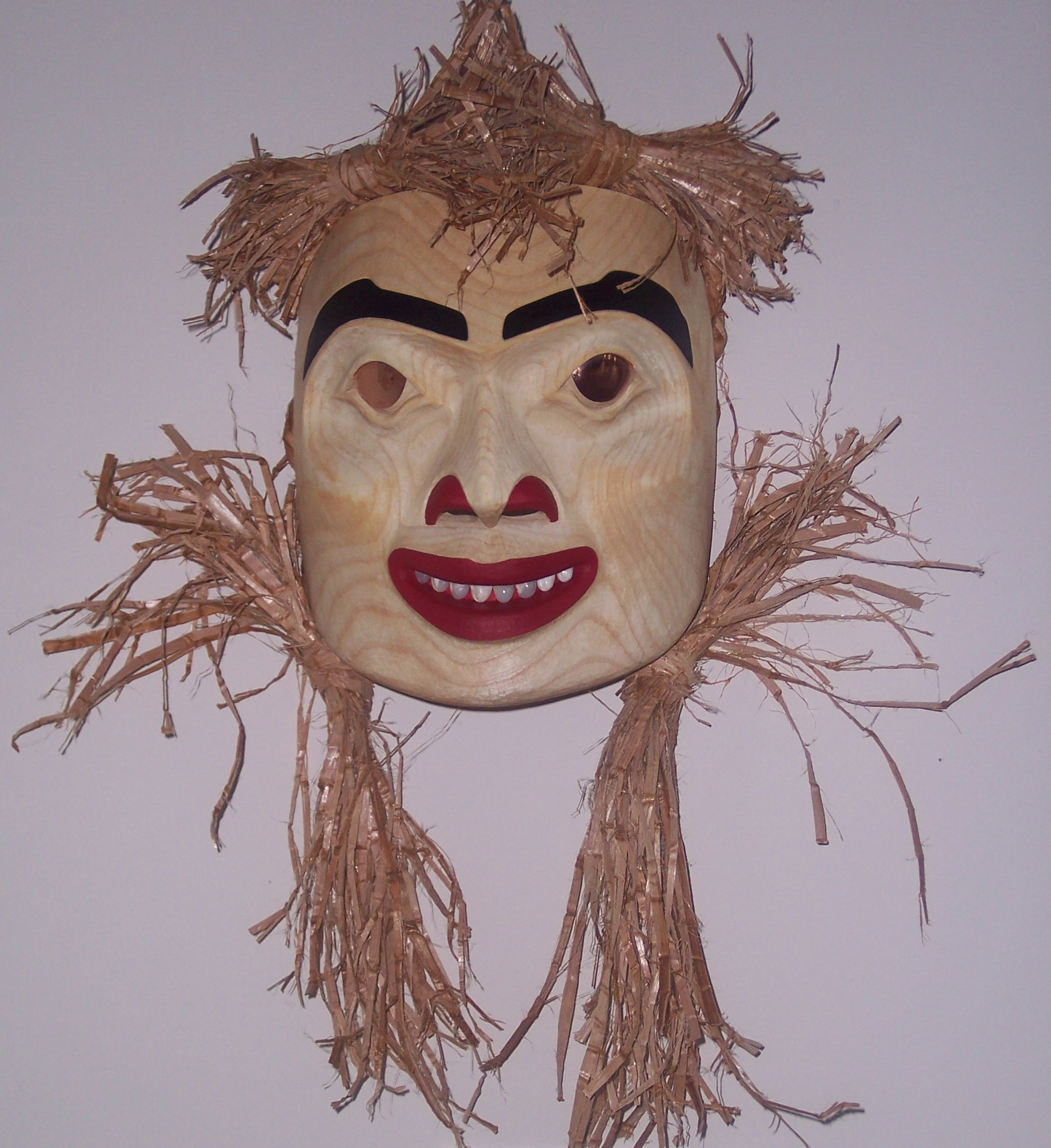
Even more development was shown in the work of Carol Young Bagshaw, the winner of last years’ Mature Student Award. While last year at this time, you could tell which teachers she was working with on each of her masks, this year, she displayed her own sense of style. Her masks are less stylized than traditional northern work, looking more like portraits, and taking full advantage of the beauty of the grain and the unpainted wood:

These graduates set a high standard, but at least some of the first year students seem likely to equal them. Nathan Wilson, who has already sold professionally, produced a solid piece entitled “Moon in Human Form,” that hinted at his skill, even though it was far from his best work:

Another emerging professional in first year, Kelly Robinson, easily rivaled the second years with “Visions Within,” even though he talked of adding some finishing touches to it:

Yet another talented first year students was Paula Wesley with the fine line and unique hair of her cannibal woman “Thu-Wixia,” which she danced at the end of the opening evening:

Accompanying Wesley in the dance was Evan Aster, who won one of this years’ Honorable Mentions for the Mature Student Award. Like Wesley, Aster promises to be a strong artist when his carving equals his painting:

The same could be said of Nigel Fox, a first year student who also paints in a style reminiscent of Canadian Impressionism. Fox’s “Surface Tension” was an interesting take on colors running together in the water:

Unfortunately, though, the painting overwhelmed the carving. Fox was on much more solid ground when he created an Escher-like design out of traditional butterflies in “Butterflies #3” (which is now in my possession):

Still other first years showed a mastery of the fundamentals of traditional design that should allow them to come into their own during their second years. They included Barry Sampare, this years’ winner of the Mature Student Award:

as well as Robert Moses White, who received an Honorable Mention for the Mature Student Award:

The pick of the show moves south on May 29 to Vancouver’s Spirit Wrestler Gallery, where I predict brisk first day sales. But although Spirit Wrestler is much closer than Terrace for me, I was glad to see the complete show, especially in Waap Galts’ap, the Northwest Community College longhouse, which is a comfortable blend of traditional design and carving and modern building and safety codes.

My thanks to everyone at the college and in the Terrace First Nations art community for making my visit such a pleasant one.

Read Full Post »

Over the past weekend, I was in Terrace in northern British Columbia to attend the graduation ceremony and exhibition for the Freda Diesing School of Northwest Coast Art. I would have wrangled an invitation anyway that I could, because the art show is worth seeing, but fortunately I didn’t have to. I was invited to attend so that I could announce the Mature Student Award, and, just before I rose to spoke, a touching thing happened.

The award was started by me and my late partner, Patricia Louise Williams two years ago, after I noticed that many of the awards for First Nations carvers required that the recipient be under twenty-five. Knowing that older students give up even more than young ones when they return to school, and how much older students add to the class room, we decided that they deserved an award, too.

This year was the first time the award had been given out since my partner died and the award was listed as being in her honor. I knew, too, that Carol Young, last year’s winner, was going to give a eulogy for Trish – something I knew that I could not possibly do without becoming incoherent with tears. So I knew going into the graduation ceremony that my emotions would be running high.

Carol gave a brief speech that had me fighting to keep control. She spoke of Trish’s lifelong interest in Northwest Coast Art and of the crafts that she was always doing. She spoke, too, of Trish’s generosity, and how she used to cut the blossoms from her miniature roses and hand them out when we were on our weekend errands.

Then she announced that, in honor of Trish, each student would take a rose and hand it to someone in the audience.

That was it. I lost all hope of control and started crying. By the time Carol announced me, I could barely see for crying.

I walked slowly to the front, buying time to dredge up some composure. To say the least, I didn’t succeed very well.

Somehow, I managed to stand straight and talk slowly. Afterwards, people said I talked well, but I don’t know if they were being kind or not. I don’t even remember what I said.

But I got through somehow. I may have said that, because of money donated at Trish’s memorial service and raised through the sale of her craft supplies, that this year the award was being given to three students, two of whom were honorable mentions. I’m not sure, though. All I know for sure is that I announced the winners, and handed each a wrapped book, and faltered back towards my seat.

The ceremony ended soon after, and the crowd followed two drummers to Waap Galts’ap, the campus longhouse, which is a happy blend of a traditional Tsimshian and a modern building. There, we heard the students talk, and watched Nuxalk and Tsimshian/Salishan dancers moving around the flats and glass cases of the exhibition.

Occasionally, as the evening continued, I saw people in the crowd holding one of the roses. Usually, they were women, and often seniors, although once I heard a lover give a male student a rose, on the grounds that men rarely receive roses. That seemed especially fitting, since Trish had said something similar to me on my twenty-first birthday.

But no matter who held the rose, the sight never failed to leave a catch in my breath and tears in my eyes. Later that night, as I stared up into the dark in my hotel room, I reflected how strange it was that a gesture carried out by people who had never known Trish should be so much more moving that the memorial service held a few weeks after her death. I was not the least ashamed of crying, because I knew that Trish would have sobbed to see it, and I knew I had to cry in her place. I drifted off in melancholy satisfaction, and slept well I awoke, grateful for the gesture and wondering if it might be repeated next year.

Read Full Post »

Three and a half months after my spouse died, I found myself attending another memorial service for her. Officially, that wasn’t what the Trish’s Stash Sale was about, but in practice that’s what it was, particularly for me.

Trish had many virtues, but tidiness was never one of them. When she died, she left three decades’ worth of craft supplies in our townhouse. Crochet, cross-stitch, hardanger, blackwork, ribbon embroidery, weaving, knitting – you name it, and at one time or other Trish had practiced it. With the help of her friend Lin, Lin’s husband, and Trish’s sister Marion, I hauled nearly a hundred boxes and bags out of the townhouse,divided into rough categories. Then, the Coquitlam Needlearts Guild (to which Trish had belonged for many years) started sorting it, and eventually decreed the sale to make sure that as much as possible of Trish’s craft supplies found someone who could use it.

I was asked to contribute a picture of Trish, and a picture of our parrots with the caption, “We Contributed the Seeds!” (apparently, some Guild members with poor closeup vision had worried during the sorting that the seeds were an insect infestation). I also provided frame art cards for some forty of those who helped with the sale, and a box full of Trish’s trademark origami ornaments to give out as further mementos.

When I arrived at the Scout Hall in Blue Mountain Park in Coquitlam today, I was prepared to help with setup. As the technical owner of the craft supplies, I felt a certain obligation – similar, I joked, to that of Doctor Frankenstein to his monster. But, despite the fact that it was barely 8AM (on a Saturday!), most of the work was already done.

I knew that some of the supplies had been already claimed by the volunteers for their unpaid efforts. Other things were being held back for Guild members to counter the increasing rarity of craft stores in greater Vancouver. Even so, Lin had told me yesterday that she was worried that what remained would never fit into the hall.

Fortunately, her concern was unwarranted. With an efficiency I can admire but never hope to match, the Guild had gone beyond my crude sorting to bag and price everything, and arrange it on tables. Working alone, I doubt I could have done the job in less that a couple of years – although, as the day wore on, that estimate expanded slowly to ten years. The effort was both extraordinary and unexpected.

I set up just inside the door, and found a stool to perch on. I was given a blue ribbon to wear to mark me as a volunteer – or “a friend of Trish,” as the organizer put it. By 8:40, the volunteers had turned into customers, and the first part of the sale began. It was for Guild members only, at half the price the general public would be charged.

I quickly settled down to a morning of urging ornaments and copies of the program from Trish’s memorial service to anyone who passed by my table. Often, people stopped to express their condolences. At times, I walked through the sale, remembering some of the items for sale, and sternly resisting the urge to buy anything back. More than once, a kind word or hug sent me stumbling outside until I could master the tears that were never far away.

At lunch, I wandered down to Austin Avenue for a sandwich, and returned with a dozen donuts. Almost all the volunteers bemoaned the calories, but most took at least half a donut.

In the afternoon, Trish’s sister Marion arrived, and so did their friend Nancy, who had visited Trish during her last stay in the hospital. The afternoon continued much as before.

As expected, the slowest sellers were the magazines, even though they had priced to sell. But the reference books, patterns, yarn, buttons, beards and fabric squares all sold between 50-70% of what was on the tables. But by 3:30, people had stopped coming, so takedown began with the same efficiency as setup.

At the last moment, a woman took all the miniatures magazines. That still leaves all sorts of charities doing baby clothes for poor mothers, quilts for women’s shelters or fire victims, and school craft programs to benefit in the coming weeks. Meanwhile, although expenses still have to be calculated, $2000 seems to have been raised for the Mature Student Award at the Freda Diesing School, which Trish and I founded in 2009.

Trish had wanted to make sure that her craft supplies went to those who could use them, and the Mature Student Award was something she was proud to have helped create. For these reasons, the sale felt like a last gesture of respect to Trish from some of her closest friends.

I’d like to thank them for that, and for their kind words about Trish and their kind treatment of me. Although I was left emotionally exhausted, so far as I’m concerned, I couldn’t have too many days like today while I actively mourn for her. Short of her still being alive and healthy, seeing good done in her name was the best thing that could have happened for me.

Read Full Post »

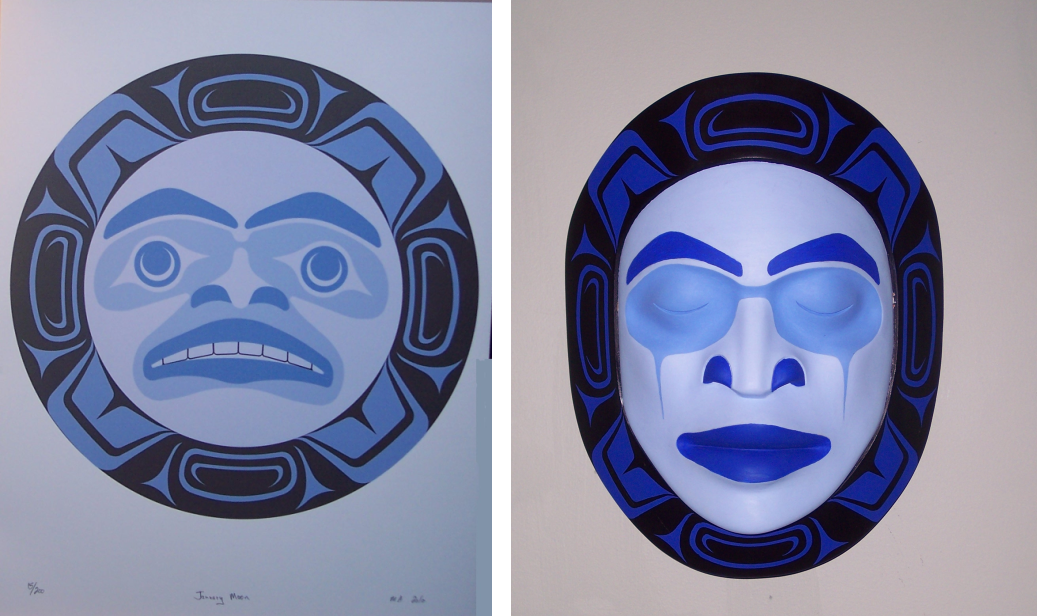
Back in June, I had dinner at the Steamworks pub with Haida / Tsimshian artist Mitch Adams and his wife Diana. Mitch kindly offered me a selection from the giclee prints that he was in Vancouver to sell. Few things feel so luxurious as a choice like that, and I could have selected several from his portfolio. However, eventually I decided on “January Moon,” which was the inspiration for his “Blue Moon Mask,” which was one of the standouts at the 2010 graduation exhibit for the Freda Diesing School of Northwest Coast Art.

The connection between the two pieces would have been obvious even if Mitch had not mentioned it. But the differences are interesting, because they show the evolution from a good execution of an idea to an outstanding one. There is little in “January Moon” that is not improved in “Blue Moon Mask.”

"January Moon" (left) and "Blue Moon Mask" (right)

The most obvious differences are in the shape and color. With its perfectly round shape, “January Moon” feels relatively static, and more abstract. In comparison, the change to an oval face in “Blue Moon Mask” is more ambiguous, as well as more realistic. Just as importantly, the colors are bolder and more glossy in the mask, as well as the contrast between them. In the print, the colors are muted, and the tones are a better match, but the result is that design tends to fade into the paper.

The exception to this general observation is the blue and black design on the rim. “January Moon”’s rim has more contrast between the colors, while “Blue Moon Mask”’s uses a darker blue that is much closer to the black. This change works because it frames the face most clearly; in “January Moon,” the blue of the rim is closer to those of the face, so that the rim frames less effectively.

However, the greatest changes are in the face. Some elements remain the same, most noticeably using the same colors for the lips, nostrils, and eyebrows. But, in “January Moon,” the eyes are also the same color, which is probably one feature too many for the design, which seems much busier than the mask.

By contrast, on “Blue Moon Mask,” the design is simplified. The teeth are gone, whose black outline is mildly discordant in “January Moon,” and much of the complication of the highlighting as well. The eyes shrink from an angry glare to closed eyelids, and the lips are smaller and barely parted instead of scowling.

The only element that is added is the tear tracks from the eyes, which I suspect originated in an accidental trickle of paint, but which works brilliantly, helping to emphasize the elongation of the face and suggesting an undercurrent of suppressed intense emotion beneath the surface appearance of serenity.

Somewhere in the middle of all these changes, the gender changes as well. “January Moon” registers as masculine to my eye (and that of those who have seen it), perhaps because of the mouth and bared teeth. “Blue Moon Mask,” however, seems female, or at least sexually ambiguous. Added to the suggestion of intense emotion being controlled, this ambiguity makes most eyes keep returning to “Blue Moon Mask” in a way that they do not to “January Moon.” Despite “January Moon”’s aggressive expression – or perhaps because of it – the eye has a hard time lingering over it. Its anger has nothing of the mystery found in “Blue Moon Mask.”

None of this is to dismiss “January Moon.” Its non-traditional eyes with their crescent moon and the creation of the nose through a clever use of negative space are admirable in themselves – so much so that I could wish they could have somehow been retained in “Blue Moon Mask.” But in the end, “January Moon” could be described as a first draft for “Blue Moon Mask.” Although “Blue Moon Mask” is the superior work, very likely it would not have succeeded if “January Moon” had not been created first. Together, they show an artist taking a leap in his development – and, I suspect, learning a lot in the process himself.

Read Full Post »

I spent the afternoon at the opening for the Northern Exposure show at the Spirit Wrestler Gallery. This is an annual show for the Freda Diesing School of Northwest Art, featuring the graduating class and the pick of the work by first year students. Besides giving students some extra cash, the show also teaches students how to deal with a gallery and an exhibition. So, naturally, when I was talking to the students, a common topic was whether they should try to place more pieces in galleries or find other ways to make a living from their art.

The question, I found, is hard to answer in the abstract. Not only does the answer depend on the galleries involved, but I suspect that the details of the answer are starting to change.

On the one hand, a gallery that is enthusiastic about an artists’ work can be the best advertising that the artist can have. The gallery staff can draw visitors’ attention to the artist to increase their sales. The gallery can act as an unofficial agent, passing commissions on to the artist. I’ve heard of gallery owners advising artists about what is selling, and the prices that buyers are willing to pay. They can promote an artist in a group show – or, better yet, a solo show. Artists can’t expect a gallery to promise to buy regularly (“That would mean we were taking on responsibility for an artist earning a living,” one gallery employee remarked to me), but an unofficial agreement that an artist will give a gallery first right of refusal for new works can benefit everyone.

On the other hand, horror stories about galleries are common. I have on good – but strictly anonymous – authority that certain gallery owners regularly break verbal agreements, all the while insisting that written contracts aren’t necessary. Some, too, delay payment for months; in one case I know about, the artist had to wait ten months for over ten thousand dollars. Artists who ask about such delays have had gallery owners scream abuse at them.

However, regardless of how a gallery treats artists, all of them have one thing in common: They stand between artists and their audience. This relation has the advantage of freeing artists from having to promote themselves. But it also means that 40-60% of the total price of a piece goes to the gallery. Considering that literary agents charge 15-20% for the same services, artists may feel that the price is too high, no matter how good the services are.

Fortunately, for artists who feel that way, the Internet provides some alternatives. Websites, Facebook fan pages, and microblogs like Twitter all provide ways for artists to interact directly with their audiences, bypassing the galleries entirely, if they choose. With free software content management systems like Joomla! or Drupal, artists can even conduct online auctions, using Paypal or credit card services for payment. As for pricing, artists can charge more than the wholesale price they receive and still offer prices that are lower than a gallery would charge.

And, increasingly, artists are taking full advantage of these alternatives. One senior First Nations artist says that 80% of his sales come from the Internet. Another estimates that about one-third of his sales are online, and is trying to boost that fraction every way he can.

But artists pay a price when taking control of their sales in this way. They have to learn marketing skills, which can make them nervous and uncomfortable if they are inexperienced or introverted. They have to learn the principles of commercial design, which are very different from the art they create. They not only have to create their initial web pages or Facebook pages, but keep them constantly replenished with new content, because nothing looks less professional than a long outdated web presence. If buyers are unsatisfied, they have to deal with the problem themselves. Most important of all, they either have to spend time on business and promotion – perhaps as much as a third of their working hours, especially at first – or find a sympathetic friend or family member or maybe a consultant to do the work for them. With these demands, some artists might feel that the price for taking full control of their career is too high.

Yet another problem is that an artist can make a living promoting themselves, but, in doing so, they become invisible to the traditional art market. If that happens, then the artists may not be mentioned in art books, or approached by governments and other institutions for large commissions.

My own suspicion is that, despite the disadvantages, an increasing number of artists will start to market themselves. Most Northwest Coast artists I know are doing some online promotion, although none (so far as I know) are doing all they could. In the future, galleries will continue to exist, but they may have less control over artists than they have traditionally had, because the alternatives will be too well-known.

Whatever happens, artists today have a choice that they didn’t have fifteen years ago. However, what choices they should make depends very much on their own skills, personality, and preferences.

Read Full Post »

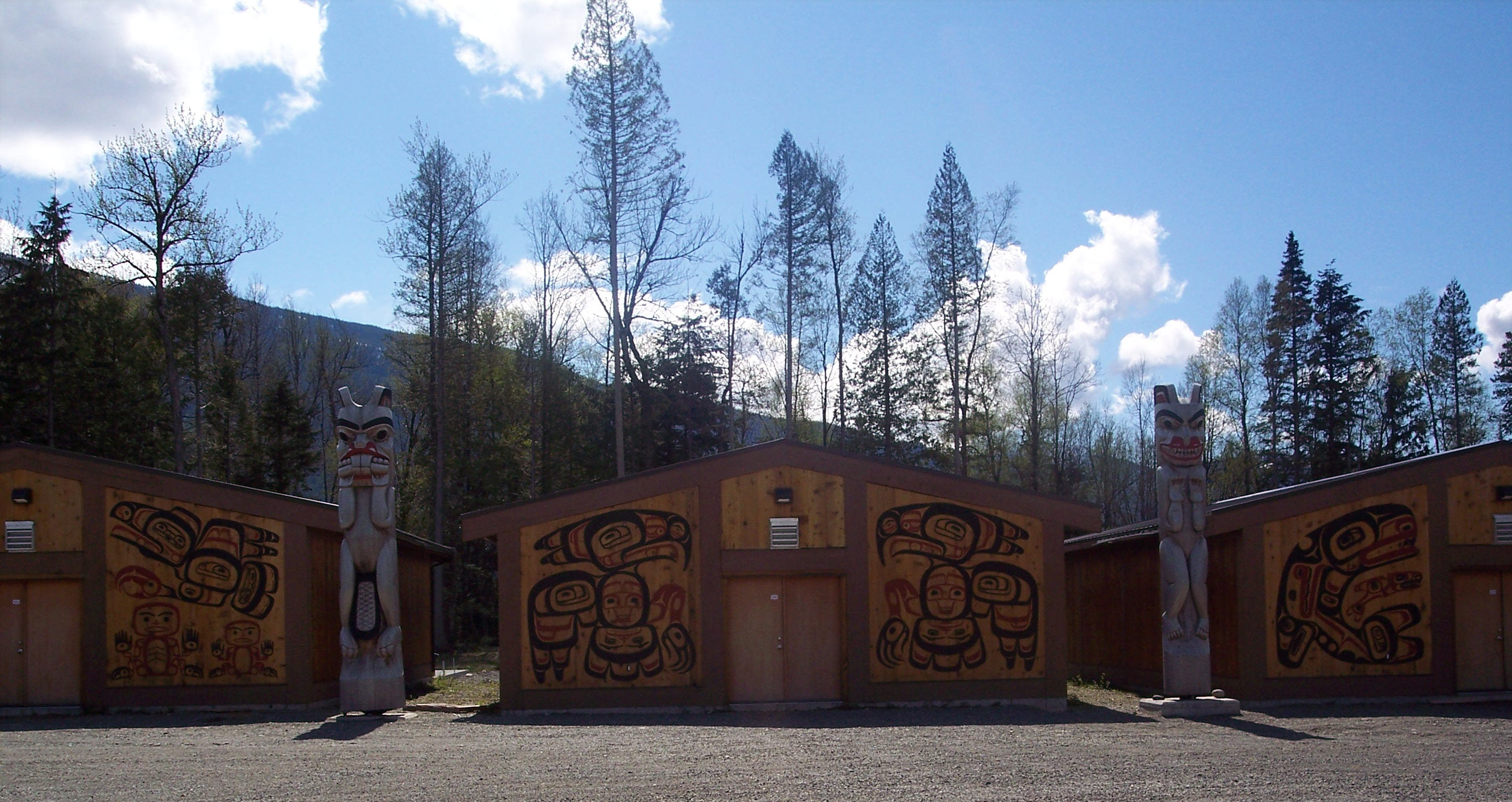
A couple of weeks ago when I was in Terrace, Dean Heron drove me the fifteen kilometers northeast to the Kitselas Canyon National Historic Site. We left the highway, bounced up a gravel road through some second growth forest to a gate and, after opening it, descended to the top of the site.

I’ve been hearing about construction on the site for a couple of years and the work that teachers, students, and graduates of the Freda Diesing School of Northwest Coast Art had been doing there, but nothing really prepared me for the site or the scope of the effort. The top of the site was dominated by a nearby mountain, so dramatically close that I could never quite keep it out of my glance, or resist looking up at it (or be unaware of it at my back):

To date, four longhouses have been completed. A fifth is largely complete but unpainted and will eventually display a wolf design, if I remember correctly.

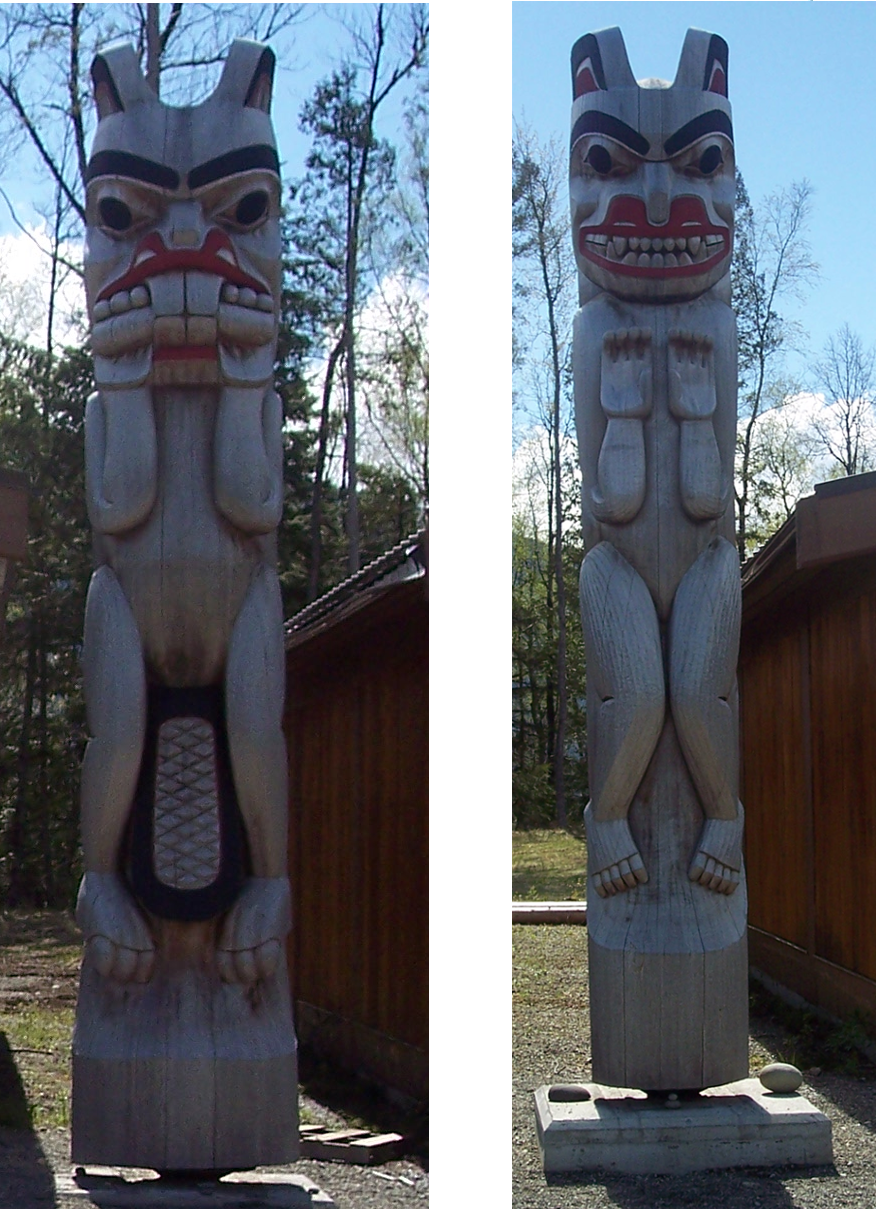
In front of the line of longhouses, are the carved figures of a grizzly bear and a beaver:

Each of the longhouses, Heron explained to me, would become the showcase for a different aspect of the local Tsimshian culture. About a hundred meters across the gravel was the future gift shop and the washroom.

However, the current buildings were just the start of the plans. Eventually, part of the leveled gravel will become a ground for dances and ceremonies. And, behind the gift house, a path lead down to the archaeological site where the original village had been located. I would have liked to descend to the site, where an interpretive center was being built, but Heron was unsure of his right to go there. He had a key to the gate, and having worked on the top of the site, had no hesitation about going there, but the archaeological site was another matter – perhaps because he was not a member of the Kitselas First Nation.

Nor could we enter any of the longhouses, because alarms had been added recently to them. Naturally, I was disappointed, but I was glad that some pre-cautions were being taken, because apparently one of the longhouses had already been broken into. In fact, considering some of the art work there, I can see a day coming when the site has security staff around the clock.

Still, even without seeing everything, I was impressed, both by what had been done and what I imagined the finished result would be. Between the magnificence of the setting and the carvings by Dempsey Bob, Stan Bevan, and their current and ex-pupils, Kitselas Canyon has every chance of being the cultural and tourist landmark it is intended to become. Personally, I can’t wait to see what it should become in a few years — and I’m grateful to Dean for the preview.

Read Full Post »

« Newer Posts - Older Posts »