Feeds:
Posts
Comments

Archive for the ‘art appreciation’ Category

The Northwest Coast art in our home includes many contemporary pieces. However, I am also fascinated by traditional pieces, particularly recreations of historical masks according to modern sensibilities. That is why, when John Wilson’s “Voices of Our Ancestors” (aka “Portrait Mask”) became available, I jumped at the chance to buy it.

John Wilson, "Spirit of Our Ancestors"

“Voices of Our Ancestors” is based on two historical Haisla masks in J. C. H. King’s “Portrait Masks from the Northwest Coast of America,” a book first published in 1979. It is a mask well worth studying for its own sake, all the more so because examples of Haisla design are relatively rare. When you do see them, you have no trouble placing the Haisla geographically, because their art often seems like a combination of Kwakwaka’wakw and Tsimshian traditions. Nor is Wilson’s mask an exception.

Artists Unknown, Historic Haisla Masks

However, what especially interests me is Wilson’s reinterpretation of the historic masks. To start with, Wilson chooses a less rounded, more northern shape for the mask. This change is accompanied by some changes in proportions, such as a wider space between the lips and nose, and a higher placement of the ears. He has also decided not to include the teeth that are in the originals, and replaced the originals’ rounded eyes with more smaller, more slanted ones. In addition, the cheekbones of Wilson’s mask are far less prominent than in the originals. The result is a less human, more supernatural look – a fitting change, considering that the mask is a work of a modern man looking back on the past.

Another noticeable difference is in the selection of colors. This difference is not just a matter of what was available; one of the older masks actually has a brighter red than the one that Wilson uses. By contrast, even allowing for aging, the historical piece has a more subdued blue than Wilson uses. Wilson also accents the red by drawing thicker formlines, and using it in places where the historical piece uses blue.

Wilson has followed the general designs of the original, including the stylized mustache and goatee, but almost always he has put his own interpretation on them. For instance, he has taken the rows of parallel lines just visible on the colored original, and added them as a design element below the nose, replacing the rather uninspired blobs of cross-hatching, and perhaps suggesting mustache stubble.

However, the largest difference between Wilson’s mask and its inspiration is in the form lines. Although formline influence is obvious in the originals, Wilson’s formlines are more disciplined, with more variation in thickness and more balance. For instance, where the formlines on the forehead in the original meets above the left eye, Wilson’s meet between the eyes. Similarly, where the original has formlines meet on on the cheeks, Wilson’s meet at the nostril.

Probably the most obvious difference in the design is on the cheeks, where the formline helps to replace the cross-hatching, and the blue u-shapes are greatly reduced in size. Even more importantly, the red formline that follows the line of the cheek curves upwards rather than downwards as in the original, doing more than any single element to make the modern mask less human and more arresting than the originals.

“Spirit of Our Ancestors” is obviously influenced by the sources that Wilson acknowledges, but clearly it is more than imitation, or an unthinking copying of a classical piece. Wilson’s mask is more balanced piece of work than either of the originals, with a stronger northern influence as well. Although somewhat of a new direction for Wilson, it more than succeeds on its own terms. Wilson has not simply copied, but repeatedly improved as well.

Read Full Post »

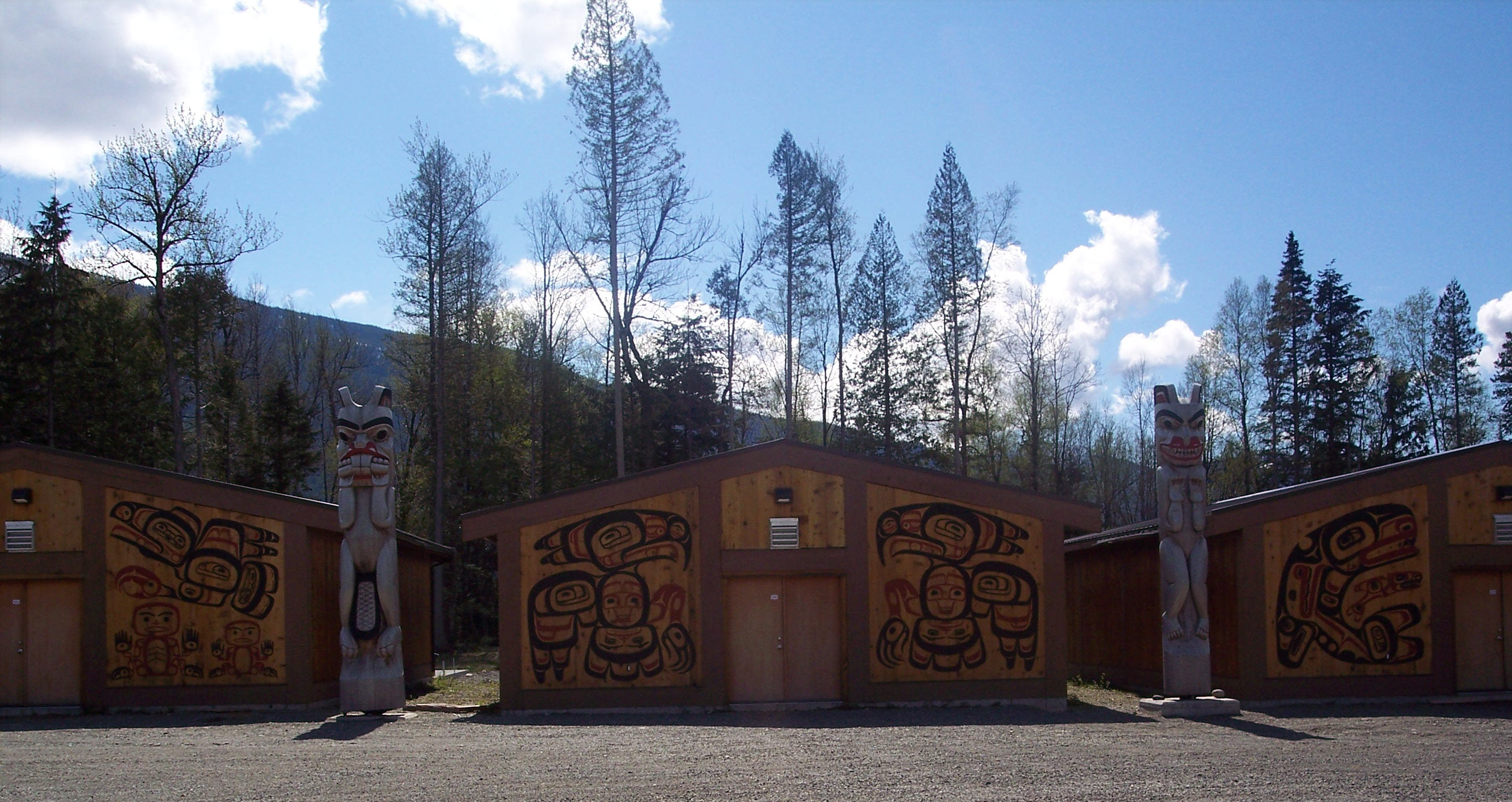
A couple of weeks ago when I was in Terrace, Dean Heron drove me the fifteen kilometers northeast to the Kitselas Canyon National Historic Site. We left the highway, bounced up a gravel road through some second growth forest to a gate and, after opening it, descended to the top of the site.

I’ve been hearing about construction on the site for a couple of years and the work that teachers, students, and graduates of the Freda Diesing School of Northwest Coast Art had been doing there, but nothing really prepared me for the site or the scope of the effort. The top of the site was dominated by a nearby mountain, so dramatically close that I could never quite keep it out of my glance, or resist looking up at it (or be unaware of it at my back):

To date, four longhouses have been completed. A fifth is largely complete but unpainted and will eventually display a wolf design, if I remember correctly.

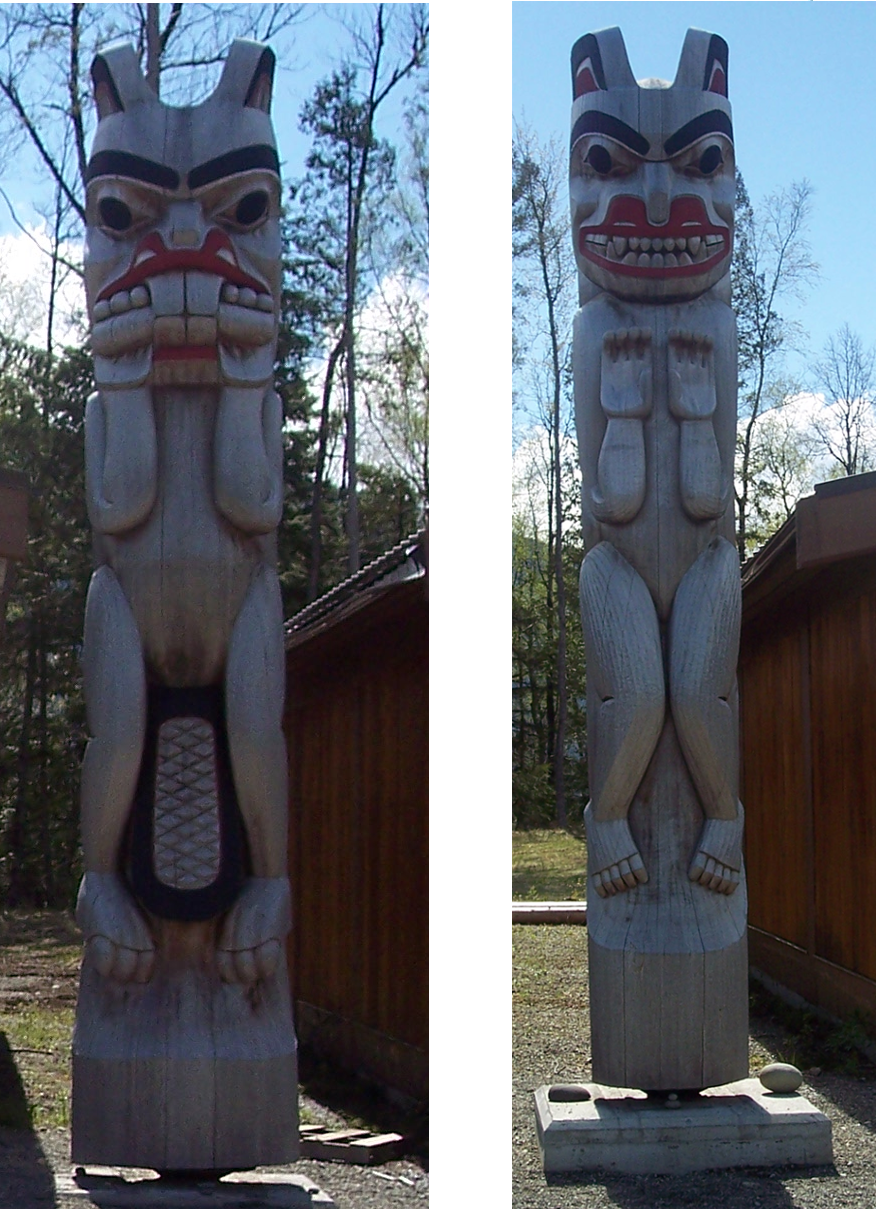
In front of the line of longhouses, are the carved figures of a grizzly bear and a beaver:

Each of the longhouses, Heron explained to me, would become the showcase for a different aspect of the local Tsimshian culture. About a hundred meters across the gravel was the future gift shop and the washroom.

However, the current buildings were just the start of the plans. Eventually, part of the leveled gravel will become a ground for dances and ceremonies. And, behind the gift house, a path lead down to the archaeological site where the original village had been located. I would have liked to descend to the site, where an interpretive center was being built, but Heron was unsure of his right to go there. He had a key to the gate, and having worked on the top of the site, had no hesitation about going there, but the archaeological site was another matter – perhaps because he was not a member of the Kitselas First Nation.

Nor could we enter any of the longhouses, because alarms had been added recently to them. Naturally, I was disappointed, but I was glad that some pre-cautions were being taken, because apparently one of the longhouses had already been broken into. In fact, considering some of the art work there, I can see a day coming when the site has security staff around the clock.

Still, even without seeing everything, I was impressed, both by what had been done and what I imagined the finished result would be. Between the magnificence of the setting and the carvings by Dempsey Bob, Stan Bevan, and their current and ex-pupils, Kitselas Canyon has every chance of being the cultural and tourist landmark it is intended to become. Personally, I can’t wait to see what it should become in a few years — and I’m grateful to Dean for the preview.

Read Full Post »

I have read about and seen something of the culture of the Haida, Tsimshian, Nisga’a and other First Nations of the northern British Columbia coast. However, I know little about the Nuxalk of the central coast beyond the fact that the nation prefers not to be referred to as the Bella Coola, as they once were. For that reason, when Latham Mack, one of this years’ graduates of the Freda Diesing School danced a Nuxalk mask, I was an attentive member of the audience.

I am used to thinking of Latham Mack, who twice won the YVR Art Foundation scholarship, as a designer more than a carver. Certainly, he has done far more designs than masks to this point, including a limited edition print. However, as part of his final work in the Freda Diesing program, Mack finished two Thunder masks, a blue one for the year end exhibit and the upcoming  show at the Spirit Wrestler gallery, and a black one that he has announced that he will keep in his private collection.

Both masks reflect the story of the four brothers who saw a dancing figure on the mountain who created the thunder – an important story in the Nuxalk tradition. The hooked nose and flaring nostrils are a traditional part of the figure’s depiction.The small branches attached to the head, presumably to suggest lightning, are also traditional, although Mack’s mask makes greater use of them than several others that I’ve seen pictures of. This tradition, as Mack emphasized to me, is separate from the Thunderbird of the Kwakwaka’wakw or other First Nations, with the central figure representing the spirit of the storm.

Latham Mack tells me, “Two major dance rituals make up our winter dance ceremonies, the Sisaok (ancestral family dances) and the Kusiut (secret society ceremonies). The Thunder dance is performed by members of the Kusiut society. According to Bella Coola belief, the supernatural ones in the upper land resemble human beings in performing Kusiut dances. Corresponding to the prowess of his patron, the dance of his human protégé is one of the most important Kusiut rituals. Only the strongest of course danced the Thunder because of the movements and physical fitness you had to be in to actually dance it. Only the families who owned the story actually danced it, but as the years have gone by, we have lost the identity of those owners. So now it’s basically owned by the whole Nuxalk people.”

Mack goes on to say that, “The dance of Thunder can be performed with four, two or one masked dancers, depending on the prerogative of the protégé. When the dance is done with four Thunders, these represent the four brothers in the oral tradition. Numerous dances lead up to the Thunder dance, the Herald introduces the dance of Thunder. He beats his stick on the floor and announces the impending Thunder dance.”

Many dances can lead up to the Thunder dance, but, in this case, the performance was divided into three sections, each introduced and narrated by a member of Mack’s family who also provided a rattle accompaniment.

Since the mask had never been used before, the ceremony began with a blessing of the mask by sprinkling down over it.

Then, before Mack’s actual dance, three female members of his family prepared the area in which he would dance with their own dance. It was a stately dance, done with upraised palms and constant circular steps. The narrator explained that this preparation was a traditional role for women in Nuxalk dances.

Then Mack danced. He wore an apron threaded with loose pieces of wood that he shook for percussion, and wooden clappers on his back.

Frequently, he threw himself down on his knees and climbed to his feet again.

His hands and lower arms made constant flickering gestures, as if to shoo people away, but actually to bestow blessings upon the audience.

It was an energetic dance, enough to scare several young children at the front of the audience, who quickly moved away. He also wore cuffs around his ankles and wrists and the modern innovation of knee pads (which was wise, since he was dancing on a concrete floor, and would have otherwise damaged his knees). It was an obviously exhausting performance, powerful and contrasting sharply with the graceful motions of the women’s dance a few moments before

All too often, those of us who are not directly involved in First Nations culture can forget that the masks that we admire have a ceremonial purpose — or are supposed to have. Mack’s dance was a small reminder of this basic fact, and left me wondering where I could find more about Nuxalk culture.

(Note: Ordinarily, this dance is not photographed, but Latham Mack’s grandfather, Lawrence Mack (Lhulhulhnimut), a chief of the Grizzly clan from the ancestral village of Nusq’lst gave permission for those in attendance to photograph it. He also graciously gave me permission to post the pictures I took on this blog. Needless to say, any mistaken cultural references here are due to my ignorance or to lapses in my memory, and not to his kindness. Should anyone see any mistakes, please let me know so that I can correct them.).

Read Full Post »

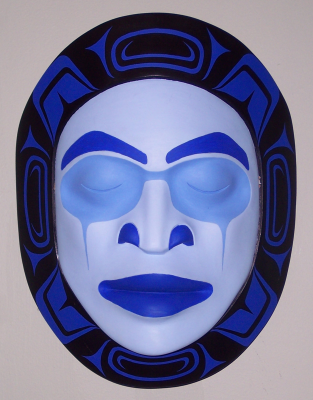
Mitch Adams is an artist I’ve been watching for some time. From the pictures he’s posted on Facebook in the last year, I suspected that it was only a matter of time before I saw one of his works that I wanted to buy. And, sure enough, when I walked into the 2010 Freda Diesing School Student Art Exhibition, his “Blue Moon Mask” immediately caught my eye. I consider it one of the finer examples of contemporary Northwest Coast art that I’ve seen in the last year – an opinion with which some traditionalists strongly disagree.

I am not the only one to think so highly of the mask. I know of at least half a dozen people who would have been happy to buy it, and who wished that it had not been marked as not for sale. Two of those people were frankly envious when I told them that, after I expressed my admiration, Adams decided not to send it to the upcoming Spirit Wrestler show after all, but to sell it to me. One even asked me if I would resell it.

Similarly, when I posted a picture of it in my review of the exhibition, one viewer called it “the most stunning mask I have ever seen.”

To me, such reactions seem perfectly logical for anyone who has troubled to look at the mask. Although “Blue Moon Mask” is covered entirely with paint, the paint is not so thick that you cannot see the smoothness of the carving.If anything, the palest blue on the mask tends to emphasis the plans of the carving, making them into shadows rather than lines.

The careful selection of the shades of blues is equally obvious, from the pale, almost white skin color to the darker blue on the outer rim, and makes the mask seem ever-changing, especially with the tear tracks falling from the eyes. Depending on the light and the angle, the mask can look serene, corpse-like, or even like the heavy makeup of a Goth on Friday night. It is a work that is both accessible and ambiguous at the same time.

Some aspects of the work are traditional. Looking through galleries or museums, you should have no trouble finding other moon masks of the same general shape. Many details are traditional, too, including the eyebrows and nostrils, and the array of U-shapes and ovoids surrounding the face.

Yet the work departs from the northern tradition in at least two key ways. For one thing, in the northern tradition, blue is a third color, used in small amounts if it is present at all. Black and red are the typical colors, with a third being added by the natural color of the wood. A departure from this norm is, by itself, enough to define a work as contemporary.

For another thing, the use of paint on the entire mask is unusual in Adam’s Haida and Tsimshian tradition (although not entirely unheard of, either). The northern tradition tends to be sparing in its use of paint, with designs painted across the mask that ignore the features beneath them. Adams’ decision to paint the entire mask would be more common in the Kwakwaka’wakw tradition, although, even there, his use of different shades of the same color instead of contrasting ones would be more characteristic of modern artists such as Beau Dick or perhaps Simon Dick.

To make these departures is a risk – but I believe it is a necessary one, of the kind needed to keep Northwest Coast art developing and relevant. Nor is it a unique one. Historically, the art form has long been a combination of local conventions meeting industrial societies’ technologies and sensibilities. So-called tradition has long changed and benefited from artists’ discoveries of metal tools, industrially produced paints, and, much later, of power tools. Similarly, the first European influence on subject matter is over a century and a half old, in top-hatted figures on poles and sailing ships on argillite plates. From this perspective, what Adams does in “Blue Moon Mask” is not radical, and should be easy to appreciate.

Yet, sadly, a minority noticed “Blue Moon Mask”’s departure from strict tradition and could not get past it. I am told that one teacher reacted strongly to it, and that another one joked about it. Even worse, some students, seeing the teachers’ reactions, immediately imitated them rather than using their own eyes.

These reactions strike me as both unfortunate and short-sighted. The basis of Northwest Coast art will always be the traditional work. If nothing else, the contemporary needs the traditional to react against.

Yet I do not see why admiration for the traditional must include a rejection of everything contemporary. True, you may prefer one over the other, or prefer one in your own work. But what you like and what is done well are by no means synonymous. Nor does preferring one require that you condemn the other.

Personally, I refuse to take sides. “Blue Moon Mask” is a technically skilled piece, and amidst our collection of traditional works by artists like Norman Tait or Richard Hunt and of contemporary pieces by artists like Alano Edzerza or Ron Telek, it claims a place on our wall on its own merits. It’s a piece that I consider myself lucky to live with, and I’m proud to have our keeping.

Read Full Post »

This was only the second year that I attended the Freda Diesing School’s year end exhibition, but the show has become a must-see for me. For one thing, it is one of the largest exhibitions of Northwest Coast art in any given year. For another, I never know what I might find, either because a student is unknown, or has taken a giant leap forward in their understanding of their art.

The 2010 show was slightly smaller than the previous year’s, and emphasized carving more than design, although a few limited edition prints and drawings were available up in the loft, as well as a sampling of giclee prints by second year student Mitch Adams. But in compensation, the level of carving was higher than last year, probably because, instead of specifying that each student submit three pieces to the show, the teachers urged students to focus on producing their best work, and starting it early (even so, there were many groans about last minute all-night sessions).

Close to the door were masks by people whose work I have bought in the past. John Wilson contributed his hawk woman mask to the show, which I had seen pictures of, but was glad to see in person:

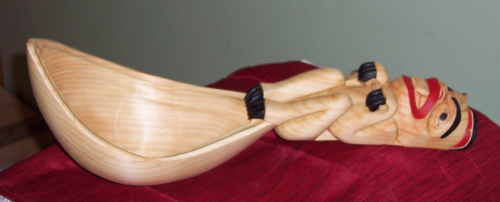
Wilson also contributed a large spoon, whose beaver handle included more detail work than I had seen before in his work:

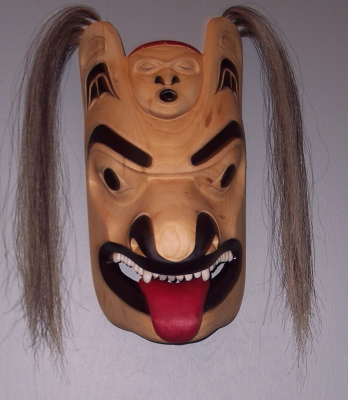
Besides Wilson’s mask hung Colin Morrison’s second mask, whose red design made the wood look like a sun-tan, and contrasted with the white hair he used:

Moving on from Wilson’s and Morrison’s masks, I quickly discovered work from artists I remembered from 2009. Previous YVR award winner Shawn Aster, whose main interest seems to be design rather than carving, contributed a mask whose interest is largely in the painting:

Second year Metis artist Mathew Daratha was one of the more prolific contributors to the show, displaying several masks, such as this one:

Still another second year student, Latham Mack, the two-times recipient of the YVR Award, was allowed to carve in his family’s traditional Nuxalk style, producing a strikingly different Thunder Mask:

Mack also danced a similar mask after the graduation ceremony.

But perhaps the most development among the second year students was shown by Sheldon Dennis, whose carving showed a considerable advance over his work last year, as well as a strong sense of originality:

Female students continue to be a minority at the school, but those enrolled in the first year class this year made a strong showing. Cherish Alexander showed a talent for combining feminine faces with bold designs:

Carol Young, the winner of the first Mature Student Award, showed a similar interest in women’s faces, and added a traditional labret to indicate high status in one of her masks:

Another first year female student, Nina Bolton chose a more traditional shape for her mask, but gave it a strong, contrasting design when she painted it:

Some of the most striking work in the show was created by Chazz Mack, Latham Mack’s cousin. Chaz Mack include two pieces in the show: a small print, and a mask whose painted design shows a strong sense of line in its curves:

However, if the show had a single outstanding piece, it was Mitch Adams’ “Blue Moon Mask.” The piece was the despair of at least one of the school’s teachers, all of whom work in the northern style and favor masks with much less paint than “Blue Moon Mask,” but its clean lines and carefully selected palette made it a crowd favorite, with at least half a dozen people clamoring to buy it:

When Adams agreed to sell it to me, several other would-be buyers frankly expressed their jealousy, and cursed their lack of initiative; apparently, I was the only one who actually asked Adams if he was firm about the Not For Sale label.

In fact, if the show had a fault, it was that most of the best pieces were labeled as not for sale for one reason or the other. If I had had my way, I could have returned home with another three or four pieces from this years’ show.

However, that’s a selfish wish. Many of the pieces marked as not for sale were reserved for the upcoming Northern Exposure show at Vancouver’s Spirit Wrestler Gallery. For many students, the show is their first chance to display their work to a large audience, so I can hardly blame them for withholding their work from sale. All of them thoroughly deserve that chance, and I hope that I will have many chances in the future to buy their work.

Read Full Post »

Finishing details, a carver once remarked to me, are what makes a mask. Our latest acquisition, Ron Telek’s “Coming of the Winter Storm” is a perfect illustration of this basic truth.

Stripped to the basics, the mask is a standard Telek face. The nose, with its short length and separate cups for each nostril, is visible on any number of Telek’s previous works. So are the lines of the cheek, the even width of the lips, and the broad forehead. The eyes are somewhat unusual, since each wraps around two sides of the face, but not their shape. All in all, the basic face is so characteristic of Telek’s work that it could have been roughed out by an apprentice (and by some accounts, it might have been).

However, what makes this piece are the finishing details. For example, the hands raised to the face suggest the depiction of the winds on old European maps. Yet, if you look closely, you see that they are much smaller than the size of the face would make you expect. Either the wind spirit is a dwarf like the Bukwus, or its proportions are altogether non-human.

Then there is the paint. Like his uncle Norman Tait, Telek does not often use color, and, in the few instances I’ve seen where he does, the color is not especially subtle. But on “Coming of the Winter Storm,” Telek manages a delicate blending of red and blue to suggest cold and chafed skin that is completely unexpected. When I say that the blending is worthy of Beau Dick or Simon Dick, followers of Northwest Coast art should understand how subtle it is.

But of course the most striking feature of the mask is its hair and eyebrows. The difference in their color is a master-stroke by itself, emphasizing the non-humanity of the spirit. The same is true of the unusual angles of the hair, and the length and angles of the brows. The fact that the hair and brow are formed by four dozen separate plugs shows a patient attention to detail.

Another point I might have missed if we didn’t already own four pieces by Telek is the finishing. Almost all of Telek’s wood sculptures are sanded so smooth they might be ivory, with a careful consideration of how the grain might enhance the work. Here, though, Telek has left parts chipped and rough – largely where the daubs of red appear. It is a detail that seems much more appropriate to this rough figure than Telek’s usual finishing.

This attention to detail uplifts what could have been something ordinary into the extraordinary. Quite literally, it made us decide to postpone redoing the kitchen floor in order to obtain the mask while we could. Now, it sits below the clock, an eye-catching piece from any angle in our living room.

Read Full Post »

Aboriginal artists in British Columbia have been combining traditions for some years now. Preston Singletary, for example, has collaborated with Maori artist Lewis Gardiner, while Terrance Campbell is strongly influenced by the jewelry of the American Southwest. But I admit I was skeptical about the collaborations of Mike Dangeli and Don McIntyre. Maybe the problem was my own ignorance, but I wondered how much artists like Dangeli in the Northwest style and McIntyre in the Woodlands style could exchange, beyond good will.

Don McIntyre (left) and Mike Dangeli (right)

However, in practice, the mingling of traditions works much better than I expected in “East Meets West: Throwing Power,” Dangeli and McIntyre’s combined show currently at the art gallery in the Student Union Building at the University of British Columbia.

The main reason, I suspect, is the obvious closeness of the two artists. Dangeli and McIntyre share studio space and are adoptive brothers. They share such a sympathy that at times, they say, they have trouble remembering who painted which line when they collaborate.

The mixture of their style may be sometimes jarring, but it succeeds because, while both Dangeli and McIntyre show a firm understanding of their respective traditions, they are also concerned with adopting those traditions to contemporary urban life, often with a sense of humor that begins with the titles of their works and continues with their choice of subject matter. Despite the large differences in traditions, this similarity of outlook allows them to meet in the middle, as their paintings do literally in the galley.

If you look at a selection of Dangeli’s work with any knowledge of the northern formline style, it immediately becomes obvious that he is intimately familiar with the tradition. And some of his work does not stray very far from that tradition, apart from the selection of colors.

However, in many of his pieces in this show, Dangeli’s rendering of that tradition is a departure from the norm. In the classical northern tradition, ovoids and U-shapes are rendered as though from a template – in fact, in large scale projects like house-fronts, artists often work from stencils.

Dangeli does work in this tradition. However, just as often – and perhaps increasingly – he favors a looser, hand-drawn rendering of classical shapes – a sketch as opposed to a smoothly finished work. Often, too, he combines shapes in non-classical ways. The result is that, where in his tradition, formlines tend to flow together, dragging the eye through a work, Dangeli’s looser renderings sometimes seem fragmentary and disjointed.

Perhaps the effect is a stylistic commentary on the survival of the northern tradition in industrial urban life. If so, the style is well-suited to Dangeli’s habit of commenting on this lifestyle.

The titles alone indicate his on-going commentary on the modern relations between First Nations people and this lifestyle, for instance, “Bright Shining Lie,” “For Those Who Had to Hide,” and “We Will Not Be Boxed In. Often, the titles are referenced by the techniques in each work, so that “Surviving the White Wash” literally has a wash of white over everything, while “We’re Not Open for Business,” an anti-Olympic statement,” has the shape of a Closed sign.

Don McIntyre’s relation to his tradition closely resembles Dangeli’s. Like Dangeli, McIntyre sometimes produces a piece that fits comfortably within his tradition, as in “A Place to Come Back To.”

"A Place to Come Back To"

Yet even when McIntyre appears to be working in the tradition, first impressions can be deceptive. His apparently innocuous drum (shown above), if you look closely, shows the union of sky and earth as an act of sex, and his title for this depiction of creation is “The Big Bang.”

Yet, where many Woodlands artists continue to depict natural scenes that have little in common with the cities in which they live, McIntyre tries to advance his school of painting by transferring its traditions to what he sees around him.

At times, the difference is subtle. As he pointed out to me at the exhibit’s opening, “Natural Urbanity” could easily be a classical work, if the streetlights were replaced by trees. At other times, as in “New Counsel,” nature creeps into the cityscape only in small oases, like the log that the birds in the canvas cling to.

"Natural Urbanity"

"New Counsel"

And, as in Dangeli’s work, McIntyre often turns his extension of his tradition into social commentary. In “(Dis) Placed Illusions,” for example, McIntyre combines an inukshuk, the symbol of the Vancouver 2010 Olympic Winter Games, with a sleeping polar bear, drawing a line between cultural appropriation and global warming .

"(Dis) Placed Illusions"

Combined with their friendship, such similarities make Dangeli and McIntyre’s collaborations exactly what collaborations should be: not just a juxtaposition, but something that neither could achieve by themselves.

For me, the most successful of the several collaborations on display was “Ben Couver: Olympic Gluttony.” The central figure, with its extended belly, fits in well with McIntyre’s style, in a way that it would not into Dangeli’s.

Yet, at the same time, Dangeli’s image of broken coppers being thrown into the water adds its own dimension. Moreover, the combination of Dangeli’s self-consuming two-headed serpent and McIntyre’s Wendigo provide two complementary images of destruction.

“East Meets West” is a small show, but it is an ambitious one. To its credit, though, it convincingly draws parallels between the two traditions in the show, and produces intriguing art in the process. While the gallery may be obscure for many people, it is well worth searching out just to see this show.

Read Full Post »

The first piece an artist does in any medium is frequently a labor of love. The artist has poured all their ability into the piece, and, even if the work is flawed, you can often tell the artist’s quality and interests from it. It was with these thoughts in mind that I jumped at the chance to buy Colin Morrison’s “Naxnox” which, as he wrote on its inside, is his “first mask ever.”

Even so, I was lucky to get it. A picture of the mask sent out in early December received a dozen replies within twenty-four hours, including eight or nine from galleries. This level of interest in an unknown artist’s work, especially at a time of year when sales are difficult, tells you all you need to know about the quality, even if you can’t judge it for yourself. It is a level of interest that, in fact, is almost unheard of.

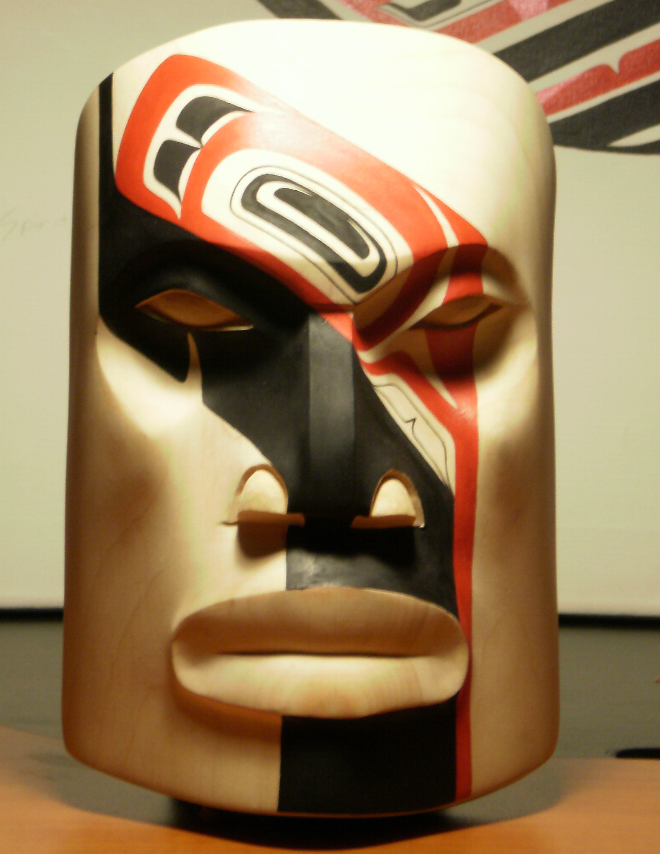
The design is arresting to the casual eye for a number of reasons, starting with the contrast between the black and red and the thickness of their lines, and continuing with the unpainted nostrils and the ovoid in the middle of the forehead like a supernatural third eye. On the right, the mask looks dark and brooding; on the left, carnal and scowling. The result is a mask with an unusual degree of presence.

In terms of the northern school, the mask is even more interesting because it seems both traditional and contemporary at the same time. On the one hand, the shape of the mask is a standard one in Tsimshian art. The painting across the face without regard for individual features is also common in the northern schools. On the other hand, I have never seen paint applied in such an angular slash across the face to create such an asymmetrical, modern effect. You might almost say that the traditional and contemporary are at war across the mask – a suggestion of conflict that contributes to the strong sense of presence.

This sense of conflict seems especially apt when I remember Morrison’s description of his own background: “I’ve learnt as much as I could about traditional life as I could, but I feel as if I don’t know as much as the elders. I know a little more then the next guy, but not a lot. Most of what I learnt, came from books, my granny, and uncle. I don’t know a lot of my Sm’algyax, but some words I do know. I don’t dance, and don’t sing. I’m getting a Sm’algyax name when we have a feast, but I have been waiting for years for it to happen.”

Traditionally, naxnox was used to refer to the masks and regalia used in ceremonies. In Tsimshian languages like Sm’algyax (Coast Tsimshian), naxnox means “beyond human understanding.” Or, if you prefer, you might translate the word as “supernatural” or “spiritual.” Such works were often concealed when not being used, and, should they not be treated with the proper respect, were capable of extracting revenge.

Obviously, Morrison’s mask is not naxnox in the literal sense, since it is meant to hang on a wall rather than being danced. Yet, metaphorically, the name seems to suit the mask’s presence and its mixture of the traditional and modern.

I wonder: Could the meaning be extended to mean “psychological?” Or, more to the point, could it cover the latent power revealed in a first work? Although I’m not a linguist, I like to think that it could. Because, however you regard it, “Naxnox,” like Morrison’s “The Spirit of the Wolf,” is a work that holds great potential for Morrison’s future career.

Read Full Post »

I first crossed paths with John Paul Wilson a year ago. Another artist wanted to send me pictures, and John agreed to take and send them. Since then, we have been in touch once or twice a week, and I have enjoyed watching his art move from promising to a first maturity. It is hardly surprising, then, that “Summer Moon Maskette” was under our Christmas tree this year.

The moon is a popular subject in Northwest Coast art. So far as I know, the moon is nobody’s crest, so the question of having permission to use it never arises. Perhaps just as importantly, it is a subject that requires no special knowledge of mythology to appreciate. Wilson himself describes the moon as one of his favorite subjects, and, if you look at his Flickr site, you can see several different ways that he has approached it.

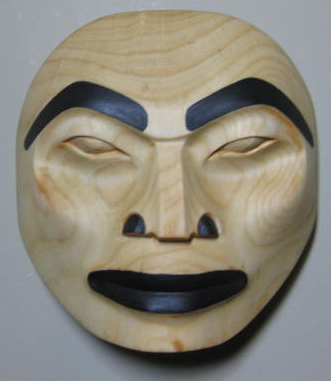
What makes “Summer Moon Maskette” stand out is its simplicity. It has no complicated design, and no red, the second most important color in the northern style. Even the black paint is applied sparingly, being confined to the mouth, nostrils, and eyebrows, and not to the pupils.

This simplicity means that the piece’s carving stands out more than usual. Wilson has responded to this situation by carving with more realism than usual. He has shaped the mouth more, and made the nose fuller than usual on the sides. He has also given close attention to the cheekbones and the area where the nose, eyes, and eyebrows meet.

However, what really makes “Summer Moon Maskette” stand out is the eyes. Slanted, with an inner fold and no pupils, they are very different from most eyes in the northern style – so much so that I almost wonder if they are a portrait. They seem to be closed, suggesting a sleepiness that is appropriate to a hot summer night.

Another result of the simplicity is that, after the paint, most of what catches your eyes is the grain. Wilson has always excelled in sanding the grain until it conforms with the contours of his carving, but “Summer Moon Maskette” is an especially fine example of this practice. For example, if you look, you can see how the grain conforms to the line of the cheekbones and the forehead, or the hollow beneath the eyes. The effect is almost hypnotic in itself, relieved only by a small imperfection which is confined to the chin – and which is also a relief after your eye has been following the apparently billowing lines of the grain.

This simplicity is an indication of how far Wilson has advanced in his art. A less experienced artist would be tempted to tart up the mask with abalone or copper. By contrast, Wilson lets the maskette speak for itself, which makes it all the more powerful. That is a risky approach, but the fact Wilson succeeds is a measure of his advancing skill and confidence.

Read Full Post »

A couple of months ago, Haisla artist John Wilson told me about a promising first year student at the Freda Diesing School named Colin Morrison. After seeing some minor pieces by him, I commissioned a painting. It turned out to be his first professional sale.

I am absolutely confident that it won’t be his last – and not just because I would like to boast ten years from now that I had the foresight to see his potential before he became well-known. “The Spirit of the Wolf” is an accomplished piece that illustrates Morrison’s potential better than anything I can say. It is all the more remarkable because it comes from a man in his mid-twenties.

On the surface, “The Spirit of the Wolf” is a traditional piece, reminiscent of Roy Henry Vickers’ work. It shows a strong interest in style, with a variety of ovoids and U-shapes used throughout and a variety of tactics used to control the thickness and joints of the formlines. The sheer number of tactics could easily result in a mishmash, but Morrison controls it by having shapes mirror and contrast each other in disciplined way. The mirroring is especially obvious when the primary and secondary formlines are adjacent to one another.

At the same time, you do not have to look very long before you realize that “The Spirit of the Wolf” has a playfulness that suggests a very contemporary outlook as well. The design is basically a play on the various interpretations of the title, with wolves spread throughout the design – everything from the physical wolf to the Wolf as a clan crest. This dichotomy is suggested by the vaguely yin-yang shape of the overall design.
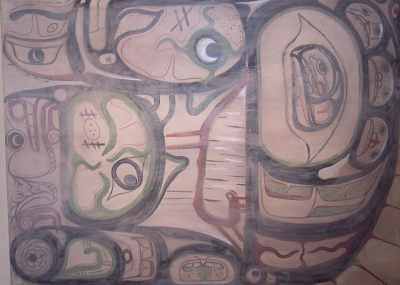
There is even, Morrison says, several spirits in the metallic paint of the design. So far, I have to admit, I have been unable to detect what kind of spirits they might be, or if anything specific is intended, but I find the idea immensely appealing all the same.

You could even go one step further and say that, since Morrison himself is a member of the Tsimshian Wolf Clan, that the painting itself is a manifestation of a wolf’s spirit.

You might call the painting a kind of Northwest Coast “Where’s Waldo?” If you wanted to say the same thing more seriously, you could say that the content is as inventive as the style.

Asked to say something about himself, Morrison replied, “I’m Tsimshian, Ginadoiks tribe, Wolf Clan. I’ve been an artist since I was young; I started painting when I was 18, and didn’t take it seriously till I was 23 years old. I’ve been painting off and on since that time, trying to figure out what I was going to do with my life.

“Then, one day last year, my Mom started going to a carving class in school. She wanted me to go and dragged me there. I started painting again, and liked what I was doing. My instructor (Harvy Ressel) saw the raw talent and asked me if I wanted to go to the Freda Diesing School. I said yes. Since then, I have found my calling.”
Since doing “The Spirit of the Wolf,” Morrison has completed his first mask and is in the process of finishing his second. I expect that the world of Northwest Coast art will be hearing more from him, but remember (I said, with a certain pride) – you heard of him first from me.

Read Full Post »

« Newer Posts - Older Posts »