Feeds:
Posts
Comments

Archive for the ‘British Columbia’ Category

This was only the second year that I attended the Freda Diesing School’s year end exhibition, but the show has become a must-see for me. For one thing, it is one of the largest exhibitions of Northwest Coast art in any given year. For another, I never know what I might find, either because a student is unknown, or has taken a giant leap forward in their understanding of their art.

The 2010 show was slightly smaller than the previous year’s, and emphasized carving more than design, although a few limited edition prints and drawings were available up in the loft, as well as a sampling of giclee prints by second year student Mitch Adams. But in compensation, the level of carving was higher than last year, probably because, instead of specifying that each student submit three pieces to the show, the teachers urged students to focus on producing their best work, and starting it early (even so, there were many groans about last minute all-night sessions).

Close to the door were masks by people whose work I have bought in the past. John Wilson contributed his hawk woman mask to the show, which I had seen pictures of, but was glad to see in person:

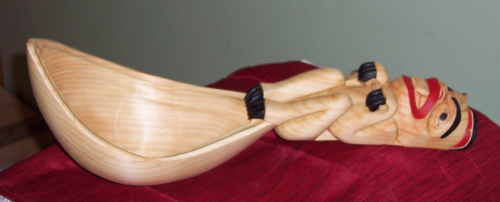
Wilson also contributed a large spoon, whose beaver handle included more detail work than I had seen before in his work:

Besides Wilson’s mask hung Colin Morrison’s second mask, whose red design made the wood look like a sun-tan, and contrasted with the white hair he used:

Moving on from Wilson’s and Morrison’s masks, I quickly discovered work from artists I remembered from 2009. Previous YVR award winner Shawn Aster, whose main interest seems to be design rather than carving, contributed a mask whose interest is largely in the painting:

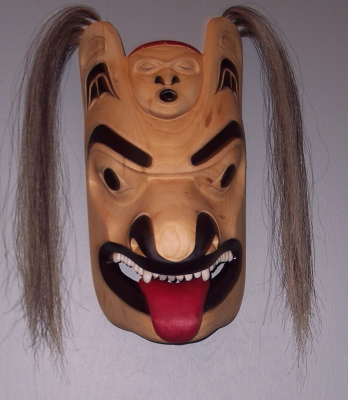
Second year Metis artist Mathew Daratha was one of the more prolific contributors to the show, displaying several masks, such as this one:

Still another second year student, Latham Mack, the two-times recipient of the YVR Award, was allowed to carve in his family’s traditional Nuxalk style, producing a strikingly different Thunder Mask:

Mack also danced a similar mask after the graduation ceremony.

But perhaps the most development among the second year students was shown by Sheldon Dennis, whose carving showed a considerable advance over his work last year, as well as a strong sense of originality:

Female students continue to be a minority at the school, but those enrolled in the first year class this year made a strong showing. Cherish Alexander showed a talent for combining feminine faces with bold designs:

Carol Young, the winner of the first Mature Student Award, showed a similar interest in women’s faces, and added a traditional labret to indicate high status in one of her masks:

Another first year female student, Nina Bolton chose a more traditional shape for her mask, but gave it a strong, contrasting design when she painted it:

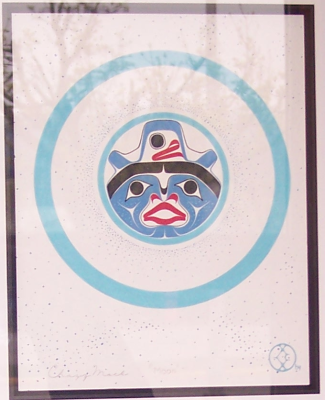
Some of the most striking work in the show was created by Chazz Mack, Latham Mack’s cousin. Chaz Mack include two pieces in the show: a small print, and a mask whose painted design shows a strong sense of line in its curves:

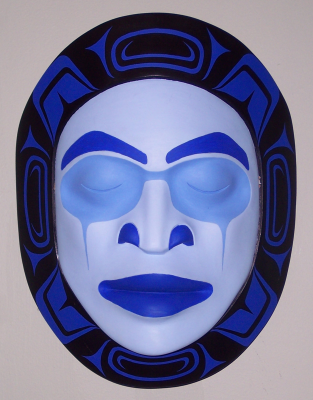
However, if the show had a single outstanding piece, it was Mitch Adams’ “Blue Moon Mask.” The piece was the despair of at least one of the school’s teachers, all of whom work in the northern style and favor masks with much less paint than “Blue Moon Mask,” but its clean lines and carefully selected palette made it a crowd favorite, with at least half a dozen people clamoring to buy it:

When Adams agreed to sell it to me, several other would-be buyers frankly expressed their jealousy, and cursed their lack of initiative; apparently, I was the only one who actually asked Adams if he was firm about the Not For Sale label.

In fact, if the show had a fault, it was that most of the best pieces were labeled as not for sale for one reason or the other. If I had had my way, I could have returned home with another three or four pieces from this years’ show.

However, that’s a selfish wish. Many of the pieces marked as not for sale were reserved for the upcoming Northern Exposure show at Vancouver’s Spirit Wrestler Gallery. For many students, the show is their first chance to display their work to a large audience, so I can hardly blame them for withholding their work from sale. All of them thoroughly deserve that chance, and I hope that I will have many chances in the future to buy their work.

Read Full Post »

On April 23, I did something I had been waiting to do for ten months: I stood up at the graduation ceremony for the Freda Diesing School of Northwest Coast Art at Northwest Community College in Terrace, and gave out the first Mature Student Award. Trish and I hope it will be the first of many, and I think the award got off to a good start by having Carol Young (Bagshaw) as the first recipient.

A member of the Haida Eagle side, Young did not grow up with traditional culture, but absorbed much of it indirectly from her mother. Later, as a single mother of four, she began selling a variety of handicrafts and art pieces loosely based on Northwest Coast design on eBay. Although she says she never thought of herself as an artist, she sold over a hundred pieces of every description imaginable. Masks, rattles, miniature canoes, and, most of all, Haida-inspired dolls – all of these and more she managed to produce as a way of bringing in extra money.

With her children grown, Young decided to do something for herself, and enrolled in the Freda Diesing School last September. Her teachers and fellow students tell me that at first she seemed to have trouble feeling comfortable in the dorms or the class room, and that learning formline design didn’t come easily to her after years of doing things her way.

However, in the second semester, especially after hearing that she had won the Mature Student Award, Young started to hit her stride. Her design took on a new discipline and maturity as she absorbed what the teachers had been telling her, and she found a place among the other students, most of whom were far younger – although at times, she told me with a smile, she felt that her role was that of den-mother in the dorms.

By the end of the school year, Young had become the speaker for the first year students, announcing them at the graduation ceremony, and appearing with fellow student Sheldon Dennis on a CBC podcast about the school. She also took it on herself to present me with a school cap and T-shirt, and, when I requested one for Trish (who was unable to attend the graduation), gave me hers, claiming that she didn’t wear T-shirts anyway – a kindness that I was grateful for, although I wondered if it was true.

During the podcast, Young said that attending the school had given her “a whole new life.” Previously, I had only contacted her briefly via email, but when I met her during the graduation ceremony and exhibition, she seemed like a person who was happy about the direction she was heading. Not only was she in the middle of preparations and cleanup for the weekend, but she talked about how she hoped she could present a female perspective in her carving, which she felt – despite the name of the school – had been under-represented or explored. She said, too, that she would like to establish an award for women at the school, and would like to teach after she graduated next year.

My impression is that Young is the sort of self-starter who can get where she wants to be under her own power and on her own terms. But I would like to think that the Mature Student Award made her self-development a little easier and quicker than it might otherwise have been.

As the first recipient of the award, she sets a high standard. If next year’s winner is even half as deserving, I will feel that our ongoing involvement in the school through the award has been worthwhile.

Carol Young, First Recipient of the Mature Student Award at the Freda Diesing School of Northwest Coast Art

Read Full Post »

One of the many songs inspired by the Jacobite Rebellion of 1745 is “Little wot ye wha’s coming.” It is little more than a list of the clans that supported Bonnie Prince Charlie, and I’ve heard it sung slowly by Ewan MacColl, and faster and faster by The Corries. Just back from the Freda Diesing School graduation exhibit in Terrace, I’m reminded of the song because I feel as though I’ve spent the last two days meeting people.

Some I knew online but had never met, others by reputation. But let me see if I can generate a list, roughly in order since I arrived at the exhibit at 2PM on Friday:

  • Jill Girodat, the Associate Registrar at Northwest Community College, who helped us set up the Mature Student Award, and is well-known among students in need for her ability to find funding for them. Jill kindly volunteered to show me around the campus.
  • Stephanie Forsyth, Northwest’s president, who saw me taking photographs when I arrived and was puzzled about who I was until I got up to give the Mature Student Award that night, but remained polite.
  • Todd Stephens, a graduate last year from the Freda Diesing, who supervises the carving shed at the George Little House. Last year, we bought his “Jorja and I,” which hangs over my computer desk.
  • Shawn Aster, one of this year’s graduates, who remains a promising artist, both in terms of his ability and in terms of his promise that one day he will finish the painting we’ve discussed.
  • Gayton Nabess, one of the first year students, who showed me a left-handed stone paint pot found on the banks of the Skeena, and pictures of a non-traditional piece he recently completed (which I’m sorry that I never had time to see).
  • Dean Heron, the newest teacher at the Freda Diesing,who kindly gave me a tour of the nearly completed longhouse on the Northwest campus, and drove me out to see the work being done at the Kitselas Canyon project.
  • Ken McNeil, one of the teachers at the school, whose work I have long admired.
  • Stan Bevan, the program coordinator at the school, who let me see not only the four crests for the longhouse, but also his home and work area, and drove me around on Saturday evening. I also appreciate the book he presented me — a reprinting of a transcript of oral tales that were originally recorded almost a century ago. It’s the sort of genuine record of First Nations culture I’m always looking for, but rarely find.
  • Rocque Berthiaume, who teaches art history at the school, whom I’ve heard praised by many students but whom I had never previously met.
  • Carol Young Bagshaw, this year’s winner of the Mature Student Award, who introduced the first year students at the graduation ceremony, and saw that I not only had my own cap and T-shirt from the school, but also a shirt to bring home to Trish.
  • Colin Morrison, whose first mask we bought. He turns out to be much taller in person than I had imagined.
  • Mitch Adams, who kindly agreed to let me buy his “Blue Moon Mask” rather than send it down to the upcoming Spirit Wrestler Show. It was one of the most sought-after pieces in the end of year exhibit, and he could have had half a dozen other buyers, had he chose. Mitch also invited me down to hear his band play, although by 10PM on Saturday, I no longer had the energy.
  • John Wilson, who is clearly the most accomplished artist in this years’ graduating class, even if he doesn’t always receive the credit he deserves. Over the last year, we’ve chatted so often on Facebook that, when he walked up, we started talking as if we met face to face everyday.
  • Latham Mack, another of this year’s graduates, who danced his Thunder Spirit Mask on Friday night, and kindly got me permission from his elders to post pictures online of the performance (which I plan to do some time this week).
  • Chaz Mack, who showed me some of his vivid and powerful works in his dorm room.
  • Dempsey Bob, the school’s Senior Advisor and one of the master carvers of his generation, who made some effort to draw me out at dinner on Saturday, when I looked overwhelmed by all the new faces.
  • Diana Wong Adams, Mitch’s spouse, whose taste for the Pogues instantly told me she was a person worth knowing.
  • Ron Telek, whose work we’ve been collecting for several years. Somehow the disasters and mishaps that have averted our previous efforts to meet were absent this time, and we actually got to hang out.
  • Peter Jackson, who drove up from Prince Rupert to talk over dessert.

These are only the people I had extended conversations with (although possibly I’ve left out one or two). Were I to include everybody I was introduced to, or exchanged a few brief remarks with, the list would be over twice as long.


But whether I mentioned people or not, my thanks to all those I met for their friendship, kindness, and hospitality. Together, you stimulated and exhausted me in equal measure. I look forward to renewing our acquaintance at the Spirit Wrestler show next month, and at next year’s graduation.

Read Full Post »

Most people are probably unaware that the South Terminal of the Vancouver airport even exists. Decades ago, it was the main terminal, but now it is reserved for small local airlines, and the occasional celebrity hoping to slip into town unobserved. A ten minute shuttle ride from the main terminal will take you there, but the effect is like stepping back in time. Looking at the two-story, yellow brick building and the small, aging Dash-8s on the tarmac, you half expect to see Humphrey Bogart and Claude Rains standing around in trench-coats talking about what they will do next over a bottle of Vichy water.

Okay, that might be an exaggeration, but the scale and the pace are very different from what you find at the main terminal. For one thing, the building is no more than seventy meters long. Inside, it looks more like a shopping mall than an airport terminal. Counters for half a dozen companies line one side, and the center of the building is dominated by a cafe. At one end is a gift shop, full of the inevitable smoked salmon and vaguely Northwest Coast designs. You have to search to find the security checkpoint, which opens on to the single waiting area, which might manage to hold a hundred people, if it were ever full (which, in my experience, it never is).

The crowds are smaller, too, and their members more casually dressed. You don’t get many executives flying out of the South Terminal – or, if they do, they are flying upcountry to small towns where blue jeans and a T-shirt are acceptable as business casual. Who you do see are many men and women in middle age, heavy set and looking as if they might have fished or cut timber thirty years ago. A few music players and netbooks are visible if you look, but not many. You can count them on the fingers of one hand, if you choose, because, there’s rarely forty people waiting at any given time.

This setting makes traveling far more casual than at the main terminal. If you have to wait in line at the counter, it’s only for a couple of people at the most. The counter staff are relaxed and chatty. So are the security staff; while they are by no means slack, they are the only security staff I’ve ever encountered who could be described as friendly and forthcoming. When I forgot my keys in a tray after my belongings were scanned, one even hurried after me with them. They almost make an annoying and pointless procedure bearable, apparently well aware that the chances of suicide bombers targeting a flight to Campbell River or Terrace are remote. Of course, they don’t have to hurry, since there are almost never two planes taking off at the same time, but I appreciate the general atmosphere all the same.
When you line up and are led to your plane along the pedestrian walkways painted on the tarmac, you find the same casual efficiency is found on board the aircraft that fly from the South Terminal – or at least you do on Hawkair, which I’ve flown twice now. When was the last time you remember that WestJet or Air Canada held an in-flight raffle? Or handed out complementary newspapers (even if it was just The Vancouver Province)? Or invited you to take advantage of the empty seats to give yourself more room? Admittedly, once on a SouthWest flight into Phoenix, the pilot announced that we were ahead of schedule and detoured so we could see the sunrise over the Grand Canyon, but I can’t remember the same atmosphere anywhere else.
If you can’t guess, I love flying out of the South Terminal. If the airlines attached to it flew every place I wanted to go, I would use it exclusively and never come near the main terminal (except to view its display of Northwest Coast Art). Given that my parents didn’t have the decency to let me born independently wealthy, it’s probably the closest I’m ever going to get to flying in a private charter.

Read Full Post »

The more I learn about Northwest Coast art, the more the term “totem pole” bothers me. For years, I’ve been looking for a better term, and now I think I’ve found a couple.

“Totem pole” bothers me for two reasons. To start with, despite what the Europeans believed when they reached the northwest coast of North America, the artifacts that the term refers to are not totems. A totem is a supernatural guardian of a group of people, often their mythological ancestor – a minor deity comparable to the local spirits of the ancient Greeks. However, so-called totem poles classically did not depict totems, but hereditary crests and the occasional allusion to both historical and mythical accounts of the family that uses the crest.

In other words, when the European settlers destroyed the artifacts in the belief that they were destroying false gods, what they were really doing was the equivalent of smashing and defacing the coats of arms depicted on government buildings and the houses of the rich in Europe.

In addition, the popular term has also given rise the idiomatic expression “low man on the totem pole.” This expression suggests that the most important figures were always at the top, when, in reality, no such convention in Northwest cultures. In fact, in some cultures, such as the Tsimshian, the most important figure was placed on the bottom, and figures of secondary importance at the top, according to master carver Henry Green.

You could use “crest pole” instead, as I have occasionally seen. But the trouble is, I also object to the word “pole.” True, “pole” is technically accurate, being a word that describes a round object made of wood, and it is often used today in place of “totem pole.” However, it greatly understates the magnificence of many of the artifacts to which it is applied. You might as well call the Arc de Triomphe a gateway or a slab.

My first hint of an alternative came when Henry Green referred to a pole he is doing using the Sm’algyax (Coast Tsimshian) word “pts’aan.” Seeing this word was a bit of a revelation, because I realized that I had never heard the word in any First Nations language for a pole. It seems to me that, if we are starting to use the original name of cities and countries, pronouncing the capital of France as “Paree” instead of “Paris” and using “Suomi” instead of “Finland,” then we might also consider using the proper names for important cultural institutions and artifacts.

Apparently, though, “pts’aan” has an even more exact meaning. According to Green, it refers specifically to a pole that is hollowed out and flattened at the back. By contrast, a pole that is left fully rounded is a “k’an.”

Seeing these words, I asked Green what he might suggest for an English translation (assuming that we need one). He emailed back, referring to both a pts’aan and a k’an as columns. Perhaps you could call a pts’aan a half-column and a k’an a column in English? If other Northwest Coast cultures have additional terms, then “column” could be further qualified as needed.

This change of terms, I think, could have a powerful effect on how the Northwest Coast cultures are regarded. Regardless of whether you refer to a totem pole, a crest pole, or just a pole, a pole sounds like a simple, utilitarian object. A pole, after all, is something you use for fishing, or to hang a light from.

However, call a pts’aan or k’an a column, and you are making it the equal of Trajan’s Column or Nelson’s Column. Suddenly, by using “column” instead of “pole,” you realize that you are talking about an object of major importance to its culture – something that required considerable effort and artistic skill to create, and celebrates something important. You are forced to confront the fact that the cultures that made such things are not primitive (assuming that this word actually refers to anything these days), but as complex and as rich as any in Europe. Just by changing the word, your entire perspective changes.

Probably, “totem pole” is too entrenched to be replaced easily. However, I am seriously thinking of trying to promote the use of “column” as a replacement. It simply seems more accurate and precise.

Read Full Post »

Finishing details, a carver once remarked to me, are what makes a mask. Our latest acquisition, Ron Telek’s “Coming of the Winter Storm” is a perfect illustration of this basic truth.

Stripped to the basics, the mask is a standard Telek face. The nose, with its short length and separate cups for each nostril, is visible on any number of Telek’s previous works. So are the lines of the cheek, the even width of the lips, and the broad forehead. The eyes are somewhat unusual, since each wraps around two sides of the face, but not their shape. All in all, the basic face is so characteristic of Telek’s work that it could have been roughed out by an apprentice (and by some accounts, it might have been).

However, what makes this piece are the finishing details. For example, the hands raised to the face suggest the depiction of the winds on old European maps. Yet, if you look closely, you see that they are much smaller than the size of the face would make you expect. Either the wind spirit is a dwarf like the Bukwus, or its proportions are altogether non-human.

Then there is the paint. Like his uncle Norman Tait, Telek does not often use color, and, in the few instances I’ve seen where he does, the color is not especially subtle. But on “Coming of the Winter Storm,” Telek manages a delicate blending of red and blue to suggest cold and chafed skin that is completely unexpected. When I say that the blending is worthy of Beau Dick or Simon Dick, followers of Northwest Coast art should understand how subtle it is.

But of course the most striking feature of the mask is its hair and eyebrows. The difference in their color is a master-stroke by itself, emphasizing the non-humanity of the spirit. The same is true of the unusual angles of the hair, and the length and angles of the brows. The fact that the hair and brow are formed by four dozen separate plugs shows a patient attention to detail.

Another point I might have missed if we didn’t already own four pieces by Telek is the finishing. Almost all of Telek’s wood sculptures are sanded so smooth they might be ivory, with a careful consideration of how the grain might enhance the work. Here, though, Telek has left parts chipped and rough – largely where the daubs of red appear. It is a detail that seems much more appropriate to this rough figure than Telek’s usual finishing.

This attention to detail uplifts what could have been something ordinary into the extraordinary. Quite literally, it made us decide to postpone redoing the kitchen floor in order to obtain the mask while we could. Now, it sits below the clock, an eye-catching piece from any angle in our living room.

Read Full Post »

Aboriginal artists in British Columbia have been combining traditions for some years now. Preston Singletary, for example, has collaborated with Maori artist Lewis Gardiner, while Terrance Campbell is strongly influenced by the jewelry of the American Southwest. But I admit I was skeptical about the collaborations of Mike Dangeli and Don McIntyre. Maybe the problem was my own ignorance, but I wondered how much artists like Dangeli in the Northwest style and McIntyre in the Woodlands style could exchange, beyond good will.

Don McIntyre (left) and Mike Dangeli (right)

However, in practice, the mingling of traditions works much better than I expected in “East Meets West: Throwing Power,” Dangeli and McIntyre’s combined show currently at the art gallery in the Student Union Building at the University of British Columbia.

The main reason, I suspect, is the obvious closeness of the two artists. Dangeli and McIntyre share studio space and are adoptive brothers. They share such a sympathy that at times, they say, they have trouble remembering who painted which line when they collaborate.

The mixture of their style may be sometimes jarring, but it succeeds because, while both Dangeli and McIntyre show a firm understanding of their respective traditions, they are also concerned with adopting those traditions to contemporary urban life, often with a sense of humor that begins with the titles of their works and continues with their choice of subject matter. Despite the large differences in traditions, this similarity of outlook allows them to meet in the middle, as their paintings do literally in the galley.

If you look at a selection of Dangeli’s work with any knowledge of the northern formline style, it immediately becomes obvious that he is intimately familiar with the tradition. And some of his work does not stray very far from that tradition, apart from the selection of colors.

However, in many of his pieces in this show, Dangeli’s rendering of that tradition is a departure from the norm. In the classical northern tradition, ovoids and U-shapes are rendered as though from a template – in fact, in large scale projects like house-fronts, artists often work from stencils.

Dangeli does work in this tradition. However, just as often – and perhaps increasingly – he favors a looser, hand-drawn rendering of classical shapes – a sketch as opposed to a smoothly finished work. Often, too, he combines shapes in non-classical ways. The result is that, where in his tradition, formlines tend to flow together, dragging the eye through a work, Dangeli’s looser renderings sometimes seem fragmentary and disjointed.

Perhaps the effect is a stylistic commentary on the survival of the northern tradition in industrial urban life. If so, the style is well-suited to Dangeli’s habit of commenting on this lifestyle.

The titles alone indicate his on-going commentary on the modern relations between First Nations people and this lifestyle, for instance, “Bright Shining Lie,” “For Those Who Had to Hide,” and “We Will Not Be Boxed In. Often, the titles are referenced by the techniques in each work, so that “Surviving the White Wash” literally has a wash of white over everything, while “We’re Not Open for Business,” an anti-Olympic statement,” has the shape of a Closed sign.

Don McIntyre’s relation to his tradition closely resembles Dangeli’s. Like Dangeli, McIntyre sometimes produces a piece that fits comfortably within his tradition, as in “A Place to Come Back To.”

"A Place to Come Back To"

Yet even when McIntyre appears to be working in the tradition, first impressions can be deceptive. His apparently innocuous drum (shown above), if you look closely, shows the union of sky and earth as an act of sex, and his title for this depiction of creation is “The Big Bang.”

Yet, where many Woodlands artists continue to depict natural scenes that have little in common with the cities in which they live, McIntyre tries to advance his school of painting by transferring its traditions to what he sees around him.

At times, the difference is subtle. As he pointed out to me at the exhibit’s opening, “Natural Urbanity” could easily be a classical work, if the streetlights were replaced by trees. At other times, as in “New Counsel,” nature creeps into the cityscape only in small oases, like the log that the birds in the canvas cling to.

"Natural Urbanity"

"New Counsel"

And, as in Dangeli’s work, McIntyre often turns his extension of his tradition into social commentary. In “(Dis) Placed Illusions,” for example, McIntyre combines an inukshuk, the symbol of the Vancouver 2010 Olympic Winter Games, with a sleeping polar bear, drawing a line between cultural appropriation and global warming .

"(Dis) Placed Illusions"

Combined with their friendship, such similarities make Dangeli and McIntyre’s collaborations exactly what collaborations should be: not just a juxtaposition, but something that neither could achieve by themselves.

For me, the most successful of the several collaborations on display was “Ben Couver: Olympic Gluttony.” The central figure, with its extended belly, fits in well with McIntyre’s style, in a way that it would not into Dangeli’s.

Yet, at the same time, Dangeli’s image of broken coppers being thrown into the water adds its own dimension. Moreover, the combination of Dangeli’s self-consuming two-headed serpent and McIntyre’s Wendigo provide two complementary images of destruction.

“East Meets West” is a small show, but it is an ambitious one. To its credit, though, it convincingly draws parallels between the two traditions in the show, and produces intriguing art in the process. While the gallery may be obscure for many people, it is well worth searching out just to see this show.

Read Full Post »

For many modern Northwest Coast artists, improving their skills means discovering their culture. Kaska/Tlingit artist Dean Heron is no different, except that he came to his art and culture later than most of his peers – and, that, in pursuit of both, last year he moved north to Terrace, instead of staying in the south where many NorthWest Coast artists now spend at least part of the year.

“I was adopted as a child,” Dean explains, “and grew up in a non-First Nations family,” mostly in Whitehorse, Kitimat, and Powell River. “I had grandparents who lived in Victoria, so we’d often go down to Victoria in the summer time. My parents always used to drag me to the Royal British Columbian Museum to look into my culture, but at that point I was six or seven, and I was more interested in riding my bike, playing street hockey – being a kid.”

Creating the Watchmen

Then, when Heron grew up, he worked as an assistant manager at a Milestones restaurant, and later in the IT department of the British Columbia Ministry of Health in Victoria.

Heron did have a general interest in art of all sorts, and he remembers a two-week survey of First Nations art when he was in Grade Seven in Kitimat. However, it was only after he met his wife Therese that his interest in his ancestral culture and art began to take shape.

“She was very inquisitive, always asking me questions about Tlingit culture,” Heron recalls. “We’d go down to the Royal BC Museum and she’d ask me all sorts of questions. And I was just blank. I didn’t really have any idea.”

Then, one Christmas in the early 1990s, when they were both students and short of money, Heron was pondering how he could give presents. “I had no idea. So Therese said, ‘Why don’t you create something?’ I think I laughed out loud, actually. I didn’t think I had an artistic bone in my body. But she went out and bought a book on First Nations art, and that was the beginning.”
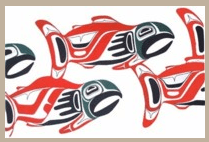
Returning Sockeye

Making the artistic connections

Even then, for years art was more a hobby than anything else. Heron know no artists, but he received encouragement from Victoria gallery directors such as John Black and Elaine Monds. “I would take my early paintings down to Elaine or John Black, and get criticisms on them and come back and produce something else.”

At the time, Monds’ Alcheringa Gallery was displaying the works of master carver Dempsey Bob and his star pupils Stan Bevan and Ken McNeil, although most of them sold quickly. Heron also remembers visiting Vancouver to see the Inuit Gallery.

“But what really did it for me was a book that Dempsey Bob had produced with the Grace Gallery called Dempsey Bob Tahltan Tlingit – Carver of the Wolf Clan. It was this little catalog, way out of print now – I don’t know if you could even find it. There was a picture of a wolf forehead mask, and I had never seen anything like it. It was distinctly Dempsey Bob’s style – it was brilliant. And I just went, ‘Wow! That’s exactly what I want to be doing’ – although at that time I didn’t really know how I was going to do it.”

Moon Mask

Then, somehow, “it all just sort of fell into place for me.” A few weeks after his family moved into a house in Victoria, he met Dempsey Bob’s son and his family at a children’s birthday barbecue. A couple of weeks later, he met Bob himself, “and it changed everything.”

Bob invited Heron to Manawa – Pacific Heartbeat, an event sponsored by the Spirit Wrestler Gallery in Vancouver featuring Maori and First Nations artists from British Columbia. There, Heron says, “I realized just how rich the culture was, and just how much I’d been missing.” Near the end of the event, Bob mentioned that the Freda Diesing School was about to open at the Terrace campus of Northwest Community College, and invited him to enroll and learn to carve.

Finding roots in the north

Deciding to accept Bob’s offers “was a giant leap of faith for me,” Heron recalls. His children were six and one, and both Heron and his wife had jobs in the provincial Ministry of Health. “But I never looked back. I think it was the best decision I ever made.”

Killer Whale Comb

After Victoria, life in Terrace “was a huge culture shock. We had everything in Victoria. That’s probably what I miss the most – having a good theater and good restaurants to choose from,” Heron says.
However, the adjustments in daily life soon seemed unimportant compared to what Heron was learning about his ancestral culture and art. Suddenly, Heron was being taught by Dempsey Bob, Stan Bevan, and Ken McNeil – three artists he had admired for years.

Today, Heron praises them for their commitment towards art, their professionalism and work ethic, and their dedication. “Although established artists, they are always learning and pushing themselves forward – and thus pushing the art forward,” Heron says. “As well, they share all their knowledge with their students. Dempsey always says, ‘Why wouldn’t I share it? If I did not, we could lose all that we have gained in a generation – it is why I am here.’”

In the new environment, Heron found his relationship to traditional culture and art changing.

“Back when I was working on art on my own, I didn’t know the rules completely. Working with Stan and Ken and Dempsey, the whole idea is that you learn the rules and make them your own. Then, you can star innovating. But you have to work from a base of tradition, which the school does.

“The first eight weeks of school, all we did was draw ovoids and U forms and secondary figures. And they break down the components of the design, so they do wing design one week and they do head designs another week. Then they’ll do feet designs and tail designs, and then you put the pieces together. The first year, there were only seven [students], so it was a really tight group of friends.
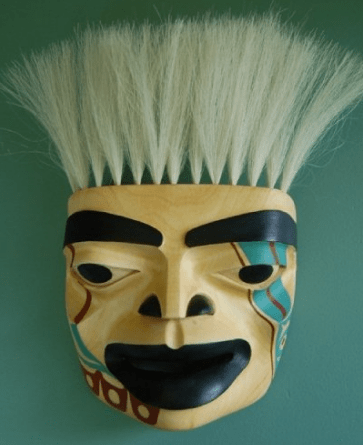
SmallTlingit Portrait Mask

“Another thing that Stan and Dempsey have really convinced me of is [the value of] collecting books. At the time I was working on my own, I was looking at galleries and contemporary works of artists like Robert Davidson, Joe David, and Art Thompson, and I never really gave any validity to the old works that are in museums and collections. That was my mentality – that’s a long time ago, that’s history. But I think everybody’s who’s doing the art and is a professional will look at the old art. [The old artists] are still pertinent today. Their advantage was they lived the art. The art was around them all the time. They used the spoons, they used the bowls, and they saw the regalia all the time.”

The result of this discipline and re-evaluation, according to Heron, is that “I’m starting to realize that there’s a lot more rules involved in creating pieces. You can’t just go out and create a frog headdress without getting permission from chiefs or elders. I’m starting to learn a lot more of those rules, where before I just drew and painted what I wanted without any thought of the culture itself. Now, I’m more careful with what I’m creating.”

Killer Whale Plaque

This new attitude created a crisis of faith when Heron, perhaps motivated by his new sense of traditional culture, looked for his birth family. Although his biological mother declined to contact him, Heron did learn that he was part Kaska, not completely Tlingit, as he had assumed.

“I remember the day I found out, my first thought was, ‘I can’t practice the art. I’m tied to those Kaska roots.’ But I found digging into my family history that there was more of a Tlingit side. So I paint particularly in the Tlingit style.”

Today and Onwards

Now, Heron thinks he might explore the Kaska side of his heritage. “I’m starting to think that as a person I have the right to know where I’m from,” he says. “So I’m looking more into the Kaska side.” In the summer of 2010, he hopes to take his family to Watson Lake for Kaska Days.

However, whether he will explore Kaska art remains uncertain. “It’s much different from the coastal art. A lot of it is beading, and moose antler carving, drumming and singing. I think they were a more nomadic people [than the Tlingit]. There’s not a lot of information out there.”

Meanwhile, Heron is keeping busy. In the fall of 2009, he completed a mural for the Snowboard Pavilion at Cypress Mountain for the Vancouver 2010 Olympic Games. “I’ve had lots of people comment on it, via email and letters,” he says.

Snowboarding Mural, Cypress Mountain

.
In addition, for much of the last year, he has been painting designs for a longhouse on the grounds of the Terrace campus of Northwest Community College. Stan Bevan is doing the formlines, and Heron and student Shawn Aster are doing the secondary elements. Currently, the interior screens are done, and the house front is being completed. The longhouse is scheduled to be completed in early May.
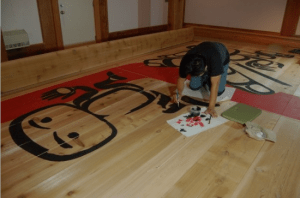
Dean Heron at work in the longhouse

When the longhouse is complete, Heron plans to continue carving his own work. In addition, “I have lots of images that I’d like to get printed.” He would also like to begin doing clothing designs, and learning jewelry-making.

Dedicating himself to art and moving into a community that was strange to him was a huge gamble, but Heron clearly feels that it has paid off for him.

“Growing up, I always felt that I was at the front door, but not right inside – always looking through the window and looking at these sculptures and not understanding the whole of them. I mean, I still don’t. And I think that’s part of the experience of being adopted and being First Nations. I’m at the point now where I’m straddling two different cultures, really. I have a non-first Nations family, so I’m getting an outsider’s point of view, but now I’m living in the community and understanding a lot more of it.”

Read Full Post »

Well, that was unexpected.

Passing through downtown Vancouver yesterday on my last errands until the end of the Winter Olympics, I imagined I’d be affected by the games preparations in any number of ways. Not being a sports fan, I thought I might be offended by the waste. I might flee the crowds and the traffic prepared to be a hermit. I might be angry for the sake of the business owners who had to close down because the traffic restrictions mean that their staff can’t get in and they can’t get deliveries. I might even have been blown away by the spectacle and find myself looking forward to the games after all.

What I didn’t expect was to look around and feel that I had been dipped in tacky excess. Everything I saw was so over the top that it might have been orchestrated by Albert Speer.

The first thing that caught my eye were the banners covering a few of the buildings. Do we really need blowups of athletes six stories high? A Canadian flag ditto, covering most of two sides of a building? Boasts that the corporate owner of a building was an Olympic sponsor? Endless urgings to “Go, Canada, Go?”

Descend to the Skytrain stations, and the excess continued. So far as I can figure, three advertisers had each won the privilege of monopolizing a transit station, and responded by covering as much of their station as possible. At Granville, it was Coca Cola, at Burrard, Macdonald’s, and Acer Computers at Waterfront.

Junk food and cheap computers? How does Vanoc square these with the Olympic ideals of athleticism and excellence? And I wonder who first imagined that repeated the same half dozen ads fifty or sixty times in a confined space was effective advertising, instead of an annoyance.

And everywhere, there were the officials and athletes from out of town, wearing their team uniforms that were not only gaudy but usually with the manufacturers’ names as large as the names of the country. Again, the connection to the Olympics eluded me. The out of towners were so gaudy that they might almost have been wearing Hawaiian shirts.

Yet the out of towners were restrained compared to some of the locals. Well over three-quarters were simply going about their Sunday business, but a minority were as gaudy as the out of towners and jingoistic as well, with Canadian flags flying from their cars and the marquees on their buses giving us a “Countdown to Gold” and urging Canadian athletes on. It was like the hockey playoffs, only on a larger scale.

A two year old might be fascinated by all the bright colors and larger-than-life consumerism, but it’s been a while since I was a child. Surrounded by such general tackiness, I could only complete my errands as fast as possible, and get out of the downtown. Except, perhaps, to see the Aboriginal Pavilion, I don’t plan on coming back until after the Olympics, when the city is back to itself.

Read Full Post »

The first piece an artist does in any medium is frequently a labor of love. The artist has poured all their ability into the piece, and, even if the work is flawed, you can often tell the artist’s quality and interests from it. It was with these thoughts in mind that I jumped at the chance to buy Colin Morrison’s “Naxnox” which, as he wrote on its inside, is his “first mask ever.”

Even so, I was lucky to get it. A picture of the mask sent out in early December received a dozen replies within twenty-four hours, including eight or nine from galleries. This level of interest in an unknown artist’s work, especially at a time of year when sales are difficult, tells you all you need to know about the quality, even if you can’t judge it for yourself. It is a level of interest that, in fact, is almost unheard of.

The design is arresting to the casual eye for a number of reasons, starting with the contrast between the black and red and the thickness of their lines, and continuing with the unpainted nostrils and the ovoid in the middle of the forehead like a supernatural third eye. On the right, the mask looks dark and brooding; on the left, carnal and scowling. The result is a mask with an unusual degree of presence.

In terms of the northern school, the mask is even more interesting because it seems both traditional and contemporary at the same time. On the one hand, the shape of the mask is a standard one in Tsimshian art. The painting across the face without regard for individual features is also common in the northern schools. On the other hand, I have never seen paint applied in such an angular slash across the face to create such an asymmetrical, modern effect. You might almost say that the traditional and contemporary are at war across the mask – a suggestion of conflict that contributes to the strong sense of presence.

This sense of conflict seems especially apt when I remember Morrison’s description of his own background: “I’ve learnt as much as I could about traditional life as I could, but I feel as if I don’t know as much as the elders. I know a little more then the next guy, but not a lot. Most of what I learnt, came from books, my granny, and uncle. I don’t know a lot of my Sm’algyax, but some words I do know. I don’t dance, and don’t sing. I’m getting a Sm’algyax name when we have a feast, but I have been waiting for years for it to happen.”

Traditionally, naxnox was used to refer to the masks and regalia used in ceremonies. In Tsimshian languages like Sm’algyax (Coast Tsimshian), naxnox means “beyond human understanding.” Or, if you prefer, you might translate the word as “supernatural” or “spiritual.” Such works were often concealed when not being used, and, should they not be treated with the proper respect, were capable of extracting revenge.

Obviously, Morrison’s mask is not naxnox in the literal sense, since it is meant to hang on a wall rather than being danced. Yet, metaphorically, the name seems to suit the mask’s presence and its mixture of the traditional and modern.

I wonder: Could the meaning be extended to mean “psychological?” Or, more to the point, could it cover the latent power revealed in a first work? Although I’m not a linguist, I like to think that it could. Because, however you regard it, “Naxnox,” like Morrison’s “The Spirit of the Wolf,” is a work that holds great potential for Morrison’s future career.

Read Full Post »

« Newer Posts - Older Posts »