Feeds:
Posts
Comments

Archive for the ‘indian art’ Category

The Northwest Coast art in our home includes many contemporary pieces. However, I am also fascinated by traditional pieces, particularly recreations of historical masks according to modern sensibilities. That is why, when John Wilson’s “Voices of Our Ancestors” (aka “Portrait Mask”) became available, I jumped at the chance to buy it.

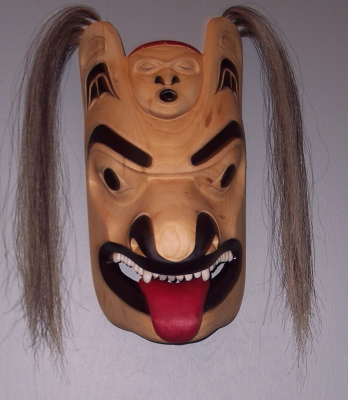
John Wilson, "Spirit of Our Ancestors"

“Voices of Our Ancestors” is based on two historical Haisla masks in J. C. H. King’s “Portrait Masks from the Northwest Coast of America,” a book first published in 1979. It is a mask well worth studying for its own sake, all the more so because examples of Haisla design are relatively rare. When you do see them, you have no trouble placing the Haisla geographically, because their art often seems like a combination of Kwakwaka’wakw and Tsimshian traditions. Nor is Wilson’s mask an exception.

Artists Unknown, Historic Haisla Masks

However, what especially interests me is Wilson’s reinterpretation of the historic masks. To start with, Wilson chooses a less rounded, more northern shape for the mask. This change is accompanied by some changes in proportions, such as a wider space between the lips and nose, and a higher placement of the ears. He has also decided not to include the teeth that are in the originals, and replaced the originals’ rounded eyes with more smaller, more slanted ones. In addition, the cheekbones of Wilson’s mask are far less prominent than in the originals. The result is a less human, more supernatural look – a fitting change, considering that the mask is a work of a modern man looking back on the past.

Another noticeable difference is in the selection of colors. This difference is not just a matter of what was available; one of the older masks actually has a brighter red than the one that Wilson uses. By contrast, even allowing for aging, the historical piece has a more subdued blue than Wilson uses. Wilson also accents the red by drawing thicker formlines, and using it in places where the historical piece uses blue.

Wilson has followed the general designs of the original, including the stylized mustache and goatee, but almost always he has put his own interpretation on them. For instance, he has taken the rows of parallel lines just visible on the colored original, and added them as a design element below the nose, replacing the rather uninspired blobs of cross-hatching, and perhaps suggesting mustache stubble.

However, the largest difference between Wilson’s mask and its inspiration is in the form lines. Although formline influence is obvious in the originals, Wilson’s formlines are more disciplined, with more variation in thickness and more balance. For instance, where the formlines on the forehead in the original meets above the left eye, Wilson’s meet between the eyes. Similarly, where the original has formlines meet on on the cheeks, Wilson’s meet at the nostril.

Probably the most obvious difference in the design is on the cheeks, where the formline helps to replace the cross-hatching, and the blue u-shapes are greatly reduced in size. Even more importantly, the red formline that follows the line of the cheek curves upwards rather than downwards as in the original, doing more than any single element to make the modern mask less human and more arresting than the originals.

“Spirit of Our Ancestors” is obviously influenced by the sources that Wilson acknowledges, but clearly it is more than imitation, or an unthinking copying of a classical piece. Wilson’s mask is more balanced piece of work than either of the originals, with a stronger northern influence as well. Although somewhat of a new direction for Wilson, it more than succeeds on its own terms. Wilson has not simply copied, but repeatedly improved as well.

Read Full Post »

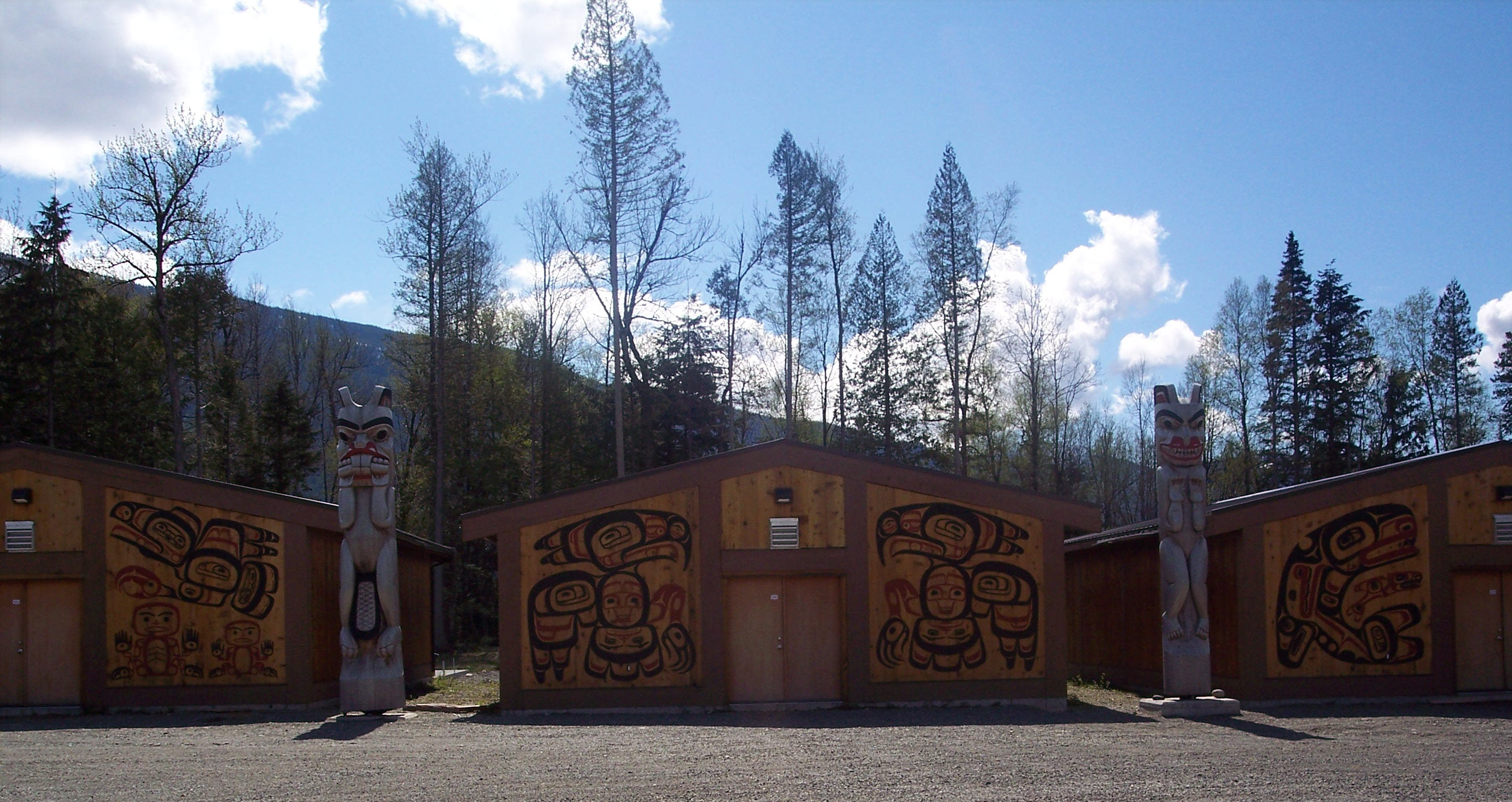
A couple of weeks ago when I was in Terrace, Dean Heron drove me the fifteen kilometers northeast to the Kitselas Canyon National Historic Site. We left the highway, bounced up a gravel road through some second growth forest to a gate and, after opening it, descended to the top of the site.

I’ve been hearing about construction on the site for a couple of years and the work that teachers, students, and graduates of the Freda Diesing School of Northwest Coast Art had been doing there, but nothing really prepared me for the site or the scope of the effort. The top of the site was dominated by a nearby mountain, so dramatically close that I could never quite keep it out of my glance, or resist looking up at it (or be unaware of it at my back):

To date, four longhouses have been completed. A fifth is largely complete but unpainted and will eventually display a wolf design, if I remember correctly.

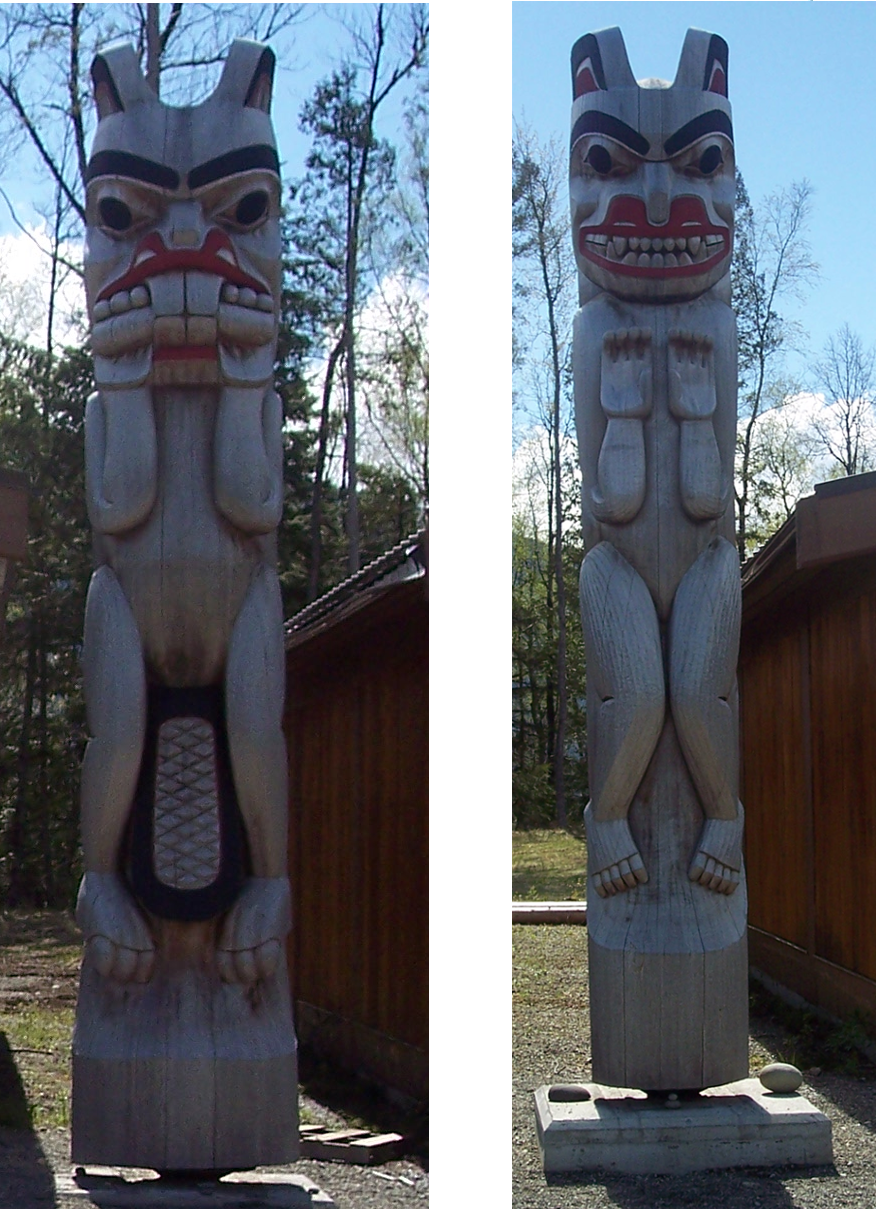
In front of the line of longhouses, are the carved figures of a grizzly bear and a beaver:

Each of the longhouses, Heron explained to me, would become the showcase for a different aspect of the local Tsimshian culture. About a hundred meters across the gravel was the future gift shop and the washroom.

However, the current buildings were just the start of the plans. Eventually, part of the leveled gravel will become a ground for dances and ceremonies. And, behind the gift house, a path lead down to the archaeological site where the original village had been located. I would have liked to descend to the site, where an interpretive center was being built, but Heron was unsure of his right to go there. He had a key to the gate, and having worked on the top of the site, had no hesitation about going there, but the archaeological site was another matter – perhaps because he was not a member of the Kitselas First Nation.

Nor could we enter any of the longhouses, because alarms had been added recently to them. Naturally, I was disappointed, but I was glad that some pre-cautions were being taken, because apparently one of the longhouses had already been broken into. In fact, considering some of the art work there, I can see a day coming when the site has security staff around the clock.

Still, even without seeing everything, I was impressed, both by what had been done and what I imagined the finished result would be. Between the magnificence of the setting and the carvings by Dempsey Bob, Stan Bevan, and their current and ex-pupils, Kitselas Canyon has every chance of being the cultural and tourist landmark it is intended to become. Personally, I can’t wait to see what it should become in a few years — and I’m grateful to Dean for the preview.

Read Full Post »

I have read about and seen something of the culture of the Haida, Tsimshian, Nisga’a and other First Nations of the northern British Columbia coast. However, I know little about the Nuxalk of the central coast beyond the fact that the nation prefers not to be referred to as the Bella Coola, as they once were. For that reason, when Latham Mack, one of this years’ graduates of the Freda Diesing School danced a Nuxalk mask, I was an attentive member of the audience.

I am used to thinking of Latham Mack, who twice won the YVR Art Foundation scholarship, as a designer more than a carver. Certainly, he has done far more designs than masks to this point, including a limited edition print. However, as part of his final work in the Freda Diesing program, Mack finished two Thunder masks, a blue one for the year end exhibit and the upcoming  show at the Spirit Wrestler gallery, and a black one that he has announced that he will keep in his private collection.

Both masks reflect the story of the four brothers who saw a dancing figure on the mountain who created the thunder – an important story in the Nuxalk tradition. The hooked nose and flaring nostrils are a traditional part of the figure’s depiction.The small branches attached to the head, presumably to suggest lightning, are also traditional, although Mack’s mask makes greater use of them than several others that I’ve seen pictures of. This tradition, as Mack emphasized to me, is separate from the Thunderbird of the Kwakwaka’wakw or other First Nations, with the central figure representing the spirit of the storm.

Latham Mack tells me, “Two major dance rituals make up our winter dance ceremonies, the Sisaok (ancestral family dances) and the Kusiut (secret society ceremonies). The Thunder dance is performed by members of the Kusiut society. According to Bella Coola belief, the supernatural ones in the upper land resemble human beings in performing Kusiut dances. Corresponding to the prowess of his patron, the dance of his human protégé is one of the most important Kusiut rituals. Only the strongest of course danced the Thunder because of the movements and physical fitness you had to be in to actually dance it. Only the families who owned the story actually danced it, but as the years have gone by, we have lost the identity of those owners. So now it’s basically owned by the whole Nuxalk people.”

Mack goes on to say that, “The dance of Thunder can be performed with four, two or one masked dancers, depending on the prerogative of the protégé. When the dance is done with four Thunders, these represent the four brothers in the oral tradition. Numerous dances lead up to the Thunder dance, the Herald introduces the dance of Thunder. He beats his stick on the floor and announces the impending Thunder dance.”

Many dances can lead up to the Thunder dance, but, in this case, the performance was divided into three sections, each introduced and narrated by a member of Mack’s family who also provided a rattle accompaniment.

Since the mask had never been used before, the ceremony began with a blessing of the mask by sprinkling down over it.

Then, before Mack’s actual dance, three female members of his family prepared the area in which he would dance with their own dance. It was a stately dance, done with upraised palms and constant circular steps. The narrator explained that this preparation was a traditional role for women in Nuxalk dances.

Then Mack danced. He wore an apron threaded with loose pieces of wood that he shook for percussion, and wooden clappers on his back.

Frequently, he threw himself down on his knees and climbed to his feet again.

His hands and lower arms made constant flickering gestures, as if to shoo people away, but actually to bestow blessings upon the audience.

It was an energetic dance, enough to scare several young children at the front of the audience, who quickly moved away. He also wore cuffs around his ankles and wrists and the modern innovation of knee pads (which was wise, since he was dancing on a concrete floor, and would have otherwise damaged his knees). It was an obviously exhausting performance, powerful and contrasting sharply with the graceful motions of the women’s dance a few moments before

All too often, those of us who are not directly involved in First Nations culture can forget that the masks that we admire have a ceremonial purpose — or are supposed to have. Mack’s dance was a small reminder of this basic fact, and left me wondering where I could find more about Nuxalk culture.

(Note: Ordinarily, this dance is not photographed, but Latham Mack’s grandfather, Lawrence Mack (Lhulhulhnimut), a chief of the Grizzly clan from the ancestral village of Nusq’lst gave permission for those in attendance to photograph it. He also graciously gave me permission to post the pictures I took on this blog. Needless to say, any mistaken cultural references here are due to my ignorance or to lapses in my memory, and not to his kindness. Should anyone see any mistakes, please let me know so that I can correct them.).

Read Full Post »

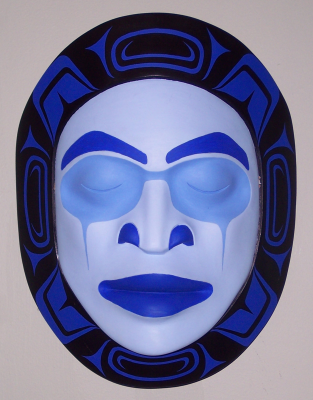
Mitch Adams is an artist I’ve been watching for some time. From the pictures he’s posted on Facebook in the last year, I suspected that it was only a matter of time before I saw one of his works that I wanted to buy. And, sure enough, when I walked into the 2010 Freda Diesing School Student Art Exhibition, his “Blue Moon Mask” immediately caught my eye. I consider it one of the finer examples of contemporary Northwest Coast art that I’ve seen in the last year – an opinion with which some traditionalists strongly disagree.

I am not the only one to think so highly of the mask. I know of at least half a dozen people who would have been happy to buy it, and who wished that it had not been marked as not for sale. Two of those people were frankly envious when I told them that, after I expressed my admiration, Adams decided not to send it to the upcoming Spirit Wrestler show after all, but to sell it to me. One even asked me if I would resell it.

Similarly, when I posted a picture of it in my review of the exhibition, one viewer called it “the most stunning mask I have ever seen.”

To me, such reactions seem perfectly logical for anyone who has troubled to look at the mask. Although “Blue Moon Mask” is covered entirely with paint, the paint is not so thick that you cannot see the smoothness of the carving.If anything, the palest blue on the mask tends to emphasis the plans of the carving, making them into shadows rather than lines.

The careful selection of the shades of blues is equally obvious, from the pale, almost white skin color to the darker blue on the outer rim, and makes the mask seem ever-changing, especially with the tear tracks falling from the eyes. Depending on the light and the angle, the mask can look serene, corpse-like, or even like the heavy makeup of a Goth on Friday night. It is a work that is both accessible and ambiguous at the same time.

Some aspects of the work are traditional. Looking through galleries or museums, you should have no trouble finding other moon masks of the same general shape. Many details are traditional, too, including the eyebrows and nostrils, and the array of U-shapes and ovoids surrounding the face.

Yet the work departs from the northern tradition in at least two key ways. For one thing, in the northern tradition, blue is a third color, used in small amounts if it is present at all. Black and red are the typical colors, with a third being added by the natural color of the wood. A departure from this norm is, by itself, enough to define a work as contemporary.

For another thing, the use of paint on the entire mask is unusual in Adam’s Haida and Tsimshian tradition (although not entirely unheard of, either). The northern tradition tends to be sparing in its use of paint, with designs painted across the mask that ignore the features beneath them. Adams’ decision to paint the entire mask would be more common in the Kwakwaka’wakw tradition, although, even there, his use of different shades of the same color instead of contrasting ones would be more characteristic of modern artists such as Beau Dick or perhaps Simon Dick.

To make these departures is a risk – but I believe it is a necessary one, of the kind needed to keep Northwest Coast art developing and relevant. Nor is it a unique one. Historically, the art form has long been a combination of local conventions meeting industrial societies’ technologies and sensibilities. So-called tradition has long changed and benefited from artists’ discoveries of metal tools, industrially produced paints, and, much later, of power tools. Similarly, the first European influence on subject matter is over a century and a half old, in top-hatted figures on poles and sailing ships on argillite plates. From this perspective, what Adams does in “Blue Moon Mask” is not radical, and should be easy to appreciate.

Yet, sadly, a minority noticed “Blue Moon Mask”’s departure from strict tradition and could not get past it. I am told that one teacher reacted strongly to it, and that another one joked about it. Even worse, some students, seeing the teachers’ reactions, immediately imitated them rather than using their own eyes.

These reactions strike me as both unfortunate and short-sighted. The basis of Northwest Coast art will always be the traditional work. If nothing else, the contemporary needs the traditional to react against.

Yet I do not see why admiration for the traditional must include a rejection of everything contemporary. True, you may prefer one over the other, or prefer one in your own work. But what you like and what is done well are by no means synonymous. Nor does preferring one require that you condemn the other.

Personally, I refuse to take sides. “Blue Moon Mask” is a technically skilled piece, and amidst our collection of traditional works by artists like Norman Tait or Richard Hunt and of contemporary pieces by artists like Alano Edzerza or Ron Telek, it claims a place on our wall on its own merits. It’s a piece that I consider myself lucky to live with, and I’m proud to have our keeping.

Read Full Post »

This was only the second year that I attended the Freda Diesing School’s year end exhibition, but the show has become a must-see for me. For one thing, it is one of the largest exhibitions of Northwest Coast art in any given year. For another, I never know what I might find, either because a student is unknown, or has taken a giant leap forward in their understanding of their art.

The 2010 show was slightly smaller than the previous year’s, and emphasized carving more than design, although a few limited edition prints and drawings were available up in the loft, as well as a sampling of giclee prints by second year student Mitch Adams. But in compensation, the level of carving was higher than last year, probably because, instead of specifying that each student submit three pieces to the show, the teachers urged students to focus on producing their best work, and starting it early (even so, there were many groans about last minute all-night sessions).

Close to the door were masks by people whose work I have bought in the past. John Wilson contributed his hawk woman mask to the show, which I had seen pictures of, but was glad to see in person:

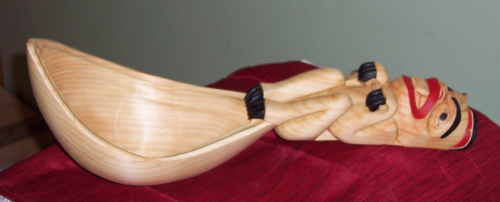
Wilson also contributed a large spoon, whose beaver handle included more detail work than I had seen before in his work:

Besides Wilson’s mask hung Colin Morrison’s second mask, whose red design made the wood look like a sun-tan, and contrasted with the white hair he used:

Moving on from Wilson’s and Morrison’s masks, I quickly discovered work from artists I remembered from 2009. Previous YVR award winner Shawn Aster, whose main interest seems to be design rather than carving, contributed a mask whose interest is largely in the painting:

Second year Metis artist Mathew Daratha was one of the more prolific contributors to the show, displaying several masks, such as this one:

Still another second year student, Latham Mack, the two-times recipient of the YVR Award, was allowed to carve in his family’s traditional Nuxalk style, producing a strikingly different Thunder Mask:

Mack also danced a similar mask after the graduation ceremony.

But perhaps the most development among the second year students was shown by Sheldon Dennis, whose carving showed a considerable advance over his work last year, as well as a strong sense of originality:

Female students continue to be a minority at the school, but those enrolled in the first year class this year made a strong showing. Cherish Alexander showed a talent for combining feminine faces with bold designs:

Carol Young, the winner of the first Mature Student Award, showed a similar interest in women’s faces, and added a traditional labret to indicate high status in one of her masks:

Another first year female student, Nina Bolton chose a more traditional shape for her mask, but gave it a strong, contrasting design when she painted it:

Some of the most striking work in the show was created by Chazz Mack, Latham Mack’s cousin. Chaz Mack include two pieces in the show: a small print, and a mask whose painted design shows a strong sense of line in its curves:

However, if the show had a single outstanding piece, it was Mitch Adams’ “Blue Moon Mask.” The piece was the despair of at least one of the school’s teachers, all of whom work in the northern style and favor masks with much less paint than “Blue Moon Mask,” but its clean lines and carefully selected palette made it a crowd favorite, with at least half a dozen people clamoring to buy it:

When Adams agreed to sell it to me, several other would-be buyers frankly expressed their jealousy, and cursed their lack of initiative; apparently, I was the only one who actually asked Adams if he was firm about the Not For Sale label.

In fact, if the show had a fault, it was that most of the best pieces were labeled as not for sale for one reason or the other. If I had had my way, I could have returned home with another three or four pieces from this years’ show.

However, that’s a selfish wish. Many of the pieces marked as not for sale were reserved for the upcoming Northern Exposure show at Vancouver’s Spirit Wrestler Gallery. For many students, the show is their first chance to display their work to a large audience, so I can hardly blame them for withholding their work from sale. All of them thoroughly deserve that chance, and I hope that I will have many chances in the future to buy their work.

Read Full Post »

The more I learn about Northwest Coast art, the more the term “totem pole” bothers me. For years, I’ve been looking for a better term, and now I think I’ve found a couple.

“Totem pole” bothers me for two reasons. To start with, despite what the Europeans believed when they reached the northwest coast of North America, the artifacts that the term refers to are not totems. A totem is a supernatural guardian of a group of people, often their mythological ancestor – a minor deity comparable to the local spirits of the ancient Greeks. However, so-called totem poles classically did not depict totems, but hereditary crests and the occasional allusion to both historical and mythical accounts of the family that uses the crest.

In other words, when the European settlers destroyed the artifacts in the belief that they were destroying false gods, what they were really doing was the equivalent of smashing and defacing the coats of arms depicted on government buildings and the houses of the rich in Europe.

In addition, the popular term has also given rise the idiomatic expression “low man on the totem pole.” This expression suggests that the most important figures were always at the top, when, in reality, no such convention in Northwest cultures. In fact, in some cultures, such as the Tsimshian, the most important figure was placed on the bottom, and figures of secondary importance at the top, according to master carver Henry Green.

You could use “crest pole” instead, as I have occasionally seen. But the trouble is, I also object to the word “pole.” True, “pole” is technically accurate, being a word that describes a round object made of wood, and it is often used today in place of “totem pole.” However, it greatly understates the magnificence of many of the artifacts to which it is applied. You might as well call the Arc de Triomphe a gateway or a slab.

My first hint of an alternative came when Henry Green referred to a pole he is doing using the Sm’algyax (Coast Tsimshian) word “pts’aan.” Seeing this word was a bit of a revelation, because I realized that I had never heard the word in any First Nations language for a pole. It seems to me that, if we are starting to use the original name of cities and countries, pronouncing the capital of France as “Paree” instead of “Paris” and using “Suomi” instead of “Finland,” then we might also consider using the proper names for important cultural institutions and artifacts.

Apparently, though, “pts’aan” has an even more exact meaning. According to Green, it refers specifically to a pole that is hollowed out and flattened at the back. By contrast, a pole that is left fully rounded is a “k’an.”

Seeing these words, I asked Green what he might suggest for an English translation (assuming that we need one). He emailed back, referring to both a pts’aan and a k’an as columns. Perhaps you could call a pts’aan a half-column and a k’an a column in English? If other Northwest Coast cultures have additional terms, then “column” could be further qualified as needed.

This change of terms, I think, could have a powerful effect on how the Northwest Coast cultures are regarded. Regardless of whether you refer to a totem pole, a crest pole, or just a pole, a pole sounds like a simple, utilitarian object. A pole, after all, is something you use for fishing, or to hang a light from.

However, call a pts’aan or k’an a column, and you are making it the equal of Trajan’s Column or Nelson’s Column. Suddenly, by using “column” instead of “pole,” you realize that you are talking about an object of major importance to its culture – something that required considerable effort and artistic skill to create, and celebrates something important. You are forced to confront the fact that the cultures that made such things are not primitive (assuming that this word actually refers to anything these days), but as complex and as rich as any in Europe. Just by changing the word, your entire perspective changes.

Probably, “totem pole” is too entrenched to be replaced easily. However, I am seriously thinking of trying to promote the use of “column” as a replacement. It simply seems more accurate and precise.

Read Full Post »

Yesterday in a local gallery, I saw a Northwest Coast mask selling for $22,000. The price surprised me, because, ordinarily, only a recognized master could ask this sort of price. However, the carver was an artist I would characterize as an experienced journeyman – someone known for his skill an with a growing celebrity, but lacking the years and a sufficient body of work to be considered a master.

Tentatively and politely, I suggested to a gallery employee that the mask was over-priced. I was told that the carver had originally planned on asking for even more.

This was not the first time I have seen artists asking higher prices than their reputation would justify, and it never fails to arouse mixed feelings in me.

On the one hand, an artist’s ability to command a price is not tied absolutely to their reputation. If an artist can find someone to buy at what I consider an inflated price, then in the most basic sense, that is all the justification the price.

Moreover, why shouldn’t artists get the best price they can? The typical Northwest Coast artist starts by selling so cheaply that the price hardly repays the price of their labor. Part of me argues that, after years of underselling their work to keep the gallery system going, artists deserve a little bit of compensation later in their careers (although, personally, I’d like to see fairer prices for newer artists).

On the other hand, the hierarchy of prices is well-established for Northwest Coast masks. New artists’ work usually sells for less than $1500, usually with 40-60% of the retail price going to the artist. As artists become better known, their prices gradually rise, although the size of a mask and its finishing details can also affect the price. When their prices hit about $4000 for an average-sized mask, you know that the artists are starting to be respected. When the prices rise to $6,000-$8000, you know you are dealing with well-respected artists. Over $10,000, and the artists are recognized as masters. At prices above $20,000, artists have international reputations like those of Bill Reid or Robert Davidson.

Exceptions exist to this rough outline – for instance, as acknowledged masters, both Beau Dick and Henry Green could increase their prices by fifty percent or more and probably still sell. However, this hierarchy is the norm, and recognized by most Northwest Coast artists.

To go outside this pricing scale is dangerous for an artist. Prices that are set too high can condemn an artists’ work to gathering dust in the gallery. But, just as importantly, when artists set their prices higher than their status, it seems to me a form of boasting. For instance, the mask I saw yesterday seems to proclaim that the artist considers himself the equal of all the great names in Northwest Coast art – to which I can only answer that he might be some day, but he isn’t yet. The mask was certainly skilled, but it was hardly outstanding, either. I have seen (and bought) masks at a fraction of the price that I considered better works of art.

Possibly, I’m showing a middle-class crassness with these reactions. At the best of times, I find a system in which even mediocre works by a major artist are worth more than an outstanding work by an unknown artist. But I do know that I would feel foolish buying a piece at an inflated price. Even if I could afford such prices, I would feel in the back of my mind that I had been conned, and that would diminish my enjoyment of the art.

So maybe it’s just as well that the price I saw yesterday was beyond what I could afford, and that I wasn’t overwhelmed by the mask. In this case, the question of putting my money where my ambivalence is doesn’t arise. But I wonder what I would do if I see a similarly over-priced piece that I really would like about the house.

Read Full Post »

Finishing details, a carver once remarked to me, are what makes a mask. Our latest acquisition, Ron Telek’s “Coming of the Winter Storm” is a perfect illustration of this basic truth.

Stripped to the basics, the mask is a standard Telek face. The nose, with its short length and separate cups for each nostril, is visible on any number of Telek’s previous works. So are the lines of the cheek, the even width of the lips, and the broad forehead. The eyes are somewhat unusual, since each wraps around two sides of the face, but not their shape. All in all, the basic face is so characteristic of Telek’s work that it could have been roughed out by an apprentice (and by some accounts, it might have been).

However, what makes this piece are the finishing details. For example, the hands raised to the face suggest the depiction of the winds on old European maps. Yet, if you look closely, you see that they are much smaller than the size of the face would make you expect. Either the wind spirit is a dwarf like the Bukwus, or its proportions are altogether non-human.

Then there is the paint. Like his uncle Norman Tait, Telek does not often use color, and, in the few instances I’ve seen where he does, the color is not especially subtle. But on “Coming of the Winter Storm,” Telek manages a delicate blending of red and blue to suggest cold and chafed skin that is completely unexpected. When I say that the blending is worthy of Beau Dick or Simon Dick, followers of Northwest Coast art should understand how subtle it is.

But of course the most striking feature of the mask is its hair and eyebrows. The difference in their color is a master-stroke by itself, emphasizing the non-humanity of the spirit. The same is true of the unusual angles of the hair, and the length and angles of the brows. The fact that the hair and brow are formed by four dozen separate plugs shows a patient attention to detail.

Another point I might have missed if we didn’t already own four pieces by Telek is the finishing. Almost all of Telek’s wood sculptures are sanded so smooth they might be ivory, with a careful consideration of how the grain might enhance the work. Here, though, Telek has left parts chipped and rough – largely where the daubs of red appear. It is a detail that seems much more appropriate to this rough figure than Telek’s usual finishing.

This attention to detail uplifts what could have been something ordinary into the extraordinary. Quite literally, it made us decide to postpone redoing the kitchen floor in order to obtain the mask while we could. Now, it sits below the clock, an eye-catching piece from any angle in our living room.

Read Full Post »

Aboriginal artists in British Columbia have been combining traditions for some years now. Preston Singletary, for example, has collaborated with Maori artist Lewis Gardiner, while Terrance Campbell is strongly influenced by the jewelry of the American Southwest. But I admit I was skeptical about the collaborations of Mike Dangeli and Don McIntyre. Maybe the problem was my own ignorance, but I wondered how much artists like Dangeli in the Northwest style and McIntyre in the Woodlands style could exchange, beyond good will.

Don McIntyre (left) and Mike Dangeli (right)

However, in practice, the mingling of traditions works much better than I expected in “East Meets West: Throwing Power,” Dangeli and McIntyre’s combined show currently at the art gallery in the Student Union Building at the University of British Columbia.

The main reason, I suspect, is the obvious closeness of the two artists. Dangeli and McIntyre share studio space and are adoptive brothers. They share such a sympathy that at times, they say, they have trouble remembering who painted which line when they collaborate.

The mixture of their style may be sometimes jarring, but it succeeds because, while both Dangeli and McIntyre show a firm understanding of their respective traditions, they are also concerned with adopting those traditions to contemporary urban life, often with a sense of humor that begins with the titles of their works and continues with their choice of subject matter. Despite the large differences in traditions, this similarity of outlook allows them to meet in the middle, as their paintings do literally in the galley.

If you look at a selection of Dangeli’s work with any knowledge of the northern formline style, it immediately becomes obvious that he is intimately familiar with the tradition. And some of his work does not stray very far from that tradition, apart from the selection of colors.

However, in many of his pieces in this show, Dangeli’s rendering of that tradition is a departure from the norm. In the classical northern tradition, ovoids and U-shapes are rendered as though from a template – in fact, in large scale projects like house-fronts, artists often work from stencils.

Dangeli does work in this tradition. However, just as often – and perhaps increasingly – he favors a looser, hand-drawn rendering of classical shapes – a sketch as opposed to a smoothly finished work. Often, too, he combines shapes in non-classical ways. The result is that, where in his tradition, formlines tend to flow together, dragging the eye through a work, Dangeli’s looser renderings sometimes seem fragmentary and disjointed.

Perhaps the effect is a stylistic commentary on the survival of the northern tradition in industrial urban life. If so, the style is well-suited to Dangeli’s habit of commenting on this lifestyle.

The titles alone indicate his on-going commentary on the modern relations between First Nations people and this lifestyle, for instance, “Bright Shining Lie,” “For Those Who Had to Hide,” and “We Will Not Be Boxed In. Often, the titles are referenced by the techniques in each work, so that “Surviving the White Wash” literally has a wash of white over everything, while “We’re Not Open for Business,” an anti-Olympic statement,” has the shape of a Closed sign.

Don McIntyre’s relation to his tradition closely resembles Dangeli’s. Like Dangeli, McIntyre sometimes produces a piece that fits comfortably within his tradition, as in “A Place to Come Back To.”

"A Place to Come Back To"

Yet even when McIntyre appears to be working in the tradition, first impressions can be deceptive. His apparently innocuous drum (shown above), if you look closely, shows the union of sky and earth as an act of sex, and his title for this depiction of creation is “The Big Bang.”

Yet, where many Woodlands artists continue to depict natural scenes that have little in common with the cities in which they live, McIntyre tries to advance his school of painting by transferring its traditions to what he sees around him.

At times, the difference is subtle. As he pointed out to me at the exhibit’s opening, “Natural Urbanity” could easily be a classical work, if the streetlights were replaced by trees. At other times, as in “New Counsel,” nature creeps into the cityscape only in small oases, like the log that the birds in the canvas cling to.

"Natural Urbanity"

"New Counsel"

And, as in Dangeli’s work, McIntyre often turns his extension of his tradition into social commentary. In “(Dis) Placed Illusions,” for example, McIntyre combines an inukshuk, the symbol of the Vancouver 2010 Olympic Winter Games, with a sleeping polar bear, drawing a line between cultural appropriation and global warming .

"(Dis) Placed Illusions"

Combined with their friendship, such similarities make Dangeli and McIntyre’s collaborations exactly what collaborations should be: not just a juxtaposition, but something that neither could achieve by themselves.

For me, the most successful of the several collaborations on display was “Ben Couver: Olympic Gluttony.” The central figure, with its extended belly, fits in well with McIntyre’s style, in a way that it would not into Dangeli’s.

Yet, at the same time, Dangeli’s image of broken coppers being thrown into the water adds its own dimension. Moreover, the combination of Dangeli’s self-consuming two-headed serpent and McIntyre’s Wendigo provide two complementary images of destruction.

“East Meets West” is a small show, but it is an ambitious one. To its credit, though, it convincingly draws parallels between the two traditions in the show, and produces intriguing art in the process. While the gallery may be obscure for many people, it is well worth searching out just to see this show.

Read Full Post »

For many modern Northwest Coast artists, improving their skills means discovering their culture. Kaska/Tlingit artist Dean Heron is no different, except that he came to his art and culture later than most of his peers – and, that, in pursuit of both, last year he moved north to Terrace, instead of staying in the south where many NorthWest Coast artists now spend at least part of the year.

“I was adopted as a child,” Dean explains, “and grew up in a non-First Nations family,” mostly in Whitehorse, Kitimat, and Powell River. “I had grandparents who lived in Victoria, so we’d often go down to Victoria in the summer time. My parents always used to drag me to the Royal British Columbian Museum to look into my culture, but at that point I was six or seven, and I was more interested in riding my bike, playing street hockey – being a kid.”

Creating the Watchmen

Then, when Heron grew up, he worked as an assistant manager at a Milestones restaurant, and later in the IT department of the British Columbia Ministry of Health in Victoria.

Heron did have a general interest in art of all sorts, and he remembers a two-week survey of First Nations art when he was in Grade Seven in Kitimat. However, it was only after he met his wife Therese that his interest in his ancestral culture and art began to take shape.

“She was very inquisitive, always asking me questions about Tlingit culture,” Heron recalls. “We’d go down to the Royal BC Museum and she’d ask me all sorts of questions. And I was just blank. I didn’t really have any idea.”

Then, one Christmas in the early 1990s, when they were both students and short of money, Heron was pondering how he could give presents. “I had no idea. So Therese said, ‘Why don’t you create something?’ I think I laughed out loud, actually. I didn’t think I had an artistic bone in my body. But she went out and bought a book on First Nations art, and that was the beginning.”
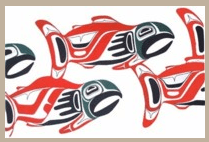
Returning Sockeye

Making the artistic connections

Even then, for years art was more a hobby than anything else. Heron know no artists, but he received encouragement from Victoria gallery directors such as John Black and Elaine Monds. “I would take my early paintings down to Elaine or John Black, and get criticisms on them and come back and produce something else.”

At the time, Monds’ Alcheringa Gallery was displaying the works of master carver Dempsey Bob and his star pupils Stan Bevan and Ken McNeil, although most of them sold quickly. Heron also remembers visiting Vancouver to see the Inuit Gallery.

“But what really did it for me was a book that Dempsey Bob had produced with the Grace Gallery called Dempsey Bob Tahltan Tlingit – Carver of the Wolf Clan. It was this little catalog, way out of print now – I don’t know if you could even find it. There was a picture of a wolf forehead mask, and I had never seen anything like it. It was distinctly Dempsey Bob’s style – it was brilliant. And I just went, ‘Wow! That’s exactly what I want to be doing’ – although at that time I didn’t really know how I was going to do it.”

Moon Mask

Then, somehow, “it all just sort of fell into place for me.” A few weeks after his family moved into a house in Victoria, he met Dempsey Bob’s son and his family at a children’s birthday barbecue. A couple of weeks later, he met Bob himself, “and it changed everything.”

Bob invited Heron to Manawa – Pacific Heartbeat, an event sponsored by the Spirit Wrestler Gallery in Vancouver featuring Maori and First Nations artists from British Columbia. There, Heron says, “I realized just how rich the culture was, and just how much I’d been missing.” Near the end of the event, Bob mentioned that the Freda Diesing School was about to open at the Terrace campus of Northwest Community College, and invited him to enroll and learn to carve.

Finding roots in the north

Deciding to accept Bob’s offers “was a giant leap of faith for me,” Heron recalls. His children were six and one, and both Heron and his wife had jobs in the provincial Ministry of Health. “But I never looked back. I think it was the best decision I ever made.”

Killer Whale Comb

After Victoria, life in Terrace “was a huge culture shock. We had everything in Victoria. That’s probably what I miss the most – having a good theater and good restaurants to choose from,” Heron says.
However, the adjustments in daily life soon seemed unimportant compared to what Heron was learning about his ancestral culture and art. Suddenly, Heron was being taught by Dempsey Bob, Stan Bevan, and Ken McNeil – three artists he had admired for years.

Today, Heron praises them for their commitment towards art, their professionalism and work ethic, and their dedication. “Although established artists, they are always learning and pushing themselves forward – and thus pushing the art forward,” Heron says. “As well, they share all their knowledge with their students. Dempsey always says, ‘Why wouldn’t I share it? If I did not, we could lose all that we have gained in a generation – it is why I am here.’”

In the new environment, Heron found his relationship to traditional culture and art changing.

“Back when I was working on art on my own, I didn’t know the rules completely. Working with Stan and Ken and Dempsey, the whole idea is that you learn the rules and make them your own. Then, you can star innovating. But you have to work from a base of tradition, which the school does.

“The first eight weeks of school, all we did was draw ovoids and U forms and secondary figures. And they break down the components of the design, so they do wing design one week and they do head designs another week. Then they’ll do feet designs and tail designs, and then you put the pieces together. The first year, there were only seven [students], so it was a really tight group of friends.
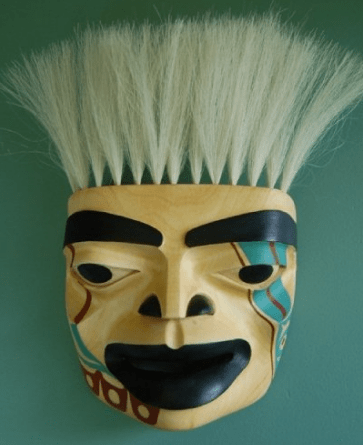
SmallTlingit Portrait Mask

“Another thing that Stan and Dempsey have really convinced me of is [the value of] collecting books. At the time I was working on my own, I was looking at galleries and contemporary works of artists like Robert Davidson, Joe David, and Art Thompson, and I never really gave any validity to the old works that are in museums and collections. That was my mentality – that’s a long time ago, that’s history. But I think everybody’s who’s doing the art and is a professional will look at the old art. [The old artists] are still pertinent today. Their advantage was they lived the art. The art was around them all the time. They used the spoons, they used the bowls, and they saw the regalia all the time.”

The result of this discipline and re-evaluation, according to Heron, is that “I’m starting to realize that there’s a lot more rules involved in creating pieces. You can’t just go out and create a frog headdress without getting permission from chiefs or elders. I’m starting to learn a lot more of those rules, where before I just drew and painted what I wanted without any thought of the culture itself. Now, I’m more careful with what I’m creating.”

Killer Whale Plaque

This new attitude created a crisis of faith when Heron, perhaps motivated by his new sense of traditional culture, looked for his birth family. Although his biological mother declined to contact him, Heron did learn that he was part Kaska, not completely Tlingit, as he had assumed.

“I remember the day I found out, my first thought was, ‘I can’t practice the art. I’m tied to those Kaska roots.’ But I found digging into my family history that there was more of a Tlingit side. So I paint particularly in the Tlingit style.”

Today and Onwards

Now, Heron thinks he might explore the Kaska side of his heritage. “I’m starting to think that as a person I have the right to know where I’m from,” he says. “So I’m looking more into the Kaska side.” In the summer of 2010, he hopes to take his family to Watson Lake for Kaska Days.

However, whether he will explore Kaska art remains uncertain. “It’s much different from the coastal art. A lot of it is beading, and moose antler carving, drumming and singing. I think they were a more nomadic people [than the Tlingit]. There’s not a lot of information out there.”

Meanwhile, Heron is keeping busy. In the fall of 2009, he completed a mural for the Snowboard Pavilion at Cypress Mountain for the Vancouver 2010 Olympic Games. “I’ve had lots of people comment on it, via email and letters,” he says.

Snowboarding Mural, Cypress Mountain

.
In addition, for much of the last year, he has been painting designs for a longhouse on the grounds of the Terrace campus of Northwest Community College. Stan Bevan is doing the formlines, and Heron and student Shawn Aster are doing the secondary elements. Currently, the interior screens are done, and the house front is being completed. The longhouse is scheduled to be completed in early May.
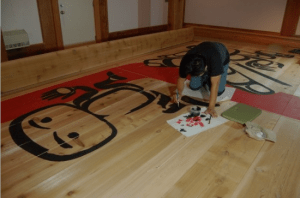
Dean Heron at work in the longhouse

When the longhouse is complete, Heron plans to continue carving his own work. In addition, “I have lots of images that I’d like to get printed.” He would also like to begin doing clothing designs, and learning jewelry-making.

Dedicating himself to art and moving into a community that was strange to him was a huge gamble, but Heron clearly feels that it has paid off for him.

“Growing up, I always felt that I was at the front door, but not right inside – always looking through the window and looking at these sculptures and not understanding the whole of them. I mean, I still don’t. And I think that’s part of the experience of being adopted and being First Nations. I’m at the point now where I’m straddling two different cultures, really. I have a non-first Nations family, so I’m getting an outsider’s point of view, but now I’m living in the community and understanding a lot more of it.”

Read Full Post »

« Newer Posts - Older Posts »