Feeds:
Posts
Comments

Archive for the ‘Personal’ Category

In my adult life, I have been vilified in the worst terms possible. Other times, I have been praised extravagantly and far beyond my worth. Yet I’ve only recently realized that, having endured the extremes, I find that the two tend to cancel each other out, making both of them impossible for me to take seriously.

On the one hand, I have been called just about every name you can imagine. Communist, pervert, paid shill, ignorant, clueless, gay (by people who obviously meant it as an insult) – I’ve not only heard them all, but heard them repeatedly, because the people who use such language often have a strong streak of obsession-compulsion and like to gossip as well. I don’t doubt that, even now, if I were to stray into certain company, I would be treated as an absolute pariah by people who have repeated these names so often that they believe them to be true – and never mind that most of them have never met me or barely knew me at best.

On the other hand, I have also been called humanitarian, intelligent, talented, thought-provoking,influential, a patron of the arts, and more. A few times, I’ve been treated as an honored guest in public, kept entertained and ferried around practically at my whim. Once or twice, people have declared themselves honored to meet me, often on just as limited grounds as I have been repeatedly insulted.

I suppose I could have listened to the abuse until I was unable to hear the compliments. Conversely, I could have left the compliments possess me until I was so conceited that the abuse no longer bothered me. Instead, I realize, something I didn’t expect has happened: The two extremes have canceled each other out, so I take neither very seriously. After all, both portraits of me can hardly be true.

That’s not to say that I can’t be irked by the extremes. I often find myself telling detractors that, while I don’t mind that they disagree with me, I would wish that they disagreed with something I actually said (that’s probably the former English instructor coming out, who has read too many papers in which the argument was based on misreading or taking statements out of context). I am surprised, too, by the venom of some of the abusers, who seem to be able to summon and maintain a level of hate that is entirely beyond my own capabilities.

Similarly, being praised or treated extravagantly does little except embarrass me. The reason isn’t that I lack a healthy ego – simply that I know that the actions of mine that are being praised weren’t particularly altruistic.

Anyway, I would rather have a lively discussion over a drink or two than be singled out. Fortunately, many people quickly sense that preference, yet, all the same, I understand now what I understood imperfectly in the days when I used to attend science fiction conventions: when guests of honor hang out together, they’re not being snobbish; I suspect that they’re simply hiding in the company of people who will treat them as equals. Most people have a very low tolerance for being lionized.

However, on a basic level, both extremes reach me less and less. The contradiction between them is so great that each of them disproves the other. Increasingly, I take the abuse as a sign of ill-will, and compliments or attempts at respect as a sign of well-wishing, and tell myself that a good deal of exaggeration is involved in both.

In the end, both reactions seem to little to do with me. Frequently, the abuse is based on hearsay or words taken out of context – on willful misunderstanding, I could almost believe – so it seems to be unconnected with my actions. The praise seems equally undeserved, because it assumes a nobility of motives when really I only acted or spoke out of interest or idleness.

Either way, how can I take the reactions seriously? I can never believe that either makes more than a passing reference to reality as I experience it.

Read Full Post »

A couple of weeks ago when I was in Terrace, Dean Heron drove me the fifteen kilometers northeast to the Kitselas Canyon National Historic Site. We left the highway, bounced up a gravel road through some second growth forest to a gate and, after opening it, descended to the top of the site.

I’ve been hearing about construction on the site for a couple of years and the work that teachers, students, and graduates of the Freda Diesing School of Northwest Coast Art had been doing there, but nothing really prepared me for the site or the scope of the effort. The top of the site was dominated by a nearby mountain, so dramatically close that I could never quite keep it out of my glance, or resist looking up at it (or be unaware of it at my back):

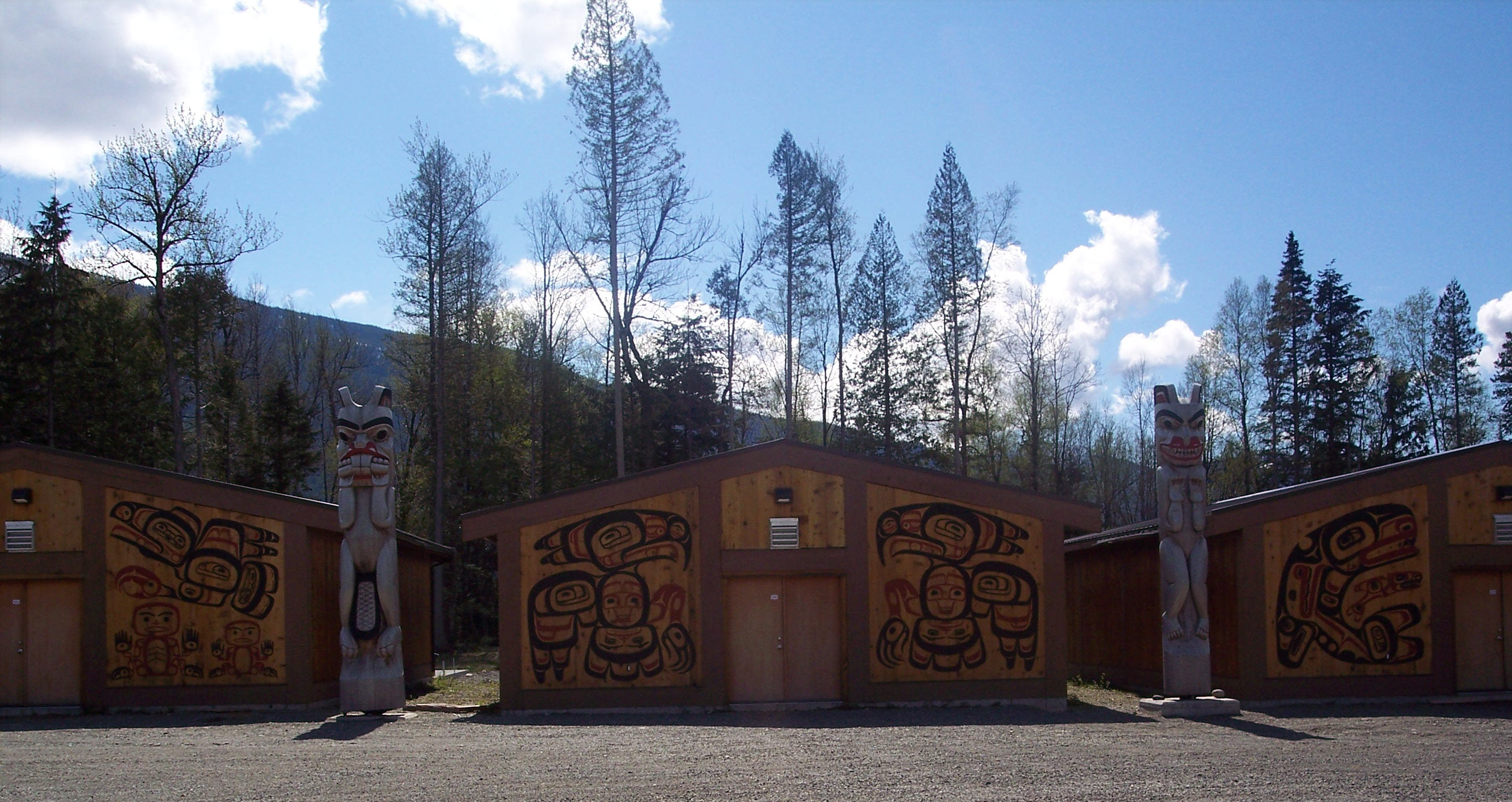
To date, four longhouses have been completed. A fifth is largely complete but unpainted and will eventually display a wolf design, if I remember correctly.

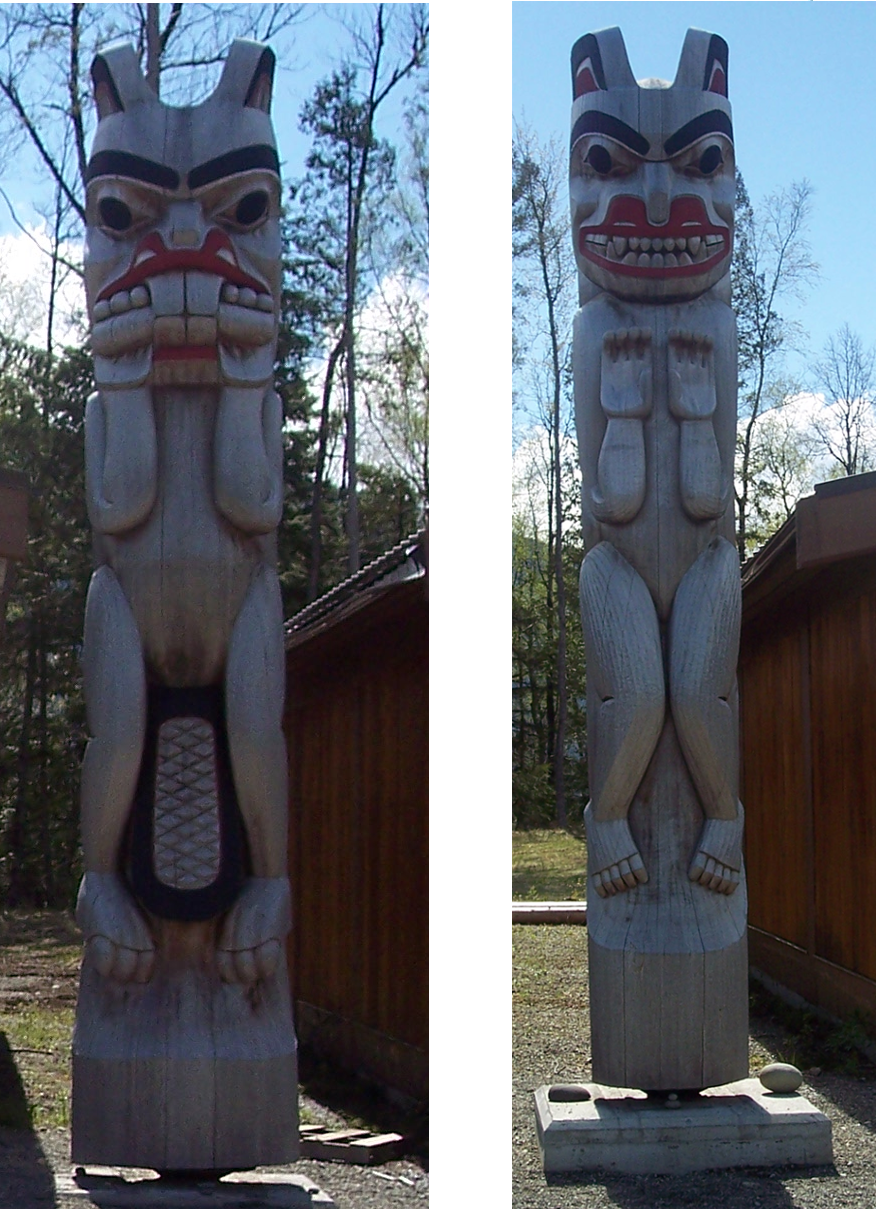
In front of the line of longhouses, are the carved figures of a grizzly bear and a beaver:

Each of the longhouses, Heron explained to me, would become the showcase for a different aspect of the local Tsimshian culture. About a hundred meters across the gravel was the future gift shop and the washroom.

However, the current buildings were just the start of the plans. Eventually, part of the leveled gravel will become a ground for dances and ceremonies. And, behind the gift house, a path lead down to the archaeological site where the original village had been located. I would have liked to descend to the site, where an interpretive center was being built, but Heron was unsure of his right to go there. He had a key to the gate, and having worked on the top of the site, had no hesitation about going there, but the archaeological site was another matter – perhaps because he was not a member of the Kitselas First Nation.

Nor could we enter any of the longhouses, because alarms had been added recently to them. Naturally, I was disappointed, but I was glad that some pre-cautions were being taken, because apparently one of the longhouses had already been broken into. In fact, considering some of the art work there, I can see a day coming when the site has security staff around the clock.

Still, even without seeing everything, I was impressed, both by what had been done and what I imagined the finished result would be. Between the magnificence of the setting and the carvings by Dempsey Bob, Stan Bevan, and their current and ex-pupils, Kitselas Canyon has every chance of being the cultural and tourist landmark it is intended to become. Personally, I can’t wait to see what it should become in a few years — and I’m grateful to Dean for the preview.

Read Full Post »

I have read about and seen something of the culture of the Haida, Tsimshian, Nisga’a and other First Nations of the northern British Columbia coast. However, I know little about the Nuxalk of the central coast beyond the fact that the nation prefers not to be referred to as the Bella Coola, as they once were. For that reason, when Latham Mack, one of this years’ graduates of the Freda Diesing School danced a Nuxalk mask, I was an attentive member of the audience.

I am used to thinking of Latham Mack, who twice won the YVR Art Foundation scholarship, as a designer more than a carver. Certainly, he has done far more designs than masks to this point, including a limited edition print. However, as part of his final work in the Freda Diesing program, Mack finished two Thunder masks, a blue one for the year end exhibit and the upcoming  show at the Spirit Wrestler gallery, and a black one that he has announced that he will keep in his private collection.

Both masks reflect the story of the four brothers who saw a dancing figure on the mountain who created the thunder – an important story in the Nuxalk tradition. The hooked nose and flaring nostrils are a traditional part of the figure’s depiction.The small branches attached to the head, presumably to suggest lightning, are also traditional, although Mack’s mask makes greater use of them than several others that I’ve seen pictures of. This tradition, as Mack emphasized to me, is separate from the Thunderbird of the Kwakwaka’wakw or other First Nations, with the central figure representing the spirit of the storm.

Latham Mack tells me, “Two major dance rituals make up our winter dance ceremonies, the Sisaok (ancestral family dances) and the Kusiut (secret society ceremonies). The Thunder dance is performed by members of the Kusiut society. According to Bella Coola belief, the supernatural ones in the upper land resemble human beings in performing Kusiut dances. Corresponding to the prowess of his patron, the dance of his human protégé is one of the most important Kusiut rituals. Only the strongest of course danced the Thunder because of the movements and physical fitness you had to be in to actually dance it. Only the families who owned the story actually danced it, but as the years have gone by, we have lost the identity of those owners. So now it’s basically owned by the whole Nuxalk people.”

Mack goes on to say that, “The dance of Thunder can be performed with four, two or one masked dancers, depending on the prerogative of the protégé. When the dance is done with four Thunders, these represent the four brothers in the oral tradition. Numerous dances lead up to the Thunder dance, the Herald introduces the dance of Thunder. He beats his stick on the floor and announces the impending Thunder dance.”

Many dances can lead up to the Thunder dance, but, in this case, the performance was divided into three sections, each introduced and narrated by a member of Mack’s family who also provided a rattle accompaniment.

Since the mask had never been used before, the ceremony began with a blessing of the mask by sprinkling down over it.

Then, before Mack’s actual dance, three female members of his family prepared the area in which he would dance with their own dance. It was a stately dance, done with upraised palms and constant circular steps. The narrator explained that this preparation was a traditional role for women in Nuxalk dances.

Then Mack danced. He wore an apron threaded with loose pieces of wood that he shook for percussion, and wooden clappers on his back.

Frequently, he threw himself down on his knees and climbed to his feet again.

His hands and lower arms made constant flickering gestures, as if to shoo people away, but actually to bestow blessings upon the audience.

It was an energetic dance, enough to scare several young children at the front of the audience, who quickly moved away. He also wore cuffs around his ankles and wrists and the modern innovation of knee pads (which was wise, since he was dancing on a concrete floor, and would have otherwise damaged his knees). It was an obviously exhausting performance, powerful and contrasting sharply with the graceful motions of the women’s dance a few moments before

All too often, those of us who are not directly involved in First Nations culture can forget that the masks that we admire have a ceremonial purpose — or are supposed to have. Mack’s dance was a small reminder of this basic fact, and left me wondering where I could find more about Nuxalk culture.

(Note: Ordinarily, this dance is not photographed, but Latham Mack’s grandfather, Lawrence Mack (Lhulhulhnimut), a chief of the Grizzly clan from the ancestral village of Nusq’lst gave permission for those in attendance to photograph it. He also graciously gave me permission to post the pictures I took on this blog. Needless to say, any mistaken cultural references here are due to my ignorance or to lapses in my memory, and not to his kindness. Should anyone see any mistakes, please let me know so that I can correct them.).

Read Full Post »

Mitch Adams is an artist I’ve been watching for some time. From the pictures he’s posted on Facebook in the last year, I suspected that it was only a matter of time before I saw one of his works that I wanted to buy. And, sure enough, when I walked into the 2010 Freda Diesing School Student Art Exhibition, his “Blue Moon Mask” immediately caught my eye. I consider it one of the finer examples of contemporary Northwest Coast art that I’ve seen in the last year – an opinion with which some traditionalists strongly disagree.

I am not the only one to think so highly of the mask. I know of at least half a dozen people who would have been happy to buy it, and who wished that it had not been marked as not for sale. Two of those people were frankly envious when I told them that, after I expressed my admiration, Adams decided not to send it to the upcoming Spirit Wrestler show after all, but to sell it to me. One even asked me if I would resell it.

Similarly, when I posted a picture of it in my review of the exhibition, one viewer called it “the most stunning mask I have ever seen.”

To me, such reactions seem perfectly logical for anyone who has troubled to look at the mask. Although “Blue Moon Mask” is covered entirely with paint, the paint is not so thick that you cannot see the smoothness of the carving.If anything, the palest blue on the mask tends to emphasis the plans of the carving, making them into shadows rather than lines.

The careful selection of the shades of blues is equally obvious, from the pale, almost white skin color to the darker blue on the outer rim, and makes the mask seem ever-changing, especially with the tear tracks falling from the eyes. Depending on the light and the angle, the mask can look serene, corpse-like, or even like the heavy makeup of a Goth on Friday night. It is a work that is both accessible and ambiguous at the same time.

Some aspects of the work are traditional. Looking through galleries or museums, you should have no trouble finding other moon masks of the same general shape. Many details are traditional, too, including the eyebrows and nostrils, and the array of U-shapes and ovoids surrounding the face.

Yet the work departs from the northern tradition in at least two key ways. For one thing, in the northern tradition, blue is a third color, used in small amounts if it is present at all. Black and red are the typical colors, with a third being added by the natural color of the wood. A departure from this norm is, by itself, enough to define a work as contemporary.

For another thing, the use of paint on the entire mask is unusual in Adam’s Haida and Tsimshian tradition (although not entirely unheard of, either). The northern tradition tends to be sparing in its use of paint, with designs painted across the mask that ignore the features beneath them. Adams’ decision to paint the entire mask would be more common in the Kwakwaka’wakw tradition, although, even there, his use of different shades of the same color instead of contrasting ones would be more characteristic of modern artists such as Beau Dick or perhaps Simon Dick.

To make these departures is a risk – but I believe it is a necessary one, of the kind needed to keep Northwest Coast art developing and relevant. Nor is it a unique one. Historically, the art form has long been a combination of local conventions meeting industrial societies’ technologies and sensibilities. So-called tradition has long changed and benefited from artists’ discoveries of metal tools, industrially produced paints, and, much later, of power tools. Similarly, the first European influence on subject matter is over a century and a half old, in top-hatted figures on poles and sailing ships on argillite plates. From this perspective, what Adams does in “Blue Moon Mask” is not radical, and should be easy to appreciate.

Yet, sadly, a minority noticed “Blue Moon Mask”’s departure from strict tradition and could not get past it. I am told that one teacher reacted strongly to it, and that another one joked about it. Even worse, some students, seeing the teachers’ reactions, immediately imitated them rather than using their own eyes.

These reactions strike me as both unfortunate and short-sighted. The basis of Northwest Coast art will always be the traditional work. If nothing else, the contemporary needs the traditional to react against.

Yet I do not see why admiration for the traditional must include a rejection of everything contemporary. True, you may prefer one over the other, or prefer one in your own work. But what you like and what is done well are by no means synonymous. Nor does preferring one require that you condemn the other.

Personally, I refuse to take sides. “Blue Moon Mask” is a technically skilled piece, and amidst our collection of traditional works by artists like Norman Tait or Richard Hunt and of contemporary pieces by artists like Alano Edzerza or Ron Telek, it claims a place on our wall on its own merits. It’s a piece that I consider myself lucky to live with, and I’m proud to have our keeping.

Read Full Post »

On April 23, I did something I had been waiting to do for ten months: I stood up at the graduation ceremony for the Freda Diesing School of Northwest Coast Art at Northwest Community College in Terrace, and gave out the first Mature Student Award. Trish and I hope it will be the first of many, and I think the award got off to a good start by having Carol Young (Bagshaw) as the first recipient.

A member of the Haida Eagle side, Young did not grow up with traditional culture, but absorbed much of it indirectly from her mother. Later, as a single mother of four, she began selling a variety of handicrafts and art pieces loosely based on Northwest Coast design on eBay. Although she says she never thought of herself as an artist, she sold over a hundred pieces of every description imaginable. Masks, rattles, miniature canoes, and, most of all, Haida-inspired dolls – all of these and more she managed to produce as a way of bringing in extra money.

With her children grown, Young decided to do something for herself, and enrolled in the Freda Diesing School last September. Her teachers and fellow students tell me that at first she seemed to have trouble feeling comfortable in the dorms or the class room, and that learning formline design didn’t come easily to her after years of doing things her way.

However, in the second semester, especially after hearing that she had won the Mature Student Award, Young started to hit her stride. Her design took on a new discipline and maturity as she absorbed what the teachers had been telling her, and she found a place among the other students, most of whom were far younger – although at times, she told me with a smile, she felt that her role was that of den-mother in the dorms.

By the end of the school year, Young had become the speaker for the first year students, announcing them at the graduation ceremony, and appearing with fellow student Sheldon Dennis on a CBC podcast about the school. She also took it on herself to present me with a school cap and T-shirt, and, when I requested one for Trish (who was unable to attend the graduation), gave me hers, claiming that she didn’t wear T-shirts anyway – a kindness that I was grateful for, although I wondered if it was true.

During the podcast, Young said that attending the school had given her “a whole new life.” Previously, I had only contacted her briefly via email, but when I met her during the graduation ceremony and exhibition, she seemed like a person who was happy about the direction she was heading. Not only was she in the middle of preparations and cleanup for the weekend, but she talked about how she hoped she could present a female perspective in her carving, which she felt – despite the name of the school – had been under-represented or explored. She said, too, that she would like to establish an award for women at the school, and would like to teach after she graduated next year.

My impression is that Young is the sort of self-starter who can get where she wants to be under her own power and on her own terms. But I would like to think that the Mature Student Award made her self-development a little easier and quicker than it might otherwise have been.

As the first recipient of the award, she sets a high standard. If next year’s winner is even half as deserving, I will feel that our ongoing involvement in the school through the award has been worthwhile.

Carol Young, First Recipient of the Mature Student Award at the Freda Diesing School of Northwest Coast Art

Read Full Post »

One of the many songs inspired by the Jacobite Rebellion of 1745 is “Little wot ye wha’s coming.” It is little more than a list of the clans that supported Bonnie Prince Charlie, and I’ve heard it sung slowly by Ewan MacColl, and faster and faster by The Corries. Just back from the Freda Diesing School graduation exhibit in Terrace, I’m reminded of the song because I feel as though I’ve spent the last two days meeting people.

Some I knew online but had never met, others by reputation. But let me see if I can generate a list, roughly in order since I arrived at the exhibit at 2PM on Friday:

  • Jill Girodat, the Associate Registrar at Northwest Community College, who helped us set up the Mature Student Award, and is well-known among students in need for her ability to find funding for them. Jill kindly volunteered to show me around the campus.
  • Stephanie Forsyth, Northwest’s president, who saw me taking photographs when I arrived and was puzzled about who I was until I got up to give the Mature Student Award that night, but remained polite.
  • Todd Stephens, a graduate last year from the Freda Diesing, who supervises the carving shed at the George Little House. Last year, we bought his “Jorja and I,” which hangs over my computer desk.
  • Shawn Aster, one of this year’s graduates, who remains a promising artist, both in terms of his ability and in terms of his promise that one day he will finish the painting we’ve discussed.
  • Gayton Nabess, one of the first year students, who showed me a left-handed stone paint pot found on the banks of the Skeena, and pictures of a non-traditional piece he recently completed (which I’m sorry that I never had time to see).
  • Dean Heron, the newest teacher at the Freda Diesing,who kindly gave me a tour of the nearly completed longhouse on the Northwest campus, and drove me out to see the work being done at the Kitselas Canyon project.
  • Ken McNeil, one of the teachers at the school, whose work I have long admired.
  • Stan Bevan, the program coordinator at the school, who let me see not only the four crests for the longhouse, but also his home and work area, and drove me around on Saturday evening. I also appreciate the book he presented me — a reprinting of a transcript of oral tales that were originally recorded almost a century ago. It’s the sort of genuine record of First Nations culture I’m always looking for, but rarely find.
  • Rocque Berthiaume, who teaches art history at the school, whom I’ve heard praised by many students but whom I had never previously met.
  • Carol Young Bagshaw, this year’s winner of the Mature Student Award, who introduced the first year students at the graduation ceremony, and saw that I not only had my own cap and T-shirt from the school, but also a shirt to bring home to Trish.
  • Colin Morrison, whose first mask we bought. He turns out to be much taller in person than I had imagined.
  • Mitch Adams, who kindly agreed to let me buy his “Blue Moon Mask” rather than send it down to the upcoming Spirit Wrestler Show. It was one of the most sought-after pieces in the end of year exhibit, and he could have had half a dozen other buyers, had he chose. Mitch also invited me down to hear his band play, although by 10PM on Saturday, I no longer had the energy.
  • John Wilson, who is clearly the most accomplished artist in this years’ graduating class, even if he doesn’t always receive the credit he deserves. Over the last year, we’ve chatted so often on Facebook that, when he walked up, we started talking as if we met face to face everyday.
  • Latham Mack, another of this year’s graduates, who danced his Thunder Spirit Mask on Friday night, and kindly got me permission from his elders to post pictures online of the performance (which I plan to do some time this week).
  • Chaz Mack, who showed me some of his vivid and powerful works in his dorm room.
  • Dempsey Bob, the school’s Senior Advisor and one of the master carvers of his generation, who made some effort to draw me out at dinner on Saturday, when I looked overwhelmed by all the new faces.
  • Diana Wong Adams, Mitch’s spouse, whose taste for the Pogues instantly told me she was a person worth knowing.
  • Ron Telek, whose work we’ve been collecting for several years. Somehow the disasters and mishaps that have averted our previous efforts to meet were absent this time, and we actually got to hang out.
  • Peter Jackson, who drove up from Prince Rupert to talk over dessert.

These are only the people I had extended conversations with (although possibly I’ve left out one or two). Were I to include everybody I was introduced to, or exchanged a few brief remarks with, the list would be over twice as long.


But whether I mentioned people or not, my thanks to all those I met for their friendship, kindness, and hospitality. Together, you stimulated and exhausted me in equal measure. I look forward to renewing our acquaintance at the Spirit Wrestler show next month, and at next year’s graduation.

Read Full Post »

Most people are probably unaware that the South Terminal of the Vancouver airport even exists. Decades ago, it was the main terminal, but now it is reserved for small local airlines, and the occasional celebrity hoping to slip into town unobserved. A ten minute shuttle ride from the main terminal will take you there, but the effect is like stepping back in time. Looking at the two-story, yellow brick building and the small, aging Dash-8s on the tarmac, you half expect to see Humphrey Bogart and Claude Rains standing around in trench-coats talking about what they will do next over a bottle of Vichy water.

Okay, that might be an exaggeration, but the scale and the pace are very different from what you find at the main terminal. For one thing, the building is no more than seventy meters long. Inside, it looks more like a shopping mall than an airport terminal. Counters for half a dozen companies line one side, and the center of the building is dominated by a cafe. At one end is a gift shop, full of the inevitable smoked salmon and vaguely Northwest Coast designs. You have to search to find the security checkpoint, which opens on to the single waiting area, which might manage to hold a hundred people, if it were ever full (which, in my experience, it never is).

The crowds are smaller, too, and their members more casually dressed. You don’t get many executives flying out of the South Terminal – or, if they do, they are flying upcountry to small towns where blue jeans and a T-shirt are acceptable as business casual. Who you do see are many men and women in middle age, heavy set and looking as if they might have fished or cut timber thirty years ago. A few music players and netbooks are visible if you look, but not many. You can count them on the fingers of one hand, if you choose, because, there’s rarely forty people waiting at any given time.

This setting makes traveling far more casual than at the main terminal. If you have to wait in line at the counter, it’s only for a couple of people at the most. The counter staff are relaxed and chatty. So are the security staff; while they are by no means slack, they are the only security staff I’ve ever encountered who could be described as friendly and forthcoming. When I forgot my keys in a tray after my belongings were scanned, one even hurried after me with them. They almost make an annoying and pointless procedure bearable, apparently well aware that the chances of suicide bombers targeting a flight to Campbell River or Terrace are remote. Of course, they don’t have to hurry, since there are almost never two planes taking off at the same time, but I appreciate the general atmosphere all the same.
When you line up and are led to your plane along the pedestrian walkways painted on the tarmac, you find the same casual efficiency is found on board the aircraft that fly from the South Terminal – or at least you do on Hawkair, which I’ve flown twice now. When was the last time you remember that WestJet or Air Canada held an in-flight raffle? Or handed out complementary newspapers (even if it was just The Vancouver Province)? Or invited you to take advantage of the empty seats to give yourself more room? Admittedly, once on a SouthWest flight into Phoenix, the pilot announced that we were ahead of schedule and detoured so we could see the sunrise over the Grand Canyon, but I can’t remember the same atmosphere anywhere else.
If you can’t guess, I love flying out of the South Terminal. If the airlines attached to it flew every place I wanted to go, I would use it exclusively and never come near the main terminal (except to view its display of Northwest Coast Art). Given that my parents didn’t have the decency to let me born independently wealthy, it’s probably the closest I’m ever going to get to flying in a private charter.

Read Full Post »

The Geek Feminist Blog, which is always a source of intelligent reading as I start my daily routine, recently posted an answer to question about how to maintain self-confidence. The poster responded with suggestions, several of which were about how to boost self-esteem – for instance, talk to supportive friends, celebrate your accomplishments, and “don’t forget to be awesome,” which apparently means to feel good about yourself and what you do. However, what neither the poster nor most of the commenters on the entry ever seemed to consider is that self-doubt might have any advantages, or, at the very least, be preferable to self-esteem.

One of the peculiarities of North American culture is that it emphasizes the extrovert. In the popular conception, to be confident and outgoing is to be successful – and not just at one end of a personality perspective.

By contrast, to be diffident and private is nearly synonymous with sociopathy. Geeky high school kids, for example, are widely viewed as the ones most likely to gun down their classmates.

Yet, when you stop to think, both these views fall far short of reality.

Confidence is based on experience, on having gained an understanding of a situation or the ability to handle a situation. But the problem is that North America favors the appearance of confidence – especially in men – and is careless about whether it is real or not. The result is a culture in which, all too often, criticism is ignored and those who argue risk being branded “not a team player.” The dangers of risk-taking are ignored, because to doubt is to show a lack of of confidence and to reveal yourself as being less than leadership material.

Sometimes, the result pays off, because audacity can take people by surprise. But, if you look around business, more often the result is rash, ill-considered, or just plain wrong decisions whose shortcomings a moment’s reflection would have revealed.

For instance, I once worked for a company that brought in a CEO armed with the latest managerial theories. His inevitable response to any company financial crisis was to purge the staff. He would protect his officer team, but otherwise his purges were random. Frequently, he fired key employees who were the only ones who understood major parts of the software that the company was producing. Not that he meant to fire key employees, but the problem was he couldn’t recognize them and was just as likely to fire them as anybody else.

The result? Survivors were demoralized, because not even the jobs of key players were safe. Often, a few months later, the key players were hired back at the more expensive rates of consultants. Other times, the company blundered on alone, trying to recover the lost knowledge instead of doing original development. Four purges and two years later, the company sold its resources and ceased business. What looked like bold and decisive action to the board of directors in the long-term destroyed the company because it was uninformed.

By contrast, self-doubt carried to extremes causes indecision. But what few people seem to consider is that, kept within reasonable limits, self-doubt can be a healthy and creative attitude. Where the artificially confident plunge unthinkingly ahead, the self-doubter looks for information and considers alternatives. Afraid they have left something out, they ask for feedback from other people. Before they act, they double-check, and try to allow some flexibility. While they may miss opportunities that require immediate response, the self-doubters are far less likely than the self-confident to do something wrong – or, if they do, they may have a plan to correct or mitigate the problem.

In other words, doubting yourself can be a source of creativity and painstaking. In fact, of all the accomplished writers and artists I have known, and of all the entrepreneurs I have known who were successful over a period of years or decades, not one of them fell into the category of the artificially self-confident. They might have a facade of confidence, especially the entrepreneurs and especially the men, yet talk to them in private and you would be in no doubt that they were self-doubters. Some of them were not the most naturally gifted, yet they succeeded because their self-doubts drove them to compensate for their perceived deficiencies.

What I have suggested seems a paradox: those who appear most likely to succeed aren’t. Yet I think this paradox is central to creativity and planning.

Robert Graves expressed the paradox elegantly in his poem, “Broken Images:”

He is quick, thinking in clear images;
I am slow, thinking in broken images.

He becomes dull, trusting to his clear images;
I become sharp, mistrusting my broken images,

Trusting his images, he assumes their relevance;
Mistrusting my images, I question their relevance.

Assuming their relevance, he assumes the fact,
Questioning their relevance, I question the fact.

When the fact fails him, he questions his senses;
When the fact fails me, I approve my senses.

He continues quick and dull in his clear images;
I continue slow and sharp in my broken images.

He in a new confusion of his understanding;
I in a new understanding of my confusion.

Read Full Post »

A few days ago, I received an invitation to participate in a study about why people blog. I deleted it without a reply, partly because I never answer phone or email surveys on the grounds that I always have something better to do. Also, I suspect that, as someone who makes a living through writing, I am not a typical blogger, so my replies wouldn’t help the study much. Still, having recently written my 400th post, the question seems legitimate: Why do I blog?

In many ways, I can more easily explain the reasons that do not motivate me. I do not blog for attention. I get enough attention, positive and negative, from my professional writing, and, like many writers, I have enough of a love/hate relationship with that attention that I feel no need to find more.

For the same reason, I do not need to assert to the world that I am writer. Since 2004, I have written approximately 850 articles that I have been paid for. That makes me a journalist by any reasonable definition, even if one obsessive critic always likes to follow my name with “who calls himself a journalist,” as if to create doubts in people’s minds that I am one.

Say what you like about the purity of amateur writing – or of so-called “indie” publication or what we used to call vanity publishing in a more honest era – there is nothing like having other people pay you and asking you to write for them to make yourself think of yourself as a writer. After the first fifty or sixty publications, the truth starts to seep in. I still get a small thrill at publication, or when a story of mine gets picked up on Slashdot, but not as much as I did six years ago. Largely, I take publication for granted, since in six years I have only had one story rejected, and a couple heavily queried.

Nor do I blog for the ego satisfaction of building an audience. Although my blog sometimes touches on free and open source software (FOSS), the general subject of my professional writing, I usually only blog on FOSS when I have something to say that I could not turn into an article for which I could get paid. I know that I could easily get a couple of thousand visitors a day if I blogged about FOSS, because those are the sorts of numbers that I have when I do. But I don’t mind in the least that this blog lopes alone at one-tenth of those numbers. If anything, I prefer the lower numbers, because I can often tell when friends have logged on.

So why do I blog ? I mean as opposed to writing in general, which is an even more complicated and difficult question to answer.

Partly because I’m writing anyway. Most of my blog posts begin as an entry in the journal that I’ve kept for years. A few journal entries are too private to go out, and remain safely in their password-protected file, but many are transferred directly into the blog.

Those that are transferred to the blog are usually on subjects that I don’t generally get paid to write about – increasingly, on Northwest Coast art. Often, they are warmups at the start of my writing day, or what’s left of my writing energies at the end of the day.

However, there is one great difference in a piece of writing done for a journal and one for eventual blog publication: for a public piece of writing, I am far more concerned with structure. Nobody – I hope – will ever see my journal entries, so they can be unfiltered streams of consciousness, in which I pay little attention to how ideas are arranged. But, when I publish anything that other eyes will see, I feel an obligation – both to myself and to readers – to organize it.

Accordingly, I do not write what most people do in a blog. My blog entries are small personal essays, which is one reason why they are much longer than a typical blog entry. By following this rule, I make a journal entry not just self-expression, but an exercise in structure. By writing blog entries as essays, I force myself to practice the art I follow, and, I hope, become more skilled in it. At the very least, I write more easily because of this rule.

Of course, this orientation sets limits on my subject matter. I rarely write about my partner to preserve her privacy, and there are huge chunks of my life that are unlikely to appear in a blog because I won’t share them.

Yet, even so, I never have any serious problems finding a subject. Writing is one of those things that I do, and this blog, essentially, is for practice.

Read Full Post »

Last Thursday afternoon, when I was not wandering downtown Calgary trying to soak in the atmosphere, most of my time was spent at the Glenbow Museum. I have heard of the Glenbow for years, but that was my first visit. I found the museum disappointing, mainly because it spread itself too thin with its exhibits.

I suppose that a diversity of exhibits is a wise move for attracting the public. However, you can immediately see the problem I am talking about simply by listing the exhibits and permanent displays that the museum was hosting when I was there. It includes “Modernist Art from the Glenbow Collection;” “Many Faces, Many Paths: Art of Asia;” “Treasures of the Mineral World;” “Warriors: A Global Journey Through Five Centuries;” “Kent Monkman: The Triumph of Mischief;” “The Nude in Canadian Art, 1920-1950;” “Where Symbols Meet: A Celebration of West African Achievement;” “Mavericks: An Incorrigible History of Alberta;” “The Blackfoot Gallery;” “The Four Directions Gallery” (an overview of four First Nations cultures), and a exhibit of five Blackfoot shirts taken to England in the 19th Century.

Possibly, I have missed a few. Even so, most of these are enormously large topics, and to reduce them to a single gallery cannot possibly do them justice, no matter how well-meaning or intense the effort. The Modernist and Warrior exhibits especially suffered from too large a scope. Usually, the exhibits that seemed most successful to me were those with limited scopes, such as the Nudes exhibit, although perhaps I might have felt that such exhibits suffered same superficiality if I had known more about their subjects.

However, my disappointment was greatest with the First Nations exhibits, which I had especially wanted to see.

The Four Directions Gallery, with its attempt to do cross-cultural comparisons of First Nations group, seemed especially prone to superficiality. Canadian First Nations share a similar experience in relation to the European settlement, but, otherwise, they are so divergent that comparing them makes far less sense than comparing, say, French and Polish culture.

In the case of the Northwest Coast, which I know best, the gallery gave no indication of the unrivaled richness of the cultures. To make matters worse, it emphasized Kwakwaka’wakw artifacts, almost entirely ignoring the three other major cultural groupings of the coast – an organizing principle that seems to have been applied for convenience rather than because it is a natural one.

Yet, even so, granted that the Kwakwaka’wakw and the Inuit both have drums and canoes, are the associations of these artifacts the same in both cultures? The Four Directions Gallery gives visitors no way of knowing, and, given the size of the room, the cultural comparison attempted can only seem lacking.

By far the strongest exhibit is The Blackfoot Gallery. However, it, too, suffers problems – although different ones from the rest of the museum. On one level, the Blackfoot Gallery was a well-meaning attempt to give a sympathetic portrayal of a First Nations culture by working with its descendants. Yet, even so, the exhibit persisted in dividing words in Nitsitapiisinni (Blackfoot) into syllables separated by hyphens, a 19th Century habit that has the effect of making the language seem simple and childish.

Another problem was that having modern Blackfoot organize the exhibit often gave the impression of propaganda, emphasizing those points that modern industrial culture could find admirable and glossing over less attractive subjects.

This impression was especially strong in the seating area where Nitsitapiisinni values were listed. Naturally, all the values were admirable ones, and I was left feeling that I had encountered the Noble Savage myth in modern, mutated form.

Perhaps such propaganda is necessary to counter the negative impressions that persisted in the 20th Century and continue in the media today, but I would much rather have a warts and all portrait of the culture than an exalted or a debased one. The First Nations of the Northwest Coast do not seem reluctant to admit that their ancestors, for all their achievements, were rigidly stratified and dealt in slaves, and I can only hope that the Nitsitapiisinni can achieve the same balance someday in talking about their own past. Meanwhile, the attitude weakened what was otherwise a genuinely informative exhibit.

Even with these deficiencies, the Glenbow Museum is mentally stimulating, and I will certainly return the next time I am in Calgary. Yet I went away wondering if the need to appeal to modern sensibilities inevitably means that museums have to be superficial and leave those wanting deeper information unsatisfied.

I don’t think so. Despite its faults, the Blackfoot Gallery has moments of real depth that could be a model for the rest of the Glenbow. But, too often, the impression I took away was that education was taking a distant second place to entertainment.

Read Full Post »

« Newer Posts - Older Posts »