Feeds:
Posts
Comments

Posts Tagged ‘Freda Diesing School of Northwest Coast Art’

I have read about and seen something of the culture of the Haida, Tsimshian, Nisga’a and other First Nations of the northern British Columbia coast. However, I know little about the Nuxalk of the central coast beyond the fact that the nation prefers not to be referred to as the Bella Coola, as they once were. For that reason, when Latham Mack, one of this years’ graduates of the Freda Diesing School danced a Nuxalk mask, I was an attentive member of the audience.

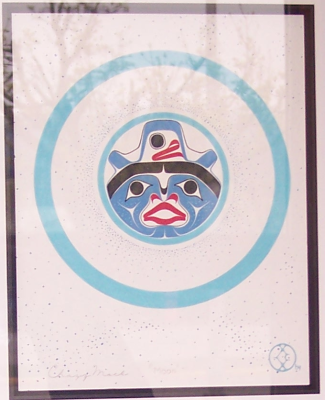
I am used to thinking of Latham Mack, who twice won the YVR Art Foundation scholarship, as a designer more than a carver. Certainly, he has done far more designs than masks to this point, including a limited edition print. However, as part of his final work in the Freda Diesing program, Mack finished two Thunder masks, a blue one for the year end exhibit and the upcoming  show at the Spirit Wrestler gallery, and a black one that he has announced that he will keep in his private collection.

Both masks reflect the story of the four brothers who saw a dancing figure on the mountain who created the thunder – an important story in the Nuxalk tradition. The hooked nose and flaring nostrils are a traditional part of the figure’s depiction.The small branches attached to the head, presumably to suggest lightning, are also traditional, although Mack’s mask makes greater use of them than several others that I’ve seen pictures of. This tradition, as Mack emphasized to me, is separate from the Thunderbird of the Kwakwaka’wakw or other First Nations, with the central figure representing the spirit of the storm.

Latham Mack tells me, “Two major dance rituals make up our winter dance ceremonies, the Sisaok (ancestral family dances) and the Kusiut (secret society ceremonies). The Thunder dance is performed by members of the Kusiut society. According to Bella Coola belief, the supernatural ones in the upper land resemble human beings in performing Kusiut dances. Corresponding to the prowess of his patron, the dance of his human protégé is one of the most important Kusiut rituals. Only the strongest of course danced the Thunder because of the movements and physical fitness you had to be in to actually dance it. Only the families who owned the story actually danced it, but as the years have gone by, we have lost the identity of those owners. So now it’s basically owned by the whole Nuxalk people.”

Mack goes on to say that, “The dance of Thunder can be performed with four, two or one masked dancers, depending on the prerogative of the protégé. When the dance is done with four Thunders, these represent the four brothers in the oral tradition. Numerous dances lead up to the Thunder dance, the Herald introduces the dance of Thunder. He beats his stick on the floor and announces the impending Thunder dance.”

Many dances can lead up to the Thunder dance, but, in this case, the performance was divided into three sections, each introduced and narrated by a member of Mack’s family who also provided a rattle accompaniment.

Since the mask had never been used before, the ceremony began with a blessing of the mask by sprinkling down over it.

Then, before Mack’s actual dance, three female members of his family prepared the area in which he would dance with their own dance. It was a stately dance, done with upraised palms and constant circular steps. The narrator explained that this preparation was a traditional role for women in Nuxalk dances.

Then Mack danced. He wore an apron threaded with loose pieces of wood that he shook for percussion, and wooden clappers on his back.

Frequently, he threw himself down on his knees and climbed to his feet again.

His hands and lower arms made constant flickering gestures, as if to shoo people away, but actually to bestow blessings upon the audience.

It was an energetic dance, enough to scare several young children at the front of the audience, who quickly moved away. He also wore cuffs around his ankles and wrists and the modern innovation of knee pads (which was wise, since he was dancing on a concrete floor, and would have otherwise damaged his knees). It was an obviously exhausting performance, powerful and contrasting sharply with the graceful motions of the women’s dance a few moments before

All too often, those of us who are not directly involved in First Nations culture can forget that the masks that we admire have a ceremonial purpose — or are supposed to have. Mack’s dance was a small reminder of this basic fact, and left me wondering where I could find more about Nuxalk culture.

(Note: Ordinarily, this dance is not photographed, but Latham Mack’s grandfather, Lawrence Mack (Lhulhulhnimut), a chief of the Grizzly clan from the ancestral village of Nusq’lst gave permission for those in attendance to photograph it. He also graciously gave me permission to post the pictures I took on this blog. Needless to say, any mistaken cultural references here are due to my ignorance or to lapses in my memory, and not to his kindness. Should anyone see any mistakes, please let me know so that I can correct them.).

Read Full Post »

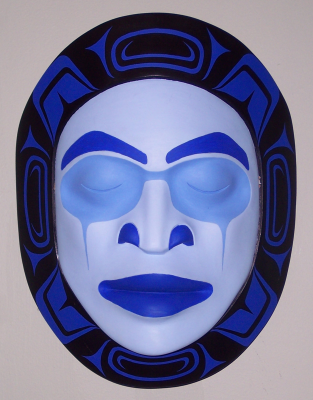
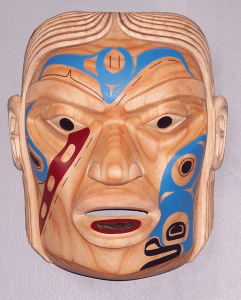
Mitch Adams is an artist I’ve been watching for some time. From the pictures he’s posted on Facebook in the last year, I suspected that it was only a matter of time before I saw one of his works that I wanted to buy. And, sure enough, when I walked into the 2010 Freda Diesing School Student Art Exhibition, his “Blue Moon Mask” immediately caught my eye. I consider it one of the finer examples of contemporary Northwest Coast art that I’ve seen in the last year – an opinion with which some traditionalists strongly disagree.

I am not the only one to think so highly of the mask. I know of at least half a dozen people who would have been happy to buy it, and who wished that it had not been marked as not for sale. Two of those people were frankly envious when I told them that, after I expressed my admiration, Adams decided not to send it to the upcoming Spirit Wrestler show after all, but to sell it to me. One even asked me if I would resell it.

Similarly, when I posted a picture of it in my review of the exhibition, one viewer called it “the most stunning mask I have ever seen.”

To me, such reactions seem perfectly logical for anyone who has troubled to look at the mask. Although “Blue Moon Mask” is covered entirely with paint, the paint is not so thick that you cannot see the smoothness of the carving.If anything, the palest blue on the mask tends to emphasis the plans of the carving, making them into shadows rather than lines.

The careful selection of the shades of blues is equally obvious, from the pale, almost white skin color to the darker blue on the outer rim, and makes the mask seem ever-changing, especially with the tear tracks falling from the eyes. Depending on the light and the angle, the mask can look serene, corpse-like, or even like the heavy makeup of a Goth on Friday night. It is a work that is both accessible and ambiguous at the same time.

Some aspects of the work are traditional. Looking through galleries or museums, you should have no trouble finding other moon masks of the same general shape. Many details are traditional, too, including the eyebrows and nostrils, and the array of U-shapes and ovoids surrounding the face.

Yet the work departs from the northern tradition in at least two key ways. For one thing, in the northern tradition, blue is a third color, used in small amounts if it is present at all. Black and red are the typical colors, with a third being added by the natural color of the wood. A departure from this norm is, by itself, enough to define a work as contemporary.

For another thing, the use of paint on the entire mask is unusual in Adam’s Haida and Tsimshian tradition (although not entirely unheard of, either). The northern tradition tends to be sparing in its use of paint, with designs painted across the mask that ignore the features beneath them. Adams’ decision to paint the entire mask would be more common in the Kwakwaka’wakw tradition, although, even there, his use of different shades of the same color instead of contrasting ones would be more characteristic of modern artists such as Beau Dick or perhaps Simon Dick.

To make these departures is a risk – but I believe it is a necessary one, of the kind needed to keep Northwest Coast art developing and relevant. Nor is it a unique one. Historically, the art form has long been a combination of local conventions meeting industrial societies’ technologies and sensibilities. So-called tradition has long changed and benefited from artists’ discoveries of metal tools, industrially produced paints, and, much later, of power tools. Similarly, the first European influence on subject matter is over a century and a half old, in top-hatted figures on poles and sailing ships on argillite plates. From this perspective, what Adams does in “Blue Moon Mask” is not radical, and should be easy to appreciate.

Yet, sadly, a minority noticed “Blue Moon Mask”’s departure from strict tradition and could not get past it. I am told that one teacher reacted strongly to it, and that another one joked about it. Even worse, some students, seeing the teachers’ reactions, immediately imitated them rather than using their own eyes.

These reactions strike me as both unfortunate and short-sighted. The basis of Northwest Coast art will always be the traditional work. If nothing else, the contemporary needs the traditional to react against.

Yet I do not see why admiration for the traditional must include a rejection of everything contemporary. True, you may prefer one over the other, or prefer one in your own work. But what you like and what is done well are by no means synonymous. Nor does preferring one require that you condemn the other.

Personally, I refuse to take sides. “Blue Moon Mask” is a technically skilled piece, and amidst our collection of traditional works by artists like Norman Tait or Richard Hunt and of contemporary pieces by artists like Alano Edzerza or Ron Telek, it claims a place on our wall on its own merits. It’s a piece that I consider myself lucky to live with, and I’m proud to have our keeping.

Read Full Post »

This was only the second year that I attended the Freda Diesing School’s year end exhibition, but the show has become a must-see for me. For one thing, it is one of the largest exhibitions of Northwest Coast art in any given year. For another, I never know what I might find, either because a student is unknown, or has taken a giant leap forward in their understanding of their art.

The 2010 show was slightly smaller than the previous year’s, and emphasized carving more than design, although a few limited edition prints and drawings were available up in the loft, as well as a sampling of giclee prints by second year student Mitch Adams. But in compensation, the level of carving was higher than last year, probably because, instead of specifying that each student submit three pieces to the show, the teachers urged students to focus on producing their best work, and starting it early (even so, there were many groans about last minute all-night sessions).

Close to the door were masks by people whose work I have bought in the past. John Wilson contributed his hawk woman mask to the show, which I had seen pictures of, but was glad to see in person:

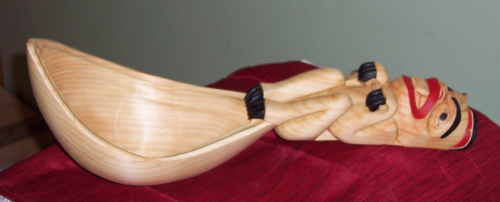
Wilson also contributed a large spoon, whose beaver handle included more detail work than I had seen before in his work:

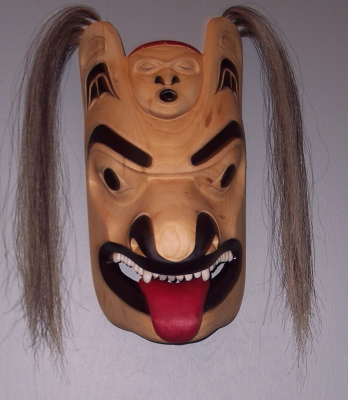
Besides Wilson’s mask hung Colin Morrison’s second mask, whose red design made the wood look like a sun-tan, and contrasted with the white hair he used:

Moving on from Wilson’s and Morrison’s masks, I quickly discovered work from artists I remembered from 2009. Previous YVR award winner Shawn Aster, whose main interest seems to be design rather than carving, contributed a mask whose interest is largely in the painting:

Second year Metis artist Mathew Daratha was one of the more prolific contributors to the show, displaying several masks, such as this one:

Still another second year student, Latham Mack, the two-times recipient of the YVR Award, was allowed to carve in his family’s traditional Nuxalk style, producing a strikingly different Thunder Mask:

Mack also danced a similar mask after the graduation ceremony.

But perhaps the most development among the second year students was shown by Sheldon Dennis, whose carving showed a considerable advance over his work last year, as well as a strong sense of originality:

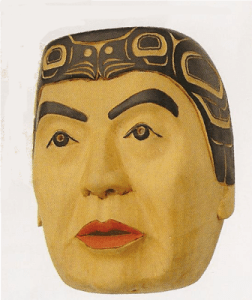
Female students continue to be a minority at the school, but those enrolled in the first year class this year made a strong showing. Cherish Alexander showed a talent for combining feminine faces with bold designs:

Carol Young, the winner of the first Mature Student Award, showed a similar interest in women’s faces, and added a traditional labret to indicate high status in one of her masks:

Another first year female student, Nina Bolton chose a more traditional shape for her mask, but gave it a strong, contrasting design when she painted it:

Some of the most striking work in the show was created by Chazz Mack, Latham Mack’s cousin. Chaz Mack include two pieces in the show: a small print, and a mask whose painted design shows a strong sense of line in its curves:

However, if the show had a single outstanding piece, it was Mitch Adams’ “Blue Moon Mask.” The piece was the despair of at least one of the school’s teachers, all of whom work in the northern style and favor masks with much less paint than “Blue Moon Mask,” but its clean lines and carefully selected palette made it a crowd favorite, with at least half a dozen people clamoring to buy it:

When Adams agreed to sell it to me, several other would-be buyers frankly expressed their jealousy, and cursed their lack of initiative; apparently, I was the only one who actually asked Adams if he was firm about the Not For Sale label.

In fact, if the show had a fault, it was that most of the best pieces were labeled as not for sale for one reason or the other. If I had had my way, I could have returned home with another three or four pieces from this years’ show.

However, that’s a selfish wish. Many of the pieces marked as not for sale were reserved for the upcoming Northern Exposure show at Vancouver’s Spirit Wrestler Gallery. For many students, the show is their first chance to display their work to a large audience, so I can hardly blame them for withholding their work from sale. All of them thoroughly deserve that chance, and I hope that I will have many chances in the future to buy their work.

Read Full Post »

On April 23, I did something I had been waiting to do for ten months: I stood up at the graduation ceremony for the Freda Diesing School of Northwest Coast Art at Northwest Community College in Terrace, and gave out the first Mature Student Award. Trish and I hope it will be the first of many, and I think the award got off to a good start by having Carol Young (Bagshaw) as the first recipient.

A member of the Haida Eagle side, Young did not grow up with traditional culture, but absorbed much of it indirectly from her mother. Later, as a single mother of four, she began selling a variety of handicrafts and art pieces loosely based on Northwest Coast design on eBay. Although she says she never thought of herself as an artist, she sold over a hundred pieces of every description imaginable. Masks, rattles, miniature canoes, and, most of all, Haida-inspired dolls – all of these and more she managed to produce as a way of bringing in extra money.

With her children grown, Young decided to do something for herself, and enrolled in the Freda Diesing School last September. Her teachers and fellow students tell me that at first she seemed to have trouble feeling comfortable in the dorms or the class room, and that learning formline design didn’t come easily to her after years of doing things her way.

However, in the second semester, especially after hearing that she had won the Mature Student Award, Young started to hit her stride. Her design took on a new discipline and maturity as she absorbed what the teachers had been telling her, and she found a place among the other students, most of whom were far younger – although at times, she told me with a smile, she felt that her role was that of den-mother in the dorms.

By the end of the school year, Young had become the speaker for the first year students, announcing them at the graduation ceremony, and appearing with fellow student Sheldon Dennis on a CBC podcast about the school. She also took it on herself to present me with a school cap and T-shirt, and, when I requested one for Trish (who was unable to attend the graduation), gave me hers, claiming that she didn’t wear T-shirts anyway – a kindness that I was grateful for, although I wondered if it was true.

During the podcast, Young said that attending the school had given her “a whole new life.” Previously, I had only contacted her briefly via email, but when I met her during the graduation ceremony and exhibition, she seemed like a person who was happy about the direction she was heading. Not only was she in the middle of preparations and cleanup for the weekend, but she talked about how she hoped she could present a female perspective in her carving, which she felt – despite the name of the school – had been under-represented or explored. She said, too, that she would like to establish an award for women at the school, and would like to teach after she graduated next year.

My impression is that Young is the sort of self-starter who can get where she wants to be under her own power and on her own terms. But I would like to think that the Mature Student Award made her self-development a little easier and quicker than it might otherwise have been.

As the first recipient of the award, she sets a high standard. If next year’s winner is even half as deserving, I will feel that our ongoing involvement in the school through the award has been worthwhile.

Carol Young, First Recipient of the Mature Student Award at the Freda Diesing School of Northwest Coast Art

Read Full Post »

Last year, when I attended the Freda Diesing School Student Art Exhibition in Terrace, I noticed that most of the awards were for students 25 years old or younger. The school has some fine younger artists, but I thought that the older students deserved some recognition, too. To fill the gap, Trish and I decided to sponsor a Mature Student Award of $1000 per year, and to work towards making the award self-funding.

The official description of the award reads:

This award is given annually to a mature student (25 and over) from the
Freda Diesing School of Northwest Coast Art who has demonstrated
leadership and mentoring qualities in the classroom. Faculty from the
School of Northwest Coast Art will select a student after confirmation of
enrollment in the second semester of the certificate or diploma program.

The award recipient must; be a First Nations Freda Diesing School of
Northwest Coast Art student; identify and work with a mentor to facilitate
the ongoing learning process; reside in British Columbia; demonstrate
potential in visual arts in the Northwest Coast style; and display
mentoring and leadership qualities in their relationships with other
students in the school both inside and outside class.

The award will be given for the first time in January 2010.

I have two main reasons for starting the award. First, as a late bloomer in my own craft of writing, I sympathize with the mature students. Being a student is hard enough when you are twenty, but when you are thirty-five or fifty, returning to school is even harder, because you probably have a family, and you are more set in your ways. Often, it means giving up a steady income when you’ve been used to one for years.

At the same time, I know from years as a university English instructor that older students are worth encouraging. They add a maturity to the discussion, and often serve as role-models and mentors to younger students.

Second, I am a buyer and lover of northwest coast art, especially art in the northern style taught at the school. I am not one of those people descended from Europeans who feel personally responsible for the wrongs against the First Nations that began before I was born, but I do believe in paying my debts and in doing the little I can to alleviate current problems. Northwest Coast art has given me hours of pleasure and learning, and I want to repay those hours with more than simple payment for each piece. I’d like to think that the award would help a student a little in the short term and in the long term maybe help them to launch their careers.

Compared to the other awards that the school gives, the Mature Student Award is starting off slowly. But I hope that it will eventually match the other awards, and become self-perpetuating.

If you are an artist, an art dealer, or someone who appreciates Northwest Coast art, please consider donating to the Mature Student Award. But don’t contact me. Instead, please contact Jill Girodat, the Associate Registrar at the Terrace campus of Northwest Community College at 250-638-5477 or jgirodat AT nwcc DOT bc DOT ca.

Read Full Post »

One of the pleasures of buying work from beginning artists is watching them fulfill their potential. Last January, I saw enough promise in John Wilson’s work to buy one of his masks. Now, in masks like “Shaman and His Helpers,” his work has reached its first maturity.

Compared to most of Wilson’s earlier works, “Shaman and His Helpers” is a busy piece, both in subject and execution. It benefits, too, from Wilson’s study of traditional masks through pictures, the most obvious benefit being the use of eye holes instead of painted irises and pupils.

The mask depicts a shaman and his spirit helpers. One of the spirit helpers sits in the shaman’s mouth, as though resting after a long climb up his esophagus. The other sits in the middle of his forehead like a frontlet. Both these positions suggest that the helpers are indicators of the shaman’s true nature.

The helpers look more or less human, but the one in the mouth is in a vaguely frog-like position, while the one on the forehead is round enough to be a moon. While the shaman’s eyes are narrowed as though he is entering a trance, both helpers have closed eyes, as if asleep or focusing inwardly.

One way or the other, you sense, the shaman’s and the helpers’ eyes are going to be in the same state shortly: Either the shaman is about to enter their world of perception or else the spirits will come into his. No matter which happens, the result is a mask of a half-realized transition.

Interestingly, too, the spirit on the forehead is painted similarly to the shaman, while the spirit at the mouth is left unpainted. That may be an artistic decision made because any paint would be overwhelmed by the red of the shaman’s lips. But the effect is to suggest that the spirits are in some ways opposite.
Are the spirits different aspects of the shaman’s nature? Or perhaps the helper in the mouth is unrevealed, a creature of the dark, and the moon-like one on the forehead is a creature of light? At the point portrayed in the mask, they do not seem at odds, so perhaps they are opposites needed for balance and insight. Whatever the case, a moment of magic and transition is depicted.

The awe of the moment is heightened by the design of the mask. Tall, thin masks are common in the northern tradition, but in this case, the physical dimensions suggest a lean asceticism that seems fitting for a shaman. This asceticism is heightened by the high cheekbones and the deepness of the eye sockets near the nose, which suggest that the shaman might have been fasting. The black eyebrows reinforce this sense of gauntness, especially in a bright light that emphasizes the cheekbones and eye sockets.

At the same time, the mask carries a hint of menace or pain. Especially from a distance, the hands of the spirit in the mouth suggest fangs. Similarly, the unusually bright red used in the mask leave a half-unconscious impression of blood, as though the shaman’s trance is accompanied by a nosebleed and his biting of his own lip. Or perhaps the redness of the lips suggests that the shaman is giving a sort of birth to the spirit clinging to his lips. The suggestions are understated – there are no blatant riverlets of blood trickling from the nostrils or down the chin – but they are only more effective for being subtle.

And always the grain, which Wilson has carefully matched to the contours of the face, stands out, suggesting a movement or fluidity just below the skin. Influenced by his teachers at the Fred Diesing School, Wilson has always shown an awareness of the grain as a finishing detail, but here that awareness is not just a reflection of technical skill, but also an addition to the design.

When this mask first went on the market, I missed the chance to buy it, and cursed my slowness to make a decision. Luckily for me, the first owner changed their mind, and I was able to buy it after all. The more I study “Shaman and His Helpers,” the more I think it is Wilson’s best mask to date. At the same time, knowing that he is a constant carver and likely to have decades to continue his learning of his craft, I can’t wait to see what levels he will reach next.

shaman-and-helpers

Read Full Post »

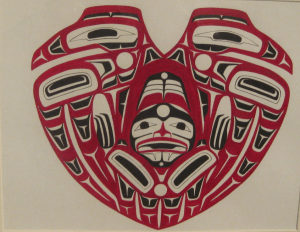
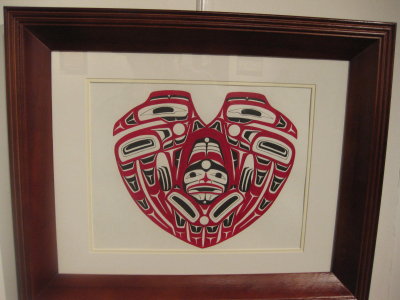
Someday, I am going to jot down the stories of my art acquisitions. There’s the story of how I had to trek to the South Terminal of the Vancouver Airport not knowing the distance, and the story of how a simple bank transfer assumed nightmare proportions as I returned again and again to the bank. And now, after yesterday, I have the story of stopping by the Chateau Granville to pick up Shawn Aster’s “Raven Heart” to the befuddlement and bemusement of the desk clerk and manager, who had obviously never heard of such a thing.

The situation was no one’s fault – just one of those times when the perversity of the universe seems set to stun. I had reserved the painting when I was in Terrace five weeks ago, but I didn’t have the time to get to a bank machine and return before the show closed for the day. As a result, I didn’t pay until after I returned home. We had floated various schemes for delivery, ranging from leaving the piece at the Grayhound station to picking it up at the Spirit Gallery reception yesterday. But an emergency had forced Aster to return home early, and the hotel desk was his improvised way of getting the piece to me.

Now that Aster has won a couple of scholarships at the Freda Diesing School, his work is starting to sell, and people are expecting a successful career ahead of him. As he takes his first steps, I can’t resist a bit of self-congratulation for having discovered the young Tsimshian artist’s work several months ago at the school’s mid-term show (and some mild complementary scorn for those who needed the scholarships to realize the quality of his work).

Many young artists seem to enjoy designs in which Northwest Coast designs are incorporated into the shapes of modern culture. For instance, Latham Mack, another scholarship winner at the Freda Diesing, did a group figure of traditional designs that formed the outline of a Playboy bunny on a T-shirt. In the same way, “Raven Heart” takes two traditional ravens and constrains them in a heart design.

This practice, I suppose, is the extension of the tradition of adjusting a design to fit the contours of the shape it is on – a pole, or a bowl, spoon, hat, or box. The main difference, of course, is that the possibilities for innovation and commentary open up when a modern shape informs the design. In the case of “Raven Heart,” the two ravens resemble a traditional split design, but, when put into a heart, suggest a rather unhappy relationship, the raven of mythology being associated more with promiscuity than faithfulness, and more with clever and expedient lies than the truthfulness that is generally thought to be a necessity for a successful relationship. A confirmation that the relationship is less than smooth is the constrained feathers on the wings that seem almost like bars confining the trapped figure inside the heart — which has a decidedly unhappy look on its face.

It is probably no accident, either, that the piece was first exhibited at a show shortly before Valentine’s Day this year. The piece seems to play one culture against the other, using each to comment sarcastically upon the other.

But what interests me most about “Raven Heart,” like all of Aster’s work that I have seen, is its technical skill. Its form lines do not have the most graceful curves that I have seen, but for the most part they are suitably varied in thickness, and the use of interior U-shapes to minimize the thickness of the intersections is well done. In addition, of course, the use of red as the primary color – a relatively rare practice, traditionally-speaking – is suited to the heart shape.

The design itself is made up of only a few shapes – notably the U-shapes and T-shapes – which vary in length and whose colors are sometimes inverted. The composition has an obvious horizontal symmetry, but it also includes a less noticeable vertical symmetry, made up of groups of threes and fours: three feathers on the stylized wings, three fingers on the trapped figure’s hands (or are they the claws of the ravens?), four interior shapes on the outer wings, and four tail feathers on the bottom. Each side, too, has three large ovoids filled with black. Similarly, the circles at the joints of the wings are balanced by one that might be the tail-bone, while three circles, irregularly shaped, are also at the center of the trapped figure’s design. There is an economy in the relatively few shapes used in the design, and an almost mathematical precision in the vertical symmetry that is rare in any Northwest Coast art, but especially rare in an artist over thirty.

I have talked off and on with Aster about a commission, and I still hope to see it one day. Meanwhile, “Raven Heart” is a masterful small performance that makes me believe that Aster has a future every bit as promising as everyone is saying.

aster

Read Full Post »

“How does this compare to a show down south?” John Wilson asked me last week, shortly after I arrived at the Freda Diesing School Student Art Exhibition in Terrace. He seemed surprised when I told him that a 23 person show with some 75 pieces almost never happened, but it’s true. The annual show is one of the largest annual exhibits of modern Northwest Coast Art anywhere.

The show lasted only two days, with a private viewing for friends and family on Friday and a public viewing on Saturday. The location is the Freda Diesing Studio on the Terrace campus of Northwest Community College, a well-lit building with a large lower floor ordinarily occupied by work benches and a loft for a more conventional class room setting:

fd-studio1

Just inside the door, above the table with the show catalog and price list were a few prints by Freda Diesing herself, including a self-portrait mask:

fd-self-portrait

These works were not for sale, but stood as tutelary spirits of the show – or, more precisely, as the standards to which the students should aspire.

Several months ago, I reviewed the school’s mid-term show via a collection of pictures sent to me by John Wilson. That show was mostly painting and sketches, the first year class in particular having not begun its study of carving at the time. By contrast, the year-end show had a few two-dimensional pieces, but consisted largely of paddles, spoons, and masks.

Painted paddles are closer to two dimensional than three dimensional works, so I was not surprised when two of the best-designed paddles were from Shawn Aster and Latham Mack, two artists who were among the standouts at the earlier shows and scholarship winners at the graduation ceremonies that accompanied the private viewing:

shawn-aster-paddle

latham-mack-paddle

However, making the transition from the two-dimensional craft of painting to the three-dimensional one of carving does not always comes easily, and many students are still making it. Latham Mack, for instance (who as a Nuxalk, is learning his second style of carving), is well on the way, using the same blue that I am starting to recognize as characteristic of his two-dimensional designs:
latham-mack

By contrast, a mask by Shawn Aster shows a sense of surfaces, but seems more tentative, with a shallowness in the carving and a thinness of line that makes you only appreciate the mask up close, as seen in this (unfortunately cropped) picture:

shawn-aster-mask

A similar lack of ease in three dimensions is true of Todd Stephens, another scholarship winner from whom I’ve bought several paintings:

todd-stephens

Other students showed similar learning curves – and, as might be expected in a student show – a certain tendency to conformity – although Norman McLean, Sr., in a triumph of social sensibility over aesthetics did do a bright pink mask, as well as a spoon with a more discrete pink ribbon around the handle as fund-raisers for breast cancer. Still, there were some interesting pieces here and there.

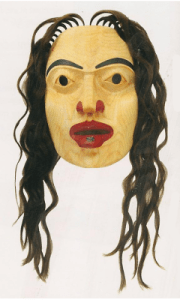
Sophia Patricia Beaton, another scholarship winner, had only one piece in the show, but the wavy hair and the obviously feminine face and the labret were original enough to make me wonder what the rest of her work might be like:

sophia-beaton

I also noticed James Weget-McNeil’s frog mask, which, although in a very different style, reminded me of some of the faux-artifacts that Beau Dick has been carving recently:

james-weget-mcneil1

However, much of the interesting carving came from mature students with more experience.

Charles Richard Wesley, whose work I noticed in the mid-term show, came up with two interestingly intricate masks:

charles-richard-wesley

I also appreciated John Wilson’s work, which he says represents an advance in finishing details over his earlier work – pointing, for example, an indentation of the eye sockets at the top of the nose:

john-wilson

These are just some of the pieces in the show, but, aside from the bowls (something needing to be left out), they give an idea of the variety to be seen at the show. I appreciate the chance to see students learning and mastering their craft, and while some flaws and weaknesses are apparent, there are just as many examples of solid and skilled works.

In fact, I could have come away from the show considerably poorer. Fortunately or unfortunately, depending on my shifting perspective, most of the pieces I considered buying were marked NFS, many earmarked for a show at the Spirit Wrestler Gallery in Vancouver later this month.

But buying is only one reason to attend such a show. A far better reason is spend a few hours surrounded by efforts of art – and that, so far as I am concerned, is more than enough reason for me to want to attend next year’s show.

My thanks to Stan Bevan for seeing that I got an invitation. That small kindness gave me an enriching day.

Read Full Post »

“Nasty disturbing uncomfortable things!” Bilbo Baggins says about adventures in The Hobbit. “Make you late for dinner!” Working out of our townhouse, I sympathize with that view. But, as with Bilbo, there must be something Tookish in me lying in wait. When I was invited to go to Terrace for the end of the year show at the Fred Diesing School of Northwest Coast Art, I was determined to go. To fly 1350 kilometers only to return the next day seemed more than a little quixotic, especially when I didn’t feel I could really afford the trip and had never met anyone there, but the whole idea seemed irresistible. For someone who had never been farther north than 100 Mile House, it seemed a small adventure, all the more interesting because I was moving way out of my comfort zone.

I flew out of the South Terminal of the Vancouver Airport, a relic of quieter days that services the coast and the remoter areas of British Columbia. After looping around the city, with me peering out eagerly to spot the Metrotown Towers, Swangard Stadium, Cleveland Dam and other visible landmarks, we headed north. The mountains grew progressively taller and more snowcapped, and I tried not to be disappointed that all I could see of the coast was the occasional inlet masquerading as a river at first glance.

I won a T-shirt in an on-board raffle, and hoped it was an indicator of how my luck was running.

As we circled Terrace and descended to the airport, I could see signs of logging that showed that I was flying into a resource extraction community. From the air, I could see that the evergreens flanking the highway were often only one hundred meters thick, and that the town, whatever its other virtues, was a stranger to zoning in most areas.

At every other airport I’ve ever visited, taxis are always awaiting incoming flights. But not at the Terrace-Kitimat Airport. Rather sheepishly, I retraced my steps and hunted for the direct phone for the taxi.

After twenty minutes, an Indian driver – that is, someone from India, not a First Nation – picked me up and took me directly to the college. We crossed the Skeena, brown with the spring runoff, and through the mixture of stores and industrial sites that forms the downtown, and up a hill to a suburb where small houses mixed with hobby farms of a few acres and pasturage for a cow or horse or two.

Semi-rural British Columbia, I thought, reminded of places in Surrey and Langley and the Sunshine Coast. I decided I could deal with it.

All the same, the college seemed incongruous when it suddenly appeared. Paying off the driver, I found my way to the cafeteria to fortify myself and ask directions if I needed to.

A bagel and orange juice revived me, and I headed across the parking lot in the middle of the college. A few inquiries confirmed that the building with the high roof and large windows was the Freda Diesing School, just as I had thought. Trundling my carry-on, I stepped inside.

Almost instantly, I was greeted by Jennifer Davidson, Henry Green, and Peter Jackson, at least one of whom must have a stronger ability to recognize people from their photos than I’ve ever managed. Then I started meeting people – Bill McMillian, carver and teacher Stan Bevan, and students with whom I’d been in contact with online but never met, including John Wilson, Latham Mack, Sean Aster, and Todd Stephens, to say nothing of ex-students like Dean Heron. The sheer number of people to meet was overwhelming, and their friendliness left me exhilarated. Really, a stranger couldn’t have asked for a better welcome to a group with such close internal connections.

I just barely had time to go around the show (which deserves a blog of its own) snapping pictures like mad before it was time to trek across campus for the graduation ceremony. While we were milling about, Jennifer Davidson took the opportunity to photograph the copper bracelet that Henry Green did for me eighteen months ago, and Henry threated to straighten it out, evoking a squeal of dismay from me.

After rampaging through the buffet, the crowd sat through the usual round of thanks at graduation ceremonies. Mercifully we were spared long speeches, although I did notice most of the students gradually sitting lower and lower in their chairs. But an end came at last, with the most deserving students receiving awards and all of them praised for their dedication.

Two drummers, one of whom was a student, were supposed to lead a procession back to the studio, but the riff-raff like me at the back lingered so long that we missed most of it. I had a chance to look at the exhibits more carefully, and saw the sketches for one piece that I hope to eventually buy, and all too soon the show was over.

John Wilson drove me downtown, where I found a hotel and we headed out for Chinese food. A sign that we were in the north was that one of the offerings at the restaurant was salmon in black bean sauce.

I had hoped to meet sculptor Ron Telek, but he was busy with family matters, and we had to make do with a quick phone call late at night. I found myself wishing that I had booked another day, both to see Ron and to see more of the town, but, as things were, I fell asleep exhausted and buoyed by the friendly welcome I had received.

The next morning, I was at the airport before most of the staff (Memo: in small towns, the rule of arriving two hours before a flight doesn’t apply). Tired but satisfied, I flew south, putting adventures behind me for a while. But now that I’ve ventured north once, I’m sure I’ll be coming back again. Terrace may be more distant from my townhouse than Calgary, but in many ways it feels more like home.

Read Full Post »

The Freda Diesing School of Northwest Coast Art in Terrace teaches not only design and carving, but also the business of being an artist. For this reason, its program includes several school shows. A few weeks ago, when I heard that the mid-term show was being held, my Internet acquaintance John Wilson said he would take some pictures for me.

I expected maybe half a dozen pictures. Instead, he sent fifty, covering most of the show and giving me a preview of the next generation of Northwest Coast artists, at least so far as sketches and paintings go.

The presentation of some of the works left something to be desired (unless, of course, you think brown parcel paper or cardboard makes a good matting), but I hardly noticed such shortcomings. Since I am just learning some of the fine points of formline and other elements of Northwest Coast design – strictly from an enthusiast’s viewpoint – I’ve had many pleasurable hours over the last few weeks pouring over the photos.

I can’t hope to mention every picture I looked at. In particular, I won’t mention John Wilson’s contributions, since I’ve blogged about his work in some detail before. However, when I narrowed them down to eight or nine, I found that I was consistently picking the same three or four artists – one of whom I already knew, and the rest of whom were new to me.

One of the pictures that stood out for me was Charles Wesley’s double whale. I am always partial to split designs, and this one caught my eye immediately, with its symmetry of lines and color. The formlines on the top of the body of the whales might be a little thick, especially at the shoulders where they meet the bottom formline, but the thickness does give a boldness to the design. Elsewhere, though, the junction of formlines is neatly minimized – especially where the bodies meet the tail. Moreover, the u-shapes between the heads and shoulders and the matching red and black designs on the body and outside it show the attention to detail of a true perfectionist.

46

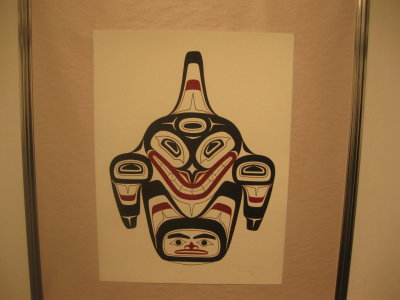
By contrast, Latham Mack’s killer-whale uses a different perspective, showing its subject head-on in a style that is more common to carving that two-dimensions, and that seems to flatten the snout . In this piece, the formlines are so thick that the design could easily have been a disaster, but mack manages to pull them off with lots of tapering and white space. at the joins I like, too, the way that the design is framed by ovoids, and similar shapes are re-used in slightly different positions throughout. Another interesting element is the way that the design on the fin suggests a hat with a potlatch ring, a detail that suggests both chieftainship and transformation.

13

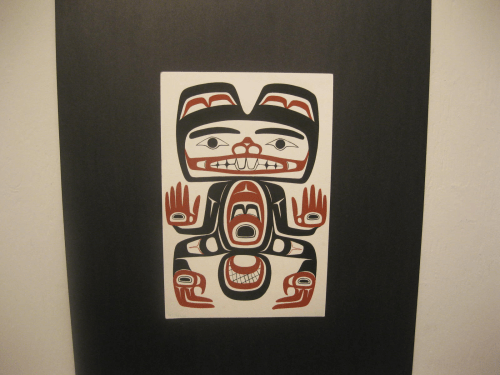
Another artist whose work caught my eye is Todd Stephens, who had several works in the show, including a beaver and a simple mask. What appeals to me is the elegant simplicity of his designs. For instance, on Stephen’s beaver, the formlline becomes the arms. Stephens also consistently minimizes the thickness of merging formlines, inserting spaces and spacers to control them. All these formlines nearing but only touching at a point or two give a realistic restlessness to the beaver, adding up to more than what Bill Reid called “the obligatory Canadian content.”

03

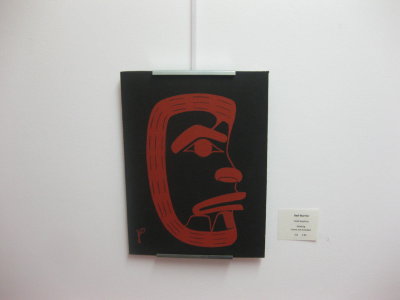
As for Stephen’s mask, it is interesting for being more a sketch of a mask than a two-dimensional face and for its inversion of the primary colors. Add the simplicity, and the result is a surprisingly contemporary look.

29

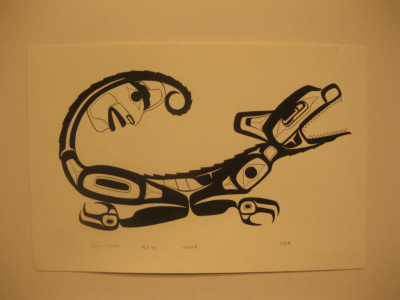
But perhaps the most interesting pieces in the show were by Shawn Aster, a young artist from whom I’ve already commissioned a painting, but whose show pieces I picked out without knowing who did them. Aster has several pieces in the show, but two in particular are strikingly original. The wolf seems almost archaic in its design (look at the teeth and the body decorations) while having enough traditional elements to place it squarely within the northern tradition. The spikiness in the design, which suggests fur, and the spirit in the tail, as well as the posture, which seems a mixture of a howl and a crouching to spring are other details I appreciate.

49

Aster’s conjoined birds are equally intriguing. The compression of the elements into the overall shape brings the already abstract elements of Northwest Coast design to an even greater level of abstraction. Meanwhile, the contrast between the serenity of the birds’ faces and the tormented, imprisoned figure between them adds another element of interest to the composition. Considering the timing of the show and the overall shape, I suppose you could consider this a Valentine’s Day design, with the central figure representing the strain of two people in a relationship – but, no matter how you interpret this design, it is one of the standouts of the show.

22

Some of these artists I hope to buy a painting or two from. Others I plan to keep an eye on. John Wilson tells me that another show is planned for the end of term in April, and I can only hope to get a remote viewing of it as well.

Read Full Post »

« Newer Posts